Abhinn Pandey Int. Journal of Engineering Research and Applications www.ijera.com
ISSN : 2248-9622, Vol. 4, Issue 12( Part 4), December 2014, pp.60-64
www.ijera.com 60 | P a g e
Study and Analysis of K-Means Clustering Algorithm Using
Rapidminer
A CASE STUDY ON STUDENTS’ EXAM RESULT
Abhinn Pandey
Computer Technology, Kavikulguru Institute of Technology and Science Nagpur, India
Abstract
Institution is a place where teacher explains and student just understands and learns the lesson. Every student
has his own definition for toughness and easiness and there isn’t any absolute scale for measuring knowledge
but examination score indicate the performance of student. In this case study, knowledge of data mining is
combined with educational strategies to improve students’ performance. Generally, data mining (sometimes
called data or knowledge discovery) is the process of analysing data from different perspectives and
summarizing it into useful information. Data mining software is one of a number of analytical tools for data. It
allows users to analyse data from many different dimensions or angles, categorize it, and summarize the
relationships identified. Technically, data mining is the process of finding correlations or patterns among dozens
of fields in large relational database. Cluster analysis or clustering is the task of grouping a set of objects in such
a way that objects in the same group (called a cluster) are more similar (in some sense or another) to each other
than to those in other groups (clusters).This project describes the use of clustering data mining technique to
improve the efficiency of academic performance in the educational institutions .In this project, a live
experiment was conducted on students .By conducting an exam on students of computer science major using
MOODLE(LMS) and analysing that data generated using RapidMiner(Datamining Software) and later by
performing clustering on the data. This method helps to identify the students who need special advising or
counselling by the teacher to give high quality of education.
Keywords: Data mining, Clustering, k-means, Moodle, RapidMiner, LMS (Learning Management
System)
I. Introduction
Data mining, also called knowledge discovery in
databases, in computer science, is the process of
discovering interesting and useful patterns and
relationships in large volumes of data. The field
combines tools from statistics and artificial
intelligence (such as neural networks and machine
learning) with database management to analyze large
digital collections, known as data sets. Data mining is
widely used in business (insurance, banking, retail),
science research (astronomy, medicine), and
government security (detection of criminals and
terrorists). The process extracts high quality of
information that can be used to draw conclusions
based on relationships or pattern within the data.
In data mining Clustering learning is a popular
and well researched way of discovering interesting
results among huge database. Cluster analysis or
clustering is the task of grouping a set of objects in
such a way that objects in the same group (called a
cluster) are more similar (in some sense or another) to
each other than to those in other groups (clusters). It
is a main task of exploratory data mining, and a
common technique for statistical data analysis, used
in many fields, including machine learning, pattern
recognition, image analysis, information retrieval,
and bioinformatics. Cluster analysis itself is not one
specific algorithm, but the general task to be solved.
It can be achieved by various algorithms that differ
significantly in their notion of what constitutes a
cluster and how to efficiently find them. Popular
notions of clusters include groups with small
distances among the cluster members, dense areas of
the data space, intervals or particular statistical
distributions. Clustering can therefore be formulated
as a multi-objective optimization problem. The
appropriate clustering algorithm and parameter
settings (including values such as the distance
function to use, a density threshold or the number of
expected clusters) depend on the individual data set
and intended use of the results. Cluster analysis as
such is not an automatic task, but an iterative process
of knowledge discovery or interactive multi-objective
optimization that involves trial and failure. It will
often be necessary to modify data pre-processing and
model parameters until the result achieves the desired
properties. There are many types of clustering
techniques.
Typical cluster models include:
1. Connectivity models
2. Centroid models
3. Distribution models
REVIEW ARTICLE OPEN ACCESS
Abhinn Pandey Int. Journal of Engineering Research and Applications www.ijera.com
ISSN : 2248-9622, Vol. 4, Issue 12( Part 4), December 2014, pp.60-64
www.ijera.com 61 | P a g e
4. Density models
5. Subspace models
6. Group models
7. Graph-based models
Among all the popular ways well verified and
mostly used ways is K-means algorithm. K-means is
one of the simplest unsupervised learning algorithms
that solve the well-known clustering problem. The
procedure follows a simple and easy way to classify a
given data set through a certain number of clusters
(assume k clusters) fixed a priori. The main idea is to
define k centroids, one for each cluster. These
centroids should be placed in a cunning way because
of different location causes different result. So, the
better choice is to place them as much as possible far
away from each other. The next step is to take each
point belonging to a given data set and associate it to
the nearest centroid. When no point is pending, the
first step is completed and an early grouping is done.
At this point we need to re-calculate k new centroids
as center of the clusters resulting from the previous
step. After we have these k new centroids, a new
binding has to be done between the same data set
points and the nearest new centroid. A loop has been
generated. As a result of this loop we may notice that
the k centroids change their location step by step until
no more changes are done. In other words centroids
do not move any more.
Finally, this algorithm aims at minimizing
an objective function, in this case a squared error
function. The objective function
(1)
Here is a chosen distance measure
between a data point xi
(j)
and the cluster center cj, is
an indicator of the distance of the n data points from
their respective cluster centers.
1.1 Knowledge discovery in databases
Many people treat data mining as a synonym for
another popularly used term, knowledge discovery
from data, or KDD, while others view data mining as
merely an essential step in the process of knowledge
discovery.
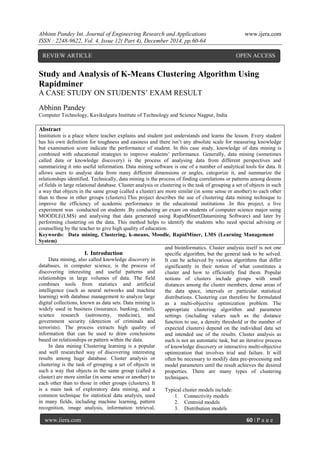
Fig 1.1: Knowledge Discovery in Databases
 Data cleaning - to remove noise and
inconsistent data
 Data integration - where multiple data
sources may be combined.
A popular trend in the information industry
is to perform data cleaning and data
integration as a preprocessing step, where
the resulting data are stored in a data
warehouse.
 Data selection - where data relevant to the
analysis task are retrieved from the database.
 Data transformation - where data are
transformed and consolidated into forms
appropriate for mining by performing
summary or aggregation operations.
Sometimes data transformation and
consolidation are performed before the data
selection process, particularly in the case of
data warehousing. Data reduction may also
be performed to obtain a smaller
representation of the original data without
sacrificing its integrity.
 Data mining - an essential process where
intelligent methods are applied to extract
data patterns.
 Pattern evaluation - to identify the truly
interesting patterns representing knowledge
based on interestingness measures.
 Knowledge presentation - where
visualization and knowledge representation
techniques are used to present mined
knowledge to users.
1.2 MOODLE
A learning management system (LMS) is a
software application for the administration,
documentation, tracking, and reporting of training
programs, classroom and online events, e-learning
programs, and training content.
Moodle (Modular Object-Oriented Dynamic Learning
Environment) is a course management system (CMS)
Abhinn Pandey Int. Journal of Engineering Research and Applications www.ijera.com
ISSN : 2248-9622, Vol. 4, Issue 12( Part 4), December 2014, pp.60-64
www.ijera.com 62 | P a g e
- a software package designed to help educators
create quality online courses and manage learner
outcomes. Such e-learning systems are sometimes
also called Learning Management Systems (LMS),
Virtual Learning Environments (VLE) and Learning
Content Management Systems (LCMS). It is one of
the most user-friendly and flexible open source
courseware products available.
1.3 RAPID MINER
Rapid Miner, formerly known as YALE (Yet
Another Learning Environment), is a software
platform that provides data mining and machine
learning procedures including: data loading and
transformation (Extract, transform, load ( ETL)), data
preprocessing and visualization, predictive analytics
and statistical modeling, evaluation, and deployment
Rapid Miner is written in the Java programming
language. The internal XML representation ensures
standardized interchange format of data mining
experiments and the scripting language allows for
automating large-scale experiments. Also it uses the
multi-layered data view concept which ensures
efficient and transparent data handling.
1.4 Problem definition
Study and analysis of K-means clustering
algorithm using Rapid Miner for analyzing students’
performance in examination and generating a way
using Clustering Data mining technique to enhance
students’ performance. Purpose of clustering is to
judge questions and on basis of that helping student
to enhance their results.
II. Implementation
The aim of project was to find out a way to
enhance student’s performance for different category
of students by using K-means clustering algorithm.
To collect student exam data a Moodle test was
conducted containing 48 questions. Each question
was from different topic of major artificial
intelligence. The timing given to exam was 50
minutes .This exam was attended by 95 students of
same class. Each question was provided with 2.08
marks and grade was calculated on basis of that.
Overall average was calculated by the formula:
Overall avg. =
Total correct attempts for a particular qn.*2.08
Total strength of class
The data sheet generated was alike as follows:
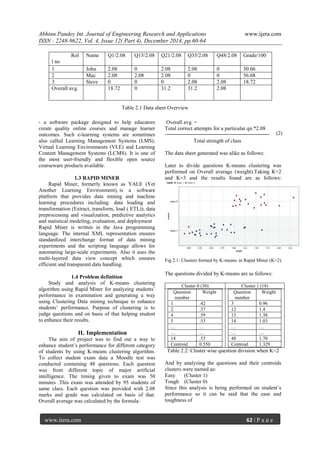
Later to divide questions K-means clustering was
performed on Overall average (weight).Taking K=2
and K=3 and the results found are as follows:
Fig 2.1: Clusters formed by K-means in Rapid Miner (K=2)
The questions divided by K-means are as follows:
Cluster 0 (30) Cluster 1 (18)
Question
number
Weight
1 .42
2 .37
4 .59
5 .53
… …
… …
18 .53
Centroid 0.550
Question
number
Weight
3 0.96
12 1.4
13 1.38
14 1.03
… …
… …
48 1.70
Centroid 1.329
Table 2.2: Cluster wise question division when K=2
And by analyzing the questions and their centroids
clusters were named as:
Easy (Cluster 1)
Tough (Cluster 0)
Since this analysis is being performed on student’s
performance so it can be said that the ease and
toughness of
Rol
l no
Name Q1/2.08 Q15/2.08 Q21/2.08 Q35/2.08 Q48/2.08 Grade/100
1 John 2.08 0 2.08 2.08 0 50.06
2 Mac 2.08 2.08 2.08 0 0 56.08
3 Steve 0 0 0 2.08 2.08 18.72
Overall avg. 18.72 0 31.2 31.2 2.08
Table 2.1 Data sheet Overview
(2)
Abhinn Pandey Int. Journal of Engineering Research and Applications www.ijera.com
ISSN : 2248-9622, Vol. 4, Issue 12( Part 4), December 2014, pp.60-64
www.ijera.com 63 | P a g e
Question is purely dependent on class performance.
Or here definition of toughness is derived from class
performance.
Later according to grades (total marks) students were
divided into four categories and for a particular
category average performance in cluster was
calculated by using formula:
Avg. performance of cluster =
Total number of correct answers of cluster*2.08
Total number of students
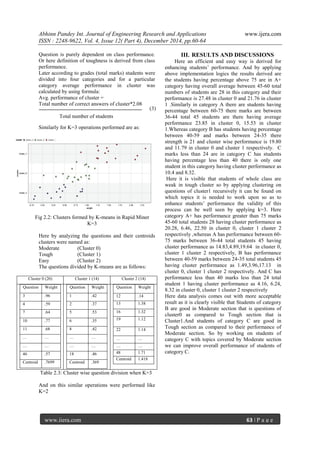
Similarly for K=3 operations performed are as:
Fig 2.2: Clusters formed by K-means in Rapid Miner
K=3
Here by analyzing the questions and their centroids
clusters were named as:
Moderate (Cluster 0)
Tough (Cluster 1)
Easy (Cluster 2)
The questions divided by K-means are as follows:
Cluster 0 (20) Cluster 1 (14) Cluster 2 (14)
Question Weight
3 .96
4 .59
7 .64
10 .77
11 .68
… …
… …
46 .57
Centroid .7699
Question Weight
1 .42
2 .37
5 .53
6 .35
8 .42
… …
… …
18 .46
Centroid .369
Question Weight
12 .14
13 1.38
16 1.32
19 1.12
22 1.14
… …
… …
48 1.71
Centroid 1.418
Table 2.3: Cluster wise question division when K=3
And on this similar operations were performed like
K=2
III. RESULTS AND DISCUSSIONS
Here an efficient and easy way is derived for
enhancing students’ performance. And by applying
above implementation logics the results derived are
the students having percentage above 75 are in A+
category having overall average between 45-60 total
numbers of students are 28 in this category and their
performance is 27.48 in cluster 0 and 21.76 in cluster
1 .Similarly in category A there are students having
percentage between 60-75 there marks are between
36-44 total 45 students are there having average
performance 23.85 in cluster 0, 15.53 in cluster
1.Whereas category B has students having percentage
between 40-59 and marks between 24-35 there
strength is 21 and cluster wise performance is 19.80
and 11.79 in cluster 0 and cluster 1 respectively. C
marks less than 24 are in category C has students
having percentage less than 40 there is only one
student in this category having cluster performance as
10.4 and 8.32.
Here it is visible that students of whole class are
weak in tough cluster so by applying clustering on
questions of cluster1 recursively it can be found on
which topics it is needed to work upon so as to
enhance students’ performance the validity of this
process can be well seen by applying k=3. Here
category A+ has performance greater than 75 marks
45-60 total students 28 having cluster performance as
20.28, 6.46, 22.50 in cluster 0, cluster 1 cluster 2
respectively ,whereas A has performance between 60-
75 marks between 36-44 total students 45 having
cluster performance as 14.83,4.89,19.64 in cluster 0,
cluster 1 cluster 2 respectively, B has performance
between 40-59 marks between 24-35 total students 45
having cluster performance as 1.49,3.96,17.13 in
cluster 0, cluster 1 cluster 2 respectively. And C has
performance less than 40 marks less than 24 total
student 1 having cluster performance as 4.16, 6.24,
8.32 in cluster 0, cluster 1 cluster 2 respectively
Here data analysis comes out with more acceptable
result as it is clearly visible that Students of category
B are good in Moderate section that is questions of
cluster0 as compared to Tough section that is
Cluster1.And students of category C are good in
Tough section as compared to their performance of
Moderate section. So by working on students of
category C with topics covered by Moderate section
we can improve overall performance of students of
category C.
(3)
Abhinn Pandey Int. Journal of Engineering Research and Applications www.ijera.com
ISSN : 2248-9622, Vol. 4, Issue 12( Part 4), December 2014, pp.60-64
www.ijera.com 64 | P a g e
Performance
Index
0-60 No. of
student
Performance
Cluster0
Easy
Performance
Cluster1
Tough
A+ >75 45-60 28 27.48 21.76
A 60-75 36-44 45 23.85 15.53
B 40-59 24-35 21 19.80 11.79
C <40 <24 01 10.4 8.32
Table 3.1 Student performance when K=2
Performance
Index
0-60 No. of
students
Performance
Cluster0
Moderate
Performance
Cluster1
Tough
Performance
Cluster2
Easy
A+ >75 45-60 28 20.28 6.46 22.50
A 60-75 36-44 45 14.83 4.89 19.64
B 40-59 24-35 21 10.49 3.96 17.13
C <40 <24 01 4.16 6.24 8.32
Table 3.2 Student performance when K=3
IV. CONCLUSION AND FUTURE
SCOPE
The result of this analysis gives clear idea about
validity of this approach, this analysis was performed
on a small dataset consisting of students and exam
marks. It is well analyzed that this approach comes
out with acceptable results. Hence this approach can
be applied to other datasets having more complex
features.
With developing data base and data analysis
approaches data mining is becoming very common
criteria hence in coming future it is going to be
pioneer approach towards data analysis as in the
short-term, the results of data mining will be
profitable, in mundane, business related areas.
Advertising will target potential customers with new
precision. In the medium term, data mining may be as
common and easy to use as e-mail. This tool can be
used to find the best airfare, root out a phone number
of a long-lost classmate, or find the best prices on
lawn mowers. The long-term prospects are truly
exciting. Imagine intelligent agents turned loose on
medical research data or on sub-atomic particle data.
Computers may reveal new treatments for diseases or
new insights into the nature of the universe.
Big data is a term for a collection of data sets so large
and complex that it becomes difficult to process using
on-hand DBMS tools or traditional data processing
applications. The challenges include capture, storage,
search, sharing, transfer, analysis and visualization.
With developing IT and its uses data sets being
developed are so large that they are so complex to be
handled in coming future the analysis and Big Data is
giving rise to an interesting collaboration among
diverse disciplines of computer science,
communication networks and devices, and behavioral
science. The advent of data science as a mainstream
subject is the outcome of these cross-domain efforts.
Applying Big Data solutions, enterprises can now
translate mountains of digital data into effective
business insights in real time. They can avoid risks,
cut costs and analyze patterns to follow trends and
customers’ preferences and suggest better choices for
the customers and increase revenue.
REFERENCES
[1] A1-Sultan K. S.,” A tabular search approach to
the clustering problem, Pattern
Recognition”,pp-28:1443-1451,1995.
[2] Al-Sultan K.S. Khan M. M., ”Computational
experience on four algorithms for the hard
clustering problem”,pp-295-308,1996.
[3] Banfield J. D. and Raftery A.E.,”Model-based
Gaussian and non-Gaussian clustering”,pp-
803-821, 1993.
[4] Bentley J. L. and Friedman J. H.,” Fast
algorithms for constructing minimal spanning
trees in coordinate spaces.”, IEEE Transactions
on Computers, C-
pp-297-105, February 1978. 275
[5] Aggarwal, C.C., Hinneburg, A.2000,”On the
distance metrics in high dimensional space”,
IBM Research report, RC 21739. Aggarwal,
C.C., procopiuc, C., Wolf, J.L., YU, P.S., J.S.
1999a.,”Fast algorithms for projected
clustering”,In Proceedings of the ACM
SIGMOD Conference, 61-72, Philadelphia,
PA.
[6] Liu, X. and Croft, W. B. (2004),”Cluster-based
retrieval using language models,”pp-234-256.
[7] Wenceslas Fernandez de la Vega, Marek
Karpinski,Claire Kenyon, and Yuval Rabani.
Approximation schemes for clustering
problems. In Proceedings of the 35th Annual
ACM Symposium on Theory of Computing
(SIGIR ’03), pages 50–58, 2003., New York,
NY, USA. ACM.

Study and Analysis of K-Means Clustering Algorithm Using Rapidminer

  • 1.
    Abhinn Pandey Int.Journal of Engineering Research and Applications www.ijera.com ISSN : 2248-9622, Vol. 4, Issue 12( Part 4), December 2014, pp.60-64 www.ijera.com 60 | P a g e Study and Analysis of K-Means Clustering Algorithm Using Rapidminer A CASE STUDY ON STUDENTS’ EXAM RESULT Abhinn Pandey Computer Technology, Kavikulguru Institute of Technology and Science Nagpur, India Abstract Institution is a place where teacher explains and student just understands and learns the lesson. Every student has his own definition for toughness and easiness and there isn’t any absolute scale for measuring knowledge but examination score indicate the performance of student. In this case study, knowledge of data mining is combined with educational strategies to improve students’ performance. Generally, data mining (sometimes called data or knowledge discovery) is the process of analysing data from different perspectives and summarizing it into useful information. Data mining software is one of a number of analytical tools for data. It allows users to analyse data from many different dimensions or angles, categorize it, and summarize the relationships identified. Technically, data mining is the process of finding correlations or patterns among dozens of fields in large relational database. Cluster analysis or clustering is the task of grouping a set of objects in such a way that objects in the same group (called a cluster) are more similar (in some sense or another) to each other than to those in other groups (clusters).This project describes the use of clustering data mining technique to improve the efficiency of academic performance in the educational institutions .In this project, a live experiment was conducted on students .By conducting an exam on students of computer science major using MOODLE(LMS) and analysing that data generated using RapidMiner(Datamining Software) and later by performing clustering on the data. This method helps to identify the students who need special advising or counselling by the teacher to give high quality of education. Keywords: Data mining, Clustering, k-means, Moodle, RapidMiner, LMS (Learning Management System) I. Introduction Data mining, also called knowledge discovery in databases, in computer science, is the process of discovering interesting and useful patterns and relationships in large volumes of data. The field combines tools from statistics and artificial intelligence (such as neural networks and machine learning) with database management to analyze large digital collections, known as data sets. Data mining is widely used in business (insurance, banking, retail), science research (astronomy, medicine), and government security (detection of criminals and terrorists). The process extracts high quality of information that can be used to draw conclusions based on relationships or pattern within the data. In data mining Clustering learning is a popular and well researched way of discovering interesting results among huge database. Cluster analysis or clustering is the task of grouping a set of objects in such a way that objects in the same group (called a cluster) are more similar (in some sense or another) to each other than to those in other groups (clusters). It is a main task of exploratory data mining, and a common technique for statistical data analysis, used in many fields, including machine learning, pattern recognition, image analysis, information retrieval, and bioinformatics. Cluster analysis itself is not one specific algorithm, but the general task to be solved. It can be achieved by various algorithms that differ significantly in their notion of what constitutes a cluster and how to efficiently find them. Popular notions of clusters include groups with small distances among the cluster members, dense areas of the data space, intervals or particular statistical distributions. Clustering can therefore be formulated as a multi-objective optimization problem. The appropriate clustering algorithm and parameter settings (including values such as the distance function to use, a density threshold or the number of expected clusters) depend on the individual data set and intended use of the results. Cluster analysis as such is not an automatic task, but an iterative process of knowledge discovery or interactive multi-objective optimization that involves trial and failure. It will often be necessary to modify data pre-processing and model parameters until the result achieves the desired properties. There are many types of clustering techniques. Typical cluster models include: 1. Connectivity models 2. Centroid models 3. Distribution models REVIEW ARTICLE OPEN ACCESS
  • 2.
    Abhinn Pandey Int.Journal of Engineering Research and Applications www.ijera.com ISSN : 2248-9622, Vol. 4, Issue 12( Part 4), December 2014, pp.60-64 www.ijera.com 61 | P a g e 4. Density models 5. Subspace models 6. Group models 7. Graph-based models Among all the popular ways well verified and mostly used ways is K-means algorithm. K-means is one of the simplest unsupervised learning algorithms that solve the well-known clustering problem. The procedure follows a simple and easy way to classify a given data set through a certain number of clusters (assume k clusters) fixed a priori. The main idea is to define k centroids, one for each cluster. These centroids should be placed in a cunning way because of different location causes different result. So, the better choice is to place them as much as possible far away from each other. The next step is to take each point belonging to a given data set and associate it to the nearest centroid. When no point is pending, the first step is completed and an early grouping is done. At this point we need to re-calculate k new centroids as center of the clusters resulting from the previous step. After we have these k new centroids, a new binding has to be done between the same data set points and the nearest new centroid. A loop has been generated. As a result of this loop we may notice that the k centroids change their location step by step until no more changes are done. In other words centroids do not move any more. Finally, this algorithm aims at minimizing an objective function, in this case a squared error function. The objective function (1) Here is a chosen distance measure between a data point xi (j) and the cluster center cj, is an indicator of the distance of the n data points from their respective cluster centers. 1.1 Knowledge discovery in databases Many people treat data mining as a synonym for another popularly used term, knowledge discovery from data, or KDD, while others view data mining as merely an essential step in the process of knowledge discovery. Fig 1.1: Knowledge Discovery in Databases  Data cleaning - to remove noise and inconsistent data  Data integration - where multiple data sources may be combined. A popular trend in the information industry is to perform data cleaning and data integration as a preprocessing step, where the resulting data are stored in a data warehouse.  Data selection - where data relevant to the analysis task are retrieved from the database.  Data transformation - where data are transformed and consolidated into forms appropriate for mining by performing summary or aggregation operations. Sometimes data transformation and consolidation are performed before the data selection process, particularly in the case of data warehousing. Data reduction may also be performed to obtain a smaller representation of the original data without sacrificing its integrity.  Data mining - an essential process where intelligent methods are applied to extract data patterns.  Pattern evaluation - to identify the truly interesting patterns representing knowledge based on interestingness measures.  Knowledge presentation - where visualization and knowledge representation techniques are used to present mined knowledge to users. 1.2 MOODLE A learning management system (LMS) is a software application for the administration, documentation, tracking, and reporting of training programs, classroom and online events, e-learning programs, and training content. Moodle (Modular Object-Oriented Dynamic Learning Environment) is a course management system (CMS)
  • 3.
    Abhinn Pandey Int.Journal of Engineering Research and Applications www.ijera.com ISSN : 2248-9622, Vol. 4, Issue 12( Part 4), December 2014, pp.60-64 www.ijera.com 62 | P a g e - a software package designed to help educators create quality online courses and manage learner outcomes. Such e-learning systems are sometimes also called Learning Management Systems (LMS), Virtual Learning Environments (VLE) and Learning Content Management Systems (LCMS). It is one of the most user-friendly and flexible open source courseware products available. 1.3 RAPID MINER Rapid Miner, formerly known as YALE (Yet Another Learning Environment), is a software platform that provides data mining and machine learning procedures including: data loading and transformation (Extract, transform, load ( ETL)), data preprocessing and visualization, predictive analytics and statistical modeling, evaluation, and deployment Rapid Miner is written in the Java programming language. The internal XML representation ensures standardized interchange format of data mining experiments and the scripting language allows for automating large-scale experiments. Also it uses the multi-layered data view concept which ensures efficient and transparent data handling. 1.4 Problem definition Study and analysis of K-means clustering algorithm using Rapid Miner for analyzing students’ performance in examination and generating a way using Clustering Data mining technique to enhance students’ performance. Purpose of clustering is to judge questions and on basis of that helping student to enhance their results. II. Implementation The aim of project was to find out a way to enhance student’s performance for different category of students by using K-means clustering algorithm. To collect student exam data a Moodle test was conducted containing 48 questions. Each question was from different topic of major artificial intelligence. The timing given to exam was 50 minutes .This exam was attended by 95 students of same class. Each question was provided with 2.08 marks and grade was calculated on basis of that. Overall average was calculated by the formula: Overall avg. = Total correct attempts for a particular qn.*2.08 Total strength of class The data sheet generated was alike as follows: Later to divide questions K-means clustering was performed on Overall average (weight).Taking K=2 and K=3 and the results found are as follows: Fig 2.1: Clusters formed by K-means in Rapid Miner (K=2) The questions divided by K-means are as follows: Cluster 0 (30) Cluster 1 (18) Question number Weight 1 .42 2 .37 4 .59 5 .53 … … … … 18 .53 Centroid 0.550 Question number Weight 3 0.96 12 1.4 13 1.38 14 1.03 … … … … 48 1.70 Centroid 1.329 Table 2.2: Cluster wise question division when K=2 And by analyzing the questions and their centroids clusters were named as: Easy (Cluster 1) Tough (Cluster 0) Since this analysis is being performed on student’s performance so it can be said that the ease and toughness of Rol l no Name Q1/2.08 Q15/2.08 Q21/2.08 Q35/2.08 Q48/2.08 Grade/100 1 John 2.08 0 2.08 2.08 0 50.06 2 Mac 2.08 2.08 2.08 0 0 56.08 3 Steve 0 0 0 2.08 2.08 18.72 Overall avg. 18.72 0 31.2 31.2 2.08 Table 2.1 Data sheet Overview (2)
  • 4.
    Abhinn Pandey Int.Journal of Engineering Research and Applications www.ijera.com ISSN : 2248-9622, Vol. 4, Issue 12( Part 4), December 2014, pp.60-64 www.ijera.com 63 | P a g e Question is purely dependent on class performance. Or here definition of toughness is derived from class performance. Later according to grades (total marks) students were divided into four categories and for a particular category average performance in cluster was calculated by using formula: Avg. performance of cluster = Total number of correct answers of cluster*2.08 Total number of students Similarly for K=3 operations performed are as: Fig 2.2: Clusters formed by K-means in Rapid Miner K=3 Here by analyzing the questions and their centroids clusters were named as: Moderate (Cluster 0) Tough (Cluster 1) Easy (Cluster 2) The questions divided by K-means are as follows: Cluster 0 (20) Cluster 1 (14) Cluster 2 (14) Question Weight 3 .96 4 .59 7 .64 10 .77 11 .68 … … … … 46 .57 Centroid .7699 Question Weight 1 .42 2 .37 5 .53 6 .35 8 .42 … … … … 18 .46 Centroid .369 Question Weight 12 .14 13 1.38 16 1.32 19 1.12 22 1.14 … … … … 48 1.71 Centroid 1.418 Table 2.3: Cluster wise question division when K=3 And on this similar operations were performed like K=2 III. RESULTS AND DISCUSSIONS Here an efficient and easy way is derived for enhancing students’ performance. And by applying above implementation logics the results derived are the students having percentage above 75 are in A+ category having overall average between 45-60 total numbers of students are 28 in this category and their performance is 27.48 in cluster 0 and 21.76 in cluster 1 .Similarly in category A there are students having percentage between 60-75 there marks are between 36-44 total 45 students are there having average performance 23.85 in cluster 0, 15.53 in cluster 1.Whereas category B has students having percentage between 40-59 and marks between 24-35 there strength is 21 and cluster wise performance is 19.80 and 11.79 in cluster 0 and cluster 1 respectively. C marks less than 24 are in category C has students having percentage less than 40 there is only one student in this category having cluster performance as 10.4 and 8.32. Here it is visible that students of whole class are weak in tough cluster so by applying clustering on questions of cluster1 recursively it can be found on which topics it is needed to work upon so as to enhance students’ performance the validity of this process can be well seen by applying k=3. Here category A+ has performance greater than 75 marks 45-60 total students 28 having cluster performance as 20.28, 6.46, 22.50 in cluster 0, cluster 1 cluster 2 respectively ,whereas A has performance between 60- 75 marks between 36-44 total students 45 having cluster performance as 14.83,4.89,19.64 in cluster 0, cluster 1 cluster 2 respectively, B has performance between 40-59 marks between 24-35 total students 45 having cluster performance as 1.49,3.96,17.13 in cluster 0, cluster 1 cluster 2 respectively. And C has performance less than 40 marks less than 24 total student 1 having cluster performance as 4.16, 6.24, 8.32 in cluster 0, cluster 1 cluster 2 respectively Here data analysis comes out with more acceptable result as it is clearly visible that Students of category B are good in Moderate section that is questions of cluster0 as compared to Tough section that is Cluster1.And students of category C are good in Tough section as compared to their performance of Moderate section. So by working on students of category C with topics covered by Moderate section we can improve overall performance of students of category C. (3)
  • 5.
    Abhinn Pandey Int.Journal of Engineering Research and Applications www.ijera.com ISSN : 2248-9622, Vol. 4, Issue 12( Part 4), December 2014, pp.60-64 www.ijera.com 64 | P a g e Performance Index 0-60 No. of student Performance Cluster0 Easy Performance Cluster1 Tough A+ >75 45-60 28 27.48 21.76 A 60-75 36-44 45 23.85 15.53 B 40-59 24-35 21 19.80 11.79 C <40 <24 01 10.4 8.32 Table 3.1 Student performance when K=2 Performance Index 0-60 No. of students Performance Cluster0 Moderate Performance Cluster1 Tough Performance Cluster2 Easy A+ >75 45-60 28 20.28 6.46 22.50 A 60-75 36-44 45 14.83 4.89 19.64 B 40-59 24-35 21 10.49 3.96 17.13 C <40 <24 01 4.16 6.24 8.32 Table 3.2 Student performance when K=3 IV. CONCLUSION AND FUTURE SCOPE The result of this analysis gives clear idea about validity of this approach, this analysis was performed on a small dataset consisting of students and exam marks. It is well analyzed that this approach comes out with acceptable results. Hence this approach can be applied to other datasets having more complex features. With developing data base and data analysis approaches data mining is becoming very common criteria hence in coming future it is going to be pioneer approach towards data analysis as in the short-term, the results of data mining will be profitable, in mundane, business related areas. Advertising will target potential customers with new precision. In the medium term, data mining may be as common and easy to use as e-mail. This tool can be used to find the best airfare, root out a phone number of a long-lost classmate, or find the best prices on lawn mowers. The long-term prospects are truly exciting. Imagine intelligent agents turned loose on medical research data or on sub-atomic particle data. Computers may reveal new treatments for diseases or new insights into the nature of the universe. Big data is a term for a collection of data sets so large and complex that it becomes difficult to process using on-hand DBMS tools or traditional data processing applications. The challenges include capture, storage, search, sharing, transfer, analysis and visualization. With developing IT and its uses data sets being developed are so large that they are so complex to be handled in coming future the analysis and Big Data is giving rise to an interesting collaboration among diverse disciplines of computer science, communication networks and devices, and behavioral science. The advent of data science as a mainstream subject is the outcome of these cross-domain efforts. Applying Big Data solutions, enterprises can now translate mountains of digital data into effective business insights in real time. They can avoid risks, cut costs and analyze patterns to follow trends and customers’ preferences and suggest better choices for the customers and increase revenue. REFERENCES [1] A1-Sultan K. S.,” A tabular search approach to the clustering problem, Pattern Recognition”,pp-28:1443-1451,1995. [2] Al-Sultan K.S. Khan M. M., ”Computational experience on four algorithms for the hard clustering problem”,pp-295-308,1996. [3] Banfield J. D. and Raftery A.E.,”Model-based Gaussian and non-Gaussian clustering”,pp- 803-821, 1993. [4] Bentley J. L. and Friedman J. H.,” Fast algorithms for constructing minimal spanning trees in coordinate spaces.”, IEEE Transactions on Computers, C- pp-297-105, February 1978. 275 [5] Aggarwal, C.C., Hinneburg, A.2000,”On the distance metrics in high dimensional space”, IBM Research report, RC 21739. Aggarwal, C.C., procopiuc, C., Wolf, J.L., YU, P.S., J.S. 1999a.,”Fast algorithms for projected clustering”,In Proceedings of the ACM SIGMOD Conference, 61-72, Philadelphia, PA. [6] Liu, X. and Croft, W. B. (2004),”Cluster-based retrieval using language models,”pp-234-256. [7] Wenceslas Fernandez de la Vega, Marek Karpinski,Claire Kenyon, and Yuval Rabani. Approximation schemes for clustering problems. In Proceedings of the 35th Annual ACM Symposium on Theory of Computing (SIGIR ’03), pages 50–58, 2003., New York, NY, USA. ACM.