A Succinct Reflection on Data Classification Methodologies
Divyanka Hooda1
, Divya Wadhwa2
, Hardik Singh3
,Anuradha4
1
Computer Science, ITM University,
Gurgaon, Haryana-122001, India.
2
Computer Science, ITM University,
Gurgaon, Haryana-122001, India.
3
Computer Science, ITM University,
Gurgaon, Haryana-122001, India.
4
Computer Science, ITM University,
Gurgaon, Haryana-122001, India.
Abstract
Classification is a data mining (machine learning) technique used
to assign group membership to various data instances. Indeed
there are many classification techniques available for a scientist
wishing to discover a model for his/her data. This diversity can
cause trouble as to which method should be applied to which data
set to solve a particular domain concentrated problem. This
review paper presents several major classification techniques like
Decision Tree Induction, Bayesian Classification, Rule-based
Classification, classification by Back Propagation, Support
Vector Machines, Lazy Learners, Genetic Algorithms, Rough Set
Approach, and Fuzzy Set Approach. The goal of this survey is to
provide a comprehensive review of different data classification
techniques.
Keywords: Classification, Decision tree, SVM, Bayesian
Classifier, Rule-Based Learning.
1. Introduction
Data mining is a collection of techniques for efficient
automated discovery of previously unknown, valid, novel,
useful and understandable patterns in large databases. We
locate data into specific categories for its most effective
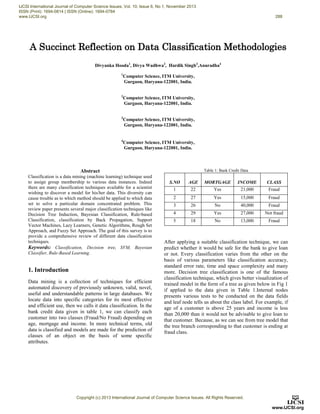
and efficient use, then we calls it data classification. In the
bank credit data given in table 1, we can classify each
customer into two classes (Fraud/No Fraud) depending on
age, mortgage and income. In more technical terms, old
data is classified and models are made for the prediction of
classes of an object on the basis of some specific
attributes.
Table 1: Bank Credit Data
S.NO AGE MORTGAGE INCOME CLASS
1 22 Yes 21,000 Fraud
2 27 Yes 15,000 Fraud
3 26 No 40,000 Fraud
4 29 Yes 27,000 Not fraud
5 18 No 13,000 Fraud
After applying a suitable classification technique, we can
predict whether it would be safe for the bank to give loan
or not. Every classification varies from the other on the
basis of various parameters like classification accuracy,
standard error rate, time and space complexity and many
more. Decision tree classification is one of the famous
classification technique, which gives better visualization of
trained model in the form of a tree as given below in Fig 1
if applied to the data given in Table 1.Internal nodes
presents various tests to be conducted on the data fields
and leaf node tells us about the class label. For example, if
age of a customer is above 25 years and income is less
than 20,000 than it would not be advisable to give loan to
that customer. Because, as we can see from tree model that
the tree branch corresponding to that customer is ending at
fraud class.
IJCSI International Journal of Computer Science Issues, Vol. 10, Issue 6, No 1, November 2013
ISSN (Print): 1694-0814 | ISSN (Online): 1694-0784
www.IJCSI.org 288
Copyright (c) 2013 International Journal of Computer Science Issues. All Rights Reserved.
1.1 Pseudo Code for Data Classification
Given below is the algorithmic flow to classify data set.
Any given data set is classified on the basis of one of its
attributes, which are having critical importance over the
others. Every time recursively partitioning the given data
set into smaller portions, which are easy to classify
depending upon whether that portion is having same class
label or not. We will stop this process either all attributes
are testing for their significance or pure portions are there.
Fig. 1 represents application of following algorithm on the
assumed data set.
1. Goal is to classify a data set into categories such
that D (n) ← Ci, where C represents a class and
i→1 to m.
2. Input original data set i.e., D (n), where n is the
number of records.
3. Find information gain i.e., Info_Gain of each
attribute Aj, where j-> 1 to p.
4. Choose Aj with max (Info_Gain), select Aj as root
node to start.
5. Partition D (n) on all possible values of Aj (i.e., k)
such that D (n) ←Pk, where P is the partition and
k←1 to q.
6. If D (n) ← Pk consists of pure class, then stop.
7. Else repeat steps 2 to 6, till the time no more
attributes left to partition.
8. End.
Fig. 1 Tree Generated by decision tree classifier.
2.Different Types of Classifiers
In the literature, there are various classifiers, each of which
works in their unique way. For example, some generate
rules for classification (rule based classification), some use
trees (decision trees generating training model in form of a
tree), fuzzy set (using truth values between 0.0 and 1.0)
and many other.
Figure 2 represents some of the techniques for data
classification, each incorporating different classifiers.
Fig. 2 Different Data Classification Techniques.
2.1 Decision Tree Induction
A tree is a graph without cycles, so a decision tree is a
structure where, root node is the parent (topmost) node,
having highest information gain, defining the favorable
sequence of attributes to investigate a domain centered
problem. Internal nodes do testing on an attribute. Branch
represents the outcome of the test. Leaf node holds the
class label. Table 2 gives famous algorithms for the same.
Table 2: Decision tree induction
DATA
CLASSIFICATION
TECHNIQUES
DECISION TREE
INDUCTION
BAYESIAN
CLASSIFICATION
RULE BASED
CLASSIFICATION
CLASSIFICATION BY
BACK PROPAGATION
SUPPORT VECTOR
MACHINES
GENETIC
ALGORITHMS
LAZY LEARNERS
ROUGH SET
FUZZY SET
ALGORITHM AUTHOR DESCRIPTION
ID3 [11][13] QUINLAN,
1983
Uses Information Gain
as splitting criteria.
C4.5 [9] QUINLAN,
1993
Evolution of ID3. Uses
gain ratio for splitting.
CART [10][12] Breiman et al.,
1984
Construction of Binary
trees for classification.
CHAID [2] Kass, 1980 Nominal attributes are
handled statistically.
QUEST [2] Loh and Shih,
1997
Supports linear
combinational splits.
CAL5 [2] Muller,
Wysotzki,
1994
For numerical - valued
attributes.
FACT [2] Loh,Vanichset
akul 1988
Uses statistical and
Discriminant analysis.
LMDT [2] Brodley,
Utgoff , 1995
Multivariate tests are
used on attributes.
T1 [2] Holte , 1993 One–level decision tree
is used.
PUBLIC [2] Rastogi, Shim,
2000
Integrates the growing
and pruning.
MARS[2] Friedman,
1991
Multiple regression is
approximated.
IJCSI International Journal of Computer Science Issues, Vol. 10, Issue 6, No 1, November 2013
ISSN (Print): 1694-0814 | ISSN (Online): 1694-0784
www.IJCSI.org 289
Copyright (c) 2013 International Journal of Computer Science Issues. All Rights Reserved.
2.2 Bayesian Classification
Naïve Bayesian classification consists of supervised
learning algorithms (classifiers) that take a training sample
as an input and returns a general classification rule as the
output. A Naïve Bayesian classifier is a simple
probabilistic classifier which applies Bayesian
theorem with strong (or naive) independence assumptions.
Baye’s theorem:
(1)
Here, x and y are two different events. Baye’s theorem
defines a relationship (as shown) between the probabilities
of x and y i.e., and respectively, and the
conditional probabilities of x given y has already occurred
i.e., and y given x has already occurred i.e.,
. Table 3 gives important Bayesian classifiers.
Table 3: Bayesian Classification
3.3 Rule-Based Classification
The extraction of useful if-then rules from data based on
statistical significance or a set of rules (which will be
written on the basis of some priority) are used in rule-based
classification. Certain association based relationships are
applied on a set of objects in a database in association rule
algorithms. For example if a rule having an expression of
the form X Y, and if a transaction of the database contain
X, then it will tend to contain Y. The Apriori association
rule based algorithm was developed on this type of
relationship for rule mining in large transaction databases
by IBM's Quest project team [19]. Table 4 represents rule
based classification algorithms.
Table 4: Rule based classification
3.4 Classification by Back Propagation
A Back propagation object specifies the parameters used
by the back propagation learning algorithm. In back
propagation, the output error on the training examples is
used to adjust the network weights. For better learning of
the algorithm, it is divided into two phases: propagation
and weight update. First the weights are initialized in the
network. Then for each training set, error is computed at
its output by the following formula:
(2)
Here E is the discrepancy. Lastly, weights are updated
until all examples are classified correctly.
3.5 Support Vector Machines
The basic goal of a SVM classifier is to predict, for each
given input, which of two possible classes forms the
output, making it a non-probabilistic binary linear
classifier. Vapnik & Chervonenkis’ statistical learning
theory in 1960s laid the groundwork for Vapnik to release
SVM approach in 1992.[21]
Linear SVM:
D is training data having a set of n points of the form:
{ { (3)
Where is either -1 or 1, indicating the class to which the
point belonging. Table 5 is the representation of SVM
algorithms.
ALGORITHM AUTHOR DESCRIPTION
Maximum A
Posteriori
(MAP)[15][16]
Dempster,
Laird, et al.
– 1977
Maximum
Likelihood
(ML)[14]
Redner,
Walker -
1984
Naïve Bayes
Classifier[17]
Thomas
Bayes,
1763
Strong independent
assumptions are used.
ALGORITHM AUTHOR DESCRIPTION
FOIL[3] Quinlan and
Cameron-
Jones, 1993.
Repeatedly searches for the
current best rule.
AQ[24] Ryszard S.
Michalski, late
1960s.
Induces a set of rules from
relations in Prolog.
PRM[3] Xiaoxin Yin
and Jiawei
Han 2003.
Modifies FOIL to achieve
higher accuracy.
CPAR[3] Xiaoxin Yin
and Jiawei
Han , 2003
Builds rules by adding
literals one by one.
RIPPER[4] Cohen ,1995 Generates “key words
spotting rules “.
1R[26] Holte, 1993 Simplest algorithm for
discrete attributes
IJCSI International Journal of Computer Science Issues, Vol. 10, Issue 6, No 1, November 2013
ISSN (Print): 1694-0814 | ISSN (Online): 1694-0784
www.IJCSI.org 290
Copyright (c) 2013 International Journal of Computer Science Issues. All Rights Reserved.
Table 5: Support vector machines
ALGORITHM AUTHOR DESCRIPTION
SVM-RS[5] Kang and Yoo,
2007
Binarizing
available user
preference data.
TV PROGRAM
RS[6]
Xu and Araki,
2006
Electronic Program
Guide as features.
SSVM[7] Xia et al, 2006 Estimate missing
elements in matrix.
CSVM[8] Oku et al, 2006 For context-aware RS
(CSVM).
3.6 Lazy Learners
Lazy learning algorithms are an instance-based algorithm
that stores only the training data or minor processing, and
waits until it is given a test tuple. Instance-based learning
algorithms are lazy-learning algorithms (Mitchell, 1997),
as they delay the induction or generalization process until
classification is performed. These algorithms require less
computation time during the training phase (than eager-
learning algorithms such as decision trees, neural and
Baye’s networks) but more computation time during the
prediction process. Some of the lazy learner’s algorithms
are represented in Table 6.
Table 6: Lazy learners
3.7 Genetic Algorithms
GA is based on an analogy to biological evolution. Each
rule is represented by a string of bits. An initial population
is created consisting of randomly generated rules. e.g., IF
A1 and Not A2 then C2 can be encoded as 100 based on
the notion of survival of the fittest; a new population is
formed to consist of the fittest rules and their off springs.
The fitness of a rule is represented by its classification
accuracy on a set of training examples. t. The schema
theorem specifies the (expected) number X(s, t+1) of
chromosomes carrying schema s in the next generation. A
simplified version has the following form:
[ ] (4)
Where u(s, t) is the average fitness of the chromosomes
carrying schema s at time t (the observed average fitness),
and e is the overall probability (usually quite small) that
the cluster s will be destroyed (or created) by mutation or
crossover [23].
3.8 Rough Set
This theory can be used to classify imprecise or noisy data
and to discover structural relationships within them. It
applies to discrete-valued attributes. Continuous-valued
attributes must therefore be discredited before its use. Z.
Pawlak [20] first released this approach to data analysis in
1982.
3.9 Fuzzy Set
Rather than having a precise cut-off between categories,
fuzzy logic uses truth values between 0.0 and 1.0
representing the degree of membership that a certain value
has in a given category. Each category represents the fuzzy
set. Fuzzy set theory is also known as possibility theory
[24]. A fuzzy set is a pair (U, m) where U is a set
and [ ].
4. Conclusion
In this survey, we have tried to give an overview of
Decision Tree Induction, Bayesian Classification, rule
based Classification, classification by Back Propagation,
Support Vector Machines, Lazy Learners, Genetic
Algorithms, Rough Set Approach, and Fuzzy Set
Approach. Every technique, however, has its own pros and
cons like nowadays mostly research is done in Support
Vector Machines (SVM). Thus, we have given an insight
on the different techniques used in machine learning for
data classification.
5. References
[1.] U. Fayyad and K. Irani, On the handling of
continuous-valued
Attributes in decision tree generation.Machine
Learning, Kluwer Academic Publishers, Boston ,
vol 8, page 87-102 (1992)
[2.] Almuallim H., An Efficient Algorithm for Optimal
Pruning of Decision Trees. Artificial Intelligence vol
83(2): page 347-362, 1996
ALORITHM AUTHOR DESCRIPTION
K-nearest
neighbor[22]
Trevor
Hastie,
Robert
Tibshirani,
1994
Instances represented as
points in a Euclidean space.
Racing
algorithm[18]
Oded
Maron,
Andrew
Moore, 1997
Provides better allocation of
computational resources
among candidate
configurations.
Locally
weighted
regression
Cleveland
and Devlin,
1988
Constructs local
approximation, to minimize
the weighted error.
IJCSI International Journal of Computer Science Issues, Vol. 10, Issue 6, No 1, November 2013
ISSN (Print): 1694-0814 | ISSN (Online): 1694-0784
www.IJCSI.org 291
Copyright (c) 2013 International Journal of Computer Science Issues. All Rights Reserved.
[3.] Prafulla Gupta & Durga Toshniwal Performance
Comparison of Rule Based Classification
Algorithms, International Journal of Computer
Science & Informatics, Volume-I, Issue-II, Page 37-
42, 2011
[4.] Cohen, W. W. (1995). Fast effective rule induction.
In Machine Learning: Proceedings of the Twelfth
International Conference, 1995
[5.] Kang, H., and Yoo, S., Svm and collaborative
filtering-based prediction of user preference for
digital fashion recommendation systems. IEEE
Transactions on Inf & Syst, 2007.
[6.] Xu, J., and Araki, K., A svm-based personal
recommendation system for TV programs. In Multi-
Media Modeling Conference Proceedings, 2006.
[7.] Xia, Z., Dong, Y., and Xing, G., 2006 Support vector
machines for collaborative filtering. In ACMSE 44:
Proceedings of the 44th annual Southeast regional
conference, pages 169–174, New York, NY, USA.
ACM.
[8.] K. O. et al., Context-aware SVM for context-
dependent information recommendation. In
International Conference on Mobile Data
Management, 2006.
[9.] Radaideh, Q., August 1989.The Impact of
Classification Evaluation Methods on, Rough Sets
Based Classifiers, Proceedings of the 2008
International.
[10.] Crawford S. L., August 1989 Extensions to the
CART algorithm. Int. J. of Man Machine Studies,
vol 31(2): pages 197-217.
[11.] Mehmed Kantardzic (2003): Review of Data Mining:
Concepts, Models, Methods, and Algorithms.
Technimetrics vol. 45, no. 3, p. 277-277
[12.] Breiman L., Friedman J., Olshen R., and Stone C.,
1984. Classification and Regression Trees.
Wadsworth Int. Group. Chapman & Hall, New York,
NY, (1984)
[13.] llim H., An Efficient Algorithm for Optimal Pruning
of Decision Trees. Artificial Intelligence 83(2): 347-
362, 1996.
[14.] Dempster, A.P. Dempster, N.M. Laird, and D.B.
Rubin, “Maximum likelihood from incomplete data
via the EM algorithm” J. Roy. Statist. Soc. B, 39: pp
1–38, 1977.
[15.] Cheeseman et al., 1988a] P. Cheeseman, J. Kelly, M.
Self, J. Stutz, W. Taylor, and D. Freeman,
1988.Autoclass: a Bayesian classification system. In
Proceedings of the Fifth International Conference on
Machine Learning.
[16.] [Cheeseman et al., 1988b] P. Cheeseman, M. Self, J.
Kelly, J. Stutz, W. Taylor, and D. Freeman, 1988.
Bayesian classification. In Seventh National
Conference on Artificial Intelligence, pages 607–
611, Saint Paul, Minnesota.
[17.] Tan P-N, Steinbach M, Kumar V (2006) Introduction
to data mining. Pearson Addison-Wesley, 2nd
Edition 2006 by Pearson Education Inc.
[18.] D.W. Aha, A Study of Instance-Based Algorithms
for Supervised Learning Tasks: Mathematical,
Empirical and Psychological Evaluations. PhD
Thesis; Technical Report No 90-42, University of
California, Irvine, November 1990.
[19.] Agrawal, R. Srikant: “Fast Algorithms for Mining
Association Rules'', Proc. of the 20th Int'l
Conference on Very Large Databases, Santiago,
Chile, Sept. 1994.
[20.] Z. Pawlak, “Rough sets”, International Journal of
Computer and Information Sciences, page 341-356,
1982.
[21.] V. N. Vapnik, Statistical Learning Theory, Wiley
New York, 1998.
[22.] Kubat, Miroslav, Cooperson Martin, A reduction
technique for nearest-neighbor classification: Small
groups of examples. Intell. Data Anal vol 5 edition 6
page 463-476, 2001.
[23.] D.E. Goldberg, Genetic algorithms in search,
optimization and machine learning, Addison-
Wesley, New York, 1989.
[24.] J.R. Castro, O. Castillo and L.G. Martínez, “Interval
Type-2 Fuzzy Logic Toolbox”, Engineering Letters
Vol 15(1), 2007, page 89-98.
[25.] R. S. Michalski, I. Mozetic, J. Hong, and N. Lavrac,
The AQ15 inductive learning system: An overview
and experiments, Report 1260, Department of
Computer Science, University of Illinois at Urbana-
Champaign, 1986.
[26.] Craig G. Nevill-Mainning Artificial Neural Network
and Expert Systems, Second New Zealand
International Two-Stream Conference on 20-23 Nov
1995 Pages 239 – 242.
IJCSI International Journal of Computer Science Issues, Vol. 10, Issue 6, No 1, November 2013
ISSN (Print): 1694-0814 | ISSN (Online): 1694-0784
www.IJCSI.org 292
Copyright (c) 2013 International Journal of Computer Science Issues. All Rights Reserved.

IJCSI-10-6-1-288-292

  • 1.
    A Succinct Reflectionon Data Classification Methodologies Divyanka Hooda1 , Divya Wadhwa2 , Hardik Singh3 ,Anuradha4 1 Computer Science, ITM University, Gurgaon, Haryana-122001, India. 2 Computer Science, ITM University, Gurgaon, Haryana-122001, India. 3 Computer Science, ITM University, Gurgaon, Haryana-122001, India. 4 Computer Science, ITM University, Gurgaon, Haryana-122001, India. Abstract Classification is a data mining (machine learning) technique used to assign group membership to various data instances. Indeed there are many classification techniques available for a scientist wishing to discover a model for his/her data. This diversity can cause trouble as to which method should be applied to which data set to solve a particular domain concentrated problem. This review paper presents several major classification techniques like Decision Tree Induction, Bayesian Classification, Rule-based Classification, classification by Back Propagation, Support Vector Machines, Lazy Learners, Genetic Algorithms, Rough Set Approach, and Fuzzy Set Approach. The goal of this survey is to provide a comprehensive review of different data classification techniques. Keywords: Classification, Decision tree, SVM, Bayesian Classifier, Rule-Based Learning. 1. Introduction Data mining is a collection of techniques for efficient automated discovery of previously unknown, valid, novel, useful and understandable patterns in large databases. We locate data into specific categories for its most effective and efficient use, then we calls it data classification. In the bank credit data given in table 1, we can classify each customer into two classes (Fraud/No Fraud) depending on age, mortgage and income. In more technical terms, old data is classified and models are made for the prediction of classes of an object on the basis of some specific attributes. Table 1: Bank Credit Data S.NO AGE MORTGAGE INCOME CLASS 1 22 Yes 21,000 Fraud 2 27 Yes 15,000 Fraud 3 26 No 40,000 Fraud 4 29 Yes 27,000 Not fraud 5 18 No 13,000 Fraud After applying a suitable classification technique, we can predict whether it would be safe for the bank to give loan or not. Every classification varies from the other on the basis of various parameters like classification accuracy, standard error rate, time and space complexity and many more. Decision tree classification is one of the famous classification technique, which gives better visualization of trained model in the form of a tree as given below in Fig 1 if applied to the data given in Table 1.Internal nodes presents various tests to be conducted on the data fields and leaf node tells us about the class label. For example, if age of a customer is above 25 years and income is less than 20,000 than it would not be advisable to give loan to that customer. Because, as we can see from tree model that the tree branch corresponding to that customer is ending at fraud class. IJCSI International Journal of Computer Science Issues, Vol. 10, Issue 6, No 1, November 2013 ISSN (Print): 1694-0814 | ISSN (Online): 1694-0784 www.IJCSI.org 288 Copyright (c) 2013 International Journal of Computer Science Issues. All Rights Reserved.
  • 2.
    1.1 Pseudo Codefor Data Classification Given below is the algorithmic flow to classify data set. Any given data set is classified on the basis of one of its attributes, which are having critical importance over the others. Every time recursively partitioning the given data set into smaller portions, which are easy to classify depending upon whether that portion is having same class label or not. We will stop this process either all attributes are testing for their significance or pure portions are there. Fig. 1 represents application of following algorithm on the assumed data set. 1. Goal is to classify a data set into categories such that D (n) ← Ci, where C represents a class and i→1 to m. 2. Input original data set i.e., D (n), where n is the number of records. 3. Find information gain i.e., Info_Gain of each attribute Aj, where j-> 1 to p. 4. Choose Aj with max (Info_Gain), select Aj as root node to start. 5. Partition D (n) on all possible values of Aj (i.e., k) such that D (n) ←Pk, where P is the partition and k←1 to q. 6. If D (n) ← Pk consists of pure class, then stop. 7. Else repeat steps 2 to 6, till the time no more attributes left to partition. 8. End. Fig. 1 Tree Generated by decision tree classifier. 2.Different Types of Classifiers In the literature, there are various classifiers, each of which works in their unique way. For example, some generate rules for classification (rule based classification), some use trees (decision trees generating training model in form of a tree), fuzzy set (using truth values between 0.0 and 1.0) and many other. Figure 2 represents some of the techniques for data classification, each incorporating different classifiers. Fig. 2 Different Data Classification Techniques. 2.1 Decision Tree Induction A tree is a graph without cycles, so a decision tree is a structure where, root node is the parent (topmost) node, having highest information gain, defining the favorable sequence of attributes to investigate a domain centered problem. Internal nodes do testing on an attribute. Branch represents the outcome of the test. Leaf node holds the class label. Table 2 gives famous algorithms for the same. Table 2: Decision tree induction DATA CLASSIFICATION TECHNIQUES DECISION TREE INDUCTION BAYESIAN CLASSIFICATION RULE BASED CLASSIFICATION CLASSIFICATION BY BACK PROPAGATION SUPPORT VECTOR MACHINES GENETIC ALGORITHMS LAZY LEARNERS ROUGH SET FUZZY SET ALGORITHM AUTHOR DESCRIPTION ID3 [11][13] QUINLAN, 1983 Uses Information Gain as splitting criteria. C4.5 [9] QUINLAN, 1993 Evolution of ID3. Uses gain ratio for splitting. CART [10][12] Breiman et al., 1984 Construction of Binary trees for classification. CHAID [2] Kass, 1980 Nominal attributes are handled statistically. QUEST [2] Loh and Shih, 1997 Supports linear combinational splits. CAL5 [2] Muller, Wysotzki, 1994 For numerical - valued attributes. FACT [2] Loh,Vanichset akul 1988 Uses statistical and Discriminant analysis. LMDT [2] Brodley, Utgoff , 1995 Multivariate tests are used on attributes. T1 [2] Holte , 1993 One–level decision tree is used. PUBLIC [2] Rastogi, Shim, 2000 Integrates the growing and pruning. MARS[2] Friedman, 1991 Multiple regression is approximated. IJCSI International Journal of Computer Science Issues, Vol. 10, Issue 6, No 1, November 2013 ISSN (Print): 1694-0814 | ISSN (Online): 1694-0784 www.IJCSI.org 289 Copyright (c) 2013 International Journal of Computer Science Issues. All Rights Reserved.
  • 3.
    2.2 Bayesian Classification NaïveBayesian classification consists of supervised learning algorithms (classifiers) that take a training sample as an input and returns a general classification rule as the output. A Naïve Bayesian classifier is a simple probabilistic classifier which applies Bayesian theorem with strong (or naive) independence assumptions. Baye’s theorem: (1) Here, x and y are two different events. Baye’s theorem defines a relationship (as shown) between the probabilities of x and y i.e., and respectively, and the conditional probabilities of x given y has already occurred i.e., and y given x has already occurred i.e., . Table 3 gives important Bayesian classifiers. Table 3: Bayesian Classification 3.3 Rule-Based Classification The extraction of useful if-then rules from data based on statistical significance or a set of rules (which will be written on the basis of some priority) are used in rule-based classification. Certain association based relationships are applied on a set of objects in a database in association rule algorithms. For example if a rule having an expression of the form X Y, and if a transaction of the database contain X, then it will tend to contain Y. The Apriori association rule based algorithm was developed on this type of relationship for rule mining in large transaction databases by IBM's Quest project team [19]. Table 4 represents rule based classification algorithms. Table 4: Rule based classification 3.4 Classification by Back Propagation A Back propagation object specifies the parameters used by the back propagation learning algorithm. In back propagation, the output error on the training examples is used to adjust the network weights. For better learning of the algorithm, it is divided into two phases: propagation and weight update. First the weights are initialized in the network. Then for each training set, error is computed at its output by the following formula: (2) Here E is the discrepancy. Lastly, weights are updated until all examples are classified correctly. 3.5 Support Vector Machines The basic goal of a SVM classifier is to predict, for each given input, which of two possible classes forms the output, making it a non-probabilistic binary linear classifier. Vapnik & Chervonenkis’ statistical learning theory in 1960s laid the groundwork for Vapnik to release SVM approach in 1992.[21] Linear SVM: D is training data having a set of n points of the form: { { (3) Where is either -1 or 1, indicating the class to which the point belonging. Table 5 is the representation of SVM algorithms. ALGORITHM AUTHOR DESCRIPTION Maximum A Posteriori (MAP)[15][16] Dempster, Laird, et al. – 1977 Maximum Likelihood (ML)[14] Redner, Walker - 1984 Naïve Bayes Classifier[17] Thomas Bayes, 1763 Strong independent assumptions are used. ALGORITHM AUTHOR DESCRIPTION FOIL[3] Quinlan and Cameron- Jones, 1993. Repeatedly searches for the current best rule. AQ[24] Ryszard S. Michalski, late 1960s. Induces a set of rules from relations in Prolog. PRM[3] Xiaoxin Yin and Jiawei Han 2003. Modifies FOIL to achieve higher accuracy. CPAR[3] Xiaoxin Yin and Jiawei Han , 2003 Builds rules by adding literals one by one. RIPPER[4] Cohen ,1995 Generates “key words spotting rules “. 1R[26] Holte, 1993 Simplest algorithm for discrete attributes IJCSI International Journal of Computer Science Issues, Vol. 10, Issue 6, No 1, November 2013 ISSN (Print): 1694-0814 | ISSN (Online): 1694-0784 www.IJCSI.org 290 Copyright (c) 2013 International Journal of Computer Science Issues. All Rights Reserved.
  • 4.
    Table 5: Supportvector machines ALGORITHM AUTHOR DESCRIPTION SVM-RS[5] Kang and Yoo, 2007 Binarizing available user preference data. TV PROGRAM RS[6] Xu and Araki, 2006 Electronic Program Guide as features. SSVM[7] Xia et al, 2006 Estimate missing elements in matrix. CSVM[8] Oku et al, 2006 For context-aware RS (CSVM). 3.6 Lazy Learners Lazy learning algorithms are an instance-based algorithm that stores only the training data or minor processing, and waits until it is given a test tuple. Instance-based learning algorithms are lazy-learning algorithms (Mitchell, 1997), as they delay the induction or generalization process until classification is performed. These algorithms require less computation time during the training phase (than eager- learning algorithms such as decision trees, neural and Baye’s networks) but more computation time during the prediction process. Some of the lazy learner’s algorithms are represented in Table 6. Table 6: Lazy learners 3.7 Genetic Algorithms GA is based on an analogy to biological evolution. Each rule is represented by a string of bits. An initial population is created consisting of randomly generated rules. e.g., IF A1 and Not A2 then C2 can be encoded as 100 based on the notion of survival of the fittest; a new population is formed to consist of the fittest rules and their off springs. The fitness of a rule is represented by its classification accuracy on a set of training examples. t. The schema theorem specifies the (expected) number X(s, t+1) of chromosomes carrying schema s in the next generation. A simplified version has the following form: [ ] (4) Where u(s, t) is the average fitness of the chromosomes carrying schema s at time t (the observed average fitness), and e is the overall probability (usually quite small) that the cluster s will be destroyed (or created) by mutation or crossover [23]. 3.8 Rough Set This theory can be used to classify imprecise or noisy data and to discover structural relationships within them. It applies to discrete-valued attributes. Continuous-valued attributes must therefore be discredited before its use. Z. Pawlak [20] first released this approach to data analysis in 1982. 3.9 Fuzzy Set Rather than having a precise cut-off between categories, fuzzy logic uses truth values between 0.0 and 1.0 representing the degree of membership that a certain value has in a given category. Each category represents the fuzzy set. Fuzzy set theory is also known as possibility theory [24]. A fuzzy set is a pair (U, m) where U is a set and [ ]. 4. Conclusion In this survey, we have tried to give an overview of Decision Tree Induction, Bayesian Classification, rule based Classification, classification by Back Propagation, Support Vector Machines, Lazy Learners, Genetic Algorithms, Rough Set Approach, and Fuzzy Set Approach. Every technique, however, has its own pros and cons like nowadays mostly research is done in Support Vector Machines (SVM). Thus, we have given an insight on the different techniques used in machine learning for data classification. 5. References [1.] U. Fayyad and K. Irani, On the handling of continuous-valued Attributes in decision tree generation.Machine Learning, Kluwer Academic Publishers, Boston , vol 8, page 87-102 (1992) [2.] Almuallim H., An Efficient Algorithm for Optimal Pruning of Decision Trees. Artificial Intelligence vol 83(2): page 347-362, 1996 ALORITHM AUTHOR DESCRIPTION K-nearest neighbor[22] Trevor Hastie, Robert Tibshirani, 1994 Instances represented as points in a Euclidean space. Racing algorithm[18] Oded Maron, Andrew Moore, 1997 Provides better allocation of computational resources among candidate configurations. Locally weighted regression Cleveland and Devlin, 1988 Constructs local approximation, to minimize the weighted error. IJCSI International Journal of Computer Science Issues, Vol. 10, Issue 6, No 1, November 2013 ISSN (Print): 1694-0814 | ISSN (Online): 1694-0784 www.IJCSI.org 291 Copyright (c) 2013 International Journal of Computer Science Issues. All Rights Reserved.
  • 5.
    [3.] Prafulla Gupta& Durga Toshniwal Performance Comparison of Rule Based Classification Algorithms, International Journal of Computer Science & Informatics, Volume-I, Issue-II, Page 37- 42, 2011 [4.] Cohen, W. W. (1995). Fast effective rule induction. In Machine Learning: Proceedings of the Twelfth International Conference, 1995 [5.] Kang, H., and Yoo, S., Svm and collaborative filtering-based prediction of user preference for digital fashion recommendation systems. IEEE Transactions on Inf & Syst, 2007. [6.] Xu, J., and Araki, K., A svm-based personal recommendation system for TV programs. In Multi- Media Modeling Conference Proceedings, 2006. [7.] Xia, Z., Dong, Y., and Xing, G., 2006 Support vector machines for collaborative filtering. In ACMSE 44: Proceedings of the 44th annual Southeast regional conference, pages 169–174, New York, NY, USA. ACM. [8.] K. O. et al., Context-aware SVM for context- dependent information recommendation. In International Conference on Mobile Data Management, 2006. [9.] Radaideh, Q., August 1989.The Impact of Classification Evaluation Methods on, Rough Sets Based Classifiers, Proceedings of the 2008 International. [10.] Crawford S. L., August 1989 Extensions to the CART algorithm. Int. J. of Man Machine Studies, vol 31(2): pages 197-217. [11.] Mehmed Kantardzic (2003): Review of Data Mining: Concepts, Models, Methods, and Algorithms. Technimetrics vol. 45, no. 3, p. 277-277 [12.] Breiman L., Friedman J., Olshen R., and Stone C., 1984. Classification and Regression Trees. Wadsworth Int. Group. Chapman & Hall, New York, NY, (1984) [13.] llim H., An Efficient Algorithm for Optimal Pruning of Decision Trees. Artificial Intelligence 83(2): 347- 362, 1996. [14.] Dempster, A.P. Dempster, N.M. Laird, and D.B. Rubin, “Maximum likelihood from incomplete data via the EM algorithm” J. Roy. Statist. Soc. B, 39: pp 1–38, 1977. [15.] Cheeseman et al., 1988a] P. Cheeseman, J. Kelly, M. Self, J. Stutz, W. Taylor, and D. Freeman, 1988.Autoclass: a Bayesian classification system. In Proceedings of the Fifth International Conference on Machine Learning. [16.] [Cheeseman et al., 1988b] P. Cheeseman, M. Self, J. Kelly, J. Stutz, W. Taylor, and D. Freeman, 1988. Bayesian classification. In Seventh National Conference on Artificial Intelligence, pages 607– 611, Saint Paul, Minnesota. [17.] Tan P-N, Steinbach M, Kumar V (2006) Introduction to data mining. Pearson Addison-Wesley, 2nd Edition 2006 by Pearson Education Inc. [18.] D.W. Aha, A Study of Instance-Based Algorithms for Supervised Learning Tasks: Mathematical, Empirical and Psychological Evaluations. PhD Thesis; Technical Report No 90-42, University of California, Irvine, November 1990. [19.] Agrawal, R. Srikant: “Fast Algorithms for Mining Association Rules'', Proc. of the 20th Int'l Conference on Very Large Databases, Santiago, Chile, Sept. 1994. [20.] Z. Pawlak, “Rough sets”, International Journal of Computer and Information Sciences, page 341-356, 1982. [21.] V. N. Vapnik, Statistical Learning Theory, Wiley New York, 1998. [22.] Kubat, Miroslav, Cooperson Martin, A reduction technique for nearest-neighbor classification: Small groups of examples. Intell. Data Anal vol 5 edition 6 page 463-476, 2001. [23.] D.E. Goldberg, Genetic algorithms in search, optimization and machine learning, Addison- Wesley, New York, 1989. [24.] J.R. Castro, O. Castillo and L.G. Martínez, “Interval Type-2 Fuzzy Logic Toolbox”, Engineering Letters Vol 15(1), 2007, page 89-98. [25.] R. S. Michalski, I. Mozetic, J. Hong, and N. Lavrac, The AQ15 inductive learning system: An overview and experiments, Report 1260, Department of Computer Science, University of Illinois at Urbana- Champaign, 1986. [26.] Craig G. Nevill-Mainning Artificial Neural Network and Expert Systems, Second New Zealand International Two-Stream Conference on 20-23 Nov 1995 Pages 239 – 242. IJCSI International Journal of Computer Science Issues, Vol. 10, Issue 6, No 1, November 2013 ISSN (Print): 1694-0814 | ISSN (Online): 1694-0784 www.IJCSI.org 292 Copyright (c) 2013 International Journal of Computer Science Issues. All Rights Reserved.