1
Histopathological and biochemical changes induced by
toluene subcutaneous administration in rabbits
Wasfi Dhahir Abid Ali
Department of basic sciences College of nursing -university of Iraq –Ph.D in physiology
Email- Wasfi.Abid_ali@uobasrah.edu.iq
Abstract
The liver is the main organ responsible for the metabolism of drugs and toxic chemicals,
and so is the primary target organ for many organic solvents. The rabbits in group II ( treated
with 0.3 cm of toluene 97% S/s for 6 weeks, At the end of the experimental period, liver and
blood samples were taken from the decapitated animals. Serum aspartate aminotransferase
(AST), alanine aminotransferase (ALT), alkaline phosphatase (ALP), were determined. Liver
tissue sections were stained with routine histological methods and examined under the light
microscope. The results revealed significant increase on liver enzymes level as well as liver
tissue changes.
Introduction
Although a number of industrial chemicals are known to be hepatotoxins, liver disease from
occupational exposure is rarely suspected or diagnosed (Giulia et al.,2012). Chemically toluene
is a hydrocarbon that is rapidly absorbed through the respiratory and gastrointestinal tracts and,
to a lesser extent, through the skin (Campagna et al., 2001). Studies by Franco 1991 have
suggested organic solvents may induce liver toxicity ] because most chemicals are metabolized
in the liver and toxic metabolites generated through the metabolism are the main cause of liver
damage. Toxic hepatitis is characterized by different degrees of steatosis and fibrosis, which can
lead to cirrhosis(Giulia et al.,2012). Sharp(1997) sited that Exposure to inhalants occurs
primarily via pulmonary absorption, and significantly less absorption takes place through the
skin or gastrointestinal tract. Most inhaled toluene is metabolized in the liver by conversion to
2
benzoic acid by two enzymes, alcohol dehydrogenase and aldehyde dehydrogenase (Greenberg
1997).
Experimental procedure
Ten adult male rabbits , weighing 950- 1200 g, were allotted in two experimental groups.
The animals were purchased from a local market and housed in individual cages (360 · 200 · 190
mm) the animal were available ad libitum Food and tap water for both groups , the first group
take normal saline 0.9% Na CL while the second group received 0.3 ml of toluene(97%)/Kg
B.W subcutaneously daily for 6 weeks. At the end of the experiment , blood were drown via
cardiac puncture after anesthetized by intramuscular injection of mixture xylazine2% (Alfasan-
Holland) and ketamine10%(Kepro -Holland), 5 ml of blood samples were collected from each
rabbit by heart puncture then they were put in tubes centrifuged ( 3500 r pm for 15 minute) and
the serum that was obtained, transferred to Eppendorf tube kept until analysis for, liver enzymes
and biochemical . animals scarified and studied organ were isolated in 10% formalin for path-
histological examination .
Results and discussion
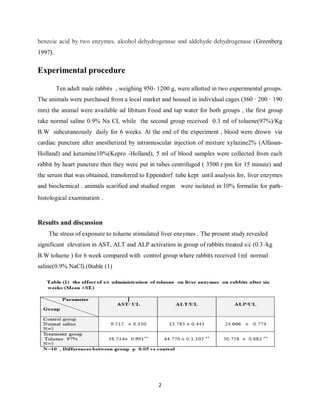
The stress of exposure to toluene stimulated liver enzymes . The present study revealed
significant elevation in AST, ALT and ALP activation in group of rabbits treated s/c (0.3 /kg
B.W toluene ) for 6 week compared with control group where rabbits received 1ml normal
saline(0.9% NaCl).(0table (1)
3
A number of animal studies have reported increased liver sizes or histological changes in
mice or rats repeatedly exposed to concentrations , Toluene inhalation significantly increased
serum ALT, AST and tissues(Tas et al., 2011).
Increased liver weights and increased serum levels of liver enzymes have been reported in rats
repeatedly exposed to toluene at doses greater than 1,125 mg/m3 (300 ppm) for at least 6 hours a
day Agency for Toxic Substances and Disease Registry (ATSDR 2000). Toluene and its
metabolites have been studied with respect to their reactive oxygen species-enhancing potential (
Cara et al ., 1983).
Murat et al.,(2013) found that the level of plasma transaminase to be increased in toluene
administered rats. Additionally, slight degeneration of hepatocyte and mononuclear cell
infiltration was observed in the liver tissue sections as well as their study showed that the high
dose of toluene triggers apoptosis in the liver of rats via the mitochondrial pathway in acute
period.
Toluene alters the lipid structure of the cell wall and interacts with proteins due to its lipophilic
nature. In acute doses, it increases membrane fluidity by significantly elevating the Na/K-
ATPase activity (Calderón-Guzmán et al., 2005). Some researchers reported that toluene causes
tissue damage by increasing the oxygen radicals (Karabulut et al., 2009; Lee et al., 2003).
Toluene, after being absorbed, can be found, in a decreasing order, in fat tissue (white and brown
adipose tissues), stomach, liver, kidneys, bone marrow, brain, and spleen Health Protection
Agency (HPA),(2007 ) . Five hours after toluene is taken, it reaches the maximum level in the
adipose tissue. High levels of toluene can be found in the liver and brain of people who have
died of glue sniffing Environmental Protection Agency (EPA)(2005),
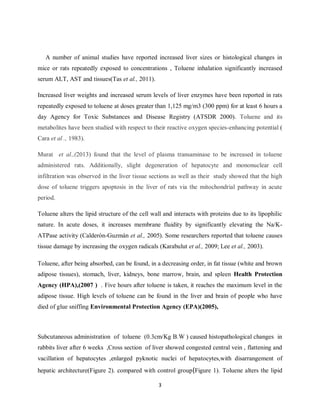
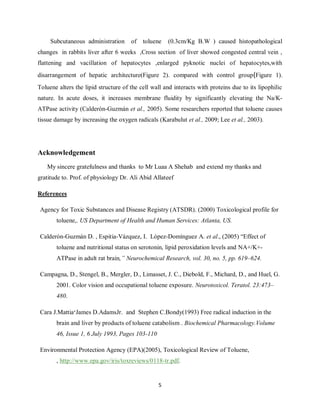
Subcutaneous administration of toluene (0.3cm/Kg B.W ) caused histopathological changes in
rabbits liver after 6 weeks ,Cross section of liver showed congested central vein , flattening and
vacillation of hepatocytes ,enlarged pyknotic nuclei of hepatocytes,with disarrangement of
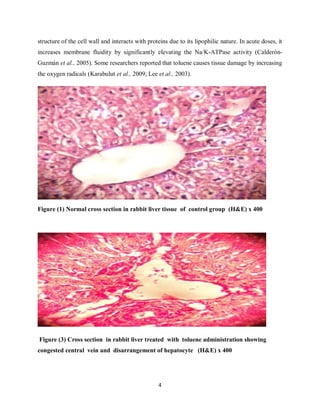
hepatic architecture(Figure 2). compared with control group(Figure 1). Toluene alters the lipid
4
structure of the cell wall and interacts with proteins due to its lipophilic nature. In acute doses, it
increases membrane fluidity by significantly elevating the Na/K-ATPase activity (Calderón-
Guzmán et al., 2005). Some researchers reported that toluene causes tissue damage by increasing
the oxygen radicals (Karabulut et al., 2009; Lee et al., 2003).
Figure (1) Normal cross section in rabbit liver tissue of control group (H&E) x 400
Figure (3) Cross section in rabbit liver treated with toluene administration showing
congested central vein and disarrangement of hepatocyte (H&E) x 400
5
Subcutaneous administration of toluene (0.3cm/Kg B.W ) caused histopathological
changes in rabbits liver after 6 weeks ,Cross section of liver showed congested central vein ,
flattening and vacillation of hepatocytes ,enlarged pyknotic nuclei of hepatocytes,with
disarrangement of hepatic architecture(Figure 2). compared with control group(Figure 1).
Toluene alters the lipid structure of the cell wall and interacts with proteins due to its lipophilic
nature. In acute doses, it increases membrane fluidity by significantly elevating the Na/K-
ATPase activity (Calderón-Guzmán et al., 2005). Some researchers reported that toluene causes
tissue damage by increasing the oxygen radicals (Karabulut et al., 2009; Lee et al., 2003).
Acknowledgement
My sincere gratefulness and thanks to Mr Luaa A Shehab and extend my thanks and
gratitude to. Prof. of physiology Dr. Ali Abid Allateef
References
Agency for Toxic Substances and Disease Registry (ATSDR). (2000) Toxicological profile for
toluene,. US Department of Health and Human Services: Atlanta, US.
Calderón-Guzmán D. , Espitia-Vázquez, I. López-Domínguez A. et al., (2005) “Effect of
toluene and nutritional status on serotonin, lipid peroxidation levels and NA+/K+-
ATPase in adult rat brain,” Neurochemical Research, vol. 30, no. 5, pp. 619–624.
Campagna, D., Stengel, B., Mergler, D., Limasset, J. C., Diebold, F., Michard, D., and Huel, G.
2001. Color vision and occupational toluene exposure. Neurotoxicol. Teratol. 23:473–
480.
Cara J.Mattia∗James D.AdamsJr. and Stephen C.Bondy(1993) Free radical induction in the
brain and liver by products of toluene catabolism . Biochemical Pharmacology.Volume
46, Issue 1, 6 July 1993, Pages 103-110
Environmental Protection Agency (EPA)(2005), Toxicological Review of Toluene,
, http://www.epa.gov/iris/toxreviews/0118-tr.pdf.
6
Franco G. (1991)New perspectives in biomonitoring liver function by means of serum bile
acids: experimental and hypothetical biochemical basis. Br J Ind Med. ;48:557–561.
Giulia M.;, Emanuela C.;a, Maria G.;, Giuseppe N.;i, Giuseppe C.; and Maria (2012):Toxic
hepatitis in occupational exposure to solvents. World J Gastroenterol.; 18(22): 2756–
2766.
Greenberg MM. (197)The central nervous system and exposure to toluene: A risk
characterization. Environ Res. 1997;72:1–7
Health Protection Agency (HPA),(2007 ) “Toluene.ToxicologicaOverview2007,
http://www.hpa.org.uk/web/HPAwebFile/HPAweb_C/1194947395545
Karabulut, I,. Balkanci, Z.D. Pehlivanoglu B., Erdem A. , and. Fadillioglu,E.(2009) “Effect of
toluene on erythrocyte membrane stability under in vivo and in vitro conditions with
assessment of oxidant/antioxidant status,” Toxicology and Industrial Health, vol. 25, no.
8, pp. 545–550,.
Lee J. Lee, K., Paik Y. and et al., (2003)“Apoptosis of hepatic stellate cells in carbon
tetrachloride induced acute liver injury of the rat: analysis of isolated hepatic stellate
cells,” Journal of Hepatology, vol. 39, no. 6, pp. 960–966,
Murat Ayan, Ufuk Tas, Erkan Sogut(2013)The apoptotic effect of a high dose of toluene on
liver tissue during the acute phase: an experimental study.
Toxicology and Industrial Health Vol 29, Issue 8.
Sharp CW Rosenberg NL. Inhalants. In: Lowinson JH Ruiz P Millman RB Langrod JG, eds.
Substance abuse . A comprehensive textbook. Baltimore: Williams and Wilkins,
1997:246–64
Tas U, Ogeturk M, Meydan S, Kus I, Kuloglu T, Ilhan N, Kose E, and Sarsilmaz
M.(2011)Hepatotoxic activity of toluene inhalation and protective role of melatonin.
Toxicol Ind Health. Jun;27(5):465-73

Ijet v5 i6p17

  • 1.
    1 Histopathological and biochemicalchanges induced by toluene subcutaneous administration in rabbits Wasfi Dhahir Abid Ali Department of basic sciences College of nursing -university of Iraq –Ph.D in physiology Email- Wasfi.Abid_ali@uobasrah.edu.iq Abstract The liver is the main organ responsible for the metabolism of drugs and toxic chemicals, and so is the primary target organ for many organic solvents. The rabbits in group II ( treated with 0.3 cm of toluene 97% S/s for 6 weeks, At the end of the experimental period, liver and blood samples were taken from the decapitated animals. Serum aspartate aminotransferase (AST), alanine aminotransferase (ALT), alkaline phosphatase (ALP), were determined. Liver tissue sections were stained with routine histological methods and examined under the light microscope. The results revealed significant increase on liver enzymes level as well as liver tissue changes. Introduction Although a number of industrial chemicals are known to be hepatotoxins, liver disease from occupational exposure is rarely suspected or diagnosed (Giulia et al.,2012). Chemically toluene is a hydrocarbon that is rapidly absorbed through the respiratory and gastrointestinal tracts and, to a lesser extent, through the skin (Campagna et al., 2001). Studies by Franco 1991 have suggested organic solvents may induce liver toxicity ] because most chemicals are metabolized in the liver and toxic metabolites generated through the metabolism are the main cause of liver damage. Toxic hepatitis is characterized by different degrees of steatosis and fibrosis, which can lead to cirrhosis(Giulia et al.,2012). Sharp(1997) sited that Exposure to inhalants occurs primarily via pulmonary absorption, and significantly less absorption takes place through the skin or gastrointestinal tract. Most inhaled toluene is metabolized in the liver by conversion to
  • 2.
    2 benzoic acid bytwo enzymes, alcohol dehydrogenase and aldehyde dehydrogenase (Greenberg 1997). Experimental procedure Ten adult male rabbits , weighing 950- 1200 g, were allotted in two experimental groups. The animals were purchased from a local market and housed in individual cages (360 · 200 · 190 mm) the animal were available ad libitum Food and tap water for both groups , the first group take normal saline 0.9% Na CL while the second group received 0.3 ml of toluene(97%)/Kg B.W subcutaneously daily for 6 weeks. At the end of the experiment , blood were drown via cardiac puncture after anesthetized by intramuscular injection of mixture xylazine2% (Alfasan- Holland) and ketamine10%(Kepro -Holland), 5 ml of blood samples were collected from each rabbit by heart puncture then they were put in tubes centrifuged ( 3500 r pm for 15 minute) and the serum that was obtained, transferred to Eppendorf tube kept until analysis for, liver enzymes and biochemical . animals scarified and studied organ were isolated in 10% formalin for path- histological examination . Results and discussion The stress of exposure to toluene stimulated liver enzymes . The present study revealed significant elevation in AST, ALT and ALP activation in group of rabbits treated s/c (0.3 /kg B.W toluene ) for 6 week compared with control group where rabbits received 1ml normal saline(0.9% NaCl).(0table (1)
  • 3.
    3 A number ofanimal studies have reported increased liver sizes or histological changes in mice or rats repeatedly exposed to concentrations , Toluene inhalation significantly increased serum ALT, AST and tissues(Tas et al., 2011). Increased liver weights and increased serum levels of liver enzymes have been reported in rats repeatedly exposed to toluene at doses greater than 1,125 mg/m3 (300 ppm) for at least 6 hours a day Agency for Toxic Substances and Disease Registry (ATSDR 2000). Toluene and its metabolites have been studied with respect to their reactive oxygen species-enhancing potential ( Cara et al ., 1983). Murat et al.,(2013) found that the level of plasma transaminase to be increased in toluene administered rats. Additionally, slight degeneration of hepatocyte and mononuclear cell infiltration was observed in the liver tissue sections as well as their study showed that the high dose of toluene triggers apoptosis in the liver of rats via the mitochondrial pathway in acute period. Toluene alters the lipid structure of the cell wall and interacts with proteins due to its lipophilic nature. In acute doses, it increases membrane fluidity by significantly elevating the Na/K- ATPase activity (Calderón-Guzmán et al., 2005). Some researchers reported that toluene causes tissue damage by increasing the oxygen radicals (Karabulut et al., 2009; Lee et al., 2003). Toluene, after being absorbed, can be found, in a decreasing order, in fat tissue (white and brown adipose tissues), stomach, liver, kidneys, bone marrow, brain, and spleen Health Protection Agency (HPA),(2007 ) . Five hours after toluene is taken, it reaches the maximum level in the adipose tissue. High levels of toluene can be found in the liver and brain of people who have died of glue sniffing Environmental Protection Agency (EPA)(2005), Subcutaneous administration of toluene (0.3cm/Kg B.W ) caused histopathological changes in rabbits liver after 6 weeks ,Cross section of liver showed congested central vein , flattening and vacillation of hepatocytes ,enlarged pyknotic nuclei of hepatocytes,with disarrangement of hepatic architecture(Figure 2). compared with control group(Figure 1). Toluene alters the lipid
  • 4.
    4 structure of thecell wall and interacts with proteins due to its lipophilic nature. In acute doses, it increases membrane fluidity by significantly elevating the Na/K-ATPase activity (Calderón- Guzmán et al., 2005). Some researchers reported that toluene causes tissue damage by increasing the oxygen radicals (Karabulut et al., 2009; Lee et al., 2003). Figure (1) Normal cross section in rabbit liver tissue of control group (H&E) x 400 Figure (3) Cross section in rabbit liver treated with toluene administration showing congested central vein and disarrangement of hepatocyte (H&E) x 400
  • 5.
    5 Subcutaneous administration oftoluene (0.3cm/Kg B.W ) caused histopathological changes in rabbits liver after 6 weeks ,Cross section of liver showed congested central vein , flattening and vacillation of hepatocytes ,enlarged pyknotic nuclei of hepatocytes,with disarrangement of hepatic architecture(Figure 2). compared with control group(Figure 1). Toluene alters the lipid structure of the cell wall and interacts with proteins due to its lipophilic nature. In acute doses, it increases membrane fluidity by significantly elevating the Na/K- ATPase activity (Calderón-Guzmán et al., 2005). Some researchers reported that toluene causes tissue damage by increasing the oxygen radicals (Karabulut et al., 2009; Lee et al., 2003). Acknowledgement My sincere gratefulness and thanks to Mr Luaa A Shehab and extend my thanks and gratitude to. Prof. of physiology Dr. Ali Abid Allateef References Agency for Toxic Substances and Disease Registry (ATSDR). (2000) Toxicological profile for toluene,. US Department of Health and Human Services: Atlanta, US. Calderón-Guzmán D. , Espitia-Vázquez, I. López-Domínguez A. et al., (2005) “Effect of toluene and nutritional status on serotonin, lipid peroxidation levels and NA+/K+- ATPase in adult rat brain,” Neurochemical Research, vol. 30, no. 5, pp. 619–624. Campagna, D., Stengel, B., Mergler, D., Limasset, J. C., Diebold, F., Michard, D., and Huel, G. 2001. Color vision and occupational toluene exposure. Neurotoxicol. Teratol. 23:473– 480. Cara J.Mattia∗James D.AdamsJr. and Stephen C.Bondy(1993) Free radical induction in the brain and liver by products of toluene catabolism . Biochemical Pharmacology.Volume 46, Issue 1, 6 July 1993, Pages 103-110 Environmental Protection Agency (EPA)(2005), Toxicological Review of Toluene, , http://www.epa.gov/iris/toxreviews/0118-tr.pdf.
  • 6.
    6 Franco G. (1991)Newperspectives in biomonitoring liver function by means of serum bile acids: experimental and hypothetical biochemical basis. Br J Ind Med. ;48:557–561. Giulia M.;, Emanuela C.;a, Maria G.;, Giuseppe N.;i, Giuseppe C.; and Maria (2012):Toxic hepatitis in occupational exposure to solvents. World J Gastroenterol.; 18(22): 2756– 2766. Greenberg MM. (197)The central nervous system and exposure to toluene: A risk characterization. Environ Res. 1997;72:1–7 Health Protection Agency (HPA),(2007 ) “Toluene.ToxicologicaOverview2007, http://www.hpa.org.uk/web/HPAwebFile/HPAweb_C/1194947395545 Karabulut, I,. Balkanci, Z.D. Pehlivanoglu B., Erdem A. , and. Fadillioglu,E.(2009) “Effect of toluene on erythrocyte membrane stability under in vivo and in vitro conditions with assessment of oxidant/antioxidant status,” Toxicology and Industrial Health, vol. 25, no. 8, pp. 545–550,. Lee J. Lee, K., Paik Y. and et al., (2003)“Apoptosis of hepatic stellate cells in carbon tetrachloride induced acute liver injury of the rat: analysis of isolated hepatic stellate cells,” Journal of Hepatology, vol. 39, no. 6, pp. 960–966, Murat Ayan, Ufuk Tas, Erkan Sogut(2013)The apoptotic effect of a high dose of toluene on liver tissue during the acute phase: an experimental study. Toxicology and Industrial Health Vol 29, Issue 8. Sharp CW Rosenberg NL. Inhalants. In: Lowinson JH Ruiz P Millman RB Langrod JG, eds. Substance abuse . A comprehensive textbook. Baltimore: Williams and Wilkins, 1997:246–64 Tas U, Ogeturk M, Meydan S, Kus I, Kuloglu T, Ilhan N, Kose E, and Sarsilmaz M.(2011)Hepatotoxic activity of toluene inhalation and protective role of melatonin. Toxicol Ind Health. Jun;27(5):465-73