




IdentifyingGifted and Talented StudentsAngela M. HousandUniversity of North Carolina, WilmingtonConfratute – University of Connecticut
&angelahousand.com
Understand the unique behaviors that characterize giftednessSpecific resources and examples for your use and adaptationAn easy to follow 6-step strategy for identifying students for talent developmentWhy This Strand?
Topics for the WeekDay 1:  Definitions of GiftednessGifted BehaviorsDay 2: Placing Student in a Program   Testing for PlacementDay 3:  Nominations andAlternative PathwaysDay 4:  Special Placements & Closure
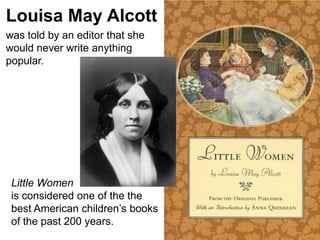
PLouisa May Alcottwas told by an editor that she would never write anything popular. Little Womenis considered one of the the best American children’s books of the past 200 years.
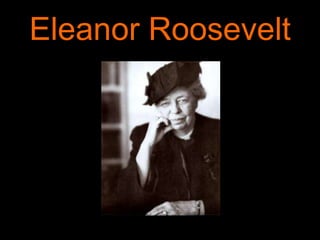
	This person had a stormy and emotionally traumatic childhood. She was considered an odd-ball by many of her playmates. Even her family provided her with very little encouragement and support. For many years she lived in fantasy as the mistress of her alcoholic father’s household.
Eleanor Roosevelt
You must do the thing you think you cannot do.-Eleanor Roosevelt
	This person was four years old before he could speak and seven before he could read: He was considered dull by both his parents and his teachers.
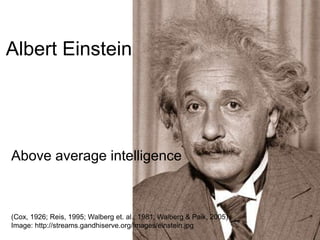
Albert EinsteinAbove average intelligence(Cox, 1926; Reis, 1995; Walberg et. al., 1981; Walberg & Paik, 2005)Image: http://streams.gandhiserve.org/images/einstein.jpg
PThis man was fired by a newspaper editor because he didn’t have enough good ideas.
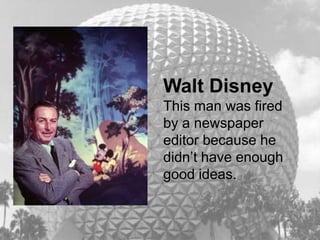
PWalt DisneyThis man was fired by a newspaper editor because he didn’t have enough good ideas.
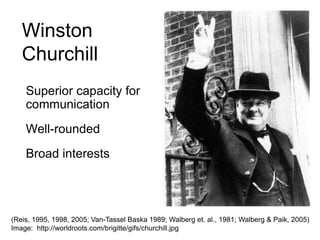
	As a child this person was hyperactive, had a speech defect, was prone to constant colds, had poor peer relationships, and frequently failed in school. It took him three years to complete the first grade. His father soon decided the boy needed more discipline and suggested military school.  Before being admitted, however, he failed the entrance examination three times. A teacher once called him the naughtiest small boy in England.
WinstonChurchill	Superior capacity for communication	Well-rounded	Broad interests(Reis, 1995, 1998, 2005; Van-Tassel Baska 1989; Walberg et. al., 1981; Walberg & Paik, 2005) Image:  http://worldroots.com/brigitte/gifs/churchill.jpg
Where would you start?
DefinitionThere is no universally accepted definition for gifted, talented, or giftedness
DefinitionThe particular definition adopted by a school district will:Guide the identification processConsequently determine who is selected for services
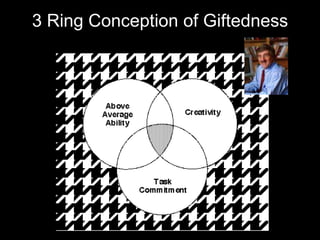
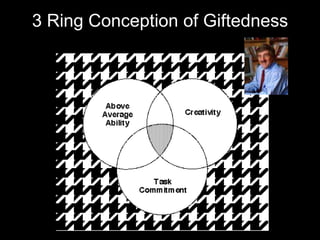
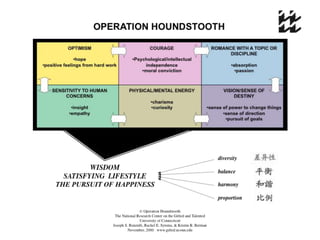
3 Ring Conception of Giftedness
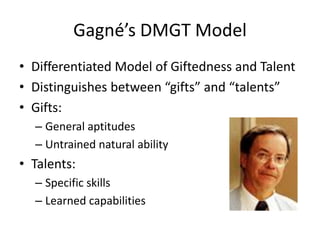
Gagné’s DMGT ModelDifferentiated Model of Giftedness and TalentDistinguishes between “gifts” and “talents”Gifts:General aptitudesUntrained natural abilityTalents:Specific skillsLearned capabilities
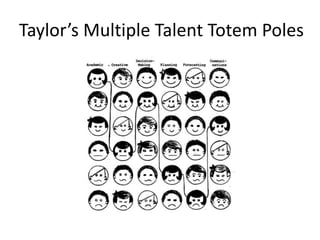
Taylor’s Multiple Talent Totem Poles
Multiple Talent Totem Poles (1984)AcademicProductive ThinkingCommunicatingForecastingDecision MakingPlanning (Designing)ImplementingHuman RelationsDiscerning Opportunities
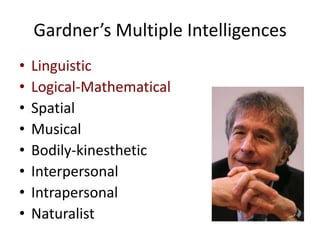
Gardner’s Multiple IntelligencesLinguisticLogical-MathematicalSpatialMusicalBodily-kinestheticInterpersonalIntrapersonalNaturalist
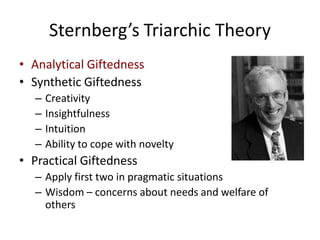
Sternberg’s Triarchic TheoryAnalytical GiftednessSynthetic GiftednessCreativityInsightfulnessIntuitionAbility to cope with noveltyPractical GiftednessApply first two in pragmatic situationsWisdom – concerns about needs and welfare of others
U.S. D.O.E Definition	Children and youth with outstanding talent perform or show the potential for performing at remarkably high levels of accomplishment when compared with others of their age, experience, or environment. These children and youth exhibit high performance capability in intellectual, creative, and/or artistic areas, possess an unusual leadership capacity, or excel in specific academic fields. They require services of activities not ordinarily provided by the schools. Outstanding talents are present in children and youth from all cultural groups, across all economic strata, and in all areas of human endeavor (Department of Education, 1993).
NAGC State of the StatesIn the U.S:  Program and Service for gifted learners made at the state and local levelsGifted By State
State DefinitionsDavidson Institute for Talent DevelopmentMissouriKansasCaliforniaConnecticutNorth Carolina
State DefinitionsWhy do you think CA provides the districts with choices for identification categories?
DefinitionDANGER!If a definition to narrow, identification methods may discriminate against low SES, minority, disabled, underachieving, and females
3 Ring Conception of Giftedness
Characteristics
CharacteristicsBehaviors
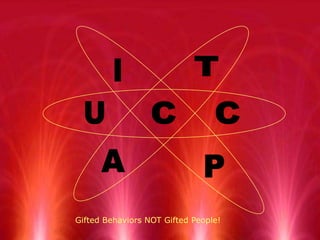
TICUCAPGifted Behaviors NOT Gifted People!
Gifted ArtistTalented MathematicianUse “defining” terms as adjectives:Talented MusicianGifted Writer
Personality FactorsInfluencing Gifted BehaviorCharm/CharismaNeed for AchievementEgo StrengthEnergySense of DestinyPerception of Self, Self-EfficacyCourageCharacterIntuitionPersonal Attractiveness
Environmental FactorsInfluencing Gifted BehaviorSESParental PersonalitiesEducation of ParentsStimulation of Childhood InterestsFamily PositionFormal EducationRole Model AvailabilityPhysical Illness and/or Well BeingChance FactorsZeitgeist
School House GiftednessCreative Giftedness
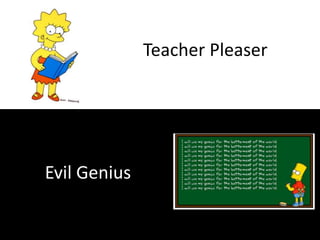
Teacher PleaserEvil Genius
Characteristics: SeeingUnusual alertnessJoy in learningKeen observationSees “Big Picture”Makes connectionsIntense focusCurious
Characteristics: SpeedEarly and rapid learningRapid language developmentMetacognitively efficient
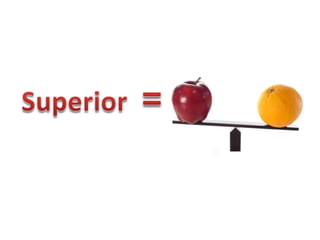
Superior  ≠
Superior  =
Characteristics: DifferencesSuperior languageVerbal fluencyLarge vocabularySuperior analytical and reasoning abilityHigh-capacity memoryGoes beyond what is soughtAbstract, complex, and insightful thinking
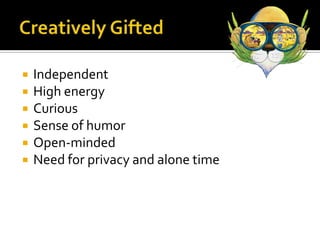
Creatively GiftedIndependentHigh energyCuriousSense of humorOpen-mindedNeed for privacy and alone time
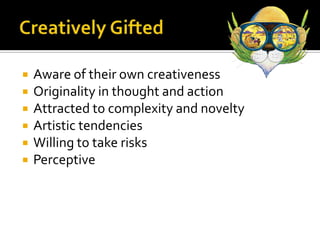
Creatively GiftedAware of their own creativenessOriginality in thought and actionAttracted to complexity and noveltyArtistic tendenciesWilling to take risksPerceptive
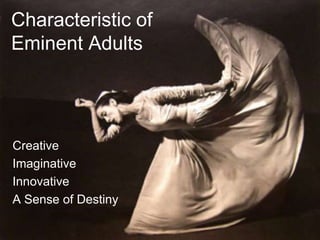
Characteristic ofEminent Adults	Creative	Imaginative	Innovative	A Sense of Destiny
And the not so good…ImpulsiveEgotisticalArgumentativeRebelliousUncooperativeStubbornChildishAbsentmindedNeuroticTemperamentalCapriciousCarelessDisorganizedDemandingIndifferent to Conventions
Characteristics: NegativeUneven mental developmentInterpersonal difficultiesUnderachievement
Asynchronous DevelopmentUneven intellectual, physical, and emotional development.
Asynchronous DevelopmentCognitively understand advanced concepts (like mortality) but lack emotional maturity to cope with knowledgePerceived as older due to cognitive ability, but lack behavioral maturity
Your Mission…
Your Mission…Does your state have a definition of gifted/talented?
Is your district required to follow the state definition?
What are the identification guidelines for your district? Are the guidelines provided by the state?Topics for the WeekTomorrow:  		   Placing Student in a Program   Testing for PlacementDay 3:  Nominations andAlternative PathwaysDay 4:  Special Placements & Closure
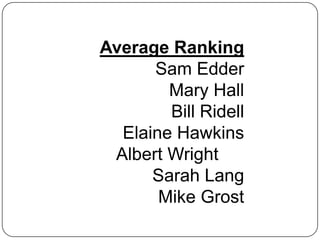
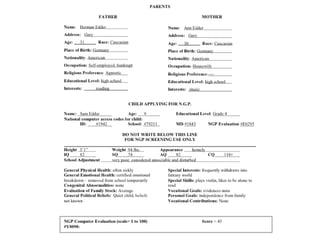
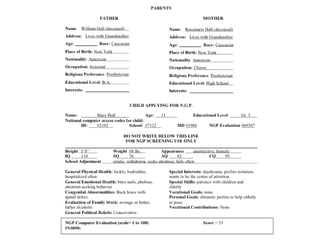
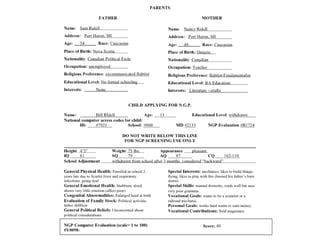
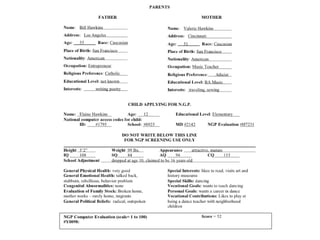
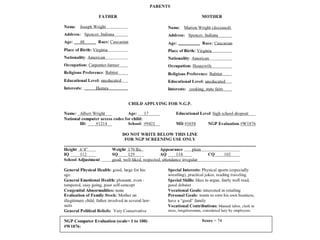
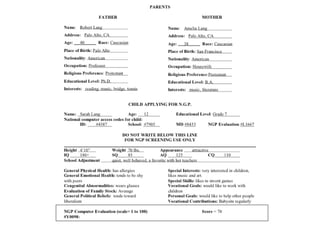
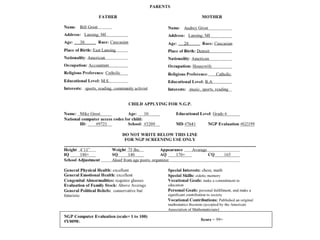
Average RankingSam EdderMary Hall   Bill RidellElaine Hawkins   Albert Wright 	 Sarah Lang   Mike Grost
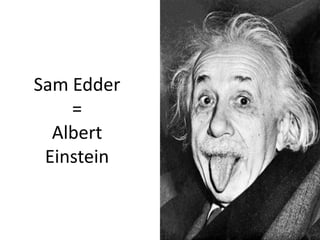
Sam Edder= Albert Einstein
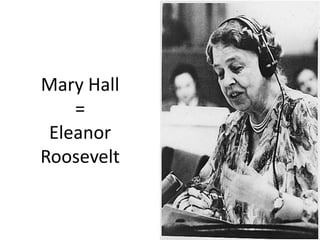
Mary Hall = Eleanor Roosevelt
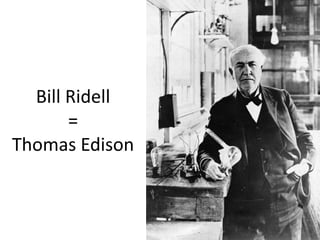
Bill Ridell= Thomas Edison
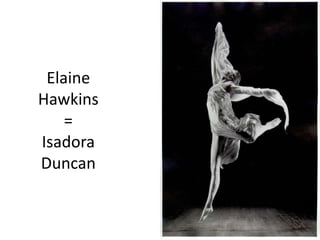
Elaine Hawkins = Isadora Duncan
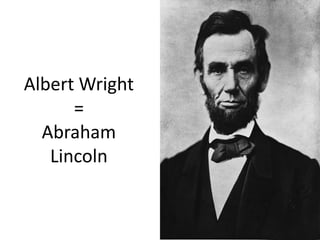
Albert Wright= Abraham Lincoln
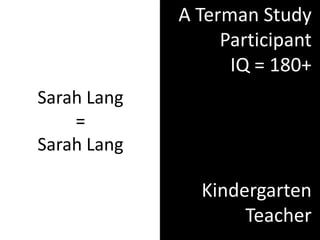
A Terman Study ParticipantIQ = 180+  Kindergarten TeacherSarah Lang = Sarah Lang
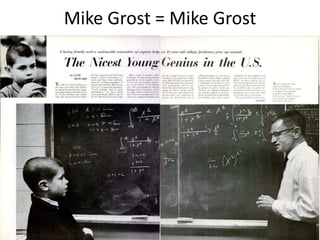
Mike Grost = Mike Grost
Identification ConsiderationsThere is no perfect identification system!Match identification procedures to the services provided
Identification ConsiderationsHigh performance vs. high potentialMay require different kinds of programming optionsEstablish localnorms using Grade levelSimilarity of learning opportunitiesBackground characteristics
Identification ConsiderationsAvoid designations or “rubber stamp”Identification procedures select students who would benefit from supplementary servicesLabel the services, not the students
Identification Procedures AnswerWho are the gifted and talented students?Why are we striving to identify them?How do we find them?
Identification Procedures AnswerWhat are the most appropriate tools for identifying students’ gifts and talents?How are data from various tools analyzed and interpreted?Who is responsible for identifying students’ gifts and talents?
Identification Procedures Should:Be provided in multiple languagesreflect the dominant student and parent populationsReflect the student population and demographics of the district
Identification Procedures Should:Reflect students’ needsBe defensible and inclusiveInclude studentswith disabilitieswho are English language learnerseconomically disadvantaged
Identification Procedures Should:Be flexibleBe communicatedteachersparentsadministratorsstudents Be updated at regular intervals to reflect changing demographics
3 Things to AvoidPitting parents of advantaged children against parents of disadvantaged childrenLeading people to believe that any one instrument is the answer to identificationProliferating the amount of paperwork
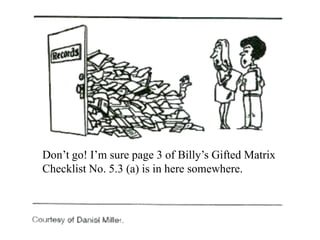
Don’t go! I’m sure page 3 of Billy’s Gifted Matrix Checklist No. 5.3 (a) is in here somewhere.
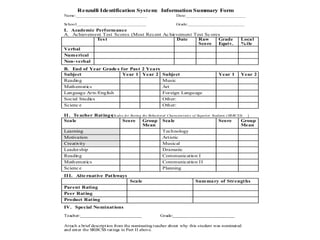
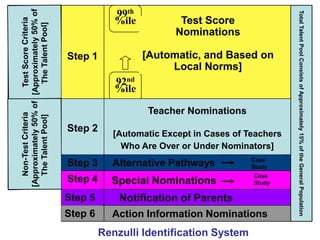
Renzulli’sIdentification SystemBased on the 3-Ring Conception of Giftedness & The Enrichment Triad ModelStrives for equity, excellence, and economyDesigned to be flexibleBased on research into the behavioral characteristics of highly creative & productive people
The 3 Goals ofRenzulli’s Identification System#1Develop creativity and/or task commitment in students who may come to an educator’s attention through alternate means of identification.
The 3 Goals ofRenzulli’s Identification System#2Provide learning experiences and support systems that promote interaction of creativity, task commitment, and above average achievement.	(Bringing the “rings together!)
The 3 Goals ofRenzulli’s Identification System#3Provide opportunities, resources, and encouragement for the development and application of gifted behaviors.
Internal ConsistencyDevelop criteria foridentificationthat matches the program!
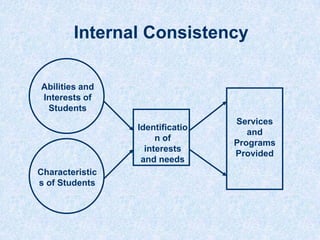
Internal ConsistencyAbilities and Interests of Students Services and Programs ProvidedIdentification of interests and needsCharacteristics of Students
Test Score Criteria [Approximately 50% of The Talent Pool] Total Talent Pool Consists of Approximately 15% of the General Population99th%ileTest ScoreNominations[Automatic, and Based on Local Norms]Step 192nd%ileNon-Test Criteria [Approximately 50% of The Talent Pool] Teacher Nominations[Automatic Except in Cases of Teachers Who Are Over or Under Nominators]Step 2Step 3Alternative PathwaysCase Study                Special NominationsStep 4Case StudyNotification of ParentsStep 5          Action Information NominationsStep 6Renzulli Identification System
Step 1: Test Score NominationAchievement TestingAndI.Q. Testing
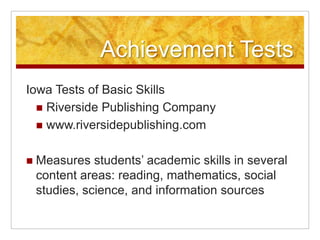
Achievement TestsIowa Tests of Basic SkillsRiverside Publishing Companywww.riversidepublishing.comMeasures students’ academic skills in several content areas: reading, mathematics, social studies, science, and information sources
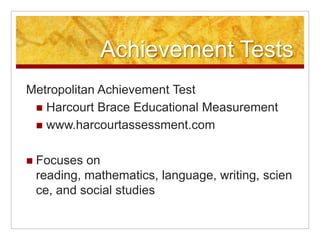
Achievement TestsMetropolitan Achievement TestHarcourt Brace Educational Measurementwww.harcourtassessment.comFocuses on reading, mathematics, language, writing, science, and social studies
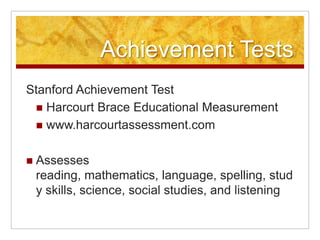
Achievement TestsStanford Achievement TestHarcourt Brace Educational Measurementwww.harcourtassessment.comAssesses reading, mathematics, language, spelling, study skills, science, social studies, and listening
AptitudeAchievement
Something accomplished…Achievement
AptitudeA readiness to learn or to perform well in a particular situation; requires a match between the situation demands and what the person brings to it.
Intelligence/Ability TestsCognitive Abilities Test Form 6 (CogAT)Riverside Publishingwww.riverpub.com/Measures both general and specific reasoning abilities in three areas: verbal, quantitative, and nonverbal
Intelligence/Ability TestsNaglieri Nonverbal Ability TestHarcourt Brace Educational Measurementwww.harcourtassessment.comMeasures nonverbal reasoning and problem-solving abilities. Reading and math skills are not required to respond to each set of patterns.
Intelligence/Ability TestsOtis-Lennon School Ability TestHarcourt Brace Educational Measurementwww.harcourtassessment.comMeasures reasoning skills, including verbal comprehension, verbal reasoning, pictorial reasoning, figural reasoning, and quantitative reasoning.
Intelligence/Ability TestsCornell Critical Thinking TestsCritical Thinking Books & Softwarewww.criticalthinking.comMeasures students’ ability to think critically when analyzing premises and conclusions, judge the reliability of information, and identify assumptions.
Intelligence/Ability TestsKuhlmann-Anderson TestsScholastic Testing Servicewww.ststesting.comAssesses verbal and nonverbal abilities. Measures academic potential or school learning ability.
Intelligence/Ability TestsUniversal Nonverbal Intelligence Test (UNIT)Riverside Publishingwww.riverpub.comAssessment of general intelligence, measured nonverbally.
Intelligence/Ability TestsStanford-Binet, Fifth EditionRiverside Publishingwww.riversidepublishing.comMeasures fluid reasoning, knowledge, quantitative reasoning, visual-spatial processing, working memory.
Intelligence/Ability TestsWechsler Nonverbal Scale of AbilityPearsonwww.pearsonassessments.comMeasure of ability; especially designed for culturally and linguistically diverse groups.
Multiple Norm GroupsPut data in spreadsheetInclude an “opportunity-to-learn” index(e.g. ELL status)Sort data by percentile rank or SASProvides Local Rank
Multiple Norm GroupsSort data again by “opportunity-to-learn” then percentile rank or SASProvides list divided into two groupsIdentifies most talented ELL students and most talented native-speaking students
Multiple Score ReviewAvoid using composite scores – look at subtests individuallyReview the appropriate informationDo not compare score with average childrenLook at the discrepancy between strengths and weaknesses
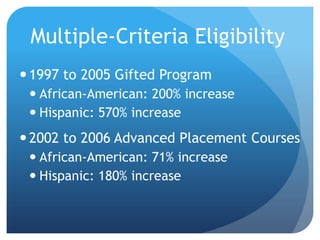
Multiple-Criteria Eligibility1997 to 2005 Gifted Program African-American: 200% increaseHispanic: 570% increase2002 to 2006 Advanced Placement CoursesAfrican-American: 71% increaseHispanic: 180% increase
Topics for the WeekTomorrow:  Nominations andAlternative PathwaysDay 4:  Special Placements & Closure
Step 2: Teacher NominationAll Teachers need to be informedProcedures for nominationStudents who have gained access through test scoresAVOID NEEDLESS PAPERWORK!
Step 2: Teacher NominationAllows identification of students who exhibit behaviors not determined by testsHigh levels of creativityTask commitmentUnusual or intense interestsUnusual talents
Step 2: Teacher NominationAcceptance equal to test scores with one exception…
Step 2: Teacher NominationAcceptance equal to test scores with one exception…	Teachers who over-identify
Teacher Rating ScalesGATESGifted and Talented Evaluation ScalesPro-edwww.proedinc.comTeachers rate intellectual ability academic skills, creativity, leadership, and artistic talentTeacher Rating ScalesGRSGifted Rating ScalesPearsonwww.pearsonassessments.comTeachers rate intellectual ability academic skills, motivation, creativity, leadership, and artistic talentTeacher Rating ScalesTracking TalentsPrufrock Presswww.prufrock.comUsed to screen and identify multiple talents: cognitive abilities, academic talents, social & physical abilities, and technological & artistic talents through peer, teacher, and self-nomination.Teacher Rating ScalesCABClinical Assessment of BehaviorPARwww4.parinc.comAssesses teachers’ and parents’ perceptions of students’ behavioral functioning including important behaviors associated with giftedness.Teacher Rating ScalesSRBCSSScales for Rating the Behavioral Characteristics of Superior StudentsCreative Learning Presswww.creativelearningpress.comTeachers assess students on 10 dimensions: learning, motivation, creativity, leadership, art, music, dramatics, planning, communication (precision), and communication (expressiveness)Step 3: Alternate PathwaysDefined locallyAllows program to reflectNeeds of student populationDemographics of district populationAllows for non-traditional students to receive services
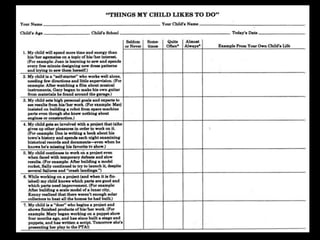
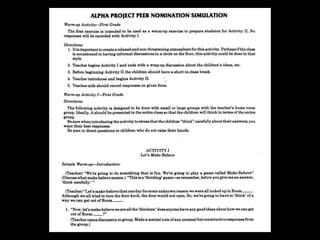
Step 3: Alternate PathwaysExamplesSelf-nominationParent nominationPeer nominationTests of CreativityProduct evaluation
Step 3: Alternate PathwaysLeads to initial consideration by a screening committeeNOT AUTOMATIC!
Step 3: Alternate PathwaysScreening evaluation based on:Previous school recordsInterviews with students, teachers, & parentsAdministered individual assessments recommended by committeePlaced in program on trial basis.
Creative Thinking SkillsTorrance Tests of Creative ThinkingScholastic Testingwww.ststesting.comFigural and Verbal tests assess fluency, flexibility, and originality. The figural test also assesses elaboration.
Creative Thinking SkillsGroup Inventory for Finding Creative TalentEducational Assessment Servicewww.sylviarimm.comFocuses on creativity via imagination, independence, and multiple interests.
Why Creative Thinking Skills Assessments?Intelligence measures are predictive of academic or school success.Creativity measures are predictive of creative activities and accomplishments later in life.Better predictor of future success.
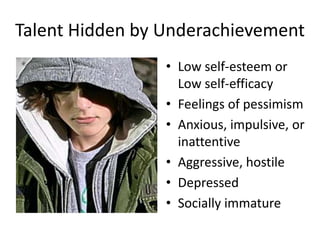
Talent Hidden by UnderachievementLow self-esteem or Low self-efficacyFeelings of pessimismAnxious, impulsive, or inattentiveAggressive, hostileDepressedSocially immature
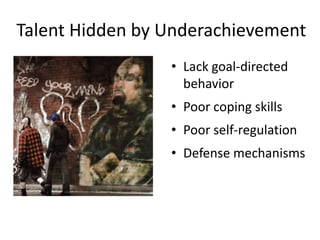
Talent Hidden by UnderachievementLack goal-directed behaviorPoor coping skillsPoor self-regulationDefense mechanisms
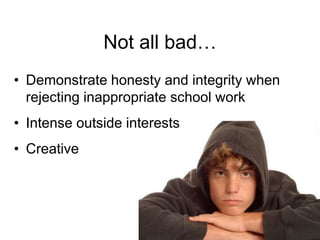
Not all bad…Demonstrate honesty and integrity when rejecting inappropriate school work
Intense outside interests
CreativeWhat about these characteristics?Inability to master certain academic skillsLack of motivationDisruptive classroom behaviorFailure to complete assignmentsLack of organizational skillsPoor listening and concentration skillsUnrealistic self-expectations
Twice-ExceptionalGifted with Learning DisabilityMay also demonstrateLearned helplessnessPerfectionismSupersensitivityLow self-esteem
Look For:Advanced vocabulary useExceptional analytic abilitiesDivergent thinkingHigh levels of creativitySpatial abilitiesAdvanced problem-solving skillsSpecific aptitudeGood                  memory
Cultural InfluenceSpiritualityHarmonyMovement & VerveAffectCommunalismExpressive IndividualismOral TraditionSocial Time Perspective
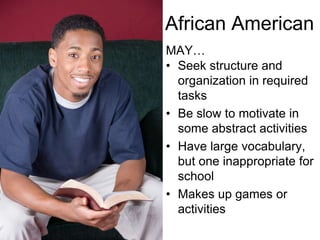
African AmericanMAY…Seek structure and organization in required tasksBe slow to motivate in some abstract activitiesHave large vocabulary, but one inappropriate for schoolMakes up games or activities
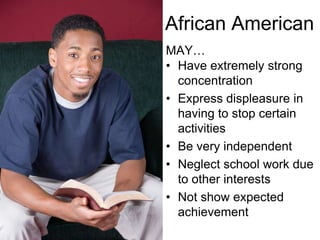
African AmericanMAY…Have extremely strong concentrationExpress displeasure in having to stop certain activitiesBe very independentNeglect school work due to other interestsNot show expected achievement
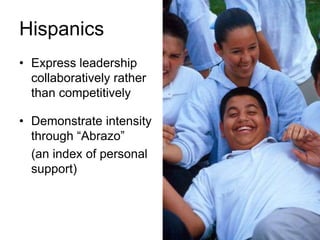
HispanicsExpress leadership collaboratively rather than competitivelyDemonstrate intensity through “Abrazo”	(an index of personal support)
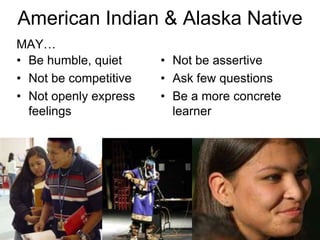
American Indian & Alaska NativeMAY…Not be assertive
Ask few questions
Be a more concrete learner
Be humble, quiet
Not be competitive
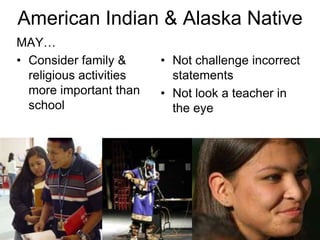
Not openly express feelingsAmerican Indian & Alaska NativeMAY…Not challenge incorrect statements
Not look a teacher in the eye
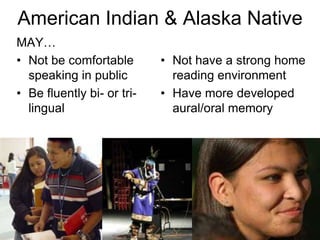
Consider family & religious activities more important than schoolAmerican Indian & Alaska NativeMAY…Not have a strong home reading environment
Have more developed aural/oral memory
Not be comfortable speaking in public
Be fluently bi- or tri-lingualStep 4: Special		  NominationsSafety Valve No.1
Step 4:Special NominationsCirculate a list to ALL past and present teachersAllows resource teachers to nominateAllows override of current teacher if necessary
Step 5:Notification & Orientation of ParentsLetter of NotificationComprehensive description of ProgramFocuses on child placement in program or Talent PoolNot certification of giftedness
Step 5:Notification & Orientation of ParentsMeeting to explain ALL program policies, procedures, & activitiesHow admission to program was determinedAdditions may be made during yearInvite further interactions
Step 5:Notification & Orientation of ParentsSimilar orientation for students!Not told they are giftedFocus on the opportunities available to develop gifted behaviors
Step 6: Action		  Information		  NominationsSafety Valve No.2
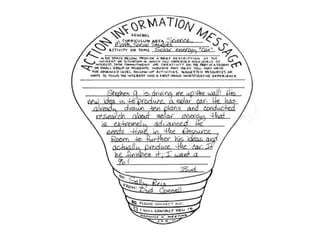
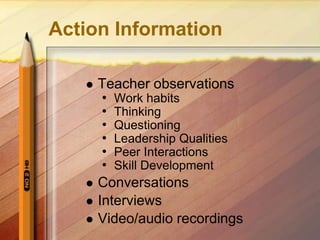
Step 6:Action Information NominationsThe dynamic interactions that occur when a student becomes extremely interested in or excited about a particular topic, area of study, issue, idea, or event.
Step 6:Action Information NominationsAny enrichment opportunity (whether school or non-school) that might turn a student onto learning or causes them to express gifted behaviors.
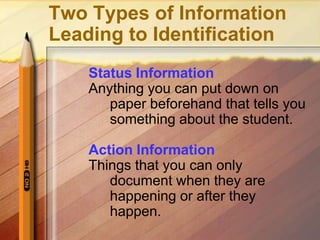
Two Types of Information Leading to IdentificationStatus InformationAnything you can put down on paper beforehand that tells you something about the student.Action InformationThings that you can only document when they are happening or after they happen.
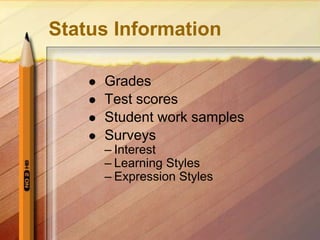
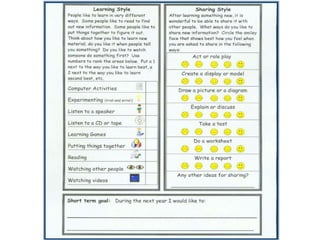
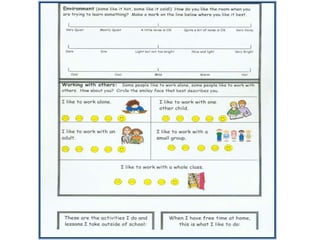
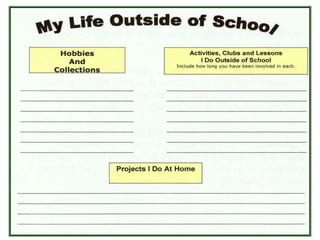
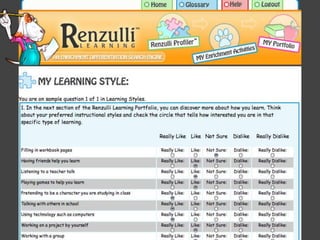
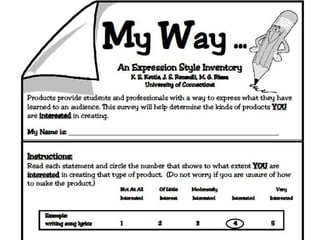
Status InformationGradesTest scoresStudent work samplesSurveysInterestLearning StylesExpression Styles
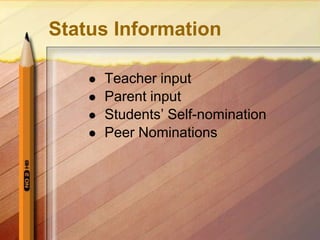
Status InformationTeacher input Parent inputStudents’ Self-nominationPeer Nominations
Action InformationTeacher observationsWork habits
Thinking
Questioning
Leadership Qualities
Peer Interactions
Skill DevelopmentConversationsInterviewsVideo/audio recordings
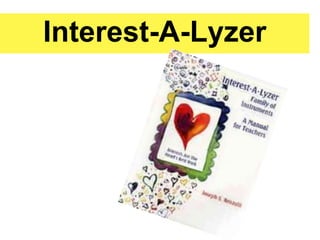
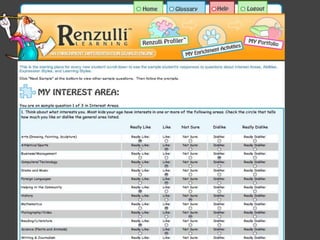
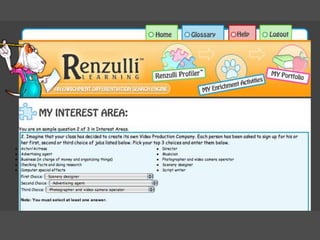
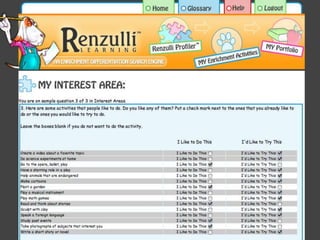
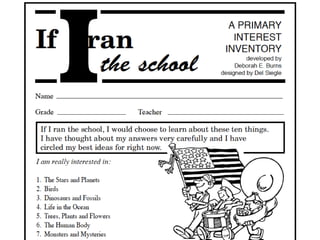
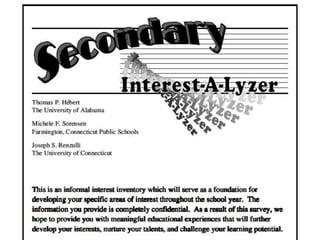
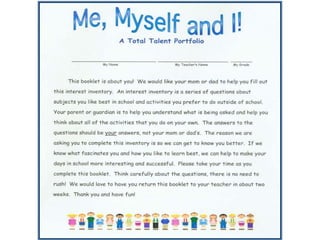
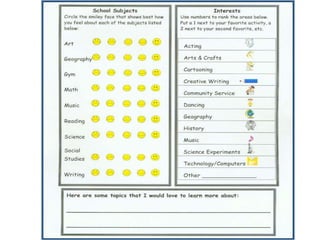
Interest-A-Lyzer
Sample Items…Imagine that you can spend a week job shadowing any person in your community to investigate a career you might like to have in the future.  List the occupations of the persons you would select.1st choice ______________________2nd choice______________________3rd choice ______________________
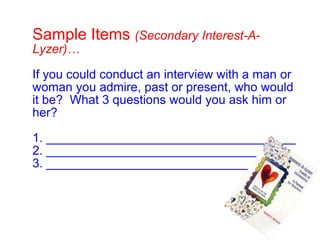
Sample Items (Secondary Interest-A-Lyzer)…If you could conduct an interview with a man or woman you admire, past or present, who would it be?  What 3 questions would you ask him or her?1. ____________________________________2. ____________________________________3. ____________________________________
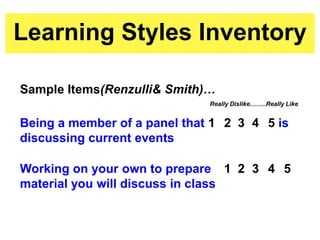
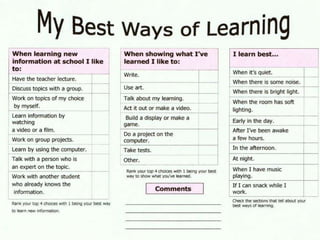
Learning Styles InventorySample Items(Renzulli & Smith)…Really Dislike……..Really Like               Being a member of a panel that 1	2	3	4	5 is discussing current eventsWorking on your own to prepare 	1	2	3	4	5material you will discuss in class
What differentiates gifted learners from high achievers?
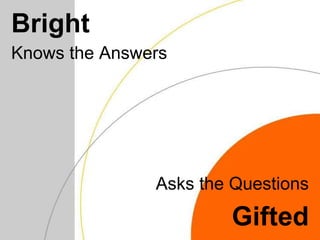
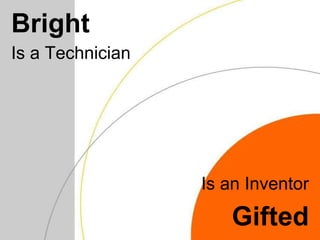
BrightKnows the Answers 	Asks the QuestionsGifted
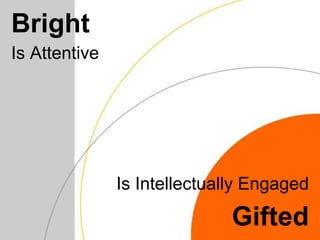
BrightIs Attentive	Is Intellectually EngagedGifted

Identifying Gifted and Talented Students

  • 1.
    IdentifyingGifted and TalentedStudentsAngela M. HousandUniversity of North Carolina, WilmingtonConfratute – University of Connecticut
  • 2.
  • 3.
    Understand the uniquebehaviors that characterize giftednessSpecific resources and examples for your use and adaptationAn easy to follow 6-step strategy for identifying students for talent developmentWhy This Strand?
  • 4.
    Topics for theWeekDay 1: Definitions of GiftednessGifted BehaviorsDay 2: Placing Student in a Program Testing for PlacementDay 3: Nominations andAlternative PathwaysDay 4: Special Placements & Closure
  • 5.
    PLouisa May Alcottwastold by an editor that she would never write anything popular. Little Womenis considered one of the the best American children’s books of the past 200 years.
  • 6.
    This person hada stormy and emotionally traumatic childhood. She was considered an odd-ball by many of her playmates. Even her family provided her with very little encouragement and support. For many years she lived in fantasy as the mistress of her alcoholic father’s household.
  • 7.
  • 8.
    You must dothe thing you think you cannot do.-Eleanor Roosevelt
  • 9.
    This person wasfour years old before he could speak and seven before he could read: He was considered dull by both his parents and his teachers.
  • 10.
    Albert EinsteinAbove averageintelligence(Cox, 1926; Reis, 1995; Walberg et. al., 1981; Walberg & Paik, 2005)Image: http://streams.gandhiserve.org/images/einstein.jpg
  • 11.
    PThis man wasfired by a newspaper editor because he didn’t have enough good ideas.
  • 12.
    PWalt DisneyThis manwas fired by a newspaper editor because he didn’t have enough good ideas.
  • 13.
    As a childthis person was hyperactive, had a speech defect, was prone to constant colds, had poor peer relationships, and frequently failed in school. It took him three years to complete the first grade. His father soon decided the boy needed more discipline and suggested military school. Before being admitted, however, he failed the entrance examination three times. A teacher once called him the naughtiest small boy in England.
  • 14.
    WinstonChurchill Superior capacity forcommunication Well-rounded Broad interests(Reis, 1995, 1998, 2005; Van-Tassel Baska 1989; Walberg et. al., 1981; Walberg & Paik, 2005) Image: http://worldroots.com/brigitte/gifs/churchill.jpg
  • 15.
  • 16.
    DefinitionThere is nouniversally accepted definition for gifted, talented, or giftedness
  • 17.
    DefinitionThe particular definitionadopted by a school district will:Guide the identification processConsequently determine who is selected for services
  • 18.
    3 Ring Conceptionof Giftedness
  • 19.
    Gagné’s DMGT ModelDifferentiatedModel of Giftedness and TalentDistinguishes between “gifts” and “talents”Gifts:General aptitudesUntrained natural abilityTalents:Specific skillsLearned capabilities
  • 20.
  • 21.
    Multiple Talent TotemPoles (1984)AcademicProductive ThinkingCommunicatingForecastingDecision MakingPlanning (Designing)ImplementingHuman RelationsDiscerning Opportunities
  • 22.
  • 23.
    Sternberg’s Triarchic TheoryAnalyticalGiftednessSynthetic GiftednessCreativityInsightfulnessIntuitionAbility to cope with noveltyPractical GiftednessApply first two in pragmatic situationsWisdom – concerns about needs and welfare of others
  • 24.
    U.S. D.O.E Definition Childrenand youth with outstanding talent perform or show the potential for performing at remarkably high levels of accomplishment when compared with others of their age, experience, or environment. These children and youth exhibit high performance capability in intellectual, creative, and/or artistic areas, possess an unusual leadership capacity, or excel in specific academic fields. They require services of activities not ordinarily provided by the schools. Outstanding talents are present in children and youth from all cultural groups, across all economic strata, and in all areas of human endeavor (Department of Education, 1993).
  • 25.
    NAGC State ofthe StatesIn the U.S: Program and Service for gifted learners made at the state and local levelsGifted By State
  • 26.
    State DefinitionsDavidson Institutefor Talent DevelopmentMissouriKansasCaliforniaConnecticutNorth Carolina
  • 27.
    State DefinitionsWhy doyou think CA provides the districts with choices for identification categories?
  • 28.
    DefinitionDANGER!If a definitionto narrow, identification methods may discriminate against low SES, minority, disabled, underachieving, and females
  • 29.
    3 Ring Conceptionof Giftedness
  • 31.
  • 32.
  • 33.
  • 34.
    Gifted ArtistTalented MathematicianUse“defining” terms as adjectives:Talented MusicianGifted Writer
  • 35.
    Personality FactorsInfluencing GiftedBehaviorCharm/CharismaNeed for AchievementEgo StrengthEnergySense of DestinyPerception of Self, Self-EfficacyCourageCharacterIntuitionPersonal Attractiveness
  • 36.
    Environmental FactorsInfluencing GiftedBehaviorSESParental PersonalitiesEducation of ParentsStimulation of Childhood InterestsFamily PositionFormal EducationRole Model AvailabilityPhysical Illness and/or Well BeingChance FactorsZeitgeist
  • 37.
  • 38.
  • 39.
    Characteristics: SeeingUnusual alertnessJoyin learningKeen observationSees “Big Picture”Makes connectionsIntense focusCurious
  • 40.
    Characteristics: SpeedEarly andrapid learningRapid language developmentMetacognitively efficient
  • 41.
  • 42.
  • 43.
    Characteristics: DifferencesSuperior languageVerbalfluencyLarge vocabularySuperior analytical and reasoning abilityHigh-capacity memoryGoes beyond what is soughtAbstract, complex, and insightful thinking
  • 44.
    Creatively GiftedIndependentHigh energyCuriousSenseof humorOpen-mindedNeed for privacy and alone time
  • 45.
    Creatively GiftedAware oftheir own creativenessOriginality in thought and actionAttracted to complexity and noveltyArtistic tendenciesWilling to take risksPerceptive
  • 46.
  • 47.
    And the notso good…ImpulsiveEgotisticalArgumentativeRebelliousUncooperativeStubbornChildishAbsentmindedNeuroticTemperamentalCapriciousCarelessDisorganizedDemandingIndifferent to Conventions
  • 48.
    Characteristics: NegativeUneven mentaldevelopmentInterpersonal difficultiesUnderachievement
  • 49.
    Asynchronous DevelopmentUneven intellectual,physical, and emotional development.
  • 50.
    Asynchronous DevelopmentCognitively understandadvanced concepts (like mortality) but lack emotional maturity to cope with knowledgePerceived as older due to cognitive ability, but lack behavioral maturity
  • 51.
  • 52.
    Your Mission…Does yourstate have a definition of gifted/talented?
  • 53.
    Is your districtrequired to follow the state definition?
  • 54.
    What are theidentification guidelines for your district? Are the guidelines provided by the state?Topics for the WeekTomorrow: Placing Student in a Program Testing for PlacementDay 3: Nominations andAlternative PathwaysDay 4: Special Placements & Closure
  • 56.
    Average RankingSam EdderMaryHall Bill RidellElaine Hawkins Albert Wright Sarah Lang Mike Grost
  • 58.
  • 60.
    Mary Hall =Eleanor Roosevelt
  • 62.
  • 64.
    Elaine Hawkins =Isadora Duncan
  • 66.
  • 68.
    A Terman StudyParticipantIQ = 180+ Kindergarten TeacherSarah Lang = Sarah Lang
  • 70.
    Mike Grost =Mike Grost
  • 71.
    Identification ConsiderationsThere isno perfect identification system!Match identification procedures to the services provided
  • 72.
    Identification ConsiderationsHigh performancevs. high potentialMay require different kinds of programming optionsEstablish localnorms using Grade levelSimilarity of learning opportunitiesBackground characteristics
  • 73.
    Identification ConsiderationsAvoid designationsor “rubber stamp”Identification procedures select students who would benefit from supplementary servicesLabel the services, not the students
  • 74.
    Identification Procedures AnswerWhoare the gifted and talented students?Why are we striving to identify them?How do we find them?
  • 75.
    Identification Procedures AnswerWhatare the most appropriate tools for identifying students’ gifts and talents?How are data from various tools analyzed and interpreted?Who is responsible for identifying students’ gifts and talents?
  • 76.
    Identification Procedures Should:Beprovided in multiple languagesreflect the dominant student and parent populationsReflect the student population and demographics of the district
  • 77.
    Identification Procedures Should:Reflectstudents’ needsBe defensible and inclusiveInclude studentswith disabilitieswho are English language learnerseconomically disadvantaged
  • 78.
    Identification Procedures Should:BeflexibleBe communicatedteachersparentsadministratorsstudents Be updated at regular intervals to reflect changing demographics
  • 79.
    3 Things toAvoidPitting parents of advantaged children against parents of disadvantaged childrenLeading people to believe that any one instrument is the answer to identificationProliferating the amount of paperwork
  • 80.
    Don’t go! I’msure page 3 of Billy’s Gifted Matrix Checklist No. 5.3 (a) is in here somewhere.
  • 81.
    Renzulli’sIdentification SystemBased onthe 3-Ring Conception of Giftedness & The Enrichment Triad ModelStrives for equity, excellence, and economyDesigned to be flexibleBased on research into the behavioral characteristics of highly creative & productive people
  • 82.
    The 3 GoalsofRenzulli’s Identification System#1Develop creativity and/or task commitment in students who may come to an educator’s attention through alternate means of identification.
  • 83.
    The 3 GoalsofRenzulli’s Identification System#2Provide learning experiences and support systems that promote interaction of creativity, task commitment, and above average achievement. (Bringing the “rings together!)
  • 84.
    The 3 GoalsofRenzulli’s Identification System#3Provide opportunities, resources, and encouragement for the development and application of gifted behaviors.
  • 85.
    Internal ConsistencyDevelop criteriaforidentificationthat matches the program!
  • 86.
    Internal ConsistencyAbilities andInterests of Students Services and Programs ProvidedIdentification of interests and needsCharacteristics of Students
  • 87.
    Test Score Criteria[Approximately 50% of The Talent Pool] Total Talent Pool Consists of Approximately 15% of the General Population99th%ileTest ScoreNominations[Automatic, and Based on Local Norms]Step 192nd%ileNon-Test Criteria [Approximately 50% of The Talent Pool] Teacher Nominations[Automatic Except in Cases of Teachers Who Are Over or Under Nominators]Step 2Step 3Alternative PathwaysCase Study Special NominationsStep 4Case StudyNotification of ParentsStep 5 Action Information NominationsStep 6Renzulli Identification System
  • 88.
    Step 1: TestScore NominationAchievement TestingAndI.Q. Testing
  • 89.
    Achievement TestsIowa Testsof Basic SkillsRiverside Publishing Companywww.riversidepublishing.comMeasures students’ academic skills in several content areas: reading, mathematics, social studies, science, and information sources
  • 90.
    Achievement TestsMetropolitan AchievementTestHarcourt Brace Educational Measurementwww.harcourtassessment.comFocuses on reading, mathematics, language, writing, science, and social studies
  • 91.
    Achievement TestsStanford AchievementTestHarcourt Brace Educational Measurementwww.harcourtassessment.comAssesses reading, mathematics, language, spelling, study skills, science, social studies, and listening
  • 92.
  • 93.
  • 94.
    AptitudeA readiness tolearn or to perform well in a particular situation; requires a match between the situation demands and what the person brings to it.
  • 95.
    Intelligence/Ability TestsCognitive AbilitiesTest Form 6 (CogAT)Riverside Publishingwww.riverpub.com/Measures both general and specific reasoning abilities in three areas: verbal, quantitative, and nonverbal
  • 96.
    Intelligence/Ability TestsNaglieri NonverbalAbility TestHarcourt Brace Educational Measurementwww.harcourtassessment.comMeasures nonverbal reasoning and problem-solving abilities. Reading and math skills are not required to respond to each set of patterns.
  • 97.
    Intelligence/Ability TestsOtis-Lennon SchoolAbility TestHarcourt Brace Educational Measurementwww.harcourtassessment.comMeasures reasoning skills, including verbal comprehension, verbal reasoning, pictorial reasoning, figural reasoning, and quantitative reasoning.
  • 98.
    Intelligence/Ability TestsCornell CriticalThinking TestsCritical Thinking Books & Softwarewww.criticalthinking.comMeasures students’ ability to think critically when analyzing premises and conclusions, judge the reliability of information, and identify assumptions.
  • 99.
    Intelligence/Ability TestsKuhlmann-Anderson TestsScholasticTesting Servicewww.ststesting.comAssesses verbal and nonverbal abilities. Measures academic potential or school learning ability.
  • 100.
    Intelligence/Ability TestsUniversal NonverbalIntelligence Test (UNIT)Riverside Publishingwww.riverpub.comAssessment of general intelligence, measured nonverbally.
  • 101.
    Intelligence/Ability TestsStanford-Binet, FifthEditionRiverside Publishingwww.riversidepublishing.comMeasures fluid reasoning, knowledge, quantitative reasoning, visual-spatial processing, working memory.
  • 102.
    Intelligence/Ability TestsWechsler NonverbalScale of AbilityPearsonwww.pearsonassessments.comMeasure of ability; especially designed for culturally and linguistically diverse groups.
  • 104.
    Multiple Norm GroupsPutdata in spreadsheetInclude an “opportunity-to-learn” index(e.g. ELL status)Sort data by percentile rank or SASProvides Local Rank
  • 105.
    Multiple Norm GroupsSortdata again by “opportunity-to-learn” then percentile rank or SASProvides list divided into two groupsIdentifies most talented ELL students and most talented native-speaking students
  • 106.
    Multiple Score ReviewAvoidusing composite scores – look at subtests individuallyReview the appropriate informationDo not compare score with average childrenLook at the discrepancy between strengths and weaknesses
  • 108.
    Multiple-Criteria Eligibility1997 to2005 Gifted Program African-American: 200% increaseHispanic: 570% increase2002 to 2006 Advanced Placement CoursesAfrican-American: 71% increaseHispanic: 180% increase
  • 109.
    Topics for theWeekTomorrow: Nominations andAlternative PathwaysDay 4: Special Placements & Closure
  • 111.
    Step 2: TeacherNominationAll Teachers need to be informedProcedures for nominationStudents who have gained access through test scoresAVOID NEEDLESS PAPERWORK!
  • 112.
    Step 2: TeacherNominationAllows identification of students who exhibit behaviors not determined by testsHigh levels of creativityTask commitmentUnusual or intense interestsUnusual talents
  • 113.
    Step 2: TeacherNominationAcceptance equal to test scores with one exception…
  • 114.
    Step 2: TeacherNominationAcceptance equal to test scores with one exception… Teachers who over-identify
  • 115.
    Teacher Rating ScalesGATESGiftedand Talented Evaluation ScalesPro-edwww.proedinc.comTeachers rate intellectual ability academic skills, creativity, leadership, and artistic talentTeacher Rating ScalesGRSGifted Rating ScalesPearsonwww.pearsonassessments.comTeachers rate intellectual ability academic skills, motivation, creativity, leadership, and artistic talentTeacher Rating ScalesTracking TalentsPrufrock Presswww.prufrock.comUsed to screen and identify multiple talents: cognitive abilities, academic talents, social & physical abilities, and technological & artistic talents through peer, teacher, and self-nomination.Teacher Rating ScalesCABClinical Assessment of BehaviorPARwww4.parinc.comAssesses teachers’ and parents’ perceptions of students’ behavioral functioning including important behaviors associated with giftedness.Teacher Rating ScalesSRBCSSScales for Rating the Behavioral Characteristics of Superior StudentsCreative Learning Presswww.creativelearningpress.comTeachers assess students on 10 dimensions: learning, motivation, creativity, leadership, art, music, dramatics, planning, communication (precision), and communication (expressiveness)Step 3: Alternate PathwaysDefined locallyAllows program to reflectNeeds of student populationDemographics of district populationAllows for non-traditional students to receive services
  • 116.
    Step 3: AlternatePathwaysExamplesSelf-nominationParent nominationPeer nominationTests of CreativityProduct evaluation
  • 117.
    Step 3: AlternatePathwaysLeads to initial consideration by a screening committeeNOT AUTOMATIC!
  • 118.
    Step 3: AlternatePathwaysScreening evaluation based on:Previous school recordsInterviews with students, teachers, & parentsAdministered individual assessments recommended by committeePlaced in program on trial basis.
  • 121.
    Creative Thinking SkillsTorranceTests of Creative ThinkingScholastic Testingwww.ststesting.comFigural and Verbal tests assess fluency, flexibility, and originality. The figural test also assesses elaboration.
  • 122.
    Creative Thinking SkillsGroupInventory for Finding Creative TalentEducational Assessment Servicewww.sylviarimm.comFocuses on creativity via imagination, independence, and multiple interests.
  • 123.
    Why Creative ThinkingSkills Assessments?Intelligence measures are predictive of academic or school success.Creativity measures are predictive of creative activities and accomplishments later in life.Better predictor of future success.
  • 124.
    Talent Hidden byUnderachievementLow self-esteem or Low self-efficacyFeelings of pessimismAnxious, impulsive, or inattentiveAggressive, hostileDepressedSocially immature
  • 125.
    Talent Hidden byUnderachievementLack goal-directed behaviorPoor coping skillsPoor self-regulationDefense mechanisms
  • 126.
    Not all bad…Demonstratehonesty and integrity when rejecting inappropriate school work
  • 127.
  • 128.
    CreativeWhat about thesecharacteristics?Inability to master certain academic skillsLack of motivationDisruptive classroom behaviorFailure to complete assignmentsLack of organizational skillsPoor listening and concentration skillsUnrealistic self-expectations
  • 129.
    Twice-ExceptionalGifted with LearningDisabilityMay also demonstrateLearned helplessnessPerfectionismSupersensitivityLow self-esteem
  • 130.
    Look For:Advanced vocabularyuseExceptional analytic abilitiesDivergent thinkingHigh levels of creativitySpatial abilitiesAdvanced problem-solving skillsSpecific aptitudeGood memory
  • 131.
    Cultural InfluenceSpiritualityHarmonyMovement &VerveAffectCommunalismExpressive IndividualismOral TraditionSocial Time Perspective
  • 132.
    African AmericanMAY…Seek structureand organization in required tasksBe slow to motivate in some abstract activitiesHave large vocabulary, but one inappropriate for schoolMakes up games or activities
  • 133.
    African AmericanMAY…Have extremelystrong concentrationExpress displeasure in having to stop certain activitiesBe very independentNeglect school work due to other interestsNot show expected achievement
  • 134.
    HispanicsExpress leadership collaborativelyrather than competitivelyDemonstrate intensity through “Abrazo” (an index of personal support)
  • 136.
    American Indian &Alaska NativeMAY…Not be assertive
  • 137.
  • 138.
    Be a moreconcrete learner
  • 139.
  • 140.
  • 141.
    Not openly expressfeelingsAmerican Indian & Alaska NativeMAY…Not challenge incorrect statements
  • 142.
    Not look ateacher in the eye
  • 143.
    Consider family &religious activities more important than schoolAmerican Indian & Alaska NativeMAY…Not have a strong home reading environment
  • 144.
    Have more developedaural/oral memory
  • 145.
    Not be comfortablespeaking in public
  • 146.
    Be fluently bi-or tri-lingualStep 4: Special NominationsSafety Valve No.1
  • 147.
    Step 4:Special NominationsCirculatea list to ALL past and present teachersAllows resource teachers to nominateAllows override of current teacher if necessary
  • 148.
    Step 5:Notification &Orientation of ParentsLetter of NotificationComprehensive description of ProgramFocuses on child placement in program or Talent PoolNot certification of giftedness
  • 149.
    Step 5:Notification &Orientation of ParentsMeeting to explain ALL program policies, procedures, & activitiesHow admission to program was determinedAdditions may be made during yearInvite further interactions
  • 150.
    Step 5:Notification &Orientation of ParentsSimilar orientation for students!Not told they are giftedFocus on the opportunities available to develop gifted behaviors
  • 151.
    Step 6: Action Information NominationsSafety Valve No.2
  • 152.
    Step 6:Action InformationNominationsThe dynamic interactions that occur when a student becomes extremely interested in or excited about a particular topic, area of study, issue, idea, or event.
  • 153.
    Step 6:Action InformationNominationsAny enrichment opportunity (whether school or non-school) that might turn a student onto learning or causes them to express gifted behaviors.
  • 155.
    Two Types ofInformation Leading to IdentificationStatus InformationAnything you can put down on paper beforehand that tells you something about the student.Action InformationThings that you can only document when they are happening or after they happen.
  • 156.
    Status InformationGradesTest scoresStudentwork samplesSurveysInterestLearning StylesExpression Styles
  • 157.
    Status InformationTeacher inputParent inputStudents’ Self-nominationPeer Nominations
  • 159.
  • 160.
  • 161.
  • 162.
  • 163.
  • 164.
  • 166.
  • 167.
    Sample Items…Imagine thatyou can spend a week job shadowing any person in your community to investigate a career you might like to have in the future. List the occupations of the persons you would select.1st choice ______________________2nd choice______________________3rd choice ______________________
  • 168.
    Sample Items (SecondaryInterest-A-Lyzer)…If you could conduct an interview with a man or woman you admire, past or present, who would it be? What 3 questions would you ask him or her?1. ____________________________________2. ____________________________________3. ____________________________________
  • 182.
    Learning Styles InventorySampleItems(Renzulli & Smith)…Really Dislike……..Really Like Being a member of a panel that 1 2 3 4 5 is discussing current eventsWorking on your own to prepare 1 2 3 4 5material you will discuss in class
  • 186.
    What differentiates giftedlearners from high achievers?
  • 187.
    BrightKnows the Answers Asks the QuestionsGifted
  • 188.
  • 189.
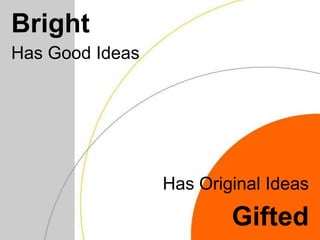
    BrightHas Good Ideas HasOriginal IdeasGifted
  • 190.
  • 191.
  • 192.
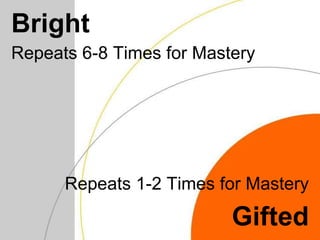
    BrightRepeats 6-8 Timesfor Mastery Repeats 1-2 Times for MasteryGifted
  • 193.
  • 194.
  • 195.
    BrightIs a Technician Isan InventorGifted
  • 196.
  • 197.

Editor's Notes

  • #7 Eleanor Roosevelt
  • #10 Albert Einstein
  • #14 Winston Churchill
  • #21 1973 Version1984 Version includes
  • #22 1973 Version1984Version includes
  • #43 It is distinguishably different, and on measures of performance, it is higher or superior
  • #57 4th – 45th – 106th – 147th – 17
  • #58 Albert Einstein (14 March 1879 – 18 April 1955) was a theoretical physicist, philosopher and author who is widely regarded as one of the most influential and best known scientists and intellectuals of all time. He is often regarded as the father of modern physics.[3] He received the 1921 Nobel Prize in Physics "for his services to Theoretical Physics, and especially for his discovery of the law of the photoelectric effect."[4]His many contributions to physics include the special and general theories of relativity, the founding of relativistic cosmology, the first post-Newtonian expansion, the explanation the perihelion precession of Mercury, the prediction of the deflection of light by gravity (gravitational lensing), the first fluctuation dissipation theorem which explained the Brownian motion of molecules, the photon theory and the wave-particle duality, the quantum theory of atomic motion in solids, the zero-point energy concept, the semiclassical version of the Schrödinger equation, and the quantum theory of a monatomic gas which predicted Bose–Einstein condensation. Einstein published more than 300 scientific and over 150 non-scientific works; he additionally wrote and commentated prolifically on various philosophical and political subjects.[5] His great intelligence and originality has made the word "Einstein" synonymous with genius.[6]
  • #59 2nd – 13rd – 04th – 35th – 15 6th – 9 7th – 16
  • #60 the First Lady of the United States from 1933 to 1945. She supported the New Deal policies of her husband, Franklin Delano Roosevelt, and became an advocate for civil rights. After her husband's death in 1945, Roosevelt continued to be an internationally prominent author, speaker, politician, and activist for the New Deal coalition. She worked to enhance the status of working women, although she opposed the Equal Rights Amendment because she believed it would adversely affect women.In the 1940s, Roosevelt was one of the co-founders of Freedom House and supported the formation of the United Nations. Roosevelt founded the UN Association of the United States in 1943 to advance support for the formation of the UN. She was a delegate to the UN General Assembly from 1945 and 1952, a job for which she was appointed by President Harry S. Truman and confirmed by the United States Senate. During her time at the United Nations she chaired the committee that drafted and approved the Universal Declaration of Human Rights. President Truman called her the "First Lady of the World" in tribute to her human rights achievements.[1]
  • #61 3rd – 1 4th – 0 5th – 176th – 16 7th - 10
  • #63 3rd – 174th - 255th – 16th - 17th - 1
  • #64 Isadora Duncan (May 26, 1877 - September 14, 1927) was a dancer, considered by many to be the creator of modern dance.
  • #65 2nd – 43rd – 224th – 125th – 1 6th – 47th – 1
  • #67 3 – 137 – 24 - 3
  • #69 41 – 1 2 – 21 – 4
  • #70 Life Magazine May 21, 1965Mike Grost (a real person, entered Michigan State University as a fully enrolled student at age 9 or 10, now a PhD in math, a systems architect and mystery writerAn article about Mike from a while back is at http://www.time.com/time/magazine/article/0,9171,939545,00.html?promoid=googlepHis mother’s book about his early life is Genius in Residence
  • #140 Hartley 1991
  • #141 Hartley 1991
  • #142 Hartley 1991