

Gifted Advocacy
Facilitator: Shabnam Yaqubie
November 19, 2013
Who Are Gifted Children?
 The Federal Government defines “Gifted and Talented”

students, children, or youth as those: “…who give evidence of
high achievement capability in areas such as intellectual,
creative, artistic, or leadership capacity, or in specific
academic fields, and who need services or activities not
ordinarily provided by the school in order to fully develop
those capabilities.”
 Varies by state
Joe Renzulli
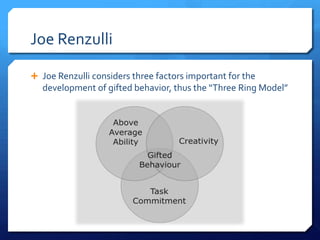
 Joe Renzulli considers three factors important for the

development of gifted behavior, thus the “Three Ring Model”
Joe Renzulli
 Within the above average abilities, Renzulli makes a

difference between general abilities (like processing
information, integrating experiences, and abstract thinking)
and specific abilities (like the capacity to acquire knowledge,
perform in an activity).
 By creativity, Renzulli understands the fluency, flexibility,

and originality of thought, an openness to experience,
sensitivity to stimulations, and a willingness to take risks.
 Under task commitment, he understands motivation turned

into action (like perseverance, endurance, hard work, but also
self-confidence, perceptiveness and a special fascination with
a special subject).
Who Are Gifted Children?
 Those who excel in academic disciplines are termed ‘gifted’
 Those who excel in areas requiring visual-spatial skills or

practical abilities are ‘talented’
 Art

 Dance
 Music
 Drama
 Sport
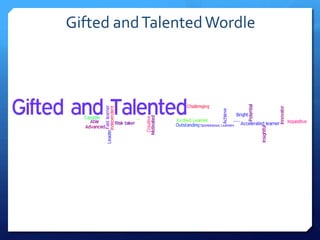
Gifted and Talented Wordle
Gifted Underachievers
 Underachievers are defined as students who are gifted and

talented but because of their outside circumstances, don’t
perform at the level they are capable of.
 Bored and restless with flashes of brilliance or interest

 High quality oral work but poor written work
 Poor test results but asks higher order thinking questions
 Dislike of routine work – often incomplete
Gifted Underachievers
 Creative interests outside school but not reflected inside

school
 Disruptive behavior in some lessons but not in others. Work

must be challenging to keep them engaged
 Low self esteem or highly self critical
 Hostile to authority
 Perfectionism
The Effective Gifted Classroom
 Higher order thinking skills
 Development of expertise – their own
 Exploration of alternative views – not one sided view
 Questioning that encourages creativity
 Problem solving
The Effective Gifted Classroom
 Connection of learning: big picture
 Independent learning
 Teaching at instructional level
 Differentiation
 Compacting
More Challenge – NOT More Work
 Be sure to AVOID:
 Repetitive extension work
 Time filling activities
 Additional writing
 Helping others when task is completed
 Starting points that provide no challenge
Teacher Suggestions
 If you notice your students seem bored and frustrated by a lack of

variety, these are are some tips:





Change the type of questions asked
Encourage the students to think for themselves
Encourage the students to ask questions themselves
Provide more opportunities for discussion

 It is important that gifted and talented students are encouraged to

think independently and to inquire into their preferred area of
expertise.

 To fulfill the potential of gifted and talented learners to think

independently, you need to provide the opportunity, support, and
time to engage in independent thinking.
Characteristics of Gifted Learners
 They learn quicker
 They ask higher order thinking questions
 They challenge accepted theories
 They are independent learners
 Unique learners – they look for the peculiar
 Clever sense of humor

 Vivid imagination
Myths About Gifted Learners
 Gifted learners always rise to the top in the classroom.
 Not always. They can have hidden learning disabilities that go

undiscovered because they can easily compensate for them in
the early years. As time goes on, it becomes harder and harder
for them to excel. This can lead to behavior problems and
depression.
 Gifted learners will do fine without special programs.
 They may appear to do fine on their own, but without proper

challenge they can become bored and unruly. As the years go by
they may find it harder as the work does become more
challenging, since they haven’t faced challenges before.
Myths About Gifted Learners
 Giftedness is something to be jealous about.
 Probably the most damaging myth
 More often than not gifted children can feel isolated and

misunderstood.
 They have more adult tastes in music, clothing, reading material
and food. These differences to other children can cause them to
be shunned and even abused verbally or physically by other
children.
Howard Gardner
 A psychologist and professor of neuroscience from Harvard

University developed the theory of Multiple Intelligences (MI)
in 1983.
 According to Gardner, human beings have different kinds of

intelligence that reflect different ways of interacting with the
world.
 Each person has a unique combination, or profile.
Howard Gardner’s
Multiple Intelligences
 Linguistic- Highly developed verbal skills
 Logical Mathematical
 Spatial – Good at pattern recognition
 Naturalist – Sensitive to natural phenomena

 Bodily Kinesthetic – Excellent body (physical) control
 Musical
 Interpersonal – High ability to understand other individuals

 Intrapersonal – High ability to understand one’s self
 Existential Intelligence – Ability to pose questions about life, death and

ultimate realities
Factors Influencing Determination of
Giftedness
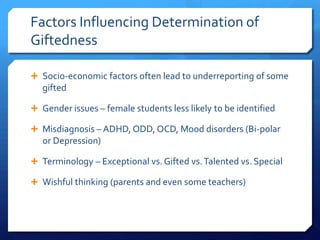
 Socio-economic factors often lead to underreporting of some

gifted
 Gender issues – female students less likely to be identified
 Misdiagnosis – ADHD, ODD, OCD, Mood disorders (Bi-polar

or Depression)
 Terminology – Exceptional vs. Gifted vs. Talented vs. Special
 Wishful thinking (parents and even some teachers)
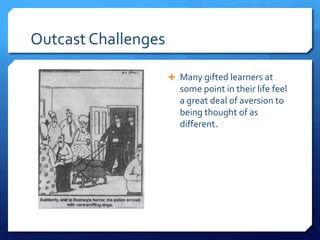
Outcast Challenges
 Many gifted learners at

some point in their life feel
a great deal of aversion to
being thought of as
different.
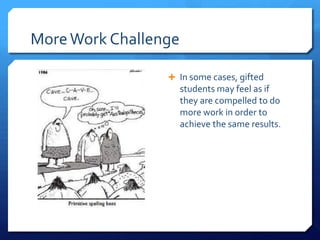
More Work Challenge
 In some cases, gifted

students may feel as if
they are compelled to do
more work in order to
achieve the same results.
Role of Teachers
 Most would agree that an important factor in the

determination of success for gifted learners was a specific
teacher.
 He/she cared for the student as an individual
 He/she communicated with the student as a peer
 The teacher was enthusiastic and knowledgeable
 The teacher was perceived as not being “mechanical” in

methods of instruction
 The teacher was perceived as having high but realistic
expectations
Resources
 Callard-Szulgit, R. (2010). Parenting and Teaching the Gifted 2nd

Edition. Baltimore, MD: Rowman and Littlefield. ISBN: 9781607094555

 Callard-Szulgit, R. (2012). Perfectionism and Gifted Children. 2nd

Edition, Lanham, MD: Scarecrow Education.

 Callard-Szulgit, R. (2008). Twice Exceptional Kids. Baltimore, MD:

Rowman and Littlefield. ISBN: 978-1578867790

 No Child Left Behind Act, P.L. 107-110 (Title IX, Part A, Definitions

(22) (2002); 20 U.S.C. Sec. 7802 (22) (2004))

 Winner, E. (1996). Gifted Children: Myths and Realities. New York:

Basic Books. ISBN: 978-0465017591
Website References
 http://www.pbs.org/wnet/gperf/education/ed_mi_overview.h

tml
 http://www.tecweb.org/styles/gardner.html
 http://www.gigers.com/matthias/gifted/three_rings.html
 http://www.gifted.uconn.edu/sem/semart13.html
 http://www.gifted.uconn.edu/sem/pdf/the_three-

ring_conception_of_giftedness.pdf

Gifted advocacy

  • 1.
    Gifted Advocacy Facilitator: ShabnamYaqubie November 19, 2013
  • 2.
    Who Are GiftedChildren?  The Federal Government defines “Gifted and Talented” students, children, or youth as those: “…who give evidence of high achievement capability in areas such as intellectual, creative, artistic, or leadership capacity, or in specific academic fields, and who need services or activities not ordinarily provided by the school in order to fully develop those capabilities.”  Varies by state
  • 3.
    Joe Renzulli  JoeRenzulli considers three factors important for the development of gifted behavior, thus the “Three Ring Model”
  • 4.
    Joe Renzulli  Withinthe above average abilities, Renzulli makes a difference between general abilities (like processing information, integrating experiences, and abstract thinking) and specific abilities (like the capacity to acquire knowledge, perform in an activity).  By creativity, Renzulli understands the fluency, flexibility, and originality of thought, an openness to experience, sensitivity to stimulations, and a willingness to take risks.  Under task commitment, he understands motivation turned into action (like perseverance, endurance, hard work, but also self-confidence, perceptiveness and a special fascination with a special subject).
  • 5.
    Who Are GiftedChildren?  Those who excel in academic disciplines are termed ‘gifted’  Those who excel in areas requiring visual-spatial skills or practical abilities are ‘talented’  Art  Dance  Music  Drama  Sport
  • 6.
  • 7.
    Gifted Underachievers  Underachieversare defined as students who are gifted and talented but because of their outside circumstances, don’t perform at the level they are capable of.  Bored and restless with flashes of brilliance or interest  High quality oral work but poor written work  Poor test results but asks higher order thinking questions  Dislike of routine work – often incomplete
  • 8.
    Gifted Underachievers  Creativeinterests outside school but not reflected inside school  Disruptive behavior in some lessons but not in others. Work must be challenging to keep them engaged  Low self esteem or highly self critical  Hostile to authority  Perfectionism
  • 9.
    The Effective GiftedClassroom  Higher order thinking skills  Development of expertise – their own  Exploration of alternative views – not one sided view  Questioning that encourages creativity  Problem solving
  • 10.
    The Effective GiftedClassroom  Connection of learning: big picture  Independent learning  Teaching at instructional level  Differentiation  Compacting
  • 11.
    More Challenge –NOT More Work  Be sure to AVOID:  Repetitive extension work  Time filling activities  Additional writing  Helping others when task is completed  Starting points that provide no challenge
  • 12.
    Teacher Suggestions  Ifyou notice your students seem bored and frustrated by a lack of variety, these are are some tips:     Change the type of questions asked Encourage the students to think for themselves Encourage the students to ask questions themselves Provide more opportunities for discussion  It is important that gifted and talented students are encouraged to think independently and to inquire into their preferred area of expertise.  To fulfill the potential of gifted and talented learners to think independently, you need to provide the opportunity, support, and time to engage in independent thinking.
  • 13.
    Characteristics of GiftedLearners  They learn quicker  They ask higher order thinking questions  They challenge accepted theories  They are independent learners  Unique learners – they look for the peculiar  Clever sense of humor  Vivid imagination
  • 14.
    Myths About GiftedLearners  Gifted learners always rise to the top in the classroom.  Not always. They can have hidden learning disabilities that go undiscovered because they can easily compensate for them in the early years. As time goes on, it becomes harder and harder for them to excel. This can lead to behavior problems and depression.  Gifted learners will do fine without special programs.  They may appear to do fine on their own, but without proper challenge they can become bored and unruly. As the years go by they may find it harder as the work does become more challenging, since they haven’t faced challenges before.
  • 15.
    Myths About GiftedLearners  Giftedness is something to be jealous about.  Probably the most damaging myth  More often than not gifted children can feel isolated and misunderstood.  They have more adult tastes in music, clothing, reading material and food. These differences to other children can cause them to be shunned and even abused verbally or physically by other children.
  • 16.
    Howard Gardner  Apsychologist and professor of neuroscience from Harvard University developed the theory of Multiple Intelligences (MI) in 1983.  According to Gardner, human beings have different kinds of intelligence that reflect different ways of interacting with the world.  Each person has a unique combination, or profile.
  • 17.
    Howard Gardner’s Multiple Intelligences Linguistic- Highly developed verbal skills  Logical Mathematical  Spatial – Good at pattern recognition  Naturalist – Sensitive to natural phenomena  Bodily Kinesthetic – Excellent body (physical) control  Musical  Interpersonal – High ability to understand other individuals  Intrapersonal – High ability to understand one’s self  Existential Intelligence – Ability to pose questions about life, death and ultimate realities
  • 18.
    Factors Influencing Determinationof Giftedness  Socio-economic factors often lead to underreporting of some gifted  Gender issues – female students less likely to be identified  Misdiagnosis – ADHD, ODD, OCD, Mood disorders (Bi-polar or Depression)  Terminology – Exceptional vs. Gifted vs. Talented vs. Special  Wishful thinking (parents and even some teachers)
  • 19.
    Outcast Challenges  Manygifted learners at some point in their life feel a great deal of aversion to being thought of as different.
  • 20.
    More Work Challenge In some cases, gifted students may feel as if they are compelled to do more work in order to achieve the same results.
  • 21.
    Role of Teachers Most would agree that an important factor in the determination of success for gifted learners was a specific teacher.  He/she cared for the student as an individual  He/she communicated with the student as a peer  The teacher was enthusiastic and knowledgeable  The teacher was perceived as not being “mechanical” in methods of instruction  The teacher was perceived as having high but realistic expectations
  • 22.
    Resources  Callard-Szulgit, R.(2010). Parenting and Teaching the Gifted 2nd Edition. Baltimore, MD: Rowman and Littlefield. ISBN: 9781607094555  Callard-Szulgit, R. (2012). Perfectionism and Gifted Children. 2nd Edition, Lanham, MD: Scarecrow Education.  Callard-Szulgit, R. (2008). Twice Exceptional Kids. Baltimore, MD: Rowman and Littlefield. ISBN: 978-1578867790  No Child Left Behind Act, P.L. 107-110 (Title IX, Part A, Definitions (22) (2002); 20 U.S.C. Sec. 7802 (22) (2004))  Winner, E. (1996). Gifted Children: Myths and Realities. New York: Basic Books. ISBN: 978-0465017591
  • 23.
    Website References  http://www.pbs.org/wnet/gperf/education/ed_mi_overview.h tml http://www.tecweb.org/styles/gardner.html  http://www.gigers.com/matthias/gifted/three_rings.html  http://www.gifted.uconn.edu/sem/semart13.html  http://www.gifted.uconn.edu/sem/pdf/the_three- ring_conception_of_giftedness.pdf