GIFTED 101 An introduction to education for gifted and talented students Presented by:  Beth Brubaker EDUFEST 2011 [email_address]
Like Captured Fireflies In her classroom our speculations ranged the world She aroused us to book waving discussions. Every morning we came to her carrying new truths, new facts, new ideas Cupped and sheltered in our hands like captured fireflies. When she went away a sadness came over us,
But the light did not go out. She left her signature upon us The literature of the teacher who writes on children’s minds. I’ve had many teachers who taught us soon forgotten things, But only a few like her who created in me a new thing, a new attitude, a new hunger.
I suppose that to a large extent I am the unsigned manuscript of that teacher. What deathless power lies in the hands of such a person. ~John Steinbeck California Teachers Association Journal October, 1957
Myths and Realities of Giftedness
The public is sympathetic to the plight of the gifted. MYTH
Special provisions for the gifted are undemocratic. MYTH
Gifted children can get a good education on their own. MYTH
Everyone is gifted in some way. MYTH
Reality The intellectually gifted differ as much from the average as do the mentally challenged.
A high IQ score is a good predictor of  real-world accomplishment. MYTH
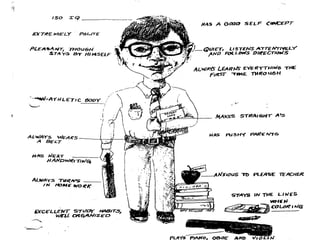
The gifted are puny, introverted, emotionally unstable persons. MYTH
 
Teachers are better at identifying giftedness than a child’s peers or parents. MYTH
Reality Labeling a child “gifted” may lead to special treatment and special problems.
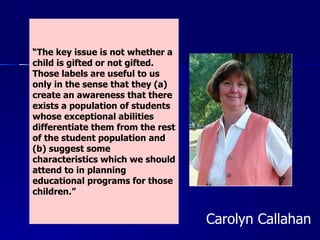
“ The key issue is not whether a child is gifted or not gifted. Those labels are useful to us only in the sense that they (a) create an awareness that there exists a population of students whose exceptional abilities differentiate them from the rest of the student population and (b) suggest some characteristics which we should attend to in planning educational programs for those children.” Carolyn Callahan

Reality Gifted individuals from racial and ethnic minorities and of low socioeconomic status are less likely to be identified.
Accelerating eager gifted learners sometimes causes them social or emotional harm. MYTH
Reality Gifted students should be encouraged to direct their own learning.
http:// www.youtube.com/watch?v = MDJst-y_ptI&feature =related
Definitions of Giftedness Marland Report:  U.S. Office of Education: Gifted and talented children are those identified by professionally qualified persons who, by virtue of outstanding abilities, are capable of high performance.  These are children who require differentiated educational programs and/or services beyond those normally provided by the regular school program in order to realize their contribution to self and society (p.IX)
Definitions of Giftedness State of Idaho: … those children possessing demonstrated or potential abilities that give evidence of high performing abilities in intellectual, academic, leadership, creativity, and visual or performing arts.
Definitions of Giftedness Susan Richert: “ There are no gifted children, only children with potential for giftedness.  Being gifted means making (as an adult) an original contribution to one’s field.”
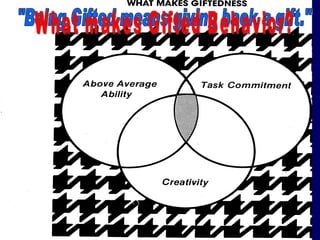
Definitions of Giftedness Jewel Hoopes: “ Being gifted means giving back a gift.”
"Being Gifted means giving back a gift." What makes Gifted Behavior?
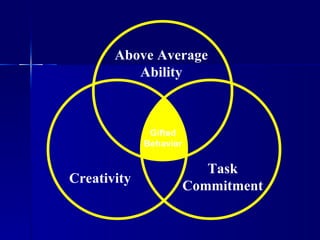
Above Average Ability Creativity Task Commitment Gifted Behavior
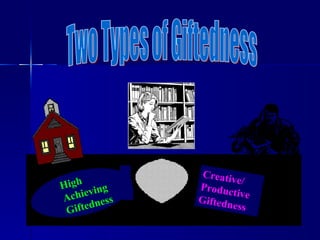
Two Types of Giftedness High Achieving Giftedness Creative/ Productive Giftedness
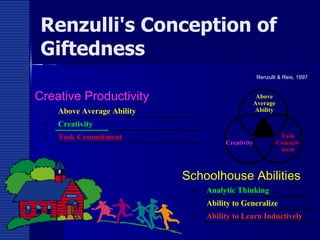
Renzulli's Conception of Giftedness Schoolhouse Abilities Creative Productivity Above Average Ability Task Commit- ment Creativity •  ___________________________ •  __________ _________________ •  ___________________________ Above Average Ability Creativity Task Commitment Renzulli & Reis, 1997 •  ____________________ •  ____________________ •  ____________________ Analytic Thinking Ability to Generalize Ability to Learn Inductively
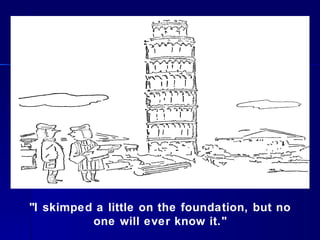
"I skimped a little on the foundation, but no one will ever know it."
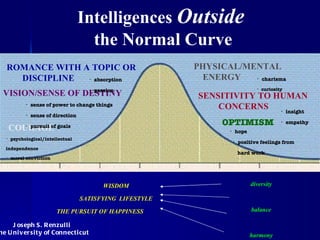
SENSITIVITY TO HUMAN  CONCERNS OPTIMISM ・ hope ・ positive feelings from  hard work ROMANCE WITH A TOPIC OR DISCIPLINE VISION/SENSE OF DESTINY PHYSICAL/MENTAL  ENERGY COURAGE WISDOM SATISFYING  LIFESTYLE THE PURSUIT OF HAPPINESS Intelligences  Outside   the Normal Curve Joseph S. Renzulli The University of Connecticut ・ psychological/intellectual  independence ・ moral conviction ・ absorption ・ passion ・ sense of power to change things ・ sense of direction ・ pursuit of goals ・ charisma ・ curiosity ・ insight ・ empathy diversity balance harmony proportion
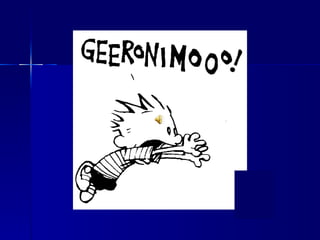
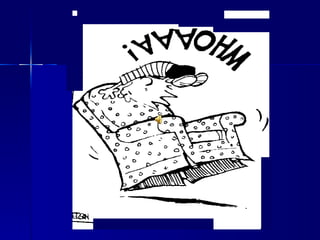
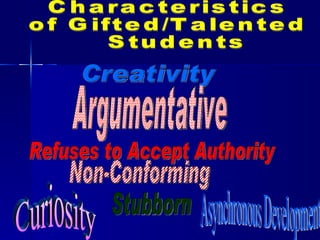
Creativity Characteristics  of Gifted/Talented Students


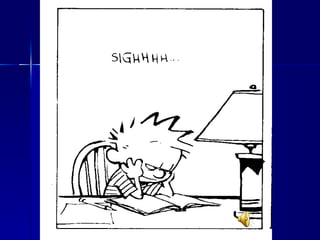
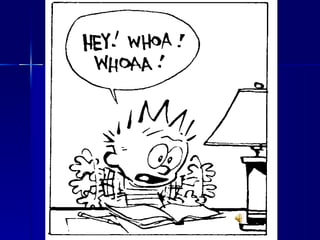
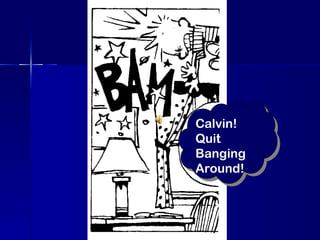
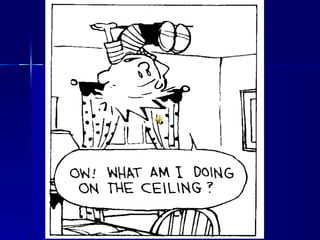
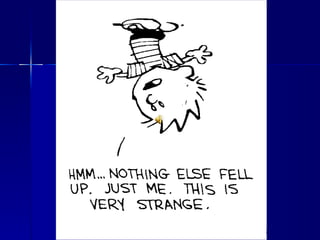
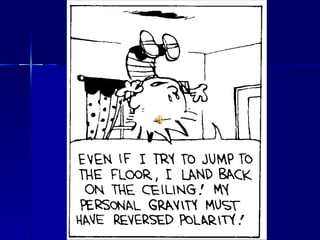
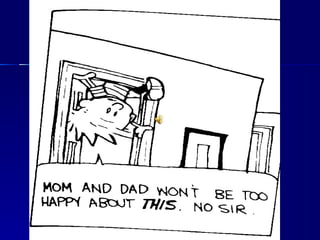
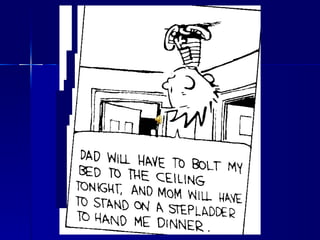
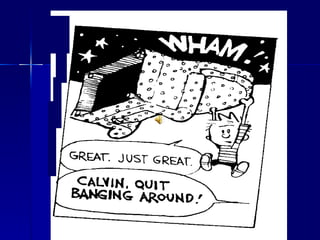
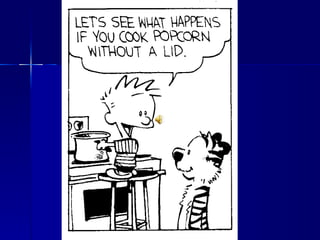
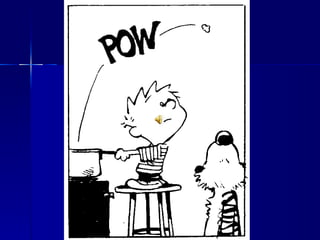
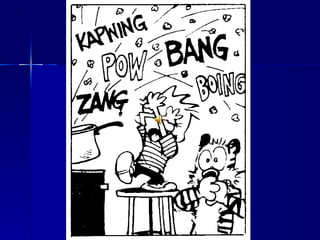
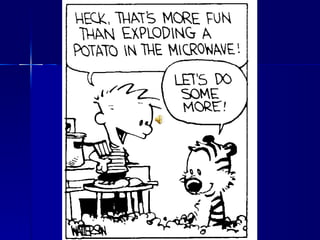
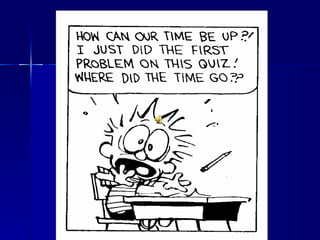
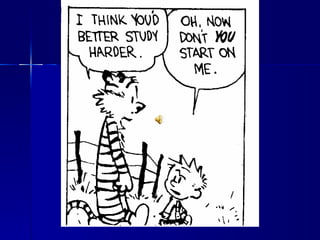
Calvin!  Quit Banging Around!


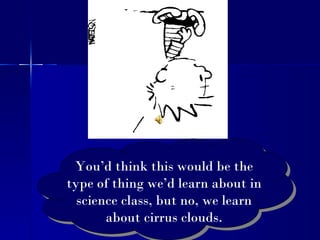
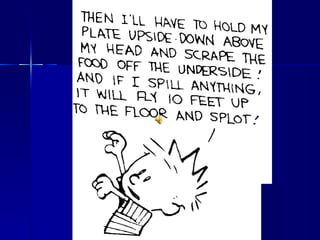
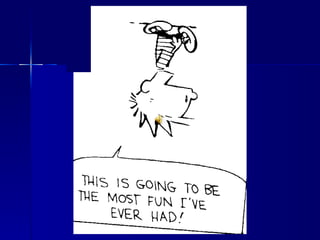
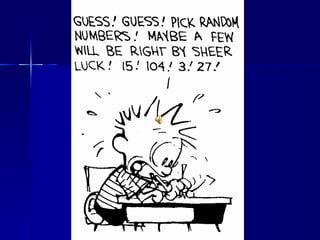
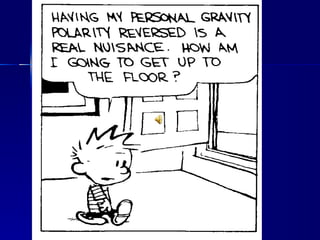
You’d think this would be the type of thing we’d learn about in science class, but no, we learn about cirrus clouds.


Curiosity Characteristics  of Gifted/Talented Students


Asynchronous Development Characteristics  of Gifted/Talented Students


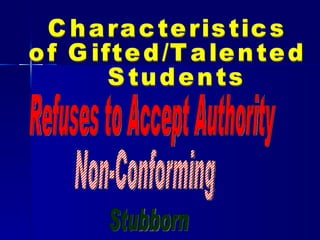
Refuses to Accept Authority Non-Conforming Stubborn Characteristics  of Gifted/Talented Students


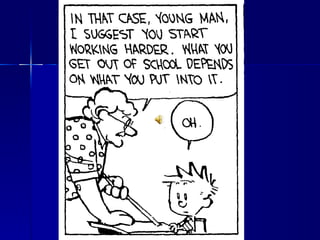
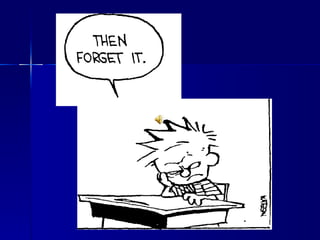
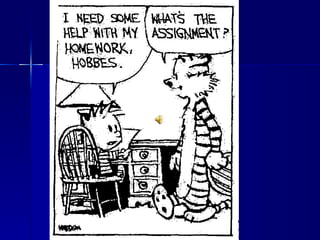
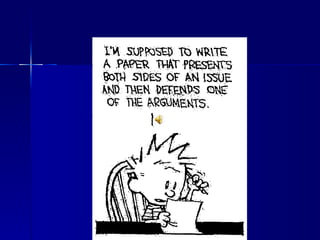
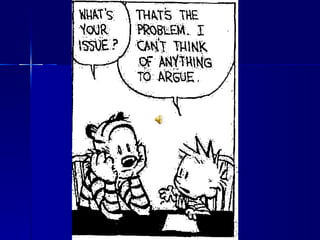
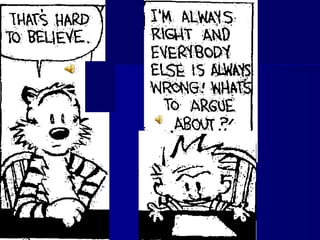
Argumentative Characteristics  of Gifted/Talented Students


Creativity Refuses to Accept Authority Non-Conforming Stubborn Argumentative Curiosity Asynchronous Development Characteristics  of Gifted/Talented Students
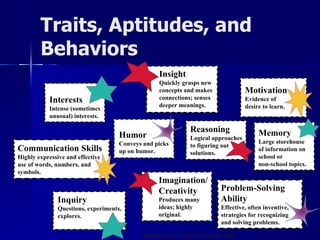
Traits, Aptitudes, and Behaviors Adapted from:  Frasier & Passow, 1994 Humor Conveys and picks up on humor. Problem-Solving Ability Effective, often inventive, strategies for recognizing and solving problems. Communication Skills Highly expressive and effective use of words, numbers, and symbols. Motivation Evidence of desire to learn. Interests Intense (sometimes unusual) interests. Inquiry Questions, experiments, explores. Memory Large storehouse of information on school or non-school topics. Insight Quickly grasps new concepts and makes connections; senses deeper meanings. Imagination/ Creativity Produces many ideas; highly original. Reasoning Logical approaches to figuring out solutions.
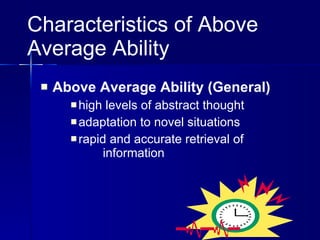
Characteristics of Above Average Ability Above Average Ability (General)   high levels of abstract thought adaptation to novel situations rapid and accurate retrieval of  information
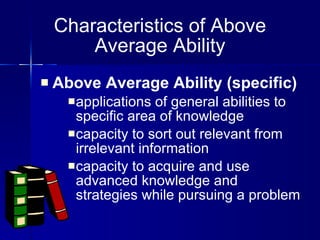
Above Average Ability (specific)   applications of general abilities to specific area of knowledge capacity to sort out relevant from irrelevant information capacity to acquire and use advanced knowledge and strategies while pursuing a problem Characteristics of Above Average Ability
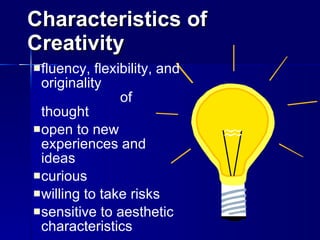
Characteristics of Creativity fluency, flexibility, and originality  of thought open to new experiences and ideas curious willing to take risks sensitive to aesthetic characteristics
Positive Characteristics  of Creativity aware of their own creativeness original independent willing to take risks energetic curious keen sense of humor attracted to complexity and novelty artistic open-minded need for privacy, alone time perceptive
Negative Characteristics of Creativity questioning rules and authority stubbornness  low interest in details forgetfulness carelessness and disorganization with unimportant matters absentmindedness indifference to common conventions tendency to be emotional
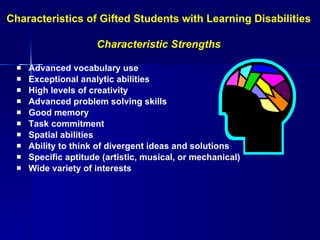
Advanced vocabulary use Exceptional analytic abilities High levels of creativity Advanced problem solving skills Good memory Task commitment Spatial abilities  Ability to think of divergent ideas and solutions Specific aptitude (artistic, musical, or mechanical) Wide variety of interests Characteristics of Gifted Students with Learning Disabilities  Characteristic Strengths
Characteristics of Gifted Students with Learning Disabilities  Characteristics Which Hamper Identification as Gifted   Frustration  with inability to master certain academic skill   Learned helplessness   General lack of motivation   Disruptive  classroom behavior   Perfectionism   Supersensitivity   Failure to complete assignments   Lack of organizational skills   Demonstration of poor listening and concentration skills   Deficiencies Low self-esteem   Unrealistic self-expectations   Absence of social skills with some peers
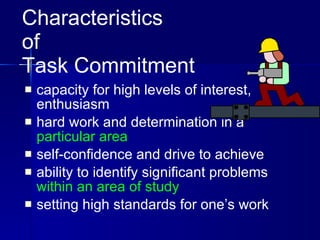
Characteristics  of  Task Commitment capacity for high levels of interest, enthusiasm hard work and determination in a  particular area self-confidence and drive to achieve ability to identify significant problems  within an area of study setting high standards for one’s work
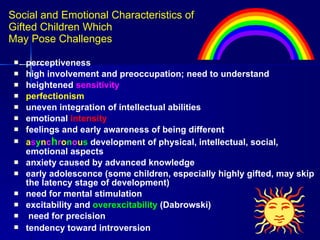
Social and Emotional Characteristics of  Gifted Children Which  May Pose Challenges perceptiveness high involvement and preoccupation; need to understand heightened  sensitivity  perfectionism uneven integration of intellectual abilities emotional  intensity  feelings and early awareness of being different  a s y n c h r o n o u s  development of physical, intellectual, social, emotional aspects  anxiety caused by advanced knowledge  early adolescence (some children, especially highly gifted, may skip the latency stage of development)  need for mental stimulation excitability and  overexcitability  (Dabrowski) need for precision tendency toward introversion
IDENTIFICATION
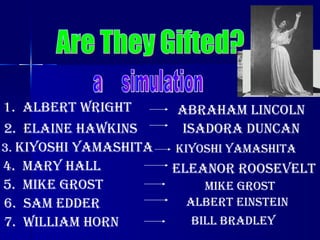
Are They Gifted? a  simulation 1.  Albert Wright 2.  Elaine Hawkins 3.  Kiyoshi Yamashita Kiyoshi Yamashita 4.  Mary hall 5.  Mike Grost 6.  Sam Edder 7.  William Horn Abraham Lincoln Isadora Duncan Eleanor Roosevelt Mike Grost Albert Einstein Bill Bradley
Identification: The Great Debate One of the most widely discussed and debated topics in education No easy answers or simple solutions to identification questions An indication of the far-reaching effects that decisions related to identification have on students, schools, and communities
Multiple Talents
http:// www.humorsphere.com/fun/8787/colortest.swf
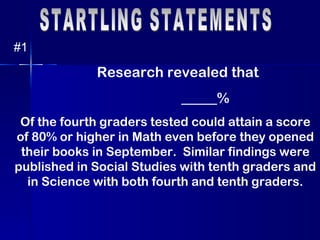
STARTLING STATEMENTS #1 Research revealed that  _____ % Of the fourth graders tested could attain a score of 80% or higher in Math even before they opened their books in September.  Similar findings were published in Social Studies with tenth graders and in Science with both fourth and tenth graders.
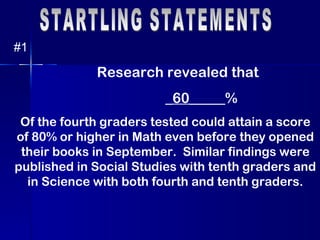
STARTLING STATEMENTS #1 Research revealed that  _60_____ % Of the fourth graders tested could attain a score of 80% or higher in Math even before they opened their books in September.  Similar findings were published in Social Studies with tenth graders and in Science with both fourth and tenth graders.
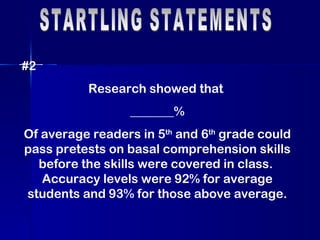
STARTLING STATEMENTS #2 Research showed that  _______% Of average readers in 5 th  and 6 th  grade could pass pretests on basal comprehension skills before the skills were covered in class.  Accuracy levels were 92% for average students and 93% for those above average.
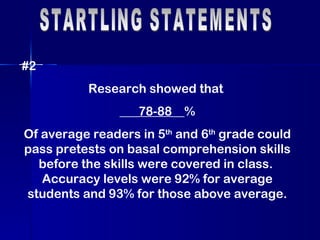
STARTLING STATEMENTS #2 Research showed that  ___ 78-88 __% Of average readers in 5 th  and 6 th  grade could pass pretests on basal comprehension skills before the skills were covered in class.  Accuracy levels were 92% for average students and 93% for those above average.
STARTLING STATEMENTS #3 At the National Research Center for Gifted and Talented at the University of Connecticut, research revealed that most elementary teachers can forego  ____________ % Of the basal regular curriculum for targeted students in the general population.
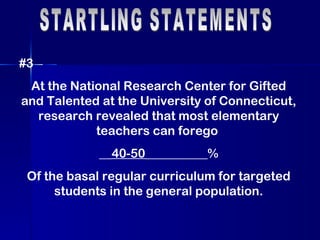
STARTLING STATEMENTS #3 At the National Research Center for Gifted and Talented at the University of Connecticut, research revealed that most elementary teachers can forego  __ 40-50 __________% Of the basal regular curriculum for targeted students in the general population.
STARTLING STATEMENTS #4 At the National Research Center for Gifted and Talented at the University of Connecticut, researchers found that in both Language Arts and Math, many bright youngsters are able to bypass as much as  _____________% of the regular curriculum.
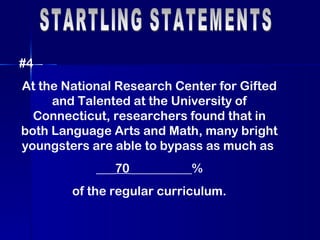
STARTLING STATEMENTS #4 At the National Research Center for Gifted and Talented at the University of Connecticut, researchers found that in both Language Arts and Math, many bright youngsters are able to bypass as much as  ___ 70 __________% of the regular curriculum.
#5 Many define “gifted” as an IQ above _________. (number)
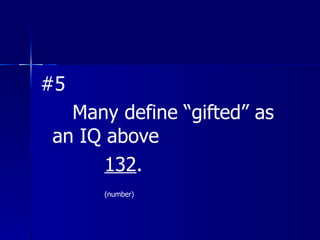
#5 Many define “gifted” as an IQ above 132 . (number)
STARTLING STATEMENTS #6 ______ (number) States do NOT require the identification of gifted students.  Idaho DOES require identification!.
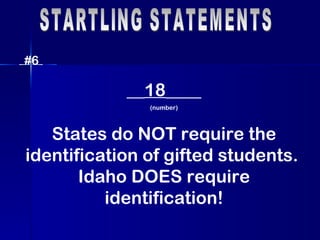
STARTLING STATEMENTS #6 __ 18 ____ (number) States do NOT require the identification of gifted students.  Idaho DOES require identification!
#7 Over  ______________% Of gifted children are introverted compared with 30% of the general population.
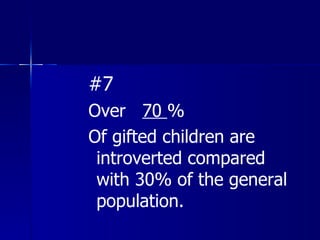
#7 Over  70  % Of gifted children are introverted compared with 30% of the general population.
STARTLING STATEMENTS #12 _______________________ (number) of gifted students in public elementary and secondary schools in the United States in 2000. (National Center for Education Statistics)
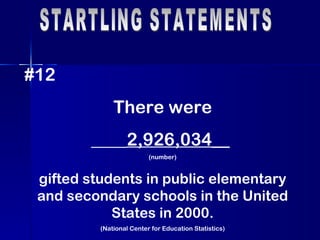
STARTLING STATEMENTS #12 There were ____ 2,926,034__   (number) gifted students in public elementary and secondary schools in the United States in 2000. (National Center for Education Statistics)
STARTLING STATEMENTS #13 Gifted students comprise, or make up,  ________%  of the total public school enrollment in the United States.
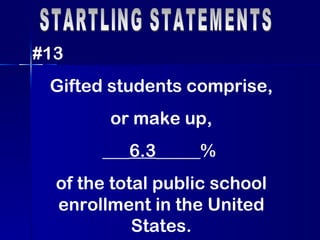
STARTLING STATEMENTS #13 Gifted students comprise, or make up,  ___ 6.3 _____%  of the total public school enrollment in the United States.
STARTLING STATEMENTS #14 Dropout rates among the gifted reach as high as ________% of the total dropout rate.
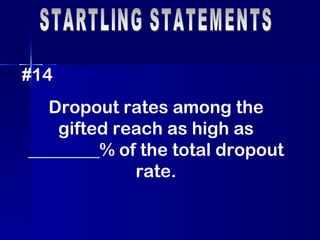
STARTLING STATEMENTS #14 Dropout rates among the gifted reach as high as ______ 30 __% of the total dropout rate.
STARTLING STATEMENTS #16 Less than ______ cents out of every federal dollar spent for education funds programs for gifted.
STARTLING STATEMENTS #16 Less than ____ 2 __ cents out of every federal dollar spent for education funds programs for gifted. CHANGE: 2011=JAVITTS GRANT REMOVED=$0.00
STARTLING STATEMENTS #17 In 2006, Congress appropriated  $______________ In the Jacob Javitts Gifted and Talented Act.
STARTLING STATEMENTS #17 In 2006, Congress appropriated  $ 9.6million _ In the Jacob Javitts Gifted and Talented Act. CHANGE: 2011=JAVITTS GRANT REMOVED=$0.00
STARTLING STATEMENTS #18 When teachers trained in curriculum modification for gifted students eliminated as much as ________%  of the regular curriculum for gifted students, NO differences in the out-of-level achievement test results were found compared to pretest scores.
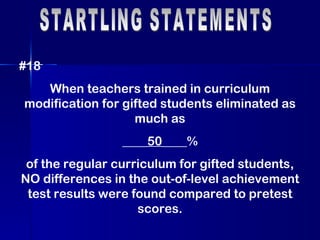
STARTLING STATEMENTS #18 When teachers trained in curriculum modification for gifted students eliminated as much as ____ 50 ____%  of the regular curriculum for gifted students, NO differences in the out-of-level achievement test results were found compared to pretest scores.
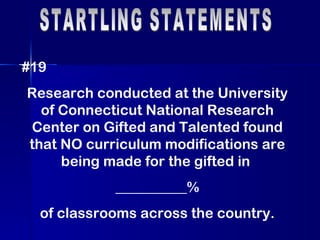
STARTLING STATEMENTS #19 Research conducted at the University of Connecticut National Research Center on Gifted and Talented found that NO curriculum modifications are being made for the gifted in  __________% of classrooms across the country.
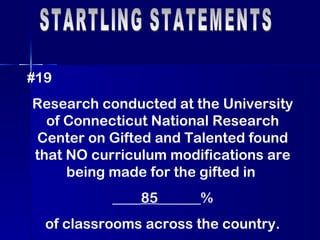
STARTLING STATEMENTS #19 Research conducted at the University of Connecticut National Research Center on Gifted and Talented found that NO curriculum modifications are being made for the gifted in  ____ 85 ______% of classrooms across the country.
STARTLING STATEMENTS #22 The Idaho Legislature formerly provided $____________ training grant money for teachers, parents, administrators, and counselors to learn about gifted students. This has now been eliminated .
STARTLING STATEMENTS #22 The Idaho Legislature formerly provided $__ 500,000 __________ training grant money for teachers, parents, administrators, and counselors to learn about gifted students. This has now been eliminated
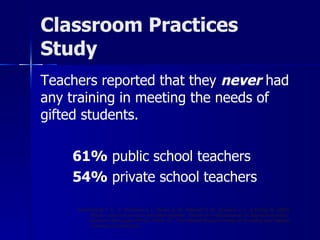
Classroom Practices Study Teachers reported that they  never  had any training in meeting the needs of gifted students. 61%  public school teachers 54%  private school teachers Archambault, F. X., Jr., Westberg, K. L., Brown, S. W., Hallmark, B. W., Emmons, C. L., & Zhang, W. (1993).  Regular classroom practices with gifted students:  Results of a national survey of classroom teachers  (Research Monograph 93102).  Storrs, CT:  The National Research Center on the Gifted and Talented, University of Connecticut.
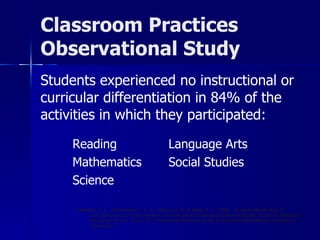
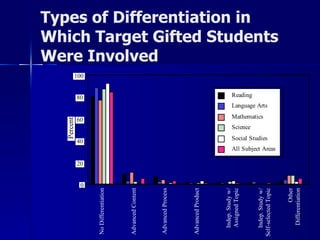
Classroom Practices Observational Study Students experienced no instructional or curricular differentiation in 84% of the activities in which they participated: Reading Language Arts Mathematics Social Studies Science Westberg, K. L., Archambault, F. X., Jr., Dobyns, S. M., & Salvin, T. J.  (1993).  An observational study of instructional and curricular practices used with gifted and talented students in regular  classroom ( Research Monograph 93104).  Storrs, CT:  The National Research Center on the Gifted and Talented, University of Connecticut.
 
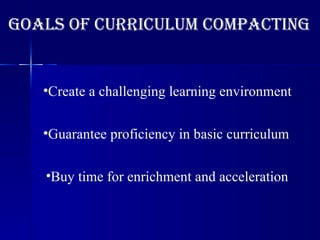
GOALS OF CURRICULUM COMPACTING Create a challenging learning environment Guarantee proficiency in basic curriculum Buy time for enrichment and acceleration
 
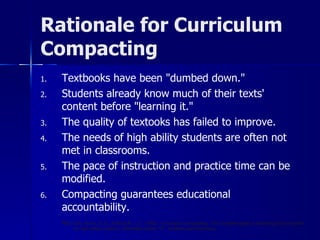
Rationale for Curriculum Compacting Textbooks have been "dumbed down." Students already know much of their texts' content before "learning it." The quality of textooks has failed to improve. The needs of high ability students are often not met in classrooms. The pace of instruction and practice time can be modified. Compacting guarantees educational accountability. Reis, S.M., Burns, D. E., & Renzulli, J. S.  (1992).  Curriculum Compacting:  The complete guide to modifying the curriculum for high ability students.  Mansfield Center, CT:  Creative Learning Press.
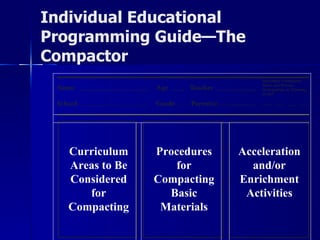
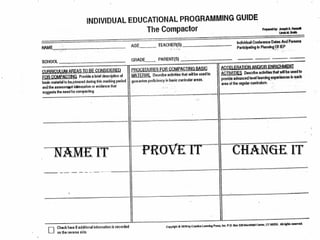
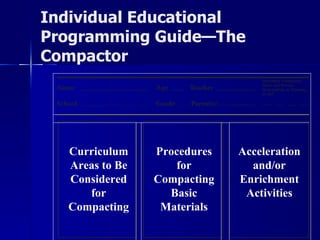
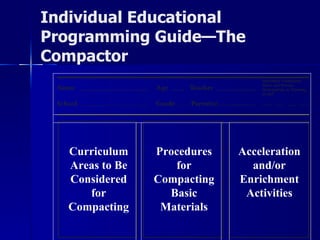
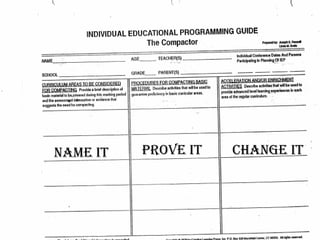
Individual Educational Programming Guide—The Compactor Curriculum Areas to Be Considered for Compacting Procedures for Compacting Basic Materials Acceleration and/or Enrichment Activities
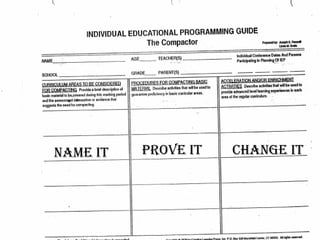
NAME IT NAME IT Prove it Change it
AREAS TO BE CONSIDERED FOR COMPACTING:  COLUMN 1 STANDARDIZED TESTS Pretests Anecdotal Records
 
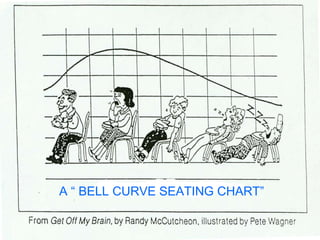
A “ BELL CURVE SEATING CHART”
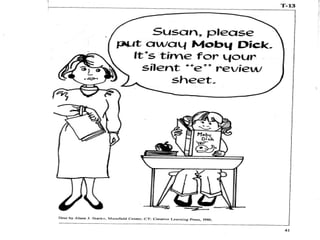
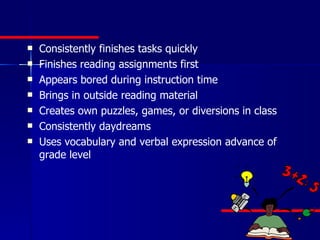
Consistently finishes tasks quickly Finishes reading assignments first Appears bored during instruction time Brings in outside reading material Creates own puzzles, games, or diversions in class Consistently daydreams Uses vocabulary and verbal expression advance of grade level
Individual Educational Programming Guide—The Compactor Curriculum Areas to Be Considered for Compacting Procedures for Compacting Basic Materials Acceleration and/or Enrichment Activities
NAME IT NAME IT Prove it Change it
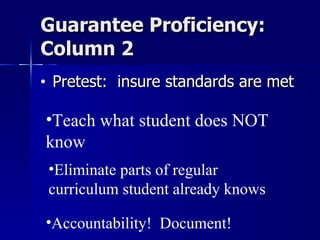
Guarantee Proficiency:  Column 2 Pretest:  insure standards are met Teach what student does NOT know Eliminate parts of regular curriculum student already knows Accountability!  Document!
Individual Educational Programming Guide—The Compactor Curriculum Areas to Be Considered for Compacting Procedures for Compacting Basic Materials Acceleration and/or Enrichment Activities
NAME IT NAME IT Prove it Change it
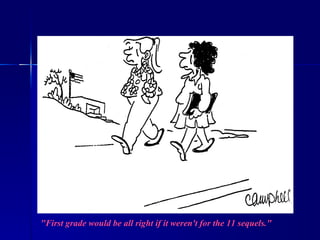
"First grade would be all right if it weren't for the 11 sequels."
Acceleration and/or Enrichment Activities:  Column 3 NOT just more quantity! Real world experiences:  research, problem solving, methodological “how to” Authentic evaluation:  find a real world  audience Consider interest areas and learning styles Provide Managerial assistance
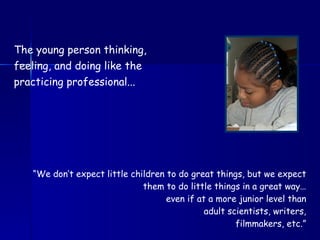
Investigating real problems… The young person thinking, feeling, and doing like the practicing professional... “ We don’t expect little children to do great things, but we expect them to do little things in a great way… even if at a more junior level than adult scientists, writers, filmmakers, etc.”
Use more authentic methods of instruction… Use Data… Use Instruments!
Designing quality Enrichment activities and opportunities Pacing Acceleration Depth  PASSION!


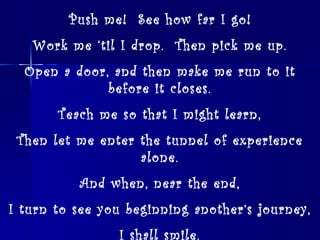
Push me!  See how far I go! Work me ‘til I drop.  Then pick me up. Open a door, and then make me run to it before it closes. Teach me so that I might learn, Then let me enter the tunnel of experience alone. And when, near the end, I turn to see you beginning another’s journey, I shall smile. ~Kathleen, age 14
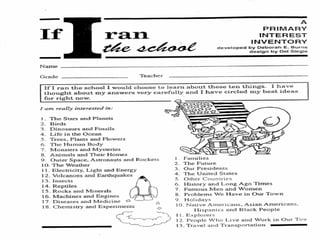
Designing quality Enrichment activities and opportunities Student Interest!
 
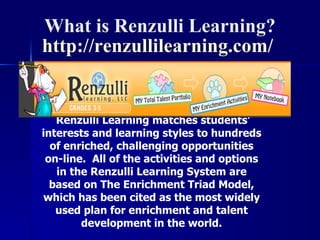
Renzulli Learning matches students’ interests and learning styles to hundreds of enriched, challenging opportunities on-line.  All of the activities and options in the Renzulli Learning System are based on The Enrichment Triad Model, which has been cited as the most widely used plan for enrichment and talent development in the world. What is Renzulli Learning? http:// renzullilearning.com /
 
Designing quality Enrichment activities and opportunities Pacing Acceleration Depth  PASSION!
Simulations Whole Class Modifications Problem  Solving Differentiation:  Cubing!  RIGOR!
 
 
Types of Differentiation in Which Target Gifted Students Were Involved No   Differentiation Advanced Content Advanced Process Advanced Product Indep. Study w/   Assigned Topic Indep. Study w/   Self-selected Topic Other Differentiation
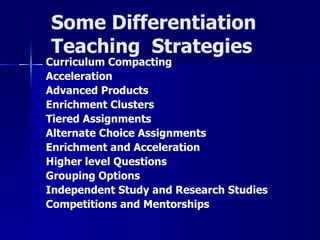
Some Differentiation Teaching  Strategies Curriculum Compacting Acceleration Advanced Products Enrichment Clusters Tiered Assignments Alternate Choice Assignments Enrichment and Acceleration Higher level Questions Grouping Options Independent Study and Research Studies Competitions and Mentorships
Whole Class Modifications Questioning Makes  the  Difference!
Students should feel proud that they have a question, rather than pleased that they have the answer. ~Janice Szabos 1995 Pieces of Learning  Active Questioning
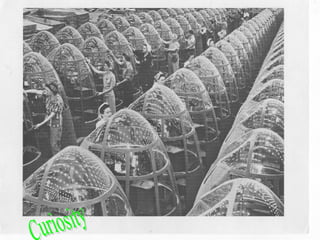
Curiosity
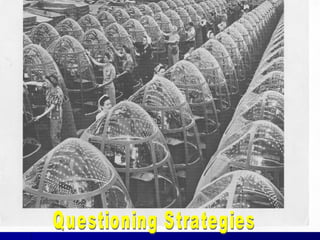
Questioning Strategies
“ It is better to know some of the questions than all of the answers.” ~James Thurber
5 Types of Questions By Nancy Johnson 1..  Quantity Questions Name many ways to get out of this room
2.  Compare / Contrast 5 Types of Questions Compare a rattlesnake to a missile.
3.  Feelings/opinions/point of   view/personification 5 Types of Questions Should our country stop importing chocolate?
4.  “What if?”   Questions 5 Types of Questions What if humans had no opposable thumbs?
5.  “How come?”  Questions 5 Types of Questions How come jumbo shrimp are so small?
Questions That Can Be Used To Escalate the Level of Discussions About Concepts and Ideas Consistency with Evidence 1.  How is the statement supported by  observations? 2.  How is the statement supported by   the observations of others? 3.  How is the statement supported by data? 4. How does evidence from nature support   the statement? 5.  How well does your statement reflect   the data?
 
I used to think kids were really smart if they could answer my questions. Now I think they’re smart if they can  ask  good questions!
Resources


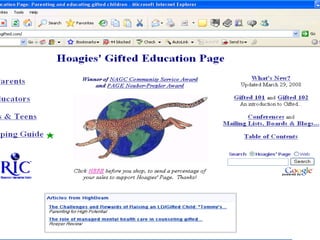
The National Research Center on the Gifted and Talented www.gifted.uconn.edu
Social and Emotional Findings
Western Academic Talent Search (WATS) Center for Bright Kids  9975 Wadsworth Pkwy Unit K-2 #504 Westminster, CO  80021-6814 Formerly known as Rocky Mountain Talent Search and Center for Innovative and Talented Youth
 
 
NAGC Gifted Program Standards Aiming for Excellence:  Annotations to the  NAGC Pre-K-Grade 12 Gifted Program Standards www.nagc.org In 1998, NAGC developed and released the  Pre-K -- Grade 12 Gifted Program Standards  designed to assist school districts in examining the quality of their programming for gifted learners.Recognizing that the on-going evaluation and re-tooling of a successful gifted program is an evolutionary process, the NAGC Standards detail a framework including both  minimum standards  (nominal requirements for satisfactory programs) and  exemplary standards  (characteristics of excellence in gifted education programming).
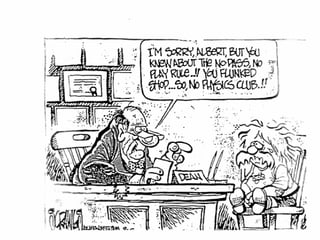
Hot Topics
 
Hot Topics Grades
Each time we steal a student’s struggle, we steal the opportunity to build self-confidence.  They must learn to do hard things to feel good about themselves.  Self-confidence comes from being successful at something we perceive as difficult. *Susan Winebrenner
Students who achieve A’s based on what they have already learned are gaining daily practice in underachievement. ~Linda Silverman
Hot Topics Grades Elitism
“ There is nothing more unequal than the equal treatment of unequal people.” ~Thomas Jefferson
Gifted programs do not cause an elitist attitude. In fact, the gifted program may be the first time a highly-capable student is truly challenged, which is a very humbling experience.
Hot Topics Grades Elitism Acceleration
Hot Topics Grades Elitism Acceleration Mastery
Hot Topics Grades Elitism Acceleration Mastery  Standardized testing Underachievement
A Nation Deceived:  How Schools Hold Back America’s Brightest Students ~The John Templeton Foundation  2004 The research is clear:  when it comes to meeting the needs of gifted students, acceleration is effective and needs to be the cornerstone of a gifted program.
Prof. Dumbledore: It is our choices, Harry, that show what we truly are, far more than our abilities. J. K. Rowling Harry Potter and The Chamber of Secrets
“ If you want to leave footprints in the sands of time, you’d better wear work boots.” ~Thomas Edison
A Hero Lies in Wait Sitting in every one of those desks is pure, unbridled potential I must look for the tiniest spark of a clue, though it may seem inconsequential And despite the behaviors that mask what’s there, what’s there is mine to reveal
I must look beyond and see inside to all they think and feel What’s inside the quiet mind?  A philosopher?  A writer? And what’s inside the rebellious one?  I’ll never know if I fight her. Which one will be the doctor who may someday cure a disease?
And which will be the adventurer who will one day sail on the breeze? And who will be the motherly one who cares for her children’s needs? Which will be the philanthropist helping through unselfish deeds? Who will be the mechanic, the attorney, or the pilot?
Who will climb the rainbow in search of indigo and violet? I have to remind myself each day, so emotions will not lead my mind astray That inside of every student I teach a hero lies in wait And the way I treat each one today will help to mold that fate. ~taken from  Seven Simple Secrets:  What the Best Teachers Know and Do
 

Gifted 101 presentation2011

  • 1.
    GIFTED 101 Anintroduction to education for gifted and talented students Presented by: Beth Brubaker EDUFEST 2011 [email_address]
  • 2.
    Like Captured FirefliesIn her classroom our speculations ranged the world She aroused us to book waving discussions. Every morning we came to her carrying new truths, new facts, new ideas Cupped and sheltered in our hands like captured fireflies. When she went away a sadness came over us,
  • 3.
    But the lightdid not go out. She left her signature upon us The literature of the teacher who writes on children’s minds. I’ve had many teachers who taught us soon forgotten things, But only a few like her who created in me a new thing, a new attitude, a new hunger.
  • 4.
    I suppose thatto a large extent I am the unsigned manuscript of that teacher. What deathless power lies in the hands of such a person. ~John Steinbeck California Teachers Association Journal October, 1957
  • 5.
    Myths and Realitiesof Giftedness
  • 6.
    The public issympathetic to the plight of the gifted. MYTH
  • 7.
    Special provisions forthe gifted are undemocratic. MYTH
  • 8.
    Gifted children canget a good education on their own. MYTH
  • 9.
    Everyone is giftedin some way. MYTH
  • 10.
    Reality The intellectuallygifted differ as much from the average as do the mentally challenged.
  • 11.
    A high IQscore is a good predictor of real-world accomplishment. MYTH
  • 12.
    The gifted arepuny, introverted, emotionally unstable persons. MYTH
  • 13.
  • 14.
    Teachers are betterat identifying giftedness than a child’s peers or parents. MYTH
  • 15.
    Reality Labeling achild “gifted” may lead to special treatment and special problems.
  • 16.
    “ The keyissue is not whether a child is gifted or not gifted. Those labels are useful to us only in the sense that they (a) create an awareness that there exists a population of students whose exceptional abilities differentiate them from the rest of the student population and (b) suggest some characteristics which we should attend to in planning educational programs for those children.” Carolyn Callahan
  • 17.
    Reality Gifted individualsfrom racial and ethnic minorities and of low socioeconomic status are less likely to be identified.
  • 18.
    Accelerating eager giftedlearners sometimes causes them social or emotional harm. MYTH
  • 19.
    Reality Gifted studentsshould be encouraged to direct their own learning.
  • 20.
    http:// www.youtube.com/watch?v =MDJst-y_ptI&feature =related
  • 21.
    Definitions of GiftednessMarland Report: U.S. Office of Education: Gifted and talented children are those identified by professionally qualified persons who, by virtue of outstanding abilities, are capable of high performance. These are children who require differentiated educational programs and/or services beyond those normally provided by the regular school program in order to realize their contribution to self and society (p.IX)
  • 22.
    Definitions of GiftednessState of Idaho: … those children possessing demonstrated or potential abilities that give evidence of high performing abilities in intellectual, academic, leadership, creativity, and visual or performing arts.
  • 23.
    Definitions of GiftednessSusan Richert: “ There are no gifted children, only children with potential for giftedness. Being gifted means making (as an adult) an original contribution to one’s field.”
  • 24.
    Definitions of GiftednessJewel Hoopes: “ Being gifted means giving back a gift.”
  • 25.
    "Being Gifted meansgiving back a gift." What makes Gifted Behavior?
  • 26.
    Above Average AbilityCreativity Task Commitment Gifted Behavior
  • 27.
    Two Types ofGiftedness High Achieving Giftedness Creative/ Productive Giftedness
  • 28.
    Renzulli's Conception ofGiftedness Schoolhouse Abilities Creative Productivity Above Average Ability Task Commit- ment Creativity • ___________________________ • __________ _________________ • ___________________________ Above Average Ability Creativity Task Commitment Renzulli & Reis, 1997 • ____________________ • ____________________ • ____________________ Analytic Thinking Ability to Generalize Ability to Learn Inductively
  • 29.
    "I skimped alittle on the foundation, but no one will ever know it."
  • 30.
    SENSITIVITY TO HUMAN CONCERNS OPTIMISM ・ hope ・ positive feelings from hard work ROMANCE WITH A TOPIC OR DISCIPLINE VISION/SENSE OF DESTINY PHYSICAL/MENTAL ENERGY COURAGE WISDOM SATISFYING LIFESTYLE THE PURSUIT OF HAPPINESS Intelligences Outside the Normal Curve Joseph S. Renzulli The University of Connecticut ・ psychological/intellectual independence ・ moral conviction ・ absorption ・ passion ・ sense of power to change things ・ sense of direction ・ pursuit of goals ・ charisma ・ curiosity ・ insight ・ empathy diversity balance harmony proportion
  • 31.
    Creativity Characteristics of Gifted/Talented Students
  • 32.
  • 33.
  • 34.
  • 35.
    Calvin! QuitBanging Around!
  • 36.
  • 37.
  • 38.
  • 39.
    You’d think thiswould be the type of thing we’d learn about in science class, but no, we learn about cirrus clouds.
  • 40.
  • 41.
  • 42.
  • 43.
  • 44.
  • 45.
  • 46.
  • 47.
  • 48.
  • 49.
  • 50.
    Curiosity Characteristics of Gifted/Talented Students
  • 51.
  • 52.
  • 53.
  • 54.
  • 55.
    Asynchronous Development Characteristics of Gifted/Talented Students
  • 56.
  • 57.
  • 58.
  • 59.
  • 60.
  • 61.
  • 62.
  • 63.
  • 64.
    Refuses to AcceptAuthority Non-Conforming Stubborn Characteristics of Gifted/Talented Students
  • 65.
  • 66.
  • 67.
  • 68.
  • 69.
    Argumentative Characteristics of Gifted/Talented Students
  • 70.
  • 71.
  • 72.
  • 73.
  • 74.
    Creativity Refuses toAccept Authority Non-Conforming Stubborn Argumentative Curiosity Asynchronous Development Characteristics of Gifted/Talented Students
  • 75.
    Traits, Aptitudes, andBehaviors Adapted from: Frasier & Passow, 1994 Humor Conveys and picks up on humor. Problem-Solving Ability Effective, often inventive, strategies for recognizing and solving problems. Communication Skills Highly expressive and effective use of words, numbers, and symbols. Motivation Evidence of desire to learn. Interests Intense (sometimes unusual) interests. Inquiry Questions, experiments, explores. Memory Large storehouse of information on school or non-school topics. Insight Quickly grasps new concepts and makes connections; senses deeper meanings. Imagination/ Creativity Produces many ideas; highly original. Reasoning Logical approaches to figuring out solutions.
  • 76.
    Characteristics of AboveAverage Ability Above Average Ability (General) high levels of abstract thought adaptation to novel situations rapid and accurate retrieval of information
  • 77.
    Above Average Ability(specific) applications of general abilities to specific area of knowledge capacity to sort out relevant from irrelevant information capacity to acquire and use advanced knowledge and strategies while pursuing a problem Characteristics of Above Average Ability
  • 78.
    Characteristics of Creativityfluency, flexibility, and originality of thought open to new experiences and ideas curious willing to take risks sensitive to aesthetic characteristics
  • 79.
    Positive Characteristics of Creativity aware of their own creativeness original independent willing to take risks energetic curious keen sense of humor attracted to complexity and novelty artistic open-minded need for privacy, alone time perceptive
  • 80.
    Negative Characteristics ofCreativity questioning rules and authority stubbornness low interest in details forgetfulness carelessness and disorganization with unimportant matters absentmindedness indifference to common conventions tendency to be emotional
  • 81.
    Advanced vocabulary useExceptional analytic abilities High levels of creativity Advanced problem solving skills Good memory Task commitment Spatial abilities Ability to think of divergent ideas and solutions Specific aptitude (artistic, musical, or mechanical) Wide variety of interests Characteristics of Gifted Students with Learning Disabilities Characteristic Strengths
  • 82.
    Characteristics of GiftedStudents with Learning Disabilities Characteristics Which Hamper Identification as Gifted Frustration with inability to master certain academic skill Learned helplessness General lack of motivation Disruptive classroom behavior Perfectionism Supersensitivity Failure to complete assignments Lack of organizational skills Demonstration of poor listening and concentration skills Deficiencies Low self-esteem Unrealistic self-expectations Absence of social skills with some peers
  • 83.
    Characteristics of Task Commitment capacity for high levels of interest, enthusiasm hard work and determination in a particular area self-confidence and drive to achieve ability to identify significant problems within an area of study setting high standards for one’s work
  • 84.
    Social and EmotionalCharacteristics of Gifted Children Which May Pose Challenges perceptiveness high involvement and preoccupation; need to understand heightened sensitivity perfectionism uneven integration of intellectual abilities emotional intensity feelings and early awareness of being different a s y n c h r o n o u s development of physical, intellectual, social, emotional aspects anxiety caused by advanced knowledge early adolescence (some children, especially highly gifted, may skip the latency stage of development) need for mental stimulation excitability and overexcitability (Dabrowski) need for precision tendency toward introversion
  • 85.
  • 86.
    Are They Gifted?a simulation 1. Albert Wright 2. Elaine Hawkins 3. Kiyoshi Yamashita Kiyoshi Yamashita 4. Mary hall 5. Mike Grost 6. Sam Edder 7. William Horn Abraham Lincoln Isadora Duncan Eleanor Roosevelt Mike Grost Albert Einstein Bill Bradley
  • 87.
    Identification: The GreatDebate One of the most widely discussed and debated topics in education No easy answers or simple solutions to identification questions An indication of the far-reaching effects that decisions related to identification have on students, schools, and communities
  • 88.
  • 89.
  • 90.
    STARTLING STATEMENTS #1Research revealed that _____ % Of the fourth graders tested could attain a score of 80% or higher in Math even before they opened their books in September. Similar findings were published in Social Studies with tenth graders and in Science with both fourth and tenth graders.
  • 91.
    STARTLING STATEMENTS #1Research revealed that _60_____ % Of the fourth graders tested could attain a score of 80% or higher in Math even before they opened their books in September. Similar findings were published in Social Studies with tenth graders and in Science with both fourth and tenth graders.
  • 92.
    STARTLING STATEMENTS #2Research showed that _______% Of average readers in 5 th and 6 th grade could pass pretests on basal comprehension skills before the skills were covered in class. Accuracy levels were 92% for average students and 93% for those above average.
  • 93.
    STARTLING STATEMENTS #2Research showed that ___ 78-88 __% Of average readers in 5 th and 6 th grade could pass pretests on basal comprehension skills before the skills were covered in class. Accuracy levels were 92% for average students and 93% for those above average.
  • 94.
    STARTLING STATEMENTS #3At the National Research Center for Gifted and Talented at the University of Connecticut, research revealed that most elementary teachers can forego ____________ % Of the basal regular curriculum for targeted students in the general population.
  • 95.
    STARTLING STATEMENTS #3At the National Research Center for Gifted and Talented at the University of Connecticut, research revealed that most elementary teachers can forego __ 40-50 __________% Of the basal regular curriculum for targeted students in the general population.
  • 96.
    STARTLING STATEMENTS #4At the National Research Center for Gifted and Talented at the University of Connecticut, researchers found that in both Language Arts and Math, many bright youngsters are able to bypass as much as _____________% of the regular curriculum.
  • 97.
    STARTLING STATEMENTS #4At the National Research Center for Gifted and Talented at the University of Connecticut, researchers found that in both Language Arts and Math, many bright youngsters are able to bypass as much as ___ 70 __________% of the regular curriculum.
  • 98.
    #5 Many define“gifted” as an IQ above _________. (number)
  • 99.
    #5 Many define“gifted” as an IQ above 132 . (number)
  • 100.
    STARTLING STATEMENTS #6______ (number) States do NOT require the identification of gifted students. Idaho DOES require identification!.
  • 101.
    STARTLING STATEMENTS #6__ 18 ____ (number) States do NOT require the identification of gifted students. Idaho DOES require identification!
  • 102.
    #7 Over ______________% Of gifted children are introverted compared with 30% of the general population.
  • 103.
    #7 Over 70 % Of gifted children are introverted compared with 30% of the general population.
  • 104.
    STARTLING STATEMENTS #12_______________________ (number) of gifted students in public elementary and secondary schools in the United States in 2000. (National Center for Education Statistics)
  • 105.
    STARTLING STATEMENTS #12There were ____ 2,926,034__ (number) gifted students in public elementary and secondary schools in the United States in 2000. (National Center for Education Statistics)
  • 106.
    STARTLING STATEMENTS #13Gifted students comprise, or make up, ________% of the total public school enrollment in the United States.
  • 107.
    STARTLING STATEMENTS #13Gifted students comprise, or make up, ___ 6.3 _____% of the total public school enrollment in the United States.
  • 108.
    STARTLING STATEMENTS #14Dropout rates among the gifted reach as high as ________% of the total dropout rate.
  • 109.
    STARTLING STATEMENTS #14Dropout rates among the gifted reach as high as ______ 30 __% of the total dropout rate.
  • 110.
    STARTLING STATEMENTS #16Less than ______ cents out of every federal dollar spent for education funds programs for gifted.
  • 111.
    STARTLING STATEMENTS #16Less than ____ 2 __ cents out of every federal dollar spent for education funds programs for gifted. CHANGE: 2011=JAVITTS GRANT REMOVED=$0.00
  • 112.
    STARTLING STATEMENTS #17In 2006, Congress appropriated $______________ In the Jacob Javitts Gifted and Talented Act.
  • 113.
    STARTLING STATEMENTS #17In 2006, Congress appropriated $ 9.6million _ In the Jacob Javitts Gifted and Talented Act. CHANGE: 2011=JAVITTS GRANT REMOVED=$0.00
  • 114.
    STARTLING STATEMENTS #18When teachers trained in curriculum modification for gifted students eliminated as much as ________% of the regular curriculum for gifted students, NO differences in the out-of-level achievement test results were found compared to pretest scores.
  • 115.
    STARTLING STATEMENTS #18When teachers trained in curriculum modification for gifted students eliminated as much as ____ 50 ____% of the regular curriculum for gifted students, NO differences in the out-of-level achievement test results were found compared to pretest scores.
  • 116.
    STARTLING STATEMENTS #19Research conducted at the University of Connecticut National Research Center on Gifted and Talented found that NO curriculum modifications are being made for the gifted in __________% of classrooms across the country.
  • 117.
    STARTLING STATEMENTS #19Research conducted at the University of Connecticut National Research Center on Gifted and Talented found that NO curriculum modifications are being made for the gifted in ____ 85 ______% of classrooms across the country.
  • 118.
    STARTLING STATEMENTS #22The Idaho Legislature formerly provided $____________ training grant money for teachers, parents, administrators, and counselors to learn about gifted students. This has now been eliminated .
  • 119.
    STARTLING STATEMENTS #22The Idaho Legislature formerly provided $__ 500,000 __________ training grant money for teachers, parents, administrators, and counselors to learn about gifted students. This has now been eliminated
  • 120.
    Classroom Practices StudyTeachers reported that they never had any training in meeting the needs of gifted students. 61% public school teachers 54% private school teachers Archambault, F. X., Jr., Westberg, K. L., Brown, S. W., Hallmark, B. W., Emmons, C. L., & Zhang, W. (1993). Regular classroom practices with gifted students: Results of a national survey of classroom teachers (Research Monograph 93102). Storrs, CT: The National Research Center on the Gifted and Talented, University of Connecticut.
  • 121.
    Classroom Practices ObservationalStudy Students experienced no instructional or curricular differentiation in 84% of the activities in which they participated: Reading Language Arts Mathematics Social Studies Science Westberg, K. L., Archambault, F. X., Jr., Dobyns, S. M., & Salvin, T. J. (1993). An observational study of instructional and curricular practices used with gifted and talented students in regular classroom ( Research Monograph 93104). Storrs, CT: The National Research Center on the Gifted and Talented, University of Connecticut.
  • 122.
  • 123.
    GOALS OF CURRICULUMCOMPACTING Create a challenging learning environment Guarantee proficiency in basic curriculum Buy time for enrichment and acceleration
  • 124.
  • 125.
    Rationale for CurriculumCompacting Textbooks have been "dumbed down." Students already know much of their texts' content before "learning it." The quality of textooks has failed to improve. The needs of high ability students are often not met in classrooms. The pace of instruction and practice time can be modified. Compacting guarantees educational accountability. Reis, S.M., Burns, D. E., & Renzulli, J. S. (1992). Curriculum Compacting: The complete guide to modifying the curriculum for high ability students. Mansfield Center, CT: Creative Learning Press.
  • 126.
    Individual Educational ProgrammingGuide—The Compactor Curriculum Areas to Be Considered for Compacting Procedures for Compacting Basic Materials Acceleration and/or Enrichment Activities
  • 127.
    NAME IT NAMEIT Prove it Change it
  • 128.
    AREAS TO BECONSIDERED FOR COMPACTING: COLUMN 1 STANDARDIZED TESTS Pretests Anecdotal Records
  • 129.
  • 130.
    A “ BELLCURVE SEATING CHART”
  • 131.
    Consistently finishes tasksquickly Finishes reading assignments first Appears bored during instruction time Brings in outside reading material Creates own puzzles, games, or diversions in class Consistently daydreams Uses vocabulary and verbal expression advance of grade level
  • 132.
    Individual Educational ProgrammingGuide—The Compactor Curriculum Areas to Be Considered for Compacting Procedures for Compacting Basic Materials Acceleration and/or Enrichment Activities
  • 133.
    NAME IT NAMEIT Prove it Change it
  • 134.
    Guarantee Proficiency: Column 2 Pretest: insure standards are met Teach what student does NOT know Eliminate parts of regular curriculum student already knows Accountability! Document!
  • 135.
    Individual Educational ProgrammingGuide—The Compactor Curriculum Areas to Be Considered for Compacting Procedures for Compacting Basic Materials Acceleration and/or Enrichment Activities
  • 136.
    NAME IT NAMEIT Prove it Change it
  • 137.
    "First grade wouldbe all right if it weren't for the 11 sequels."
  • 138.
    Acceleration and/or EnrichmentActivities: Column 3 NOT just more quantity! Real world experiences: research, problem solving, methodological “how to” Authentic evaluation: find a real world audience Consider interest areas and learning styles Provide Managerial assistance
  • 139.
    Investigating real problems…The young person thinking, feeling, and doing like the practicing professional... “ We don’t expect little children to do great things, but we expect them to do little things in a great way… even if at a more junior level than adult scientists, writers, filmmakers, etc.”
  • 140.
    Use more authenticmethods of instruction… Use Data… Use Instruments!
  • 141.
    Designing quality Enrichmentactivities and opportunities Pacing Acceleration Depth PASSION!
  • 142.
  • 143.
  • 144.
  • 145.
  • 146.
    Push me! See how far I go! Work me ‘til I drop. Then pick me up. Open a door, and then make me run to it before it closes. Teach me so that I might learn, Then let me enter the tunnel of experience alone. And when, near the end, I turn to see you beginning another’s journey, I shall smile. ~Kathleen, age 14
  • 147.
    Designing quality Enrichmentactivities and opportunities Student Interest!
  • 148.
  • 149.
    Renzulli Learning matchesstudents’ interests and learning styles to hundreds of enriched, challenging opportunities on-line. All of the activities and options in the Renzulli Learning System are based on The Enrichment Triad Model, which has been cited as the most widely used plan for enrichment and talent development in the world. What is Renzulli Learning? http:// renzullilearning.com /
  • 150.
  • 151.
    Designing quality Enrichmentactivities and opportunities Pacing Acceleration Depth PASSION!
  • 152.
    Simulations Whole ClassModifications Problem Solving Differentiation: Cubing! RIGOR!
  • 153.
  • 154.
  • 155.
    Types of Differentiationin Which Target Gifted Students Were Involved No Differentiation Advanced Content Advanced Process Advanced Product Indep. Study w/ Assigned Topic Indep. Study w/ Self-selected Topic Other Differentiation
  • 156.
    Some Differentiation Teaching Strategies Curriculum Compacting Acceleration Advanced Products Enrichment Clusters Tiered Assignments Alternate Choice Assignments Enrichment and Acceleration Higher level Questions Grouping Options Independent Study and Research Studies Competitions and Mentorships
  • 157.
    Whole Class ModificationsQuestioning Makes the Difference!
  • 158.
    Students should feelproud that they have a question, rather than pleased that they have the answer. ~Janice Szabos 1995 Pieces of Learning Active Questioning
  • 159.
  • 160.
  • 161.
    “ It isbetter to know some of the questions than all of the answers.” ~James Thurber
  • 162.
    5 Types ofQuestions By Nancy Johnson 1.. Quantity Questions Name many ways to get out of this room
  • 163.
    2. Compare/ Contrast 5 Types of Questions Compare a rattlesnake to a missile.
  • 164.
    3. Feelings/opinions/pointof view/personification 5 Types of Questions Should our country stop importing chocolate?
  • 165.
    4. “Whatif?” Questions 5 Types of Questions What if humans had no opposable thumbs?
  • 166.
    5. “Howcome?” Questions 5 Types of Questions How come jumbo shrimp are so small?
  • 167.
    Questions That CanBe Used To Escalate the Level of Discussions About Concepts and Ideas Consistency with Evidence 1. How is the statement supported by observations? 2. How is the statement supported by the observations of others? 3. How is the statement supported by data? 4. How does evidence from nature support the statement? 5. How well does your statement reflect the data?
  • 168.
  • 169.
    I used tothink kids were really smart if they could answer my questions. Now I think they’re smart if they can ask good questions!
  • 170.
  • 171.
  • 172.
  • 173.
  • 174.
  • 175.
    The National ResearchCenter on the Gifted and Talented www.gifted.uconn.edu
  • 176.
  • 177.
    Western Academic TalentSearch (WATS) Center for Bright Kids 9975 Wadsworth Pkwy Unit K-2 #504 Westminster, CO 80021-6814 Formerly known as Rocky Mountain Talent Search and Center for Innovative and Talented Youth
  • 178.
  • 179.
  • 180.
    NAGC Gifted ProgramStandards Aiming for Excellence: Annotations to the NAGC Pre-K-Grade 12 Gifted Program Standards www.nagc.org In 1998, NAGC developed and released the Pre-K -- Grade 12 Gifted Program Standards designed to assist school districts in examining the quality of their programming for gifted learners.Recognizing that the on-going evaluation and re-tooling of a successful gifted program is an evolutionary process, the NAGC Standards detail a framework including both minimum standards (nominal requirements for satisfactory programs) and exemplary standards (characteristics of excellence in gifted education programming).
  • 181.
  • 182.
  • 183.
  • 184.
    Each time westeal a student’s struggle, we steal the opportunity to build self-confidence. They must learn to do hard things to feel good about themselves. Self-confidence comes from being successful at something we perceive as difficult. *Susan Winebrenner
  • 185.
    Students who achieveA’s based on what they have already learned are gaining daily practice in underachievement. ~Linda Silverman
  • 186.
  • 187.
    “ There isnothing more unequal than the equal treatment of unequal people.” ~Thomas Jefferson
  • 188.
    Gifted programs donot cause an elitist attitude. In fact, the gifted program may be the first time a highly-capable student is truly challenged, which is a very humbling experience.
  • 189.
    Hot Topics GradesElitism Acceleration
  • 190.
    Hot Topics GradesElitism Acceleration Mastery
  • 191.
    Hot Topics GradesElitism Acceleration Mastery Standardized testing Underachievement
  • 192.
    A Nation Deceived: How Schools Hold Back America’s Brightest Students ~The John Templeton Foundation 2004 The research is clear: when it comes to meeting the needs of gifted students, acceleration is effective and needs to be the cornerstone of a gifted program.
  • 193.
    Prof. Dumbledore: Itis our choices, Harry, that show what we truly are, far more than our abilities. J. K. Rowling Harry Potter and The Chamber of Secrets
  • 194.
    “ If youwant to leave footprints in the sands of time, you’d better wear work boots.” ~Thomas Edison
  • 195.
    A Hero Liesin Wait Sitting in every one of those desks is pure, unbridled potential I must look for the tiniest spark of a clue, though it may seem inconsequential And despite the behaviors that mask what’s there, what’s there is mine to reveal
  • 196.
    I must lookbeyond and see inside to all they think and feel What’s inside the quiet mind? A philosopher? A writer? And what’s inside the rebellious one? I’ll never know if I fight her. Which one will be the doctor who may someday cure a disease?
  • 197.
    And which willbe the adventurer who will one day sail on the breeze? And who will be the motherly one who cares for her children’s needs? Which will be the philanthropist helping through unselfish deeds? Who will be the mechanic, the attorney, or the pilot?
  • 198.
    Who will climbthe rainbow in search of indigo and violet? I have to remind myself each day, so emotions will not lead my mind astray That inside of every student I teach a hero lies in wait And the way I treat each one today will help to mold that fate. ~taken from Seven Simple Secrets: What the Best Teachers Know and Do
  • 199.

Editor's Notes

  • #88 It is a longstanding and healthy debate . . .