Lecturing gifted children EDS 2101 Av, Ed, Jason and Aaron
True or False? Successful lectures promote passive teacher-centred learning.  Q&A should not be encouraged during lectures.    All gifted children are geniuses. Gifted children do not require support. All students are capable of making effective notes. Lectures cannot encourage reflective thinking.
Best used for large groups Teacher has control over : content, pace and questions Providing new information or introducing a new concept Provide the ‘big picture’ Features, why lecture?
Highlighting differences/similarities or linking concepts together Explore a lot of information in a relatively short period Provides the same point of reference for all students  Creates an organized flow between different concepts in the lecture Features, why lecture?
Limitations  (Freiberg, p. 211)   Lectures can be boring   Participation limited to 12% of the total class time  Difficult to determine student learning and receive feedback Students with insufficient note taking skills are disadvantaged  Tendency toward passive learning  (Fry, p.85)   Individual student needs are rarely met or even identified
Learning processes  (Freiberg, p. 211)   Ineffective lectures tend to…   Emphasise lower level cognitive skills of memorization and recall rather than higher level thinking of synthesis and evaluation. Rarely provides opportunities for the inclusion of the psychomotor domain and affective learning.
Effective lectures tend to…   Provide the opportunity for students to be engaged with the topic. Promote an active learning environment, that is  students take part in the lecture and contribute to the overall learning of the class. Encourage higher level learning like analytical learning and evaluative learning. Provide an affective learning experience, learning linked to a strong memory or emotional state. Learning processes  (Freiberg, p. 211)
Myths about gifted children   (Webb & Meckstroth & Tolan, 1982, p. 9, Table 1) Common in public perception Everything is going their way. Can succeed without help. Their families prize their special abilities.  Valued primarily for their brainpower. More stable and mature emotionally  Got “something for nothing” Want to be social isolates.
common among parents and educators Not aware of being different unless someone tells them Will reveal their giftedness Giftedness needs to be emphasised Need constant challenge by others to achieve Need more discipline Assume extra responsibility for others Enjoy serving as examples for other children  Myths about gifted children   (Webb & Meckstroth & Tolan, 1982, p. 9, Table 1)
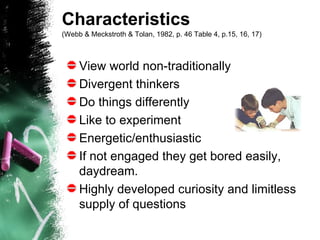
Characteristics  (Webb & Meckstroth & Tolan, 1982, p. 46 Table 4, p.15, 16, 17)   View world non-traditionally Divergent thinkers Do things differently Like to experiment Energetic/enthusiastic   If not engaged they get bored easily, daydream.  Highly developed curiosity and limitless supply of questions
Focused on personal interests  Can retain a great deal of information  Hop and skip from interest to interest – wide range of interests Not always as mature as intelligent Good vocabularies Often read earlier than most children Identify with each other Unusual sense of humour Characteristics  (Webb & Meckstroth & Tolan, 1982, p. 46 Table 4, p.15, 16, 17)
Needs  (Webb & Meckstroth & Tolan, 1982, p. 17, 29, table 3 p.36, table 6 p.67)   Guided focused supportive environment Collaborative/cooperative learning environments Teachers to work from where they are Individual needs to be met Active participation, empowerment, choices  Constructive criticism and positive reinforcement Encouragement at attempts not just success
Consistency and transparency  Passionate enthusiastic teaching with realistic high expectations Teaching that is relevant to life, interests and future  To belong, be liked by others, accepted  To feel good about themselves Respect as an individual, not just as a learner Help and opportunities to explore and recognise feelings Needs  (Webb & Meckstroth & Tolan, 1982, p. 17, 29, table 3 p.36, table 6 p.67)
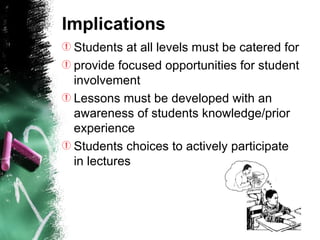
Implications Students at all levels must be catered for  provide focused opportunities for student involvement Lessons must be developed with an awareness of students knowledge/prior experience Students choices to actively participate in lectures
Creative advice Plan and organise your lecture Check what time of day your delivering your lecture Limit the lecture to 3 – 5 concepts: don’t overload State the objectives of the lecture Indicate how the lecture links in the big picture Intersperse with other teaching strategies  Lectures contextualised in student’s interests  Place yourself in the students’ position
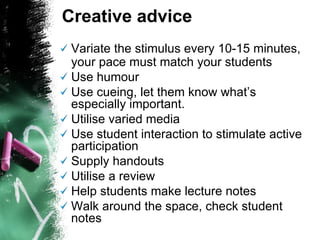
Variate the stimulus every 10-15 minutes, your pace must match your students Use humour  Use cueing, let them know what’s especially important. Utilise varied media  Use student interaction to stimulate active participation  Supply handouts Utilise a review  Help students make lecture notes  Walk around the space, check student notes Creative advice
3 Goals of the lecture Informative: provides information – content analysed into concepts/sub concepts then sequenced  Motivated: to motivate students primarily to provoke an interest in the subject Reflective/critical thinking – encourage reflection/critical thinking
Variations of the lecture   (Freiberg,2005, p.212)   Pure lecture Chalk/talk Guided note taking lecture  A/V lecture Combination lecture  Mini lecture
Main teaching steps   Freiberg, 2005, (p. 207 )   Identify 2 or 3 key concepts to be included in lecture and provide examples of concepts Prepare notes that highlight key concepts Use analogies, stories and examples to support your ideas Close lecture with summary of key points
Guidelines for lectures Content material should be presented in small steps Presentations should focus on 1 thought or idea at a time Avoid digressing during lectures Modeling should accompany lecture Best accompanied by varied and specific examples Have detailed explanations  for difficult concepts Check for student understanding before proceeding to next point Monitor progress with questions during the lecture Stay on topic until students understand
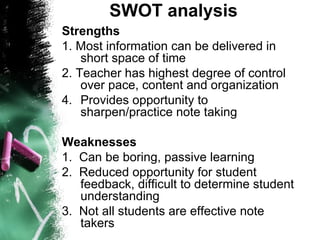
SWOT analysis  Strengths  1. Most information can be delivered in short space of time  2. Teacher has highest degree of control over pace, content and organization  Provides opportunity to sharpen/practice note taking Weaknesses 1.  Can be boring, passive learning 2.  Reduced opportunity for student feedback, difficult to determine student understanding 3.  Not all students are effective note takers
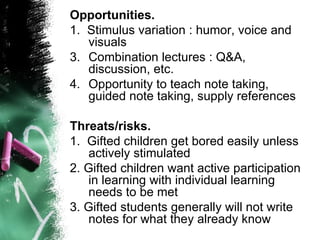
Opportunities.   1.  Stimulus variation : humor, voice and visuals  Combination lectures : Q&A, discussion, etc.  Opportunity to teach note taking, guided note taking, supply references Threats/risks. 1.  Gifted children get bored easily unless actively stimulated 2. Gifted children want active participation in learning with individual learning needs to be met 3. Gifted students generally will not write notes for what they already know
Conclusion  Reviewing what we have covered… Features of lecturing Gifted students Goals of lecturing
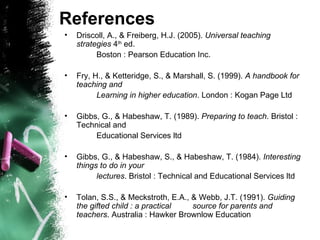
References Driscoll, A., & Freiberg, H.J. (2005).  Universal teaching strategies  4 th  ed. Boston : Pearson Education Inc.   Fry, H., & Ketteridge, S., & Marshall, S. (1999).  A handbook for teaching and  Learning in higher education . London : Kogan Page Ltd Gibbs, G., & Habeshaw, T. (1989).  Preparing to teach . Bristol : Technical and  Educational Services ltd   Gibbs, G., & Habeshaw, S., & Habeshaw, T. (1984).  Interesting things to do in your  lectures . Bristol : Technical and Educational Services ltd   Tolan, S.S., & Meckstroth, E.A., & Webb, J.T. (1991).  Guiding the gifted child : a practical  source for parents and teachers . Australia : Hawker Brownlow Education

Teaching gifted children

  • 1.
    Lecturing gifted childrenEDS 2101 Av, Ed, Jason and Aaron
  • 2.
    True or False?Successful lectures promote passive teacher-centred learning. Q&A should not be encouraged during lectures. All gifted children are geniuses. Gifted children do not require support. All students are capable of making effective notes. Lectures cannot encourage reflective thinking.
  • 3.
    Best used forlarge groups Teacher has control over : content, pace and questions Providing new information or introducing a new concept Provide the ‘big picture’ Features, why lecture?
  • 4.
    Highlighting differences/similarities orlinking concepts together Explore a lot of information in a relatively short period Provides the same point of reference for all students Creates an organized flow between different concepts in the lecture Features, why lecture?
  • 5.
    Limitations (Freiberg,p. 211) Lectures can be boring Participation limited to 12% of the total class time Difficult to determine student learning and receive feedback Students with insufficient note taking skills are disadvantaged Tendency toward passive learning (Fry, p.85) Individual student needs are rarely met or even identified
  • 6.
    Learning processes (Freiberg, p. 211) Ineffective lectures tend to… Emphasise lower level cognitive skills of memorization and recall rather than higher level thinking of synthesis and evaluation. Rarely provides opportunities for the inclusion of the psychomotor domain and affective learning.
  • 7.
    Effective lectures tendto… Provide the opportunity for students to be engaged with the topic. Promote an active learning environment, that is students take part in the lecture and contribute to the overall learning of the class. Encourage higher level learning like analytical learning and evaluative learning. Provide an affective learning experience, learning linked to a strong memory or emotional state. Learning processes (Freiberg, p. 211)
  • 8.
    Myths about giftedchildren (Webb & Meckstroth & Tolan, 1982, p. 9, Table 1) Common in public perception Everything is going their way. Can succeed without help. Their families prize their special abilities. Valued primarily for their brainpower. More stable and mature emotionally Got “something for nothing” Want to be social isolates.
  • 9.
    common among parentsand educators Not aware of being different unless someone tells them Will reveal their giftedness Giftedness needs to be emphasised Need constant challenge by others to achieve Need more discipline Assume extra responsibility for others Enjoy serving as examples for other children Myths about gifted children (Webb & Meckstroth & Tolan, 1982, p. 9, Table 1)
  • 10.
    Characteristics (Webb& Meckstroth & Tolan, 1982, p. 46 Table 4, p.15, 16, 17) View world non-traditionally Divergent thinkers Do things differently Like to experiment Energetic/enthusiastic If not engaged they get bored easily, daydream. Highly developed curiosity and limitless supply of questions
  • 11.
    Focused on personalinterests Can retain a great deal of information Hop and skip from interest to interest – wide range of interests Not always as mature as intelligent Good vocabularies Often read earlier than most children Identify with each other Unusual sense of humour Characteristics (Webb & Meckstroth & Tolan, 1982, p. 46 Table 4, p.15, 16, 17)
  • 12.
    Needs (Webb& Meckstroth & Tolan, 1982, p. 17, 29, table 3 p.36, table 6 p.67) Guided focused supportive environment Collaborative/cooperative learning environments Teachers to work from where they are Individual needs to be met Active participation, empowerment, choices Constructive criticism and positive reinforcement Encouragement at attempts not just success
  • 13.
    Consistency and transparency Passionate enthusiastic teaching with realistic high expectations Teaching that is relevant to life, interests and future To belong, be liked by others, accepted To feel good about themselves Respect as an individual, not just as a learner Help and opportunities to explore and recognise feelings Needs (Webb & Meckstroth & Tolan, 1982, p. 17, 29, table 3 p.36, table 6 p.67)
  • 14.
    Implications Students atall levels must be catered for provide focused opportunities for student involvement Lessons must be developed with an awareness of students knowledge/prior experience Students choices to actively participate in lectures
  • 15.
    Creative advice Planand organise your lecture Check what time of day your delivering your lecture Limit the lecture to 3 – 5 concepts: don’t overload State the objectives of the lecture Indicate how the lecture links in the big picture Intersperse with other teaching strategies Lectures contextualised in student’s interests Place yourself in the students’ position
  • 16.
    Variate the stimulusevery 10-15 minutes, your pace must match your students Use humour Use cueing, let them know what’s especially important. Utilise varied media Use student interaction to stimulate active participation Supply handouts Utilise a review Help students make lecture notes Walk around the space, check student notes Creative advice
  • 17.
    3 Goals ofthe lecture Informative: provides information – content analysed into concepts/sub concepts then sequenced Motivated: to motivate students primarily to provoke an interest in the subject Reflective/critical thinking – encourage reflection/critical thinking
  • 18.
    Variations of thelecture (Freiberg,2005, p.212) Pure lecture Chalk/talk Guided note taking lecture A/V lecture Combination lecture Mini lecture
  • 19.
    Main teaching steps Freiberg, 2005, (p. 207 ) Identify 2 or 3 key concepts to be included in lecture and provide examples of concepts Prepare notes that highlight key concepts Use analogies, stories and examples to support your ideas Close lecture with summary of key points
  • 20.
    Guidelines for lecturesContent material should be presented in small steps Presentations should focus on 1 thought or idea at a time Avoid digressing during lectures Modeling should accompany lecture Best accompanied by varied and specific examples Have detailed explanations for difficult concepts Check for student understanding before proceeding to next point Monitor progress with questions during the lecture Stay on topic until students understand
  • 21.
    SWOT analysis Strengths 1. Most information can be delivered in short space of time 2. Teacher has highest degree of control over pace, content and organization Provides opportunity to sharpen/practice note taking Weaknesses 1. Can be boring, passive learning 2. Reduced opportunity for student feedback, difficult to determine student understanding 3. Not all students are effective note takers
  • 22.
    Opportunities. 1. Stimulus variation : humor, voice and visuals Combination lectures : Q&A, discussion, etc. Opportunity to teach note taking, guided note taking, supply references Threats/risks. 1. Gifted children get bored easily unless actively stimulated 2. Gifted children want active participation in learning with individual learning needs to be met 3. Gifted students generally will not write notes for what they already know
  • 23.
    Conclusion Reviewingwhat we have covered… Features of lecturing Gifted students Goals of lecturing
  • 24.
    References Driscoll, A.,& Freiberg, H.J. (2005). Universal teaching strategies 4 th ed. Boston : Pearson Education Inc.   Fry, H., & Ketteridge, S., & Marshall, S. (1999). A handbook for teaching and Learning in higher education . London : Kogan Page Ltd Gibbs, G., & Habeshaw, T. (1989). Preparing to teach . Bristol : Technical and Educational Services ltd   Gibbs, G., & Habeshaw, S., & Habeshaw, T. (1984). Interesting things to do in your lectures . Bristol : Technical and Educational Services ltd   Tolan, S.S., & Meckstroth, E.A., & Webb, J.T. (1991). Guiding the gifted child : a practical source for parents and teachers . Australia : Hawker Brownlow Education