Giftedness and Talent Development Chapter 7
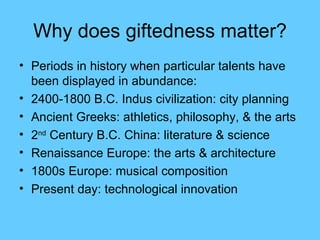
Why does giftedness matter? Periods in history when particular talents have been displayed in abundance: 2400-1800 B.C. Indus civilization: city planning Ancient Greeks: athletics, philosophy, & the arts 2 nd  Century B.C. China: literature & science Renaissance Europe: the arts & architecture 1800s Europe: musical composition Present day: technological innovation
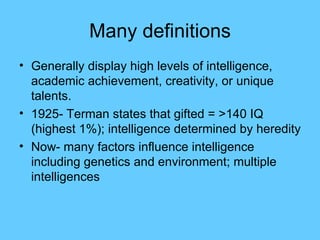
Many definitions Generally display high levels of intelligence, academic achievement, creativity, or unique talents. 1925- Terman states that gifted = >140 IQ (highest 1%); intelligence determined by heredity Now- many factors influence intelligence including genetics and environment; multiple intelligences
Jacob K. Javits Gifted and Talented Students Education Act of 1988 Children and youth with outstanding talent perform or show the potential for performing at remarkably high levels of accomplishment when compared with others of their age, experience, or environment.  These children and youth exhibit high performance capability in intellectual, creative, and/or artistic areas, possess an unusual leadership capacity, or excel in specific academic fields.  They require services or activities not ordinarily provided by the schools.  Outstanding talents are present in children and youth from all cultural groups, across all economic strata, and in all areas of human endeavor.  (U.S. Department of Education, 1994, p. 26.)
Giftedness  and  Talent Development Focus is shifting to development of talents, rather than fixed idea of giftedness. IQ tests are still primarily used to determine eligibility for programs, though they exclude some diverse children and children with disabilities. Look for: curiosity, rapid rates of development, extensive vocabulary, motivation, inquisitiveness, keen observation, creativity, thoughtfulness, and innovativeness.
Educational Impact Not everyone agrees that gifted students should have special programs; not included in IDEA. Envy and negative attitudes can lead to underachievement and dropping out. Regular educational programs do not always meet gifted students’ needs: Unchallenging curriculum Instructional pace too slow Too much mastered information is repeated Personal study is not a focus Facts, not thinking skills, are emphasized
History of the Field Exceptional students have long been recognized and trained in specific fields, depending on what was valued most in the culture. Charles Darwin and Sir Francis Galton (mid-1800s) studied differences among people concerning intelligence and heredity 1800s- egalitarianism: equal opportunities for all, special treatment for none. 1905- Binet Intelligence Test was developed 1920s- Leta Hollingworth taught the first class and wrote the first textbook in the area at Teachers College, Columbia University.  Giftedness= heredity + environment.
History of the Field 1957- SPUTNIK!!!!!!  (USA officially freaks out.) US uses federal funds to establish programs, identify high achievers, and research effective educational methods, especially in math and science.  Gifted students viewed as national resource. 60s & 70s- downturn; focus on underpriviledged 1980s- Jacob K. Javits Gifted and Talented Students Education Act
Prevalence Exact numbers are unknown because states are not required to report statistics, and not all states have programs. Less than 3% of children receive gifted education- less than it should be! 25 states mandate that gifted education be offered. Diverse populations grossly underrepresented. School culture and peer relationships can affect development and achievement. Creativity is not encouraged or recognized as it should be. Need for acceptance sometimes represses giftedness.
Common Characteristics  p. 235 Intellectual/Academic Reasons abstractly Solves problems Learns quickly Shows intellectual curiosity Adapts to new learning situations Dislikes drill and routine Displays high level of verbal ability Uses nonstandard pools of information Has wide interests Social/Emotional Criticizes self Empathizes Is intense Exhibits individualism Has strength of character Demonstrates leadership abilities Takes risks Is independent and autonomous Strives for perfection Is nonconforming
Subgroups Gifted Females : mostly based on societal gender bias Culturally and Linguistically Diverse Gifted Students : testing methods are unfair; gifted education not available in certain (poverty-stricken) areas, low expectations. Gifted Students with Disabilities : twice exceptional (now included in IDEA 2004); traditionally not allowed sufficient accommodations Gifted Students with ADHD : more focus on negative qualities masks intellectual giftedness
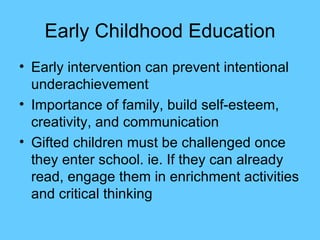
Early Childhood Education Early intervention can prevent intentional underachievement Importance of family, build self-esteem, creativity, and communication Gifted children must be challenged once they enter school. ie. If they can already read, engage them in enrichment activities and critical thinking
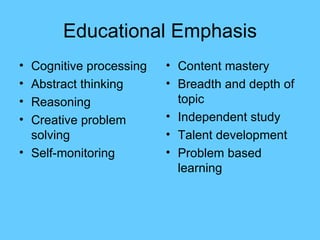
Educational Emphasis Cognitive processing Abstract thinking Reasoning Creative problem solving Self-monitoring Content mastery Breadth and depth of topic Independent study Talent development Problem based learning
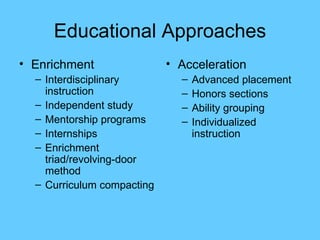
Educational Approaches Enrichment Interdisciplinary instruction Independent study Mentorship programs Internships Enrichment triad/revolving-door method Curriculum compacting Acceleration Advanced placement Honors sections Ability grouping Individualized instruction
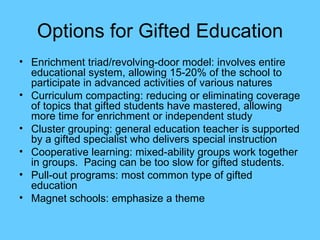
Options for Gifted Education Enrichment triad/revolving-door model: involves entire educational system, allowing 15-20% of the school to participate in advanced activities of various natures Curriculum compacting: reducing or eliminating coverage of topics that gifted students have mastered, allowing more time for enrichment or independent study Cluster grouping: general education teacher is supported by a gifted specialist who delivers special instruction Cooperative learning: mixed-ability groups work together in groups.  Pacing can be too slow for gifted students. Pull-out programs: most common type of gifted education Magnet schools: emphasize a theme
Success for the Gifted Special focus must be placed on gifted students with disabilities and those from diverse backgrounds.  Collaboration with others can make a difference. Unexpectedly high percentage of gifted students drop out of school.  College and career counseling is encouraged. Families’ role extremely important.  Learning must be valued and realistic expectations set. Infusing technology into curriculum allows for increased access to information.

Chapter 7 Ppt

  • 1.
    Giftedness and TalentDevelopment Chapter 7
  • 2.
    Why does giftednessmatter? Periods in history when particular talents have been displayed in abundance: 2400-1800 B.C. Indus civilization: city planning Ancient Greeks: athletics, philosophy, & the arts 2 nd Century B.C. China: literature & science Renaissance Europe: the arts & architecture 1800s Europe: musical composition Present day: technological innovation
  • 3.
    Many definitions Generallydisplay high levels of intelligence, academic achievement, creativity, or unique talents. 1925- Terman states that gifted = >140 IQ (highest 1%); intelligence determined by heredity Now- many factors influence intelligence including genetics and environment; multiple intelligences
  • 4.
    Jacob K. JavitsGifted and Talented Students Education Act of 1988 Children and youth with outstanding talent perform or show the potential for performing at remarkably high levels of accomplishment when compared with others of their age, experience, or environment. These children and youth exhibit high performance capability in intellectual, creative, and/or artistic areas, possess an unusual leadership capacity, or excel in specific academic fields. They require services or activities not ordinarily provided by the schools. Outstanding talents are present in children and youth from all cultural groups, across all economic strata, and in all areas of human endeavor. (U.S. Department of Education, 1994, p. 26.)
  • 5.
    Giftedness and Talent Development Focus is shifting to development of talents, rather than fixed idea of giftedness. IQ tests are still primarily used to determine eligibility for programs, though they exclude some diverse children and children with disabilities. Look for: curiosity, rapid rates of development, extensive vocabulary, motivation, inquisitiveness, keen observation, creativity, thoughtfulness, and innovativeness.
  • 6.
    Educational Impact Noteveryone agrees that gifted students should have special programs; not included in IDEA. Envy and negative attitudes can lead to underachievement and dropping out. Regular educational programs do not always meet gifted students’ needs: Unchallenging curriculum Instructional pace too slow Too much mastered information is repeated Personal study is not a focus Facts, not thinking skills, are emphasized
  • 7.
    History of theField Exceptional students have long been recognized and trained in specific fields, depending on what was valued most in the culture. Charles Darwin and Sir Francis Galton (mid-1800s) studied differences among people concerning intelligence and heredity 1800s- egalitarianism: equal opportunities for all, special treatment for none. 1905- Binet Intelligence Test was developed 1920s- Leta Hollingworth taught the first class and wrote the first textbook in the area at Teachers College, Columbia University. Giftedness= heredity + environment.
  • 8.
    History of theField 1957- SPUTNIK!!!!!! (USA officially freaks out.) US uses federal funds to establish programs, identify high achievers, and research effective educational methods, especially in math and science. Gifted students viewed as national resource. 60s & 70s- downturn; focus on underpriviledged 1980s- Jacob K. Javits Gifted and Talented Students Education Act
  • 9.
    Prevalence Exact numbersare unknown because states are not required to report statistics, and not all states have programs. Less than 3% of children receive gifted education- less than it should be! 25 states mandate that gifted education be offered. Diverse populations grossly underrepresented. School culture and peer relationships can affect development and achievement. Creativity is not encouraged or recognized as it should be. Need for acceptance sometimes represses giftedness.
  • 10.
    Common Characteristics p. 235 Intellectual/Academic Reasons abstractly Solves problems Learns quickly Shows intellectual curiosity Adapts to new learning situations Dislikes drill and routine Displays high level of verbal ability Uses nonstandard pools of information Has wide interests Social/Emotional Criticizes self Empathizes Is intense Exhibits individualism Has strength of character Demonstrates leadership abilities Takes risks Is independent and autonomous Strives for perfection Is nonconforming
  • 11.
    Subgroups Gifted Females: mostly based on societal gender bias Culturally and Linguistically Diverse Gifted Students : testing methods are unfair; gifted education not available in certain (poverty-stricken) areas, low expectations. Gifted Students with Disabilities : twice exceptional (now included in IDEA 2004); traditionally not allowed sufficient accommodations Gifted Students with ADHD : more focus on negative qualities masks intellectual giftedness
  • 12.
    Early Childhood EducationEarly intervention can prevent intentional underachievement Importance of family, build self-esteem, creativity, and communication Gifted children must be challenged once they enter school. ie. If they can already read, engage them in enrichment activities and critical thinking
  • 13.
    Educational Emphasis Cognitiveprocessing Abstract thinking Reasoning Creative problem solving Self-monitoring Content mastery Breadth and depth of topic Independent study Talent development Problem based learning
  • 14.
    Educational Approaches EnrichmentInterdisciplinary instruction Independent study Mentorship programs Internships Enrichment triad/revolving-door method Curriculum compacting Acceleration Advanced placement Honors sections Ability grouping Individualized instruction
  • 15.
    Options for GiftedEducation Enrichment triad/revolving-door model: involves entire educational system, allowing 15-20% of the school to participate in advanced activities of various natures Curriculum compacting: reducing or eliminating coverage of topics that gifted students have mastered, allowing more time for enrichment or independent study Cluster grouping: general education teacher is supported by a gifted specialist who delivers special instruction Cooperative learning: mixed-ability groups work together in groups. Pacing can be too slow for gifted students. Pull-out programs: most common type of gifted education Magnet schools: emphasize a theme
  • 16.
    Success for theGifted Special focus must be placed on gifted students with disabilities and those from diverse backgrounds. Collaboration with others can make a difference. Unexpectedly high percentage of gifted students drop out of school. College and career counseling is encouraged. Families’ role extremely important. Learning must be valued and realistic expectations set. Infusing technology into curriculum allows for increased access to information.