Students of Talent SCIS Parent Forum February, 2009
Two Types of Giftedness Schoolhouse or lesson-learning giftedness Creative/Productive giftedness
Conservative vs. Liberal Identification Methods Conservative IQ/Cognitive test scores only Top 1%-5% of student population Liberal Multiple identification criteria Top 10%-15% of student population More inclusive
Factors Influencing “Gifted” Behavior Personality Factors Perception of Self Self-Efficacy Courage Intuition Charm/Charisma Need for Achievement Ego Strength Energy Sense of Destiny Environmental Factors Parental Personalities Education of Parents Stimulation of Childhood Interests Formal Education Role Model Availability Physical Illness and/or Well Being Chance Factors
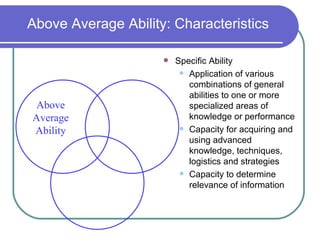
General Ability High levels of abstract thinking, verbal & numerical reasoning, spatial relations, memory and word fluency Adapts to novel situations Automization of information processing; rapid, accurate & selective retrieval of information Above Average Ability: Characteristics Above Average Ability
Above Average Ability: Characteristics Specific Ability Application of various combinations of general abilities to one or more specialized areas of knowledge or performance Capacity for acquiring and using advanced knowledge, techniques, logistics and strategies Capacity to determine relevance of information Above Average Ability
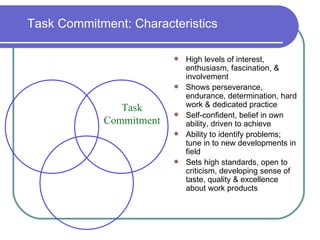
Task Commitment: Characteristics High levels of interest, enthusiasm, fascination, & involvement Shows perseverance, endurance, determination, hard work & dedicated practice Self-confident, belief in own ability, driven to achieve Ability to identify problems; tune in to new developments in field Sets high standards, open to criticism, developing sense of taste, quality & excellence about work products Task Commitment
Creativity: Characteristics Fluency, flexibility & originality of thought Openness to experience; receptive to new and different thoughts, actions & products Curious, speculative, adventurous, and “mentally playful”; willing to take risks in thought and action; uninhibited Sensitive to detail, aesthetic characteristics of ideas and things; willing to act on and react to external stimulation and own ideas and feelings Creativity
Three Ring Conception of Giftedness Giftedness Is Evident
Giftedness Appears… Under Certain Circumstances In Certain People At Certain Times C A U I C T P
Continuum of Ideologies Traditional Gifted Students Formal Identification Grouping by Ability “ Society has much to gain from examining its most evolved.” “ There is nothing so unequal as the equal treatment of unequal.” Emerging Gifted Behaviors Flexible Identification Grouping by Interests, Motivation, Learning Styles “ Every student is special if we find opportunities to make that student a specialist…” “ Giftedness is in the ways in which students respond to advanced opportunities and encouragement.
What does the term “gifted” mean to you? Intelligent Gifted Talented Creative Every  child has gifts, but not every child is “gifted”.
“ Many gifted kids and adults have a heightened sensitivity to their surroundings, to events, to ideas, and to expectations, including relentless pressure to excel.”   -Martha Kaufeldt
Keeping Gifted Children Challenged… Research indicates that parents’ perceptions of their children’s talents are usually accurate. “… if adults don’t make accommodations to challenge their gifted children at home, it gives children a message that academic challenge is a lesser priority than social conformity and that hard work is unimportant.” Dr. Sylvia Rimm
“ Parent Pointers”  by Dr. Sylvia Rimm: http://www.sylviarimm.com/ “ Try some positive achievement messages about your work to inspire your gifted children to become hard workers”: “ It’s been a hard day, but a good day.” “ I really helped someone today.” “ My education really paid off.  I’m doing a job I enjoy.” “ This may not be an ideal job, but I’m learning many things. “ Your Dad/Mom is really respected for his/her work.” “ I guess you have to pay your dues.  I don’t mind doing a little extra.” “ Let me tell you about my interesting day...” “ It feels good to make a difference.” “ I don’t know how your Mom/Dad does it all— PAFA, great cook, a college student, and a great wife/husband.  You’re lucky kids.”
It is important that we educate our family, friends, and community, the best way we can, on what “giftedness” means.  Giftedness does not mean one child is better than another, it simply means gifted children have special needs and that we are partners in meeting those needs in flexible and appropriate ways.
Links Davidson Institute www.gt-cybersource.org John Hopkins Link  http://cty.jhu.edu/research/research.html Supporting Emotional Needs http://www.sengifted.org/ Davidson Institute for Talent Development http://www.davidsongifted.org/youngscholars/ About.com – Good compilation of links http://giftedkids.about.com/

Talent Identification

  • 1.
    Students of TalentSCIS Parent Forum February, 2009
  • 2.
    Two Types ofGiftedness Schoolhouse or lesson-learning giftedness Creative/Productive giftedness
  • 3.
    Conservative vs. LiberalIdentification Methods Conservative IQ/Cognitive test scores only Top 1%-5% of student population Liberal Multiple identification criteria Top 10%-15% of student population More inclusive
  • 4.
    Factors Influencing “Gifted”Behavior Personality Factors Perception of Self Self-Efficacy Courage Intuition Charm/Charisma Need for Achievement Ego Strength Energy Sense of Destiny Environmental Factors Parental Personalities Education of Parents Stimulation of Childhood Interests Formal Education Role Model Availability Physical Illness and/or Well Being Chance Factors
  • 5.
    General Ability Highlevels of abstract thinking, verbal & numerical reasoning, spatial relations, memory and word fluency Adapts to novel situations Automization of information processing; rapid, accurate & selective retrieval of information Above Average Ability: Characteristics Above Average Ability
  • 6.
    Above Average Ability:Characteristics Specific Ability Application of various combinations of general abilities to one or more specialized areas of knowledge or performance Capacity for acquiring and using advanced knowledge, techniques, logistics and strategies Capacity to determine relevance of information Above Average Ability
  • 7.
    Task Commitment: CharacteristicsHigh levels of interest, enthusiasm, fascination, & involvement Shows perseverance, endurance, determination, hard work & dedicated practice Self-confident, belief in own ability, driven to achieve Ability to identify problems; tune in to new developments in field Sets high standards, open to criticism, developing sense of taste, quality & excellence about work products Task Commitment
  • 8.
    Creativity: Characteristics Fluency,flexibility & originality of thought Openness to experience; receptive to new and different thoughts, actions & products Curious, speculative, adventurous, and “mentally playful”; willing to take risks in thought and action; uninhibited Sensitive to detail, aesthetic characteristics of ideas and things; willing to act on and react to external stimulation and own ideas and feelings Creativity
  • 9.
    Three Ring Conceptionof Giftedness Giftedness Is Evident
  • 10.
    Giftedness Appears… UnderCertain Circumstances In Certain People At Certain Times C A U I C T P
  • 11.
    Continuum of IdeologiesTraditional Gifted Students Formal Identification Grouping by Ability “ Society has much to gain from examining its most evolved.” “ There is nothing so unequal as the equal treatment of unequal.” Emerging Gifted Behaviors Flexible Identification Grouping by Interests, Motivation, Learning Styles “ Every student is special if we find opportunities to make that student a specialist…” “ Giftedness is in the ways in which students respond to advanced opportunities and encouragement.
  • 12.
    What does theterm “gifted” mean to you? Intelligent Gifted Talented Creative Every child has gifts, but not every child is “gifted”.
  • 13.
    “ Many giftedkids and adults have a heightened sensitivity to their surroundings, to events, to ideas, and to expectations, including relentless pressure to excel.” -Martha Kaufeldt
  • 14.
    Keeping Gifted ChildrenChallenged… Research indicates that parents’ perceptions of their children’s talents are usually accurate. “… if adults don’t make accommodations to challenge their gifted children at home, it gives children a message that academic challenge is a lesser priority than social conformity and that hard work is unimportant.” Dr. Sylvia Rimm
  • 15.
    “ Parent Pointers” by Dr. Sylvia Rimm: http://www.sylviarimm.com/ “ Try some positive achievement messages about your work to inspire your gifted children to become hard workers”: “ It’s been a hard day, but a good day.” “ I really helped someone today.” “ My education really paid off. I’m doing a job I enjoy.” “ This may not be an ideal job, but I’m learning many things. “ Your Dad/Mom is really respected for his/her work.” “ I guess you have to pay your dues. I don’t mind doing a little extra.” “ Let me tell you about my interesting day...” “ It feels good to make a difference.” “ I don’t know how your Mom/Dad does it all— PAFA, great cook, a college student, and a great wife/husband. You’re lucky kids.”
  • 16.
    It is importantthat we educate our family, friends, and community, the best way we can, on what “giftedness” means. Giftedness does not mean one child is better than another, it simply means gifted children have special needs and that we are partners in meeting those needs in flexible and appropriate ways.
  • 17.
    Links Davidson Institutewww.gt-cybersource.org John Hopkins Link http://cty.jhu.edu/research/research.html Supporting Emotional Needs http://www.sengifted.org/ Davidson Institute for Talent Development http://www.davidsongifted.org/youngscholars/ About.com – Good compilation of links http://giftedkids.about.com/