Learning Disabilities
What is a learning disability?
Having trouble:
Processing information
Organizing information
Applying information
Types of Learning Disabilities
 Dyslexia
A language and reading disability
 Dyscalculia
Problems with arithmetic and math concepts
 Dysgraphia
A writing disorder resulting in illegibility
 Dyspraxia (Sensory Integration Disorder)
Problems with motor coordination
Types of Learning Disabilities
 Central Auditory Processing Disorder
Difficulty processing and remembering language-related
tasks
 Non-Verbal Learning Disorders
Trouble with nonverbal cues, e.g., body language; poor
coordination, clumsy
 Visual Perceptual/Visual Motor Deficit
Reverses letters; cannot copy accurately;
 Language Disorders (Aphasia/Dysphasia)
Trouble understanding spoken language; poor reading
comprehension
Causes or Presumed causes of
Learning Disabilities
NO real causes
Might be caused by:
Hereditary
Teratogenic
Medical
Environmental
Incidence Rates
Estimated 15 % of the U.S. population
6 % to 8 % of school age population
Not a Learning Disability
• Visual
• Hearing
• Motor disabilities
• Mental retardation
• Emotional disturbance
• Environmental, cultural, or economic
disadvantage
Does my student have ADD or
ADHD?
 Hyperactive
 Impulsive
 Fidgety
 Inattentive
 Disorganized
 Unreasonable
emotional negativity
 Emotional outbursts
 Frustration over
minor issues
 Bedwetting
 (All characteristics may vary
with age)
Approaches to diagnose ADD and
ADHD
Evaluate student’s behavior
Continuous performance test (CPT)
Diagnosis should be based on multiple
pieces of information and observations
Approaches used to diagnose
dyslexia
Today, only after a student has reading
difficulties can dyslexia be diagnosed
Dyslexia may have “biological roots”
Psychological testing can determine if a
child has dyslexia
Characteristics of Learning
Disabilities
 Most students exhibit uneven areas of ability
 Student is physically “normal”
 Average or above average intelligence
 Commonly found in general education classes:
dyslexia and ADD/ADHD
 Many LDs need to be medically diagnosed
Does the child have dyslexia?
Reading characteristics
Writing characteristics
Numbers/Sequencing
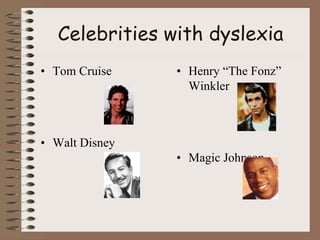
Celebrities with dyslexia
• Tom Cruise
• Walt Disney
• Henry “The Fonz”
Winkler
• Magic Johnson
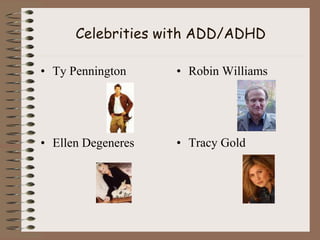
Celebrities with ADD/ADHD
• Ty Pennington
• Ellen Degeneres
• Robin Williams
• Tracy Gold
INSTRUCTIONAL IDEAS:
ASSISTANCE WITH AUDIO AND VISUAL
ASPECTS OF LEARNING
Teachers may find the following helpful:
Repeat and summarize oral lecture notes and give
students written versions of key points.
Verbalize what is being written on the chalkboard and
read aloud the material contained in handouts.
Send students a copy of booklist for upcoming
semester/school year so that students can “get a jump
on” the reading assignments.
ASSISTANCE DURING
ASSESSMENTS:
The teacher may wish to:
Choose an alternate exam site away from the general
education classroom. Ensure that this alternate locale
is free from auditory and visual distracters.
Avoid confusing or complicated language and/or
consider a substitute exam/assessment.
Allow student extra time to complete
exams/assignments, especially if there are unique
demands regarding reading and writing skills.
ADDITIONAL
INSTRUCTIONAL IDEAS
Teachers should:
Supporting learning with visuals
Stressing step-by-step instructions
For students with ADHD, teachers should:
Give only one assignment at a time.
TECHNOLOGY USED
COMPUTERS:
For writing assignments, students with LD should be
allowed to use a computer (if available) so that they
can get spelling support through the spell check
program.
Students with dyslexia may find that writing
assignments are more easily completed on a computer.
Consider trying computer software, like Kurzweil
3000, which reads textbooks and other materials to
students.
OTHER ASSISTIVE
TECHNOLOGY
Teachers may:
Allow students to use calculators during Math, when
the goal is concept attainment (and not automaticity of
math facts)
Allow students to tape record lectures and/or tape
notes for students.
Allow students who cannot speak clearly to use a
speech synthesizer
Assessment:
Allow for alternate forms of assessment by allowing
students to demonstrate learning through such things
as portfolios, slide presentations, photographic essays,
or taped interviews.
INTERESTING FACTS
EMOTIONAL ISSUES
 Students with learning disabilities may suffer from
emotional problems/depression, and/or low
self-esteem. This may cause students to withdraw
from social interaction.
 These same students may turn to drugs or alcohol for relief
from feelings of low self-worth.
 As many as 35% of students with learning disorders,
drop out of High School (Girod, 2001, p. 31).
 “Teenagers with dyslexia …[are] more likely to…think about
and to attempt suicide than other young people their age” (Landau, 2004,
pp. 48-9).
Additional Resources
• Learning Disabilities Association of America
4156 Library Road
Pittsburgh, PA 15234
(412) 341-1515
• President's Committee on Employment of People with Disabilities
1331 F Street, N.W.
Washington, DC 20004
(202) 376-6200
• National Center for Law and Learning Disabilities
P.O. Box 368
Cabin John, MD 20818
(301) 469-8308
• http://www.ldonline.org/
• http://www.iser.com/index.shtml
• http://www.childdevelopmentinfo.com/learning/learning_disabilities.shtml
• http://www.starbeacon.com/index.asp?MC=NEXT&NID=4&AID=3767
Resourceshttp://www.odc.state.or.us/tadoc/ada40.htm
http://65.54.187.250/cgibin/linkrd?_lang=EN&lah=d0b0b9bbf10d4f4426ce5e44a90e1454&lat=1084
629747&hm___action=http%3a%2f%2fericec%2eorg%2ffact%2ffamous%2ehtml
http://www.addforums.com/forums/showthread/t-4159.html
Flynn, M. & Flynn, P. (1998). Thinking about having a learning disability. London:
Belitha Press.
Girod, C. M. (2001). Diseases and disorders: Learning disabilities. San Diego: Lucent
Books.
Landau, E. (2004). Dyslexia. New York: Franklin Watts.
Silverstein, A., Silverstein V., & Silverstein Nunn, L. (2001). Dyslexia. New York:
Franklin Watts.
"How Not to Diagnose ADHD" Contemporary Pediatrics Archive, Nov. 1996 by Martin Baren MD,
James Swanson, PhD
"The Clinical Characteristics of Behaviors of ADD/ADHD People Vary with Age" ADD Medical
Treatment Center of Santa Clara valley
The Gardner School online site. www.gardnerschool.org
"Georgetown researchers to present evidence of biological cause of dyslexia" Press release Feb
14, 2001. Georgetown University Medical Center
Learning Disabilities Association of America www.ldanatl.org
The International Dyslexia Society, www.interdys.org

learning disability

  • 1.
  • 2.
    What is alearning disability? Having trouble: Processing information Organizing information Applying information
  • 3.
    Types of LearningDisabilities  Dyslexia A language and reading disability  Dyscalculia Problems with arithmetic and math concepts  Dysgraphia A writing disorder resulting in illegibility  Dyspraxia (Sensory Integration Disorder) Problems with motor coordination
  • 4.
    Types of LearningDisabilities  Central Auditory Processing Disorder Difficulty processing and remembering language-related tasks  Non-Verbal Learning Disorders Trouble with nonverbal cues, e.g., body language; poor coordination, clumsy  Visual Perceptual/Visual Motor Deficit Reverses letters; cannot copy accurately;  Language Disorders (Aphasia/Dysphasia) Trouble understanding spoken language; poor reading comprehension
  • 5.
    Causes or Presumedcauses of Learning Disabilities NO real causes Might be caused by: Hereditary Teratogenic Medical Environmental
  • 6.
    Incidence Rates Estimated 15% of the U.S. population 6 % to 8 % of school age population
  • 7.
    Not a LearningDisability • Visual • Hearing • Motor disabilities • Mental retardation • Emotional disturbance • Environmental, cultural, or economic disadvantage
  • 8.
    Does my studenthave ADD or ADHD?  Hyperactive  Impulsive  Fidgety  Inattentive  Disorganized  Unreasonable emotional negativity  Emotional outbursts  Frustration over minor issues  Bedwetting  (All characteristics may vary with age)
  • 9.
    Approaches to diagnoseADD and ADHD Evaluate student’s behavior Continuous performance test (CPT) Diagnosis should be based on multiple pieces of information and observations
  • 10.
    Approaches used todiagnose dyslexia Today, only after a student has reading difficulties can dyslexia be diagnosed Dyslexia may have “biological roots” Psychological testing can determine if a child has dyslexia
  • 11.
    Characteristics of Learning Disabilities Most students exhibit uneven areas of ability  Student is physically “normal”  Average or above average intelligence  Commonly found in general education classes: dyslexia and ADD/ADHD  Many LDs need to be medically diagnosed
  • 12.
    Does the childhave dyslexia? Reading characteristics Writing characteristics Numbers/Sequencing
  • 13.
    Celebrities with dyslexia •Tom Cruise • Walt Disney • Henry “The Fonz” Winkler • Magic Johnson
  • 14.
    Celebrities with ADD/ADHD •Ty Pennington • Ellen Degeneres • Robin Williams • Tracy Gold
  • 15.
    INSTRUCTIONAL IDEAS: ASSISTANCE WITHAUDIO AND VISUAL ASPECTS OF LEARNING Teachers may find the following helpful: Repeat and summarize oral lecture notes and give students written versions of key points. Verbalize what is being written on the chalkboard and read aloud the material contained in handouts. Send students a copy of booklist for upcoming semester/school year so that students can “get a jump on” the reading assignments.
  • 16.
    ASSISTANCE DURING ASSESSMENTS: The teachermay wish to: Choose an alternate exam site away from the general education classroom. Ensure that this alternate locale is free from auditory and visual distracters. Avoid confusing or complicated language and/or consider a substitute exam/assessment. Allow student extra time to complete exams/assignments, especially if there are unique demands regarding reading and writing skills.
  • 17.
    ADDITIONAL INSTRUCTIONAL IDEAS Teachers should: Supportinglearning with visuals Stressing step-by-step instructions For students with ADHD, teachers should: Give only one assignment at a time.
  • 18.
    TECHNOLOGY USED COMPUTERS: For writingassignments, students with LD should be allowed to use a computer (if available) so that they can get spelling support through the spell check program. Students with dyslexia may find that writing assignments are more easily completed on a computer. Consider trying computer software, like Kurzweil 3000, which reads textbooks and other materials to students.
  • 19.
    OTHER ASSISTIVE TECHNOLOGY Teachers may: Allowstudents to use calculators during Math, when the goal is concept attainment (and not automaticity of math facts) Allow students to tape record lectures and/or tape notes for students. Allow students who cannot speak clearly to use a speech synthesizer Assessment: Allow for alternate forms of assessment by allowing students to demonstrate learning through such things as portfolios, slide presentations, photographic essays, or taped interviews.
  • 20.
    INTERESTING FACTS EMOTIONAL ISSUES Students with learning disabilities may suffer from emotional problems/depression, and/or low self-esteem. This may cause students to withdraw from social interaction.  These same students may turn to drugs or alcohol for relief from feelings of low self-worth.  As many as 35% of students with learning disorders, drop out of High School (Girod, 2001, p. 31).  “Teenagers with dyslexia …[are] more likely to…think about and to attempt suicide than other young people their age” (Landau, 2004, pp. 48-9).
  • 21.
    Additional Resources • LearningDisabilities Association of America 4156 Library Road Pittsburgh, PA 15234 (412) 341-1515 • President's Committee on Employment of People with Disabilities 1331 F Street, N.W. Washington, DC 20004 (202) 376-6200 • National Center for Law and Learning Disabilities P.O. Box 368 Cabin John, MD 20818 (301) 469-8308 • http://www.ldonline.org/ • http://www.iser.com/index.shtml • http://www.childdevelopmentinfo.com/learning/learning_disabilities.shtml • http://www.starbeacon.com/index.asp?MC=NEXT&NID=4&AID=3767
  • 22.
    Resourceshttp://www.odc.state.or.us/tadoc/ada40.htm http://65.54.187.250/cgibin/linkrd?_lang=EN&lah=d0b0b9bbf10d4f4426ce5e44a90e1454&lat=1084 629747&hm___action=http%3a%2f%2fericec%2eorg%2ffact%2ffamous%2ehtml http://www.addforums.com/forums/showthread/t-4159.html Flynn, M. &Flynn, P. (1998). Thinking about having a learning disability. London: Belitha Press. Girod, C. M. (2001). Diseases and disorders: Learning disabilities. San Diego: Lucent Books. Landau, E. (2004). Dyslexia. New York: Franklin Watts. Silverstein, A., Silverstein V., & Silverstein Nunn, L. (2001). Dyslexia. New York: Franklin Watts. "How Not to Diagnose ADHD" Contemporary Pediatrics Archive, Nov. 1996 by Martin Baren MD, James Swanson, PhD "The Clinical Characteristics of Behaviors of ADD/ADHD People Vary with Age" ADD Medical Treatment Center of Santa Clara valley The Gardner School online site. www.gardnerschool.org "Georgetown researchers to present evidence of biological cause of dyslexia" Press release Feb 14, 2001. Georgetown University Medical Center Learning Disabilities Association of America www.ldanatl.org The International Dyslexia Society, www.interdys.org