Social/Emotional Issues  of  Gifted Children
Outline Definition of giftedness Identification of gifted individuals Nature of gifted individuals Maladjustment (Social/Emotional Issues) Recommendations
Definition of  Gifted
Gifted Being born with a quality or trait valued by one’s society
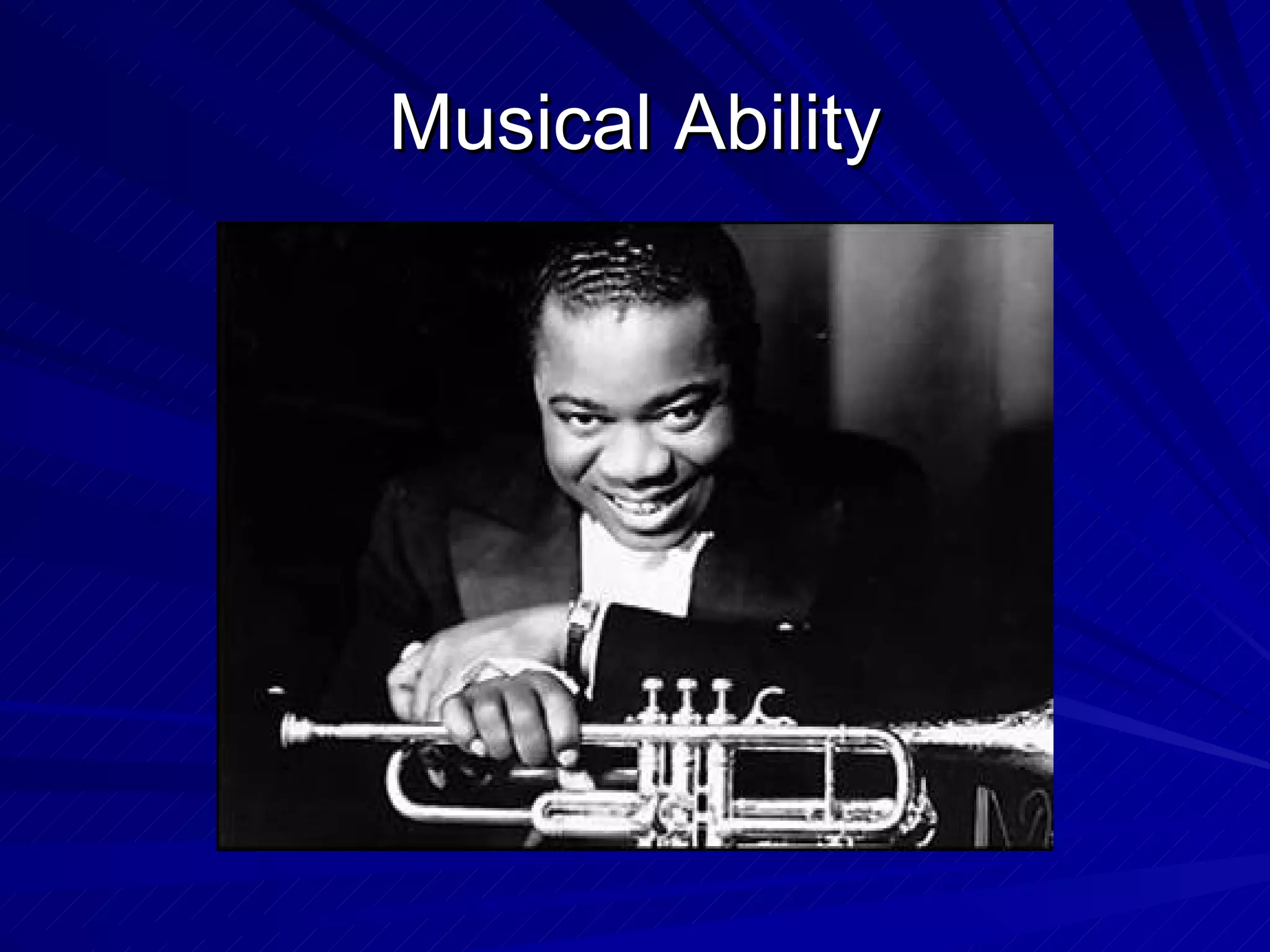
Musical Ability
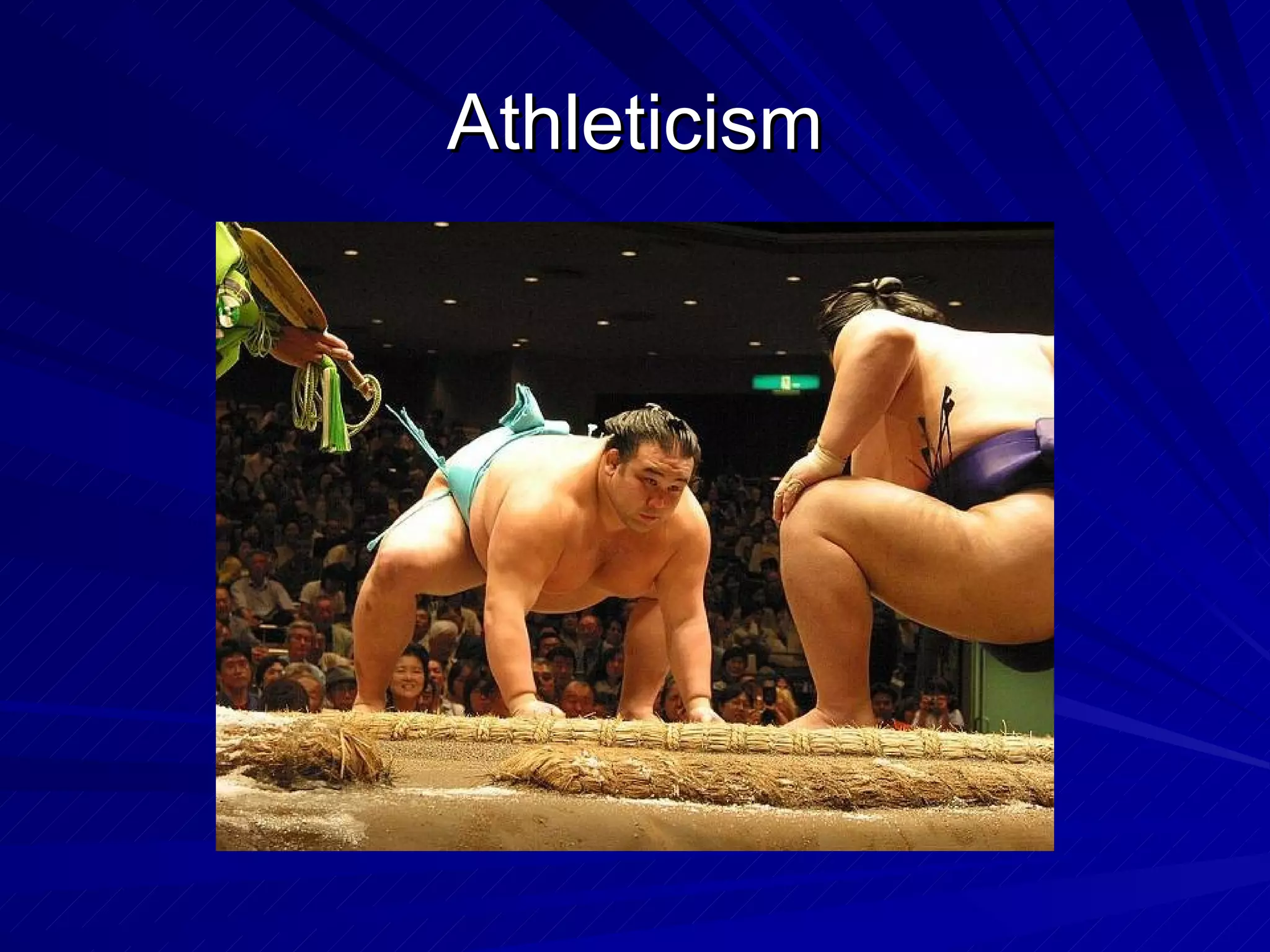
Athleticism
Physical Beauty
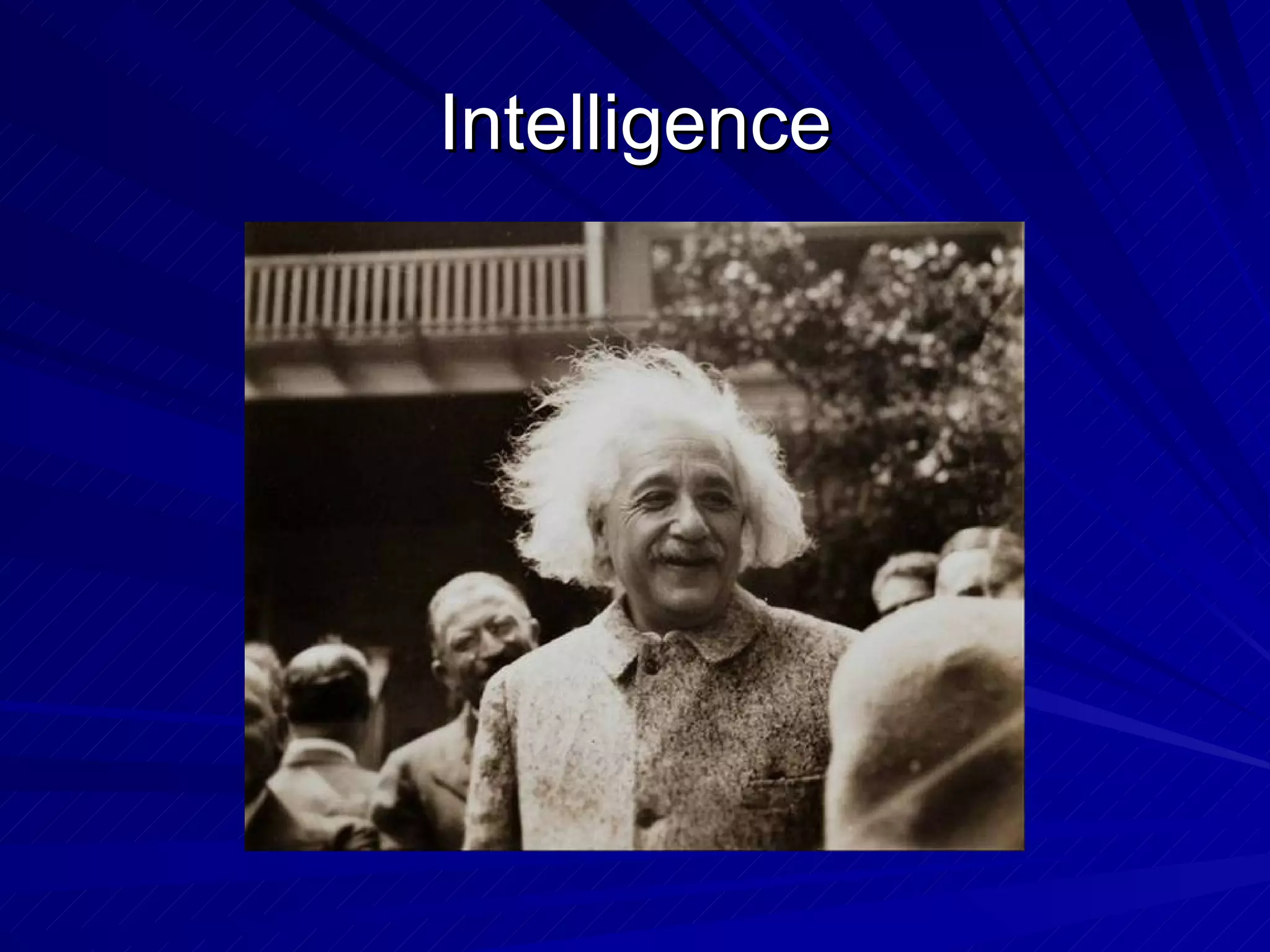
Intelligence
…Valued By One’s Society
Athleticism
Physical Beauty
Gifted vs.  Gifted and Talented Francoys Gagne
Gifts                 Talents 10,000 hour rule Daniel Levitin, Michael Howe, Malcolm Gladwell, and Many, many others
NYS Reflects  Gifts                 Talents Those pupils who show evidence of high performance capability and exceptional potential… [including] those pupils who require educational programs or services   beyond those normally provided by the regular school program in order to realize their full potential.”  (New York Education Law § 4452)
Note on New York State’s Requirements Define Giftedness as requiring different services Mandate that all students be assessed and parents of gifted children be notified Don’t mandate that anything be done for the gifted children Don’t set aside any money to provide gifted education for those defined as requiring it
NY One of 7 States   Least   Supportive of Gifted Children
For Our Purposes Today, Gifted: Having an inborn cognitive ability more than two standard deviations above the mean (IQ of 130 or greater)
Giftedness is Abnormal Top 3% of population in any given area of ability
Identifying Gifted Individuals Theory and Assessment  of Cognition
Cattel, Horn Carrol Woodcock
Screening  ->  Assessment Screening (large, inclusive filter) Assessment (more accurate, finer filter)
Screening Group test of cognitive abilities State Achievement Tests* Parent referral Teacher referral Administrative referral Self referral
Assessment WJTCA-NU WISC-IV
Serving Gifted Children Well Define Identify Differentiate Academic Social/Emotional
Nature of Gifted Individuals
Gifted People Are Different Neorosystem Perception Behavior Environment
Neurology Larger Frontal Lobes Faster synapses More efficient processes (Sanjay Gupta) Men and Women (Dr. Richard Haier) Gray  White
Neurology    Perception
Perception    Behavior Overexcitabilities (Kazimierz Dabrowski,1902-1980)
Overexcitability Means Increased… Sensitivity Awareness Intensity
Areas of Intensity Psychomotor Sensual Intellectual Imaginational Emotional
Psychomotor OE “Capacity for being active and energetic"  (Piechowski, 1991, p. 287)
Psychomotor OE  talk compulsively act impulsively,  display nervous habits compulsively organize others may find them overwhelming.  seem never to be still
 
Common Misdiagnosis ADHD
Sensual OE Heightened experience of  sensual pleasure
Sensual OE Heightened experience of sensual pleasure  or displeasure  emanating from sight, smell, touch, taste, and hearing (Dabrowski & Piechowski, 1977; Piechowski, 1979, 1991)
Sensual OE + Increased and early appreciation of  Music Language Art Endless delight from  Tastes Smells Textures Sounds sights.  These children may also become so absorbed in their love of a particular piece of art or music that the outside world ceases to exist
Sensual OE +  Over stimulated or uncomfortable  May withdraw from stimulation.  Distractions from schoolwork (ADD) Rough clothing Cafeteria Smells Sounds Pencil pressure
Pleasure and Pain Are  More Intense
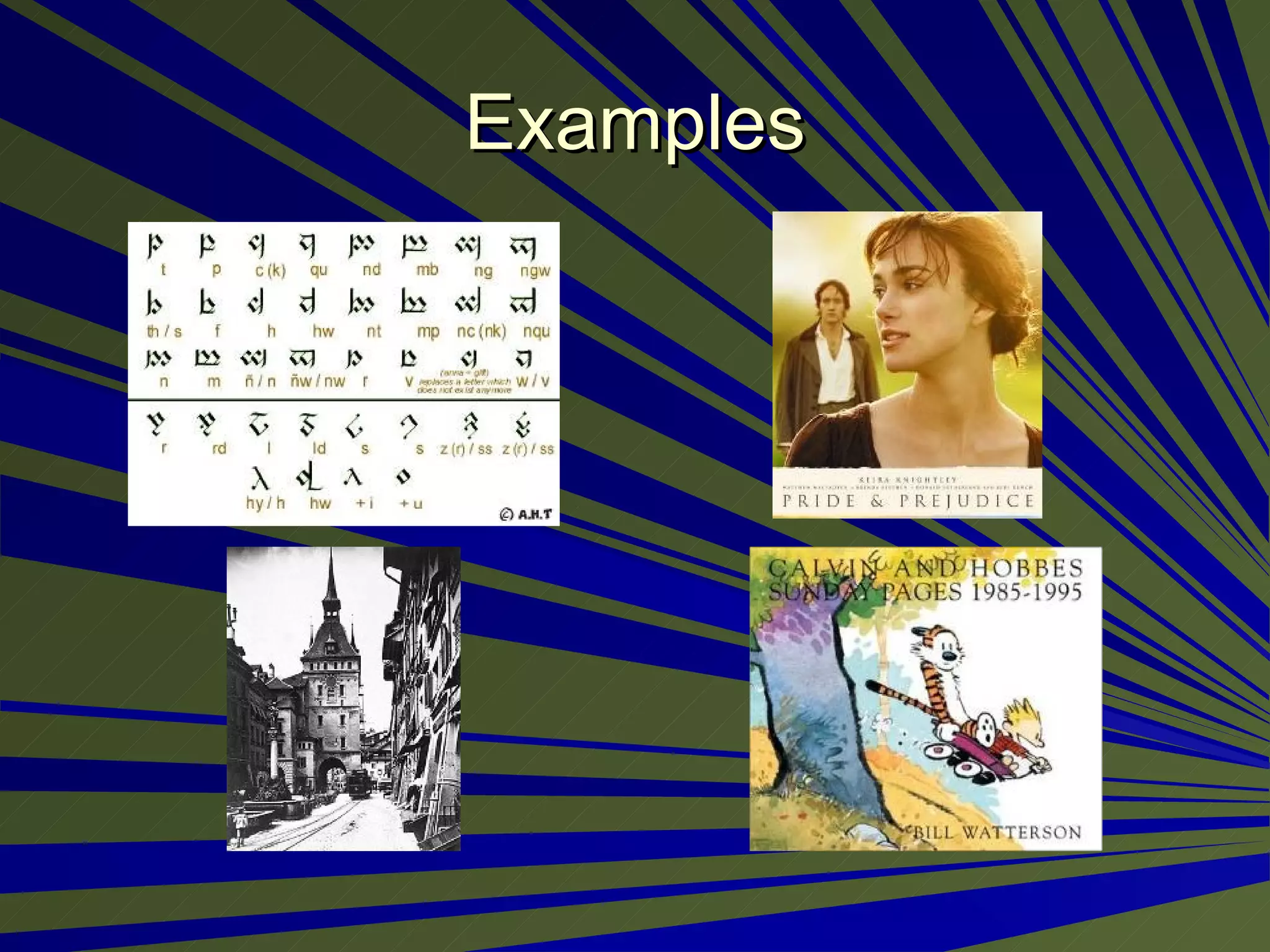
Examples
Intellectual OE Marked need to seek understanding and truth, to gain knowledge, and to analyze and synthesize  (Dabrowski & Piechowski, 1977; Piechowski, 1979, 1991)
Intellectual OE Intensely curious Often avid readers Keen observers Able to engage in prolonged intellectual effort Tenacious in problem solving  when they choose . Elaborate planning  Detailed visual recall Love theory, thinking about thinking, and moral thinking Strong concerns about moral and ethical issues Sometimes impatient with others who cannot sustain their intellectual pace So excited about an idea that they interrupt at inappropriate times
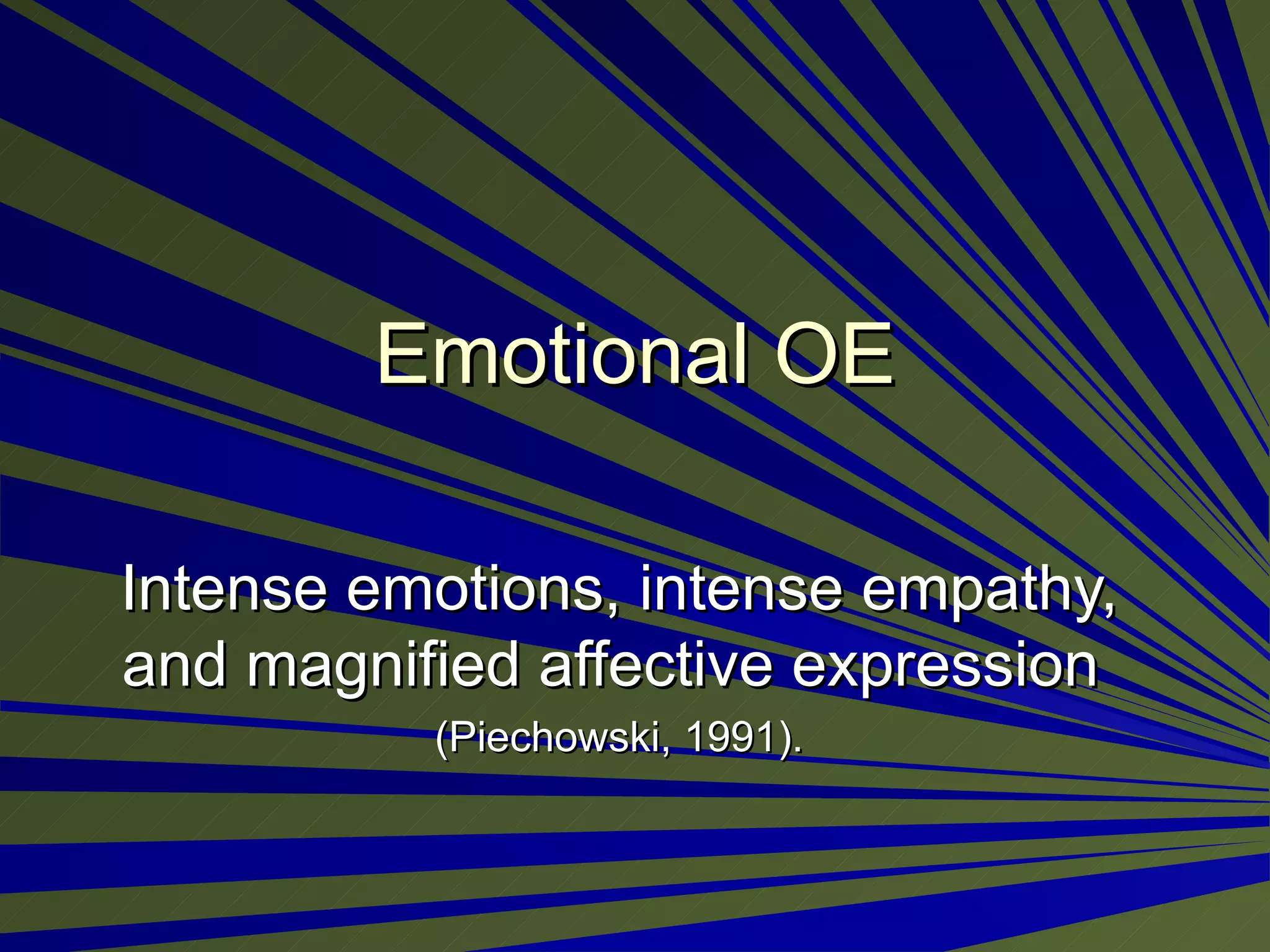
Examples
Imaginational OE Rich association of images and impressions, frequent use of image and metaphor, facility for invention and fantasy, detailed visualization, and elaborate dreams  (Dabrowski & Piechowski,1977; Piechowski, 1979, 1991)
Imaginational OE Mix truth with fiction Create [internal] private worlds Imaginary companions and dramatizations to escape boredom Difficulty staying tuned to rigid academic curriculum. (They may write stories or draw instead) Difficulty completing tasks when some incredible idea captures their thoughts
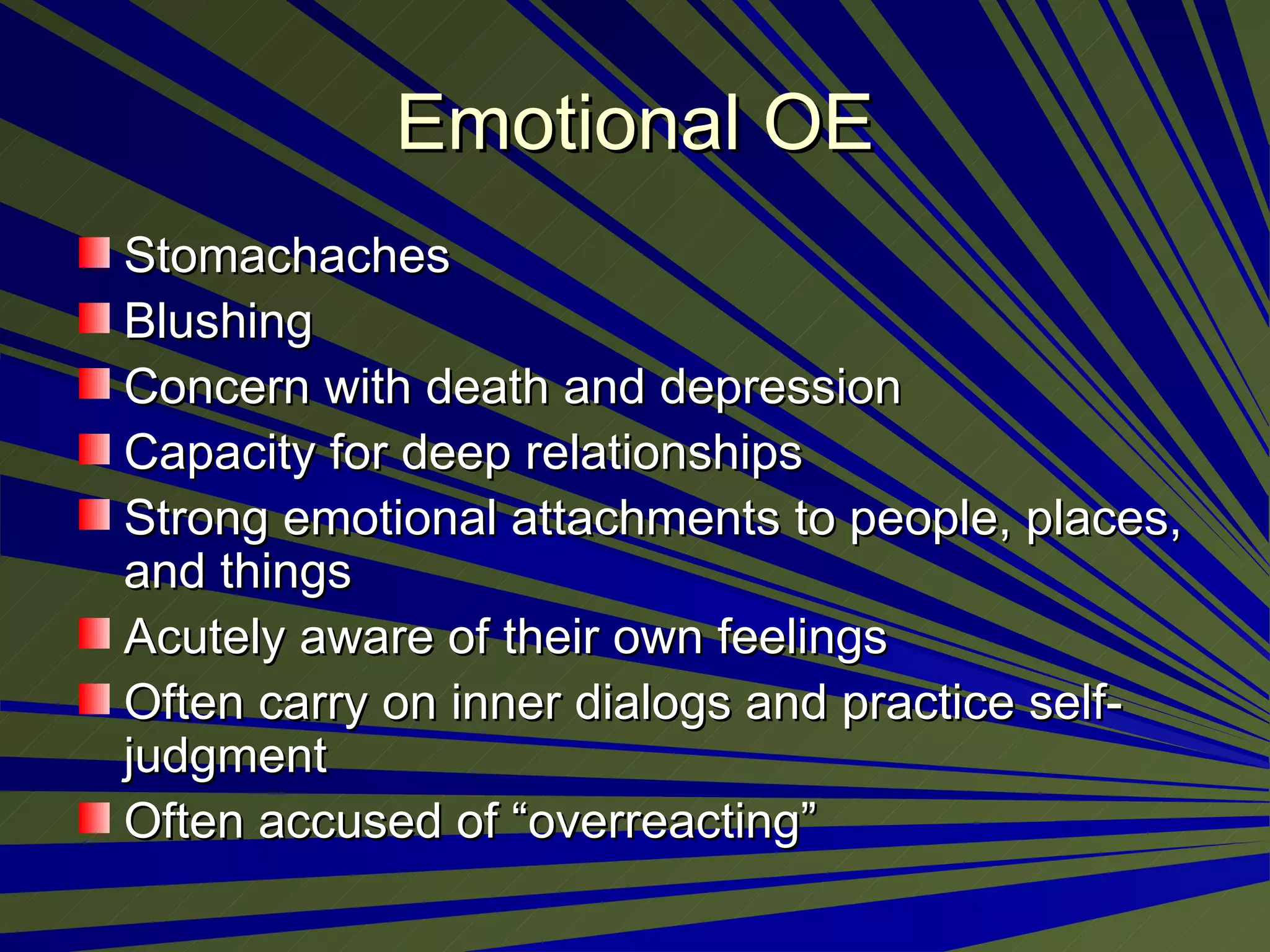
Examples
Personal Experience
Emotional OE Intense emotions, intense empathy, and magnified affective expression  (Piechowski, 1991).
Emotional OE Stomachaches  Blushing  Concern with death and depression  Capacity for deep relationships Strong emotional attachments to people, places, and things Acutely aware of their own feelings Often carry on inner dialogs and practice self-judgment  Often accused of “overreacting”
Overexcitability represents a  real  difference in the fabric of life and quality of experience (Lind, 2001)
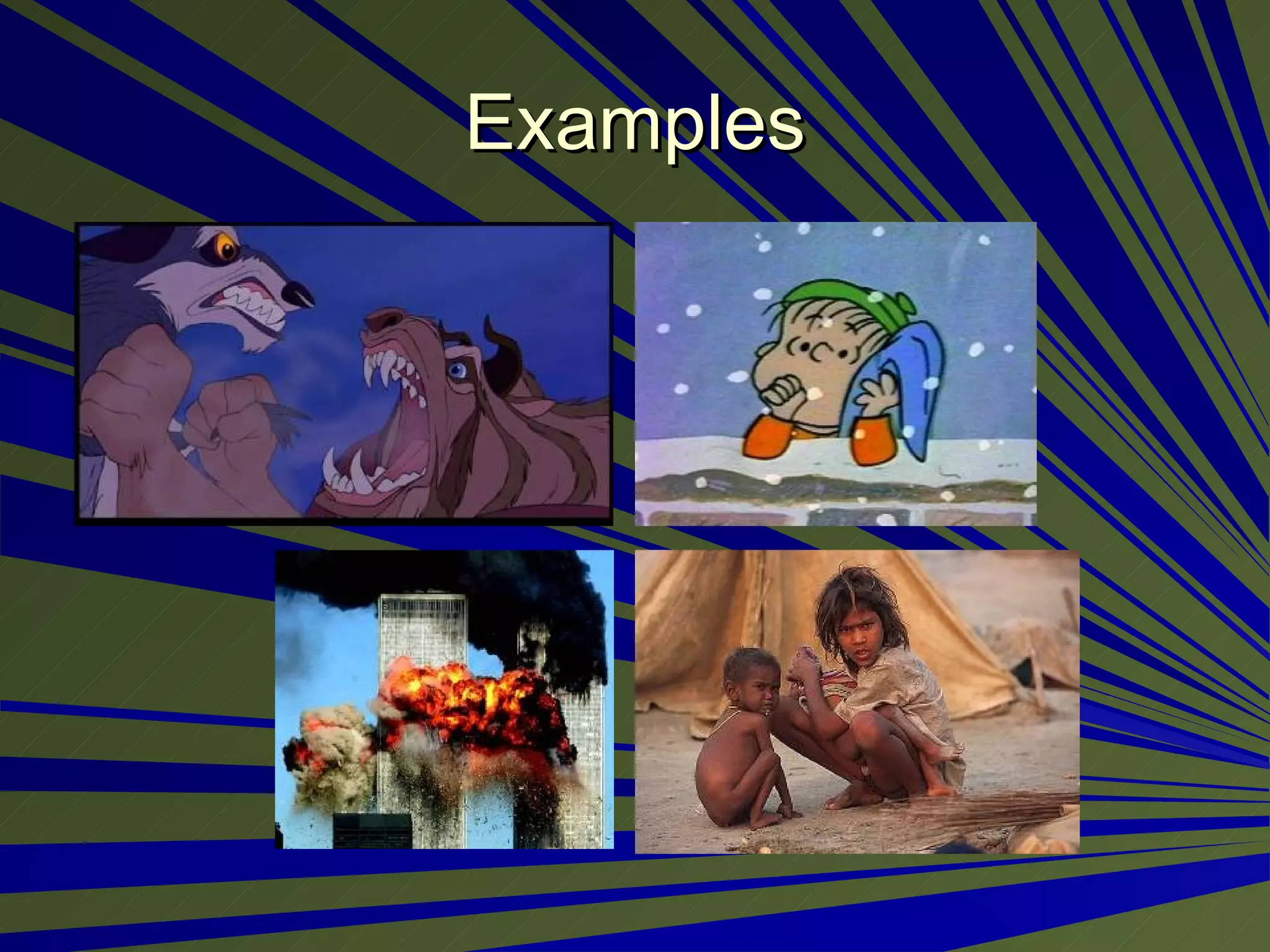
Examples
"One who manifests several forms of overexcitability, sees reality in a different, stronger and more multisided manner" (Dabrowski, 1972, p. 7)
Gifted People Are Different Neorosystem Perception Behavior Environment
Gifted Behavior is Abnormal


Experience of Gifted People is  Not Normal Being Gifted  Doesn’t Feel Like a Gift
Gifted People Are Different Neorosystem Perception Behavior Environment
Environment Are you gifted?
Beauty Backlash Don’t hate me Because I’m beautiful.
Boredom
How Much Time is Wasted? 140 IQ = 50% of their time 170 IQ = 99% of their time Hollingworth (1942), Renzulli, Silverman (1991)
Example from Weekly 25-Word Spelling Unit Pretest = 96% Post test = 100% Time: 45 minutes of drill time per week:   Learned: 1 spelling word
Homework for Spelling Make a Word Search Puzzle Using All 25 Spelling words
Child’s Solution
Personality Type Myers Briggs
Percent Introversion
Percent Intuition
Percent Thinking
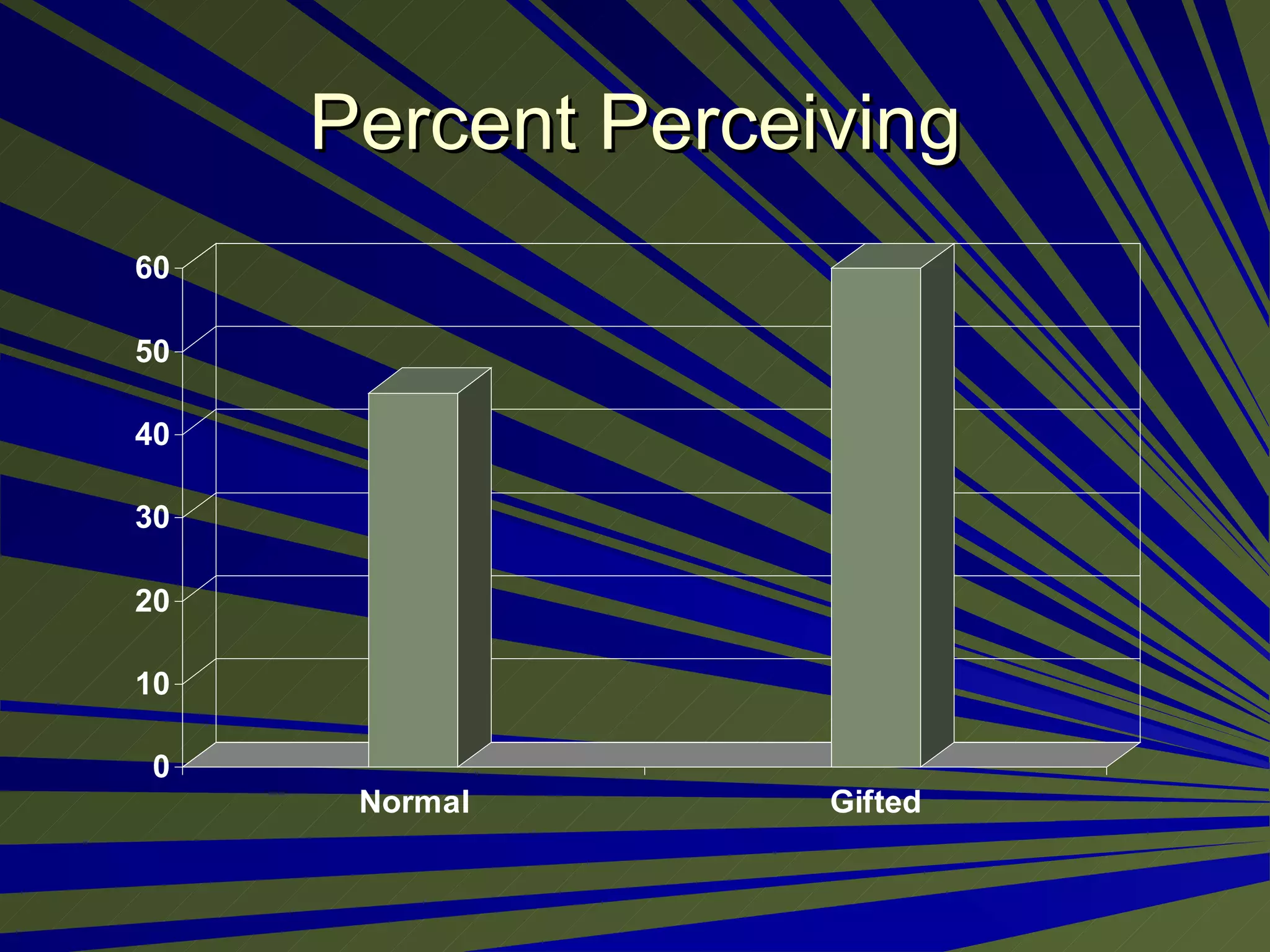
Percent Perceiving
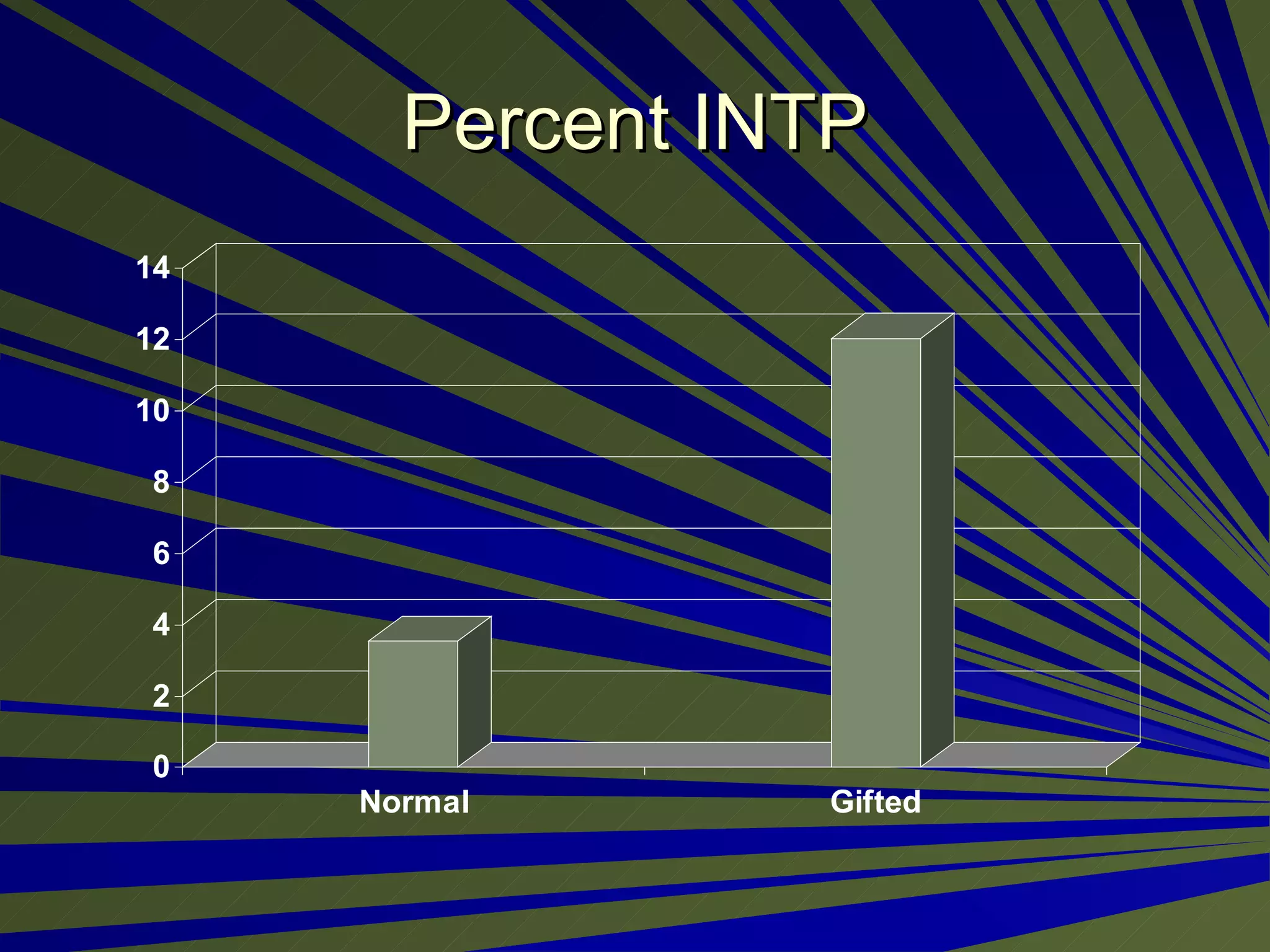
Percent INTP
What Are the Implications?
Differences Neurological Perceptual Behavioral Environmental
Maladjustment (Social/Emotional Issues) Leta Hollingworth
Ideal IQ 125-145 160 Spike in normal curve
Interaction Nature of Environment Nature of Gifted People
Interaction Enriching Home Flexible School Cognitive Peers Absent Parents Limited Resources Rigid School Small Population 1 st  Grader with 148 IQ Emotional OE
Outliers Ability Birth year Birth month Chance Culture Family Background Time (10,000 hours) Race and perception
Inliers Gifted children who suffer socially and emotionally and don’t enjoy developing to their potential
Myth Gifted Kids Are Lucky and Will Succeed Without Anything Extra From Us
Success of U.S. Advanced Placement Students  (National Excellence: A case for developing America’s Talent) Compared with the top students  of 13 other nations
Biology 1 2 3 4 5 6 7 8 9 10 11 12 13 14
Chemistry 1 2 3 4 5 6 7 8 9 10 11 12 13 14
Physics 1 2 3 4 5 6 7 8 9 10 11 12 13 14
Algebra 1 2 3 4 5 6 7 8 9 10 11 12 13
Calculus 1 2 3 4 5 6 7 8 9 10 11 12 13 (National Excellence: A case for developing America’s Talent)
Excuse “ We are egalitarian and we educate a higher percentage of our youth than other nations.”
Correction (Ross, 1993) United States Advanced Placement Students International Competitor’s Top Students
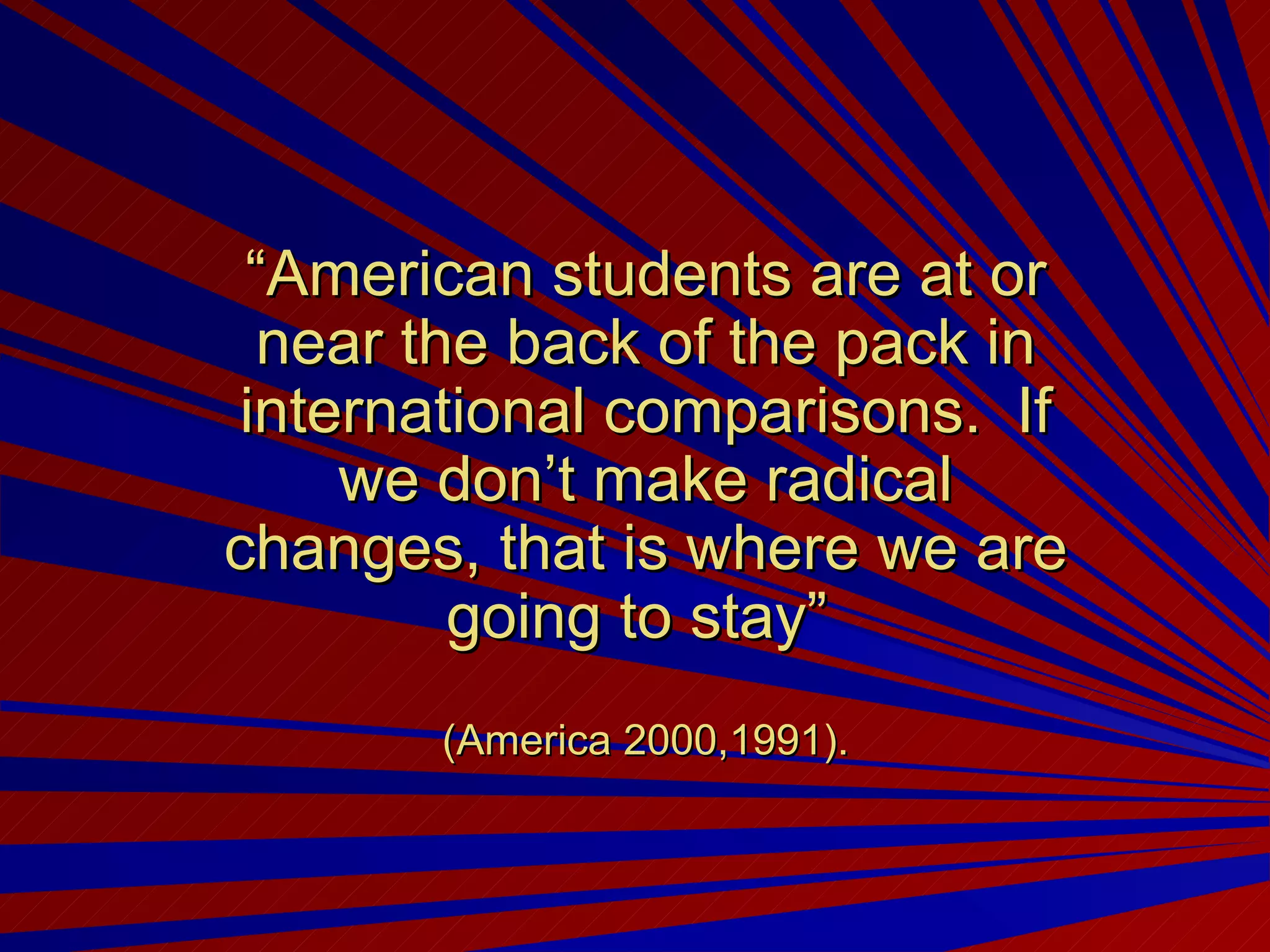
“ American students are at or near the back of the pack in international comparisons.  If we don’t make radical changes, that is where we are going to stay”  (America 2000,1991).
Negative Characteristics of  Cognitively Gifted  People Uneven Mental Development Social Difficulties Underachievement—especially in uninteresting areas Nonconformity—sometimes in disturbing directions Perfectionism, sometimes extreme to the point of crippling Self-doubt, poor self-image Depression
Common Negative Characteristics of  Creative  Persons Overactive Excessively Emotional Indifferent to conventions and courtesies Questions rules, laws, and authority Stubborn Egocentric, intolerant, tactless Careless, disorderly Arrogant, cynical, sarcastic Impatient, demanding Absentminded, forgetful Argumentative Sloppy and disorganized Rebellious, uncooperative
Gifted Children Don’t Just… “ make it on their own”
 
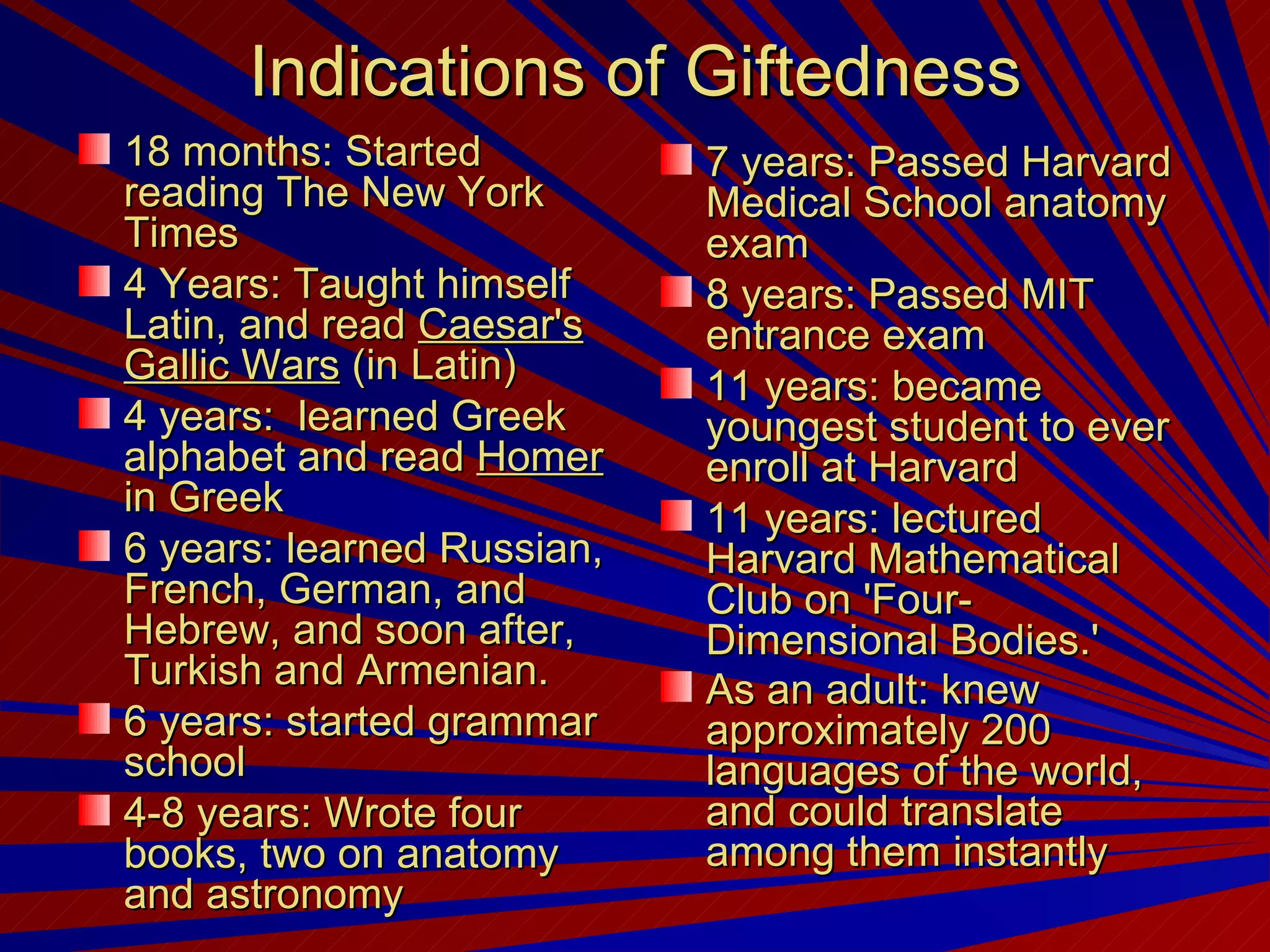
Indications of Giftedness 18 months: Started reading The New York Times 4 Years: Taught himself Latin, and read  Caesar's Gallic Wars  (in Latin)  4 years:  learned Greek alphabet and read  Homer  in Greek 6 years: learned Russian, French, German, and Hebrew, and soon after, Turkish and Armenian.  6 years: started grammar school 4-8 years: Wrote four books, two on anatomy and astronomy  7 years: Passed Harvard Medical School anatomy exam  8 years: Passed MIT entrance exam  11 years: became youngest student to ever enroll at Harvard 11 years: lectured Harvard Mathematical Club on 'Four-Dimensional Bodies.'  As an adult: knew approximately 200 languages of the world, and could translate among them instantly
Dropout Rates (Michael, 2005) General Population Gifted Population 11% 25%
Depending on one’s definition of gifted, the New York State dropout rate among gifted children in who do not receive intervention services is as high as 25% (Michael, 2005)
Recommendations School SocialWorkers and School Psychologists Learn and Stay Current Issues Related to Identifying and helping Gifted Children Active Screening for Social/Emotional needs, not just cognitive needs Provide increased opportunity for gifted support groups guided by appropriate professionals Provide Individual counseling as needed Advocate and Educate
Good News We can usually make things better for gifted individuals by improving their environment

Social

  • 1.
    Social/Emotional Issues of Gifted Children
  • 2.
    Outline Definition ofgiftedness Identification of gifted individuals Nature of gifted individuals Maladjustment (Social/Emotional Issues) Recommendations
  • 3.
  • 4.
    Gifted Being bornwith a quality or trait valued by one’s society
  • 5.
  • 6.
  • 7.
  • 8.
  • 9.
  • 10.
  • 11.
  • 12.
    Gifted vs. Gifted and Talented Francoys Gagne
  • 13.
    Gifts      Talents 10,000 hour rule Daniel Levitin, Michael Howe, Malcolm Gladwell, and Many, many others
  • 14.
    NYS Reflects Gifts      Talents Those pupils who show evidence of high performance capability and exceptional potential… [including] those pupils who require educational programs or services beyond those normally provided by the regular school program in order to realize their full potential.” (New York Education Law § 4452)
  • 15.
    Note on NewYork State’s Requirements Define Giftedness as requiring different services Mandate that all students be assessed and parents of gifted children be notified Don’t mandate that anything be done for the gifted children Don’t set aside any money to provide gifted education for those defined as requiring it
  • 16.
    NY One of7 States Least Supportive of Gifted Children
  • 17.
    For Our PurposesToday, Gifted: Having an inborn cognitive ability more than two standard deviations above the mean (IQ of 130 or greater)
  • 18.
    Giftedness is AbnormalTop 3% of population in any given area of ability
  • 19.
    Identifying Gifted IndividualsTheory and Assessment of Cognition
  • 20.
  • 21.
    Screening -> Assessment Screening (large, inclusive filter) Assessment (more accurate, finer filter)
  • 22.
    Screening Group testof cognitive abilities State Achievement Tests* Parent referral Teacher referral Administrative referral Self referral
  • 23.
  • 24.
    Serving Gifted ChildrenWell Define Identify Differentiate Academic Social/Emotional
  • 25.
    Nature of GiftedIndividuals
  • 26.
    Gifted People AreDifferent Neorosystem Perception Behavior Environment
  • 27.
    Neurology Larger FrontalLobes Faster synapses More efficient processes (Sanjay Gupta) Men and Women (Dr. Richard Haier) Gray White
  • 28.
    Neurology  Perception
  • 29.
    Perception  Behavior Overexcitabilities (Kazimierz Dabrowski,1902-1980)
  • 30.
    Overexcitability Means Increased…Sensitivity Awareness Intensity
  • 31.
    Areas of IntensityPsychomotor Sensual Intellectual Imaginational Emotional
  • 32.
    Psychomotor OE “Capacityfor being active and energetic" (Piechowski, 1991, p. 287)
  • 33.
    Psychomotor OE talk compulsively act impulsively, display nervous habits compulsively organize others may find them overwhelming. seem never to be still
  • 34.
  • 35.
  • 36.
    Sensual OE Heightenedexperience of sensual pleasure
  • 37.
    Sensual OE Heightenedexperience of sensual pleasure or displeasure emanating from sight, smell, touch, taste, and hearing (Dabrowski & Piechowski, 1977; Piechowski, 1979, 1991)
  • 38.
    Sensual OE +Increased and early appreciation of Music Language Art Endless delight from Tastes Smells Textures Sounds sights. These children may also become so absorbed in their love of a particular piece of art or music that the outside world ceases to exist
  • 39.
    Sensual OE + Over stimulated or uncomfortable May withdraw from stimulation. Distractions from schoolwork (ADD) Rough clothing Cafeteria Smells Sounds Pencil pressure
  • 40.
    Pleasure and PainAre More Intense
  • 41.
  • 42.
    Intellectual OE Markedneed to seek understanding and truth, to gain knowledge, and to analyze and synthesize (Dabrowski & Piechowski, 1977; Piechowski, 1979, 1991)
  • 43.
    Intellectual OE Intenselycurious Often avid readers Keen observers Able to engage in prolonged intellectual effort Tenacious in problem solving when they choose . Elaborate planning Detailed visual recall Love theory, thinking about thinking, and moral thinking Strong concerns about moral and ethical issues Sometimes impatient with others who cannot sustain their intellectual pace So excited about an idea that they interrupt at inappropriate times
  • 44.
  • 45.
    Imaginational OE Richassociation of images and impressions, frequent use of image and metaphor, facility for invention and fantasy, detailed visualization, and elaborate dreams (Dabrowski & Piechowski,1977; Piechowski, 1979, 1991)
  • 46.
    Imaginational OE Mixtruth with fiction Create [internal] private worlds Imaginary companions and dramatizations to escape boredom Difficulty staying tuned to rigid academic curriculum. (They may write stories or draw instead) Difficulty completing tasks when some incredible idea captures their thoughts
  • 47.
  • 48.
  • 49.
    Emotional OE Intenseemotions, intense empathy, and magnified affective expression (Piechowski, 1991).
  • 50.
    Emotional OE Stomachaches Blushing Concern with death and depression Capacity for deep relationships Strong emotional attachments to people, places, and things Acutely aware of their own feelings Often carry on inner dialogs and practice self-judgment Often accused of “overreacting”
  • 51.
    Overexcitability represents a real difference in the fabric of life and quality of experience (Lind, 2001)
  • 52.
  • 53.
    "One who manifestsseveral forms of overexcitability, sees reality in a different, stronger and more multisided manner" (Dabrowski, 1972, p. 7)
  • 54.
    Gifted People AreDifferent Neorosystem Perception Behavior Environment
  • 55.
  • 56.
  • 57.
  • 58.
  • 59.
  • 60.
    Experience of GiftedPeople is Not Normal Being Gifted Doesn’t Feel Like a Gift
  • 61.
    Gifted People AreDifferent Neorosystem Perception Behavior Environment
  • 62.
  • 63.
    Beauty Backlash Don’thate me Because I’m beautiful.
  • 64.
  • 65.
    How Much Timeis Wasted? 140 IQ = 50% of their time 170 IQ = 99% of their time Hollingworth (1942), Renzulli, Silverman (1991)
  • 66.
    Example from Weekly25-Word Spelling Unit Pretest = 96% Post test = 100% Time: 45 minutes of drill time per week: Learned: 1 spelling word
  • 67.
    Homework for SpellingMake a Word Search Puzzle Using All 25 Spelling words
  • 68.
  • 69.
  • 70.
  • 71.
  • 72.
  • 73.
  • 74.
  • 75.
    What Are theImplications?
  • 76.
    Differences Neurological PerceptualBehavioral Environmental
  • 77.
  • 78.
    Ideal IQ 125-145160 Spike in normal curve
  • 79.
    Interaction Nature ofEnvironment Nature of Gifted People
  • 80.
    Interaction Enriching HomeFlexible School Cognitive Peers Absent Parents Limited Resources Rigid School Small Population 1 st Grader with 148 IQ Emotional OE
  • 81.
    Outliers Ability Birthyear Birth month Chance Culture Family Background Time (10,000 hours) Race and perception
  • 82.
    Inliers Gifted childrenwho suffer socially and emotionally and don’t enjoy developing to their potential
  • 83.
    Myth Gifted KidsAre Lucky and Will Succeed Without Anything Extra From Us
  • 84.
    Success of U.S.Advanced Placement Students (National Excellence: A case for developing America’s Talent) Compared with the top students of 13 other nations
  • 85.
    Biology 1 23 4 5 6 7 8 9 10 11 12 13 14
  • 86.
    Chemistry 1 23 4 5 6 7 8 9 10 11 12 13 14
  • 87.
    Physics 1 23 4 5 6 7 8 9 10 11 12 13 14
  • 88.
    Algebra 1 23 4 5 6 7 8 9 10 11 12 13
  • 89.
    Calculus 1 23 4 5 6 7 8 9 10 11 12 13 (National Excellence: A case for developing America’s Talent)
  • 90.
    Excuse “ Weare egalitarian and we educate a higher percentage of our youth than other nations.”
  • 91.
    Correction (Ross, 1993)United States Advanced Placement Students International Competitor’s Top Students
  • 92.
    “ American studentsare at or near the back of the pack in international comparisons. If we don’t make radical changes, that is where we are going to stay” (America 2000,1991).
  • 93.
    Negative Characteristics of Cognitively Gifted People Uneven Mental Development Social Difficulties Underachievement—especially in uninteresting areas Nonconformity—sometimes in disturbing directions Perfectionism, sometimes extreme to the point of crippling Self-doubt, poor self-image Depression
  • 94.
    Common Negative Characteristicsof Creative Persons Overactive Excessively Emotional Indifferent to conventions and courtesies Questions rules, laws, and authority Stubborn Egocentric, intolerant, tactless Careless, disorderly Arrogant, cynical, sarcastic Impatient, demanding Absentminded, forgetful Argumentative Sloppy and disorganized Rebellious, uncooperative
  • 95.
    Gifted Children Don’tJust… “ make it on their own”
  • 96.
  • 97.
    Indications of Giftedness18 months: Started reading The New York Times 4 Years: Taught himself Latin, and read Caesar's Gallic Wars (in Latin) 4 years: learned Greek alphabet and read Homer in Greek 6 years: learned Russian, French, German, and Hebrew, and soon after, Turkish and Armenian. 6 years: started grammar school 4-8 years: Wrote four books, two on anatomy and astronomy 7 years: Passed Harvard Medical School anatomy exam 8 years: Passed MIT entrance exam 11 years: became youngest student to ever enroll at Harvard 11 years: lectured Harvard Mathematical Club on 'Four-Dimensional Bodies.' As an adult: knew approximately 200 languages of the world, and could translate among them instantly
  • 98.
    Dropout Rates (Michael,2005) General Population Gifted Population 11% 25%
  • 99.
    Depending on one’sdefinition of gifted, the New York State dropout rate among gifted children in who do not receive intervention services is as high as 25% (Michael, 2005)
  • 100.
    Recommendations School SocialWorkersand School Psychologists Learn and Stay Current Issues Related to Identifying and helping Gifted Children Active Screening for Social/Emotional needs, not just cognitive needs Provide increased opportunity for gifted support groups guided by appropriate professionals Provide Individual counseling as needed Advocate and Educate
  • 101.
    Good News Wecan usually make things better for gifted individuals by improving their environment