





Understanding the World of Academically & Intellectually GiftedAngela Housand, Ph.D.housanda@uncw.eduChicago Public Schools 2010
http://angelahousand.com
AND
Understand the unique behaviors that characterize giftednessSpecific resources and examples for your use and adaptationAn easy to follow 6-step strategy for identifying students for talent developmentWhy This Session?
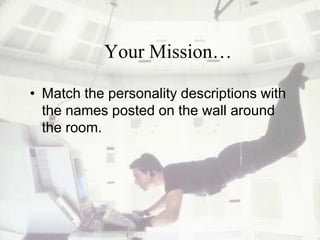
Your Mission…Match the personality descriptions with the names posted on the wall around the room.Your Mission…
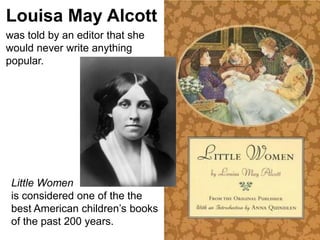
	This person was told by an editor that she could never write anything that had popular appeal.
PLouisa May Alcottwas told by an editor that she would never write anything popular. Little Womenis considered one of the the best American children’s books of the past 200 years.
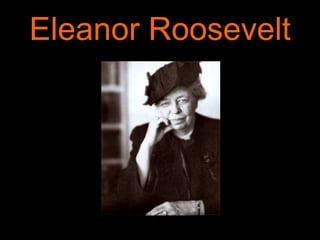
	This person had a stormy and emotionally traumatic childhood. She was considered an odd-ball by many of her playmates. Even her family provided her with very little encouragement and support. For many years she lived in fantasy as the mistress of her alcoholic father’s household.
Eleanor Roosevelt
You must do the thing you think you cannot do.-Eleanor Roosevelt
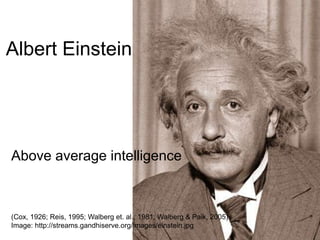
	This person was four years old before he could speak and seven before he could read: He was considered dull by both his parents and his teachers.
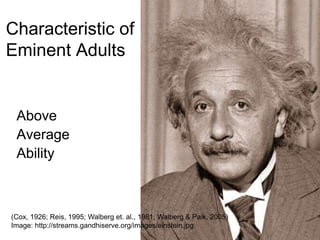
Albert EinsteinAbove average intelligence(Cox, 1926; Reis, 1995; Walberg et. al., 1981; Walberg & Paik, 2005)Image: http://streams.gandhiserve.org/images/einstein.jpg
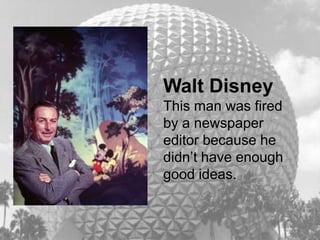
PThis man was fired by a newspaper editor because he didn’t have enough good ideas.
PWalt DisneyThis man was fired by a newspaper editor because he didn’t have enough good ideas.
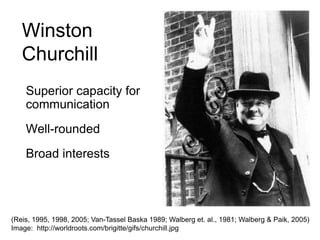
	As a child this person was hyperactive, had a speech defect, was prone to constant colds, had poor peer relationships, and frequently failed in school. It took him three years to complete the first grade. His father soon decided the boy needed more discipline and suggested military school.  Before being admitted, however, he failed the entrance examination three times. A teacher once called him the naughtiest small boy in England.
WinstonChurchill	Superior capacity for communication	Well-rounded	Broad interests(Reis, 1995, 1998, 2005; Van-Tassel Baska 1989; Walberg et. al., 1981; Walberg & Paik, 2005) Image:  http://worldroots.com/brigitte/gifs/churchill.jpg
DefinitionThere is no universally accepted definition for gifted, talented, or giftedness
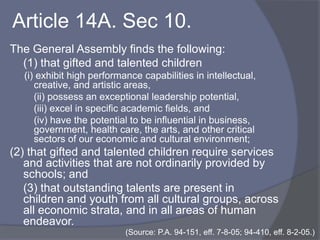
Article 14A. Sec 10.The General Assembly finds the following:	(1) that gifted and talented children(i) exhibit high performance capabilities in intellectual, creative, and artistic areas, 	(ii) possess an exceptional leadership potential, 	(iii) excel in specific academic fields, and 	(iv) have the potential to be influential in business, government, health care, the arts, and other critical sectors of our economic and cultural environment;(2) that gifted and talented children require services and activities that are not ordinarily provided by schools; and	(3) that outstanding talents are present in children and youth from all cultural groups, across all economic strata, and in all areas of human endeavor.(Source: P.A. 94-151, eff. 7-8-05; 94-410, eff. 8-2-05.)
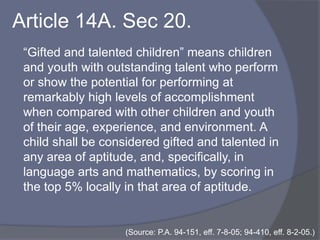
Article 14A. Sec 20.	“Gifted and talented children” means children and youth with outstanding talent who perform or show the potential for performing at remarkably high levels of accomplishment when compared with other children and youth of their age, experience, and environment. A child shall be considered gifted and talented in any area of aptitude, and, specifically, in language arts and mathematics, by scoring in the top 5% locally in that area of aptitude.(Source: P.A. 94-151, eff. 7-8-05; 94-410, eff. 8-2-05.)
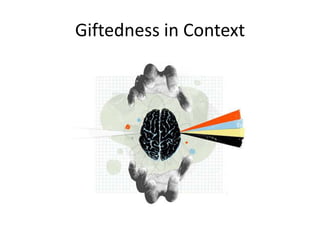
Giftedness in Context
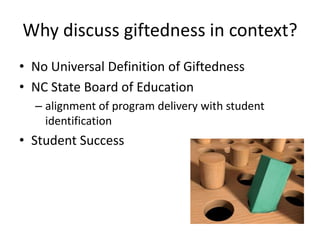
Why discuss giftedness in context?No Universal Definition of GiftednessNC State Board of Education alignment of program delivery with student identificationStudent Success
What gifted program services does your school offer?
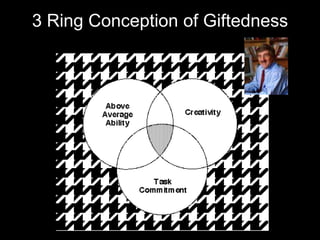
3 Ring Conception of Giftedness
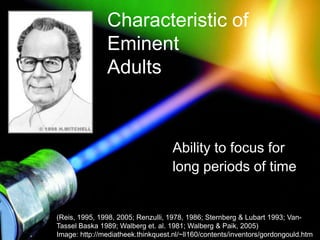
Characteristic of EminentAdults	Ability to focus for 	long periods of time(Reis, 1995, 1998, 2005; Renzulli, 1978, 1986; Sternberg & Lubart 1993; Van-Tassel Baska 1989; Walberg et. al. 1981; Walberg & Paik, 2005)Image: http://mediatheek.thinkquest.nl/~ll160/contents/inventors/gordongould.htm
Characteristic of Eminent AdultsAboveAverageAbility(Cox, 1926; Reis, 1995; Walberg et. al., 1981; Walberg & Paik, 2005)Image: http://streams.gandhiserve.org/images/einstein.jpg
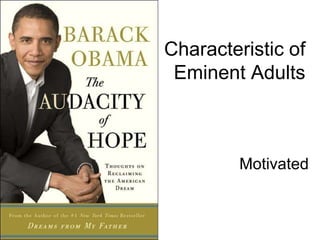
Characteristic of Eminent AdultsMotivated(Reis, 1995; Walberg et. al. 1981; Walberg & Paik, 2005)
Characteristics: SeeingUnusual alertnessJoy in learningKeen observationSees “Big Picture”Makes connectionsIntense focusCurious
Characteristics: SpeedEarly and rapid learningRapid language developmentMetacognitively efficient
Superior  ≠
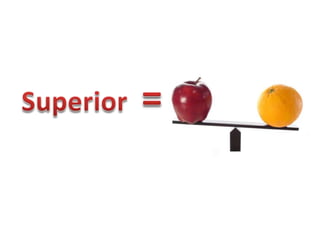
Superior  =
Characteristics: DifferencesSuperior languageVerbal fluencyLarge vocabularySuperior analytical and reasoning abilityHigh-capacity memoryGoes beyond what is soughtAbstract, complex, and insightful thinking
Characteristics
CharacteristicsBehaviors
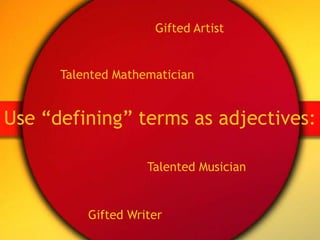
Gifted ArtistTalented MathematicianUse “defining” terms as adjectives:Talented MusicianGifted Writer
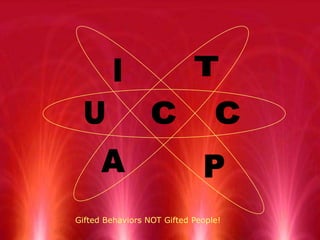
TICUCAPGifted Behaviors NOT Gifted People!
School House GiftednessCreative Giftedness
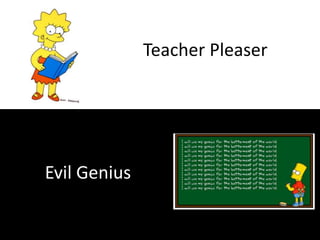
Teacher PleaserEvil Genius
Creatively GiftedIndependentHigh energyCuriousSense of humorOpen-mindedNeed for privacy and alone time
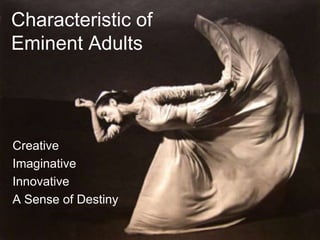
Characteristic ofEminent Adults	Creative	Imaginative	Innovative	A Sense of Destiny
Creatively GiftedAware of their own creativenessOriginality in thought and actionAttracted to complexity and noveltyArtistic tendenciesWilling to take risksPerceptive
And the not so good…ImpulsiveEgotisticalArgumentativeRebelliousUncooperativeStubbornChildishAbsentmindedNeuroticTemperamentalCapriciousCarelessDisorganizedDemandingIndifferent to Conventions
Characteristics: NegativeUneven mental developmentInterpersonal difficultiesUnderachievement
Asynchronous DevelopmentUneven intellectual, physical, and emotional development.
Asynchronous DevelopmentCognitively understand advanced concepts (like mortality) but lack emotional maturity to cope with knowledgePerceived as older due to cognitive ability, but lack behavioral maturity
Underachievers: PersonalityLow self-esteem or Low self-efficacyFeelings of PessimismAnxious, impulsive, or inattentiveAggressive, hostileDepressedSocially immature
Internal MediatorsFear of failureFear of successNegative attitude toward schoolAntisocial, rebelliousSelf-critical or perfectionistic
Maladaptive StrategiesLack goal-directed behaviorPoor coping skillsPoor self-regulationDefense mechanisms
Not all bad…Demonstrate honesty and integrity when rejecting inappropriate school work
Intense outside interests
CreativeWhat about these characteristics?Inability to master certain academic skillsLack of motivationDisruptive classroom behaviorFailure to complete assignmentsLack of organizational skillsPoor listening and concentration skillsUnrealistic self-expectations
Twice-ExceptionalGifted with Learning DisabilityMay also demonstrateLearned helplessnessPerfectionismSupersensitivityLow self-esteemBehaviors may hamper identification
Look For:Advanced vocabulary useExceptional analytic abilitiesHigh levels of creativityAdvanced problem-solving skillsDivergent thinkingSpecific aptitudeGood memorySpatial abilities
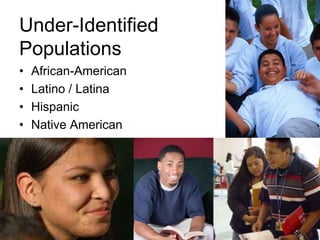
Under-Identified PopulationsAfrican-AmericanLatino / LatinaHispanicNative American
What differentiates gifted learners from high achievers?
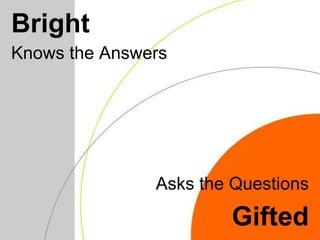
BrightKnows the Answers 	Asks the QuestionsGifted
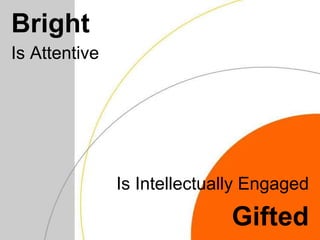
BrightIs Attentive	Is Intellectually EngagedGifted
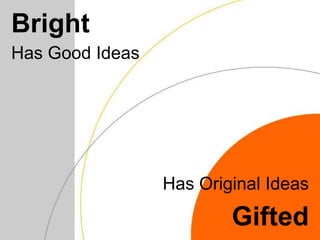
BrightHas Good Ideas	Has Original IdeasGifted
BrightAbsorbs Information	Manipulates InformationGifted
BrightTop Student	Beyond Her Age PeersGifted
BrightRepeats 6-8 Times for Mastery	Repeats 1-2 Times for MasteryGifted
BrightUnderstands Ideas	Constructs AbstractionsGifted
BrightGrasps the Meaning	Draws InferencesGifted
BrightIs a Technician	Is an InventorGifted
Thank You!

Identifying Gifted Students in the Classroom

Editor's Notes

  • #8 Louisa May Alcott
  • #10 Eleanor Roosevelt
  • #13 Albert Einstein
  • #17 Winston Churchill
  • #36 It is distinguishably different, and on measures of performance, it is higher or superior