CHARACTERISTICS  OF  GIFTED  AND  TALENTED  STUDENTS 2008
Gifted and talented students may exhibit positive and/or negative characteristics.  Positive characteristics include --
Intellectual  ABILITY
Uses advanced reasoning skills  Has extensive and detailed memory  Answers questions in detail  Wants to learn  and is very curious  Makes logical inferences, draws  conclusions based on sound  reasoning Understands abstract ideas and  complex concepts  Learns new information quickly Applies prior knowledge to problem  solving
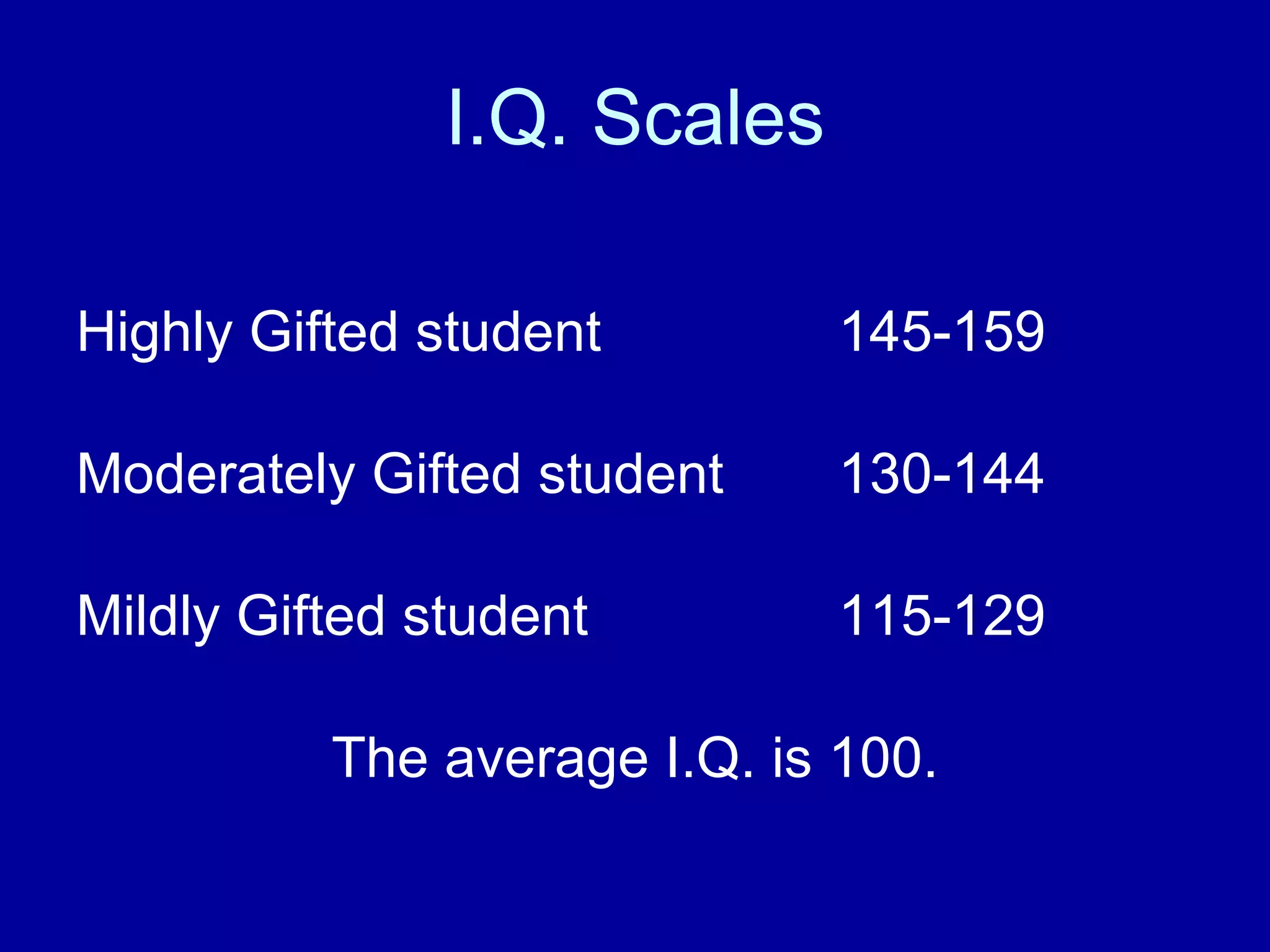
I.Q. Scales Highly Gifted student 145-159 Moderately Gifted student 130-144 Mildly Gifted student 115-129 The average I.Q. is 100.
ACADEMIC  ABILITY
Has an intense, sustained interest  Completes academic work  correctly/unassisted  Contributes to academic discussions  Excels in one or more subject areas  Has hobbies/collections related to field  Has an inquisitive nature and  asks relevant questions  Demonstrates knowledge of facts in  one  or more academic areas Demonstrates knowledge about current  events
Creative  ability
Has active imagination  Is emotionally sensitive (i.e. to beauty)  Brings inventive/innovative approach to  problems  Generates “what if” questions  Experiments with ideas  Is a nonconformist, uninhibited in  expression, adventurous  Is a risk taker  Comfortable not having the “correct”  answer  Constructs jokes, clever plays on  words, ironic observations
Artistic  Talent  … specialized
Produces imaginative/original art  Appreciates subtle variations in artistic  products or performances  Seems to pick up skills in the arts with little  or no instruction  Art performance/products marked by detail,  complexity, richness  Concentrates for long periods of time on  artistic projects  Expresses emotion in art  Communicates effectively via artistic media
Leadership  Ability
Acts responsibly in social situations  Has a cooperative attitude  Projects positive image to peers  Earns respect and trust of others  Is self-confident  Gets others to work together  Maintains on-task focus  Takes charge in group situations  Is visionary – has a holistic view  Can do backwards planning
MOTIVATION
Shows pride in work  Wants to perform at highest possible  level  Reacts to challenges enthusiastically  Approaches situations expecting to do  well  Places high value on mastery  Works tenaciously, not easily  discouraged  Sets challenging goals  Strives to improve  Attempts tasks above current skill level
 
How Can I Tell The Difference  Between  High Achievers  &   Gifted Students?
HIGH ACHIEVERS…  Know the Answers  Enjoy School  Grasp Meaning  Copy Accurately  Have Good Ideas  Absorb Information  Achieve Mastery in  3-8 Repetitions  GIFTED STUDENTS…  Ask the questions  Enjoy Learning  Draw Inferences  Create New Designs  Have Unexpected Ideas  Manipulate Information  Achieve Mastery in  1-2 Repetitions
Negative Characteristics Some characteristics of gifted students often keep them out of G/T programs.  This can be related to teacher misidentification.  Teachers tend to identify “teacher-pleasers” as gifted and ignore some gifted kids with “annoying” behaviors.
General Definition of a Teacher Pleaser A  Teacher Pleaser  is a student who has and/or does all the nice, pleasing, helpful, and considerate things in class as well as bails you out of uncomfortable situations when possible.  This student achieves high grades in class AND scores in the 90 th  percentile or above on standard achievement tests.  Teacher Pleasers  may vary from class to class.
“ Teacher Pleaser or Gifted?
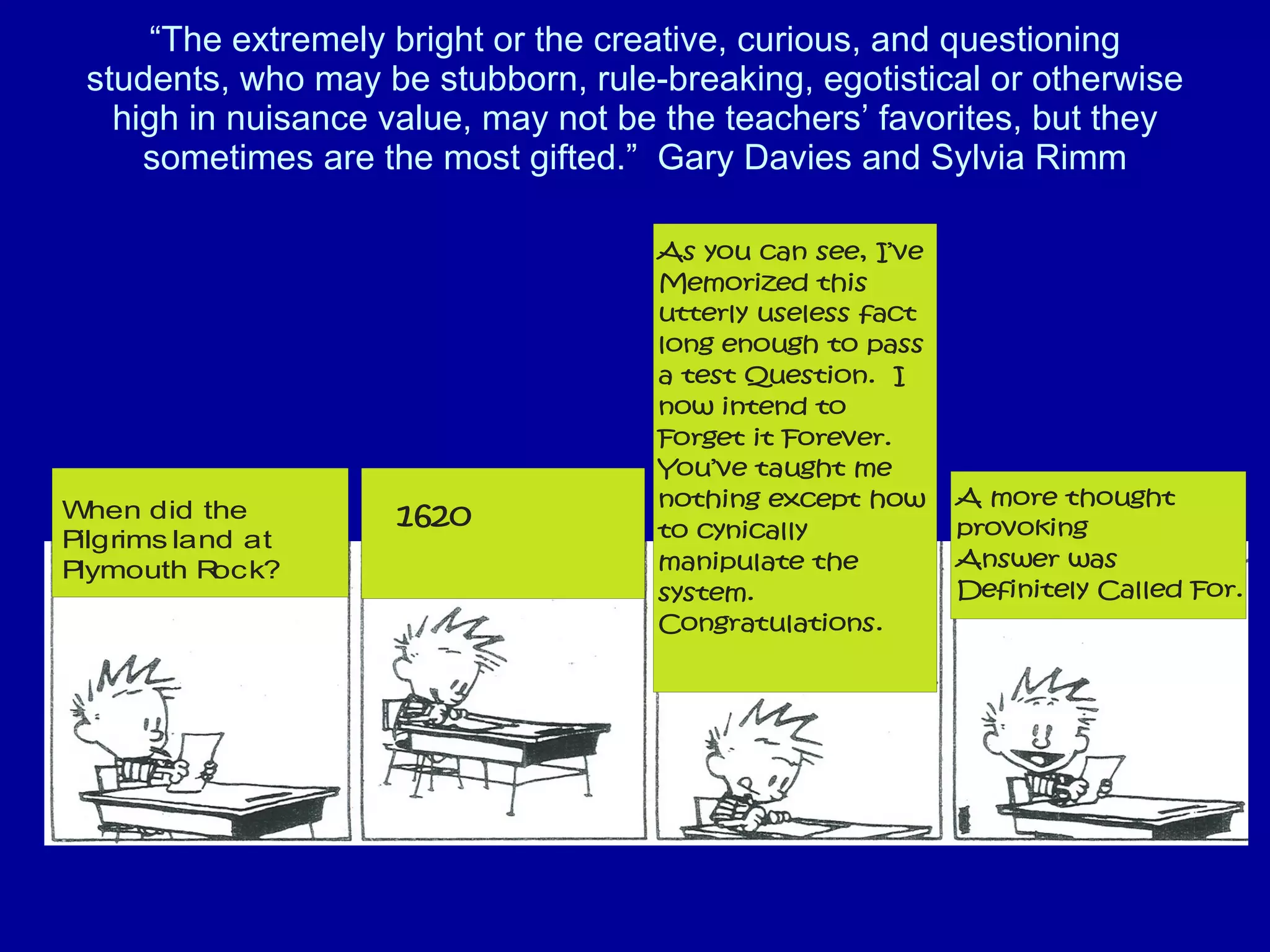
“ The extremely bright or the creative, curious, and questioning students, who may be stubborn, rule-breaking, egotistical or otherwise high in nuisance value, may not be the teachers’ favorites, but they sometimes are the most gifted.”  Gary Davies and Sylvia Rimm
Negative Characteristics of Creativity Being bored with routine tasks, refusing to do rote homework. Not being interested in details, handing in messy work Making jokes or puns at inappropriate times
Negative Characteristics of Motivation Being emotionally sensitive, overreacting, getting angry easily, or crying if things go wrong
Negative Characteristics of  Critical Thinking Being self-critical and impatient with failure Being critical of others, even of the teacher
General Definition of a Potentially  Gifted Student A  Potentially Gifted  student is a student who is pleased with original work, right or wrong, and who is strongly opinionated regarding moral issues.  This student may also possess all, some or none of the labels associated with the Teacher Pleaser.
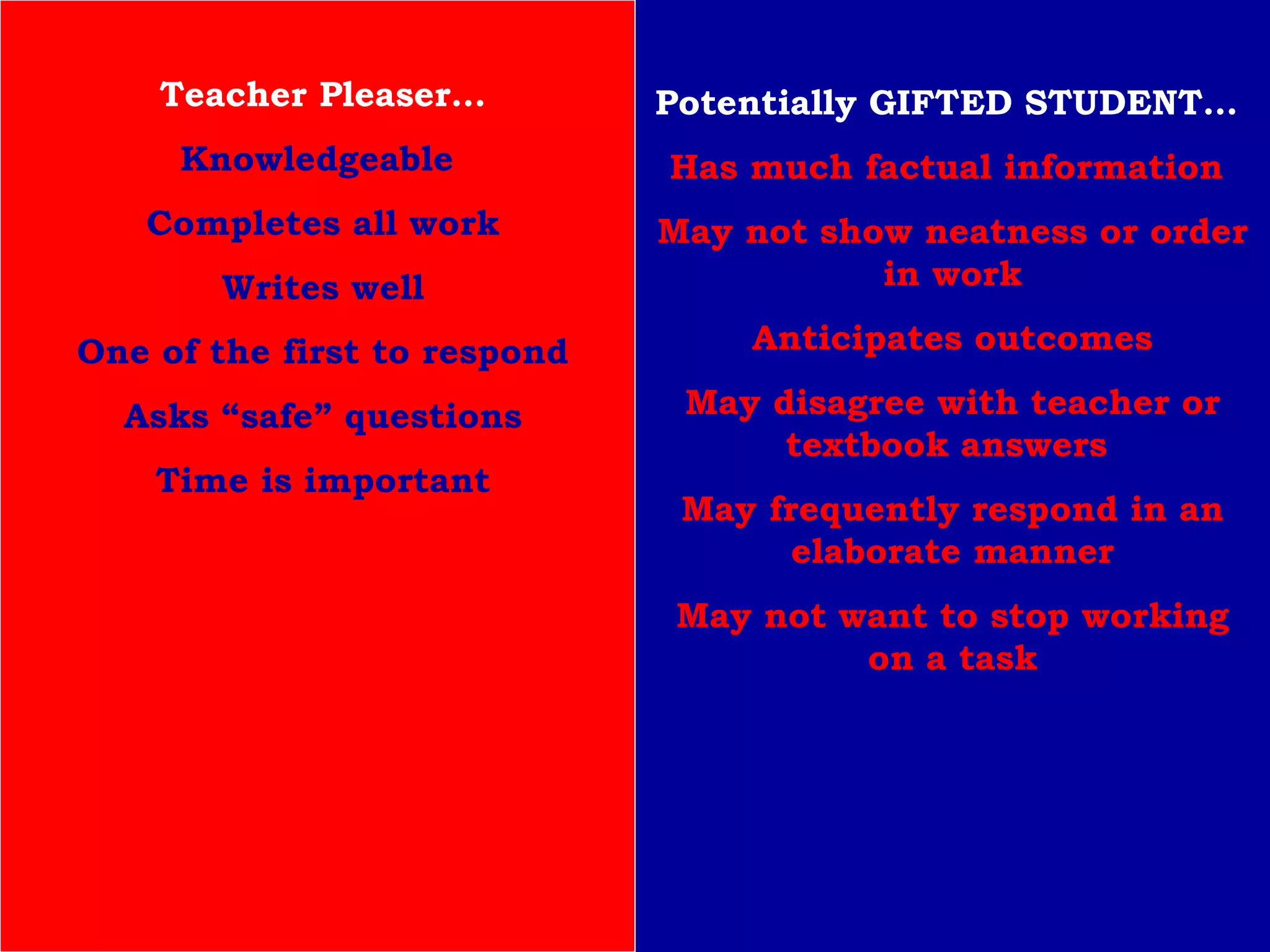
Teacher Pleaser… Knowledgeable   Completes all work Writes well One of the first to respond Asks “safe” questions Time is important Potentially GIFTED STUDENT…  Has much factual information  May not show neatness or order in work Anticipates outcomes May disagree with teacher or textbook answers  May frequently respond in an elaborate manner May not want to stop working on a task
OVER-Achievers  Are Typically  TEACHER-PLEASERS  (They turn in homework…)  …  Many Gifted Kids  Are NOT! (Homework?  What homework?)
A Matter of Perspective
CHARACTERISTICS  OF Giftedness  in Persons with Disabilities  …  and other challenges
Characteristics of Intellectually and Academically Gifted/  Physically Disabled Youth  •  Advanced lexicon  •  Broad knowledge base  •  Advanced memory skills  •  Excellent abstract-thinking skills  •  High level of determination  •  Curiosity  •  Creative problem-solving skills  •  Nontraditional means of expression to convey intellectual ability  •  Ability to compensate for disability  •  Preference for gifted programs  •  Forceful personality  •  Perfectionism  •  High level of emotional stress, self-criticism, and dissatisfaction with society Stephen Hawking
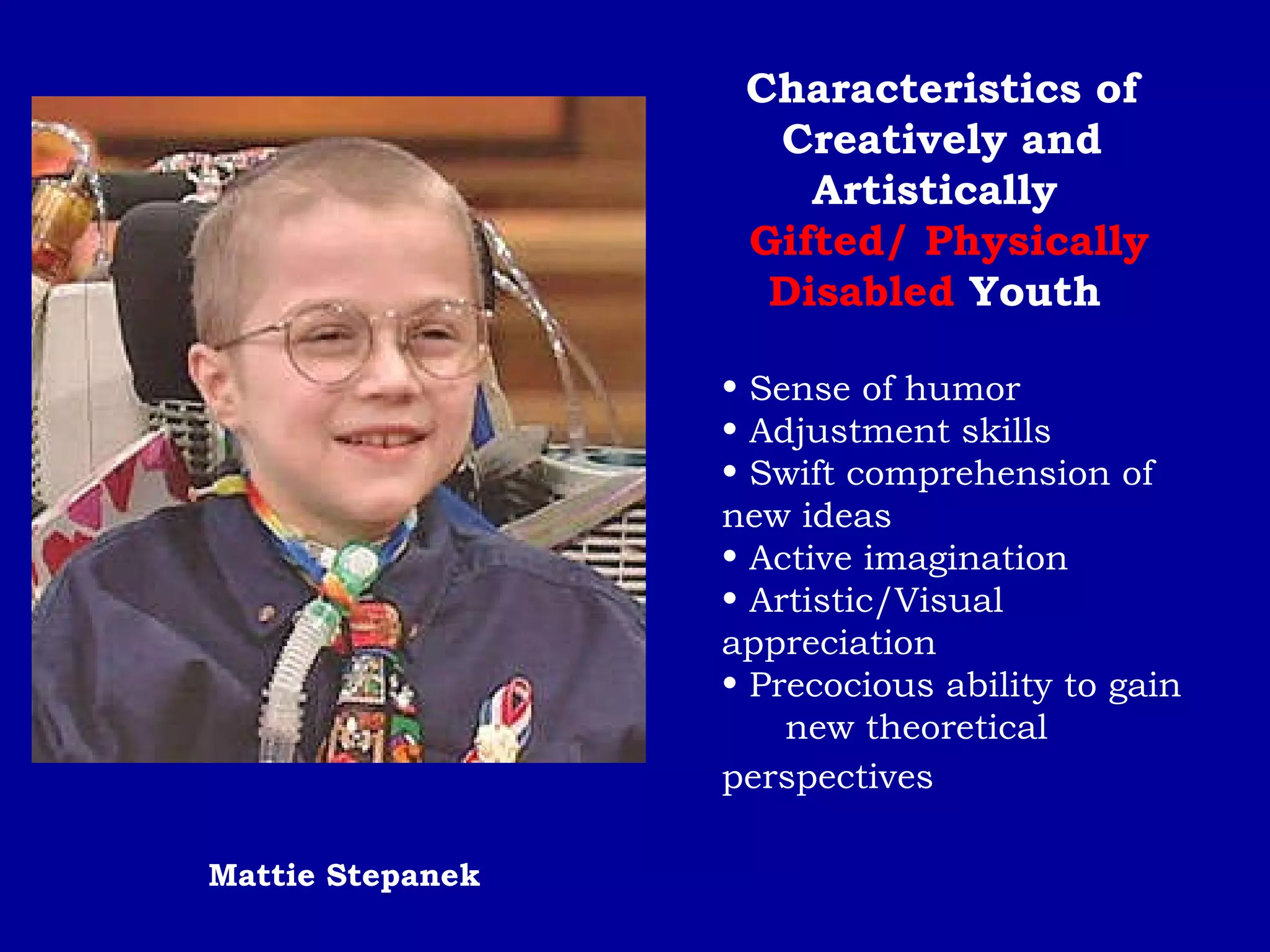
Characteristics of Creatively and Artistically  Gifted/ Physically Disabled  Youth  Sense of humor  Adjustment skills  Swift comprehension of  new ideas  Active imagination  Artistic/Visual  appreciation  Precocious ability to gain  new theoretical  perspectives   Mattie Stepanek
Characteristics of  Gifted/Visually Impaired  Gifted Youth  •  High task commitment  •  Perceptive to the  environment  •  Precocious ability to learn  Braille/Computer Skills  •  Love of reading  •  Creative thought process  •  Tendency to work on grade  level  •  Strong communication  skills   Helen Keller
Characteristics of  Gifted/Hearing Impaired  Youth  •  Tendency to work on  grade level  •  Good sense of humor  •  Intuition  •  Poor speaking ability  •  Ingenious problem- solving skills  Clearly symbolic language  capabilities   No literal explanations  necessary  Heather Whitestone
Characteristics of  Gifted/ADHD  Youth  •  Inattentiveness  •  Impulsive/hyperactive  conduct  •  Eagerness  •  Compassion  •  Fidgetiness  •  Minimal need of sleep  •  Strong-mindedness  since early childhood  •  Difficulty with lengthy  assignments
Many Characteristics Of The Highly Creative  Are ALSO Characteristics of ADHD  Inattention and Daydreaming  Sensation Seeking Inability to Finish Projects Hyperactivity Enthusiasm and Playfulness Difficult Temperament Deficient Social Skills Hypersensitivity to Stimulation Mood Swings
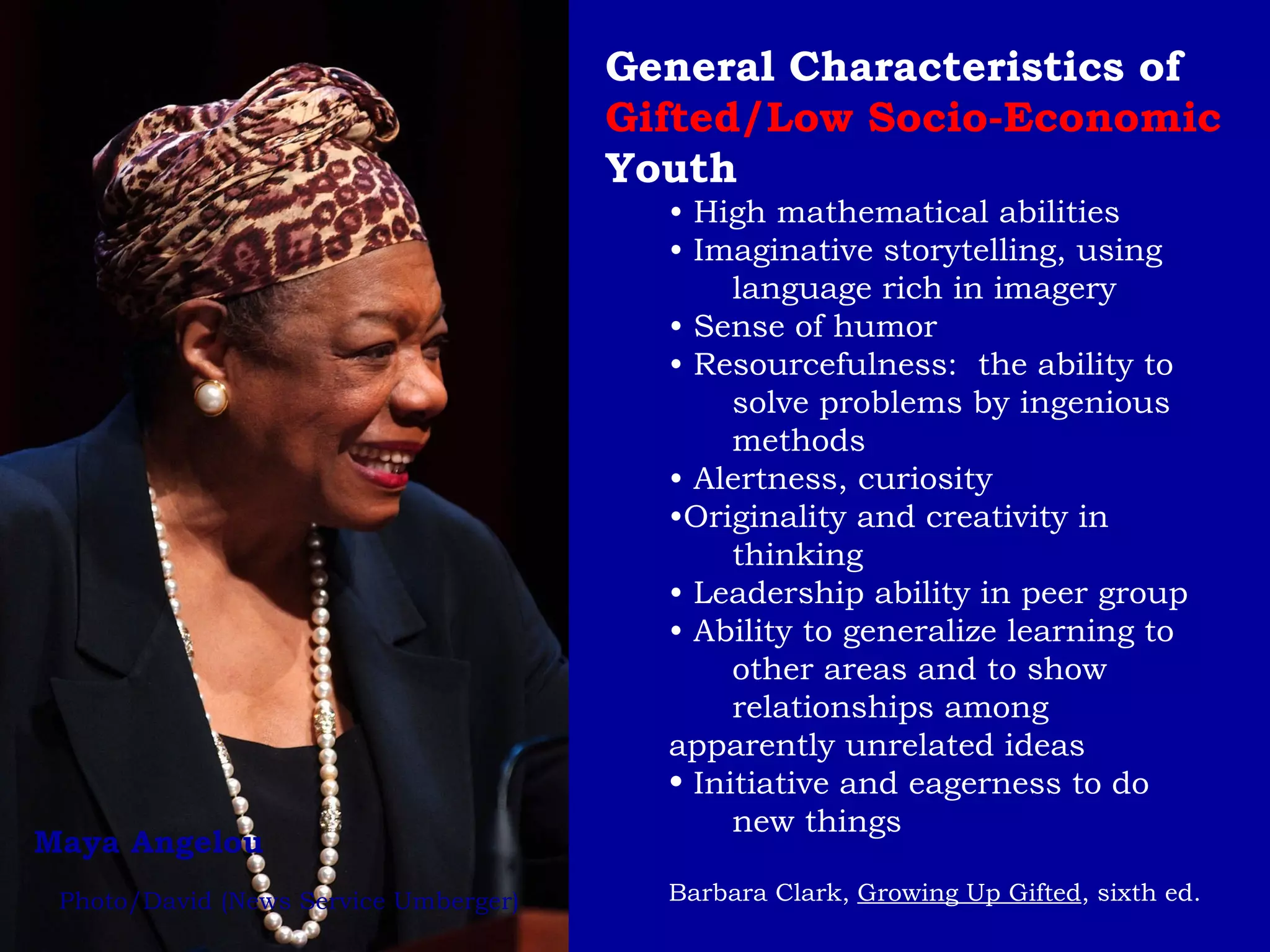
General Characteristics of  Gifted/Low Socio-Economic  Youth  •  High mathematical abilities  •  Imaginative storytelling, using  language rich in imagery •  Sense of humor •  Resourcefulness:  the ability to  solve problems by ingenious  methods  •  Alertness, curiosity • Originality and creativity in  thinking  •  Leadership ability in peer group  •  Ability to generalize learning to  other areas and to show  relationships among  apparently unrelated ideas Initiative and eagerness to do  new things Barbara Clark,  Growing Up Gifted , sixth ed. Maya Angelou Photo/David (News Service Umberger)
Gifted Characteristics Associated with  ESL (English as Second Language) Students Reads two grades above in native language Has advanced knowledge of idioms and native dialects with ability to translate and explain meanings Keeps busy and entertained, especially by imaginative games and ingenious applications Exhibits leadership ability, although in an unobtrusive manner; often best observed in non-traditional settings, e.g. playground, church, home, sports, clubs Accepts responsibilities at home normally reserved for older children Enjoys intelligent and/or effective risk-taking behavior, often accompanied by a sense of drama Demonstrates a strong sense of pride in cultural heritage Eagerly shares native culture
Even “more”  Characteristics  That  Conceal  Giftedness
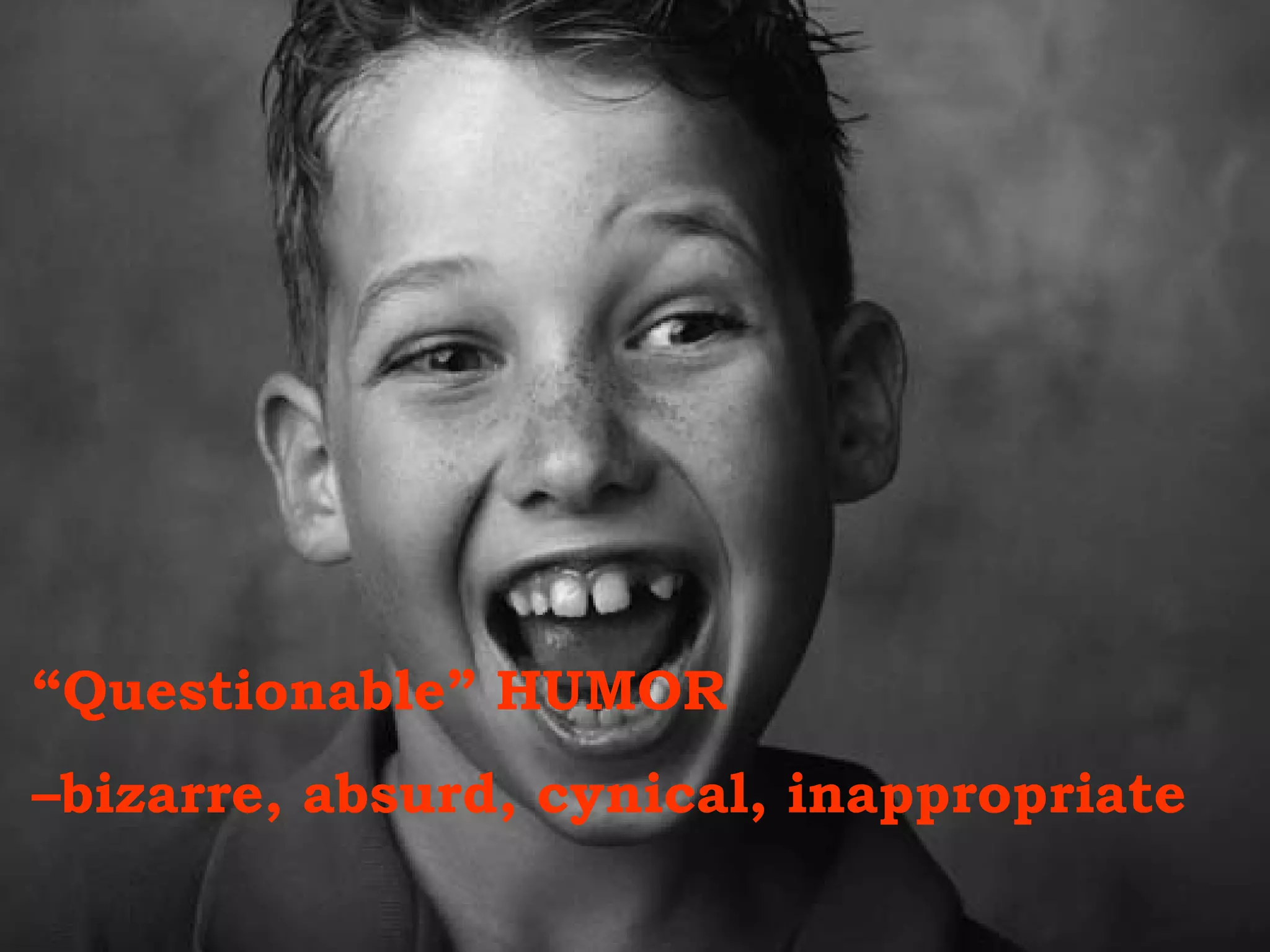
“ Questionable” HUMOR  – bizarre, absurd, cynical, inappropriate
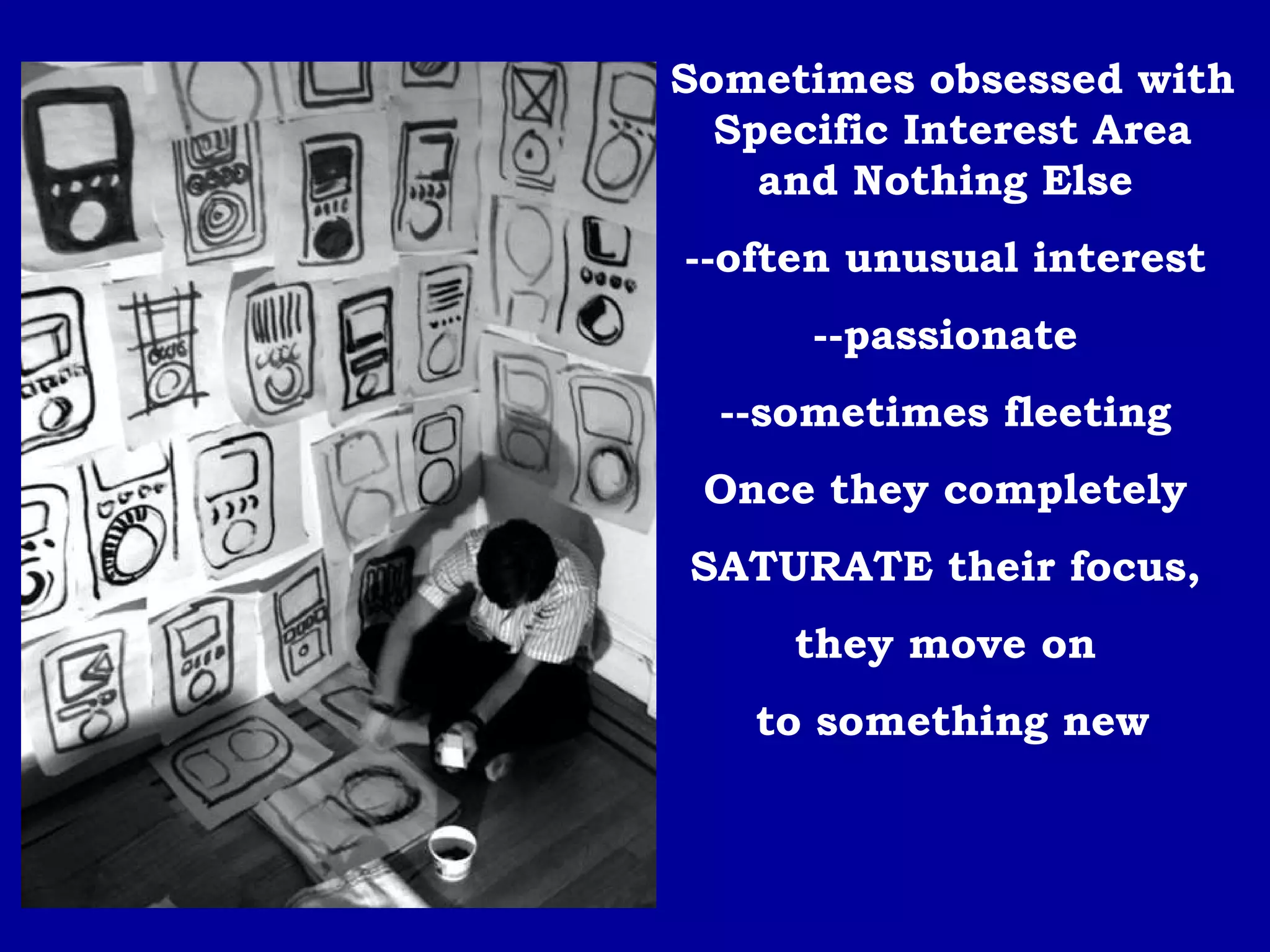
Sometimes obsessed with Specific Interest Area and Nothing Else  --often unusual interest  --passionate  --sometimes fleeting  Once they completely  SATURATE their focus,  they move on  to something new
Frustration with inability to master certain academic skills
DISRUPTIVE  Classroom  Behavior
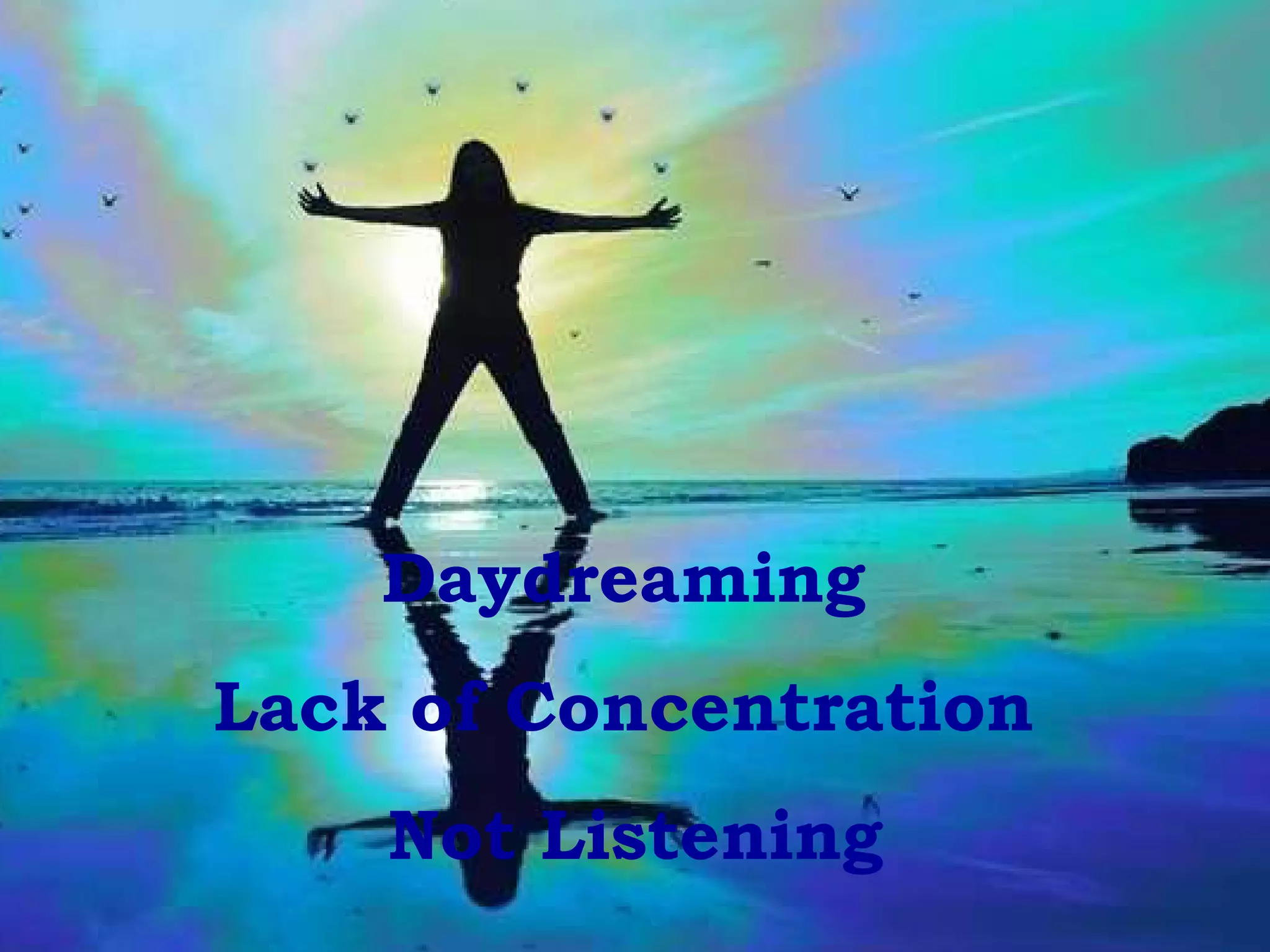
Daydreaming  Lack of Concentration  Not Listening
Perfectionism “ If it can’t be perfect I won’t do it at all, or I’ll intentionally do a poor job.  I’d rather have a “zero” than a “B” or “C.”
In the Classroom Some Gifted Kids –  Can easily become bored with routine  assignments.  May want to do things his/her own way—why not?  Can become a real pest.  May notice the teacher’s lack of inconsistency with  “But you said we should always…”  May not always pay close attention to directions.  Can make jokes at adults’ expense.  Not everyone  appreciates this.  Sometimes TOO innovative.
Restless, inattentive, disturbing others  Poor in Spelling, careless in handwriting,  inaccurate in Math because they are impatient  with details requiring rote learning or drill. Lackadaisical in completing or handing in  assignments and can be indifferent to classroom  work when not interested.  Outspokenly critical of both themselves and  others, an attitude which often alienates adults  as well as peers. Can become too bossy and be unwilling to listen to  the opinions of others.
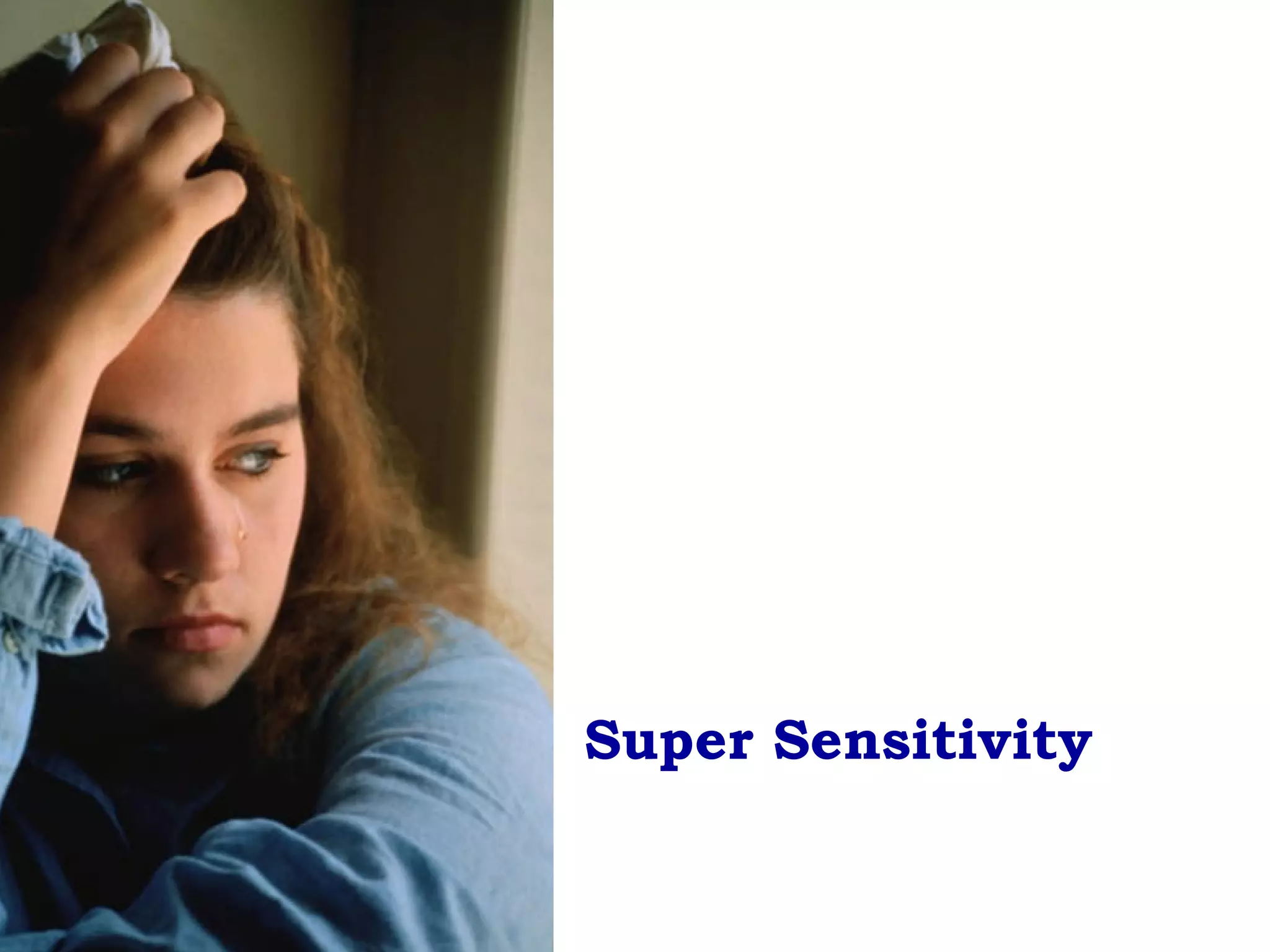
Super Sensitivity
Lack of Organizational Skills
LOW   SELF-ESTEEM
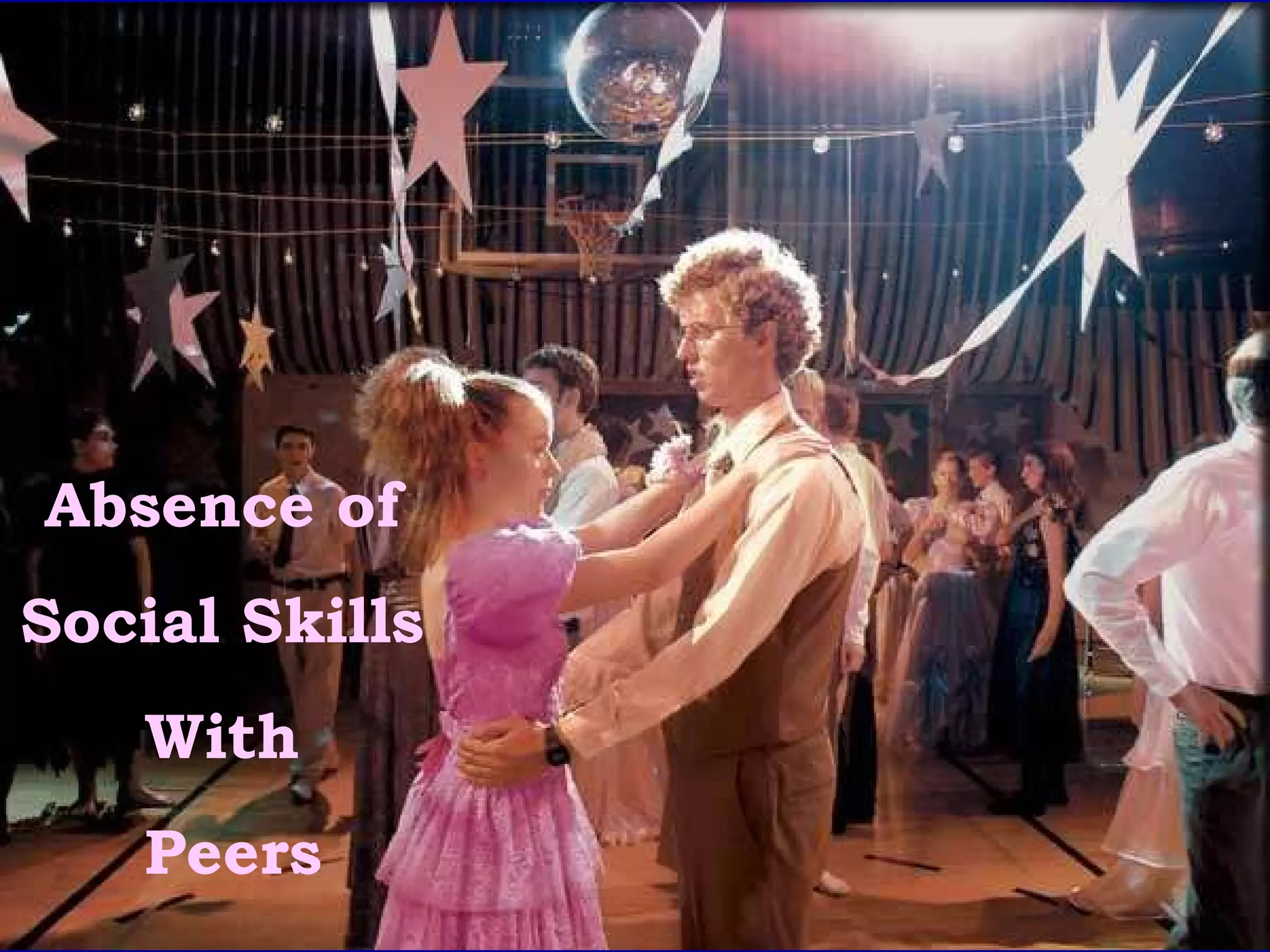
Absence of  Social Skills  With  Peers
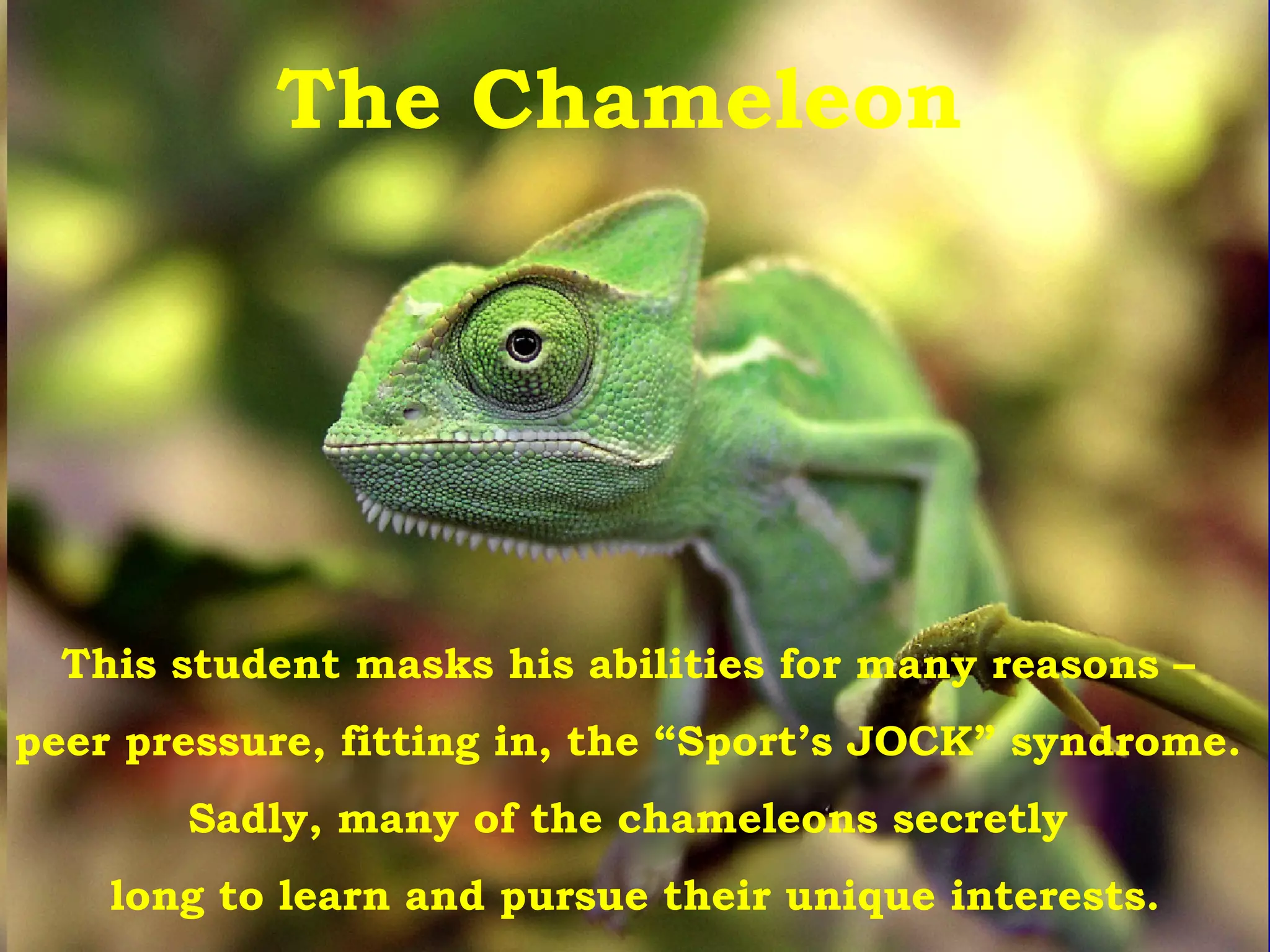
The Chameleon This student masks his abilities for many reasons –  peer pressure, fitting in, the “Sport’s JOCK” syndrome.  Sadly, many of the chameleons secretly  long to learn and pursue their unique interests.
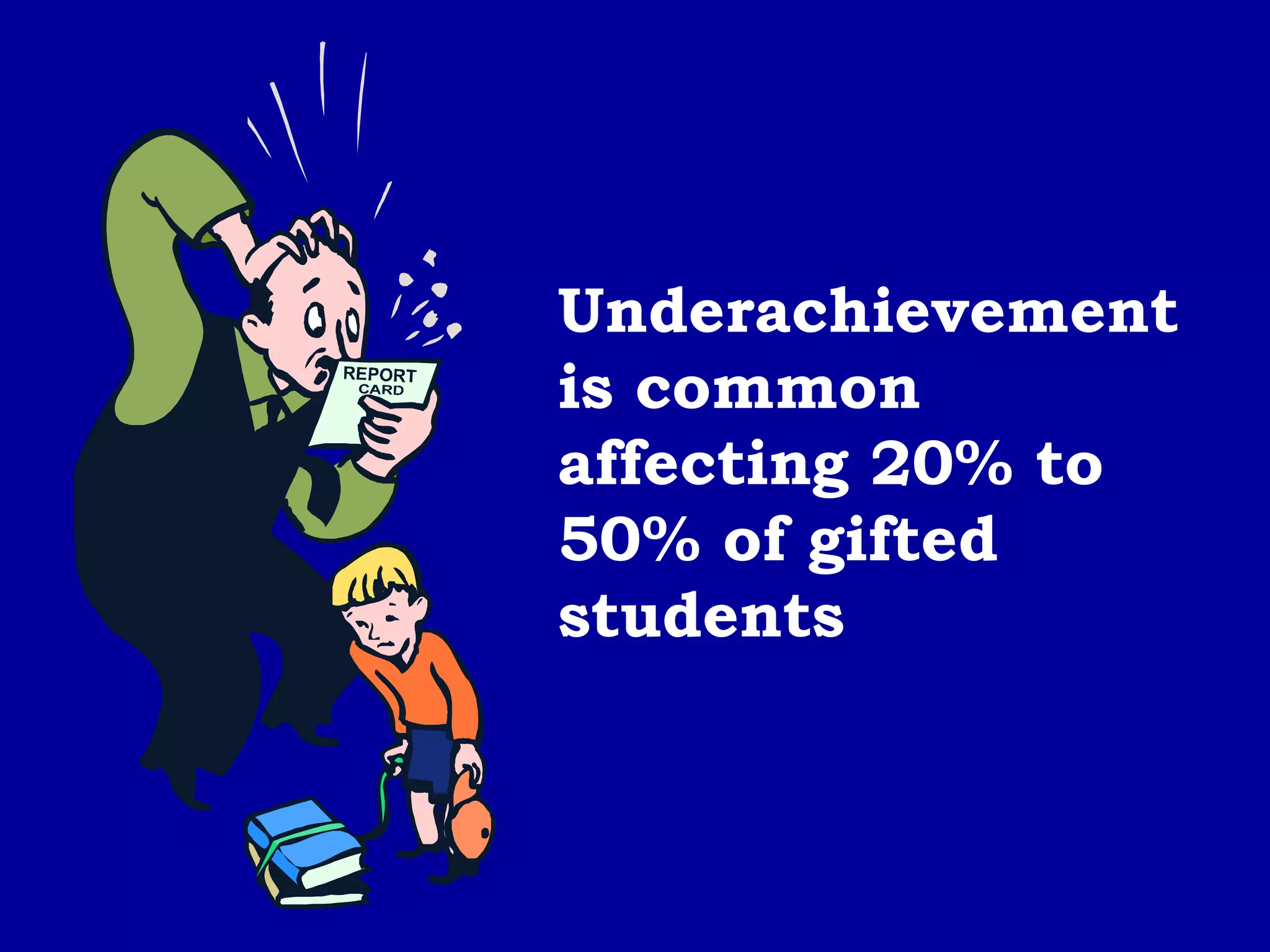
Underachievement is common affecting 20% to 50% of gifted students
Most Potentially Gifted Students Who Underachieve - Encounter external and internal barriers in  school and self Have not had opportunities to understand  their interests, strengths, styles, and  deficits Fear failure so do not take risks May feel powerless due to age and  maturity to make changes
The child who does well in school,  gets good grades, wins awards,  and “performs” beyond the norm  is considered talented.  The child who does not, no matter what  his innate intellectual capacities  or developmental level,  is less and less likely to be identified,  less and less likely to be served.  More and more, “gifted” is perceived  as synonymous with (and limited to)  academic achievement.
There is no ONE indicator of giftedness.  Gifted and talented children are found in expected AND unexpected places.  However, it is important to  always remember that…
the gifted child  is a CHILD First!
Acknowledgements Patricia Hesse – Gifted/Talented Coordinator, grades 2-12 for Weiner Public Schools, Arkansas  (slide format)  Shirley Kohl – CMS Elementary Talent Development Specialist  (revision, editing) Sally Reis – Professor & department head of Educational Psychology at the University of Connecticut  (research) Linda Silverman – Leading expert in the field of gifted education and author of  Counseling the Gifted and Talented  (research) Susan K. Johnsen – Professor in Department of Educational Psychology at Baylor University.  Director of Ph.D. Program and programs related to gifted and talented education. (research) E. Susanne Richert – Director, federal contract on national identification methods (research)

Characteristics of gifted students

  • 1.
    CHARACTERISTICS OF GIFTED AND TALENTED STUDENTS 2008
  • 2.
    Gifted and talentedstudents may exhibit positive and/or negative characteristics. Positive characteristics include --
  • 3.
  • 4.
    Uses advanced reasoningskills Has extensive and detailed memory Answers questions in detail Wants to learn and is very curious Makes logical inferences, draws conclusions based on sound reasoning Understands abstract ideas and complex concepts Learns new information quickly Applies prior knowledge to problem solving
  • 5.
    I.Q. Scales HighlyGifted student 145-159 Moderately Gifted student 130-144 Mildly Gifted student 115-129 The average I.Q. is 100.
  • 6.
  • 7.
    Has an intense,sustained interest Completes academic work correctly/unassisted Contributes to academic discussions Excels in one or more subject areas Has hobbies/collections related to field Has an inquisitive nature and asks relevant questions Demonstrates knowledge of facts in one or more academic areas Demonstrates knowledge about current events
  • 8.
  • 9.
    Has active imagination Is emotionally sensitive (i.e. to beauty) Brings inventive/innovative approach to problems Generates “what if” questions Experiments with ideas Is a nonconformist, uninhibited in expression, adventurous Is a risk taker Comfortable not having the “correct” answer Constructs jokes, clever plays on words, ironic observations
  • 10.
    Artistic Talent … specialized
  • 11.
    Produces imaginative/original art Appreciates subtle variations in artistic products or performances Seems to pick up skills in the arts with little or no instruction Art performance/products marked by detail, complexity, richness Concentrates for long periods of time on artistic projects Expresses emotion in art Communicates effectively via artistic media
  • 12.
  • 13.
    Acts responsibly insocial situations Has a cooperative attitude Projects positive image to peers Earns respect and trust of others Is self-confident Gets others to work together Maintains on-task focus Takes charge in group situations Is visionary – has a holistic view Can do backwards planning
  • 14.
  • 15.
    Shows pride inwork Wants to perform at highest possible level Reacts to challenges enthusiastically Approaches situations expecting to do well Places high value on mastery Works tenaciously, not easily discouraged Sets challenging goals Strives to improve Attempts tasks above current skill level
  • 16.
  • 17.
    How Can ITell The Difference Between High Achievers & Gifted Students?
  • 18.
    HIGH ACHIEVERS… Know the Answers Enjoy School Grasp Meaning Copy Accurately Have Good Ideas Absorb Information Achieve Mastery in 3-8 Repetitions GIFTED STUDENTS… Ask the questions Enjoy Learning Draw Inferences Create New Designs Have Unexpected Ideas Manipulate Information Achieve Mastery in 1-2 Repetitions
  • 19.
    Negative Characteristics Somecharacteristics of gifted students often keep them out of G/T programs. This can be related to teacher misidentification. Teachers tend to identify “teacher-pleasers” as gifted and ignore some gifted kids with “annoying” behaviors.
  • 20.
    General Definition ofa Teacher Pleaser A Teacher Pleaser is a student who has and/or does all the nice, pleasing, helpful, and considerate things in class as well as bails you out of uncomfortable situations when possible. This student achieves high grades in class AND scores in the 90 th percentile or above on standard achievement tests. Teacher Pleasers may vary from class to class.
  • 21.
  • 22.
    “ The extremelybright or the creative, curious, and questioning students, who may be stubborn, rule-breaking, egotistical or otherwise high in nuisance value, may not be the teachers’ favorites, but they sometimes are the most gifted.” Gary Davies and Sylvia Rimm
  • 23.
    Negative Characteristics ofCreativity Being bored with routine tasks, refusing to do rote homework. Not being interested in details, handing in messy work Making jokes or puns at inappropriate times
  • 24.
    Negative Characteristics ofMotivation Being emotionally sensitive, overreacting, getting angry easily, or crying if things go wrong
  • 25.
    Negative Characteristics of Critical Thinking Being self-critical and impatient with failure Being critical of others, even of the teacher
  • 26.
    General Definition ofa Potentially Gifted Student A Potentially Gifted student is a student who is pleased with original work, right or wrong, and who is strongly opinionated regarding moral issues. This student may also possess all, some or none of the labels associated with the Teacher Pleaser.
  • 27.
    Teacher Pleaser… Knowledgeable Completes all work Writes well One of the first to respond Asks “safe” questions Time is important Potentially GIFTED STUDENT… Has much factual information May not show neatness or order in work Anticipates outcomes May disagree with teacher or textbook answers May frequently respond in an elaborate manner May not want to stop working on a task
  • 28.
    OVER-Achievers AreTypically TEACHER-PLEASERS (They turn in homework…) … Many Gifted Kids Are NOT! (Homework? What homework?)
  • 29.
    A Matter ofPerspective
  • 30.
    CHARACTERISTICS OFGiftedness in Persons with Disabilities … and other challenges
  • 31.
    Characteristics of Intellectuallyand Academically Gifted/ Physically Disabled Youth • Advanced lexicon • Broad knowledge base • Advanced memory skills • Excellent abstract-thinking skills • High level of determination • Curiosity • Creative problem-solving skills • Nontraditional means of expression to convey intellectual ability • Ability to compensate for disability • Preference for gifted programs • Forceful personality • Perfectionism • High level of emotional stress, self-criticism, and dissatisfaction with society Stephen Hawking
  • 32.
    Characteristics of Creativelyand Artistically Gifted/ Physically Disabled Youth Sense of humor Adjustment skills Swift comprehension of new ideas Active imagination Artistic/Visual appreciation Precocious ability to gain new theoretical perspectives Mattie Stepanek
  • 33.
    Characteristics of Gifted/Visually Impaired Gifted Youth • High task commitment • Perceptive to the environment • Precocious ability to learn Braille/Computer Skills • Love of reading • Creative thought process • Tendency to work on grade level • Strong communication skills Helen Keller
  • 34.
    Characteristics of Gifted/Hearing Impaired Youth • Tendency to work on grade level • Good sense of humor • Intuition • Poor speaking ability • Ingenious problem- solving skills Clearly symbolic language capabilities No literal explanations necessary Heather Whitestone
  • 35.
    Characteristics of Gifted/ADHD Youth • Inattentiveness • Impulsive/hyperactive conduct • Eagerness • Compassion • Fidgetiness • Minimal need of sleep • Strong-mindedness since early childhood • Difficulty with lengthy assignments
  • 36.
    Many Characteristics OfThe Highly Creative Are ALSO Characteristics of ADHD Inattention and Daydreaming Sensation Seeking Inability to Finish Projects Hyperactivity Enthusiasm and Playfulness Difficult Temperament Deficient Social Skills Hypersensitivity to Stimulation Mood Swings
  • 37.
    General Characteristics of Gifted/Low Socio-Economic Youth • High mathematical abilities • Imaginative storytelling, using language rich in imagery • Sense of humor • Resourcefulness: the ability to solve problems by ingenious methods • Alertness, curiosity • Originality and creativity in thinking • Leadership ability in peer group • Ability to generalize learning to other areas and to show relationships among apparently unrelated ideas Initiative and eagerness to do new things Barbara Clark, Growing Up Gifted , sixth ed. Maya Angelou Photo/David (News Service Umberger)
  • 38.
    Gifted Characteristics Associatedwith ESL (English as Second Language) Students Reads two grades above in native language Has advanced knowledge of idioms and native dialects with ability to translate and explain meanings Keeps busy and entertained, especially by imaginative games and ingenious applications Exhibits leadership ability, although in an unobtrusive manner; often best observed in non-traditional settings, e.g. playground, church, home, sports, clubs Accepts responsibilities at home normally reserved for older children Enjoys intelligent and/or effective risk-taking behavior, often accompanied by a sense of drama Demonstrates a strong sense of pride in cultural heritage Eagerly shares native culture
  • 39.
    Even “more” Characteristics That Conceal Giftedness
  • 40.
    “ Questionable” HUMOR – bizarre, absurd, cynical, inappropriate
  • 41.
    Sometimes obsessed withSpecific Interest Area and Nothing Else --often unusual interest --passionate --sometimes fleeting Once they completely SATURATE their focus, they move on to something new
  • 42.
    Frustration with inabilityto master certain academic skills
  • 43.
  • 44.
    Daydreaming Lackof Concentration Not Listening
  • 45.
    Perfectionism “ Ifit can’t be perfect I won’t do it at all, or I’ll intentionally do a poor job. I’d rather have a “zero” than a “B” or “C.”
  • 46.
    In the ClassroomSome Gifted Kids – Can easily become bored with routine assignments. May want to do things his/her own way—why not? Can become a real pest. May notice the teacher’s lack of inconsistency with “But you said we should always…” May not always pay close attention to directions. Can make jokes at adults’ expense.  Not everyone appreciates this. Sometimes TOO innovative.
  • 47.
    Restless, inattentive, disturbingothers Poor in Spelling, careless in handwriting, inaccurate in Math because they are impatient with details requiring rote learning or drill. Lackadaisical in completing or handing in assignments and can be indifferent to classroom work when not interested. Outspokenly critical of both themselves and others, an attitude which often alienates adults as well as peers. Can become too bossy and be unwilling to listen to the opinions of others.
  • 48.
  • 49.
  • 50.
    LOW SELF-ESTEEM
  • 51.
    Absence of Social Skills With Peers
  • 52.
    The Chameleon Thisstudent masks his abilities for many reasons – peer pressure, fitting in, the “Sport’s JOCK” syndrome. Sadly, many of the chameleons secretly long to learn and pursue their unique interests.
  • 53.
    Underachievement is commonaffecting 20% to 50% of gifted students
  • 54.
    Most Potentially GiftedStudents Who Underachieve - Encounter external and internal barriers in school and self Have not had opportunities to understand their interests, strengths, styles, and deficits Fear failure so do not take risks May feel powerless due to age and maturity to make changes
  • 55.
    The child whodoes well in school, gets good grades, wins awards, and “performs” beyond the norm is considered talented. The child who does not, no matter what his innate intellectual capacities or developmental level, is less and less likely to be identified, less and less likely to be served. More and more, “gifted” is perceived as synonymous with (and limited to) academic achievement.
  • 56.
    There is noONE indicator of giftedness. Gifted and talented children are found in expected AND unexpected places. However, it is important to always remember that…
  • 57.
    the gifted child is a CHILD First!
  • 58.
    Acknowledgements Patricia Hesse– Gifted/Talented Coordinator, grades 2-12 for Weiner Public Schools, Arkansas (slide format) Shirley Kohl – CMS Elementary Talent Development Specialist (revision, editing) Sally Reis – Professor & department head of Educational Psychology at the University of Connecticut (research) Linda Silverman – Leading expert in the field of gifted education and author of Counseling the Gifted and Talented (research) Susan K. Johnsen – Professor in Department of Educational Psychology at Baylor University. Director of Ph.D. Program and programs related to gifted and talented education. (research) E. Susanne Richert – Director, federal contract on national identification methods (research)

Editor's Notes

  • #20 E. Susanne Richert (1991)
  • #24 Susanne Richert. These negative traits are associated with creativity because creative students have high tolerance for ambiguity, are independent, divergent thinkers, are risk takers, and are imaginative and sensitive
  • #32 Professor and author of The Universe in a Nutshell. Holds 12 honorary degrees.
  • #33 Mattie has always had three wishes: to have his poems published, to meet his hero Jimmy Carter and to share his message of peace on The Oprah Winfrey Show . Why? “Because they last forever”
  • #35 First Ms. America with a disability (1995). Deaf at age 18 mo. Due to reaction to diphtheria vaccine