THERMAL POWER CYCLES
-
THERMAL POWER PLANT
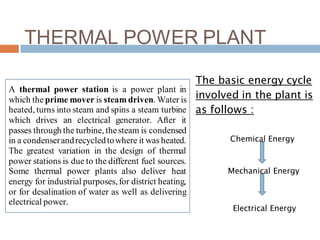
The basic energy cycle
involved in the plant is
as follows :
Chemical Energy
Mechanical Energy
Electrical Energy
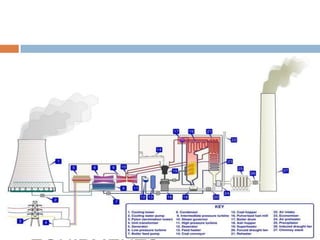
A thermal power station is a power plant in
which the prime mover is steam driven. Water is
heated, turns into steam and spins a steam turbine
which drives an electrical generator. After it
passes through the turbine, thesteam is condensed
in a condenserandrecycledtowhere it was heated.
The greatest variation in the design of thermal
power stations is due to the different fuel sources.
Some thermal power plants also deliver heat
energy for industrial purposes, for district heating,
or for desalination of water as well as delivering
electrical power.
POWER CYCLES
 CARNOT CYCLE
 RANKINE CYCLE
 DIESEL CYCLE
 OTTO CYCLE
 BRAYTON CYCLE
 STIRLING CYCLE
 COMBINED CYCLES
LAWS OF THERMODYNAMICS
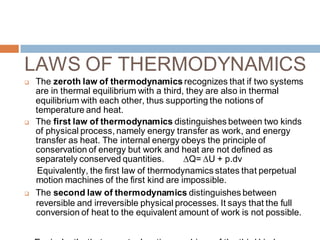
 The zeroth law of thermodynamics recognizes that if two systems
are in thermal equilibrium with a third, they are also in thermal
equilibrium with each other, thus supporting the notions of
temperature and heat.
 The first law of thermodynamics distinguishes between two kinds
of physical process, namely energy transfer as work, and energy
transfer as heat. The internal energy obeys the principle of
conservation of energy but work and heat are not defined as
separately conserved quantities. ∆Q= ∆U + p.dv
Equivalently, the first law of thermodynamics states that perpetual
motion machines of the first kind are impossible.
 The second law of thermodynamics distinguishes between
reversible and irreversible physical processes. It says that the full
conversion of heat to the equivalent amount of work is not possible.
Equivalently, perpetual motion machines of the second kind are
impossible.
 The third law of thermodynamics concerns the entropy of a
perfect crystal at absolute zero temperature, and implies that it is
impossible to cool a system to exactly absolute zero.
THERMODYNAMIC
PROCESSES
 Isobaric processes.
 Isothermal Processes.
 Adiabatic processes.
 Isentropic Processes.
 Isochoric processes.
 Throttling.
CARNOT CYCLE
The Carnot cycle can be thought of as the most efficient heat engine cycle allowed by
physical laws. The most efficient heat engine cycle is the Carnot cycle, consisting of
two isothermal processes and two adiabatic processes. When the second law of
thermodynamics states that not all the supplied heat in a heat engine can be used to
do work, the Carnot efficiency sets the limiting value on the fraction of the heat which
can be so used.
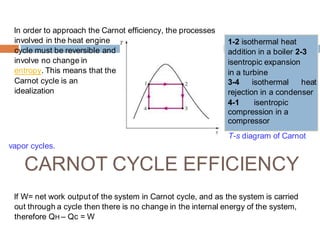
In order to approach the Carnot efficiency, the processes
involved in the heat engine
cycle must be reversible and
involve no change in
entropy. This means that the
Carnot cycle is an
idealization
T-s diagram of Carnot
vapor cycles. 7
CARNOT CYCLE EFFICIENCY
If W= net work output of the system in Carnot cycle, and as the system is carried
out through a cycle then there is no change in the internal energy of the system,
therefore QH – Qc = W
1-2 isothermal heat
addition in a boiler 2-3
isentropic expansion
in a turbine
3-4 isothermal heat
rejection in a condenser
4-1 isentropic
compression in a
compressor
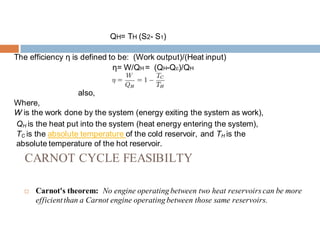
QH= TH (S2- S1)
The efficiency η is defined to be: (Work output)/(Heat input)
η= W/QH = (QH-Qc)/QH
also,
Where,
W is the work done by the system (energy exiting the system as work),
QH is the heat put into the system (heat energy entering the system),
TC is the absolute temperature of the cold reservoir, and TH is the
absolute temperature of the hot reservoir.
CARNOT CYCLE FEASIBILTY
 Carnot's theorem: No engine operating between two heat reservoirs can be more
efficientthan a Carnot engine operating between those same reservoirs.
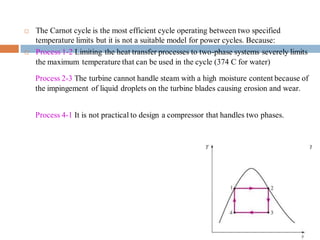
 The Carnot cycle is the most efficient cycle operating between two specified
temperature limits but it is not a suitable model for power cycles. Because:
 Process 1-2 Limiting the heat transfer processes to two-phase systems severely limits
the maximum temperature that can be used in the cycle (374 C for water)
Process 2-3 The turbine cannot handle steam with a high moisture content because of
the impingement of liquid droplets on the turbine blades causing erosion and wear.
Process 4-1 It is not practical to design a compressor that handles two phases.
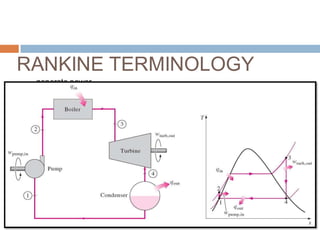
RANKINE TERMINOLOGY
generate power.
The Rankine cycle most closely describes the process by which
steamoperated heat engines most commonly found in power generation plants
to
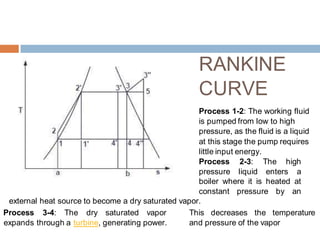
RANKINE
CURVE
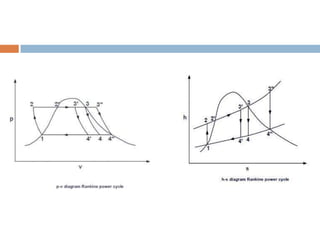
Process 1-2: The working fluid
is pumped from low to high
pressure, as the fluid is a liquid
at this stage the pump requires
little input energy.
Process 2-3: The high
pressure liquid enters a
boiler where it is heated at
constant pressure by an
external heat source to become a dry saturated vapor.
Process 3-4: The dry saturated vapor
expands through a turbine, generating power.
This decreases the temperature
and pressure of the vapor
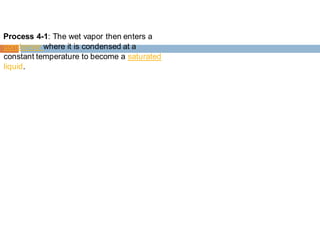
Process 4-1: The wet vapor then enters a
condenser where it is condensed at a
constant temperature to become a saturated
liquid.
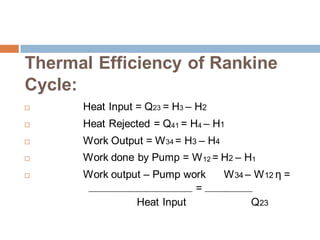
Thermal Efficiency of Rankine
Cycle:
 Heat Input = Q23 = H3 – H2
 Heat Rejected = Q41 = H4 – H1
 Work Output = W34 = H3 – H4
 Work done by Pump = W12 = H2 – H1
 Work output – Pump work W34 – W12 η =
=
Heat Input Q23
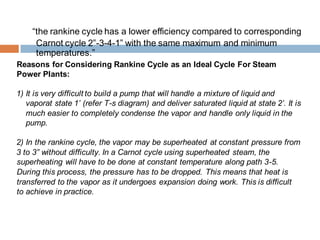
“the rankine cycle has a lower efficiency compared to corresponding
Carnot cycle 2‟-3-4-1‟ with the same maximum and minimum
temperatures.”
Reasons for Considering Rankine Cycle as an Ideal Cycle For Steam
Power Plants:
1) It is very difficult to build a pump that will handle a mixture of liquid and
vaporat state 1’ (refer T-s diagram) and deliver saturated liquid at state 2’. It is
much easier to completely condense the vapor and handle only liquid in the
pump.
2) In the rankine cycle, the vapor may be superheated at constant pressure from
3 to 3” without difficulty. In a Carnot cycle using superheated steam, the
superheating will have to be done at constant temperature along path 3-5.
During this process, the pressure has to be dropped. This means that heat is
transferred to the vapor as it undergoes expansion doing work. This is difficult
to achieve in practice.
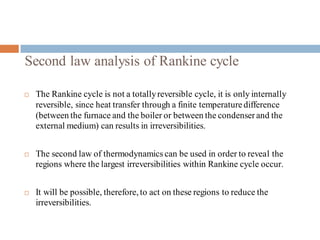
Second law analysis of Rankine cycle
 The Rankine cycle is not a totallyreversible cycle, it is only internally
reversible, since heat transfer through a finite temperaturedifference
(between the furnace and the boiler or between the condenserand the
external medium) can results in irreversibilities.
 The second law of thermodynamics can be used in order to reveal the
regions where the largest irreversibilities within Rankine cycle occur.
 It will be possible, therefore, to act on these regions to reduce the
irreversibilities.
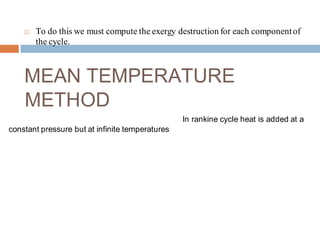
 To do this we must compute the exergy destruction for each componentof
the cycle.
MEAN TEMPERATURE
METHOD
In rankine cycle heat is added at a
constant pressure but at infinite temperatures
If TM1 is the mean temperature of the heat addition as shown in the figure so that
the area under the curve 2 to 3”
is equal to the area under 6 and
7 then the heat added is
Q23” = Tm1 (S3”- S2) Tm1 =
(H3”- H2)/(S3” – S2)
Heat rejected, Q4”1 = H4” – H1
= T2 (S4” – S1)
of heat addition, higher will be
the
η = 1 – Q23”/Q4”1
Rankine cycle efficiency.”
η = [1 – Tm1/T2]
DEVIATION OF
ACTUAL VAPOUR
Tm1
T2
6 7
“The higher the mean temperature
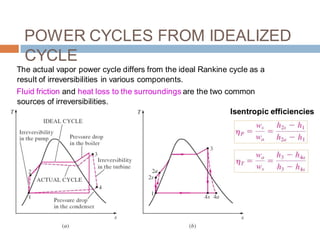
POWER CYCLES FROM IDEALIZED
CYCLE
The actual vapor power cycle differs from the ideal Rankine cycle as a
result of irreversibilities in various components.
Fluid friction and heat loss to the surroundings are the two common
sources of irreversibilities.
Isentropic efficiencies
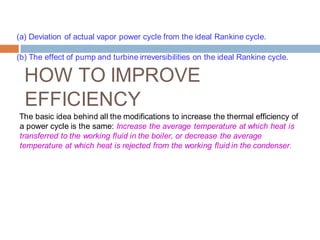
(a) Deviation of actual vapor power cycle from the ideal Rankine cycle.
(b) The effect of pump and turbine irreversibilities on the ideal Rankine cycle.
HOW TO IMPROVE
EFFICIENCY
The basic idea behind all the modifications to increase the thermal efficiency of
a power cycle is the same: Increase the average temperature at which heat is
transferred to the working fluid in the boiler, or decrease the average
temperature at which heat is rejected from the working fluid in the condenser.
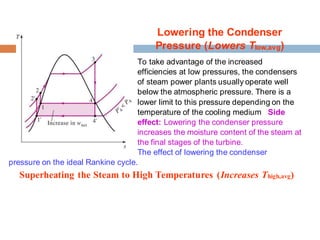
Lowering the Condenser
Pressure (Lowers Tlow,avg)
To take advantage of the increased
efficiencies at low pressures, the condensers
of steam power plants usually operate well
below the atmospheric pressure. There is a
lower limit to this pressure depending on the
temperature of the cooling medium Side
effect: Lowering the condenser pressure
increases the moisture content of the steam at
the final stages of the turbine.
The effect of lowering the condenser
pressure on the ideal Rankine cycle.18
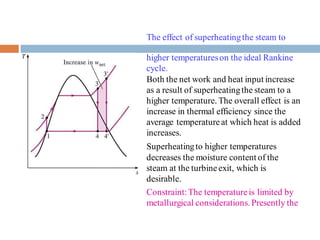
Superheating the Steam to High Temperatures (Increases Thigh,avg)
The effect of superheatingthe steam to
higher temperatureson the ideal Rankine
cycle.
Both the net work and heat input increase
as a result of superheatingthe steam to a
higher temperature. The overall effect is an
increase in thermal efficiency since the
average temperatureat which heat is added
increases.
Superheatingto higher temperatures
decreases the moisture content of the
steam at the turbineexit, which is
desirable.
Constraint:The temperatureis limited by
metallurgical considerations. Presently the
highest steam temperature
allowed at the turbine inlet is
about 620 C.
19
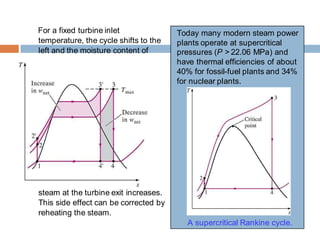
Increasing the Boiler Pressure (Increases Thigh,avg)
For a fixed turbine inlet
temperature, the cycle shifts to the
left and the moisture content of
steam at the turbine exit increases.
This side effect can be corrected by
reheating the steam.
A supercritical Rankine cycle.
Today many modern steam power
plants operate at supercritical
pressures (P > 22.06 MPa) and
have thermal efficiencies of about
40% for fossil-fuel plants and 34%
for nuclear plants.
The effect of increasing the boiler
pressure on the ideal Rankine cycle. 20
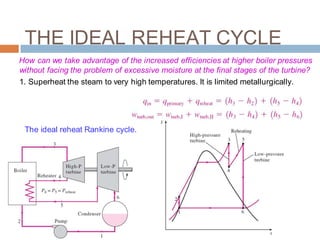
THE IDEAL REHEAT CYCLE
How can we take advantage of the increased efficiencies at higher boiler pressures
without facing the problem of excessive moisture at the final stages of the turbine?
1. Superheat the steam to very high temperatures. It is limited metallurgically.
21
The ideal reheat Rankine cycle.
2. Expand the steam in the turbine in two stages, and reheat it in between (reheat)
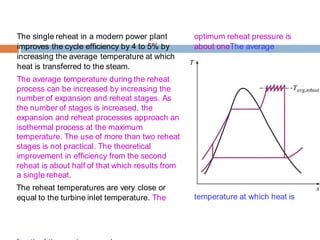
The single reheat in a modern power plant
improves the cycle efficiency by 4 to 5% by
increasing the average temperature at which
heat is transferred to the steam.
The average temperature during the reheat
process can be increased by increasing the
number of expansion and reheat stages. As
the number of stages is increased, the
expansion and reheat processes approach an
isothermal process at the maximum
temperature. The use of more than two reheat
stages is not practical. The theoretical
improvement in efficiency from the second
reheat is about half of that which results from
a single reheat.
The reheat temperatures are very close or
equal to the turbine inlet temperature. The
optimum reheat pressure is
about oneThe average
temperature at which heat is
transferred during reheating increases as
the number of reheat stages is increased.
The End

Rnakine reheat regen

  • 1.
  • 2.
    THERMAL POWER PLANT Thebasic energy cycle involved in the plant is as follows : Chemical Energy Mechanical Energy Electrical Energy A thermal power station is a power plant in which the prime mover is steam driven. Water is heated, turns into steam and spins a steam turbine which drives an electrical generator. After it passes through the turbine, thesteam is condensed in a condenserandrecycledtowhere it was heated. The greatest variation in the design of thermal power stations is due to the different fuel sources. Some thermal power plants also deliver heat energy for industrial purposes, for district heating, or for desalination of water as well as delivering electrical power.
  • 4.
    POWER CYCLES  CARNOTCYCLE  RANKINE CYCLE  DIESEL CYCLE  OTTO CYCLE  BRAYTON CYCLE  STIRLING CYCLE  COMBINED CYCLES
  • 5.
    LAWS OF THERMODYNAMICS The zeroth law of thermodynamics recognizes that if two systems are in thermal equilibrium with a third, they are also in thermal equilibrium with each other, thus supporting the notions of temperature and heat.  The first law of thermodynamics distinguishes between two kinds of physical process, namely energy transfer as work, and energy transfer as heat. The internal energy obeys the principle of conservation of energy but work and heat are not defined as separately conserved quantities. ∆Q= ∆U + p.dv Equivalently, the first law of thermodynamics states that perpetual motion machines of the first kind are impossible.  The second law of thermodynamics distinguishes between reversible and irreversible physical processes. It says that the full conversion of heat to the equivalent amount of work is not possible.
  • 6.
    Equivalently, perpetual motionmachines of the second kind are impossible.  The third law of thermodynamics concerns the entropy of a perfect crystal at absolute zero temperature, and implies that it is impossible to cool a system to exactly absolute zero. THERMODYNAMIC PROCESSES  Isobaric processes.  Isothermal Processes.  Adiabatic processes.  Isentropic Processes.  Isochoric processes.
  • 7.
     Throttling. CARNOT CYCLE TheCarnot cycle can be thought of as the most efficient heat engine cycle allowed by physical laws. The most efficient heat engine cycle is the Carnot cycle, consisting of two isothermal processes and two adiabatic processes. When the second law of thermodynamics states that not all the supplied heat in a heat engine can be used to do work, the Carnot efficiency sets the limiting value on the fraction of the heat which can be so used.
  • 8.
    In order toapproach the Carnot efficiency, the processes involved in the heat engine cycle must be reversible and involve no change in entropy. This means that the Carnot cycle is an idealization T-s diagram of Carnot vapor cycles. 7 CARNOT CYCLE EFFICIENCY If W= net work output of the system in Carnot cycle, and as the system is carried out through a cycle then there is no change in the internal energy of the system, therefore QH – Qc = W 1-2 isothermal heat addition in a boiler 2-3 isentropic expansion in a turbine 3-4 isothermal heat rejection in a condenser 4-1 isentropic compression in a compressor
  • 9.
    QH= TH (S2-S1) The efficiency η is defined to be: (Work output)/(Heat input) η= W/QH = (QH-Qc)/QH also, Where, W is the work done by the system (energy exiting the system as work), QH is the heat put into the system (heat energy entering the system), TC is the absolute temperature of the cold reservoir, and TH is the absolute temperature of the hot reservoir. CARNOT CYCLE FEASIBILTY  Carnot's theorem: No engine operating between two heat reservoirs can be more efficientthan a Carnot engine operating between those same reservoirs.
  • 10.
     The Carnotcycle is the most efficient cycle operating between two specified temperature limits but it is not a suitable model for power cycles. Because:  Process 1-2 Limiting the heat transfer processes to two-phase systems severely limits the maximum temperature that can be used in the cycle (374 C for water) Process 2-3 The turbine cannot handle steam with a high moisture content because of the impingement of liquid droplets on the turbine blades causing erosion and wear. Process 4-1 It is not practical to design a compressor that handles two phases.
  • 11.
  • 12.
    The Rankine cyclemost closely describes the process by which steamoperated heat engines most commonly found in power generation plants to
  • 13.
    RANKINE CURVE Process 1-2: Theworking fluid is pumped from low to high pressure, as the fluid is a liquid at this stage the pump requires little input energy. Process 2-3: The high pressure liquid enters a boiler where it is heated at constant pressure by an external heat source to become a dry saturated vapor. Process 3-4: The dry saturated vapor expands through a turbine, generating power. This decreases the temperature and pressure of the vapor
  • 14.
    Process 4-1: Thewet vapor then enters a condenser where it is condensed at a constant temperature to become a saturated liquid.
  • 16.
    Thermal Efficiency ofRankine Cycle:  Heat Input = Q23 = H3 – H2  Heat Rejected = Q41 = H4 – H1  Work Output = W34 = H3 – H4  Work done by Pump = W12 = H2 – H1  Work output – Pump work W34 – W12 η = = Heat Input Q23
  • 17.
    “the rankine cyclehas a lower efficiency compared to corresponding Carnot cycle 2‟-3-4-1‟ with the same maximum and minimum temperatures.” Reasons for Considering Rankine Cycle as an Ideal Cycle For Steam Power Plants: 1) It is very difficult to build a pump that will handle a mixture of liquid and vaporat state 1’ (refer T-s diagram) and deliver saturated liquid at state 2’. It is much easier to completely condense the vapor and handle only liquid in the pump. 2) In the rankine cycle, the vapor may be superheated at constant pressure from 3 to 3” without difficulty. In a Carnot cycle using superheated steam, the superheating will have to be done at constant temperature along path 3-5. During this process, the pressure has to be dropped. This means that heat is transferred to the vapor as it undergoes expansion doing work. This is difficult to achieve in practice.
  • 18.
    Second law analysisof Rankine cycle  The Rankine cycle is not a totallyreversible cycle, it is only internally reversible, since heat transfer through a finite temperaturedifference (between the furnace and the boiler or between the condenserand the external medium) can results in irreversibilities.  The second law of thermodynamics can be used in order to reveal the regions where the largest irreversibilities within Rankine cycle occur.  It will be possible, therefore, to act on these regions to reduce the irreversibilities.
  • 19.
     To dothis we must compute the exergy destruction for each componentof the cycle. MEAN TEMPERATURE METHOD In rankine cycle heat is added at a constant pressure but at infinite temperatures
  • 20.
    If TM1 isthe mean temperature of the heat addition as shown in the figure so that the area under the curve 2 to 3” is equal to the area under 6 and 7 then the heat added is Q23” = Tm1 (S3”- S2) Tm1 = (H3”- H2)/(S3” – S2) Heat rejected, Q4”1 = H4” – H1 = T2 (S4” – S1) of heat addition, higher will be the η = 1 – Q23”/Q4”1 Rankine cycle efficiency.” η = [1 – Tm1/T2] DEVIATION OF ACTUAL VAPOUR Tm1 T2 6 7 “The higher the mean temperature
  • 21.
    POWER CYCLES FROMIDEALIZED CYCLE The actual vapor power cycle differs from the ideal Rankine cycle as a result of irreversibilities in various components. Fluid friction and heat loss to the surroundings are the two common sources of irreversibilities. Isentropic efficiencies
  • 22.
    (a) Deviation ofactual vapor power cycle from the ideal Rankine cycle. (b) The effect of pump and turbine irreversibilities on the ideal Rankine cycle. HOW TO IMPROVE EFFICIENCY The basic idea behind all the modifications to increase the thermal efficiency of a power cycle is the same: Increase the average temperature at which heat is transferred to the working fluid in the boiler, or decrease the average temperature at which heat is rejected from the working fluid in the condenser.
  • 23.
    Lowering the Condenser Pressure(Lowers Tlow,avg) To take advantage of the increased efficiencies at low pressures, the condensers of steam power plants usually operate well below the atmospheric pressure. There is a lower limit to this pressure depending on the temperature of the cooling medium Side effect: Lowering the condenser pressure increases the moisture content of the steam at the final stages of the turbine. The effect of lowering the condenser pressure on the ideal Rankine cycle.18 Superheating the Steam to High Temperatures (Increases Thigh,avg)
  • 24.
    The effect ofsuperheatingthe steam to higher temperatureson the ideal Rankine cycle. Both the net work and heat input increase as a result of superheatingthe steam to a higher temperature. The overall effect is an increase in thermal efficiency since the average temperatureat which heat is added increases. Superheatingto higher temperatures decreases the moisture content of the steam at the turbineexit, which is desirable. Constraint:The temperatureis limited by metallurgical considerations. Presently the
  • 25.
    highest steam temperature allowedat the turbine inlet is about 620 C. 19
  • 26.
    Increasing the BoilerPressure (Increases Thigh,avg)
  • 27.
    For a fixedturbine inlet temperature, the cycle shifts to the left and the moisture content of steam at the turbine exit increases. This side effect can be corrected by reheating the steam. A supercritical Rankine cycle. Today many modern steam power plants operate at supercritical pressures (P > 22.06 MPa) and have thermal efficiencies of about 40% for fossil-fuel plants and 34% for nuclear plants.
  • 28.
    The effect ofincreasing the boiler pressure on the ideal Rankine cycle. 20
  • 29.
    THE IDEAL REHEATCYCLE How can we take advantage of the increased efficiencies at higher boiler pressures without facing the problem of excessive moisture at the final stages of the turbine? 1. Superheat the steam to very high temperatures. It is limited metallurgically. 21 The ideal reheat Rankine cycle.
  • 30.
    2. Expand thesteam in the turbine in two stages, and reheat it in between (reheat)
  • 31.
    The single reheatin a modern power plant improves the cycle efficiency by 4 to 5% by increasing the average temperature at which heat is transferred to the steam. The average temperature during the reheat process can be increased by increasing the number of expansion and reheat stages. As the number of stages is increased, the expansion and reheat processes approach an isothermal process at the maximum temperature. The use of more than two reheat stages is not practical. The theoretical improvement in efficiency from the second reheat is about half of that which results from a single reheat. The reheat temperatures are very close or equal to the turbine inlet temperature. The optimum reheat pressure is about oneThe average temperature at which heat is
  • 32.
    transferred during reheatingincreases as the number of reheat stages is increased. The End