POWER CYCLES
Submitted By:
Himanshu Rajput(13363)
Mechanical Engineering
Department
NIT Hamirpur
INTRODUCTION2
 In any thermal power generation plant, heat energy
converts into mechanical work. Then it is converted to
electrical energy by rotating a generator which
produces electrical energy.
 Heat is derived from various energy sources like fossil fuels,
nuclear fusion of radioactive elements and geothermal
energy.
 Potential energy stored in water also can produce
mechanical work, and then mechanical work to
electrical energy, this conversion of energy is commonly
known as hydropower generation. Kinetic energy of wind
and solar radiation are the other sources of energy that
can be used to produce electrical energy by conversion.
POWER CYCLES
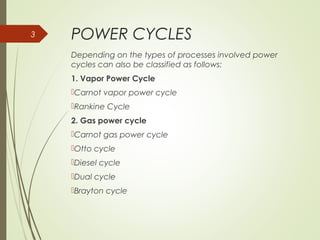
Depending on the types of processes involved power
cycles can also be classified as follows:
1. Vapor Power Cycle
Carnot vapor power cycle
Rankine Cycle
2. Gas power cycle
Carnot gas power cycle
Otto cycle
Diesel cycle
Dual cycle
Brayton cycle
3
4 THE CARNOT VAPOR CYCLE
The Carnot cycle is the most efficient cycle operating between
two specified temperature limits.
TH= T1= T2
TL = T3= T4
5
1 – 2 : isothermal heat addition in the boiler
2 – 3 : adiabatic expansion in the turbine
3 – 4 : isothermal heat rejection in the condenser
4 – 1 : adiabatic compression in the feed pump
q12 = h2 – h1
- w23 = h3 – h2
q34 = h4 – h3
- w41 = h1 – h4
Processes : all processes are reversible
6
Thermal efficiency
addedHeat
Net Work
=thη
4123 wwNet work −= 3412 qqheatNet −=






−=





−=
−
=
−
=
H
L
th
T
T
1
q
q
1
q
qq
q
ww
12
34
12
3412
12
4123
η
Thermal efficiency can
also be expressed as:
( ) ( )
12
1432
hh
hhhh
th
−
−+−
=η
7 RANKINE CYCLE
• Rankine cycle is ideal cycle for vapor power cycles.
• The Rankine Cycle is similar to the Carnot Cycle, but the
Rankine Cycle is much more practical because the working
fluid typically exists as a single phase (liquid or vapor) for the
two pressure change processes.
8
The simple ideal Rankine cycle.
9
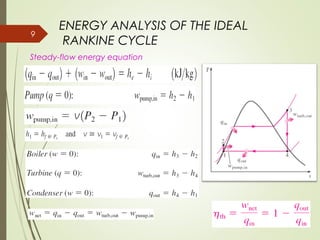
ENERGY ANALYSIS OF THE IDEAL
RANKINE CYCLE
Steady-flow energy equation
10
DEVIATION OF ACTUAL VAPOR POWER
CYCLES FROM IDEALIZED ONES
(a) Deviation of actual vapor power cycle from the ideal Rankine cycle.
(b) (b) The effect of pump and turbine irreversibilities on the ideal Rankine cycle.
The actual vapor power cycle differs from the ideal Rankine cycle as
a result of irreversibilities in various components.
Fluid friction and heat loss to the surroundings are the two common
sources of irreversibilities.
Isentropic efficiencies
11
INCREASING THE EFFICIENCY OF THE
RANKINE CYCLE
The basic idea behind all the modifications to increase the thermal efficiency of a
power cycle is the same: Increase the average temperature at which heat is
transferred to the working fluid in the boiler, or decrease the average temperature
at which heat is rejected from the working fluid in the condenser.
1. Lowering the Condenser Pressure
To take advantage of the
increased efficiencies at low
pressures, the condensers of
steam power plants usually
operate well below the
atmospheric pressure. There is a
lower limit to this pressure
depending on the temperature of
the cooling medium
Side effect: Lowering the
condenser pressure increases the
moisture content of the steam at
the final stages of the turbine.
12
The effect of superheating the
steam to higher temperatures
on the ideal Rankine cycle.
2. SUPERHEATING THE STEAM TO HIGH
TEMPERATURES
• Both the net work and heat input
increase as a result of superheating
the steam to a higher temperature.
The overall effect is an increase in
thermal efficiency since the average
temperature at which heat is added
increases.
• Superheating to higher temperatures
decreases the moisture content of
the steam at the turbine exit, which
is desirable.
• The temperature is limited by
metallurgical considerations.
Presently the highest steam
temperature allowed at the turbine
inlet is about 620°C.
13 3. INCREASING THE BOILER PRESSURE
The effect of increasing the boiler
pressure on the ideal Rankine cycle.
For a fixed turbine inlet
temperature, the cycle
shifts to the left and the
moisture content of
steam at the turbine
exit increases. This side
effect can be
corrected by reheating
the steam.
14
THE IDEAL REHEAT RANKINE CYCLE
Advantage of the increased efficiencies at higher boiler pressures without
facing the problem of excessive moisture at the final stages of the turbine
1. Superheat the steam to very high temperatures. It is limited
metallurgically.
2. Expand the steam in the turbine in two stages, and reheat it in between
(reheat)
The ideal reheat Rankine cycle.
15
The average temperature at
which heat is transferred during
reheating increases as the
number of reheat stages is
increased.
• The single reheat in a modern
power plant improves the cycle
efficiency by 4 to 5% by
increasing the average
temperature at which heat is
transferred to the steam.
• The average temperature
during the reheat process can
be increased by increasing the
number of expansion and
reheat stages. As the number of
stages is increased, the
expansion and reheat
processes approach an
isothermal process at the
maximum temperature. The use
of more than two reheat stages
is not practical. The theoretical
improvement in efficiency from
the second reheat is about half
of that which results from a
single reheat.
• The reheat temperatures are
very close or equal to the
turbine inlet temperature.
16 THE IDEAL REGENERATIVE RANKINE CYCLE
The first part of the heat-addition
process in the boiler takes place at
relatively low temperatures.
• Heat is transferred to the working fluid
during process 2-2’ at a relatively low
temperature. This lowers the average
heat-addition temperature and thus
the cycle efficiency.
• In steam power plants, steam is
extracted from the turbine at various
points. This steam, which could have
produced more work by expanding
further in the turbine, is used to heat
the feedwater instead. The device
where the feedwater is heated by
regeneration is called a regenerator, or
a feedwater heater (FWH).
• A feedwater heater is basically a heat
exchanger where heat is transferred
from the steam to the feedwater either
by mixing the two fluid streams (open
feedwater heaters) or without mixing
them (closed feedwater heaters).
17 OPEN FEEDWATER HEATERS
The ideal regenerative Rankine cycle with an open feedwater heater.
An open (or direct-contact) feedwater heater is basically a
mixing chamber, where the steam extracted from the turbine
mixes with the feedwater exiting the pump. Ideally, the mixture
leaves the heater as a saturated liquid at the heater pressure.
18
19 CLOSED FEEDWATER HEATERS
The ideal regenerative Rankine cycle with a closed feedwater heater.
Another type of feedwater heater frequently used in steam power
plants is the closed feedwater heater, in which heat is transferred
from the extracted steam to the feedwater without any mixing
taking place. The two streams now can be at different pressures,
since they do not mix.
20
A steam power plant with one
open and three closed
feedwater heaters.
The closed feedwater heaters are more complex because of the internal
tubing network, and thus they are more expensive. Heat transfer in closed
feedwater heaters is less effective since the two streams are not allowed
to be in direct contact. However, closed feedwater heaters do not
require a separate pump for each heater since the extracted steam and
the feedwater can be at different pressures.
Open feedwater
heaters are simple
and inexpensive and
have good heat
transfer
characteristics. For
each heater,
however, a pump is
required to handle
the feedwater.
Most steam power
plants use a
combination of open
and closed
feedwater heaters.
BINARY VAPOR POWER
CYCLE
 There are two distinct
circuits, one for mercury
and the other for
steam.
 Saturated mercury
vapor from the mercury
boiler at state C enters
the mercury turbine,
expands to state D,
and is condensed at
state A.
 The condensate is
pumped back to the
boiler by the mercury
pump.
21
 The heat rejected in the
mercury condenser is used to
vaporize water into steam at
state 3. Thus, the mercury
condenser also acts as the
steam boiler.
 There is a considerable
temperature differential
between condensing mercury
and boiling water.
 Saturated steam is then
superheated to state 4 as
shown, expanded in the steam
turbine to state 5 and then
condensed. The mercury cycle
is represented by A-B-C-D-A
and the steam cycle by 1-2-3-4-
5-1 on the T-s diagram.
22
RESEARCH PAPER SELECTED
UTILISATION OF WASTE HEAT FROM
THE POWER PLANT BY USE OF THE
ORC AIDED WITH BLEED STEAM AND
EXTRA SOURCE OF HEAT
23
INTRODUCTION
Power generation industry that is related to electricity
production at the highest possible efficiency at
minimum impact to the natural environment.
To attain the objectives of the directive it is necessary
to develop highly efficient power plants.
When lower temperatures of heat sources are the
option other than water working fluids should be used
and then such cycles are named the ORC (organic
Rankine Cycles).
24
CONCEPT USED
 Concept is to utilize waste heat from the power plant
with the aid of the low-temperature ORC incorporated
to the reference plant by its connection to the
extraction steam lines.
 The ORC system is heated from at least two heat
sources, the first one being the flow rate of waste heat
obtained from the exhaust gases from the power
plant.
 Subsequently, the working fluid in the cycle is
additionally heated by the condensing steam taken
from the low pressure turbine extraction points
increasing in such way the level of temperature of
working fluid before turbine to 120 C.
25
Summary
 The Carnot vapor cycle
 Rankine cycle
 Energy analysis of the ideal Rankine cycle
 Deviation of actual vapor power cycles from idealized ones
 Increasing the efficiency of the Rankine cycle
 Lowering the condenser pressure (Lowers Tlow,avg)
 Superheating the steam to high temperatures (Increases Thigh,avg)
 Increasing the boiler pressure (Increases Thigh,avg)
 The ideal reheat Rankine cycle
 The ideal regenerative Rankine cycle
 Open feedwater heaters
 Closed feedwater heaters
26
THANK YOU
27

Power cycles

  • 1.
    POWER CYCLES Submitted By: HimanshuRajput(13363) Mechanical Engineering Department NIT Hamirpur
  • 2.
    INTRODUCTION2  In anythermal power generation plant, heat energy converts into mechanical work. Then it is converted to electrical energy by rotating a generator which produces electrical energy.  Heat is derived from various energy sources like fossil fuels, nuclear fusion of radioactive elements and geothermal energy.  Potential energy stored in water also can produce mechanical work, and then mechanical work to electrical energy, this conversion of energy is commonly known as hydropower generation. Kinetic energy of wind and solar radiation are the other sources of energy that can be used to produce electrical energy by conversion.
  • 3.
    POWER CYCLES Depending onthe types of processes involved power cycles can also be classified as follows: 1. Vapor Power Cycle Carnot vapor power cycle Rankine Cycle 2. Gas power cycle Carnot gas power cycle Otto cycle Diesel cycle Dual cycle Brayton cycle 3
  • 4.
    4 THE CARNOTVAPOR CYCLE The Carnot cycle is the most efficient cycle operating between two specified temperature limits. TH= T1= T2 TL = T3= T4
  • 5.
    5 1 – 2: isothermal heat addition in the boiler 2 – 3 : adiabatic expansion in the turbine 3 – 4 : isothermal heat rejection in the condenser 4 – 1 : adiabatic compression in the feed pump q12 = h2 – h1 - w23 = h3 – h2 q34 = h4 – h3 - w41 = h1 – h4 Processes : all processes are reversible
  • 6.
    6 Thermal efficiency addedHeat Net Work =thη 4123wwNet work −= 3412 qqheatNet −=       −=      −= − = − = H L th T T 1 q q 1 q qq q ww 12 34 12 3412 12 4123 η Thermal efficiency can also be expressed as: ( ) ( ) 12 1432 hh hhhh th − −+− =η
  • 7.
    7 RANKINE CYCLE •Rankine cycle is ideal cycle for vapor power cycles. • The Rankine Cycle is similar to the Carnot Cycle, but the Rankine Cycle is much more practical because the working fluid typically exists as a single phase (liquid or vapor) for the two pressure change processes.
  • 8.
    8 The simple idealRankine cycle.
  • 9.
    9 ENERGY ANALYSIS OFTHE IDEAL RANKINE CYCLE Steady-flow energy equation
  • 10.
    10 DEVIATION OF ACTUALVAPOR POWER CYCLES FROM IDEALIZED ONES (a) Deviation of actual vapor power cycle from the ideal Rankine cycle. (b) (b) The effect of pump and turbine irreversibilities on the ideal Rankine cycle. The actual vapor power cycle differs from the ideal Rankine cycle as a result of irreversibilities in various components. Fluid friction and heat loss to the surroundings are the two common sources of irreversibilities. Isentropic efficiencies
  • 11.
    11 INCREASING THE EFFICIENCYOF THE RANKINE CYCLE The basic idea behind all the modifications to increase the thermal efficiency of a power cycle is the same: Increase the average temperature at which heat is transferred to the working fluid in the boiler, or decrease the average temperature at which heat is rejected from the working fluid in the condenser. 1. Lowering the Condenser Pressure To take advantage of the increased efficiencies at low pressures, the condensers of steam power plants usually operate well below the atmospheric pressure. There is a lower limit to this pressure depending on the temperature of the cooling medium Side effect: Lowering the condenser pressure increases the moisture content of the steam at the final stages of the turbine.
  • 12.
    12 The effect ofsuperheating the steam to higher temperatures on the ideal Rankine cycle. 2. SUPERHEATING THE STEAM TO HIGH TEMPERATURES • Both the net work and heat input increase as a result of superheating the steam to a higher temperature. The overall effect is an increase in thermal efficiency since the average temperature at which heat is added increases. • Superheating to higher temperatures decreases the moisture content of the steam at the turbine exit, which is desirable. • The temperature is limited by metallurgical considerations. Presently the highest steam temperature allowed at the turbine inlet is about 620°C.
  • 13.
    13 3. INCREASINGTHE BOILER PRESSURE The effect of increasing the boiler pressure on the ideal Rankine cycle. For a fixed turbine inlet temperature, the cycle shifts to the left and the moisture content of steam at the turbine exit increases. This side effect can be corrected by reheating the steam.
  • 14.
    14 THE IDEAL REHEATRANKINE CYCLE Advantage of the increased efficiencies at higher boiler pressures without facing the problem of excessive moisture at the final stages of the turbine 1. Superheat the steam to very high temperatures. It is limited metallurgically. 2. Expand the steam in the turbine in two stages, and reheat it in between (reheat) The ideal reheat Rankine cycle.
  • 15.
    15 The average temperatureat which heat is transferred during reheating increases as the number of reheat stages is increased. • The single reheat in a modern power plant improves the cycle efficiency by 4 to 5% by increasing the average temperature at which heat is transferred to the steam. • The average temperature during the reheat process can be increased by increasing the number of expansion and reheat stages. As the number of stages is increased, the expansion and reheat processes approach an isothermal process at the maximum temperature. The use of more than two reheat stages is not practical. The theoretical improvement in efficiency from the second reheat is about half of that which results from a single reheat. • The reheat temperatures are very close or equal to the turbine inlet temperature.
  • 16.
    16 THE IDEALREGENERATIVE RANKINE CYCLE The first part of the heat-addition process in the boiler takes place at relatively low temperatures. • Heat is transferred to the working fluid during process 2-2’ at a relatively low temperature. This lowers the average heat-addition temperature and thus the cycle efficiency. • In steam power plants, steam is extracted from the turbine at various points. This steam, which could have produced more work by expanding further in the turbine, is used to heat the feedwater instead. The device where the feedwater is heated by regeneration is called a regenerator, or a feedwater heater (FWH). • A feedwater heater is basically a heat exchanger where heat is transferred from the steam to the feedwater either by mixing the two fluid streams (open feedwater heaters) or without mixing them (closed feedwater heaters).
  • 17.
    17 OPEN FEEDWATERHEATERS The ideal regenerative Rankine cycle with an open feedwater heater. An open (or direct-contact) feedwater heater is basically a mixing chamber, where the steam extracted from the turbine mixes with the feedwater exiting the pump. Ideally, the mixture leaves the heater as a saturated liquid at the heater pressure.
  • 18.
  • 19.
    19 CLOSED FEEDWATERHEATERS The ideal regenerative Rankine cycle with a closed feedwater heater. Another type of feedwater heater frequently used in steam power plants is the closed feedwater heater, in which heat is transferred from the extracted steam to the feedwater without any mixing taking place. The two streams now can be at different pressures, since they do not mix.
  • 20.
    20 A steam powerplant with one open and three closed feedwater heaters. The closed feedwater heaters are more complex because of the internal tubing network, and thus they are more expensive. Heat transfer in closed feedwater heaters is less effective since the two streams are not allowed to be in direct contact. However, closed feedwater heaters do not require a separate pump for each heater since the extracted steam and the feedwater can be at different pressures. Open feedwater heaters are simple and inexpensive and have good heat transfer characteristics. For each heater, however, a pump is required to handle the feedwater. Most steam power plants use a combination of open and closed feedwater heaters.
  • 21.
    BINARY VAPOR POWER CYCLE There are two distinct circuits, one for mercury and the other for steam.  Saturated mercury vapor from the mercury boiler at state C enters the mercury turbine, expands to state D, and is condensed at state A.  The condensate is pumped back to the boiler by the mercury pump. 21
  • 22.
     The heatrejected in the mercury condenser is used to vaporize water into steam at state 3. Thus, the mercury condenser also acts as the steam boiler.  There is a considerable temperature differential between condensing mercury and boiling water.  Saturated steam is then superheated to state 4 as shown, expanded in the steam turbine to state 5 and then condensed. The mercury cycle is represented by A-B-C-D-A and the steam cycle by 1-2-3-4- 5-1 on the T-s diagram. 22
  • 23.
    RESEARCH PAPER SELECTED UTILISATIONOF WASTE HEAT FROM THE POWER PLANT BY USE OF THE ORC AIDED WITH BLEED STEAM AND EXTRA SOURCE OF HEAT 23
  • 24.
    INTRODUCTION Power generation industrythat is related to electricity production at the highest possible efficiency at minimum impact to the natural environment. To attain the objectives of the directive it is necessary to develop highly efficient power plants. When lower temperatures of heat sources are the option other than water working fluids should be used and then such cycles are named the ORC (organic Rankine Cycles). 24
  • 25.
    CONCEPT USED  Conceptis to utilize waste heat from the power plant with the aid of the low-temperature ORC incorporated to the reference plant by its connection to the extraction steam lines.  The ORC system is heated from at least two heat sources, the first one being the flow rate of waste heat obtained from the exhaust gases from the power plant.  Subsequently, the working fluid in the cycle is additionally heated by the condensing steam taken from the low pressure turbine extraction points increasing in such way the level of temperature of working fluid before turbine to 120 C. 25
  • 26.
    Summary  The Carnotvapor cycle  Rankine cycle  Energy analysis of the ideal Rankine cycle  Deviation of actual vapor power cycles from idealized ones  Increasing the efficiency of the Rankine cycle  Lowering the condenser pressure (Lowers Tlow,avg)  Superheating the steam to high temperatures (Increases Thigh,avg)  Increasing the boiler pressure (Increases Thigh,avg)  The ideal reheat Rankine cycle  The ideal regenerative Rankine cycle  Open feedwater heaters  Closed feedwater heaters 26
  • 27.