Carnot cycles
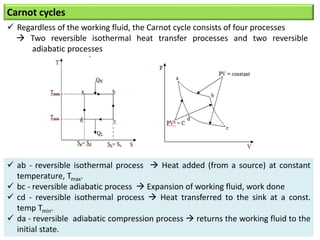
 Regardless of the working fluid, the Carnot cycle consists of four processes
 Two reversible isothermal heat transfer processes and two reversible
adiabatic processes
 ab - reversible isothermal process  Heat added (from a source) at constant
temperature, Tmax.
 bc - reversible adiabatic process  Expansion of working fluid, work done
 cd - reversible isothermal process  Heat transferred to the sink at a const.
temp Tmin.
 da - reversible adiabatic compression process  returns the working fluid to the
initial state.
Efficiency of a Carnot cycle
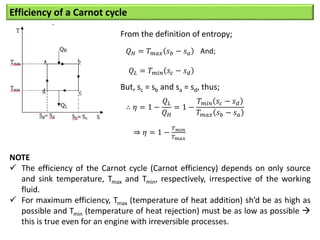
From the definition of entropy;
And;
𝑄𝐻 = 𝑇𝑚𝑎𝑥 𝑠𝑏 − 𝑠𝑎
𝑄𝐿 = 𝑇𝑚𝑖𝑛 𝑠𝑐 − 𝑠𝑑
But, sc = sb and sa = sd, thus;
∴ 𝜂 = 1 −
𝑄𝐿
𝑄𝐻
= 1 −
𝑇𝑚𝑖𝑛 𝑠𝑐 − 𝑠𝑑
𝑇𝑚𝑎𝑥 𝑠𝑏 − 𝑠𝑎
⇒ 𝜂 = 1 −
𝑇𝑚𝑖𝑛
𝑇𝑚𝑎𝑥
NOTE
 The efficiency of the Carnot cycle (Carnot efficiency) depends on only source
and sink temperature, Tmax and Tmin, respectively, irrespective of the working
fluid.
 For maximum efficiency, Tmax (temperature of heat addition) sh’d be as high as
possible and Tmin (temperature of heat rejection) must be as low as possible 
this is true even for an engine with irreversible processes.
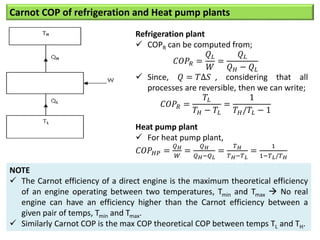
Carnot COP of refrigeration and Heat pump plants
Refrigeration plant
 COPR can be computed from;
𝐶𝑂𝑃𝑅 =
𝑄𝐿
𝑊
=
𝑄𝐿
𝑄𝐻 − 𝑄𝐿
 Since, 𝑄 = 𝑇∆𝑆 , considering that all
processes are reversible, then we can write;
𝐶𝑂𝑃𝑅 =
𝑇𝐿
𝑇𝐻 − 𝑇𝐿
=
1
𝑇𝐻/𝑇𝐿 − 1
Heat pump plant
 For heat pump plant,
𝐶𝑂𝑃𝐻𝑃 =
𝑄𝐻
𝑊
=
𝑄𝐻
𝑄𝐻−𝑄𝐿
=
𝑇𝐻
𝑇𝐻−𝑇𝐿
=
1
1−𝑇𝐿/𝑇𝐻
NOTE
 The Carnot efficiency of a direct engine is the maximum theoretical efficiency
of an engine operating between two temperatures, Tmin and Tmax  No real
engine can have an efficiency higher than the Carnot efficiency between a
given pair of temps, Tmin and Tmax.
 Similarly Carnot COP is the max COP theoretical COP between temps TL and TH.
Examples 6.1
1. A Carnot heat engine receives 500 kJ of heat per cycle from a high –
temperature source at 6250C and rejects heat to a low – temperature sink at
300C. Determine:
(i) The thermal efficiency of this Carnot engine. (67.2%)
(ii) The amount of heat rejected to the heat sink per cycle. (164 kJ)
2. An investor claims to have developed a refrigerator that maintains the
refrigerated space at 350F while operating in a room where the temperature is
750F and has a COP of 13.5. Is this claim reasonable?
3. A heat pump maintains a house at a fixed temperature. The house is to be
maintained at 210C at all times. The house is estimated to be losing heat at a rate
of 135,000 kJ/h when the outside temperature drops to -50C. Determine the
minimum power required to drive this heat pump. (3.32 kW)
Steam power plants
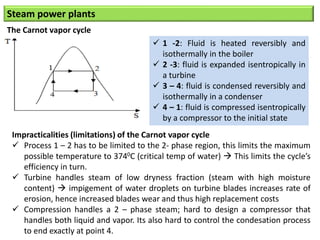
The Carnot vapor cycle
 1 -2: Fluid is heated reversibly and
isothermally in the boiler
 2 -3: fluid is expanded isentropically in
a turbine
 3 – 4: fluid is condensed reversibly and
isothermally in a condenser
 4 – 1: fluid is compressed isentropically
by a compressor to the initial state
Impracticalities (limitations) of the Carnot vapor cycle
 Process 1 – 2 has to be limited to the 2- phase region, this limits the maximum
possible temperature to 3740C (critical temp of water)  This limits the cycle’s
efficiency in turn.
 Turbine handles steam of low dryness fraction (steam with high moisture
content)  impigement of water droplets on turbine blades increases rate of
erosion, hence increased blades wear and thus high replacement costs
 Compression handles a 2 – phase steam; hard to design a compressor that
handles both liquid and vapor. Its also hard to control the condesation process
to end exactly at point 4.
Rankine cycle
 Addresses the limitations of the Carnot vapour cycle
 Rankine cycle is the ideal for the vapour power and refrigeration cycles
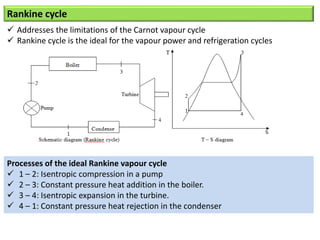
Processes of the ideal Rankine vapour cycle
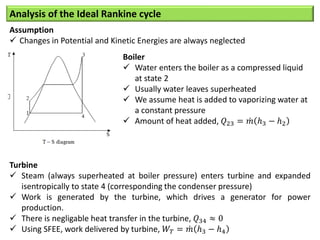
 1 – 2: Isentropic compression in a pump
 2 – 3: Constant pressure heat addition in the boiler.
 3 – 4: Isentropic expansion in the turbine.
 4 – 1: Constant pressure heat rejection in the condenser
Analysis of the Ideal Rankine cycle
Assumption
 Changes in Potential and Kinetic Energies are always neglected
Boiler
 Water enters the boiler as a compressed liquid
at state 2
 Usually water leaves superheated
 We assume heat is added to vaporizing water at
a constant pressure
 Amount of heat added, 𝑄23 = 𝑚 ℎ3 − ℎ2
Turbine
 Steam (always superheated at boiler pressure) enters turbine and expanded
isentropically to state 4 (corresponding the condenser pressure)
 Work is generated by the turbine, which drives a generator for power
production.
 There is negligable heat transfer in the turbine, 𝑄34 ≈ 0
 Using SFEE, work delivered by turbine, 𝑊𝑇 = 𝑚 ℎ3 − ℎ4
Analysis of the Ideal Rankine cycle cont’d
Condenser
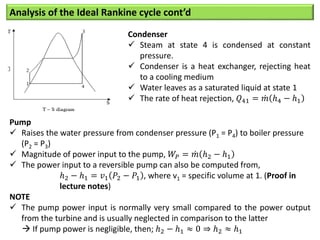
 Steam at state 4 is condensed at constant
pressure.
 Condenser is a heat exchanger, rejecting heat
to a cooling medium
 Water leaves as a saturated liquid at state 1
 The rate of heat rejection, 𝑄41 = 𝑚 ℎ4 − ℎ1
Pump
 Raises the water pressure from condenser pressure (P1 = P4) to boiler pressure
(P2 = P3)
 Magnitude of power input to the pump, 𝑊𝑃 = 𝑚 ℎ2 − ℎ1
 The power input to a reversible pump can also be computed from,
ℎ2 − ℎ1 = 𝑣1 𝑃2 − 𝑃1 , where v1 = specific volume at 1. (Proof in
lecture notes)
NOTE
 The pump power input is normally very small compared to the power output
from the turbine and is usually neglected in comparison to the latter
 If pump power is negligible, then; ℎ2 − ℎ1 ≈ 0 ⇒ ℎ2 ≈ ℎ1
Rankine cycle thermal efficiency
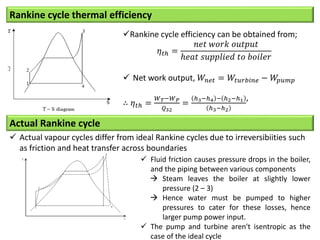
Rankine cycle efficiency can be obtained from;
𝜂𝑡ℎ =
𝑛𝑒𝑡 𝑤𝑜𝑟𝑘 𝑜𝑢𝑡𝑝𝑢𝑡
ℎ𝑒𝑎𝑡 𝑠𝑢𝑝𝑝𝑙𝑖𝑒𝑑 𝑡𝑜 𝑏𝑜𝑖𝑙𝑒𝑟
 Net work output, 𝑊𝑛𝑒𝑡 = 𝑊𝑡𝑢𝑟𝑏𝑖𝑛𝑒 − 𝑊
𝑝𝑢𝑚𝑝
∴ 𝜂𝑡ℎ =
𝑊𝑇−𝑊𝑃
𝑄32
=
ℎ3−ℎ4 − ℎ2−ℎ1
ℎ3−ℎ2
’
Actual Rankine cycle
 Actual vapour cycles differ from ideal Rankine cycles due to irreversibiities such
as friction and heat transfer across boundaries
 Fluid friction causes pressure drops in the boiler,
and the piping between various components
 Steam leaves the boiler at slightly lower
pressure (2 – 3)
 Hence water must be pumped to higher
pressures to cater for these losses, hence
larger pump power input.
 The pump and turbine aren't isentropic as the
case of the ideal cycle
Analysis of the actual Rankine cycle
 The pressure drops are very small (less than 3%)  always neglected.
 Losses in pump and turbine are significant
 Always taken care of using isentropic efficiency
 If,
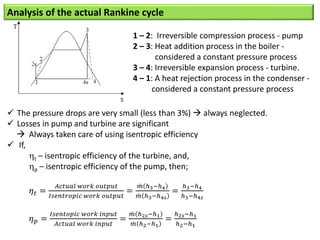
t – isentropic efficiency of the turbine, and,
p – isentropic efficiency of the pump, then;
𝜂𝑡 =
𝐴𝑐𝑡𝑢𝑎𝑙 𝑤𝑜𝑟𝑘 𝑜𝑢𝑡𝑝𝑢𝑡
𝐼𝑠𝑒𝑛𝑡𝑟𝑜𝑝𝑖𝑐 𝑤𝑜𝑟𝑘 𝑜𝑢𝑡𝑝𝑢𝑡
=
𝑚 ℎ3−ℎ4
𝑚 ℎ3−ℎ4𝑠
=
ℎ3−ℎ4
ℎ3−ℎ4𝑠
𝜂𝑝 =
𝐼𝑠𝑒𝑛𝑡𝑜𝑝𝑖𝑐 𝑤𝑜𝑟𝑘 𝑖𝑛𝑝𝑢𝑡
𝐴𝑐𝑡𝑢𝑎𝑙 𝑤𝑜𝑟𝑘 𝑖𝑛𝑝𝑢𝑡
=
𝑚 ℎ2𝑠−ℎ1
𝑚 ℎ2−ℎ1
=
ℎ2𝑠−ℎ1
ℎ2−ℎ1
1 – 2: Irreversible compression process - pump
2 – 3: Heat addition process in the boiler -
considered a constant pressure process
3 – 4: Irreversible expansion process - turbine.
4 – 1: A heat rejection process in the condenser -
considered a constant pressure process
Other criteria used in comparing steam power plants
Efficiency ratio
 Ratio of the actual cycle efficiency to Rankine efficiency
 Sh’d be as large as possible, the closer it is to 1.0 , the less is the energy wasted
against irreversibilities.
Work ratio
𝑊𝑜𝑟𝑘 𝑟𝑎𝑡𝑖𝑜 =
𝑁𝑒𝑡 𝑤𝑜𝑟𝑘
𝑔𝑟𝑜𝑠𝑠 𝑤𝑜𝑟𝑘
=
𝑊𝑜𝑟𝑘 𝑡𝑢𝑟𝑏𝑖𝑛𝑒−𝑊𝑜𝑟𝑘 𝑝𝑢𝑚𝑝
𝑊𝑜𝑟𝑘 𝑡𝑢𝑟𝑏𝑖𝑛𝑒
Specific steam consumption (ssc)
 It relates the plant output to the steam that is flowing through it
 Amount of steam flow also indicates the size of the components  measure of
relative sizes of the steam plants.
𝑠𝑠𝑐 =
3600
𝑊𝑛𝑒𝑡
, where Wnet – network output [kJ/kg]
Ways of increasing the efficiency of steam power plants
 Steam power plant efficiency can be increased by either;
Increasing the average temperature and/or pressure of heat addition OR,
decrease the temperature at which heat is rejected.
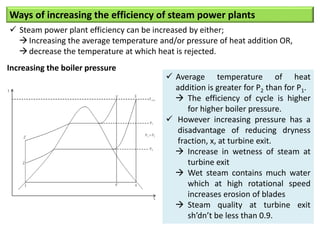
Increasing the boiler pressure
 Average temperature of heat
addition is greater for P2 than for P1.
 The efficiency of cycle is higher
for higher boiler pressure.
 However increasing pressure has a
disadvantage of reducing dryness
fraction, x, at turbine exit.
 Increase in wetness of steam at
turbine exit
 Wet steam contains much water
which at high rotational speed
increases erosion of blades
 Steam quality at turbine exit
sh’dn’t be less than 0.9.
Ways of increasing the efficiency of steam power plants cont’d
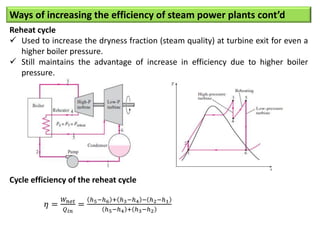
Reheat cycle
 Used to increase the dryness fraction (steam quality) at turbine exit for even a
higher boiler pressure.
 Still maintains the advantage of increase in efficiency due to higher boiler
pressure.
Cycle efficiency of the reheat cycle
𝜂 =
𝑊𝑛𝑒𝑡
𝑄𝑖𝑛
=
ℎ5−ℎ6 + ℎ3−ℎ4 − ℎ2−ℎ1
ℎ5−ℎ4 + ℎ3−ℎ2
Ways of increasing the efficiency of steam power plants cont’d
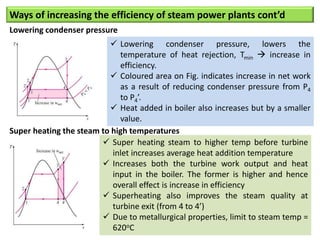
Lowering condenser pressure
 Lowering condenser pressure, lowers the
temperature of heat rejection, Tmin  increase in
efficiency.
 Coloured area on Fig. indicates increase in net work
as a result of reducing condenser pressure from P4
to P4’.
 Heat added in boiler also increases but by a smaller
value.
Super heating the steam to high temperatures
 Super heating steam to higher temp before turbine
inlet increases average heat addition temperature
 Increases both the turbine work output and heat
input in the boiler. The former is higher and hence
overall effect is increase in efficiency
 Superheating also improves the steam quality at
turbine exit (from 4 to 4’)
 Due to metallurgical properties, limit to steam temp =
620oC
Examples 6.2
1. A steam power plant operates on a simple ideal Rankine cycle between
pressure limits of 3 MPa and 50 kPa. The temperature of the steam at the
turbine inlet is 4500C, and the mass flow rate of steam through the cycle is 40
kg/s. Show the cycle on a T –s diagram with respect to saturation lines, and
determine:
(i) The thermal efficiency of the cycle (29.3%)
(ii) The net power output of the power plant. (35.17 MW)
2. A power plant which operates on a Rankine cycle with steam as the working fluid
operates at a boiler pressure of 40 bar and a condenser pressure of 0.1 bar. If
the temperature at the turbine inlet is 4000C, and the isentropic efficiencies of
the turbine and the pump are 80% and 90% respectively, find:
(i) The thermal efficiency (25.5%)
(ii) Work ratio of the plant (0.994)

Lecture 5.pptx

  • 2.
    Carnot cycles  Regardlessof the working fluid, the Carnot cycle consists of four processes  Two reversible isothermal heat transfer processes and two reversible adiabatic processes  ab - reversible isothermal process  Heat added (from a source) at constant temperature, Tmax.  bc - reversible adiabatic process  Expansion of working fluid, work done  cd - reversible isothermal process  Heat transferred to the sink at a const. temp Tmin.  da - reversible adiabatic compression process  returns the working fluid to the initial state.
  • 3.
    Efficiency of aCarnot cycle From the definition of entropy; And; 𝑄𝐻 = 𝑇𝑚𝑎𝑥 𝑠𝑏 − 𝑠𝑎 𝑄𝐿 = 𝑇𝑚𝑖𝑛 𝑠𝑐 − 𝑠𝑑 But, sc = sb and sa = sd, thus; ∴ 𝜂 = 1 − 𝑄𝐿 𝑄𝐻 = 1 − 𝑇𝑚𝑖𝑛 𝑠𝑐 − 𝑠𝑑 𝑇𝑚𝑎𝑥 𝑠𝑏 − 𝑠𝑎 ⇒ 𝜂 = 1 − 𝑇𝑚𝑖𝑛 𝑇𝑚𝑎𝑥 NOTE  The efficiency of the Carnot cycle (Carnot efficiency) depends on only source and sink temperature, Tmax and Tmin, respectively, irrespective of the working fluid.  For maximum efficiency, Tmax (temperature of heat addition) sh’d be as high as possible and Tmin (temperature of heat rejection) must be as low as possible  this is true even for an engine with irreversible processes.
  • 4.
    Carnot COP ofrefrigeration and Heat pump plants Refrigeration plant  COPR can be computed from; 𝐶𝑂𝑃𝑅 = 𝑄𝐿 𝑊 = 𝑄𝐿 𝑄𝐻 − 𝑄𝐿  Since, 𝑄 = 𝑇∆𝑆 , considering that all processes are reversible, then we can write; 𝐶𝑂𝑃𝑅 = 𝑇𝐿 𝑇𝐻 − 𝑇𝐿 = 1 𝑇𝐻/𝑇𝐿 − 1 Heat pump plant  For heat pump plant, 𝐶𝑂𝑃𝐻𝑃 = 𝑄𝐻 𝑊 = 𝑄𝐻 𝑄𝐻−𝑄𝐿 = 𝑇𝐻 𝑇𝐻−𝑇𝐿 = 1 1−𝑇𝐿/𝑇𝐻 NOTE  The Carnot efficiency of a direct engine is the maximum theoretical efficiency of an engine operating between two temperatures, Tmin and Tmax  No real engine can have an efficiency higher than the Carnot efficiency between a given pair of temps, Tmin and Tmax.  Similarly Carnot COP is the max COP theoretical COP between temps TL and TH.
  • 5.
    Examples 6.1 1. ACarnot heat engine receives 500 kJ of heat per cycle from a high – temperature source at 6250C and rejects heat to a low – temperature sink at 300C. Determine: (i) The thermal efficiency of this Carnot engine. (67.2%) (ii) The amount of heat rejected to the heat sink per cycle. (164 kJ) 2. An investor claims to have developed a refrigerator that maintains the refrigerated space at 350F while operating in a room where the temperature is 750F and has a COP of 13.5. Is this claim reasonable? 3. A heat pump maintains a house at a fixed temperature. The house is to be maintained at 210C at all times. The house is estimated to be losing heat at a rate of 135,000 kJ/h when the outside temperature drops to -50C. Determine the minimum power required to drive this heat pump. (3.32 kW)
  • 6.
    Steam power plants TheCarnot vapor cycle  1 -2: Fluid is heated reversibly and isothermally in the boiler  2 -3: fluid is expanded isentropically in a turbine  3 – 4: fluid is condensed reversibly and isothermally in a condenser  4 – 1: fluid is compressed isentropically by a compressor to the initial state Impracticalities (limitations) of the Carnot vapor cycle  Process 1 – 2 has to be limited to the 2- phase region, this limits the maximum possible temperature to 3740C (critical temp of water)  This limits the cycle’s efficiency in turn.  Turbine handles steam of low dryness fraction (steam with high moisture content)  impigement of water droplets on turbine blades increases rate of erosion, hence increased blades wear and thus high replacement costs  Compression handles a 2 – phase steam; hard to design a compressor that handles both liquid and vapor. Its also hard to control the condesation process to end exactly at point 4.
  • 7.
    Rankine cycle  Addressesthe limitations of the Carnot vapour cycle  Rankine cycle is the ideal for the vapour power and refrigeration cycles Processes of the ideal Rankine vapour cycle  1 – 2: Isentropic compression in a pump  2 – 3: Constant pressure heat addition in the boiler.  3 – 4: Isentropic expansion in the turbine.  4 – 1: Constant pressure heat rejection in the condenser
  • 8.
    Analysis of theIdeal Rankine cycle Assumption  Changes in Potential and Kinetic Energies are always neglected Boiler  Water enters the boiler as a compressed liquid at state 2  Usually water leaves superheated  We assume heat is added to vaporizing water at a constant pressure  Amount of heat added, 𝑄23 = 𝑚 ℎ3 − ℎ2 Turbine  Steam (always superheated at boiler pressure) enters turbine and expanded isentropically to state 4 (corresponding the condenser pressure)  Work is generated by the turbine, which drives a generator for power production.  There is negligable heat transfer in the turbine, 𝑄34 ≈ 0  Using SFEE, work delivered by turbine, 𝑊𝑇 = 𝑚 ℎ3 − ℎ4
  • 9.
    Analysis of theIdeal Rankine cycle cont’d Condenser  Steam at state 4 is condensed at constant pressure.  Condenser is a heat exchanger, rejecting heat to a cooling medium  Water leaves as a saturated liquid at state 1  The rate of heat rejection, 𝑄41 = 𝑚 ℎ4 − ℎ1 Pump  Raises the water pressure from condenser pressure (P1 = P4) to boiler pressure (P2 = P3)  Magnitude of power input to the pump, 𝑊𝑃 = 𝑚 ℎ2 − ℎ1  The power input to a reversible pump can also be computed from, ℎ2 − ℎ1 = 𝑣1 𝑃2 − 𝑃1 , where v1 = specific volume at 1. (Proof in lecture notes) NOTE  The pump power input is normally very small compared to the power output from the turbine and is usually neglected in comparison to the latter  If pump power is negligible, then; ℎ2 − ℎ1 ≈ 0 ⇒ ℎ2 ≈ ℎ1
  • 10.
    Rankine cycle thermalefficiency Rankine cycle efficiency can be obtained from; 𝜂𝑡ℎ = 𝑛𝑒𝑡 𝑤𝑜𝑟𝑘 𝑜𝑢𝑡𝑝𝑢𝑡 ℎ𝑒𝑎𝑡 𝑠𝑢𝑝𝑝𝑙𝑖𝑒𝑑 𝑡𝑜 𝑏𝑜𝑖𝑙𝑒𝑟  Net work output, 𝑊𝑛𝑒𝑡 = 𝑊𝑡𝑢𝑟𝑏𝑖𝑛𝑒 − 𝑊 𝑝𝑢𝑚𝑝 ∴ 𝜂𝑡ℎ = 𝑊𝑇−𝑊𝑃 𝑄32 = ℎ3−ℎ4 − ℎ2−ℎ1 ℎ3−ℎ2 ’ Actual Rankine cycle  Actual vapour cycles differ from ideal Rankine cycles due to irreversibiities such as friction and heat transfer across boundaries  Fluid friction causes pressure drops in the boiler, and the piping between various components  Steam leaves the boiler at slightly lower pressure (2 – 3)  Hence water must be pumped to higher pressures to cater for these losses, hence larger pump power input.  The pump and turbine aren't isentropic as the case of the ideal cycle
  • 11.
    Analysis of theactual Rankine cycle  The pressure drops are very small (less than 3%)  always neglected.  Losses in pump and turbine are significant  Always taken care of using isentropic efficiency  If, t – isentropic efficiency of the turbine, and, p – isentropic efficiency of the pump, then; 𝜂𝑡 = 𝐴𝑐𝑡𝑢𝑎𝑙 𝑤𝑜𝑟𝑘 𝑜𝑢𝑡𝑝𝑢𝑡 𝐼𝑠𝑒𝑛𝑡𝑟𝑜𝑝𝑖𝑐 𝑤𝑜𝑟𝑘 𝑜𝑢𝑡𝑝𝑢𝑡 = 𝑚 ℎ3−ℎ4 𝑚 ℎ3−ℎ4𝑠 = ℎ3−ℎ4 ℎ3−ℎ4𝑠 𝜂𝑝 = 𝐼𝑠𝑒𝑛𝑡𝑜𝑝𝑖𝑐 𝑤𝑜𝑟𝑘 𝑖𝑛𝑝𝑢𝑡 𝐴𝑐𝑡𝑢𝑎𝑙 𝑤𝑜𝑟𝑘 𝑖𝑛𝑝𝑢𝑡 = 𝑚 ℎ2𝑠−ℎ1 𝑚 ℎ2−ℎ1 = ℎ2𝑠−ℎ1 ℎ2−ℎ1 1 – 2: Irreversible compression process - pump 2 – 3: Heat addition process in the boiler - considered a constant pressure process 3 – 4: Irreversible expansion process - turbine. 4 – 1: A heat rejection process in the condenser - considered a constant pressure process
  • 12.
    Other criteria usedin comparing steam power plants Efficiency ratio  Ratio of the actual cycle efficiency to Rankine efficiency  Sh’d be as large as possible, the closer it is to 1.0 , the less is the energy wasted against irreversibilities. Work ratio 𝑊𝑜𝑟𝑘 𝑟𝑎𝑡𝑖𝑜 = 𝑁𝑒𝑡 𝑤𝑜𝑟𝑘 𝑔𝑟𝑜𝑠𝑠 𝑤𝑜𝑟𝑘 = 𝑊𝑜𝑟𝑘 𝑡𝑢𝑟𝑏𝑖𝑛𝑒−𝑊𝑜𝑟𝑘 𝑝𝑢𝑚𝑝 𝑊𝑜𝑟𝑘 𝑡𝑢𝑟𝑏𝑖𝑛𝑒 Specific steam consumption (ssc)  It relates the plant output to the steam that is flowing through it  Amount of steam flow also indicates the size of the components  measure of relative sizes of the steam plants. 𝑠𝑠𝑐 = 3600 𝑊𝑛𝑒𝑡 , where Wnet – network output [kJ/kg]
  • 13.
    Ways of increasingthe efficiency of steam power plants  Steam power plant efficiency can be increased by either; Increasing the average temperature and/or pressure of heat addition OR, decrease the temperature at which heat is rejected. Increasing the boiler pressure  Average temperature of heat addition is greater for P2 than for P1.  The efficiency of cycle is higher for higher boiler pressure.  However increasing pressure has a disadvantage of reducing dryness fraction, x, at turbine exit.  Increase in wetness of steam at turbine exit  Wet steam contains much water which at high rotational speed increases erosion of blades  Steam quality at turbine exit sh’dn’t be less than 0.9.
  • 14.
    Ways of increasingthe efficiency of steam power plants cont’d Reheat cycle  Used to increase the dryness fraction (steam quality) at turbine exit for even a higher boiler pressure.  Still maintains the advantage of increase in efficiency due to higher boiler pressure. Cycle efficiency of the reheat cycle 𝜂 = 𝑊𝑛𝑒𝑡 𝑄𝑖𝑛 = ℎ5−ℎ6 + ℎ3−ℎ4 − ℎ2−ℎ1 ℎ5−ℎ4 + ℎ3−ℎ2
  • 15.
    Ways of increasingthe efficiency of steam power plants cont’d Lowering condenser pressure  Lowering condenser pressure, lowers the temperature of heat rejection, Tmin  increase in efficiency.  Coloured area on Fig. indicates increase in net work as a result of reducing condenser pressure from P4 to P4’.  Heat added in boiler also increases but by a smaller value. Super heating the steam to high temperatures  Super heating steam to higher temp before turbine inlet increases average heat addition temperature  Increases both the turbine work output and heat input in the boiler. The former is higher and hence overall effect is increase in efficiency  Superheating also improves the steam quality at turbine exit (from 4 to 4’)  Due to metallurgical properties, limit to steam temp = 620oC
  • 16.
    Examples 6.2 1. Asteam power plant operates on a simple ideal Rankine cycle between pressure limits of 3 MPa and 50 kPa. The temperature of the steam at the turbine inlet is 4500C, and the mass flow rate of steam through the cycle is 40 kg/s. Show the cycle on a T –s diagram with respect to saturation lines, and determine: (i) The thermal efficiency of the cycle (29.3%) (ii) The net power output of the power plant. (35.17 MW) 2. A power plant which operates on a Rankine cycle with steam as the working fluid operates at a boiler pressure of 40 bar and a condenser pressure of 0.1 bar. If the temperature at the turbine inlet is 4000C, and the isentropic efficiencies of the turbine and the pump are 80% and 90% respectively, find: (i) The thermal efficiency (25.5%) (ii) Work ratio of the plant (0.994)