Babu Appat
Institute of Engineering and Technology,
                                 University of Calicut
        http://www.thepleasuresofteaching.webs.com/
If I cant Learn the way You
Teach Can you Teach me the
       way I Can Learn?
         I Can Learn?
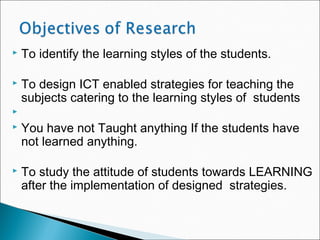
   To identify the learning styles of the students.

   To design ICT enabled strategies for teaching the
    subjects catering to the learning styles of students

   You have not Taught anything If the students have
    not learned anything.

   To study the attitude of students towards LEARNING
    after the implementation of designed strategies.
   The studies of Know and Jones (1995), Pamela Sims
    (1997), Alkesh Patel (2000), Schroder et al. (2002)
    revealed that students have different learning styles. A
    teacher has to identify these different learning styles. Thus,
    Teachers must use variety of techniques to satisfy the needs
    of all learners.
   According to Keefe (1979), Reid (1987), Riding &
    Smith (1992), S. Montgomery et al. (1996), Pat
    Wayman (2003) learning styles could be used to predict
    what kind of instructional strategies or methods would be
    most effective for a given task. They further concluded that if
    students’ styles of learning are accommodated, it can result in
    improved achievement and positive attitude towards the
    subject.
 Susan Montgomery (1994), Graff (1999), N.
  Bagraktarevic et al. (2002), S.J. Rathod
  (2004) emphasized use of computer software,
  multimedia , hypermedia and other technology (ICT)
  to match teaching and learning styles in multi faceted
  settings of the classroom
 The studies of Okebukola (1986), Felder. R. et

  al. (1990), Foriska (1992), Felder.R. (1993),
  Tobias (1993) revealed that the use of varied
  instructional strategies according to students learning
  styles in science classroom results in higher
  achievement and positive attitude towards the
  science.
The present study was developmental cum
experimental in nature. Different strategies were
decided for broad spectrum of students learning
styles. Based on these strategies an intervention
program in the form of designed lesson plan was
used for the treatment of experimental group.


                Pre-Test   Treatment   Post-test
      Group 1   …………….          X          O
      Group 2   ……………. ……………               O
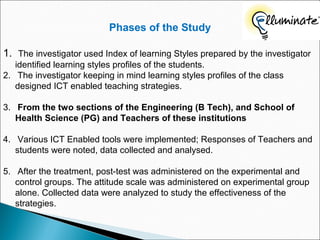
Phases of the Study

1. The investigator used Index of learning Styles prepared by the investigator
   identified learning styles profiles of the students.
2. The investigator keeping in mind learning styles profiles of the class
   designed ICT enabled teaching strategies.

3. From the two sections of the Engineering (B Tech), and School of
   Health Science (PG) and Teachers of these institutions

4. Various ICT Enabled tools were implemented; Responses of Teachers and
   students were noted, data collected and analysed.

5. After the treatment, post-test was administered on the experimental and
   control groups. The attitude scale was administered on experimental group
   alone. Collected data were analyzed to study the effectiveness of the
   strategies.
The population of the present study was the students
  and teachers of various departments and affiliated
            colleges University of Calicut.

  The students Institute of Engineering Technology,
School of Health Sciences, Centre for Health Sciences,
Computer Centre, University of Calicut, Department of
Computer Science, University of Calicut etc also been
          selected and used for the purpose.

     A-View, wiziq, figs, wiki educator, blogger,co
     sribbed.com, youtube.com, dailymotion.com,
piratebay.co, moodle, webs, weebly etc also has been
                          used.
Hypotheses
For the present study, the following tools were
used for different purposes during the study.
  • Index of Learning Styles (ILS)
  • Science Attitude Scale (SAS)
  • Achievement Test

                 Data Collection
The data were collected in three phases.
  • Pre-intervention phase
  • Intervention phase
  • Post intervention phase
Standardised Statistical tools has been resorted
            as and when needed.
A.   Learning Styles of the Students


    The learning style of the Engineering (B-Tech) and Health Sciences students has
     been changed for the better.

    Quality of technical information they possess has been improved

    Their listening span has been bettered

    Retention capacity has been bettered

    Content quantity has also been improved

    Overall approach to learning has also been bettered.
    The same result can be expected from other students too.
   61% of students process new information in an active manner. More
    than half of the class finds it hard to learn through the lecture
    method, as they need to actively process new material.

   The majority of the students (80%) demonstrated a global preference in
    understanding new material . 13% of them have strong or very strong
    preference for global understanding.
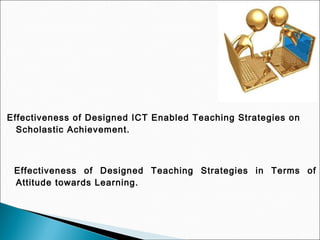
Effectiveness of Designed ICT Enabled Teaching Strategies on
  Scholastic Achievement.


 Effectiveness of Designed Teaching Strategies in Terms of
 Attitude towards Learning.
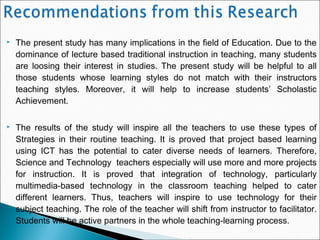
   The present study has many implications in the field of Education. Due to the
    dominance of lecture based traditional instruction in teaching, many students
    are loosing their interest in studies. The present study will be helpful to all
    those students whose learning styles do not match with their instructors
    teaching styles. Moreover, it will help to increase students’ Scholastic
    Achievement.

   The results of the study will inspire all the teachers to use these types of
    Strategies in their routine teaching. It is proved that project based learning
    using ICT has the potential to cater diverse needs of learners. Therefore,
    Science and Technology teachers especially will use more and more projects
    for instruction. It is proved that integration of technology, particularly
    multimedia-based technology in the classroom teaching helped to cater
    different learners. Thus, teachers will inspire to use technology for their
    subject teaching. The role of the teacher will shift from instructor to facilitator.
    Students will be active partners in the whole teaching-learning process.
These types of strategies can be used for all subjects and for all levels of
education. Thereby improved achievement and positive attitude towards
the subject. The concept of learning styles should be included in the
syllabus of teacher education. The knowledge of learning styles will help
trainee teachers to understand the learners in a better way. The learning
styles profile of the students should be kept in the mind while designing
sessions plan during practice teaching.

Various learning styles inventories are used to determine the learning
styles of an individual or group of students. Most of the tools are in English
language. The investigator prepared the learning styles inventory (ILS) in
local language Gujarati. It will be very useful to local school teacher to
identify the learning styles profile of their students. Moreover, Science
Attitude Scale (SAS) prepared by the investigator can be utilized to
measure students’ attitude towards the Science subject.

The study will be helpful to state government during their in-service training
programs to realize their quality education goal. Ultimately, it can be helpful
to achieve the target of universalization of quality education.
ICT Enabled Teaching

ICT Enabled Teaching

  • 1.
    Babu Appat Institute ofEngineering and Technology, University of Calicut http://www.thepleasuresofteaching.webs.com/
  • 2.
    If I cantLearn the way You Teach Can you Teach me the way I Can Learn? I Can Learn?
  • 3.
    To identify the learning styles of the students.  To design ICT enabled strategies for teaching the subjects catering to the learning styles of students   You have not Taught anything If the students have not learned anything.  To study the attitude of students towards LEARNING after the implementation of designed strategies.
  • 4.
    The studies of Know and Jones (1995), Pamela Sims (1997), Alkesh Patel (2000), Schroder et al. (2002) revealed that students have different learning styles. A teacher has to identify these different learning styles. Thus, Teachers must use variety of techniques to satisfy the needs of all learners.  According to Keefe (1979), Reid (1987), Riding & Smith (1992), S. Montgomery et al. (1996), Pat Wayman (2003) learning styles could be used to predict what kind of instructional strategies or methods would be most effective for a given task. They further concluded that if students’ styles of learning are accommodated, it can result in improved achievement and positive attitude towards the subject.
  • 5.
     Susan Montgomery(1994), Graff (1999), N. Bagraktarevic et al. (2002), S.J. Rathod (2004) emphasized use of computer software, multimedia , hypermedia and other technology (ICT) to match teaching and learning styles in multi faceted settings of the classroom  The studies of Okebukola (1986), Felder. R. et al. (1990), Foriska (1992), Felder.R. (1993), Tobias (1993) revealed that the use of varied instructional strategies according to students learning styles in science classroom results in higher achievement and positive attitude towards the science.
  • 6.
    The present studywas developmental cum experimental in nature. Different strategies were decided for broad spectrum of students learning styles. Based on these strategies an intervention program in the form of designed lesson plan was used for the treatment of experimental group. Pre-Test Treatment Post-test Group 1 ……………. X O Group 2 ……………. …………… O
  • 7.
    Phases of theStudy 1. The investigator used Index of learning Styles prepared by the investigator identified learning styles profiles of the students. 2. The investigator keeping in mind learning styles profiles of the class designed ICT enabled teaching strategies. 3. From the two sections of the Engineering (B Tech), and School of Health Science (PG) and Teachers of these institutions 4. Various ICT Enabled tools were implemented; Responses of Teachers and students were noted, data collected and analysed. 5. After the treatment, post-test was administered on the experimental and control groups. The attitude scale was administered on experimental group alone. Collected data were analyzed to study the effectiveness of the strategies.
  • 8.
    The population ofthe present study was the students and teachers of various departments and affiliated colleges University of Calicut. The students Institute of Engineering Technology, School of Health Sciences, Centre for Health Sciences, Computer Centre, University of Calicut, Department of Computer Science, University of Calicut etc also been selected and used for the purpose. A-View, wiziq, figs, wiki educator, blogger,co sribbed.com, youtube.com, dailymotion.com, piratebay.co, moodle, webs, weebly etc also has been used.
  • 9.
  • 10.
    For the presentstudy, the following tools were used for different purposes during the study. • Index of Learning Styles (ILS) • Science Attitude Scale (SAS) • Achievement Test Data Collection The data were collected in three phases. • Pre-intervention phase • Intervention phase • Post intervention phase
  • 11.
    Standardised Statistical toolshas been resorted as and when needed.
  • 12.
    A. Learning Styles of the Students  The learning style of the Engineering (B-Tech) and Health Sciences students has been changed for the better.  Quality of technical information they possess has been improved  Their listening span has been bettered  Retention capacity has been bettered  Content quantity has also been improved  Overall approach to learning has also been bettered.  The same result can be expected from other students too.
  • 13.
    61% of students process new information in an active manner. More than half of the class finds it hard to learn through the lecture method, as they need to actively process new material.  The majority of the students (80%) demonstrated a global preference in understanding new material . 13% of them have strong or very strong preference for global understanding.
  • 14.
    Effectiveness of DesignedICT Enabled Teaching Strategies on Scholastic Achievement. Effectiveness of Designed Teaching Strategies in Terms of Attitude towards Learning.
  • 15.
    The present study has many implications in the field of Education. Due to the dominance of lecture based traditional instruction in teaching, many students are loosing their interest in studies. The present study will be helpful to all those students whose learning styles do not match with their instructors teaching styles. Moreover, it will help to increase students’ Scholastic Achievement.  The results of the study will inspire all the teachers to use these types of Strategies in their routine teaching. It is proved that project based learning using ICT has the potential to cater diverse needs of learners. Therefore, Science and Technology teachers especially will use more and more projects for instruction. It is proved that integration of technology, particularly multimedia-based technology in the classroom teaching helped to cater different learners. Thus, teachers will inspire to use technology for their subject teaching. The role of the teacher will shift from instructor to facilitator. Students will be active partners in the whole teaching-learning process.
  • 16.
    These types ofstrategies can be used for all subjects and for all levels of education. Thereby improved achievement and positive attitude towards the subject. The concept of learning styles should be included in the syllabus of teacher education. The knowledge of learning styles will help trainee teachers to understand the learners in a better way. The learning styles profile of the students should be kept in the mind while designing sessions plan during practice teaching. Various learning styles inventories are used to determine the learning styles of an individual or group of students. Most of the tools are in English language. The investigator prepared the learning styles inventory (ILS) in local language Gujarati. It will be very useful to local school teacher to identify the learning styles profile of their students. Moreover, Science Attitude Scale (SAS) prepared by the investigator can be utilized to measure students’ attitude towards the Science subject. The study will be helpful to state government during their in-service training programs to realize their quality education goal. Ultimately, it can be helpful to achieve the target of universalization of quality education.