















10 CSM- Liner shipping Management- Digitisation of Shipping
operations
Transglobe Academy
Babu Appat
10 E-Commerce- Digitisation of Shipping
Operations
E-COMMERCE
APPLICATIONS IN LINER
COMPANIES
B A B U A P PAT
Computer based data processing systems now
have a place in almost all types of businesses
irrespective of the size and nature of the
business unit.
Right from vegetable market, small
coffee shop till the highly sophisticated office,
the computer and its services have become
inevitable in the commercial world.
Not only with reference to commercial
activities it has become an inevitable one but
also in the education system, medical
system, astrology and in astronomy too.
Shipping Industry is not an exception to this, and
the growth of shipping industry is directly linked with
the growth and development in Technology.
The choice of computer hardware today
is greater than ever before, both in the range
of manufacturers and in the choice of types
of systems, i.e., large central processors, or
a number of separate systems on mini or personal
computers.
Like in any business, the computer
applications in shipping business also can be
divided into the following broad categories:
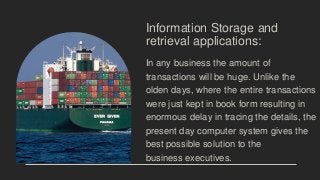
Information Storage and
retrieval applications:
In any business the amount of
transactions will be huge. Unlike the
olden days, where the entire transactions
were just kept in book form resulting in
enormous delay in tracing the details, the
present day computer system gives the
best possible solution to the
business executives.
ADVANTAGES OF
COMPUTERIZATION
IN LINER BUSINESS:
1. Handling of large
data volumes:
The movement of goods in international
trade is always associated with the need to
record significant volumes of data. Most of
the data are repetitive in nature. For
example, container number will have to be
recorded many times in the course of its
journey from origin to destination. The use
of computer stored data will avoid the need
for data to be copied, thus reducing the
clerical workload and avoiding the risk of
inaccuracies.
2. Opportunities for
data validation:
The use of information stored on
the computer can improve
accuracy, as it does not have to
be manually recopied each time
when it is used. Various logical
checks can be applied to data
on input, to avoid capturing
spurious data. For example,
information on container
movements can be checked against
the previous recorded position and
status of the container, to check that
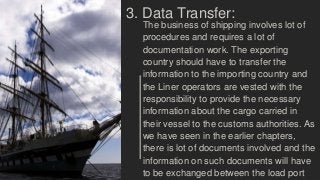
3. Data Transfer:
The business of shipping involves lot of
procedures and requires a lot of
documentation work. The exporting
country should have to transfer the
information to the importing country and
the Liner operators are vested with the
responsibility to provide the necessary
information about the cargo carried in
their vessel to the customs authorities. As
we have seen in the earlier chapters,
there is lot of documents involved and the
information on such documents will have
to be exchanged between the load port
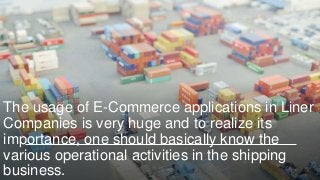
The usage of E-Commerce applications in Liner
Companies is very huge and to realize its
importance, one should basically know the
various operational activities in the shipping
business.
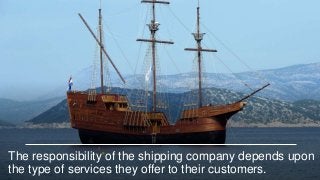
The responsibility of the shipping company depends upon
the type of services they offer to their customers.
While few a shipping companies
offer only transportation of cargo
between ports, few other accept
cargo from the warehouse of the
manufacturer till the delivery of
cargo at the buyers warehouse.
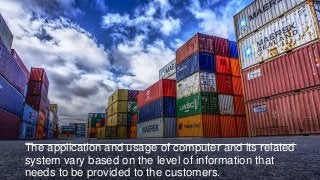
The application and usage of computer and its related
system vary based on the level of information that
needs to be provided to the customers.
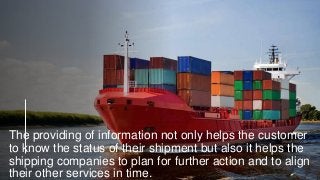
The providing of information not only helps the customer
to know the status of their shipment but also it helps the
shipping companies to plan for further action and to align
their other services in time.
Electronic Fund
Transfer
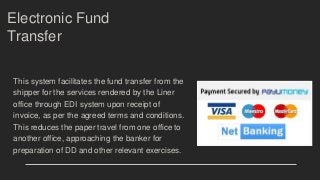
This system facilitates the fund transfer from the
shipper for the services rendered by the Liner
office through EDI system upon receipt of
invoice, as per the agreed terms and conditions.
This reduces the paper travel from one office to
another office, approaching the banker for
preparation of DD and other relevant exercises.
Arrival Notice
Every shipper would be closely
monitoring the arrival status of
the cargo. One of the functions
of the shipping company is to
send cargo arrival notices and
Transshipment advices.
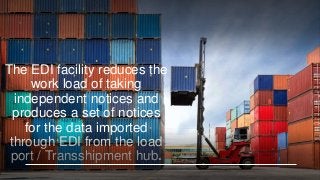
The EDI facility reduces the
work load of taking
independent notices and
produces a set of notices
for the data imported
through EDI from the load
port / Transshipment hub.
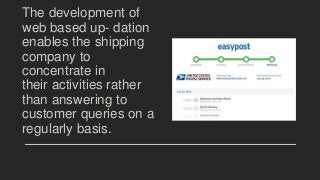
The development of
web based up- dation
enables the shipping
company to
concentrate in
their activities rather
than answering to
customer queries on a
regularly basis.
Most of the shipping companies update their websit
e wherein the details of shipment are captured from
the time of loading till the arrival of cargo in the
When the details are getting updated in the web site of
the liners, based on the relationship established between
the customer and the liner office, through this EDI facility, directly
the liner office can reach the arrival information to the customer’s
office.
Shipment Status:
With any one of the available
information like container number, bill
of lading number, the shipment status
can be viewed from the website of
the liner shipping company. The
importer/ consignee can get the
information about their shipment
sitting in their place at any point of
time.
Benefits of EDI
System
1. It offers better communication process between the
shipper and the shipping line.
2. It eliminates keying in the data once again and thus
eliminates errors and rechecking of the information.
3. It eliminates paper handling and the document
storage.
4. It improves the accuracy of data. It eliminates the
need for using some other slower modes of
communication like faxing, etc.
A few of the information/services that are
commonly available to the customers under
e-business/web system of the shipping lines
are indicated as below:
• Rates & Tariffs
• Schedules
• B/L Instructions
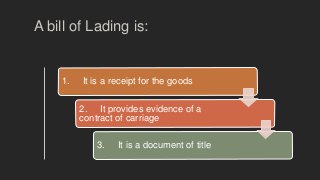
A bill of Lading is:
1. It is a receipt for the goods
2. It provides evidence of a
contract of carriage
3. It is a document of title
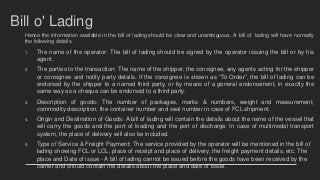
Bill o' Lading
Hence the information available in the bill of lading should be clear and unambiguous. A bill of lading will have normally
the following details.
1. The name of the operator: The bill of lading should be signed by the operator issuing the bill or by his
agent.
2. The parties to the transaction: The name of the shipper, the consignee, any agents acting for the shipper
or consignee and notify party details. If the consignee is shown as “To Order”, the bill of lading can be
endorsed by the shipper to a named third party, or by means of a general endorsement, in exactly the
same way as a cheque can be endorsed to a third party.
3. Description of goods: The number of packages, marks & numbers, weight and measurement,
commodity description, the container number and seal number in case of FCL shipment.
4. Origin and Destination of Goods: A bill of lading will contain the details about the name of the vessel that
will carry the goods and the port of loading and the port of discharge. In case of multimodal transport
system, the place of delivery will also be included.
5. Type of Service & Freight Payment: The service provided by the operator will be mentioned in the bill of
lading showing FCL or LCL, place of receipt and place of delivery, the freight payment details, etc. The
place and Date of issue - A bill of lading cannot be issued before the goods have been received by the
carrier and should contain the details about the place and date of issue.
On Board bill of lading can be issued only
upon receipt of cargo on board the vessel
and in exchange of mate receipt.
Any discrepancy
in the bill of lading will
result in amendments
and in time delay. This
can be avoided by
using EDI/system
facility of the liner
shipping company.
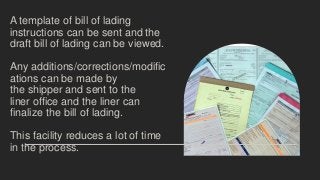
A template of bill of lading
instructions can be sent and the
draft bill of lading can be viewed.
Any additions/corrections/modific
ations can be made by
the shipper and sent to the
liner office and the liner can
finalize the bill of lading.
This facility reduces a lot of time
in the process.
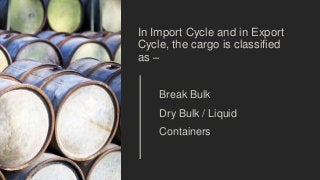
In Import Cycle and in Export
Cycle, the cargo is classified
as –
Break Bulk
Dry Bulk / Liquid
Containers
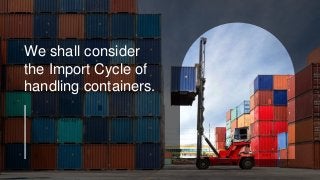
We shall consider
the Import Cycle of
handling containers.
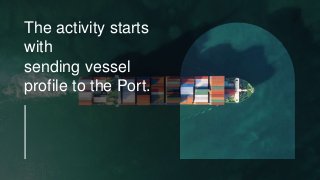
The activity starts
with
sending vessel
profile to the Port.
After that the
Voyage registration will have
to be made by the agent and
the necessary information will
have to be sent to the Port.
Upon receipt of this, Port
allots the VIA No. to the
vessel.
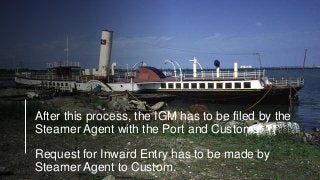
After this process, the IGM has to be filed by the
Steamer Agent with the Port and Customs.
Request for Inward Entry has to be made by
Steamer Agent to Custom.
Steamer Agent Submits:
1. Berthing/Pilot
Application, giving
the vessel
dimensions and
cargo details.
2. Cargo details &
Hazardous Cargo
Declaration
3. Along with the
declaration, the
instructions
regarding handling
of Hazardous cargo
4. Stowage Plan
5. Advance
Container List
6. PHO Certificate
7. Plant Quarantine
Certificate,
Immigration
Certificate
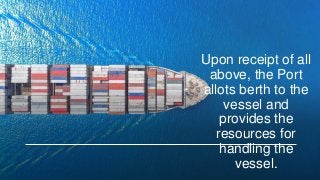
Upon receipt of all
above, the Port
allots berth to the
vessel and
provides the
resources for
handling the
vessel.
While the
unloading operation is on, at
every stage, for the
cargo unloaded, there is a
tally report made and
the same has to be given by
the Port to steamer agent
and also to customs.
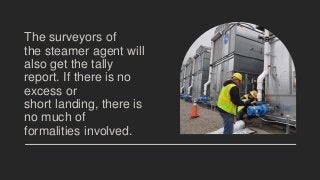
The surveyors of
the steamer agent will
also get the tally
report. If there is no
excess or
short landing, there is
no much of
formalities involved.
When there is an excess cargo landing, the details will have
to be sent by port to customs. The steamer agent will have
to file a supplement IGM with customs and port for such
excess landing.
When there is no excess landing, the further
process begins. We shall discuss about the
container trade for our understanding on the
EDI system usage in effecting delivery of box
from the terminal.
Depending upon the practice of the port,
after the consignee / their agents
completing the custom formalities, port
allows delivery in any one of the following
ways –
1. Direct Delivery of containers will be given to the consignees upon they submitting the
necessary documents for having completed the customs formalities.
2. Cargo can be destuffed from the containers and the cargo will be delivered against valid
documents.
3. Neither there is a facility of effecting direct delivery to the consignees nor any facility to
devan the containers and to effect delivery of cargo alone. In this case the amount of
formalities involved in transferring the containers from the terminal to the CFS/ICD and the
documentation process involved in getting the permission is a time consuming one and the
necessary papers of such request will have to move from table to table from one office to
another. While the above three different practice exist with few of the ports, in few other
ports there is a combination in the style of effecting delivery of containers. Some portion of
containers belonging to consignees enjoying better rating with customs (RMS) may get
delivered directly to the consignees and the rest will be moved to the CFS. Whenever the
container is moving out of the port, the same has to be updated and maintaining manual
record is not at all possible where the throughput is about a million TEUs in a container
terminal. While the containers are delivered from port, necessarily there has to be a gate
pass and the preparation of gate pass on manual basis is not possible, where system only
can contribute efficiency and time saving in the activities.
So we can understand digitisation makes the
operation smoother and easier. It improves the
speed and efficacy of shipping operations
Any
Questions
?
T H I N K I T O V E R , W H A T W E
H A V E L E A R N E D T I L L N O W ,
Happy learning *
fruitful career
Wish you all success in your
life
Babu Appat

10 CSM E-Commerce in Liner Shipping

  • 1.
    10 CSM- Linershipping Management- Digitisation of Shipping operations Transglobe Academy Babu Appat
  • 2.
    10 E-Commerce- Digitisationof Shipping Operations
  • 3.
  • 4.
    Computer based dataprocessing systems now have a place in almost all types of businesses irrespective of the size and nature of the business unit.
  • 5.
    Right from vegetablemarket, small coffee shop till the highly sophisticated office, the computer and its services have become inevitable in the commercial world.
  • 6.
    Not only withreference to commercial activities it has become an inevitable one but also in the education system, medical system, astrology and in astronomy too.
  • 7.
    Shipping Industry isnot an exception to this, and the growth of shipping industry is directly linked with the growth and development in Technology.
  • 8.
    The choice ofcomputer hardware today is greater than ever before, both in the range of manufacturers and in the choice of types of systems, i.e., large central processors, or a number of separate systems on mini or personal computers.
  • 9.
    Like in anybusiness, the computer applications in shipping business also can be divided into the following broad categories:
  • 10.
    Information Storage and retrievalapplications: In any business the amount of transactions will be huge. Unlike the olden days, where the entire transactions were just kept in book form resulting in enormous delay in tracing the details, the present day computer system gives the best possible solution to the business executives.
  • 11.
    ADVANTAGES OF COMPUTERIZATION IN LINERBUSINESS: 1. Handling of large data volumes: The movement of goods in international trade is always associated with the need to record significant volumes of data. Most of the data are repetitive in nature. For example, container number will have to be recorded many times in the course of its journey from origin to destination. The use of computer stored data will avoid the need for data to be copied, thus reducing the clerical workload and avoiding the risk of inaccuracies.
  • 12.
    2. Opportunities for datavalidation: The use of information stored on the computer can improve accuracy, as it does not have to be manually recopied each time when it is used. Various logical checks can be applied to data on input, to avoid capturing spurious data. For example, information on container movements can be checked against the previous recorded position and status of the container, to check that
  • 13.
    3. Data Transfer: Thebusiness of shipping involves lot of procedures and requires a lot of documentation work. The exporting country should have to transfer the information to the importing country and the Liner operators are vested with the responsibility to provide the necessary information about the cargo carried in their vessel to the customs authorities. As we have seen in the earlier chapters, there is lot of documents involved and the information on such documents will have to be exchanged between the load port
  • 14.
    The usage ofE-Commerce applications in Liner Companies is very huge and to realize its importance, one should basically know the various operational activities in the shipping business.
  • 15.
    The responsibility ofthe shipping company depends upon the type of services they offer to their customers.
  • 16.
    While few ashipping companies offer only transportation of cargo between ports, few other accept cargo from the warehouse of the manufacturer till the delivery of cargo at the buyers warehouse.
  • 17.
    The application andusage of computer and its related system vary based on the level of information that needs to be provided to the customers.
  • 18.
    The providing ofinformation not only helps the customer to know the status of their shipment but also it helps the shipping companies to plan for further action and to align their other services in time.
  • 19.
    Electronic Fund Transfer This systemfacilitates the fund transfer from the shipper for the services rendered by the Liner office through EDI system upon receipt of invoice, as per the agreed terms and conditions. This reduces the paper travel from one office to another office, approaching the banker for preparation of DD and other relevant exercises.
  • 20.
    Arrival Notice Every shipperwould be closely monitoring the arrival status of the cargo. One of the functions of the shipping company is to send cargo arrival notices and Transshipment advices.
  • 21.
    The EDI facilityreduces the work load of taking independent notices and produces a set of notices for the data imported through EDI from the load port / Transshipment hub.
  • 22.
    The development of webbased up- dation enables the shipping company to concentrate in their activities rather than answering to customer queries on a regularly basis.
  • 23.
    Most of theshipping companies update their websit e wherein the details of shipment are captured from the time of loading till the arrival of cargo in the
  • 24.
    When the detailsare getting updated in the web site of the liners, based on the relationship established between the customer and the liner office, through this EDI facility, directly the liner office can reach the arrival information to the customer’s office.
  • 25.
    Shipment Status: With anyone of the available information like container number, bill of lading number, the shipment status can be viewed from the website of the liner shipping company. The importer/ consignee can get the information about their shipment sitting in their place at any point of time.
  • 26.
    Benefits of EDI System 1.It offers better communication process between the shipper and the shipping line. 2. It eliminates keying in the data once again and thus eliminates errors and rechecking of the information. 3. It eliminates paper handling and the document storage. 4. It improves the accuracy of data. It eliminates the need for using some other slower modes of communication like faxing, etc.
  • 27.
    A few ofthe information/services that are commonly available to the customers under e-business/web system of the shipping lines are indicated as below: • Rates & Tariffs • Schedules • B/L Instructions
  • 28.
    A bill ofLading is: 1. It is a receipt for the goods 2. It provides evidence of a contract of carriage 3. It is a document of title
  • 29.
    Bill o' Lading Hencethe information available in the bill of lading should be clear and unambiguous. A bill of lading will have normally the following details. 1. The name of the operator: The bill of lading should be signed by the operator issuing the bill or by his agent. 2. The parties to the transaction: The name of the shipper, the consignee, any agents acting for the shipper or consignee and notify party details. If the consignee is shown as “To Order”, the bill of lading can be endorsed by the shipper to a named third party, or by means of a general endorsement, in exactly the same way as a cheque can be endorsed to a third party. 3. Description of goods: The number of packages, marks & numbers, weight and measurement, commodity description, the container number and seal number in case of FCL shipment. 4. Origin and Destination of Goods: A bill of lading will contain the details about the name of the vessel that will carry the goods and the port of loading and the port of discharge. In case of multimodal transport system, the place of delivery will also be included. 5. Type of Service & Freight Payment: The service provided by the operator will be mentioned in the bill of lading showing FCL or LCL, place of receipt and place of delivery, the freight payment details, etc. The place and Date of issue - A bill of lading cannot be issued before the goods have been received by the carrier and should contain the details about the place and date of issue.
  • 30.
    On Board billof lading can be issued only upon receipt of cargo on board the vessel and in exchange of mate receipt.
  • 31.
    Any discrepancy in thebill of lading will result in amendments and in time delay. This can be avoided by using EDI/system facility of the liner shipping company.
  • 32.
    A template ofbill of lading instructions can be sent and the draft bill of lading can be viewed. Any additions/corrections/modific ations can be made by the shipper and sent to the liner office and the liner can finalize the bill of lading. This facility reduces a lot of time in the process.
  • 33.
    In Import Cycleand in Export Cycle, the cargo is classified as – Break Bulk Dry Bulk / Liquid Containers
  • 34.
    We shall consider theImport Cycle of handling containers.
  • 35.
    The activity starts with sendingvessel profile to the Port.
  • 36.
    After that the Voyageregistration will have to be made by the agent and the necessary information will have to be sent to the Port.
  • 37.
    Upon receipt ofthis, Port allots the VIA No. to the vessel.
  • 38.
    After this process,the IGM has to be filed by the Steamer Agent with the Port and Customs. Request for Inward Entry has to be made by Steamer Agent to Custom.
  • 39.
    Steamer Agent Submits: 1.Berthing/Pilot Application, giving the vessel dimensions and cargo details. 2. Cargo details & Hazardous Cargo Declaration 3. Along with the declaration, the instructions regarding handling of Hazardous cargo 4. Stowage Plan 5. Advance Container List 6. PHO Certificate 7. Plant Quarantine Certificate, Immigration Certificate
  • 40.
    Upon receipt ofall above, the Port allots berth to the vessel and provides the resources for handling the vessel.
  • 41.
    While the unloading operationis on, at every stage, for the cargo unloaded, there is a tally report made and the same has to be given by the Port to steamer agent and also to customs.
  • 42.
    The surveyors of thesteamer agent will also get the tally report. If there is no excess or short landing, there is no much of formalities involved.
  • 43.
    When there isan excess cargo landing, the details will have to be sent by port to customs. The steamer agent will have to file a supplement IGM with customs and port for such excess landing.
  • 44.
    When there isno excess landing, the further process begins. We shall discuss about the container trade for our understanding on the EDI system usage in effecting delivery of box from the terminal.
  • 45.
    Depending upon thepractice of the port, after the consignee / their agents completing the custom formalities, port allows delivery in any one of the following ways – 1. Direct Delivery of containers will be given to the consignees upon they submitting the necessary documents for having completed the customs formalities. 2. Cargo can be destuffed from the containers and the cargo will be delivered against valid documents. 3. Neither there is a facility of effecting direct delivery to the consignees nor any facility to devan the containers and to effect delivery of cargo alone. In this case the amount of formalities involved in transferring the containers from the terminal to the CFS/ICD and the documentation process involved in getting the permission is a time consuming one and the necessary papers of such request will have to move from table to table from one office to another. While the above three different practice exist with few of the ports, in few other ports there is a combination in the style of effecting delivery of containers. Some portion of containers belonging to consignees enjoying better rating with customs (RMS) may get delivered directly to the consignees and the rest will be moved to the CFS. Whenever the container is moving out of the port, the same has to be updated and maintaining manual record is not at all possible where the throughput is about a million TEUs in a container terminal. While the containers are delivered from port, necessarily there has to be a gate pass and the preparation of gate pass on manual basis is not possible, where system only can contribute efficiency and time saving in the activities.
  • 46.
    So we canunderstand digitisation makes the operation smoother and easier. It improves the speed and efficacy of shipping operations
  • 47.
    Any Questions ? T H IN K I T O V E R , W H A T W E H A V E L E A R N E D T I L L N O W ,
  • 48.
    Happy learning * fruitfulcareer Wish you all success in your life Babu Appat