Utilizing Learning Styles
                    For effective Web-Based Learning

Mohamed M. Bouker                                    Mohamed A. Arteimi
Academy of Graduate Studies                          Computer Science Department
Tripoli-Libya                                        7th of April University
Bouker@hiep.edu.ly                                   Zawia-Libya
                                                     arteimi@yahoo.com


Abstract

        We present a model of web-based learning for teaching Visual Programming in
Delphi, by adopting individual learning styles. A software system was developed for
this purpose where two learning models (namely; 4MAT system and PBL system) are
implemented. The goal of this research is to examine the influence of the two selected
models on students of different learning styles enrolled in a web-based programming
course.
Students were randomly divided into two groups, one for each learning model, and are
given access to a website designed specifically for this purpose. Pre and post-tests were
carried out.
A controlled evaluation is currently underway to assess the impacts of the system on
students programming skills as well as their attitudes surrounding the use of available
web facilities.

Keywords: web-based learning; learning styles; learning models; PBL; 4MAT.
1   Introduction
        The integration between information and telecommunication technologies has
supported distance learning by providing learning situations that are accessible to
individuals at any time and anywhere.

        The issue of assisting people to “ learn how to learn “ has been an active
research area, and now there is a growing acceptance that understanding the way
students learn is the key to improve the education process. There is a consensus that
each person has a preferred way of perceiving and utilizing knowledge, which indicates
the way he/she structures and analyses the information. Therefore, learning will be
easier when there is a strong correlation between the ways in which new material is
presented to us and our learning preferences. Conversely, We will find learning more
difficult when there is a large disparity between our learning style and the mode of
learning. Hence, As teachers, our teaching methods reflect our style in learning, thus
knowing our learning style will help us develop a strategy for learning / teaching
strategies.
        For the last three decades researchers have started to pay considerable attention
to learning styles theory. Although some researchers in the field of Computer Science
Education have adopted the idea of using learning styles in education, there is still little
research on the adaptation to individual styles in web-based learning environments[8].

        This research investigates the difference of student’s performance with respect
to the selected learning model, which will provide us with information about the
suitability of web-based learning in the area of computer programming, as well as the
viability of incorporating learning styles in the design of web-based courses.

        A system named “WBLS” was designed and implemented to provide a flexible
environment for learners by adopting learning styles theory in web-based learning. The
System can be located at (www.delphi4all.com).


2 Objectives

    The main purpose of this research project is to find out better way to design online
material that is enjoyable and easy to comprehend, and enhances the learning process.
The research attempts to answer the following two questions:


                                             2
o Is there a viable relationship between learning styles conceptualized by Kolb,
       McCarthy and others, and the web-based learning with respect to teaching visual
       programming in computer science?
   o Are the learning styles models, adopted in this research work, equally effective
       for all students?
   Considering the importance of distance learning especially for large number of
students or when there is a shortage in teaching staff and tutors, we hope that the
expected results of the proposed research will be a step on the way to facilitate the
education process and would contribute a positive add in the aspect of web-based
learning.
Three null hypotheses were developed for testing at the two-tailed α priori level of 0.05.
   HO1. There are no statistically significant differences in the mean WBLS class
   achievement scores among the online students when grouped by different learning
   styles for both Models
   HO2. There are no statistically significant differences in the mean WBLS class
   achievement scores among the online students when grouped by their gender for
   both Models.
   HO3. There are no statistically significant differences in the mean WBLS class
   achievement scores among the online students of the two Models.


   3    Background Research
   3.1 Learning Styles theory


       The term “Learning styles” refers to the ways individuals prefer to receive,
process and present information and ideas. Some people, for example, find it easier to
understand a new concept by reading a textbook, whilst others prefer a verbal
explanation. Likewise, people may vary in how they most effectively demonstrate their
understanding: graphically, verbally, or in writing. Since the 1970's the educational
community has had considerable interest in the notion of learning styles. A number of
different models have been proposed, and research in a wide variety of educational
contexts has taken place in the past 30 years. As a consequence, the wide acceptance of
use of learning styles in education led to application of such approach to web-based
courses [1,4,5].


                                             3
In this research, two learning Models are applied, Problem Based Learning (PBL) and
the 4MAT System Model.
3.2   Problem-Based Learning (PBL)


       The first learning method that has been selected to be applied on web-based
learning is the problem-based learning. PBL could be applied in any learning
environment in which the problem drives the learning. That is, before students learn any
information they are given a problem. The problem is posed so that a student discovers
that he/she needs to learn some new knowledge before he/she can solve the problem.
However, there is an indication that problem-based learning method is appropriate for
the majority of learners [2].


       Posing a problem before learning a new piece of information tends to motivate
students and know why they are learning the new knowledge. Learning in the context of
the need to solve a problem also tends to store the knowledge in memory patterns that
facilitate later recall for solving problems (most of us have forgotten some material we
have learned during undergraduate study)
       PBL promotes students’ confidence in their problem-solving skills and strives to
make them self-directed learners. These skills can put PBL students at an advantage in
future courses and in their careers.
There are many reasons behind the selection of PBL method such as:
         •   It enables students to be active learners and self directed.
         •   It engages students to work in groups and acquire very good skills in
             Problem solving and enhance their communication skills.
         •   It enables students to learn for understanding rather than for recall of
             isolated facts.

3.3 4MAT System Model
This system incorporates Kolb's four learning styles and recent research on right/left
brain hemispheric processing. As Kolb [6] described that each person's learning style is
a combination of perceiving and processing information; McCarthy [7] describes four
major styles:
1- Type One "Innovative Learners"                 2- Type Two "Analytic Learners"
3- Type Three "Common Sense Learners"             4- Type Four "Dynamic Learners"


                                              4
A cycle is made with four quadrants; each student should pass all four quadrants to
learn the material. Each learning style can get the most from one quadrant but can be
improved by the other quadrants.
Each quadrant may contain many activities, so the student will go through all these
activities.


                  Figure 1: Four quadrants of 4MAT model
        By passing the 4 quadrants, students ask the following 4 questions respectively:
Why? What? How? What if?


                     Figure 2: Four learning types(styles) - four questions


        McCarthy identified eight theoretical approaches to the learning process cycle,
which format the 4MAT System Model [3,7].


                                           5
Brain processing, or the way in which the brain is able to take in and perceive the
information is important in understanding learning styles. This area has to do with the
concept of left and right brain dominance . It is important to understand that both sides
of the brain are able to reason, however, they use different strategies and it may appear
that one side is dominant over the other.
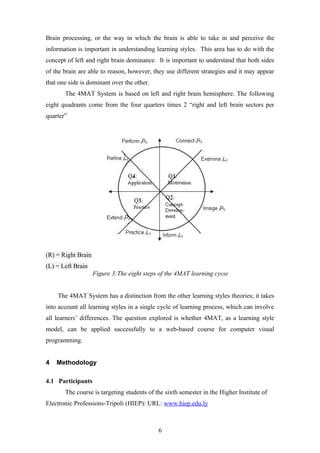
       The 4MAT System is based on left and right brain hemisphere. The following
eight quadrants come from the four quarters times 2 “right and left brain sectors per
quarter”


(R) = Right Brain
(L) = Left Brain
                    Figure 3:The eight steps of the 4MAT learning cycle


    The 4MAT System has a distinction from the other learning styles theories; it takes
into account all learning styles in a single cycle of learning process, which can involve
all learners’ differences. The question explored is whether 4MAT, as a learning style
model, can be applied successfully to a web-based course for computer visual
programming.


4   Methodology

4.1 Participants
       The course is targeting students of the sixth semester in the Higher Institute of
Electronic Professions-Tripoli (HIEP): URL: www.hiep.edu.ly


                                            6
The population of the study consisted of 30 students during the fall semester of
the academic year 2005/2006.


4.2 Domain
           The system was used to teach Visual Programming in DELPHI as a web-based
course instead of the traditional face-to-face method. The material is designed in two
different aspects, one according to the 4MAT Model and the other according to the PBL
Model. To benefit from the electronic advantages, the course material is supported with
pictures, sounds, animations and videos. This was a Web-based course in which all the
course materials and resources were accessed and delivered by the Internet, and the
student could access any sections or tools within his part (group) of this learning
environment.


4.3    Procedure
      The study was empirical and exploratory. In order to collect data on participants
learning styles, the instructor administered a questionnaire that takes about 20 minutes
for the participants to complete. Students were randomly assigned to two groups: a
4MAT Group or a PBL group. A statistical analysis was conducted at the end of the
course.
4.4       The research instruments
             The instructor administered two types of questionnaires; the first was used to
identify each student’s preferred learning style, which is used in the comparison of the
two learning methods. This comparison is expected to clarify:
      •    Which group will gain better achievement.
      •    Which learning method can offer a balance between different learning styles in a
           web-based learning environment.
      The second type of questionnaire was a Likert-Type survey administered at the end
      of the course to gather students’ opinions about the course and to see if participants
      enjoyed the course and developed positive attitude toward web-based learning.
      Pre and post tests were carried out as an evaluation method and the obtained results
      were analyzed as a basis of the research.
4.5       System Architecture
           The WBLS system was built over IIS web server, ASP dynamic web pages and
SQL database. VB Script & Java Script codes are used in addition to HTML code.


                                               7
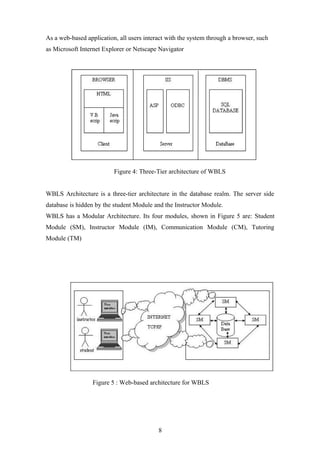
As a web-based application, all users interact with the system through a browser, such
as Microsoft Internet Explorer or Netscape Navigator


                          Figure 4: Three-Tier architecture of WBLS


WBLS Architecture is a three-tier architecture in the database realm. The server side
database is hidden by the student Module and the Instructor Module.
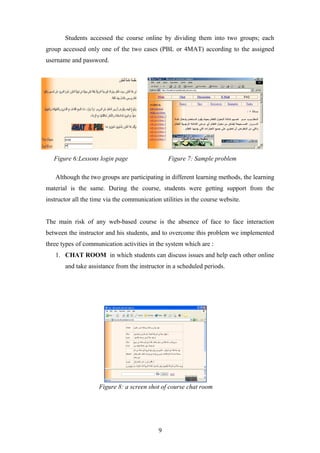
WBLS has a Modular Architecture. Its four modules, shown in Figure 5 are: Student
Module (SM), Instructor Module (IM), Communication Module (CM), Tutoring
Module (TM)


                  Figure 5 : Web-based architecture for WBLS


                                           8
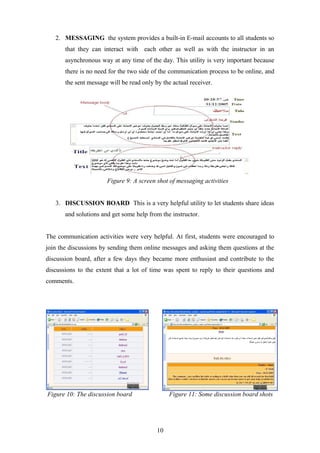
Students accessed the course online by dividing them into two groups; each
group accessed only one of the two cases (PBL or 4MAT) according to the assigned
username and password.


   Figure 6:Lessons login page                   Figure 7: Sample problem

   Although the two groups are participating in different learning methods, the learning
material is the same. During the course, students were getting support from the
instructor all the time via the communication utilities in the course website.


The main risk of any web-based course is the absence of face to face interaction
between the instructor and his students, and to overcome this problem we implemented
three types of communication activities in the system which are :
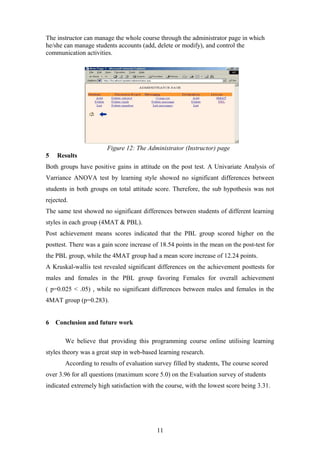
   1. CHAT ROOM in which students can discuss issues and help each other online
       and take assistance from the instructor in a scheduled periods.


                     Figure 8: a screen shot of course chat room


                                             9
2. MESSAGING the system provides a built-in E-mail accounts to all students so
       that they can interact with each other as well as with the instructor in an
       asynchronous way at any time of the day. This utility is very important because
       there is no need for the two side of the communication process to be online, and
       the sent message will be read only by the actual receiver.


                       Figure 9: A screen shot of messaging activities


   3. DISCUSSION BOARD This is a very helpful utility to let students share ideas
       and solutions and get some help from the instructor.


The communication activities were very helpful. At first, students were encouraged to
join the discussions by sending them online messages and asking them questions at the
discussion board, after a few days they became more enthusiast and contribute to the
discussions to the extent that a lot of time was spent to reply to their questions and
comments.


Figure 10: The discussion board                 Figure 11: Some discussion board shots


                                           10
The instructor can manage the whole course through the administrator page in which
he/she can manage students accounts (add, delete or modify), and control the
communication activities.


                        Figure 12: The Administrator (Instructor) page
5   Results
Both groups have positive gains in attitude on the post test. A Univariate Analysis of
Varriance ANOVA test by learning style showed no significant differences between
students in both groups on total attitude score. Therefore, the sub hypothesis was not
rejected.
The same test showed no significant differences between students of different learning
styles in each group (4MAT & PBL).
Post achievement means scores indicated that the PBL group scored higher on the
posttest. There was a gain score increase of 18.54 points in the mean on the post-test for
the PBL group, while the 4MAT group had a mean score increase of 12.24 points.
A Kruskal-wallis test revealed significant differences on the achievement posttests for
males and females in the PBL group favoring Females for overall achievement
( p=0.025 < .05) , while no significant differences between males and females in the
4MAT group (p=0.283).


6   Conclusion and future work

       We believe that providing this programming course online utilising learning
styles theory was a great step in web-based learning research.
       According to results of evaluation survey filled by students, The course scored
over 3.96 for all questions (maximum score 5.0) on the Evaluation survey of students
indicated extremely high satisfaction with the course, with the lowest score being 3.31.


                                           11
Although the results of this study may not be generalized to the entire population
of undergraduate students, the results can still provide valuable information to
educational providers as they plan and deliver education program to students.


       Some good comments are reported by students in which will take place in
future. The research is still under progress, so replication study covering more
participants is undertaking during the spring semester 2006 to acquire more accurate
results. By doing more experiments and by adopting more learning models, we may
discover a strategy to expect the suitability of each model to the participant
characteristics such as: preferred learning style, sex, and dominant side of his brain.
The system may be developed to automatically determine the participant’s
characteristics and adapt the lessons accordingly.

7   References

    1. Desypris, G. (2002), “Enhancement of Learning Process in Web-based Courses
       Using Combined Media Components”, M.Sc. thesis, naval postgraduate school,
       California.
    2. Edward, S. N. (2001), “Evaluation of a constructivist approach to student
       induction in relation to students’ learning style”, European Journal of
       Engineering Education, 26/4, pp.429-440.

    3. Gary, D. and Palmer, J. (2001), “Learning Styles and Web-Based Learning: The
       4MAT Methodology”, WebNet Journal, 3/2, April-June.

    4. Han, B. (2001),“ Student Modeling and Adaptive in Web-based Learning
       Systems”, Masters thesis, Massey university.

    5. Knut, O.T.(2002) , “Mobile Learning Technological Challenges on Multi
       channel E-learning”, Masters thesis , Agder university college.

    6. Kolb, D. (1984), “Experiential Learning: Experience as the Source of Learning
       and Development”, Prentice-Hall, Englewood Cliffs, N.J.
    7. McCarthy, B. (1987), “The 4MAT System: Teaching to Learning Styles with
       Right/Left Mode Techniques”, Barrington, IL: Excel, Inc.

    8. Wolf, C. (2003), “iWeaver: Towards 'Learning Style-based e-Learning in
       Computer Science Education”, Ph.D. Project, RMIT University.


                                            12

Utilising learning styles

  • 1.
    Utilizing Learning Styles For effective Web-Based Learning Mohamed M. Bouker Mohamed A. Arteimi Academy of Graduate Studies Computer Science Department Tripoli-Libya 7th of April University Bouker@hiep.edu.ly Zawia-Libya arteimi@yahoo.com Abstract We present a model of web-based learning for teaching Visual Programming in Delphi, by adopting individual learning styles. A software system was developed for this purpose where two learning models (namely; 4MAT system and PBL system) are implemented. The goal of this research is to examine the influence of the two selected models on students of different learning styles enrolled in a web-based programming course. Students were randomly divided into two groups, one for each learning model, and are given access to a website designed specifically for this purpose. Pre and post-tests were carried out. A controlled evaluation is currently underway to assess the impacts of the system on students programming skills as well as their attitudes surrounding the use of available web facilities. Keywords: web-based learning; learning styles; learning models; PBL; 4MAT.
  • 2.
    1 Introduction The integration between information and telecommunication technologies has supported distance learning by providing learning situations that are accessible to individuals at any time and anywhere. The issue of assisting people to “ learn how to learn “ has been an active research area, and now there is a growing acceptance that understanding the way students learn is the key to improve the education process. There is a consensus that each person has a preferred way of perceiving and utilizing knowledge, which indicates the way he/she structures and analyses the information. Therefore, learning will be easier when there is a strong correlation between the ways in which new material is presented to us and our learning preferences. Conversely, We will find learning more difficult when there is a large disparity between our learning style and the mode of learning. Hence, As teachers, our teaching methods reflect our style in learning, thus knowing our learning style will help us develop a strategy for learning / teaching strategies. For the last three decades researchers have started to pay considerable attention to learning styles theory. Although some researchers in the field of Computer Science Education have adopted the idea of using learning styles in education, there is still little research on the adaptation to individual styles in web-based learning environments[8]. This research investigates the difference of student’s performance with respect to the selected learning model, which will provide us with information about the suitability of web-based learning in the area of computer programming, as well as the viability of incorporating learning styles in the design of web-based courses. A system named “WBLS” was designed and implemented to provide a flexible environment for learners by adopting learning styles theory in web-based learning. The System can be located at (www.delphi4all.com). 2 Objectives The main purpose of this research project is to find out better way to design online material that is enjoyable and easy to comprehend, and enhances the learning process. The research attempts to answer the following two questions: 2
  • 3.
    o Is therea viable relationship between learning styles conceptualized by Kolb, McCarthy and others, and the web-based learning with respect to teaching visual programming in computer science? o Are the learning styles models, adopted in this research work, equally effective for all students? Considering the importance of distance learning especially for large number of students or when there is a shortage in teaching staff and tutors, we hope that the expected results of the proposed research will be a step on the way to facilitate the education process and would contribute a positive add in the aspect of web-based learning. Three null hypotheses were developed for testing at the two-tailed α priori level of 0.05. HO1. There are no statistically significant differences in the mean WBLS class achievement scores among the online students when grouped by different learning styles for both Models HO2. There are no statistically significant differences in the mean WBLS class achievement scores among the online students when grouped by their gender for both Models. HO3. There are no statistically significant differences in the mean WBLS class achievement scores among the online students of the two Models. 3 Background Research 3.1 Learning Styles theory The term “Learning styles” refers to the ways individuals prefer to receive, process and present information and ideas. Some people, for example, find it easier to understand a new concept by reading a textbook, whilst others prefer a verbal explanation. Likewise, people may vary in how they most effectively demonstrate their understanding: graphically, verbally, or in writing. Since the 1970's the educational community has had considerable interest in the notion of learning styles. A number of different models have been proposed, and research in a wide variety of educational contexts has taken place in the past 30 years. As a consequence, the wide acceptance of use of learning styles in education led to application of such approach to web-based courses [1,4,5]. 3
  • 4.
    In this research,two learning Models are applied, Problem Based Learning (PBL) and the 4MAT System Model. 3.2 Problem-Based Learning (PBL) The first learning method that has been selected to be applied on web-based learning is the problem-based learning. PBL could be applied in any learning environment in which the problem drives the learning. That is, before students learn any information they are given a problem. The problem is posed so that a student discovers that he/she needs to learn some new knowledge before he/she can solve the problem. However, there is an indication that problem-based learning method is appropriate for the majority of learners [2]. Posing a problem before learning a new piece of information tends to motivate students and know why they are learning the new knowledge. Learning in the context of the need to solve a problem also tends to store the knowledge in memory patterns that facilitate later recall for solving problems (most of us have forgotten some material we have learned during undergraduate study) PBL promotes students’ confidence in their problem-solving skills and strives to make them self-directed learners. These skills can put PBL students at an advantage in future courses and in their careers. There are many reasons behind the selection of PBL method such as: • It enables students to be active learners and self directed. • It engages students to work in groups and acquire very good skills in Problem solving and enhance their communication skills. • It enables students to learn for understanding rather than for recall of isolated facts. 3.3 4MAT System Model This system incorporates Kolb's four learning styles and recent research on right/left brain hemispheric processing. As Kolb [6] described that each person's learning style is a combination of perceiving and processing information; McCarthy [7] describes four major styles: 1- Type One "Innovative Learners" 2- Type Two "Analytic Learners" 3- Type Three "Common Sense Learners" 4- Type Four "Dynamic Learners" 4
  • 5.
    A cycle ismade with four quadrants; each student should pass all four quadrants to learn the material. Each learning style can get the most from one quadrant but can be improved by the other quadrants. Each quadrant may contain many activities, so the student will go through all these activities. Figure 1: Four quadrants of 4MAT model By passing the 4 quadrants, students ask the following 4 questions respectively: Why? What? How? What if? Figure 2: Four learning types(styles) - four questions McCarthy identified eight theoretical approaches to the learning process cycle, which format the 4MAT System Model [3,7]. 5
  • 6.
    Brain processing, orthe way in which the brain is able to take in and perceive the information is important in understanding learning styles. This area has to do with the concept of left and right brain dominance . It is important to understand that both sides of the brain are able to reason, however, they use different strategies and it may appear that one side is dominant over the other. The 4MAT System is based on left and right brain hemisphere. The following eight quadrants come from the four quarters times 2 “right and left brain sectors per quarter” (R) = Right Brain (L) = Left Brain Figure 3:The eight steps of the 4MAT learning cycle The 4MAT System has a distinction from the other learning styles theories; it takes into account all learning styles in a single cycle of learning process, which can involve all learners’ differences. The question explored is whether 4MAT, as a learning style model, can be applied successfully to a web-based course for computer visual programming. 4 Methodology 4.1 Participants The course is targeting students of the sixth semester in the Higher Institute of Electronic Professions-Tripoli (HIEP): URL: www.hiep.edu.ly 6
  • 7.
    The population ofthe study consisted of 30 students during the fall semester of the academic year 2005/2006. 4.2 Domain The system was used to teach Visual Programming in DELPHI as a web-based course instead of the traditional face-to-face method. The material is designed in two different aspects, one according to the 4MAT Model and the other according to the PBL Model. To benefit from the electronic advantages, the course material is supported with pictures, sounds, animations and videos. This was a Web-based course in which all the course materials and resources were accessed and delivered by the Internet, and the student could access any sections or tools within his part (group) of this learning environment. 4.3 Procedure The study was empirical and exploratory. In order to collect data on participants learning styles, the instructor administered a questionnaire that takes about 20 minutes for the participants to complete. Students were randomly assigned to two groups: a 4MAT Group or a PBL group. A statistical analysis was conducted at the end of the course. 4.4 The research instruments The instructor administered two types of questionnaires; the first was used to identify each student’s preferred learning style, which is used in the comparison of the two learning methods. This comparison is expected to clarify: • Which group will gain better achievement. • Which learning method can offer a balance between different learning styles in a web-based learning environment. The second type of questionnaire was a Likert-Type survey administered at the end of the course to gather students’ opinions about the course and to see if participants enjoyed the course and developed positive attitude toward web-based learning. Pre and post tests were carried out as an evaluation method and the obtained results were analyzed as a basis of the research. 4.5 System Architecture The WBLS system was built over IIS web server, ASP dynamic web pages and SQL database. VB Script & Java Script codes are used in addition to HTML code. 7
  • 8.
    As a web-basedapplication, all users interact with the system through a browser, such as Microsoft Internet Explorer or Netscape Navigator Figure 4: Three-Tier architecture of WBLS WBLS Architecture is a three-tier architecture in the database realm. The server side database is hidden by the student Module and the Instructor Module. WBLS has a Modular Architecture. Its four modules, shown in Figure 5 are: Student Module (SM), Instructor Module (IM), Communication Module (CM), Tutoring Module (TM) Figure 5 : Web-based architecture for WBLS 8
  • 9.
    Students accessed thecourse online by dividing them into two groups; each group accessed only one of the two cases (PBL or 4MAT) according to the assigned username and password. Figure 6:Lessons login page Figure 7: Sample problem Although the two groups are participating in different learning methods, the learning material is the same. During the course, students were getting support from the instructor all the time via the communication utilities in the course website. The main risk of any web-based course is the absence of face to face interaction between the instructor and his students, and to overcome this problem we implemented three types of communication activities in the system which are : 1. CHAT ROOM in which students can discuss issues and help each other online and take assistance from the instructor in a scheduled periods. Figure 8: a screen shot of course chat room 9
  • 10.
    2. MESSAGING thesystem provides a built-in E-mail accounts to all students so that they can interact with each other as well as with the instructor in an asynchronous way at any time of the day. This utility is very important because there is no need for the two side of the communication process to be online, and the sent message will be read only by the actual receiver. Figure 9: A screen shot of messaging activities 3. DISCUSSION BOARD This is a very helpful utility to let students share ideas and solutions and get some help from the instructor. The communication activities were very helpful. At first, students were encouraged to join the discussions by sending them online messages and asking them questions at the discussion board, after a few days they became more enthusiast and contribute to the discussions to the extent that a lot of time was spent to reply to their questions and comments. Figure 10: The discussion board Figure 11: Some discussion board shots 10
  • 11.
    The instructor canmanage the whole course through the administrator page in which he/she can manage students accounts (add, delete or modify), and control the communication activities. Figure 12: The Administrator (Instructor) page 5 Results Both groups have positive gains in attitude on the post test. A Univariate Analysis of Varriance ANOVA test by learning style showed no significant differences between students in both groups on total attitude score. Therefore, the sub hypothesis was not rejected. The same test showed no significant differences between students of different learning styles in each group (4MAT & PBL). Post achievement means scores indicated that the PBL group scored higher on the posttest. There was a gain score increase of 18.54 points in the mean on the post-test for the PBL group, while the 4MAT group had a mean score increase of 12.24 points. A Kruskal-wallis test revealed significant differences on the achievement posttests for males and females in the PBL group favoring Females for overall achievement ( p=0.025 < .05) , while no significant differences between males and females in the 4MAT group (p=0.283). 6 Conclusion and future work We believe that providing this programming course online utilising learning styles theory was a great step in web-based learning research. According to results of evaluation survey filled by students, The course scored over 3.96 for all questions (maximum score 5.0) on the Evaluation survey of students indicated extremely high satisfaction with the course, with the lowest score being 3.31. 11
  • 12.
    Although the resultsof this study may not be generalized to the entire population of undergraduate students, the results can still provide valuable information to educational providers as they plan and deliver education program to students. Some good comments are reported by students in which will take place in future. The research is still under progress, so replication study covering more participants is undertaking during the spring semester 2006 to acquire more accurate results. By doing more experiments and by adopting more learning models, we may discover a strategy to expect the suitability of each model to the participant characteristics such as: preferred learning style, sex, and dominant side of his brain. The system may be developed to automatically determine the participant’s characteristics and adapt the lessons accordingly. 7 References 1. Desypris, G. (2002), “Enhancement of Learning Process in Web-based Courses Using Combined Media Components”, M.Sc. thesis, naval postgraduate school, California. 2. Edward, S. N. (2001), “Evaluation of a constructivist approach to student induction in relation to students’ learning style”, European Journal of Engineering Education, 26/4, pp.429-440. 3. Gary, D. and Palmer, J. (2001), “Learning Styles and Web-Based Learning: The 4MAT Methodology”, WebNet Journal, 3/2, April-June. 4. Han, B. (2001),“ Student Modeling and Adaptive in Web-based Learning Systems”, Masters thesis, Massey university. 5. Knut, O.T.(2002) , “Mobile Learning Technological Challenges on Multi channel E-learning”, Masters thesis , Agder university college. 6. Kolb, D. (1984), “Experiential Learning: Experience as the Source of Learning and Development”, Prentice-Hall, Englewood Cliffs, N.J. 7. McCarthy, B. (1987), “The 4MAT System: Teaching to Learning Styles with Right/Left Mode Techniques”, Barrington, IL: Excel, Inc. 8. Wolf, C. (2003), “iWeaver: Towards 'Learning Style-based e-Learning in Computer Science Education”, Ph.D. Project, RMIT University. 12