Perception of LNHS
Dressmaking Students on
Teaching Techniques and Strategies
Use by Dressmaking Teachers
RATIONALE
We come up this study because of the following problems;
Students Failure
Academic Unpreparedness
Fear
Laziness
Apathy
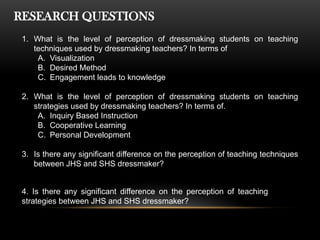
RESEARCH QUESTIONS
1. What is the level of perception of dressmaking students on teaching
techniques used by dressmaking teachers? In terms of
A. Visualization
B. Desired Method
C. Engagement leads to knowledge
2. What is the level of perception of dressmaking students on teaching
strategies used by dressmaking teachers? In terms of.
A. Inquiry Based Instruction
B. Cooperative Learning
C. Personal Development
3. Is there any significant difference on the perception of teaching techniques
between JHS and SHS dressmaker?
4. Is there any significant difference on the perception of teaching
strategies between JHS and SHS dressmaker?
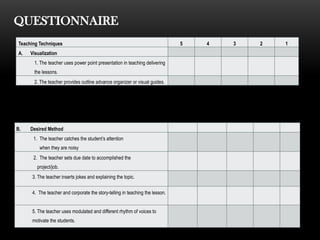
QUESTIONNAIRE
Teaching Techniques 5 4 3 2 1
A. Visualization
1. The teacher uses power point presentation in teaching delivering
the lessons.
2. The teacher provides outline advance organizer or visual guides.
B. Desired Method
1. The teacher catches the student’s attention
when they are noisy
2. The teacher sets due date to accomplished the
project/job.
3. The teacher inserts jokes and explaining the topic.
4. The teacher and corporate the story-telling in teaching the lesson.
5. The teacher uses modulated and different rhythm of voices to
motivate the students.
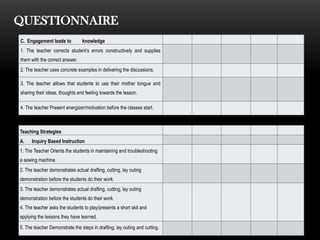
QUESTIONNAIRE
C. Engagement leads to knowledge
1. The teacher corrects student’s errors constructively and supplies
them with the correct answer.
2. The teacher uses concrete examples in delivering the discussions.
3. The teacher allows that students to use their mother tongue and
sharing their ideas, thoughts and feeling towards the lesson.
4. The teacher Present energizer/motivation before the classes start.
Teaching Strategies
A. Inquiry Based Instruction
1. The Teacher Orients the students in maintaining and troubleshooting
a sewing machine.
2. The teacher demonstrates actual drafting, cutting, lay outing
demonstration before the students do their work.
3. The teacher demonstrates actual drafting, cutting, lay outing
demonstration before the students do their work.
4. The teacher asks the students to play/presents a short skit and
applying the lessons they have learned.
5. The teacher Demonstrate the steps in drafting, lay outing and cutting.
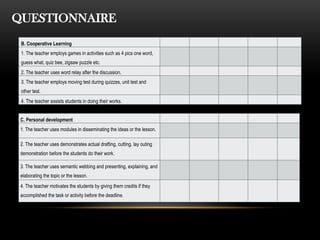
QUESTIONNAIRE
B. Cooperative Learning
1. The teacher employs games in activities such as 4 pics one word,
guess what, quiz bee, zigsaw puzzle etc.
2. The teacher uses word relay after the discussion.
3. The teacher employs moving test during quizzes, unit test and
other test.
4. The teacher assists students in doing their works.
C. Personal development
1. The teacher uses modules in disseminating the ideas or the lesson.
2. The teacher uses demonstrates actual drafting, cutting, lay outing
demonstration before the students do their work.
3. The teacher uses semantic webbing and presenting, explaining, and
elaborating the topic or the lesson.
4. The teacher motivates the students by giving them credits if they
accomplished the task or activity before the deadline.
HYPOTHESIS
Teaching techniques and strategies determines the performance of the teachers on
teaching. This will allow students to give feedback to their teachers, such feedback can improve
student motivation either through position reinforcement or through the improvement gained as
result of technique development.
REVIEW OF RELATED
LETARATURE
Teaching Techniques
Helping students understand in the classroom is one of the primary concerns of
every teacher. Teachers need to motivate students how to learn. According to Schlecty (2015),
students who understand the lesson tend to be more engaged and show different
characteristics such as attraction to do work, persistence in the work despite challenges and
obstacles, and take visible delight in accomplishing their work. In developing student’s
understanding to learn important concepts, teacher may use a variety of teaching strategies
and would work best for his/her students. Wlodkowskie and Giinsberg (2014), research has
shown that no teaching techniques consistently engage all learners. The key is helping
students’ prior knowledge in understanding new concepts.
Visualization. According to Goupvis (2002) States that Visualizing strengthens reading
comprehension skills as students gain more thorough understanding of the text they are
reading by consciously using the words to create mental images. Students who visualize as
they read not only have richer reading experience but can recall what they have read for
longer periods of time.
REVIEW OF RELATED
LETARATURE
Desired Method. According to Gruber (2006) States that desired method can help students
to be knowledgeable, Enthusiastic, Approachable and friendly teaching method are
appropriate and efficient it has to be in relation with the characteristics of the learner and the
type of learning it is supposed to being about.
Engagement leads to knowledge. According to Wang (2004) states that student
engagement sets the stage for developing cognitive and behavioral processes self-regulated
learning techniques or cognitive engagement and greater behavioral engagement within the
classroom.
Teaching Strategies
Akhtar (2017), studied that teaching strategies is the most effective teaching
methods to increase knowledge retention and induce a positive change and environmental
attitudes.
REVIEW OF RELATED
LETARATURE
Inquiry-Based Instruction. According Adams (2004) states that inquiry-based instruction
that can help teachers to conceptualize and to use inquiry in the classroom. With these ideas
in mind, teachers can better evaluate curriculum materials and teaching practice that are
assumed to be inquiry based.
Cooperative Learning. According to Cox (2019) states that teachers use to help their
students process information more quickly by having them work in small groups to
accomplish a common goal. Jacobs (2008) students learn not only the subject matter, but
interpersonal skills and how to work. In terms students are taught skills of communication
Leadership, and conflict management during the early stages of cooperative learning
sessions.
Personal Development. According Ashwin (2009) states that can help students improve
awareness and identity, develop talents and potential, build human capital and facilitate
employability, enhance the quality of life and contribute to the realization of dreams and
aspiration.
THEORITICAL FRAMEWORK
There are many different theories regarding the way people learn, Some of them
are Behaviorism, Cognitivism, Constructivism, Experiential Learning, Humanism and
Pragmatism.
Behaviorism
Behaviorism assumes a learner is essentially passive, and will be shaped
through positive or negative reinforcement. Skinner (2014) believed that behavior is a
function of its consequences. Learners will repeat the desired behavior if positive
reinforcement is given.
Cognitivism
Cognitivism focuses on what happens in the mind such as thinking and
problem-solving. New knowledge is built upon prior knowledge and learners need active
participation in order to learn. Change in behavior are observed, but only as an indication
of what is taking place in the learner’s mind.
THEORITICAL FRAMEWORK
Constructivism
Constructivism is about learning being an active, contextualized process of
constructing knowledge rather than acquiring it. The learner brings past experiences and
cultural factors to a current situation and each person has a different interpretation and
construction of the knowledge process.
Experiential Learning
Experiential Learning is about the learner experiencing things
for themselves and learning from them, Kolb (2015) proposed a four
stage model known as the experiential learning cycle. It is a way by
which people can understand their experience and, as a result, modify
their behavior. It is based on the idea that the more often a learner
reflects on a task, the more often they have the opportunity to model
and define their efforts.
Humanism
Humanism is an approach that believes learning is seen as a personal act to
fulfill potential. Humanists believe that is necessary to study a person as a whole,
particularly as they grow and develop over their lifetime. Rogers (2016) and others
developed the theory of facilitative learning based on a belief that people have a natural
human eagerness to learn and that learning involves changing your own concept of
yourself.
THEORITICAL FRAMEWORK
Pragmatism
John Dewey (2016) believed that formal schooling was falling short of its
potential. He emphasized facilitating learning promoting various activities rather than by
using a traditional teacher-focused method. He believed that learners learn more from
guided experiences than form authoritarian instruction.
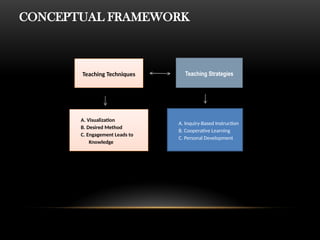
CONCEPTUAL FRAMEWORK
Teaching Techniques Teaching Strategies
A. Visualization
B. Desired Method
C. Engagement Leads to
Knowledge
A. Inquiry-Based Instruction
B. Cooperative Learning
C. Personal Development
SIGNIFICANCE OF THE STUDY
Learning is the aspects of development that connotes modification of
behavior, skills and knowledge that results from practice and experience which bought
for quality education.
The generalization of the present study would be a great contribution to the
vast knowledge in relation with students and teachers. Vital results of this investigation
could of highly significant and beneficial especially to the students.
Teaching techniques and Strategies are very important and can enhance or
prevent teaching effectiveness, but explaining the most successful results depend on
many factors. Every teacher develops particular way of going about the complex task
of teaching.
RESEARCH DESIGN
The researcher made use of quantitative survey research in employing the
researcher made questioner as Data Gathering Instruments. It is quantitative since it
evaluates the level perception of Dressmaking Students on Teaching Technique and
Strategies used by Dressmaking Teachers. It is survey in the sense that if ask
questions to a sample of respondents, using paper questionnaires.
According to Aliga and Gunderson (2002) Quantitative Research is an inquiry into
analysis using mathematically structured methods E.G. in particular statistics. It is
survey methodology will be used to collect data for the purpose of this research as
the task of Saunders (2003) has been very valuable in orienting the decision of data
collection method for this study.
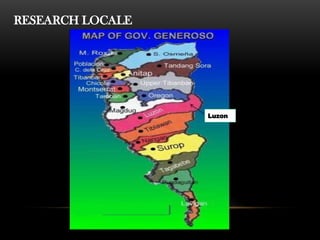
Luzon
RESEARCH LOCALE
POPULATION AND SAMPLE
Since the study assessed the teaching techniques and strategies use by the
dressmaking teachers from Luzon National High School, the point of reference in selecting
the dressmaking students was from the total numbers of dressmaking students. The
researcher serves the universal sampling in determining the total number of dressmaking
students. There were a total of 3 dressmaking teachers whose using the Techniques and
Strategies was rated by Dressmaking students.
The researcher choose the dressmaking students of Luzon National High
School as the respondents of the study because they are more competent in answering
the survey questionnaire and they are know their teachers on how their teacher use the
teaching techniques and strategies. A total of 55 Dressmaking students were involved in
the study. Stratified Random sampling was applied in choosing the number of respondents.
It was used in determining the number of students per teacher whereby 55 students were
tasked to rate each of their Teacher Teaching Techniques and strategies in Teaching.
In Stratified Random Sampling, known as Strata the strata are formed based on
numbers shared attributes or the sample of individuals that exist in a population; the individuals
are randomly selected from the population and placed into a sample. This method of randomly
selecting individuals seeks to select a sample size that is an unbiased Representation of the
population (Steven Nickolas 2019)
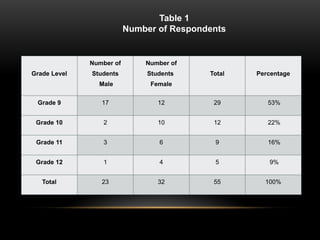
As shown in table 1, there were 3 Dressmaking Teachers out of these Teachers, 55
students or 100 percent served as the subject of the study. There were 29 students or 53%
percent from grade 9 dressmaking students since there were only 1 dressmaking teacher
handling dressmaking course meanwhile, there were 12 students or 22% percent from grade
10 dressmaking students since there were only 1 dressmaking teacher. Likewise, there were 9
or 16% Percent from 11 dressmaking students. There were 5 or 9% percent dressmaking
students since there were only 1 dressmaking teachers. In summary, Stratified random
sampling was used in selecting the number of students as respondents of the study.
The study was delimited to Teachers Teaching Techniques and Strategies. The
teaching Techniques and strategies were Delimited to the following aspects: Visualization,
Desired Method, Engagement leads to knowledge, Inquiry based instruction, Cooperative
Learning and Personal Development. The conduct of this study was done during the school
year 2019-2020.
POPULATION AND SAMPLE
Grade Level
Number of
Students
Male
Number of
Students
Female
Total Percentage
Grade 9 17 12 29 53%
Grade 10 2 10 12 22%
Grade 11 3 6 9 16%
Grade 12 1 4 5 9%
Total 23 32 55 100%
Table 1
Number of Respondents
RESEARCH INSTRUMENT
The researcher used adapted questionnaire in gathering the data. The adapted
questionnaire was from Mary Rose Dancel Castro, Precious D. Andres and Mark-Jhon R.
Prestoza (2018) on Teaching Techniques and Strategies Study the test was designed for use
with respect to basic need satisfaction scale which was used to determine the level of Teaching
Techniques and Strategies.
The improvement of the questionnaire was done in the following manner first, the
questionnaire were presented to teacher Sitoy for the comments and suggestions for
improvement and Refinement. Second, after the instrument and checked and approved. Then
we conduct the survey to the 55 Dressmaking students of Luzon National High School.
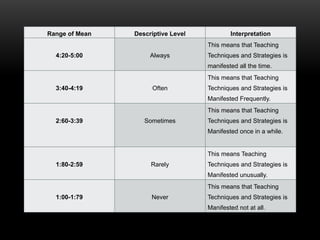
The rating scale used in evaluating the response of the respondents is as follows:
The scoring guide in the analysis of the responses on the teaching techniques and strategies
was categorized into five levels. The scale is as follows:
Range of Mean Descriptive Level Interpretation
4:20-5:00 Always
This means that Teaching
Techniques and Strategies is
manifested all the time.
3:40-4:19 Often
This means that Teaching
Techniques and Strategies is
Manifested Frequently.
2:60-3:39 Sometimes
This means that Teaching
Techniques and Strategies is
Manifested once in a while.
1:80-2:59 Rarely
This means Teaching
Techniques and Strategies is
Manifested unusually.
1:00-1:79 Never
This means that Teaching
Techniques and Strategies is
Manifested not at all.
DATA COLLECTION
In Gathering the data, proper procedures were considered and observed
thoroughly to come up with the desired result or outcome of the study.
The researcher sought permission to conduct the study. The researcher, guided
by Teacher Lilibeth M. Bermoy and Oliver Jouie Sitoy, and then has signed by the Principal
Jonathan S. Del Rosario for Authorization for the study.
After the Approval, the researchers personally approached the advisers of the
students to gathered data for the research. By the approval and the adviser, the researcher
conducted the interview to gather the data from 9 to 12 Dressmaking students that were
enlisted in the said school.
The study was conducted on the following schedules: February 8, 2020 and
February 9, 2020. Out of 120 Dressmaking students there were only 55 survey respondents.
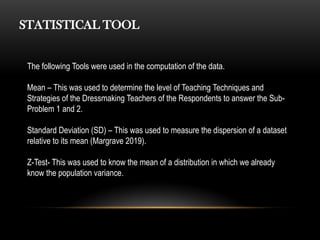
STATISTICAL TOOL
The following Tools were used in the computation of the data.
Mean – This was used to determine the level of Teaching Techniques and
Strategies of the Dressmaking Teachers of the Respondents to answer the Sub-
Problem 1 and 2.
Standard Deviation (SD) – This was used to measure the dispersion of a dataset
relative to its mean (Margrave 2019).
Z-Test- This was used to know the mean of a distribution in which we already
know the population variance.
ETHICAL CONSIDERATION
Last February 6, 2020, we conducted our survey to the grade 9 students, grade
10, grade 11, and grade 12 dressmaking students of LNHS. We are doing this study in
order to know how well the teacher teaches their students. Also, to our two subjects w/c
practical and 3 I’s. We assure that all the information we gathered are safe and will not be
published to the public. The result of these is confidential and easy the researchers and the
teachers who are involved in the subject will know about it.
Moreover, our curriculum and institution required us to do these and it is one of
our subjects. Not just that, but it is also our training ground in preparation to college. Lastly,
each member will take responsibility the risks of the study.
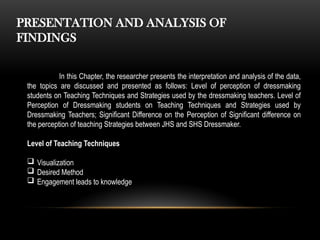
PRESENTATION AND ANALYSIS OF
FINDINGS
In this Chapter, the researcher presents the interpretation and analysis of the data,
the topics are discussed and presented as follows: Level of perception of dressmaking
students on Teaching Techniques and Strategies used by the dressmaking teachers. Level of
Perception of Dressmaking students on Teaching Techniques and Strategies used by
Dressmaking Teachers; Significant Difference on the Perception of Significant difference on
the perception of teaching Strategies between JHS and SHS Dressmaker.
Level of Teaching Techniques
 Visualization
 Desired Method
 Engagement leads to knowledge
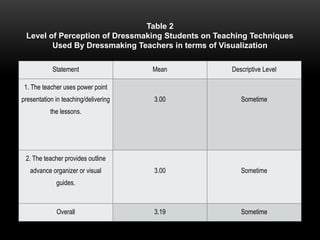
Statement Mean Descriptive Level
1. The teacher uses power point
presentation in teaching/delivering
the lessons.
3.00 Sometime
2. The teacher provides outline
advance organizer or visual
guides.
3.00 Sometime
Overall 3.19 Sometime
Table 2
Level of Perception of Dressmaking Students on Teaching Techniques
Used By Dressmaking Teachers in terms of Visualization
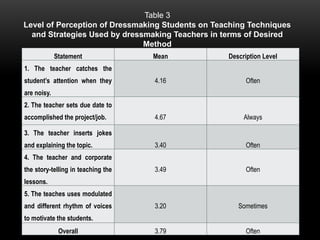
Statement Mean Description Level
1. The teacher catches the
student’s attention when they
are noisy.
4.16 Often
2. The teacher sets due date to
accomplished the project/job. 4.67 Always
3. The teacher inserts jokes
and explaining the topic. 3.40 Often
4. The teacher and corporate
the story-telling in teaching the
lessons.
3.49 Often
5. The teaches uses modulated
and different rhythm of voices
to motivate the students.
3.20 Sometimes
Overall 3.79 Often
Table 3
Level of Perception of Dressmaking Students on Teaching Techniques
and Strategies Used by dressmaking Teachers in terms of Desired
Method
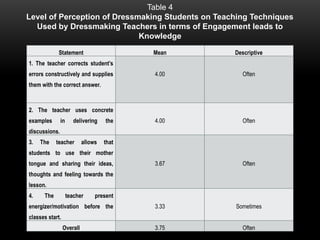
Statement Mean Descriptive
1. The teacher corrects student’s
errors constructively and supplies
them with the correct answer.
4.00 Often
2. The teacher uses concrete
examples in delivering the
discussions.
4.00 Often
3. The teacher allows that
students to use their mother
tongue and sharing their ideas,
thoughts and feeling towards the
lesson.
3.67 Often
4. The teacher present
energizer/motivation before the
classes start.
3.33 Sometimes
Overall 3.75 Often
Table 4
Level of Perception of Dressmaking Students on Teaching Techniques
Used by Dressmaking Teachers in terms of Engagement leads to
Knowledge
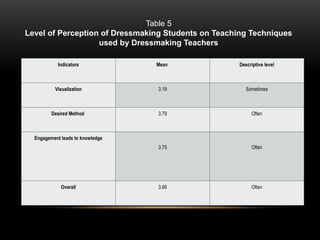
Indicators Mean Descriptive level
Visualization 3.19 Sometimes
Desired Method 3.79 Often
Engagement leads to knowledge
3.75 Often
Overall 3.66 Often
Table 5
Level of Perception of Dressmaking Students on Teaching Techniques
used by Dressmaking Teachers
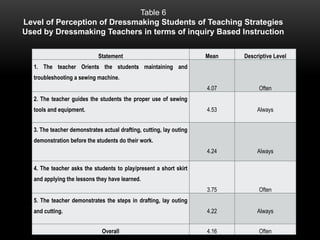
Statement Mean Descriptive Level
1. The teacher Orients the students maintaining and
troubleshooting a sewing machine.
4.07 Often
2. The teacher guides the students the proper use of sewing
tools and equipment. 4.53 Always
3. The teacher demonstrates actual drafting, cutting, lay outing
demonstration before the students do their work.
4.24 Always
4. The teacher asks the students to play/present a short skirt
and applying the lessons they have learned.
3.75 Often
5. The teacher demonstrates the steps in drafting, lay outing
and cutting. 4.22 Always
Overall 4.16 Often
Table 6
Level of Perception of Dressmaking Students of Teaching Strategies
Used by Dressmaking Teachers in terms of inquiry Based Instruction
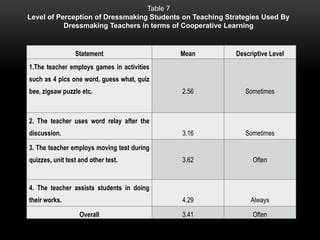
Statement Mean Descriptive Level
1.The teacher employs games in activities
such as 4 pics one word, guess what, quiz
bee, zigsaw puzzle etc. 2.56 Sometimes
2. The teacher uses word relay after the
discussion. 3.16 Sometimes
3. The teacher employs moving test during
quizzes, unit test and other test. 3.62 Often
4. The teacher assists students in doing
their works. 4.29 Always
Overall 3.41 Often
Table 7
Level of Perception of Dressmaking Students on Teaching Strategies Used By
Dressmaking Teachers in terms of Cooperative Learning
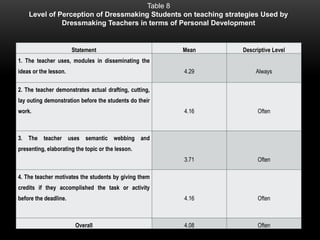
Statement Mean Descriptive Level
1. The teacher uses, modules in disseminating the
ideas or the lesson. 4.29 Always
2. The teacher demonstrates actual drafting, cutting,
lay outing demonstration before the students do their
work. 4.16 Often
3. The teacher uses semantic webbing and
presenting, elaborating the topic or the lesson.
3.71 Often
4. The teacher motivates the students by giving them
credits if they accomplished the task or activity
before the deadline. 4.16 Often
Overall 4.08 Often
Table 8
Level of Perception of Dressmaking Students on teaching strategies Used by
Dressmaking Teachers in terms of Personal Development
Indicators Mean Descriptive Level
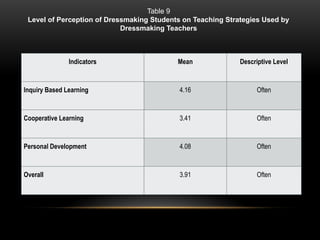
Inquiry Based Learning 4.16 Often
Cooperative Learning 3.41 Often
Personal Development 4.08 Often
Overall 3.91 Often
Table 9
Level of Perception of Dressmaking Students on Teaching Strategies Used by
Dressmaking Teachers
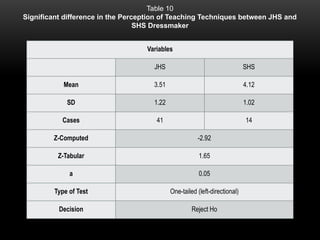
Variables
JHS SHS
Mean 3.51 4.12
SD 1.22 1.02
Cases 41 14
Z-Computed -2.92
Z-Tabular 1.65
a 0.05
Type of Test One-tailed (left-directional)
Decision Reject Ho
Table 10
Significant difference in the Perception of Teaching Techniques between JHS and
SHS Dressmaker
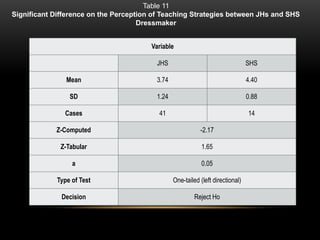
Variable
JHS SHS
Mean 3.74 4.40
SD 1.24 0.88
Cases 41 14
Z-Computed -2.17
Z-Tabular 1.65
a 0.05
Type of Test One-tailed (left directional)
Decision Reject Ho
Table 11
Significant Difference on the Perception of Teaching Strategies between JHs and SHS
Dressmaker
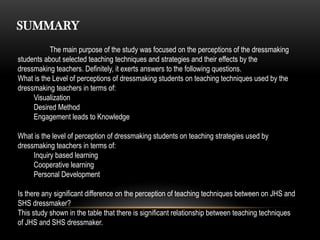
SUMMARY
The main purpose of the study was focused on the perceptions of the dressmaking
students about selected teaching techniques and strategies and their effects by the
dressmaking teachers. Definitely, it exerts answers to the following questions.
What is the Level of perceptions of dressmaking students on teaching techniques used by the
dressmaking teachers in terms of:
Visualization
Desired Method
Engagement leads to Knowledge
What is the level of perception of dressmaking students on teaching strategies used by
dressmaking teachers in terms of:
Inquiry based learning
Cooperative learning
Personal Development
Is there any significant difference on the perception of teaching techniques between on JHS and
SHS dressmaker?
This study shown in the table that there is significant relationship between teaching techniques
of JHS and SHS dressmaker.
The study made use of the qualitative survey research employs the research
made questionnaire as data gathering instruments.
Is there any significant difference on the perception of teaching strategies between JHS and
SHS dressmaker?
This study shown on the table 3 that there is significant relationship between teaching
strategies of JHS and SHS dressmaker
The study made use of the quantitative survey research employing the instrument.
This study was conducted among the 55 students of Luzon National High School 29 students
of Grade 9, 12 students from Grade 10, 9 students from grade 11, and 5 students from grade
12 during school year 2019-2020.
The following were the findings of the study.
The overall mean rating of teaching techniques was 3.66. The main obtained for the
indicators were 3.19 for the desired Method; 3.79 for engagement lead to knowledge 3.75.
This means that teaching techniques in manifested oftentimes.
The overall mean rating of teaching strategies was 3.91. The mean ratings of indicators were
4.16 for need for cooperative learning 3.41 for need for personal development 4.08 this
means that teaching strategies of student is manifested oftentimes.
The significant difference on the perception of teaching techniques between
JHS and SHS dressmaker
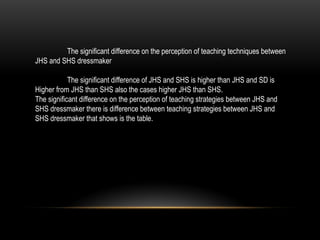
The significant difference of JHS and SHS is higher than JHS and SD is
Higher from JHS than SHS also the cases higher JHS than SHS.
The significant difference on the perception of teaching strategies between JHS and
SHS dressmaker there is difference between teaching strategies between JHS and
SHS dressmaker that shows is the table.
Conclusion
Based on the findings of the study, the following conclusions stated
below:
1. There is an often level of teacher teaching techniques in terms
Visualization, desired Method and Engagement leads to Knowledge.
2. There is an often level of teachers teaching strategies in terms of inquiry-
based instruction, cooperative learning and Personal Development
3. There is a significant difference on the perception of teaching techniques
between JHS and SHS dressmaker.
4. This shows that the JHS and SHS teachers have different ways in teaching
result the student well practice and become competent.
Recommendation
Based on the findings and conclusions of the study
recommendation are given
1. The school administration should also give the dressmaking teachers
the opportunity to attend conference to keep them updated and they can
get more information about dressmaking subject/specialization.
2. The teachers should also give the students a different activities,
teaching techniques and teaching strategies, in order to mountain the
interest of the students in order for preparing their assessment and
individual successful
3. The student should study their lesson, and encouraged their self, so that
they can do their job will, also they should give a high education in the
specialization to be prepared in the future.
THANK
YOU

POWER POINT RESEARCH PAPER FOR SHS STUDENTS

  • 1.
    Perception of LNHS DressmakingStudents on Teaching Techniques and Strategies Use by Dressmaking Teachers
  • 2.
    RATIONALE We come upthis study because of the following problems; Students Failure Academic Unpreparedness Fear Laziness Apathy
  • 3.
    RESEARCH QUESTIONS 1. Whatis the level of perception of dressmaking students on teaching techniques used by dressmaking teachers? In terms of A. Visualization B. Desired Method C. Engagement leads to knowledge 2. What is the level of perception of dressmaking students on teaching strategies used by dressmaking teachers? In terms of. A. Inquiry Based Instruction B. Cooperative Learning C. Personal Development 3. Is there any significant difference on the perception of teaching techniques between JHS and SHS dressmaker? 4. Is there any significant difference on the perception of teaching strategies between JHS and SHS dressmaker?
  • 4.
    QUESTIONNAIRE Teaching Techniques 54 3 2 1 A. Visualization 1. The teacher uses power point presentation in teaching delivering the lessons. 2. The teacher provides outline advance organizer or visual guides. B. Desired Method 1. The teacher catches the student’s attention when they are noisy 2. The teacher sets due date to accomplished the project/job. 3. The teacher inserts jokes and explaining the topic. 4. The teacher and corporate the story-telling in teaching the lesson. 5. The teacher uses modulated and different rhythm of voices to motivate the students.
  • 5.
    QUESTIONNAIRE C. Engagement leadsto knowledge 1. The teacher corrects student’s errors constructively and supplies them with the correct answer. 2. The teacher uses concrete examples in delivering the discussions. 3. The teacher allows that students to use their mother tongue and sharing their ideas, thoughts and feeling towards the lesson. 4. The teacher Present energizer/motivation before the classes start. Teaching Strategies A. Inquiry Based Instruction 1. The Teacher Orients the students in maintaining and troubleshooting a sewing machine. 2. The teacher demonstrates actual drafting, cutting, lay outing demonstration before the students do their work. 3. The teacher demonstrates actual drafting, cutting, lay outing demonstration before the students do their work. 4. The teacher asks the students to play/presents a short skit and applying the lessons they have learned. 5. The teacher Demonstrate the steps in drafting, lay outing and cutting.
  • 6.
    QUESTIONNAIRE B. Cooperative Learning 1.The teacher employs games in activities such as 4 pics one word, guess what, quiz bee, zigsaw puzzle etc. 2. The teacher uses word relay after the discussion. 3. The teacher employs moving test during quizzes, unit test and other test. 4. The teacher assists students in doing their works. C. Personal development 1. The teacher uses modules in disseminating the ideas or the lesson. 2. The teacher uses demonstrates actual drafting, cutting, lay outing demonstration before the students do their work. 3. The teacher uses semantic webbing and presenting, explaining, and elaborating the topic or the lesson. 4. The teacher motivates the students by giving them credits if they accomplished the task or activity before the deadline.
  • 7.
    HYPOTHESIS Teaching techniques andstrategies determines the performance of the teachers on teaching. This will allow students to give feedback to their teachers, such feedback can improve student motivation either through position reinforcement or through the improvement gained as result of technique development.
  • 8.
    REVIEW OF RELATED LETARATURE TeachingTechniques Helping students understand in the classroom is one of the primary concerns of every teacher. Teachers need to motivate students how to learn. According to Schlecty (2015), students who understand the lesson tend to be more engaged and show different characteristics such as attraction to do work, persistence in the work despite challenges and obstacles, and take visible delight in accomplishing their work. In developing student’s understanding to learn important concepts, teacher may use a variety of teaching strategies and would work best for his/her students. Wlodkowskie and Giinsberg (2014), research has shown that no teaching techniques consistently engage all learners. The key is helping students’ prior knowledge in understanding new concepts. Visualization. According to Goupvis (2002) States that Visualizing strengthens reading comprehension skills as students gain more thorough understanding of the text they are reading by consciously using the words to create mental images. Students who visualize as they read not only have richer reading experience but can recall what they have read for longer periods of time.
  • 9.
    REVIEW OF RELATED LETARATURE DesiredMethod. According to Gruber (2006) States that desired method can help students to be knowledgeable, Enthusiastic, Approachable and friendly teaching method are appropriate and efficient it has to be in relation with the characteristics of the learner and the type of learning it is supposed to being about. Engagement leads to knowledge. According to Wang (2004) states that student engagement sets the stage for developing cognitive and behavioral processes self-regulated learning techniques or cognitive engagement and greater behavioral engagement within the classroom. Teaching Strategies Akhtar (2017), studied that teaching strategies is the most effective teaching methods to increase knowledge retention and induce a positive change and environmental attitudes.
  • 10.
    REVIEW OF RELATED LETARATURE Inquiry-BasedInstruction. According Adams (2004) states that inquiry-based instruction that can help teachers to conceptualize and to use inquiry in the classroom. With these ideas in mind, teachers can better evaluate curriculum materials and teaching practice that are assumed to be inquiry based. Cooperative Learning. According to Cox (2019) states that teachers use to help their students process information more quickly by having them work in small groups to accomplish a common goal. Jacobs (2008) students learn not only the subject matter, but interpersonal skills and how to work. In terms students are taught skills of communication Leadership, and conflict management during the early stages of cooperative learning sessions. Personal Development. According Ashwin (2009) states that can help students improve awareness and identity, develop talents and potential, build human capital and facilitate employability, enhance the quality of life and contribute to the realization of dreams and aspiration.
  • 11.
    THEORITICAL FRAMEWORK There aremany different theories regarding the way people learn, Some of them are Behaviorism, Cognitivism, Constructivism, Experiential Learning, Humanism and Pragmatism. Behaviorism Behaviorism assumes a learner is essentially passive, and will be shaped through positive or negative reinforcement. Skinner (2014) believed that behavior is a function of its consequences. Learners will repeat the desired behavior if positive reinforcement is given. Cognitivism Cognitivism focuses on what happens in the mind such as thinking and problem-solving. New knowledge is built upon prior knowledge and learners need active participation in order to learn. Change in behavior are observed, but only as an indication of what is taking place in the learner’s mind.
  • 12.
    THEORITICAL FRAMEWORK Constructivism Constructivism isabout learning being an active, contextualized process of constructing knowledge rather than acquiring it. The learner brings past experiences and cultural factors to a current situation and each person has a different interpretation and construction of the knowledge process. Experiential Learning Experiential Learning is about the learner experiencing things for themselves and learning from them, Kolb (2015) proposed a four stage model known as the experiential learning cycle. It is a way by which people can understand their experience and, as a result, modify their behavior. It is based on the idea that the more often a learner reflects on a task, the more often they have the opportunity to model and define their efforts.
  • 13.
    Humanism Humanism is anapproach that believes learning is seen as a personal act to fulfill potential. Humanists believe that is necessary to study a person as a whole, particularly as they grow and develop over their lifetime. Rogers (2016) and others developed the theory of facilitative learning based on a belief that people have a natural human eagerness to learn and that learning involves changing your own concept of yourself. THEORITICAL FRAMEWORK Pragmatism John Dewey (2016) believed that formal schooling was falling short of its potential. He emphasized facilitating learning promoting various activities rather than by using a traditional teacher-focused method. He believed that learners learn more from guided experiences than form authoritarian instruction.
  • 14.
    CONCEPTUAL FRAMEWORK Teaching TechniquesTeaching Strategies A. Visualization B. Desired Method C. Engagement Leads to Knowledge A. Inquiry-Based Instruction B. Cooperative Learning C. Personal Development
  • 15.
    SIGNIFICANCE OF THESTUDY Learning is the aspects of development that connotes modification of behavior, skills and knowledge that results from practice and experience which bought for quality education. The generalization of the present study would be a great contribution to the vast knowledge in relation with students and teachers. Vital results of this investigation could of highly significant and beneficial especially to the students. Teaching techniques and Strategies are very important and can enhance or prevent teaching effectiveness, but explaining the most successful results depend on many factors. Every teacher develops particular way of going about the complex task of teaching.
  • 16.
    RESEARCH DESIGN The researchermade use of quantitative survey research in employing the researcher made questioner as Data Gathering Instruments. It is quantitative since it evaluates the level perception of Dressmaking Students on Teaching Technique and Strategies used by Dressmaking Teachers. It is survey in the sense that if ask questions to a sample of respondents, using paper questionnaires. According to Aliga and Gunderson (2002) Quantitative Research is an inquiry into analysis using mathematically structured methods E.G. in particular statistics. It is survey methodology will be used to collect data for the purpose of this research as the task of Saunders (2003) has been very valuable in orienting the decision of data collection method for this study.
  • 17.
  • 18.
    POPULATION AND SAMPLE Sincethe study assessed the teaching techniques and strategies use by the dressmaking teachers from Luzon National High School, the point of reference in selecting the dressmaking students was from the total numbers of dressmaking students. The researcher serves the universal sampling in determining the total number of dressmaking students. There were a total of 3 dressmaking teachers whose using the Techniques and Strategies was rated by Dressmaking students. The researcher choose the dressmaking students of Luzon National High School as the respondents of the study because they are more competent in answering the survey questionnaire and they are know their teachers on how their teacher use the teaching techniques and strategies. A total of 55 Dressmaking students were involved in the study. Stratified Random sampling was applied in choosing the number of respondents. It was used in determining the number of students per teacher whereby 55 students were tasked to rate each of their Teacher Teaching Techniques and strategies in Teaching.
  • 19.
    In Stratified RandomSampling, known as Strata the strata are formed based on numbers shared attributes or the sample of individuals that exist in a population; the individuals are randomly selected from the population and placed into a sample. This method of randomly selecting individuals seeks to select a sample size that is an unbiased Representation of the population (Steven Nickolas 2019) As shown in table 1, there were 3 Dressmaking Teachers out of these Teachers, 55 students or 100 percent served as the subject of the study. There were 29 students or 53% percent from grade 9 dressmaking students since there were only 1 dressmaking teacher handling dressmaking course meanwhile, there were 12 students or 22% percent from grade 10 dressmaking students since there were only 1 dressmaking teacher. Likewise, there were 9 or 16% Percent from 11 dressmaking students. There were 5 or 9% percent dressmaking students since there were only 1 dressmaking teachers. In summary, Stratified random sampling was used in selecting the number of students as respondents of the study. The study was delimited to Teachers Teaching Techniques and Strategies. The teaching Techniques and strategies were Delimited to the following aspects: Visualization, Desired Method, Engagement leads to knowledge, Inquiry based instruction, Cooperative Learning and Personal Development. The conduct of this study was done during the school year 2019-2020. POPULATION AND SAMPLE
  • 20.
    Grade Level Number of Students Male Numberof Students Female Total Percentage Grade 9 17 12 29 53% Grade 10 2 10 12 22% Grade 11 3 6 9 16% Grade 12 1 4 5 9% Total 23 32 55 100% Table 1 Number of Respondents
  • 21.
    RESEARCH INSTRUMENT The researcherused adapted questionnaire in gathering the data. The adapted questionnaire was from Mary Rose Dancel Castro, Precious D. Andres and Mark-Jhon R. Prestoza (2018) on Teaching Techniques and Strategies Study the test was designed for use with respect to basic need satisfaction scale which was used to determine the level of Teaching Techniques and Strategies. The improvement of the questionnaire was done in the following manner first, the questionnaire were presented to teacher Sitoy for the comments and suggestions for improvement and Refinement. Second, after the instrument and checked and approved. Then we conduct the survey to the 55 Dressmaking students of Luzon National High School. The rating scale used in evaluating the response of the respondents is as follows: The scoring guide in the analysis of the responses on the teaching techniques and strategies was categorized into five levels. The scale is as follows:
  • 22.
    Range of MeanDescriptive Level Interpretation 4:20-5:00 Always This means that Teaching Techniques and Strategies is manifested all the time. 3:40-4:19 Often This means that Teaching Techniques and Strategies is Manifested Frequently. 2:60-3:39 Sometimes This means that Teaching Techniques and Strategies is Manifested once in a while. 1:80-2:59 Rarely This means Teaching Techniques and Strategies is Manifested unusually. 1:00-1:79 Never This means that Teaching Techniques and Strategies is Manifested not at all.
  • 23.
    DATA COLLECTION In Gatheringthe data, proper procedures were considered and observed thoroughly to come up with the desired result or outcome of the study. The researcher sought permission to conduct the study. The researcher, guided by Teacher Lilibeth M. Bermoy and Oliver Jouie Sitoy, and then has signed by the Principal Jonathan S. Del Rosario for Authorization for the study. After the Approval, the researchers personally approached the advisers of the students to gathered data for the research. By the approval and the adviser, the researcher conducted the interview to gather the data from 9 to 12 Dressmaking students that were enlisted in the said school. The study was conducted on the following schedules: February 8, 2020 and February 9, 2020. Out of 120 Dressmaking students there were only 55 survey respondents.
  • 24.
    STATISTICAL TOOL The followingTools were used in the computation of the data. Mean – This was used to determine the level of Teaching Techniques and Strategies of the Dressmaking Teachers of the Respondents to answer the Sub- Problem 1 and 2. Standard Deviation (SD) – This was used to measure the dispersion of a dataset relative to its mean (Margrave 2019). Z-Test- This was used to know the mean of a distribution in which we already know the population variance.
  • 25.
    ETHICAL CONSIDERATION Last February6, 2020, we conducted our survey to the grade 9 students, grade 10, grade 11, and grade 12 dressmaking students of LNHS. We are doing this study in order to know how well the teacher teaches their students. Also, to our two subjects w/c practical and 3 I’s. We assure that all the information we gathered are safe and will not be published to the public. The result of these is confidential and easy the researchers and the teachers who are involved in the subject will know about it. Moreover, our curriculum and institution required us to do these and it is one of our subjects. Not just that, but it is also our training ground in preparation to college. Lastly, each member will take responsibility the risks of the study.
  • 26.
    PRESENTATION AND ANALYSISOF FINDINGS In this Chapter, the researcher presents the interpretation and analysis of the data, the topics are discussed and presented as follows: Level of perception of dressmaking students on Teaching Techniques and Strategies used by the dressmaking teachers. Level of Perception of Dressmaking students on Teaching Techniques and Strategies used by Dressmaking Teachers; Significant Difference on the Perception of Significant difference on the perception of teaching Strategies between JHS and SHS Dressmaker. Level of Teaching Techniques  Visualization  Desired Method  Engagement leads to knowledge
  • 27.
    Statement Mean DescriptiveLevel 1. The teacher uses power point presentation in teaching/delivering the lessons. 3.00 Sometime 2. The teacher provides outline advance organizer or visual guides. 3.00 Sometime Overall 3.19 Sometime Table 2 Level of Perception of Dressmaking Students on Teaching Techniques Used By Dressmaking Teachers in terms of Visualization
  • 28.
    Statement Mean DescriptionLevel 1. The teacher catches the student’s attention when they are noisy. 4.16 Often 2. The teacher sets due date to accomplished the project/job. 4.67 Always 3. The teacher inserts jokes and explaining the topic. 3.40 Often 4. The teacher and corporate the story-telling in teaching the lessons. 3.49 Often 5. The teaches uses modulated and different rhythm of voices to motivate the students. 3.20 Sometimes Overall 3.79 Often Table 3 Level of Perception of Dressmaking Students on Teaching Techniques and Strategies Used by dressmaking Teachers in terms of Desired Method
  • 29.
    Statement Mean Descriptive 1.The teacher corrects student’s errors constructively and supplies them with the correct answer. 4.00 Often 2. The teacher uses concrete examples in delivering the discussions. 4.00 Often 3. The teacher allows that students to use their mother tongue and sharing their ideas, thoughts and feeling towards the lesson. 3.67 Often 4. The teacher present energizer/motivation before the classes start. 3.33 Sometimes Overall 3.75 Often Table 4 Level of Perception of Dressmaking Students on Teaching Techniques Used by Dressmaking Teachers in terms of Engagement leads to Knowledge
  • 30.
    Indicators Mean Descriptivelevel Visualization 3.19 Sometimes Desired Method 3.79 Often Engagement leads to knowledge 3.75 Often Overall 3.66 Often Table 5 Level of Perception of Dressmaking Students on Teaching Techniques used by Dressmaking Teachers
  • 31.
    Statement Mean DescriptiveLevel 1. The teacher Orients the students maintaining and troubleshooting a sewing machine. 4.07 Often 2. The teacher guides the students the proper use of sewing tools and equipment. 4.53 Always 3. The teacher demonstrates actual drafting, cutting, lay outing demonstration before the students do their work. 4.24 Always 4. The teacher asks the students to play/present a short skirt and applying the lessons they have learned. 3.75 Often 5. The teacher demonstrates the steps in drafting, lay outing and cutting. 4.22 Always Overall 4.16 Often Table 6 Level of Perception of Dressmaking Students of Teaching Strategies Used by Dressmaking Teachers in terms of inquiry Based Instruction
  • 32.
    Statement Mean DescriptiveLevel 1.The teacher employs games in activities such as 4 pics one word, guess what, quiz bee, zigsaw puzzle etc. 2.56 Sometimes 2. The teacher uses word relay after the discussion. 3.16 Sometimes 3. The teacher employs moving test during quizzes, unit test and other test. 3.62 Often 4. The teacher assists students in doing their works. 4.29 Always Overall 3.41 Often Table 7 Level of Perception of Dressmaking Students on Teaching Strategies Used By Dressmaking Teachers in terms of Cooperative Learning
  • 33.
    Statement Mean DescriptiveLevel 1. The teacher uses, modules in disseminating the ideas or the lesson. 4.29 Always 2. The teacher demonstrates actual drafting, cutting, lay outing demonstration before the students do their work. 4.16 Often 3. The teacher uses semantic webbing and presenting, elaborating the topic or the lesson. 3.71 Often 4. The teacher motivates the students by giving them credits if they accomplished the task or activity before the deadline. 4.16 Often Overall 4.08 Often Table 8 Level of Perception of Dressmaking Students on teaching strategies Used by Dressmaking Teachers in terms of Personal Development
  • 34.
    Indicators Mean DescriptiveLevel Inquiry Based Learning 4.16 Often Cooperative Learning 3.41 Often Personal Development 4.08 Often Overall 3.91 Often Table 9 Level of Perception of Dressmaking Students on Teaching Strategies Used by Dressmaking Teachers
  • 35.
    Variables JHS SHS Mean 3.514.12 SD 1.22 1.02 Cases 41 14 Z-Computed -2.92 Z-Tabular 1.65 a 0.05 Type of Test One-tailed (left-directional) Decision Reject Ho Table 10 Significant difference in the Perception of Teaching Techniques between JHS and SHS Dressmaker
  • 36.
    Variable JHS SHS Mean 3.744.40 SD 1.24 0.88 Cases 41 14 Z-Computed -2.17 Z-Tabular 1.65 a 0.05 Type of Test One-tailed (left directional) Decision Reject Ho Table 11 Significant Difference on the Perception of Teaching Strategies between JHs and SHS Dressmaker
  • 37.
    SUMMARY The main purposeof the study was focused on the perceptions of the dressmaking students about selected teaching techniques and strategies and their effects by the dressmaking teachers. Definitely, it exerts answers to the following questions. What is the Level of perceptions of dressmaking students on teaching techniques used by the dressmaking teachers in terms of: Visualization Desired Method Engagement leads to Knowledge What is the level of perception of dressmaking students on teaching strategies used by dressmaking teachers in terms of: Inquiry based learning Cooperative learning Personal Development Is there any significant difference on the perception of teaching techniques between on JHS and SHS dressmaker? This study shown in the table that there is significant relationship between teaching techniques of JHS and SHS dressmaker.
  • 38.
    The study madeuse of the qualitative survey research employs the research made questionnaire as data gathering instruments. Is there any significant difference on the perception of teaching strategies between JHS and SHS dressmaker? This study shown on the table 3 that there is significant relationship between teaching strategies of JHS and SHS dressmaker The study made use of the quantitative survey research employing the instrument. This study was conducted among the 55 students of Luzon National High School 29 students of Grade 9, 12 students from Grade 10, 9 students from grade 11, and 5 students from grade 12 during school year 2019-2020. The following were the findings of the study. The overall mean rating of teaching techniques was 3.66. The main obtained for the indicators were 3.19 for the desired Method; 3.79 for engagement lead to knowledge 3.75. This means that teaching techniques in manifested oftentimes. The overall mean rating of teaching strategies was 3.91. The mean ratings of indicators were 4.16 for need for cooperative learning 3.41 for need for personal development 4.08 this means that teaching strategies of student is manifested oftentimes.
  • 39.
    The significant differenceon the perception of teaching techniques between JHS and SHS dressmaker The significant difference of JHS and SHS is higher than JHS and SD is Higher from JHS than SHS also the cases higher JHS than SHS. The significant difference on the perception of teaching strategies between JHS and SHS dressmaker there is difference between teaching strategies between JHS and SHS dressmaker that shows is the table.
  • 40.
    Conclusion Based on thefindings of the study, the following conclusions stated below: 1. There is an often level of teacher teaching techniques in terms Visualization, desired Method and Engagement leads to Knowledge. 2. There is an often level of teachers teaching strategies in terms of inquiry- based instruction, cooperative learning and Personal Development 3. There is a significant difference on the perception of teaching techniques between JHS and SHS dressmaker. 4. This shows that the JHS and SHS teachers have different ways in teaching result the student well practice and become competent.
  • 41.
    Recommendation Based on thefindings and conclusions of the study recommendation are given 1. The school administration should also give the dressmaking teachers the opportunity to attend conference to keep them updated and they can get more information about dressmaking subject/specialization. 2. The teachers should also give the students a different activities, teaching techniques and teaching strategies, in order to mountain the interest of the students in order for preparing their assessment and individual successful 3. The student should study their lesson, and encouraged their self, so that they can do their job will, also they should give a high education in the specialization to be prepared in the future.
  • 42.