



Max Planck
Content Bibliography Work life Physic Theory
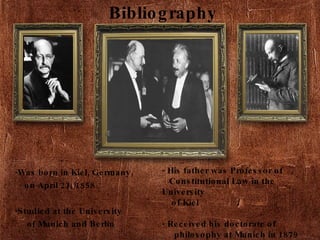
Bibliography -Was born in Kiel, Germany,  on April 23, 1858 -Studied at the University  of Munich and Berlin -  His father was Professor of  Constitutional Law in the University  of Kiel  - R eceived his doctorate of  philosophy at Munich in 1879
Work life Planck's earliest work was on the subject of thermodynamics   He published papers on entropy, on thermoelectricity and on the theory of dilute solutions . From these studies he was able to deduce the relationship between the energy and the frequency of radiation .
W ork Life Experimental  observations was on the wavelength  distribution  of the energy emitted by a black body. He came  up with idea that the energy emitted by a  resonator  could only take on discrete values or quanta . The energy  for a resonator of frequency  v  is  hv  where  h   is a universal  constant, now called  Planck's   constant .
W ork Life So basically , Planck was known for Planck’s constant, Planck’s postulate and Planck’s law of black body radiation He got  a Nobel prize in 1918 He died  on October 4 th  in the year 1947 when he  was   89
Max Planck’s Works and Discoveries As Planck w as conducting an experiment, he found that experimental observations on the wavelength distribution of the energy emitted by a black body as a function of temperature were inconsistent with the predictions of classical physics .  However, he was able to deduce the relationship between the energy and the frequency of radiation .  In 1900, he announced his derivation of the relationship that the energy emitted by a resonator could only take on discrete values or quanta .  The energy for a resonator of frequency  v  is  hv  where  h  is a universal constant, now called Planck's constant .
Planck’s Works -Planck’s law of Black-body radiation -Planck’s Constant -Planck Postulate
What is Black body? A  black body  is an  object  that absorbs all  electromagnetic radiation  that falls on it .  No electromagnetic radiation passes through it and none is  reflected.  Because no light  ( visible electromagnetic radiation )  is reflected or transmitted. A black body at temperature  T  emits exactly the same wavelengths and intensities which would be present in an environment at equilibrium at temperature  T , and which would be absorbed by the body .  Since the radiation in such an environment has a spectrum that depends only on temperature, the temperature of the object is directly related to the wavelengths of the light that it emits .  The light emitted by a black body is called  black-body radiation .
Pl anc k’s law   of Bla ck-body  radiation Planck's law   describes the  spectral radiance  of  electromagnetic radiation  at all  wavelengths  from a black body at  temperature   T . As a function of  frequency   ν , Planck's law is written as:                      This function represents the emitted power per unit area of emitting surface, per unit solid angle, and per unit frequency .  where,                is the amount of  energy  per unit  surface area  per unit  time  per unit  solid angle  emitted in the frequency range between ν and ν+dν by a black body at temperature  T ;        is  Planck's constant ;       is the  speed of light ; and        is  Boltzmann's constant.
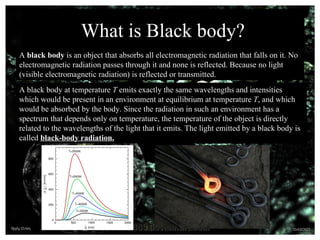
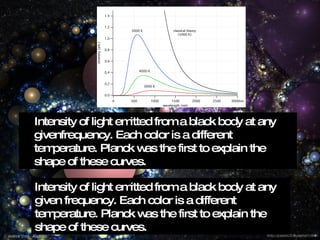
Intensity of light emitted from a  black body  at any givenfrequency .  Each color is a different temperature .  Planck was the first to explain the shape of these curves .  Intensity of light emitted from a  black body  at any given frequency .  Each color is a different temperature .  Planck was the first to explain the shape of these curves .
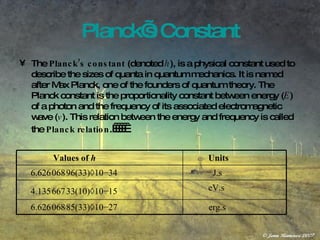
Planck’s Constant The  Planck ’s  constant  ( denoted  h ) , is a  physical constant  used to describe the sizes of  quanta  in  quantum mechanics.  It is named after  Max Planck , one of the founders of quantum theory .  The Planck constant is the  proportionality constant  between  energy ( E )  of a  photon  and the  frequency  of its associated  electromagnetic wave ( ν ).  This relation between the energy and frequency is called the  Planck relation .               erg.s 6.626   068   85 ( 33 ) ×10 −27   eV.s 4.135   667   33 ( 10 ) ×10 −15   J.s 6.626   068   96 ( 33 ) ×10 −34 Units Values of  h
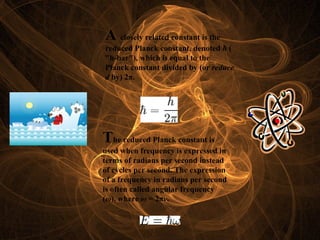
A  closely related constant is the  reduced Planck constant , denoted  ħ  ("h-bar") , which is equal to the Planck constant divided by  ( or  reduced  by )  2 π. T he reduced Planck constant is used when frequency is expressed in terms of  radians  per second instead of  cycles  per second .  The expression of a frequency in radians per second is often called  angular frequency ( ω ) , where  ω   =  2 π ν .
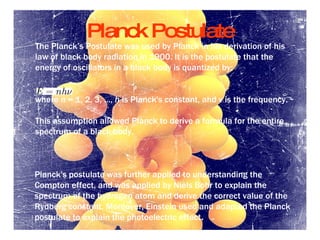
Planck Postulate The  Planck ’s  Postulate  was used by  Planck  in his derivation of  his law of black body radiation  in 1900 .  It is the  postulate  that the energy of  oscillators  in a  black body  is quantized by : where  n  =  1, 2, 3,  ... ,  h  is  Planck's constant , and  ν  is the frequency . This assumption allowed Planck to derive a formula for the entire  spectrum  of a  black body. Planck's postulate was further applied to understanding the  Compton effect , and was applied by  Niels Bohr  to explain the spectrum of the  hydrogen atom  and derive the correct value of the  Rydberg constant.  Moreover,  Einstein  used and  adapted the Planck postulate to explain the  photoelectric effect .
http :// nobelprize . org / nobel_prizes / physics / laureates / 1918 / planck - bio . html http :// nobelprize . org / nobel_prizes / physics / laureates / 1918 / planck - bio . html http :// en . wikipedia . org / wiki / Black_body#Equations_governing_black_bodies http :// en . wikipedia . org / wiki / Planck%27s_law_of_black - body_radiation http :// en . wikipedia . org / wiki / Planck%27s_constant http :// en . wikipedia . org / wiki / Planck_postulate References

Max Planck (student preso)

  • 1.
  • 2.
    Content Bibliography Worklife Physic Theory
  • 3.
    Bibliography -Was bornin Kiel, Germany, on April 23, 1858 -Studied at the University of Munich and Berlin - His father was Professor of Constitutional Law in the University of Kiel - R eceived his doctorate of philosophy at Munich in 1879
  • 4.
    Work life Planck'searliest work was on the subject of thermodynamics He published papers on entropy, on thermoelectricity and on the theory of dilute solutions . From these studies he was able to deduce the relationship between the energy and the frequency of radiation .
  • 5.
    W ork LifeExperimental observations was on the wavelength distribution of the energy emitted by a black body. He came up with idea that the energy emitted by a resonator could only take on discrete values or quanta . The energy for a resonator of frequency v is hv where h is a universal constant, now called Planck's constant .
  • 6.
    W ork LifeSo basically , Planck was known for Planck’s constant, Planck’s postulate and Planck’s law of black body radiation He got a Nobel prize in 1918 He died on October 4 th in the year 1947 when he was 89
  • 7.
    Max Planck’s Worksand Discoveries As Planck w as conducting an experiment, he found that experimental observations on the wavelength distribution of the energy emitted by a black body as a function of temperature were inconsistent with the predictions of classical physics . However, he was able to deduce the relationship between the energy and the frequency of radiation . In 1900, he announced his derivation of the relationship that the energy emitted by a resonator could only take on discrete values or quanta . The energy for a resonator of frequency v is hv where h is a universal constant, now called Planck's constant .
  • 8.
    Planck’s Works -Planck’slaw of Black-body radiation -Planck’s Constant -Planck Postulate
  • 9.
    What is Blackbody? A black body is an object that absorbs all electromagnetic radiation that falls on it . No electromagnetic radiation passes through it and none is reflected. Because no light ( visible electromagnetic radiation ) is reflected or transmitted. A black body at temperature T emits exactly the same wavelengths and intensities which would be present in an environment at equilibrium at temperature T , and which would be absorbed by the body . Since the radiation in such an environment has a spectrum that depends only on temperature, the temperature of the object is directly related to the wavelengths of the light that it emits . The light emitted by a black body is called black-body radiation .
  • 10.
    Pl anc k’slaw of Bla ck-body radiation Planck's law describes the spectral radiance of electromagnetic radiation at all wavelengths from a black body at temperature T . As a function of frequency ν , Planck's law is written as:                     This function represents the emitted power per unit area of emitting surface, per unit solid angle, and per unit frequency . where,               is the amount of energy per unit surface area per unit time per unit solid angle emitted in the frequency range between ν and ν+dν by a black body at temperature T ;     is Planck's constant ;     is the speed of light ; and     is Boltzmann's constant.
  • 11.
    Intensity of lightemitted from a black body at any givenfrequency . Each color is a different temperature . Planck was the first to explain the shape of these curves . Intensity of light emitted from a black body at any given frequency . Each color is a different temperature . Planck was the first to explain the shape of these curves .
  • 12.
    Planck’s Constant The Planck ’s constant ( denoted h ) , is a physical constant used to describe the sizes of quanta in quantum mechanics. It is named after Max Planck , one of the founders of quantum theory . The Planck constant is the proportionality constant between energy ( E ) of a photon and the frequency of its associated electromagnetic wave ( ν ). This relation between the energy and frequency is called the Planck relation .             erg.s 6.626   068   85 ( 33 ) ×10 −27 eV.s 4.135   667   33 ( 10 ) ×10 −15 J.s 6.626   068   96 ( 33 ) ×10 −34 Units Values of h
  • 13.
    A closelyrelated constant is the reduced Planck constant , denoted ħ ("h-bar") , which is equal to the Planck constant divided by ( or reduced by ) 2 π. T he reduced Planck constant is used when frequency is expressed in terms of radians per second instead of cycles per second . The expression of a frequency in radians per second is often called angular frequency ( ω ) , where ω   =  2 π ν .
  • 14.
    Planck Postulate The Planck ’s Postulate was used by Planck in his derivation of his law of black body radiation in 1900 . It is the postulate that the energy of oscillators in a black body is quantized by : where n = 1, 2, 3, ... , h is Planck's constant , and ν is the frequency . This assumption allowed Planck to derive a formula for the entire spectrum of a black body. Planck's postulate was further applied to understanding the Compton effect , and was applied by Niels Bohr to explain the spectrum of the hydrogen atom and derive the correct value of the Rydberg constant. Moreover, Einstein used and adapted the Planck postulate to explain the photoelectric effect .
  • 15.
    http :// nobelprize. org / nobel_prizes / physics / laureates / 1918 / planck - bio . html http :// nobelprize . org / nobel_prizes / physics / laureates / 1918 / planck - bio . html http :// en . wikipedia . org / wiki / Black_body#Equations_governing_black_bodies http :// en . wikipedia . org / wiki / Planck%27s_law_of_black - body_radiation http :// en . wikipedia . org / wiki / Planck%27s_constant http :// en . wikipedia . org / wiki / Planck_postulate References