Adarsh B Nair
Physical Science
No :25
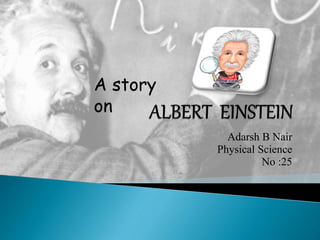
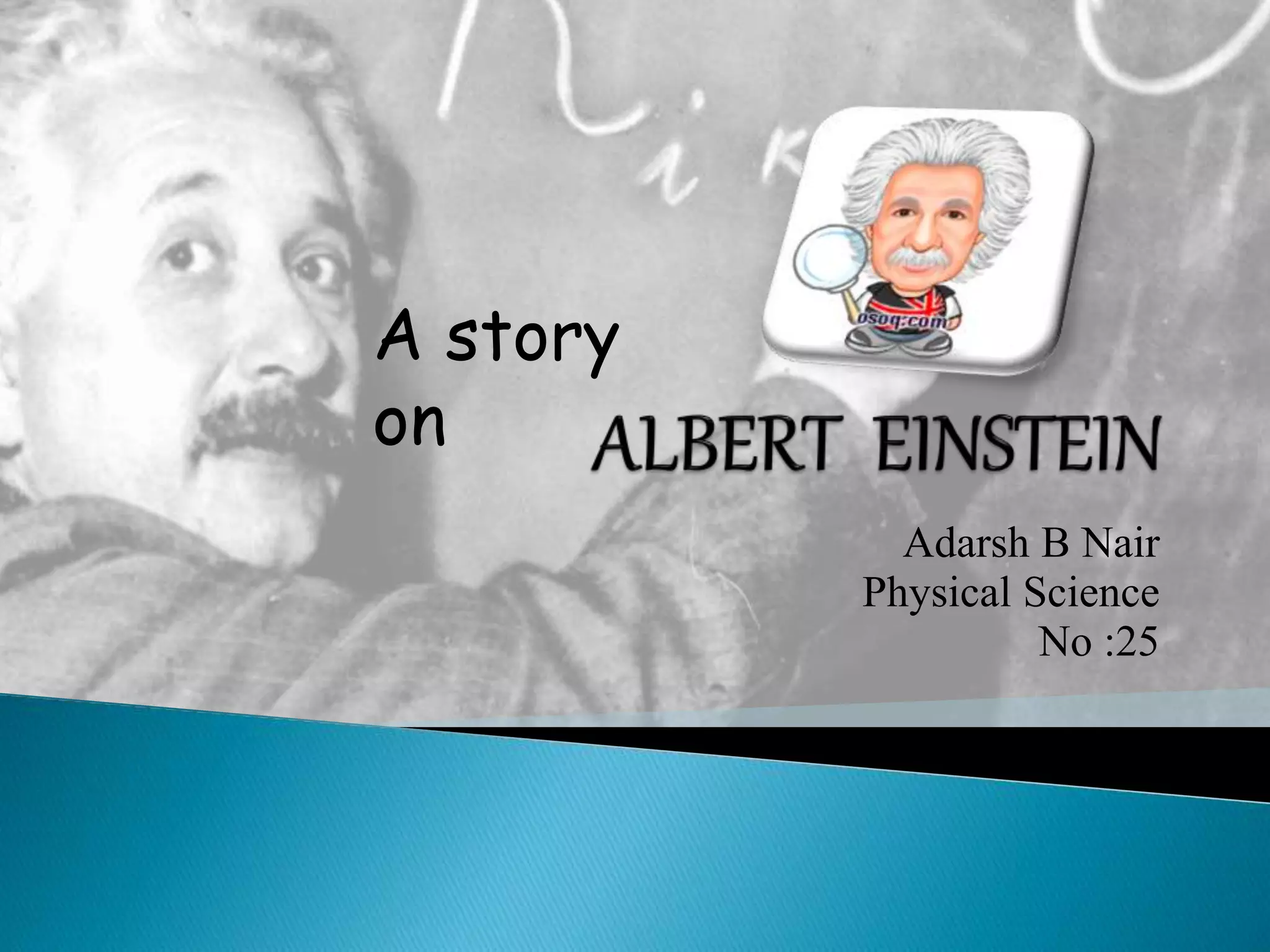
A story
on
 Albert Einstein was a scientific genius who
changed the way we viewed our universe.
 He united space and time together in one
mathematical expression through his
theories.
 Most of his theories are related on the
working of universe.
 The mass energy equation is one of his
greatest contribution to science
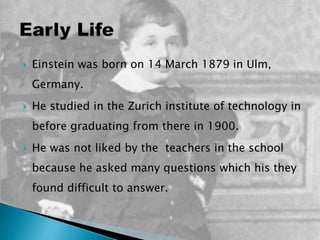
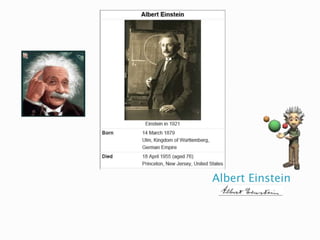
 Einstein was born on 14 March 1879 in Ulm,
Germany.
 He studied in the Zurich institute of technology in
before graduating from there in 1900.
 He was not liked by the teachers in the school
because he asked many questions which his they
found difficult to answer.
 In 1895 at the age of 16 Einstein took an
entrance examination in Swiss Polytechnic in
Zurich.
 He failed to reach the required standard but
the principal on seeing his exceptional grades
in mathematics and physics advised him to
join the Argovian cantonal school in Aarau,
Switzerland.
 After his graduation in 1990, He spend his
time for a teaching job but finally ended up
as an assistant examiner in Federal Office
For Intellectual Property Patent, Bern
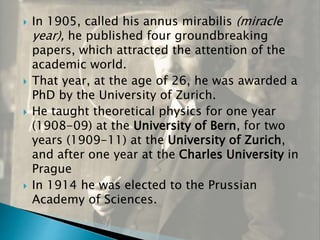
 In 1905, called his annus mirabilis (miracle
year), he published four groundbreaking
papers, which attracted the attention of the
academic world.
 That year, at the age of 26, he was awarded a
PhD by the University of Zurich.
 He taught theoretical physics for one year
(1908-09) at the University of Bern, for two
years (1909-11) at the University of Zurich,
and after one year at the Charles University in
Prague
 In 1914 he was elected to the Prussian
Academy of Sciences.
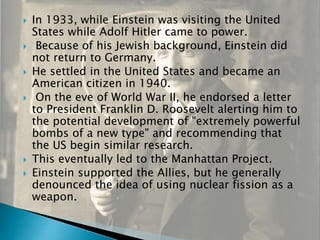
 In 1933, while Einstein was visiting the United
States while Adolf Hitler came to power.
 Because of his Jewish background, Einstein did
not return to Germany.
 He settled in the United States and became an
American citizen in 1940.
 On the eve of World War II, he endorsed a letter
to President Franklin D. Roosevelt alerting him to
the potential development of "extremely powerful
bombs of a new type" and recommending that
the US begin similar research.
 This eventually led to the Manhattan Project.
 Einstein supported the Allies, but he generally
denounced the idea of using nuclear fission as a
weapon.
 Throughout his life, Einstein published hundreds
of books and articles.
 He published more than 300 scientific papers
and 150 non scientific ones.
 On 5th December 2014 universities and archives
announced the release of Einstein’s paper
comprising more than 3000 unique documents.
 Einstein’s intellectual achievements and
originality have made the word Einstein
synonymous with genius.
 In addition to works he did himself, he also
collaborated with their scientists on additional
projects included the Bose-Einstein statistics.
 Einstein's "Zur Elektrodynamik bewegter Körper“ ("On the
Electrodynamics of Moving Bodies") was and published 26
September 1905.
 It reconciled conflicts between Maxwell's equations (the
laws of electricity and magnetism) and the laws of
Newtonian mechanics by introducing changes to the laws
of mechanics.
 Observationally, the effects of these changes are most
apparent at high speeds. The theory developed in this
paper later became known as Einstein's special theory of
relativity.
 This paper predicted that, when measured in the frame of
a relatively moving observer, a clock carried by a moving
body would appear to slow down, and the body itself
would contract in its direction of motion.
 In his paper on mass–energy equivalence,
Einstein produced E = mc2 as a consequence
of his special relativity equations.
 Einstein's 1905 work on relativity remained
controversial for many years, but was
accepted by leading physicists, starting with
Max Planck.
 In 1908, Hermann Minkowski reinterpreted
special relativity in geometric terms as a
theory of spacetime. Einstein adopted
Minkowski‘s formalism in his 1915 general
theory of relativity.
 General relativity (GR) is a theory of gravitation that was
developed by Einstein between 1907 and 1915.
 According to general relativity, the observed gravitational
attraction between masses results from the warping of space
and time by those masses.
 General relativity has developed into an essential tool in
modern astrophysics since It provides the foundation for the
current understanding of black holes, regions of space where
gravitational attraction is so strong that not even light can
escape.
 In 1911, Einstein published an article "On the Influence of
Gravitation on the Propagation of Light" in which he estimated
the amount of deflection of light by massive bodies. Thus, the
theoretical prediction of general relativity could for the first
time be tested experimentally.
 Einstein choose the problem of thermodynamic
fluctuations, giving a treatment of the density
variations in a fluid at its critical point.
 Ordinarily the density fluctuations are controlled by
the second derivative of the free energy with respect
to the density.
 At the critical point, this derivative is zero, leading to
large fluctuations. The effect of density fluctuations is
that light of all wavelengths is scattered, making the
fluid look milky white.
 Einstein relates this to Rayleigh scattering, which is
what happens when the fluctuation size is much
smaller than the wavelength, and which explains why
the sky is blue.
 In 1935, Einstein collaborated with Nathan Rosen to
produce a model of a wormhole, often called
Einstein–Rosen bridges.
 His motivation was to model elementary particles
with charge as a solution of gravitational field
equations, in line with the program outlined in the
paper "Do Gravitational Fields play an Important Role
in the Constitution of the Elementary Particles?".
 These solutions cut and pasted Schwarzschild black
holes to make a bridge between two patches.
 If one end of a wormhole was positively charged, the
other end would be negatively charged.
 These properties led Einstein to believe that pairs of
particles and antiparticles could be described in this
way.
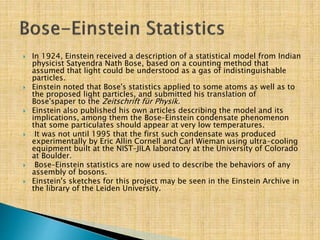
 In 1924, Einstein received a description of a statistical model from Indian
physicist Satyendra Nath Bose, based on a counting method that
assumed that light could be understood as a gas of indistinguishable
particles.
 Einstein noted that Bose's statistics applied to some atoms as well as to
the proposed light particles, and submitted his translation of
Bose'spaper to the Zeitschrift für Physik.
 Einstein also published his own articles describing the model and its
implications, among them the Bose–Einstein condensate phenomenon
that some particulates should appear at very low temperatures.
 It was not until 1995 that the first such condensate was produced
experimentally by Eric Allin Cornell and Carl Wieman using ultra-cooling
equipment built at the NIST–JILA laboratory at the University of Colorado
at Boulder.
 Bose–Einstein statistics are now used to describe the behaviors of any
assembly of bosons.
 Einstein's sketches for this project may be seen in the Einstein Archive in
the library of the Leiden University.
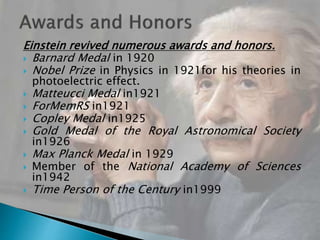
Einstein revived numerous awards and honors.
 Barnard Medal in 1920
 Nobel Prize in Physics in 1921for his theories in
photoelectric effect.
 Matteucci Medal in1921
 ForMemRS in1921
 Copley Medal in1925
 Gold Medal of the Royal Astronomical Society
in1926
 Max Planck Medal in 1929
 Member of the National Academy of Sciences
in1942
 Time Person of the Century in1999
Albert Einstein
Albert  einstein ppt

Albert einstein ppt

  • 1.
    Adarsh B Nair PhysicalScience No :25 A story on
  • 2.
     Albert Einsteinwas a scientific genius who changed the way we viewed our universe.  He united space and time together in one mathematical expression through his theories.  Most of his theories are related on the working of universe.  The mass energy equation is one of his greatest contribution to science
  • 3.
     Einstein wasborn on 14 March 1879 in Ulm, Germany.  He studied in the Zurich institute of technology in before graduating from there in 1900.  He was not liked by the teachers in the school because he asked many questions which his they found difficult to answer.
  • 4.
     In 1895at the age of 16 Einstein took an entrance examination in Swiss Polytechnic in Zurich.  He failed to reach the required standard but the principal on seeing his exceptional grades in mathematics and physics advised him to join the Argovian cantonal school in Aarau, Switzerland.  After his graduation in 1990, He spend his time for a teaching job but finally ended up as an assistant examiner in Federal Office For Intellectual Property Patent, Bern
  • 5.
     In 1905,called his annus mirabilis (miracle year), he published four groundbreaking papers, which attracted the attention of the academic world.  That year, at the age of 26, he was awarded a PhD by the University of Zurich.  He taught theoretical physics for one year (1908-09) at the University of Bern, for two years (1909-11) at the University of Zurich, and after one year at the Charles University in Prague  In 1914 he was elected to the Prussian Academy of Sciences.
  • 6.
     In 1933,while Einstein was visiting the United States while Adolf Hitler came to power.  Because of his Jewish background, Einstein did not return to Germany.  He settled in the United States and became an American citizen in 1940.  On the eve of World War II, he endorsed a letter to President Franklin D. Roosevelt alerting him to the potential development of "extremely powerful bombs of a new type" and recommending that the US begin similar research.  This eventually led to the Manhattan Project.  Einstein supported the Allies, but he generally denounced the idea of using nuclear fission as a weapon.
  • 7.
     Throughout hislife, Einstein published hundreds of books and articles.  He published more than 300 scientific papers and 150 non scientific ones.  On 5th December 2014 universities and archives announced the release of Einstein’s paper comprising more than 3000 unique documents.  Einstein’s intellectual achievements and originality have made the word Einstein synonymous with genius.  In addition to works he did himself, he also collaborated with their scientists on additional projects included the Bose-Einstein statistics.
  • 9.
     Einstein's "ZurElektrodynamik bewegter Körper“ ("On the Electrodynamics of Moving Bodies") was and published 26 September 1905.  It reconciled conflicts between Maxwell's equations (the laws of electricity and magnetism) and the laws of Newtonian mechanics by introducing changes to the laws of mechanics.  Observationally, the effects of these changes are most apparent at high speeds. The theory developed in this paper later became known as Einstein's special theory of relativity.  This paper predicted that, when measured in the frame of a relatively moving observer, a clock carried by a moving body would appear to slow down, and the body itself would contract in its direction of motion.
  • 10.
     In hispaper on mass–energy equivalence, Einstein produced E = mc2 as a consequence of his special relativity equations.  Einstein's 1905 work on relativity remained controversial for many years, but was accepted by leading physicists, starting with Max Planck.  In 1908, Hermann Minkowski reinterpreted special relativity in geometric terms as a theory of spacetime. Einstein adopted Minkowski‘s formalism in his 1915 general theory of relativity.
  • 11.
     General relativity(GR) is a theory of gravitation that was developed by Einstein between 1907 and 1915.  According to general relativity, the observed gravitational attraction between masses results from the warping of space and time by those masses.  General relativity has developed into an essential tool in modern astrophysics since It provides the foundation for the current understanding of black holes, regions of space where gravitational attraction is so strong that not even light can escape.  In 1911, Einstein published an article "On the Influence of Gravitation on the Propagation of Light" in which he estimated the amount of deflection of light by massive bodies. Thus, the theoretical prediction of general relativity could for the first time be tested experimentally.
  • 12.
     Einstein choosethe problem of thermodynamic fluctuations, giving a treatment of the density variations in a fluid at its critical point.  Ordinarily the density fluctuations are controlled by the second derivative of the free energy with respect to the density.  At the critical point, this derivative is zero, leading to large fluctuations. The effect of density fluctuations is that light of all wavelengths is scattered, making the fluid look milky white.  Einstein relates this to Rayleigh scattering, which is what happens when the fluctuation size is much smaller than the wavelength, and which explains why the sky is blue.
  • 13.
     In 1935,Einstein collaborated with Nathan Rosen to produce a model of a wormhole, often called Einstein–Rosen bridges.  His motivation was to model elementary particles with charge as a solution of gravitational field equations, in line with the program outlined in the paper "Do Gravitational Fields play an Important Role in the Constitution of the Elementary Particles?".  These solutions cut and pasted Schwarzschild black holes to make a bridge between two patches.  If one end of a wormhole was positively charged, the other end would be negatively charged.  These properties led Einstein to believe that pairs of particles and antiparticles could be described in this way.
  • 14.
     In 1924,Einstein received a description of a statistical model from Indian physicist Satyendra Nath Bose, based on a counting method that assumed that light could be understood as a gas of indistinguishable particles.  Einstein noted that Bose's statistics applied to some atoms as well as to the proposed light particles, and submitted his translation of Bose'spaper to the Zeitschrift für Physik.  Einstein also published his own articles describing the model and its implications, among them the Bose–Einstein condensate phenomenon that some particulates should appear at very low temperatures.  It was not until 1995 that the first such condensate was produced experimentally by Eric Allin Cornell and Carl Wieman using ultra-cooling equipment built at the NIST–JILA laboratory at the University of Colorado at Boulder.  Bose–Einstein statistics are now used to describe the behaviors of any assembly of bosons.  Einstein's sketches for this project may be seen in the Einstein Archive in the library of the Leiden University.
  • 15.
    Einstein revived numerousawards and honors.  Barnard Medal in 1920  Nobel Prize in Physics in 1921for his theories in photoelectric effect.  Matteucci Medal in1921  ForMemRS in1921  Copley Medal in1925  Gold Medal of the Royal Astronomical Society in1926  Max Planck Medal in 1929  Member of the National Academy of Sciences in1942  Time Person of the Century in1999
  • 16.