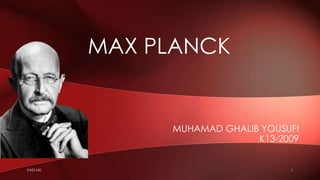
MAX PLANCK

MUHAMAD GHALIB YOUSUFI
K13-2009

FAST-NU

1
INTRODUCTION :
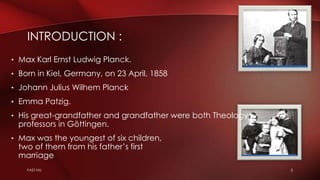
• Max Karl Ernst Ludwig Planck.

• Born in Kiel, Germany, on 23 April, 1858
• Johann Julius Wilhem Planck
• Emma Patzig.

• His great-grandfather and grandfather were both Theology

professors in Göttingen.

• Max was the youngest of six children,

two of them from his father’s first
marriage
FAST-NU

2
FAST-NU

‹#›
ACHIEVEMENTS :
• At the age of 21, he completed his thesis on the second law

of thermodynamics.

• Lecturer _ University of Munich _ 1880 -1885.

• In 1900 _ Black Body Radiation.
• Energy radiated units are “QUANTA”.
• Published papers on thermo dynamicity and entropy.
• Noble prize – 1918

FAST-NU

4
CONTRIBUTIONS :
His major contributions to physics are:
• PLANK’S QUANTUM THEORY.
• PLANK’S CONSTANT.
• BLACK BODY RADIATION.

FAST-NU

5
MAX PLANCK INSTITUTE
• The Max Planck Institute is a an
independent non-profit society
devoted to research for the
advancement of science.
• There are currently 80 research
facilities throughout Germany in the
following fields of study listed below…
• Biology and Medicine
• Chemistry
• Physics
• Technology
• Humanities
FAST-NU

6
• Max also worked with Albert Einstein for many years.
• Max also has a great contribution in the

invention of the theory of relativity.
• He had also written many books which

includes:
 Vorlesungen über Thermodynamik (1897)
 Entropy and Temperature of Radiant Heat - Annalen der Physik,

vol. 1. no 4. April, pg. 719-737 (1900)

 On the Law of Distribution of Energy in the Normal Spectrum

– Annalen der Physik, vol. 4, p. 553 ff (1901)

FAST-NU

7
• After several happy years the Planck family was struck

with several tragedies.

• In October 1909, Marie Planck died from tuberculosis.
• All of his family members were killed in a missile attack in

the World War I.

• And finally in the year 1947, this legend died of heart

attack.

• THANKYOU
FAST-NU

8

Max planck

  • 1.
    MAX PLANCK MUHAMAD GHALIBYOUSUFI K13-2009 FAST-NU 1
  • 2.
    INTRODUCTION : • MaxKarl Ernst Ludwig Planck. • Born in Kiel, Germany, on 23 April, 1858 • Johann Julius Wilhem Planck • Emma Patzig. • His great-grandfather and grandfather were both Theology professors in Göttingen. • Max was the youngest of six children, two of them from his father’s first marriage FAST-NU 2
  • 3.
  • 4.
    ACHIEVEMENTS : • Atthe age of 21, he completed his thesis on the second law of thermodynamics. • Lecturer _ University of Munich _ 1880 -1885. • In 1900 _ Black Body Radiation. • Energy radiated units are “QUANTA”. • Published papers on thermo dynamicity and entropy. • Noble prize – 1918 FAST-NU 4
  • 5.
    CONTRIBUTIONS : His majorcontributions to physics are: • PLANK’S QUANTUM THEORY. • PLANK’S CONSTANT. • BLACK BODY RADIATION. FAST-NU 5
  • 6.
    MAX PLANCK INSTITUTE •The Max Planck Institute is a an independent non-profit society devoted to research for the advancement of science. • There are currently 80 research facilities throughout Germany in the following fields of study listed below… • Biology and Medicine • Chemistry • Physics • Technology • Humanities FAST-NU 6
  • 7.
    • Max alsoworked with Albert Einstein for many years. • Max also has a great contribution in the invention of the theory of relativity. • He had also written many books which includes:  Vorlesungen über Thermodynamik (1897)  Entropy and Temperature of Radiant Heat - Annalen der Physik, vol. 1. no 4. April, pg. 719-737 (1900)  On the Law of Distribution of Energy in the Normal Spectrum – Annalen der Physik, vol. 4, p. 553 ff (1901) FAST-NU 7
  • 8.
    • After severalhappy years the Planck family was struck with several tragedies. • In October 1909, Marie Planck died from tuberculosis. • All of his family members were killed in a missile attack in the World War I. • And finally in the year 1947, this legend died of heart attack. • THANKYOU FAST-NU 8