ENGLISH 100 Just Right Elementary Gabriela Jiménez Aguilar March, 2009
Unit 1 Topic:  Meeting people Introductions Functions: Introducing someone
Grammar: Subject pronouns Verb to be (affirmative) Vocabulary Useful phrases The alphabet
Useful phrases Thank you! You´re welcome. Excuse me. I’m sorry! I don’t understand. What did you say? See you later! Bye!/ Good bye! /Bye bye!!
Greetings Hello! Hi! Hey!
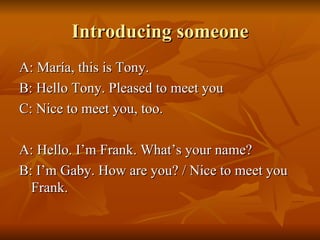
Introducing someone A: María, this is Tony. B: Hello Tony. Pleased to meet you C: Nice to meet you, too. A: Hello. I’m Frank. What’s your name? B: I’m Gaby. How are you? / Nice to meet you Frank.
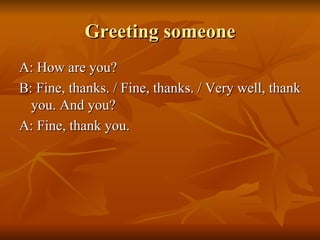
Greeting someone A: How are you? B: Fine, thanks. / Fine, thanks. / Very well, thank you. And you? A: Fine, thank you.
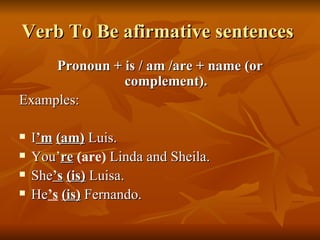
Verb To Be afirmative sentences  Pronoun + is / am /are + name (or complement). Examples: I ’m   (am)  Luis. You’ re   (are)  Linda and Sheila. She ’s   (is)  Luisa. He ’s   (is)  Fernando.
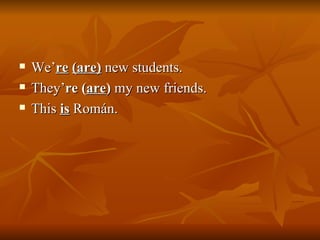
We’ re   (are)  new students. They’ re   ( are )  my new friends. This  is  Román.
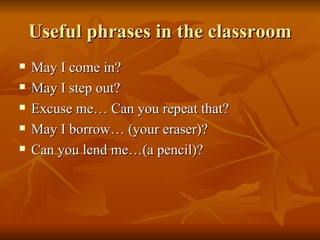
Useful phrases in the classroom May I come in? May I step out? Excuse me… Can you repeat that? May I borrow… (your eraser)? Can you lend me…(a pencil)?
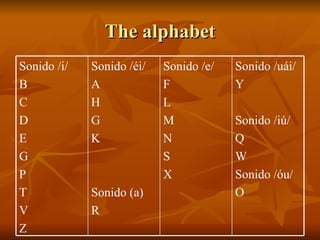
The alphabet Sonido /uái/ Y Sonido /iú/ Q W Sonido /óu/ O Sonido /e/ F L M N S X Sonido /éi/ A H G K Sonido (a) R Sonido /i/ B C D E G P T V Z
You can consult: Grammar Dimensions 1, Unit 1, 3. Essential Grammar in Use, Unit 1, 2. Essential Grammar in Use supplementary exercises 1-5. Clear Grammar 1, Unit 1. Clear Grammar student workbook, Unit 1.
Unit 2 Topic:  Meeting people Functions: Greetings
Grammar: Verb to be (negative and interrogative) Vocabulary Colors Countries Nationalities
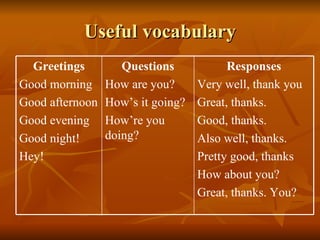
Useful vocabulary Responses Very well, thank you Great, thanks. Good, thanks. Also well, thanks. Pretty good, thanks How about you? Great, thanks. You? Questions How are you? How’s it going? How’re you doing? Greetings Good morning Good afternoon Good evening Good night! Hey!
Saying good bye Good bye! Bye! See you tomorrow! See you next Monday. See you next week.
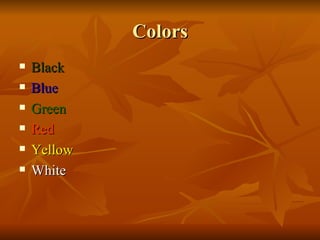
Colors Black Blue Green Red Yellow White
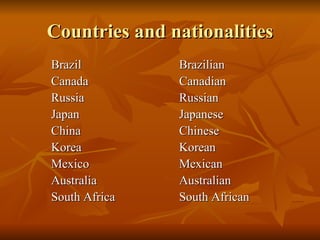
Countries and nationalities Brazil  Brazilian Canada   Canadian Russia Russian Japan Japanese China Chinese Korea Korean Mexico Mexican Australia Australian South Africa South African
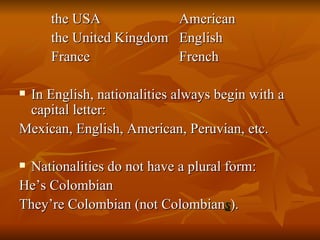
the USA American the United Kingdom English France French In English, nationalities always begin with a capital letter: Mexican, English, American, Peruvian, etc. Nationalities do not have a plural form: He’s Colombian They’re Colombian (not Colombian s ).
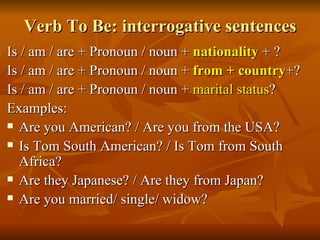
Verb To Be: interrogative sentences Is / am / are + Pronoun / noun +  nationality  + ? Is / am / are + Pronoun / noun +  from + country +? Is / am / are + Pronoun / noun +  marital status ? Examples: Are you American? / Are you from the USA? Is Tom South American? / Is Tom from South Africa? Are they Japanese? / Are they from Japan? Are you married/ single/ widow?
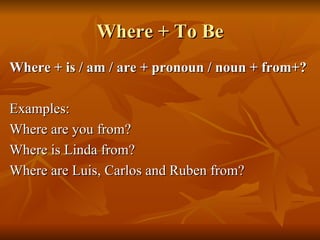
Where + To Be Where + is / am / are + pronoun / noun + from+? Examples:  Where are you from? Where is Linda from? Where are Luis, Carlos and Ruben from?
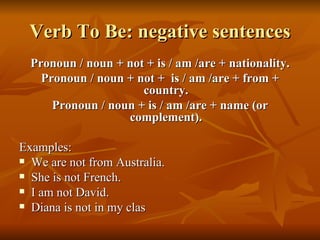
Verb To Be: negative sentences Pronoun / noun + not + is / am /are + nationality. Pronoun / noun + not +  is / am /are + from + country. Pronoun / noun + is / am /are + name (or complement). Examples: We are not from Australia. She is not French. I am not David. Diana is not in my clas
You can consult: Grammar Dimensions 1, Unit 2. Skyline 1 Grammar Resource book, Unit 1 Lessons 1 & 2.
Unit 3:  Topics: Jobs and occupations Personal information Functions: Asking and giving personal information
Grammar: A, an Possesive adjectives Prepositions of time Vocabulary: Jobs and occupations Days and months
Jobs and occupations Indefinite articles  a, an  are only used with  singular nouns : A + consonant sound E.g.: A  n urse A  s tudent A  c ab driver But:  A uniform (u sounds /y/) A union (u sounds /y/)
An + vowel sound E.g.: An  a rchitect An  a ccountant An  a ctor But: A hotel (h sound /j/) A hospital (h sound /j/)
You can consult: Grammar Dimensions 1, Unit 4. Essential Grammar in Use, Unit 64.
Possessive adjectives Possessive adjective  + noun My job Your house His dog Her students Its name Our class Their telephone numbers Pronoun I You He She It We They
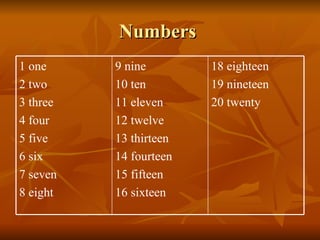
Numbers  18 eighteen 19 nineteen 20 twenty 9 nine 10 ten 11 eleven 12 twelve 13 thirteen 14 fourteen 15 fifteen 16 sixteen 1 one 2 two 3 three 4 four 5 five 6 six 7 seven 8 eight
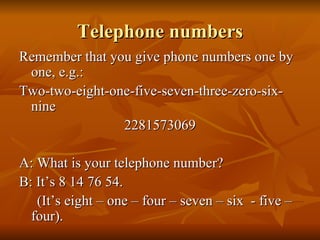
Telephone numbers Remember that you give phone numbers one by one, e.g.: Two-two-eight-one-five-seven-three-zero-six-nine 2281573069 A: What is your telephone number? B: It’s 8 14 76 54. (It’s eight – one – four – seven – six  - five – four).
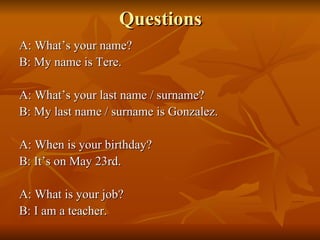
Questions A: What’s your name?  B: My name is Tere. A: What’s your last name / surname?  B: My last name / surname is Gonzalez. A: When is your birthday? B: It’s on May 23rd. A: What is your job? B: I am a teacher.
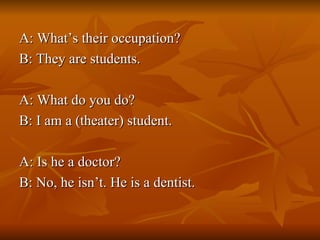
A: What’s their occupation? B: They are students. A: What do you do? B: I am a (theater) student. A: Is he a doctor? B: No, he isn’t. He is a dentist.
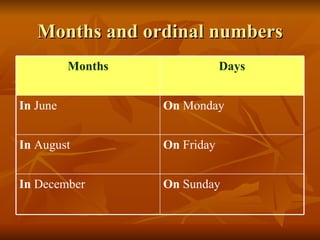
Months and ordinal numbers On  Sunday In  December On  Friday In  August On  Monday In  June Days Months
Ordinal numbers We use ordinal numbers for full dates, for example: My birthday is on March 16th. My wedding anniversary is on the 28th of October. My graduation party is on  February 5th. The Revolution Day is on November 20 th .
You can consult: Clear Grammar 1, student’s book, Unit 11. Clear Grammar 1, workbook, Unit 11. Grammar Dimensions 1, Unit 2. Skyline 1 Grammar Resource book, Unit 1 Lessons 1 & 2.
Do you have email?  Yes, I do. / No, I don’t. What’s your email address? It’s karla9@org.com (It’s karla-nine- at -o-r-g- dot -com). What’s your address? It’s 165, Ursulo Galván street.
How do you spell your name /last name? D-a-l-i-a / R-a-m-i-r-e-z. How do you spell “engineer”? It’s e-n-g-i-n-e-e-r. What’s your nationality? I’m from Mexico. I’m Mexican.
You can consult: Essential Grammar in use (third edition), Unit 7.
Unit 4 Topic: The family Functions: Talking about age
Grammar:  Demonstratives (this, that, these, those) Vocabulary: Family members Numbers from 20 to 100 Regular and irregular plural nouns
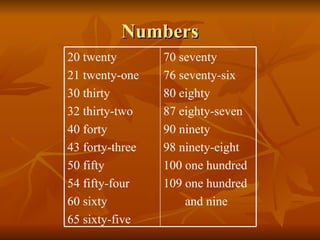
Numbers 70 seventy 76 seventy-six 80 eighty 87 eighty-seven 90 ninety 98 ninety-eight 100 one hundred 109 one hundred and nine 20 twenty 21 twenty-one 30 thirty 32 thirty-two 40 forty 43 forty-three 50 fifty 54 fifty-four 60 sixty 65 sixty-five
Age How old are you?  I’m 21  (years old). What’s her age? She’s 32 (years old). How old is the baby? He’s two months old.
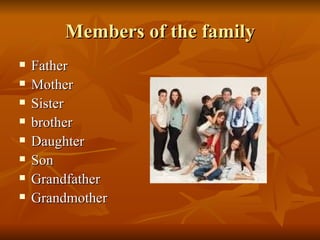
Members of the family Father Mother Sister brother Daughter Son Grandfather Grandmother
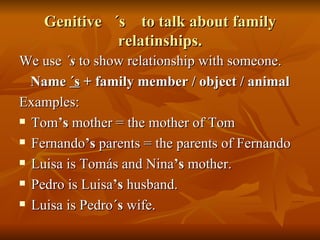
Genitive  ´s  to talk about family relatinships. We use  ´ s  to show relationship with someone. Name  ´s  + family member / object / animal Examples: Tom ’s  mother = the mother of Tom Fernando ’s  parents = the parents of Fernando Luisa is Tomás and Nina ’s  mother. Pedro is Luisa ’s  husband. Luisa is Pedro ´s  wife.
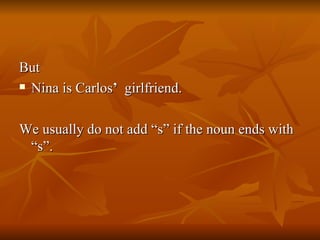
But Nina is Carlos ’   girlfriend. We usually do not add “s” if the noun ends with “s”.
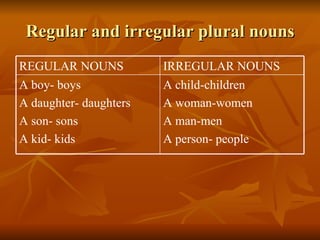
Regular and irregular plural nouns A child-children A woman-women A man-men A person- people A boy- boys A daughter- daughters A son- sons A kid- kids IRREGULAR NOUNS REGULAR NOUNS
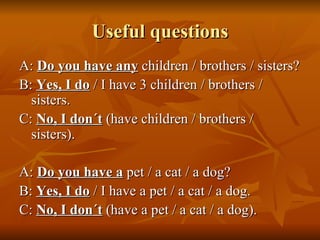
Useful questions A:  Do you have   any  children / brothers / sisters? B:  Yes, I do  / I have 3 children / brothers / sisters. C:  No, I don´t  (have children / brothers / sisters). A:  Do you have a  pet / a cat / a dog? B:  Yes, I do  / I have a pet / a cat / a dog. C:  No, I don´t  (have a pet / a cat / a dog).
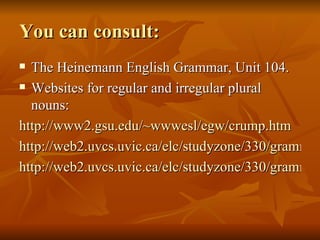
You can consult: The Heinemann English Grammar, Unit 104. Websites for regular and irregular plural nouns: http://www2.gsu.edu/~wwwesl/egw/crump.htm http://web2.uvcs.uvic.ca/elc/studyzone/330/grammar/irrplu.htm http://web2.uvcs.uvic.ca/elc/studyzone/330/grammar/plural.htm
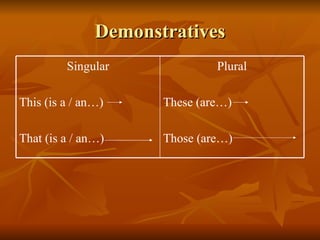
Demonstratives Plural These (are…) Those (are…) Singular This (is a / an…) That (is a / an…)
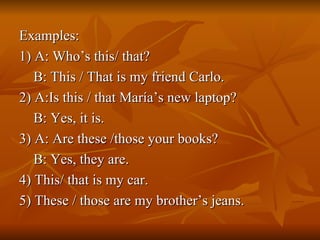
Examples: 1) A: Who’s this/ that?  B: This / That is my friend Carlo. 2) A:Is this / that María’s new laptop?  B: Yes, it is. 3) A: Are these /those your books?  B: Yes, they are. 4) This/ that is my car. 5) These / those are my brother’s jeans.
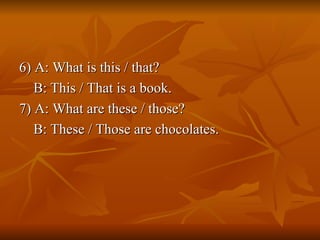
6) A: What is this / that? B: This / That is a book. 7) A: What are these / those? B: These / Those are chocolates.
You can consult: Clear Grammar 1, Student’s book, Unit 3. Clear Grammar 1, Workbook, Unit 3.
Unit 5 Topic: Routines Functions: Telling the time
Grammar: Present simple (affirmative and negative) Vocabulary: Everyday actions Seasons of the year The weather
The time What time is it? 11:00  It’s eleven o’clock 5:00  It’s five a. m. 9:00  It’s nine p. m. 3:15  It’s three fifteen / It’s three and a quarter    / It’s a quarter after three 4:30  It’s a half past four / It’s four thirty
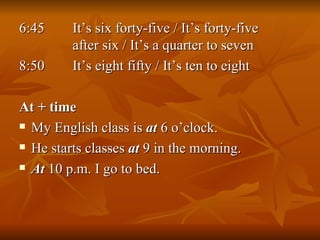
6:45   It’s six forty-five / It’s forty-five      after six / It’s a quarter to seven 8:50   It’s eight fifty / It’s ten to eight At + time My English class is  at  6 o’clock. He starts classes  at  9 in the morning. At  10 p.m. I go to bed.
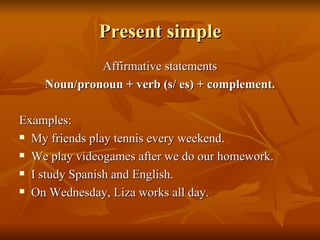
Present simple Affirmative statements Noun/pronoun + verb (s/ es) + complement. Examples: My friends play tennis every weekend. We play videogames after we do our homework. I study Spanish and English. On Wednesday, Liza works all day.
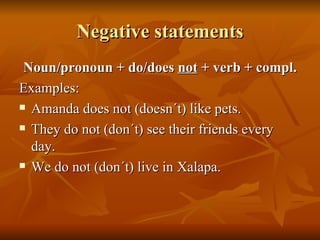
Negative statements Noun/pronoun + do/does  not  + verb + compl. Examples: Amanda does not (doesn´t) like pets. They do not (don´t) see their friends every day. We do not (don´t) live in Xalapa.
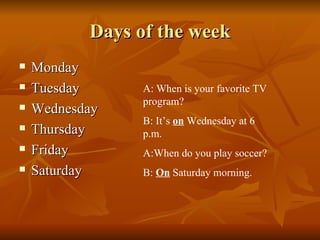
Days of the week Monday Tuesday Wednesday Thursday Friday Saturday A: When is your favorite TV program? B: It’s  on  Wednesday at 6 p.m. A:When do you play soccer? B:  On  Saturday morning.
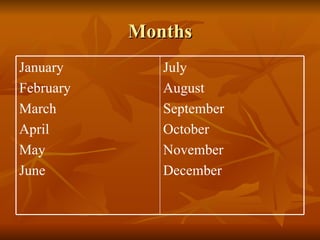
Months July August September October November December January February March April May June
Seasons of the year Spring Summer Autumn / Fall Winter
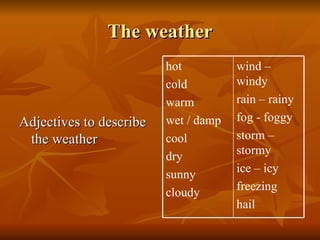
The weather Adjectives to describe the weather wind – windy rain – rainy fog - foggy storm – stormy ice – icy freezing hail hot cold  warm wet / damp cool dry  sunny cloudy
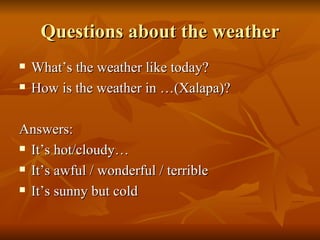
Questions about the weather What’s the weather like today? How is the weather in …(Xalapa)?   Answers: It’s hot/cloudy…  It’s awful / wonderful / terrible It’s sunny but cold
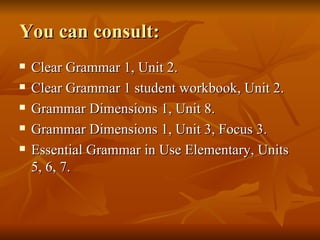
You can consult: Clear Grammar 1, Unit 2. Clear Grammar 1 student workbook, Unit 2. Grammar Dimensions 1, Unit 8. Grammar Dimensions 1, Unit 3, Focus 3. Essential Grammar in Use Elementary, Units 5, 6, 7.
Unit 6 Topic: Favorite foods Functions: Ordering food
Grammar: Present simple (yes/no questions and short answers) Vocabulary: Food and drink
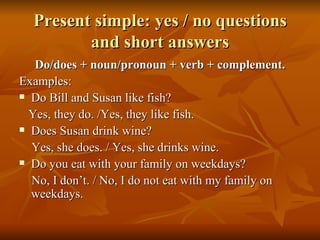
Present simple: yes / no questions and short answers Do/does + noun/pronoun + verb + complement. Examples: Do Bill and Susan like fish? Yes, they do. /Yes, they like fish. Does Susan drink wine? Yes, she does. / Yes, she drinks wine. Do you eat with your family on weekdays? No, I don’t. / No, I do not eat with my family on weekdays.
Clear Grammar 1, Unit 2. Clear Grammar 1 student workbook, Unit 2. Grammar Dimensions 1, Unit 8. Grammar Spectrum 2, Unit 3. Essential Grammar in Use Elementary, Units 5, 6, 7.
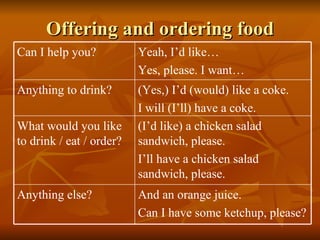
Offering and ordering food And an orange juice. Can I have some ketchup, please? Anything else? (I’d like) a chicken salad sandwich, please. I’ll have a chicken salad sandwich, please. What would you like to drink / eat / order? (Yes,) I’d (would) like a coke. I will (I’ll) have a coke. Anything to drink? Yeah, I’d like… Yes, please. I want… Can I help you?
You can consult: Grammar Spectrum 2, Unit 27.
Unit 7 Topic: Free time and hobbies Function: Agreeing and disagreeing on statements.
Grammar: Present simple (wh-questions) Vocabulary: Hobbies
Present simple with Wh-questions Where (dónde) What (qué) When (cuándo) Who ( quién) How (cómo)
Wh-question word + do/does + noun / pronoun + verb + complement + ? Examples: What do you do in your free time? What does she do everyday? Where do you play soccer? Where does she go shopping?
When do you watch TV? When does he play video games? How do you go to school? By car / bus / On foot. What time do you finish school? At 9 p.m.
You can consult: Grammar Dimensions 1, Unit 8, Focus 1. Skyline 1 Grammar Resource book, Unit 3, Lessons 2 & 3.
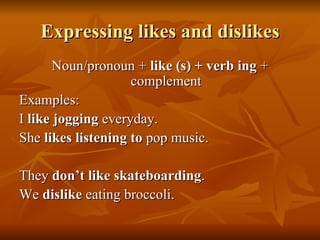
Expressing likes and dislikes Noun/pronoun +  like (s) + verb ing  + complement Examples: I  like jogging  everyday.  She  likes listening to  pop music. They  don’t like skateboarding . We  dislike  eating broccoli.
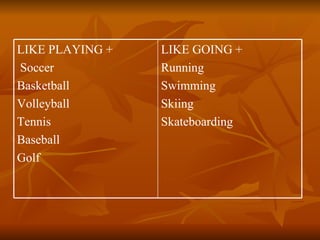
LIKE GOING + Running Swimming Skiing Skateboarding LIKE PLAYING + Soccer Basketball Volleyball Tennis Baseball Golf
You can consult: Grammar Spectrum 2, Unit 27.
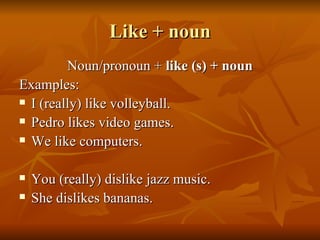
Like + noun Noun/pronoun +  like (s) + noun Examples: I (really) like volleyball. Pedro likes video games. We like computers. You (really) dislike jazz music. She dislikes bananas.
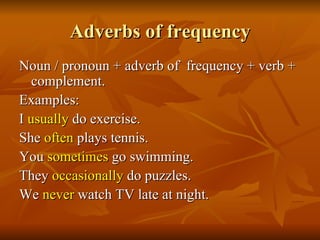
Adverbs of frequency Noun / pronoun + adverb of  frequency + verb + complement. Examples: I  usually  do exercise. She  often  plays tennis. You  sometimes  go swimming. They  occasionally  do puzzles. We  never  watch TV late at night.
You can consult: Gramática Delti, Unidad 35. Larousse, Gramática inglesa comunicativa, page 45.
Unit 8 Topic: Health habits and health problems Function: Asking and talking about health.
Grammar: Frequency adverbs Vocabulary: Parts of the body
Frequency How often  do/does + noun/pronoun+ verb + complement + ? Examples: How often do you go to the dentist? Twice a year. How often does Teresa go to the doctor? Once a month.  How often do they work out? Everyday.
You can consult: Larousse, Gramática inglesa comunicativa, page 44.
More adverbs of frequency Noun / pronoun + adv. of frequency + verb + complement. Example: She  often  goes for a walk in the park. Everyday Once a week / a month / a year Twice a week / a month / a year Three / four times a week / a month / a year Never
Always Sometimes Usually Never Specific time: Two  to  five hours a week Ten  to  20 hours a week / a month
Unit 10 Topic: What are you doing now? Function: Asking for language help
Grammar: Present progressive or continuous Vocabulary Actions
Asking for language help Help with difficult words: How do you say____? What does _____ mean? Help with difficult sentences: I don’t understand. Can you speak slowly, please? Can you say that again, please?
Present simple (review) Noun/pronoun + frequency adverb + verb + complement Examples: I sometimes play basketball on Sundays. Peter always drives to work. They never drink at parties.
Present simple (review) Do/does + noun/pronoun + verb + complement? Examples: Do you walk to school? Does Mary ever do exercise? Do they ever study on weekends?
Present progressive or continuous It is used to talk about actions that are happening at the moment of speaking, for example, you are reading this power point presentation right now, you are studying English now, etc. Affirmative sentences: Noun / pronoun+ to be + verb -ing+ complement.
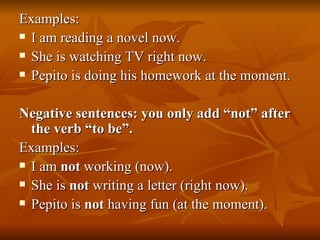
Examples: I am reading a novel now. She is watching TV right now. Pepito is doing his homework at the moment. Negative sentences: you only add “not” after the verb “to be”. Examples: I am  not  working (now). She is  not  writing a letter (right now). Pepito is  not  having fun (at the moment).
You can consult: Clear Grammar 1, Student’s book, Unit 9. Clear Grammar 1, Workbook, Unit 99. Grammar Spectrum 1, Unit 5 & 6.
Useful phrases to write a postcard Saying goodbye: Love Wish you were here! Take care! Describing the place: This place is fun! (place)  is cool! (place)  is beautiful / great! Opening phrase: Hello! Dear…, Hi!
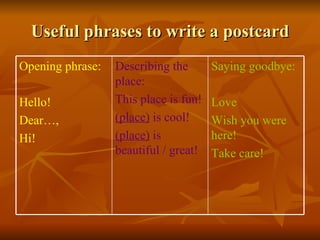
Unit 11 Topic: Physical appearance Function: Describing people
Grammar: Present progressive (wh-questions) Vocabulary: Hair, body and face
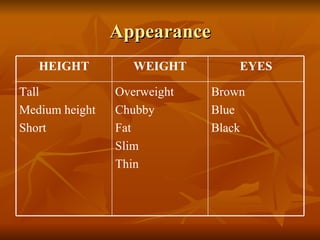
Appearance Brown Blue Black Overweight Chubby Fat Slim Thin Tall Medium height Short EYES WEIGHT HEIGHT
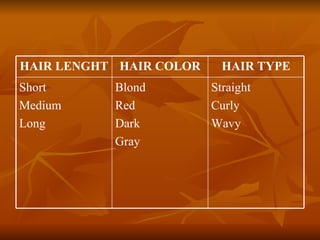
Straight Curly Wavy Blond Red Dark Gray Short Medium Long HAIR TYPE HAIR COLOR HAIR LENGHT
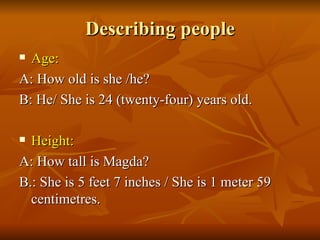
Describing people Age: A: How old is she /he? B: He/ She is 24 (twenty-four) years old. Height: A: How tall is Magda? B.: She is 5 feet 7 inches / She is 1 meter 59 centimetres.
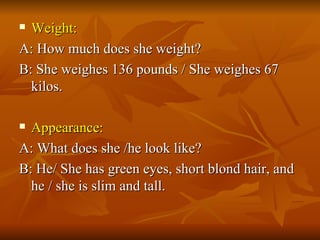
Weight: A: How much does she weight? B: She weighes 136 pounds / She weighes 67 kilos. Appearance: A: What does she /he look like? B: He/ She has green eyes, short blond hair, and he / she is slim and tall.
A: What color is his/her hair? B: His / her hair is black. A: What is she /he wearing? B: She / he is wearing a brown suit.
Describing personality Adjectives to describe personality: Shy Talkative Serious Outgoing Nice Funny Quiet
What is Brad Pitt like? He is friendly and talkative What are you like? I’m …
Describing physical appearance Adjectives to describe physical appearance: Tall Short Thin Handsome Pretty Heavy Good-looking
What does Angelina Jolie look like? She is tall and beautiful. What do you look like? I’m…
Present progressive or continuous (Interrogative ) Is / am / are + noun/pronoun +  verb-ing  + complement + ? Examples:  Are you  eating  now? Is Pedro  studying  for his exam? Are we  wearing  a uniform?
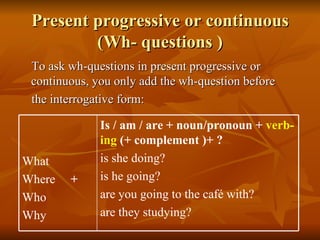
Present progressive or continuous (Wh- questions ) To ask wh-questions in present progressive or continuous, you only add the wh-question before  the interrogative form: Is / am / are + noun/pronoun +  verb-ing  (+ complement )+ ? is she doing? is he going? are you going to the café with? are they studying? What Where  + Who Why
Examples: What  is the teacher doing? (She is) writing on the blackboard. Where  is your friend going? (He’s going) to the bathroom. Who  are you going to the party with? (I’m going) with my sister. Why  are you reading that book? Because I like historical novels.
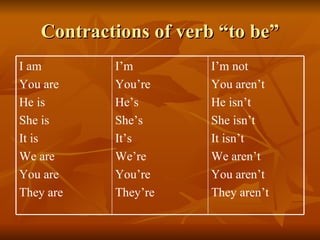
Contractions of verb “to be” I’m not You aren’t He isn’t She isn’t It isn’t We aren’t You aren’t They aren’t I’m You’re He’s She’s It’s We’re You’re They’re I am You are He is  She is It is We are You are They are
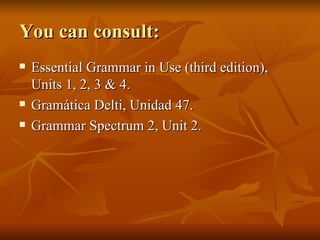
You can consult: Essential Grammar in Use (third edition), Units 1, 2, 3 & 4. Gramática Delti, Unidad 47. Grammar Spectrum 2, Unit 2.
Unit 12 Topic: Being in touch Function: Using the telephone
Grammar: Present progressive and present simple Vocabulary:  Interacting
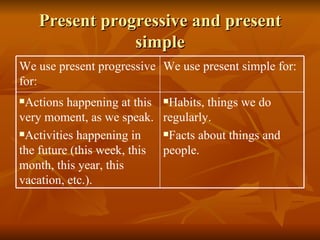
Present progressive and present simple Habits, things we do regularly. Facts about things and people. Actions happening at this very moment, as we speak. Activities happening in the future (this week, this month, this year, this vacation, etc.). We use present simple for: We use present progressive for:
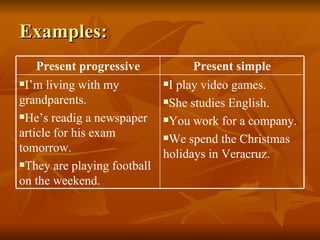
Examples: I play video games. She studies English. You work for a company. We spend the Christmas holidays in Veracruz. I’m living with my grandparents.  He’s readig a newspaper article for his exam tomorrow. They are playing football on the weekend. Present simple Present progressive
You can consult: Gramática Delti, Unidad 47.
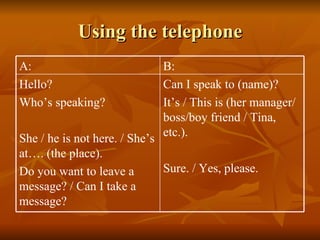
Using the telephone Can I speak to (name)? It’s / This is (her manager/ boss/boy friend / Tina, etc.). Sure. / Yes, please. Hello? Who’s speaking? She / he is not here. / She’s at…. (the place). Do you want to leave a message? / Can I take a message? B: A:
Unit 13 Topic: Looking for things Function: Looking for something
Grammar: Possession Prepositions of place  Vocabulary:  Rooms & furniture
Parts of a house / apartment Living room Dining room Bedroom Bathroom Kitchen Yard Garden Garage
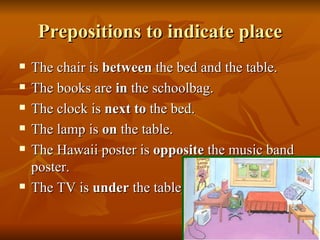
Prepositions to indicate place The chair is  between  the bed and the table. The books are  in  the schoolbag. The clock is  next to  the bed. The lamp is  on  the table. The Hawaii poster is  opposite  the music band poster. The TV is  under  the table.
Prepositions to indicate location of public places On At Next to Between Opposite Across from Behind
Examples: The cathedral is between Revolución street and Lucio street. The Language Center is next to the market “Los sauces”. The “Domo suterm” is across from the Language Center.
You can consult: Gramática Delti, Unidad 40.
‘ S Use apostrophe  ‘s  after a name to indicate possession of an object or a relationship, for example: That’s John ’s  shirt. (=That shirt belongs to John).  She’s Mary ’s  sister. (=She is her sister).
Apostrophe ‘s  is also used to indicate the abbreviation os “is” and it is followed by a verb in gerund (ing), for example: Celia ’s  do ing  her homework. (=Celia  is  doing her homework). Roberto ’s  listen ing  to the radio. (=Roberto  is  listening to the radio).
You can consult: Grammar Spectrum 1, Units 5 & 22. The Heinemann English Grammar, Unit 104.
Unit 14 Topic: Finding things and places. Function: Asking for and giving location.
Grammar: There is /there are Vocabulary: Public places
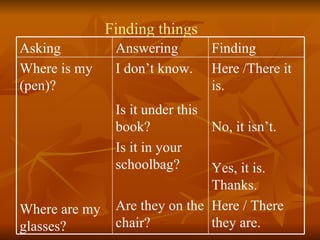
Finding things Here /There it is. No, it isn’t. Yes, it is. Thanks. Here / There they are. I don’t know. Is it under this book?  Is it in your schoolbag? Are they on the chair? Where is my (pen)? Where are my glasses? Finding Answering Asking
Public places Mall Hospital Bank School Swimming pool Parking lot Supermarket City hall Gym Movie theater
Definite article “the” We use “the” : a) to indicate that the following noun is definite or has been specified by context or by circumstance. Example: Take the pencil. (toma el lápiz) [Different from: take a pencil (toma un lápiz, cualquiera)].
b) Before nouns that designate natural phenomena: Eg.: The night is cold. c) To indicate that the noun is unique or a particular member of its class: Eg.: The President. d) Before a proper name: Eg.: The Mayflower.
e) Before a proper name to indicate the distinctive characteristics of a person or thing: Eg.: The Johnsons. f) Before a singular noun to indicate that the noun is to be understood generically: Eg.: The dog is a domestic animal.
You can consult: The Heinemann English Grammar, Unit 110, 111 & 112.
There is / There are Use  there is a  with singular countable nouns: There is a  camera under the table. Use  there is some  with uncountable nouns: There is some milk in the refrigerator. Use  there are some  with plural countable nouns: There are some oranges in the fridge.
Use  there isn’t a  with singular countable noun: There isn’t a post-office near here. Use  there isn’t any  with uncountable nouns. There isn’t any rice in the cupboard. Use  there aren’t any /there are no  with plural countable nouns: There aren’t any books in the bedroom / There are no books in the bedroom.
Questions with There is /are Is there a / Are there (any)+ noun + complement +? Is there a karaoke in your house? Yes, there is a karaoke. / No, there isn’t a karaoke. Are there any video games in your bedroom? Yes, there are some. / No, there aren’t any.
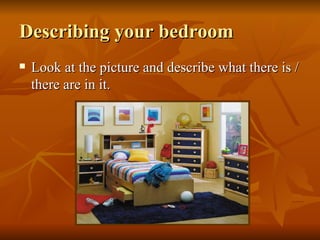
Describing your bedroom Look at the picture and describe what there is / there are in it.
Grammar Dimensions 1, Unit 7, Focus 1, 2 & 4.
Unit 15 Topics: Abilities Permission Function: Asking for permission. Talking about abilities.
Grammar: Can / can’t Vocabulary: music
Musical instruments Clarinet Trumpet Drums Violin Piano Saxophone Guitar
Types of music Jazz Classical Pop Country Dance Hip-hop
Asking for permission Use the modal “can” to ask for permission: A: Mom,  can I  go to the party tomorrow? B: No, you can’t. First, you have to do your homework.
Asking for abilities Use “can” to talk about abilities. Can + noun / pronoun + complement? Examples: A: Can you speak English? B: Yes, I can a little. A: Can they play tennis? B: No, they can’t (cannot). A: Can Nora play the violin? B: Yes, Nora /she can.
Talking about your abilities Write 3 things you can do, and 3 things you cannot do, as in the examples: I can play football, but I can’t play volleyball. I can cook, but I cannot cook a cake.
Remember that… Can is an auxiliar and is for all the persons, you don’t have to do any change to the verb: I can (can’t) cook spaguetti a la carbonara. She can (can’t) sing very well. He can (can’t) read music. The dog can (can’t) sleep in the house. We can (can’t) dance Danzon. You can (can’t) play the drums in the school.
Connectors And, But, Or Use “and” to link two similar ideas: She can drive a car  and  she can ride a motorcycle. Use “but” to link two contrasting ideas: They can watch TV  but  they can’t play video games. Use “or” to indicate an alternative or option. I can cook a cake or a pie for your birthday.
You can consult: Gramática Delti, Unidad 43 & 66. Grammar Dimensions 1, Unit 14, Focus 1, 2, 3 & 4.
Unit 17 Topic: Giving instructions Function: Warnings Grammar: Imperatives Vocabulary: Classroom instructions
Imperatives We use imperatives to give warnings, instructions, directions and commands. The structure is the same for all these functions: Affirmative: Verb + complement . Negative: Don’t + verb +  complement.
Examples: Warnings: Be careful! Don’t walk here. Instructions: Find the white rabbit. Don´t smoke.
Commands and instructions in the class: Be quiet! Listen carefully Work in pairs Underline… Come in Etc.
You can consult: Gramática Delti, Unidad 63. Larousse Gramática inglesa comunicativa, pages 158 & 159.
Recomendaciones Trabajar las secciones de audio (diálogos, ejercicios para completar, etc.) con los Cd’s que trae el Student’s book y el Workbook. Recuerda que el Cd del student’s book solo trae la grabación de las lecturas de cada unidad. Para trabajar los ejercicios del libro debes solicitar el Cd del maestro. Estos los puedes solicitar en recepción.
Trabajar el student’s book y el workbook a la par, pues los ejercicios se complementan y refuerzan lo visto en cada unidad. Seleccionar y trabajar el material extra contenido en el pathway o ruta de aprendizaje para Inglés Básico 100 – Just Right Elementary.
Evaluar tu desempeño checando las claves de respuesta del student´s book y workbook de Just Right que se encuentran en la sala de lectura y escritura.  Anotar tus dudas para que las aclaremos en la asesoría.*
Solicitar una práctica oral para trabajar los diálogos del student’s book, para realizar los ejercicios donde entrevistes a un compañero-a, o  la conversación de acuerdo al tema de la unidad.* *  Los dos últimos puntos son para los alumnos autónomos únicamente.

IBAS 1

  • 1.
    ENGLISH 100 JustRight Elementary Gabriela Jiménez Aguilar March, 2009
  • 2.
    Unit 1 Topic: Meeting people Introductions Functions: Introducing someone
  • 3.
    Grammar: Subject pronounsVerb to be (affirmative) Vocabulary Useful phrases The alphabet
  • 4.
    Useful phrases Thankyou! You´re welcome. Excuse me. I’m sorry! I don’t understand. What did you say? See you later! Bye!/ Good bye! /Bye bye!!
  • 5.
  • 6.
    Introducing someone A:María, this is Tony. B: Hello Tony. Pleased to meet you C: Nice to meet you, too. A: Hello. I’m Frank. What’s your name? B: I’m Gaby. How are you? / Nice to meet you Frank.
  • 7.
    Greeting someone A:How are you? B: Fine, thanks. / Fine, thanks. / Very well, thank you. And you? A: Fine, thank you.
  • 8.
    Verb To Beafirmative sentences Pronoun + is / am /are + name (or complement). Examples: I ’m (am) Luis. You’ re (are) Linda and Sheila. She ’s (is) Luisa. He ’s (is) Fernando.
  • 9.
    We’ re (are) new students. They’ re ( are ) my new friends. This is Román.
  • 10.
    Useful phrases inthe classroom May I come in? May I step out? Excuse me… Can you repeat that? May I borrow… (your eraser)? Can you lend me…(a pencil)?
  • 11.
    The alphabet Sonido/uái/ Y Sonido /iú/ Q W Sonido /óu/ O Sonido /e/ F L M N S X Sonido /éi/ A H G K Sonido (a) R Sonido /i/ B C D E G P T V Z
  • 12.
    You can consult:Grammar Dimensions 1, Unit 1, 3. Essential Grammar in Use, Unit 1, 2. Essential Grammar in Use supplementary exercises 1-5. Clear Grammar 1, Unit 1. Clear Grammar student workbook, Unit 1.
  • 13.
    Unit 2 Topic: Meeting people Functions: Greetings
  • 14.
    Grammar: Verb tobe (negative and interrogative) Vocabulary Colors Countries Nationalities
  • 15.
    Useful vocabulary ResponsesVery well, thank you Great, thanks. Good, thanks. Also well, thanks. Pretty good, thanks How about you? Great, thanks. You? Questions How are you? How’s it going? How’re you doing? Greetings Good morning Good afternoon Good evening Good night! Hey!
  • 16.
    Saying good byeGood bye! Bye! See you tomorrow! See you next Monday. See you next week.
  • 17.
    Colors Black BlueGreen Red Yellow White
  • 18.
    Countries and nationalitiesBrazil Brazilian Canada Canadian Russia Russian Japan Japanese China Chinese Korea Korean Mexico Mexican Australia Australian South Africa South African
  • 19.
    the USA Americanthe United Kingdom English France French In English, nationalities always begin with a capital letter: Mexican, English, American, Peruvian, etc. Nationalities do not have a plural form: He’s Colombian They’re Colombian (not Colombian s ).
  • 20.
    Verb To Be:interrogative sentences Is / am / are + Pronoun / noun + nationality + ? Is / am / are + Pronoun / noun + from + country +? Is / am / are + Pronoun / noun + marital status ? Examples: Are you American? / Are you from the USA? Is Tom South American? / Is Tom from South Africa? Are they Japanese? / Are they from Japan? Are you married/ single/ widow?
  • 21.
    Where + ToBe Where + is / am / are + pronoun / noun + from+? Examples: Where are you from? Where is Linda from? Where are Luis, Carlos and Ruben from?
  • 22.
    Verb To Be:negative sentences Pronoun / noun + not + is / am /are + nationality. Pronoun / noun + not + is / am /are + from + country. Pronoun / noun + is / am /are + name (or complement). Examples: We are not from Australia. She is not French. I am not David. Diana is not in my clas
  • 23.
    You can consult:Grammar Dimensions 1, Unit 2. Skyline 1 Grammar Resource book, Unit 1 Lessons 1 & 2.
  • 24.
    Unit 3: Topics: Jobs and occupations Personal information Functions: Asking and giving personal information
  • 25.
    Grammar: A, anPossesive adjectives Prepositions of time Vocabulary: Jobs and occupations Days and months
  • 26.
    Jobs and occupationsIndefinite articles a, an are only used with singular nouns : A + consonant sound E.g.: A n urse A s tudent A c ab driver But: A uniform (u sounds /y/) A union (u sounds /y/)
  • 27.
    An + vowelsound E.g.: An a rchitect An a ccountant An a ctor But: A hotel (h sound /j/) A hospital (h sound /j/)
  • 28.
    You can consult:Grammar Dimensions 1, Unit 4. Essential Grammar in Use, Unit 64.
  • 29.
    Possessive adjectives Possessiveadjective + noun My job Your house His dog Her students Its name Our class Their telephone numbers Pronoun I You He She It We They
  • 30.
    Numbers 18eighteen 19 nineteen 20 twenty 9 nine 10 ten 11 eleven 12 twelve 13 thirteen 14 fourteen 15 fifteen 16 sixteen 1 one 2 two 3 three 4 four 5 five 6 six 7 seven 8 eight
  • 31.
    Telephone numbers Rememberthat you give phone numbers one by one, e.g.: Two-two-eight-one-five-seven-three-zero-six-nine 2281573069 A: What is your telephone number? B: It’s 8 14 76 54. (It’s eight – one – four – seven – six - five – four).
  • 32.
    Questions A: What’syour name? B: My name is Tere. A: What’s your last name / surname? B: My last name / surname is Gonzalez. A: When is your birthday? B: It’s on May 23rd. A: What is your job? B: I am a teacher.
  • 33.
    A: What’s theiroccupation? B: They are students. A: What do you do? B: I am a (theater) student. A: Is he a doctor? B: No, he isn’t. He is a dentist.
  • 34.
    Months and ordinalnumbers On Sunday In December On Friday In August On Monday In June Days Months
  • 35.
    Ordinal numbers Weuse ordinal numbers for full dates, for example: My birthday is on March 16th. My wedding anniversary is on the 28th of October. My graduation party is on February 5th. The Revolution Day is on November 20 th .
  • 36.
    You can consult:Clear Grammar 1, student’s book, Unit 11. Clear Grammar 1, workbook, Unit 11. Grammar Dimensions 1, Unit 2. Skyline 1 Grammar Resource book, Unit 1 Lessons 1 & 2.
  • 37.
    Do you haveemail? Yes, I do. / No, I don’t. What’s your email address? It’s karla9@org.com (It’s karla-nine- at -o-r-g- dot -com). What’s your address? It’s 165, Ursulo Galván street.
  • 38.
    How do youspell your name /last name? D-a-l-i-a / R-a-m-i-r-e-z. How do you spell “engineer”? It’s e-n-g-i-n-e-e-r. What’s your nationality? I’m from Mexico. I’m Mexican.
  • 39.
    You can consult:Essential Grammar in use (third edition), Unit 7.
  • 40.
    Unit 4 Topic:The family Functions: Talking about age
  • 41.
    Grammar: Demonstratives(this, that, these, those) Vocabulary: Family members Numbers from 20 to 100 Regular and irregular plural nouns
  • 42.
    Numbers 70 seventy76 seventy-six 80 eighty 87 eighty-seven 90 ninety 98 ninety-eight 100 one hundred 109 one hundred and nine 20 twenty 21 twenty-one 30 thirty 32 thirty-two 40 forty 43 forty-three 50 fifty 54 fifty-four 60 sixty 65 sixty-five
  • 43.
    Age How oldare you? I’m 21 (years old). What’s her age? She’s 32 (years old). How old is the baby? He’s two months old.
  • 44.
    Members of thefamily Father Mother Sister brother Daughter Son Grandfather Grandmother
  • 45.
    Genitive ´s to talk about family relatinships. We use ´ s to show relationship with someone. Name ´s + family member / object / animal Examples: Tom ’s mother = the mother of Tom Fernando ’s parents = the parents of Fernando Luisa is Tomás and Nina ’s mother. Pedro is Luisa ’s husband. Luisa is Pedro ´s wife.
  • 46.
    But Nina isCarlos ’ girlfriend. We usually do not add “s” if the noun ends with “s”.
  • 47.
    Regular and irregularplural nouns A child-children A woman-women A man-men A person- people A boy- boys A daughter- daughters A son- sons A kid- kids IRREGULAR NOUNS REGULAR NOUNS
  • 48.
    Useful questions A: Do you have any children / brothers / sisters? B: Yes, I do / I have 3 children / brothers / sisters. C: No, I don´t (have children / brothers / sisters). A: Do you have a pet / a cat / a dog? B: Yes, I do / I have a pet / a cat / a dog. C: No, I don´t (have a pet / a cat / a dog).
  • 49.
    You can consult:The Heinemann English Grammar, Unit 104. Websites for regular and irregular plural nouns: http://www2.gsu.edu/~wwwesl/egw/crump.htm http://web2.uvcs.uvic.ca/elc/studyzone/330/grammar/irrplu.htm http://web2.uvcs.uvic.ca/elc/studyzone/330/grammar/plural.htm
  • 50.
    Demonstratives Plural These(are…) Those (are…) Singular This (is a / an…) That (is a / an…)
  • 51.
    Examples: 1) A:Who’s this/ that? B: This / That is my friend Carlo. 2) A:Is this / that María’s new laptop? B: Yes, it is. 3) A: Are these /those your books? B: Yes, they are. 4) This/ that is my car. 5) These / those are my brother’s jeans.
  • 52.
    6) A: Whatis this / that? B: This / That is a book. 7) A: What are these / those? B: These / Those are chocolates.
  • 53.
    You can consult:Clear Grammar 1, Student’s book, Unit 3. Clear Grammar 1, Workbook, Unit 3.
  • 54.
    Unit 5 Topic:Routines Functions: Telling the time
  • 55.
    Grammar: Present simple(affirmative and negative) Vocabulary: Everyday actions Seasons of the year The weather
  • 56.
    The time Whattime is it? 11:00 It’s eleven o’clock 5:00 It’s five a. m. 9:00 It’s nine p. m. 3:15 It’s three fifteen / It’s three and a quarter / It’s a quarter after three 4:30 It’s a half past four / It’s four thirty
  • 57.
    6:45 It’s six forty-five / It’s forty-five after six / It’s a quarter to seven 8:50 It’s eight fifty / It’s ten to eight At + time My English class is at 6 o’clock. He starts classes at 9 in the morning. At 10 p.m. I go to bed.
  • 58.
    Present simple Affirmativestatements Noun/pronoun + verb (s/ es) + complement. Examples: My friends play tennis every weekend. We play videogames after we do our homework. I study Spanish and English. On Wednesday, Liza works all day.
  • 59.
    Negative statements Noun/pronoun+ do/does not + verb + compl. Examples: Amanda does not (doesn´t) like pets. They do not (don´t) see their friends every day. We do not (don´t) live in Xalapa.
  • 60.
    Days of theweek Monday Tuesday Wednesday Thursday Friday Saturday A: When is your favorite TV program? B: It’s on Wednesday at 6 p.m. A:When do you play soccer? B: On Saturday morning.
  • 61.
    Months July AugustSeptember October November December January February March April May June
  • 62.
    Seasons of theyear Spring Summer Autumn / Fall Winter
  • 63.
    The weather Adjectivesto describe the weather wind – windy rain – rainy fog - foggy storm – stormy ice – icy freezing hail hot cold warm wet / damp cool dry sunny cloudy
  • 64.
    Questions about theweather What’s the weather like today? How is the weather in …(Xalapa)? Answers: It’s hot/cloudy… It’s awful / wonderful / terrible It’s sunny but cold
  • 65.
    You can consult:Clear Grammar 1, Unit 2. Clear Grammar 1 student workbook, Unit 2. Grammar Dimensions 1, Unit 8. Grammar Dimensions 1, Unit 3, Focus 3. Essential Grammar in Use Elementary, Units 5, 6, 7.
  • 66.
    Unit 6 Topic:Favorite foods Functions: Ordering food
  • 67.
    Grammar: Present simple(yes/no questions and short answers) Vocabulary: Food and drink
  • 68.
    Present simple: yes/ no questions and short answers Do/does + noun/pronoun + verb + complement. Examples: Do Bill and Susan like fish? Yes, they do. /Yes, they like fish. Does Susan drink wine? Yes, she does. / Yes, she drinks wine. Do you eat with your family on weekdays? No, I don’t. / No, I do not eat with my family on weekdays.
  • 69.
    Clear Grammar 1,Unit 2. Clear Grammar 1 student workbook, Unit 2. Grammar Dimensions 1, Unit 8. Grammar Spectrum 2, Unit 3. Essential Grammar in Use Elementary, Units 5, 6, 7.
  • 70.
    Offering and orderingfood And an orange juice. Can I have some ketchup, please? Anything else? (I’d like) a chicken salad sandwich, please. I’ll have a chicken salad sandwich, please. What would you like to drink / eat / order? (Yes,) I’d (would) like a coke. I will (I’ll) have a coke. Anything to drink? Yeah, I’d like… Yes, please. I want… Can I help you?
  • 71.
    You can consult:Grammar Spectrum 2, Unit 27.
  • 72.
    Unit 7 Topic:Free time and hobbies Function: Agreeing and disagreeing on statements.
  • 73.
    Grammar: Present simple(wh-questions) Vocabulary: Hobbies
  • 74.
    Present simple withWh-questions Where (dónde) What (qué) When (cuándo) Who ( quién) How (cómo)
  • 75.
    Wh-question word +do/does + noun / pronoun + verb + complement + ? Examples: What do you do in your free time? What does she do everyday? Where do you play soccer? Where does she go shopping?
  • 76.
    When do youwatch TV? When does he play video games? How do you go to school? By car / bus / On foot. What time do you finish school? At 9 p.m.
  • 77.
    You can consult:Grammar Dimensions 1, Unit 8, Focus 1. Skyline 1 Grammar Resource book, Unit 3, Lessons 2 & 3.
  • 78.
    Expressing likes anddislikes Noun/pronoun + like (s) + verb ing + complement Examples: I like jogging everyday. She likes listening to pop music. They don’t like skateboarding . We dislike eating broccoli.
  • 79.
    LIKE GOING +Running Swimming Skiing Skateboarding LIKE PLAYING + Soccer Basketball Volleyball Tennis Baseball Golf
  • 80.
    You can consult:Grammar Spectrum 2, Unit 27.
  • 81.
    Like + nounNoun/pronoun + like (s) + noun Examples: I (really) like volleyball. Pedro likes video games. We like computers. You (really) dislike jazz music. She dislikes bananas.
  • 82.
    Adverbs of frequencyNoun / pronoun + adverb of frequency + verb + complement. Examples: I usually do exercise. She often plays tennis. You sometimes go swimming. They occasionally do puzzles. We never watch TV late at night.
  • 83.
    You can consult:Gramática Delti, Unidad 35. Larousse, Gramática inglesa comunicativa, page 45.
  • 84.
    Unit 8 Topic:Health habits and health problems Function: Asking and talking about health.
  • 85.
    Grammar: Frequency adverbsVocabulary: Parts of the body
  • 86.
    Frequency How often do/does + noun/pronoun+ verb + complement + ? Examples: How often do you go to the dentist? Twice a year. How often does Teresa go to the doctor? Once a month. How often do they work out? Everyday.
  • 87.
    You can consult:Larousse, Gramática inglesa comunicativa, page 44.
  • 88.
    More adverbs offrequency Noun / pronoun + adv. of frequency + verb + complement. Example: She often goes for a walk in the park. Everyday Once a week / a month / a year Twice a week / a month / a year Three / four times a week / a month / a year Never
  • 89.
    Always Sometimes UsuallyNever Specific time: Two to five hours a week Ten to 20 hours a week / a month
  • 90.
    Unit 10 Topic:What are you doing now? Function: Asking for language help
  • 91.
    Grammar: Present progressiveor continuous Vocabulary Actions
  • 92.
    Asking for languagehelp Help with difficult words: How do you say____? What does _____ mean? Help with difficult sentences: I don’t understand. Can you speak slowly, please? Can you say that again, please?
  • 93.
    Present simple (review)Noun/pronoun + frequency adverb + verb + complement Examples: I sometimes play basketball on Sundays. Peter always drives to work. They never drink at parties.
  • 94.
    Present simple (review)Do/does + noun/pronoun + verb + complement? Examples: Do you walk to school? Does Mary ever do exercise? Do they ever study on weekends?
  • 95.
    Present progressive orcontinuous It is used to talk about actions that are happening at the moment of speaking, for example, you are reading this power point presentation right now, you are studying English now, etc. Affirmative sentences: Noun / pronoun+ to be + verb -ing+ complement.
  • 96.
    Examples: I amreading a novel now. She is watching TV right now. Pepito is doing his homework at the moment. Negative sentences: you only add “not” after the verb “to be”. Examples: I am not working (now). She is not writing a letter (right now). Pepito is not having fun (at the moment).
  • 97.
    You can consult:Clear Grammar 1, Student’s book, Unit 9. Clear Grammar 1, Workbook, Unit 99. Grammar Spectrum 1, Unit 5 & 6.
  • 98.
    Useful phrases towrite a postcard Saying goodbye: Love Wish you were here! Take care! Describing the place: This place is fun! (place) is cool! (place) is beautiful / great! Opening phrase: Hello! Dear…, Hi!
  • 99.
    Unit 11 Topic:Physical appearance Function: Describing people
  • 100.
    Grammar: Present progressive(wh-questions) Vocabulary: Hair, body and face
  • 101.
    Appearance Brown BlueBlack Overweight Chubby Fat Slim Thin Tall Medium height Short EYES WEIGHT HEIGHT
  • 102.
    Straight Curly WavyBlond Red Dark Gray Short Medium Long HAIR TYPE HAIR COLOR HAIR LENGHT
  • 103.
    Describing people Age:A: How old is she /he? B: He/ She is 24 (twenty-four) years old. Height: A: How tall is Magda? B.: She is 5 feet 7 inches / She is 1 meter 59 centimetres.
  • 104.
    Weight: A: Howmuch does she weight? B: She weighes 136 pounds / She weighes 67 kilos. Appearance: A: What does she /he look like? B: He/ She has green eyes, short blond hair, and he / she is slim and tall.
  • 105.
    A: What coloris his/her hair? B: His / her hair is black. A: What is she /he wearing? B: She / he is wearing a brown suit.
  • 106.
    Describing personality Adjectivesto describe personality: Shy Talkative Serious Outgoing Nice Funny Quiet
  • 107.
    What is BradPitt like? He is friendly and talkative What are you like? I’m …
  • 108.
    Describing physical appearanceAdjectives to describe physical appearance: Tall Short Thin Handsome Pretty Heavy Good-looking
  • 109.
    What does AngelinaJolie look like? She is tall and beautiful. What do you look like? I’m…
  • 110.
    Present progressive orcontinuous (Interrogative ) Is / am / are + noun/pronoun + verb-ing + complement + ? Examples: Are you eating now? Is Pedro studying for his exam? Are we wearing a uniform?
  • 111.
    Present progressive orcontinuous (Wh- questions ) To ask wh-questions in present progressive or continuous, you only add the wh-question before the interrogative form: Is / am / are + noun/pronoun + verb-ing (+ complement )+ ? is she doing? is he going? are you going to the café with? are they studying? What Where + Who Why
  • 112.
    Examples: What is the teacher doing? (She is) writing on the blackboard. Where is your friend going? (He’s going) to the bathroom. Who are you going to the party with? (I’m going) with my sister. Why are you reading that book? Because I like historical novels.
  • 113.
    Contractions of verb“to be” I’m not You aren’t He isn’t She isn’t It isn’t We aren’t You aren’t They aren’t I’m You’re He’s She’s It’s We’re You’re They’re I am You are He is She is It is We are You are They are
  • 114.
    You can consult:Essential Grammar in Use (third edition), Units 1, 2, 3 & 4. Gramática Delti, Unidad 47. Grammar Spectrum 2, Unit 2.
  • 115.
    Unit 12 Topic:Being in touch Function: Using the telephone
  • 116.
    Grammar: Present progressiveand present simple Vocabulary: Interacting
  • 117.
    Present progressive andpresent simple Habits, things we do regularly. Facts about things and people. Actions happening at this very moment, as we speak. Activities happening in the future (this week, this month, this year, this vacation, etc.). We use present simple for: We use present progressive for:
  • 118.
    Examples: I playvideo games. She studies English. You work for a company. We spend the Christmas holidays in Veracruz. I’m living with my grandparents. He’s readig a newspaper article for his exam tomorrow. They are playing football on the weekend. Present simple Present progressive
  • 119.
    You can consult:Gramática Delti, Unidad 47.
  • 120.
    Using the telephoneCan I speak to (name)? It’s / This is (her manager/ boss/boy friend / Tina, etc.). Sure. / Yes, please. Hello? Who’s speaking? She / he is not here. / She’s at…. (the place). Do you want to leave a message? / Can I take a message? B: A:
  • 121.
    Unit 13 Topic:Looking for things Function: Looking for something
  • 122.
    Grammar: Possession Prepositionsof place Vocabulary: Rooms & furniture
  • 123.
    Parts of ahouse / apartment Living room Dining room Bedroom Bathroom Kitchen Yard Garden Garage
  • 124.
    Prepositions to indicateplace The chair is between the bed and the table. The books are in the schoolbag. The clock is next to the bed. The lamp is on the table. The Hawaii poster is opposite the music band poster. The TV is under the table.
  • 125.
    Prepositions to indicatelocation of public places On At Next to Between Opposite Across from Behind
  • 126.
    Examples: The cathedralis between Revolución street and Lucio street. The Language Center is next to the market “Los sauces”. The “Domo suterm” is across from the Language Center.
  • 127.
    You can consult:Gramática Delti, Unidad 40.
  • 128.
    ‘ S Useapostrophe ‘s after a name to indicate possession of an object or a relationship, for example: That’s John ’s shirt. (=That shirt belongs to John). She’s Mary ’s sister. (=She is her sister).
  • 129.
    Apostrophe ‘s is also used to indicate the abbreviation os “is” and it is followed by a verb in gerund (ing), for example: Celia ’s do ing her homework. (=Celia is doing her homework). Roberto ’s listen ing to the radio. (=Roberto is listening to the radio).
  • 130.
    You can consult:Grammar Spectrum 1, Units 5 & 22. The Heinemann English Grammar, Unit 104.
  • 131.
    Unit 14 Topic:Finding things and places. Function: Asking for and giving location.
  • 132.
    Grammar: There is/there are Vocabulary: Public places
  • 133.
    Finding things Here/There it is. No, it isn’t. Yes, it is. Thanks. Here / There they are. I don’t know. Is it under this book? Is it in your schoolbag? Are they on the chair? Where is my (pen)? Where are my glasses? Finding Answering Asking
  • 134.
    Public places MallHospital Bank School Swimming pool Parking lot Supermarket City hall Gym Movie theater
  • 135.
    Definite article “the”We use “the” : a) to indicate that the following noun is definite or has been specified by context or by circumstance. Example: Take the pencil. (toma el lápiz) [Different from: take a pencil (toma un lápiz, cualquiera)].
  • 136.
    b) Before nounsthat designate natural phenomena: Eg.: The night is cold. c) To indicate that the noun is unique or a particular member of its class: Eg.: The President. d) Before a proper name: Eg.: The Mayflower.
  • 137.
    e) Before aproper name to indicate the distinctive characteristics of a person or thing: Eg.: The Johnsons. f) Before a singular noun to indicate that the noun is to be understood generically: Eg.: The dog is a domestic animal.
  • 138.
    You can consult:The Heinemann English Grammar, Unit 110, 111 & 112.
  • 139.
    There is /There are Use there is a with singular countable nouns: There is a camera under the table. Use there is some with uncountable nouns: There is some milk in the refrigerator. Use there are some with plural countable nouns: There are some oranges in the fridge.
  • 140.
    Use thereisn’t a with singular countable noun: There isn’t a post-office near here. Use there isn’t any with uncountable nouns. There isn’t any rice in the cupboard. Use there aren’t any /there are no with plural countable nouns: There aren’t any books in the bedroom / There are no books in the bedroom.
  • 141.
    Questions with Thereis /are Is there a / Are there (any)+ noun + complement +? Is there a karaoke in your house? Yes, there is a karaoke. / No, there isn’t a karaoke. Are there any video games in your bedroom? Yes, there are some. / No, there aren’t any.
  • 142.
    Describing your bedroomLook at the picture and describe what there is / there are in it.
  • 143.
    Grammar Dimensions 1,Unit 7, Focus 1, 2 & 4.
  • 144.
    Unit 15 Topics:Abilities Permission Function: Asking for permission. Talking about abilities.
  • 145.
    Grammar: Can /can’t Vocabulary: music
  • 146.
    Musical instruments ClarinetTrumpet Drums Violin Piano Saxophone Guitar
  • 147.
    Types of musicJazz Classical Pop Country Dance Hip-hop
  • 148.
    Asking for permissionUse the modal “can” to ask for permission: A: Mom, can I go to the party tomorrow? B: No, you can’t. First, you have to do your homework.
  • 149.
    Asking for abilitiesUse “can” to talk about abilities. Can + noun / pronoun + complement? Examples: A: Can you speak English? B: Yes, I can a little. A: Can they play tennis? B: No, they can’t (cannot). A: Can Nora play the violin? B: Yes, Nora /she can.
  • 150.
    Talking about yourabilities Write 3 things you can do, and 3 things you cannot do, as in the examples: I can play football, but I can’t play volleyball. I can cook, but I cannot cook a cake.
  • 151.
    Remember that… Canis an auxiliar and is for all the persons, you don’t have to do any change to the verb: I can (can’t) cook spaguetti a la carbonara. She can (can’t) sing very well. He can (can’t) read music. The dog can (can’t) sleep in the house. We can (can’t) dance Danzon. You can (can’t) play the drums in the school.
  • 152.
    Connectors And, But,Or Use “and” to link two similar ideas: She can drive a car and she can ride a motorcycle. Use “but” to link two contrasting ideas: They can watch TV but they can’t play video games. Use “or” to indicate an alternative or option. I can cook a cake or a pie for your birthday.
  • 153.
    You can consult:Gramática Delti, Unidad 43 & 66. Grammar Dimensions 1, Unit 14, Focus 1, 2, 3 & 4.
  • 154.
    Unit 17 Topic:Giving instructions Function: Warnings Grammar: Imperatives Vocabulary: Classroom instructions
  • 155.
    Imperatives We useimperatives to give warnings, instructions, directions and commands. The structure is the same for all these functions: Affirmative: Verb + complement . Negative: Don’t + verb + complement.
  • 156.
    Examples: Warnings: Becareful! Don’t walk here. Instructions: Find the white rabbit. Don´t smoke.
  • 157.
    Commands and instructionsin the class: Be quiet! Listen carefully Work in pairs Underline… Come in Etc.
  • 158.
    You can consult:Gramática Delti, Unidad 63. Larousse Gramática inglesa comunicativa, pages 158 & 159.
  • 159.
    Recomendaciones Trabajar lassecciones de audio (diálogos, ejercicios para completar, etc.) con los Cd’s que trae el Student’s book y el Workbook. Recuerda que el Cd del student’s book solo trae la grabación de las lecturas de cada unidad. Para trabajar los ejercicios del libro debes solicitar el Cd del maestro. Estos los puedes solicitar en recepción.
  • 160.
    Trabajar el student’sbook y el workbook a la par, pues los ejercicios se complementan y refuerzan lo visto en cada unidad. Seleccionar y trabajar el material extra contenido en el pathway o ruta de aprendizaje para Inglés Básico 100 – Just Right Elementary.
  • 161.
    Evaluar tu desempeñochecando las claves de respuesta del student´s book y workbook de Just Right que se encuentran en la sala de lectura y escritura. Anotar tus dudas para que las aclaremos en la asesoría.*
  • 162.
    Solicitar una prácticaoral para trabajar los diálogos del student’s book, para realizar los ejercicios donde entrevistes a un compañero-a, o la conversación de acuerdo al tema de la unidad.* * Los dos últimos puntos son para los alumnos autónomos únicamente.