Basic Level English Course August 21 st , 2010 The Verb BE (Part II)
To discover more things you can do/talk about in our world  with the verb BE. Descubrir mas cosas que se pueden hacer/hablar en nuestro mundo con el verbo SER/ESTAR.
FORMAL: TITLES + LAST NAMES INFORMAL: FIRST NAMES OR NICKNAMES Mr. For Males/Single or Married (Masculino/Soltero o Casado) Mr. Kinin Mrs. For Females/Married (Femenino/Casada) Mrs. Romero Miss. For Females/Single (Femenino/Soltera) Miss Culqui Ms. For Females/Single or Married – in writing (Femenino/Soltera o Casada – Por escrito. Ms. Noningo First Names & Nicknames Richard = Dick Robert = Bob William = Bill Andrew = Andy Rebecca = Becky Bradford = Brad Rosario = Charo Jose = Pepe Denice = Deni Jorge = Coqui
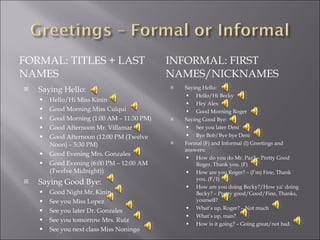
FORMAL: TITLES + LAST NAMES INFORMAL: FIRST NAMES/NICKNAMES Saying Hello: Hello/Hi Miss Kinin Good Morning Miss Culqui Good Morning (1:00 AM – 11:30 PM) Good Afternoon Mr. Villamar Good Afternoon (12:00 PM (Twelve Noon) – 5:30 PM) Good Evening Mrs. Gonzales Good Evening (6:00 PM – 12:00 AM (Twelve Midnight)) Saying Good Bye: Good Night Mr. Kinin See you Miss Lopez See you later Dr. Gonzales  See you tomorrow Mrs. Ruiz See you next class Miss Noningo Saying Hello: Hello/Hi Becky Hey Alex Good Morning Roger Saying Good Bye: See you later Deni Bye Bob/Bye bye Deni Formal (F) and Informal (I) Greetings and answers: How do you do Mr. Paz? – Pretty Good Roger, Thank you. (F) How are you Roger? – (I’m) Fine, Thank you. (F/I) How are you doing Becky?/How ya’ doing Becky? – Pretty good/Good/Fine, Thanks, yourself? What’s up, Roger? – Not much What’s up, man? How is it going? – Going great/not bad.
FORMAL: INFORMAL: A: A pleasure to meet you Mr. Green. B: A pleasure to meet you  too  Roger. Nice to meet you Miss Culqui. Nice to meet you  too  Roger. Good to know you Mark? Nice to know you  too , Bill How ya’ doing Vinnie? Hey, what’s up? How’s it going, man? What’s up, man? Hey, What’ up? Note :  The word  too  expresses an = feeling Nota :  La palabra  too  expresa Un sentimiento =
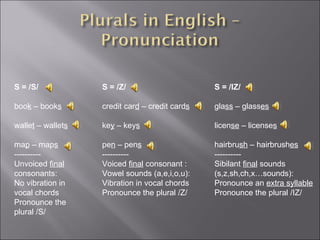
S = /S/ boo k  – book s walle t  – wallet s ma p  – map s   ---------- Unvoiced  final consonants: No vibration in vocal chords Pronounce the plural /S/ S = /Z/ credit car d  – credit card s ke y  – key s pe n  – pen s ---------- Voiced  final  consonant : Vowel sounds (a,e,i,o,u): Vibration in vocal chords Pronounce the plural /Z/ S = /IZ/ gla ss  – glass es licen se  – license s hairbru sh  – hairbrush es ---------- Sibilant  final  sounds  (s,z,sh,ch,x…sounds): Pronounce an  extra syllable Pronounce the plural /IZ/
POSSESSIVE ADJECTIVES + NOUNS POSSESSIVES WITH NAMES (NAME +  ‘S  + NOUN) My house His   CD Her   boyfriend Its   color Our house Your class (Plural) Their   teacher ---- Edilberto ’ s   CD Victoria ’ s   boyfriend The cat ’ s   color ---- ---- Roger is  Becky and Alex ’ s   teacher Note:   (A)  Carlos 's  or Carlos ‘  - Names with “s”/Nombres con “s”   (B)  The girls ’  restroom/The kids ’  bathroom  - Plural names or  nouns/Nombres/Sustantivos en plural
S = /S/ Robert – Robert’s Dick – Dick’s  ---------- Unvoiced final consonants: No vibration in vocal chords Pronounce the plural /S/ S = /Z/ Daniel – Daniel’s Edilberto – Edilberto’s Eduardo – Eduardo’s Becky – Becky’s Nugkui – Nugkui’s Angela – Angela’s Wilson – Wilson’s Ermeto – Ermeto’s Dina – Dina’s Pedro – Pedro’s ---------- Voiced final consonant : Vowel sounds (a,e,i,o,u): Vibration in vocal chords Pronounce the plural /Z/ S = /IZ/ Alice – Alice’s Denice – Denice’s Alex – Alex’s ---------- Sibilant final sounds  (s,z,sh,ch,x…sounds): Pronounce an  extra syllable Pronounce the plural /IZ/
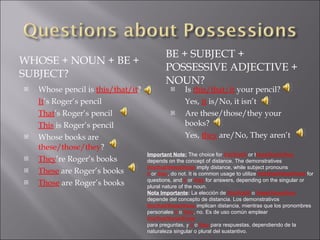
WHOSE + NOUN + BE + SUBJECT? BE + SUBJECT + POSSESSIVE ADJECTIVE + NOUN? Whose pencil is  this/that/it ? It ’s Roger’s pencil That ’s Roger’s pencil This  is Roger’s pencil Whose books are  these/those/they ? They ’re Roger’s books These  are Roger’s books Those  are Roger’s books Is  this/that/it  your pencil? Yes,  it  is/No, it isn’t Are these/those/they your books? Yes,  they  are/No, They aren’t Important Note:   The choice for  this/that/it  or t hese/those/they   depends on the concept of distance. The demonstratives  this/that/these/those  imply distance, while subject pronouns  it   or  they , do not. It is common usage to utilize  this/that/these/those  for  questions, and  it   or  they  for answers, depending on the singular or  plural nature of the noun. Nota Importante :  La elección de  this/that/it  o  these/those/they depende del concepto de distancia. Los demonstrativos  this/that/these/those  implican distancia, mientras que los pronombres personales  it  o  they , no. Es de uso común emplear  this/that/these/those para preguntas, y  it  o  they  para respuestas, dependiendo de la  naturaleza singular o plural del sustantivo.
WE WRITE THE ANSWERS/NOSOTROS ESCRIBIMOS LAS RESPUESTAS PLEASE, WRITE THE  YES/NO  OR  WH -QUESTIONS/POR FAVOR ESCRIBE LAS PREGUNTAS  YES/NO  O  WH - This is AIDESEP’s board Yes, it is. It is my marker. It’s Maria and Jose’s car. They are Carlos and Alice’s kids. It’s our English class Yes, they are. They are our dogs. Whose board is this? Is that your marker? Whose car is that? Whose kids are those? Whose class is this? Are these your dogs?
WE WRITE THE ANSWERS/NOSOTROS ESCRIBIMOS LAS RESPUESTAS PLEASE, WRITE THE  YES/NO  OR  WH -QUESTIONS/POR FAVOR ESCRIBE LAS PREGUNTAS  YES/NO  O  WH - No, it’s not. It’s Alex’s notebook. Yes, it is. It is our house. They are Dick and Jane’s radio. They are my glasses. It’s our office. Yes, they are. They’re our pens. --------------------------- ? --------------------------- ? --------------------------- ? --------------------------- ? --------------------------- ? --------------------------- ? Click to go to the next slide and see the answers. Haga click para ir a la siguiente diapositiva y ver las respuestas.
WE WRITE THE ANSWERS/NOSOTROS ESCRIBIMOS LAS RESPUESTAS PLEASE, CLICK TO SEE THE ANSWERS/POR FAVOR HAGA CLICK PARA VER LAS RESPUESTAS No, it’s not. It’s Alex’s notebook. Yes, it is. It is our house. They are Dick and Jane’s radio. They are my glasses. It’s our office. Yes, they are. They’re our pens. Is this your notebook? Is that your house? Whose radio is that? Whose glasses are those? Whose office is this? Are these your pens?
Conversation/ Conversción Roger:  Hi, how are you? Denice:  How ya’ doing? Roger:  Nice to meet you. I’m Roger Denice:  Nice to meet you too. I’m Denice Roger:  is that your dog? Denice:  No, it’s not. Roger:  Whose dog is that? Denice:  It’s Nare’s dog. Roger:  Who’s Nare? Denice:  She’s my sister. Roger:  What’s the dog’s name? Denice:  Racumin. Roger:  Oh Okay. See you later, Denice. Denice:  Bye bye.
Conversation Conversación You:  Good morning… Your friend:  Hi, how are you? You:  Is that your…?

Third Class - The Verb BE (Part II)

  • 1.
    Basic Level EnglishCourse August 21 st , 2010 The Verb BE (Part II)
  • 2.
    To discover morethings you can do/talk about in our world with the verb BE. Descubrir mas cosas que se pueden hacer/hablar en nuestro mundo con el verbo SER/ESTAR.
  • 3.
    FORMAL: TITLES +LAST NAMES INFORMAL: FIRST NAMES OR NICKNAMES Mr. For Males/Single or Married (Masculino/Soltero o Casado) Mr. Kinin Mrs. For Females/Married (Femenino/Casada) Mrs. Romero Miss. For Females/Single (Femenino/Soltera) Miss Culqui Ms. For Females/Single or Married – in writing (Femenino/Soltera o Casada – Por escrito. Ms. Noningo First Names & Nicknames Richard = Dick Robert = Bob William = Bill Andrew = Andy Rebecca = Becky Bradford = Brad Rosario = Charo Jose = Pepe Denice = Deni Jorge = Coqui
  • 4.
    FORMAL: TITLES +LAST NAMES INFORMAL: FIRST NAMES/NICKNAMES Saying Hello: Hello/Hi Miss Kinin Good Morning Miss Culqui Good Morning (1:00 AM – 11:30 PM) Good Afternoon Mr. Villamar Good Afternoon (12:00 PM (Twelve Noon) – 5:30 PM) Good Evening Mrs. Gonzales Good Evening (6:00 PM – 12:00 AM (Twelve Midnight)) Saying Good Bye: Good Night Mr. Kinin See you Miss Lopez See you later Dr. Gonzales See you tomorrow Mrs. Ruiz See you next class Miss Noningo Saying Hello: Hello/Hi Becky Hey Alex Good Morning Roger Saying Good Bye: See you later Deni Bye Bob/Bye bye Deni Formal (F) and Informal (I) Greetings and answers: How do you do Mr. Paz? – Pretty Good Roger, Thank you. (F) How are you Roger? – (I’m) Fine, Thank you. (F/I) How are you doing Becky?/How ya’ doing Becky? – Pretty good/Good/Fine, Thanks, yourself? What’s up, Roger? – Not much What’s up, man? How is it going? – Going great/not bad.
  • 5.
    FORMAL: INFORMAL: A:A pleasure to meet you Mr. Green. B: A pleasure to meet you too Roger. Nice to meet you Miss Culqui. Nice to meet you too Roger. Good to know you Mark? Nice to know you too , Bill How ya’ doing Vinnie? Hey, what’s up? How’s it going, man? What’s up, man? Hey, What’ up? Note : The word too expresses an = feeling Nota : La palabra too expresa Un sentimiento =
  • 6.
    S = /S/boo k – book s walle t – wallet s ma p – map s ---------- Unvoiced final consonants: No vibration in vocal chords Pronounce the plural /S/ S = /Z/ credit car d – credit card s ke y – key s pe n – pen s ---------- Voiced final consonant : Vowel sounds (a,e,i,o,u): Vibration in vocal chords Pronounce the plural /Z/ S = /IZ/ gla ss – glass es licen se – license s hairbru sh – hairbrush es ---------- Sibilant final sounds (s,z,sh,ch,x…sounds): Pronounce an extra syllable Pronounce the plural /IZ/
  • 7.
    POSSESSIVE ADJECTIVES +NOUNS POSSESSIVES WITH NAMES (NAME + ‘S + NOUN) My house His CD Her boyfriend Its color Our house Your class (Plural) Their teacher ---- Edilberto ’ s CD Victoria ’ s boyfriend The cat ’ s color ---- ---- Roger is Becky and Alex ’ s teacher Note: (A) Carlos 's or Carlos ‘ - Names with “s”/Nombres con “s” (B) The girls ’ restroom/The kids ’ bathroom - Plural names or nouns/Nombres/Sustantivos en plural
  • 8.
    S = /S/Robert – Robert’s Dick – Dick’s ---------- Unvoiced final consonants: No vibration in vocal chords Pronounce the plural /S/ S = /Z/ Daniel – Daniel’s Edilberto – Edilberto’s Eduardo – Eduardo’s Becky – Becky’s Nugkui – Nugkui’s Angela – Angela’s Wilson – Wilson’s Ermeto – Ermeto’s Dina – Dina’s Pedro – Pedro’s ---------- Voiced final consonant : Vowel sounds (a,e,i,o,u): Vibration in vocal chords Pronounce the plural /Z/ S = /IZ/ Alice – Alice’s Denice – Denice’s Alex – Alex’s ---------- Sibilant final sounds (s,z,sh,ch,x…sounds): Pronounce an extra syllable Pronounce the plural /IZ/
  • 9.
    WHOSE + NOUN+ BE + SUBJECT? BE + SUBJECT + POSSESSIVE ADJECTIVE + NOUN? Whose pencil is this/that/it ? It ’s Roger’s pencil That ’s Roger’s pencil This is Roger’s pencil Whose books are these/those/they ? They ’re Roger’s books These are Roger’s books Those are Roger’s books Is this/that/it your pencil? Yes, it is/No, it isn’t Are these/those/they your books? Yes, they are/No, They aren’t Important Note: The choice for this/that/it or t hese/those/they depends on the concept of distance. The demonstratives this/that/these/those imply distance, while subject pronouns it or they , do not. It is common usage to utilize this/that/these/those for questions, and it or they for answers, depending on the singular or plural nature of the noun. Nota Importante : La elección de this/that/it o these/those/they depende del concepto de distancia. Los demonstrativos this/that/these/those implican distancia, mientras que los pronombres personales it o they , no. Es de uso común emplear this/that/these/those para preguntas, y it o they para respuestas, dependiendo de la naturaleza singular o plural del sustantivo.
  • 10.
    WE WRITE THEANSWERS/NOSOTROS ESCRIBIMOS LAS RESPUESTAS PLEASE, WRITE THE YES/NO OR WH -QUESTIONS/POR FAVOR ESCRIBE LAS PREGUNTAS YES/NO O WH - This is AIDESEP’s board Yes, it is. It is my marker. It’s Maria and Jose’s car. They are Carlos and Alice’s kids. It’s our English class Yes, they are. They are our dogs. Whose board is this? Is that your marker? Whose car is that? Whose kids are those? Whose class is this? Are these your dogs?
  • 11.
    WE WRITE THEANSWERS/NOSOTROS ESCRIBIMOS LAS RESPUESTAS PLEASE, WRITE THE YES/NO OR WH -QUESTIONS/POR FAVOR ESCRIBE LAS PREGUNTAS YES/NO O WH - No, it’s not. It’s Alex’s notebook. Yes, it is. It is our house. They are Dick and Jane’s radio. They are my glasses. It’s our office. Yes, they are. They’re our pens. --------------------------- ? --------------------------- ? --------------------------- ? --------------------------- ? --------------------------- ? --------------------------- ? Click to go to the next slide and see the answers. Haga click para ir a la siguiente diapositiva y ver las respuestas.
  • 12.
    WE WRITE THEANSWERS/NOSOTROS ESCRIBIMOS LAS RESPUESTAS PLEASE, CLICK TO SEE THE ANSWERS/POR FAVOR HAGA CLICK PARA VER LAS RESPUESTAS No, it’s not. It’s Alex’s notebook. Yes, it is. It is our house. They are Dick and Jane’s radio. They are my glasses. It’s our office. Yes, they are. They’re our pens. Is this your notebook? Is that your house? Whose radio is that? Whose glasses are those? Whose office is this? Are these your pens?
  • 13.
    Conversation/ Conversción Roger: Hi, how are you? Denice: How ya’ doing? Roger: Nice to meet you. I’m Roger Denice: Nice to meet you too. I’m Denice Roger: is that your dog? Denice: No, it’s not. Roger: Whose dog is that? Denice: It’s Nare’s dog. Roger: Who’s Nare? Denice: She’s my sister. Roger: What’s the dog’s name? Denice: Racumin. Roger: Oh Okay. See you later, Denice. Denice: Bye bye.
  • 14.
    Conversation Conversación You: Good morning… Your friend: Hi, how are you? You: Is that your…?