MODULE 1
Basic 1
Contents
Unit 1
Lesson 1 Meet someone new.
Lesson 2 Identify and Describe people.
Lesson 3 Provide personal information.
Lesson 4 Introduce someone to a group.
Unit 2
Lesson 1 Accept or decline an invitation.
Lesson 2 Express locations and give directions.
Lesson 3 Make plans to see an event.
Lesson 4 Talk about musical tastes.
Unit 3
Lesson 1 Report news about relationships.
Lesson 2 Describe extended families.
Lesson 3 Compare people.
UNIT 1 GETTING ACQUAINTED
Acquainted - definition and synonyms
 If two people are acquainted, they know each other, usually not very
well. Get/become acquainted (=start to know someone by talking or doing
something together) (Dictionary, n.d.)
 Language and culture.
Each country has its culture, and customs for example in Japan, when you meet
someone that person gives you his or her business cards with two hands to show
respect. In some countries it is common to hug or kiss a person since the first time they
meet, but in El Salvador is reserved for friends or family members.
VERB TO BE
The verb to be has different meanings in English, it tells who you are and also where
you are.
We use the verb to be as an auxiliary or helper when we talk about actions in process
and short future.
Getting to know each other.
1. T: Hi! My name is Christian. What´s your name?
S: Hi, Christian. My name is Priscila. Nice to meet you.
T: It is nice to meet you too.
2. A: Good morning, my name is Christian Magana and I am your teacher. What´s
your name?
B: hello, my name is Diego, and she is Karen my classmate.
C: hi, good morning Mr. Magana.
A: Hi, Karen. Nice to meet you.
B/C: nice to meet you too.
LESSON 1 Meet someone new.
Grammar.
Information questions using the verb to be:
Usage and form.
Singular Plural
Who is your teacher? Where are your friends
What is your name? What are their names?
Where is your sister from? Where are your parents from?
How old is your sister? How old are your friends?
How old are you? How old are your parents?
VERB TO BE
SUBJECT / PRONOUN SIMPLE FORM CONTRACTED FORM
+ I AM I´M
I - I AM NOT I´M NOT
? AM I -
+ YOU ARE YOU´RE
YOU - YOU ARE NOT YOU´RE NOT / YOU
AREN´T.
? ARE YOU
+ SHE IS SHE´S
SHE - SHE IS NOT SHE´S NOT / SHE
ISN´T
? IS SHE
+ HE IS HE´S
HE - HE IS NOT HE´S NOT / HE ISN´T
? IS HE
+ IT IS IT´S
IT - IT IS NOT IT´S NOT / IT ISN´T
? IS IT
+ YOU ARE YOU´RE
YOU - YOU ARE NOT YOU´RE NOT / YOU
AREN´T.
? ARE YOU
+ WE ARE WE´RE
WE - WE ARE NOT WE´RE NOT / WE
AREN´T
? ARE WE
+ THEY ARE THEY´RE
THEY - THEY ARE NOT THEY´RE NOT / THEY
AREN´T
? ARE THEY
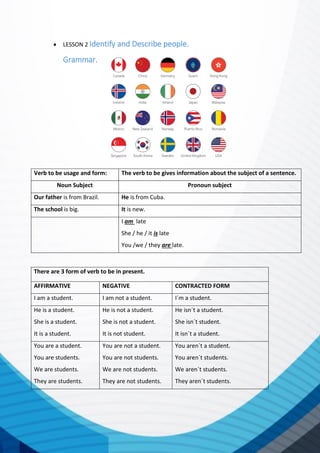
 LESSON 2 Identify and Describe people.
Grammar.
Verb to be usage and form: The verb to be gives information about the subject of a sentence.
Noun Subject Pronoun subject
Our father is from Brazil. He is from Cuba.
The school is big. It is new.
I am late
She / he / it is late
You /we / they are late.
There are 3 form of verb to be in present.
AFFIRMATIVE NEGATIVE CONTRACTED FORM
I am a student. I am not a student. I´m a student.
He is a student.
She is a student.
It is a student.
He is not a student.
She is not a student.
It is not student.
He isn´t a student.
She isn´t student.
It isn´t a student.
You are a student.
You are students.
We are students.
They are students.
You are not a student.
You are not students.
We are not students.
They are not students.
You aren´t a student.
You aren´t students.
We aren´t students.
They aren´t students.
 LESSON 3 Provide personal information.
Grammar. .
Use a capital letter to begin a sentence.
Meet my new classmate. Her first name is Sue.
Use a capital letter for:
Cities / Countries I live in El Salvador. She is from L.A.
Nationalities They ´re Honduran.
Language I speak Spanish and English.
Days and month My birthday is on Tuesday, June
20th.
The pronoun I My sister and I are doctors.
Names and formal titles I´d like you to meet Adan.
Professions
Accountant a person that works with the money and accounts of a
company.
My father is an accountant at the bank of central America.
Architect a person that designs building and houses.
She is an excellent architect, she designs my house.
Author They write books or novels.
One of my favorite author is Stephen King.
Baker They make bread and cakes and normally work in a bakery.
I love chocolate cake from Dulce café, there is a professional baker there.
Bus driver a person that drives buses.
I love my bus, it is nice to be a bus driver.
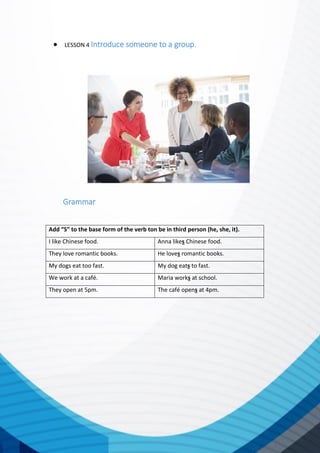
 LESSON 4 Introduce someone to a group.
Grammar
Add “S” to the base form of the verb ton be in third person (he, she, it).
I like Chinese food. Anna likes Chinese food.
They love romantic books. He loves romantic books.
My dogs eat too fast. My dog eats to fast.
We work at a café. Maria works at school.
They open at 5pm. The café opens at 4pm.
Pronoun Possessive
adjectives
Example
I MY I love my pet.
YOU YOUR Your car is big.
HE HIS His house is white.
SHE HER Her brother is tall.
IT ITS Its sound is good.
YOU YOUR Your
WE OUR Our friends are here.
THEY THEIR Their school is nice.
Possessive nouns
Add “S” to a name or noun.
This is Mario’s car. What is your father´s name?
Ana´s bother is there. What is your sister´s name?
There are Juan’s keys. Where is Mario´s father from?
Juan´s bar. Where is Maria’s mother?
Add an apostrophe (´) to plural nouns that end in “S”.
What are the dancers’ names? Who is this car´s driver?
UNIT 2 GOING OUT
The sentences.
In English, a sentence is a group of words that expresses a complete thought. A
sentence has a subject and a verb. When you write a sentence, begin with a capital
letter and end with a period.
Part of the speech
English language, words can be considered as the smallest elements that have
distinctive meanings. Based on their use and functions, words are categorized into
several types or parts of speech. This article will offer definitions and examples for the
8 major parts of speech in English
grammar: noun, pronoun, verb, adverb, adjective, conjunction, preposition,
and interjection. (speech.org, s.f.)
Nouns A noun is common or proper name, place, thing, or idea.
Pronoun We use them instead of a noun.
Verb The action of the sentences.
Adjective Describes nouns and pronouns.
Adverb Describe and modify adjectives, verbs and adverbs.
Preposition Are used to join two simple sentence into a compound one.
Conjunction Joins words or sentences.
Interjections Words that express emotion.
 LESSON 1 Accept or decline an invitation.
Grammar.
Prepositions of time and places: usage rules.
Time
Use on with the names of days or dates.
On Thursday On Monday morning On new year´s day On May 3rd
On the weekend On Sundays On a weekday
Use in with periods of time (but not with names of days).
In 2008 In July In (the) sprint In an hour
In the morning In the 20th century In the 1950´s In two weeks
Use at with specific moments in time.
At 9:00 At down At noon At night
At sunrise At dusk At midnight
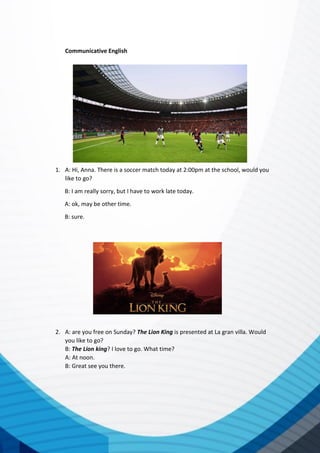
Communicative English
1. A: Hi, Anna. There is a soccer match today at 2:00pm at the school, would you
like to go?
B: I am really sorry, but I have to work late today.
A: ok, may be other time.
B: sure.
2. A: are you free on Sunday? The Lion King is presented at La gran villa. Would
you like to go?
B: The Lion king? I love to go. What time?
A: At noon.
B: Great see you there.
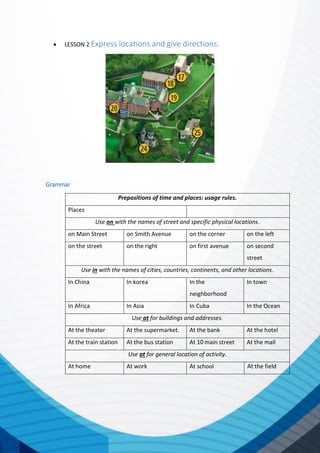
 LESSON 2 Express locations and give directions.
Grammar
Prepositions of time and places: usage rules.
Places
Use on with the names of street and specific physical locations.
on Main Street on Smith Avenue on the corner on the left
on the street on the right on first avenue on second
street
Use in with the names of cities, countries, continents, and other locations.
In China In korea In the
neighborhood
In town
In Africa In Asia In Cuba In the Ocean
Use at for buildings and addresses.
At the theater At the supermarket. At the bank At the hotel
At the train station At the bus station At 10 main street At the mall
Use at for general location of activity.
At home At work At school At the field
Communicative English
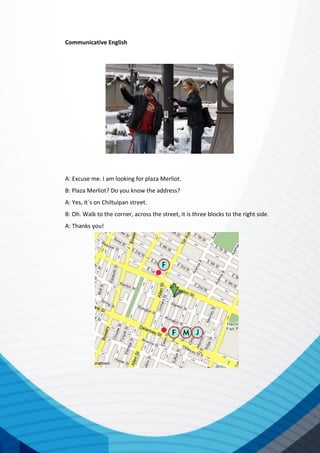
A: Excuse me. I am looking for plaza Merliot.
B: Plaza Merliot? Do you know the address?
A: Yes, it´s on Chiltuipan street.
B: Oh. Walk to the corner, across the street, it is three blocks to the right side.
A: Thanks you!
 LESSON 3 Make plans to see an event.
Grammar
Would like for preference
You can express a preference for an activity with would you like + a verb.
Statements
I´d like to go to the movie tonight. She would like to see a play.
They´d like to be friends. He would like to be here-
We´d like to be your classmate. We would like to dance with you.
He´d like to be your teacher. I would like to walk alone.
Questions and answers
Would you like to go with your father? Yes, I would.
What kind of food would you like to eat? I would like Mexican food
Would you like to eat pizza? Yes, I would.
Recycle this language.
Invite Accept and decline Location / directions
Are you free on Sunday? I´d love to go It´s across from the _
There´s a (play) at city
mall.
I´m a real _ fan. It´s around the corner
from the_
Would you like to go? See you at the mall. It´s on the other side of
the street.
Ask information Maybe some other time. It´s between the market
and the mall.
How about a movie? There is not for me. Walk to the mall.
 LESSON 4 Talk about musical tastes.
Music in your life
CesarMagana,Manager,BostonMassachusetts.
I am a big music fan. My favorite genres are rock, and electronic, and hip hop. I listen when I
sad, when I happy, when I bored, when I relaxing… almost all the time. I actually don’t
download music because there are lots of good streaming services. It’s so easy, and it
doesn’t cost much. I just click on an app on my smart phone and listen.
KarentContreras,ChefManager,ElSalvador.
I am a real music lover, so I listen a lot. I even listen to music when I´m doing other things. I
listen to quiet music while I prepare my classes, and I listen to exciting music when I
exercise. If I don’t, I bored.at home, I listen on my computer: MP3s from my library or to
online radio.
Grammar
Subject Verb Subject Verb
The play is great. She loves music.
My car is really big. It has a leg
Martha is a nice girl. She does beautiful
things.
Tom and Anna are in the school. They Study hard.
Verb
to be
Subject Auxiliary
Do/Does
Subject Verb
Is the play great? Does She love music?
Is my car really big? Does It have a leg?
Is Martha a nice girl? Does She do beautiful things?
Are Tom and Anna in the
school?
Do they Study hard?
UNIT 3 THE EXTENDED FAMILY.
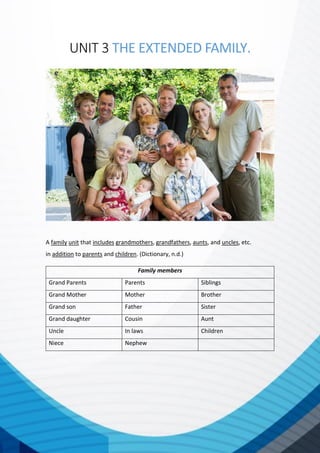
A family unit that includes grandmothers, grandfathers, aunts, and uncles, etc.
in addition to parents and children. (Dictionary, n.d.)
Family members
Grand Parents Parents Siblings
Grand Mother Mother Brother
Grand son Father Sister
Grand daughter Cousin Aunt
Uncle In laws Children
Niece Nephew
Communicative English
1. A: Who is that guy? Your brother?
B: No, that’s my brother in law, Marcello.
A: Does he have a sister?
B: No, he doesn’t.
2. A: What´s new?
B: Actually, I have some good news. My sister just got engaged!
A: That´s great. Congratulations!
B: Thanks!
A: So tell me about her fiancé. What does he do?
B: Well, he works at Sky. He is an engineer.
LESSON 1 Report news about relationships.
Combining sentences with and, or but
And But
Use and to ask two sentences if you
want to add information. Its common,
but not necessary, to add comma before
and.
Use but to combine two sentences if you
want to show a difference or contrast.
It’s common, but not necessary, to use a
comma before but.
The simple present tense
Affirmative Negative
My in-laws live in San Salvador. My aunt doesn’t live in El Salvador.
My ex-wife lives in Canada My cousin doesn’t work at home.
Yes / no questions and short answers
Do they have any children? Yes, they do.
Does your sister have a car? No, she doesn’t.
Do your parents work? No, they don’t.
Spelling rules
Add “S” to the base form of most verbs
Works Plays Likes Calls
Add es to verbs that ends in
Sh y O x
Washes Flies Does Relaxes
LESSON 2 Describe extended families.
Use the simple present to talk about facts and habitual actions in the
present.
Facts Habitual activities
Marcello speaks Spanish very well. Peter speaks English every day.
They work in a hospital. They work late today.
He drives cars. He drives home today.
The simple present tense – information questions
What do you’re in –laws do? What do you do?
Where does your father work? Where does your mother live?
When do you have the birthday party? When does she go?
How many brothers do you have? How many sisters does she have?
How old are you? How old is she?
Where does she live? Who is your friend?
What does she study? Why is he studying English?
When do you have classes? Who is your mother?
Communicative English
A: Do you come from a large family?
B: Not really. I have two brothers.
A: what about aunts and uncles?
B: Well, I have three aunts and four uncles in my father side, and three aunts, five uncles in my
mother sides.
A: That´s pretty big.
LESSON 3 Compare people.
Word Comparative Superlative
Bad Worse Worst
Much More Most
Little Less Least
Far Farther farthest Further furthest
We look alike.
We are different.
You look like your brother.
We both like rock music.
We were different clothes.
They look different.
I like different kind of music.
Your father and mother look alike.
Are we alike?
Is she like your mother?
They both have the same number of kids
They don’t have kids, like their brothers.
Bibliography
Foresman, S. (2008). The Grammar and Writing book. Pearson .
resources, M. E. (2009). Macmillan Dictionary. Retrieved from
https://www.macmillandictionary.com
woodwardenglish. (2019, 08 15). Retrieved from parts of speech :
https://www.grammar.cl/english/parts-of-speech.htm

Modulo1

  • 1.
    MODULE 1 Basic 1 Contents Unit1 Lesson 1 Meet someone new. Lesson 2 Identify and Describe people. Lesson 3 Provide personal information. Lesson 4 Introduce someone to a group. Unit 2 Lesson 1 Accept or decline an invitation. Lesson 2 Express locations and give directions. Lesson 3 Make plans to see an event. Lesson 4 Talk about musical tastes. Unit 3 Lesson 1 Report news about relationships. Lesson 2 Describe extended families. Lesson 3 Compare people.
  • 2.
    UNIT 1 GETTINGACQUAINTED Acquainted - definition and synonyms  If two people are acquainted, they know each other, usually not very well. Get/become acquainted (=start to know someone by talking or doing something together) (Dictionary, n.d.)  Language and culture. Each country has its culture, and customs for example in Japan, when you meet someone that person gives you his or her business cards with two hands to show respect. In some countries it is common to hug or kiss a person since the first time they meet, but in El Salvador is reserved for friends or family members. VERB TO BE The verb to be has different meanings in English, it tells who you are and also where you are. We use the verb to be as an auxiliary or helper when we talk about actions in process and short future.
  • 3.
    Getting to knoweach other. 1. T: Hi! My name is Christian. What´s your name? S: Hi, Christian. My name is Priscila. Nice to meet you. T: It is nice to meet you too. 2. A: Good morning, my name is Christian Magana and I am your teacher. What´s your name? B: hello, my name is Diego, and she is Karen my classmate. C: hi, good morning Mr. Magana. A: Hi, Karen. Nice to meet you. B/C: nice to meet you too.
  • 4.
    LESSON 1 Meetsomeone new. Grammar. Information questions using the verb to be: Usage and form. Singular Plural Who is your teacher? Where are your friends What is your name? What are their names? Where is your sister from? Where are your parents from? How old is your sister? How old are your friends? How old are you? How old are your parents?
  • 5.
    VERB TO BE SUBJECT/ PRONOUN SIMPLE FORM CONTRACTED FORM + I AM I´M I - I AM NOT I´M NOT ? AM I - + YOU ARE YOU´RE YOU - YOU ARE NOT YOU´RE NOT / YOU AREN´T. ? ARE YOU + SHE IS SHE´S SHE - SHE IS NOT SHE´S NOT / SHE ISN´T ? IS SHE + HE IS HE´S HE - HE IS NOT HE´S NOT / HE ISN´T ? IS HE + IT IS IT´S IT - IT IS NOT IT´S NOT / IT ISN´T ? IS IT + YOU ARE YOU´RE YOU - YOU ARE NOT YOU´RE NOT / YOU AREN´T. ? ARE YOU + WE ARE WE´RE WE - WE ARE NOT WE´RE NOT / WE AREN´T ? ARE WE + THEY ARE THEY´RE THEY - THEY ARE NOT THEY´RE NOT / THEY AREN´T ? ARE THEY
  • 6.
     LESSON 2Identify and Describe people. Grammar. Verb to be usage and form: The verb to be gives information about the subject of a sentence. Noun Subject Pronoun subject Our father is from Brazil. He is from Cuba. The school is big. It is new. I am late She / he / it is late You /we / they are late. There are 3 form of verb to be in present. AFFIRMATIVE NEGATIVE CONTRACTED FORM I am a student. I am not a student. I´m a student. He is a student. She is a student. It is a student. He is not a student. She is not a student. It is not student. He isn´t a student. She isn´t student. It isn´t a student. You are a student. You are students. We are students. They are students. You are not a student. You are not students. We are not students. They are not students. You aren´t a student. You aren´t students. We aren´t students. They aren´t students.
  • 7.
     LESSON 3Provide personal information. Grammar. . Use a capital letter to begin a sentence. Meet my new classmate. Her first name is Sue. Use a capital letter for: Cities / Countries I live in El Salvador. She is from L.A. Nationalities They ´re Honduran. Language I speak Spanish and English. Days and month My birthday is on Tuesday, June 20th. The pronoun I My sister and I are doctors. Names and formal titles I´d like you to meet Adan. Professions Accountant a person that works with the money and accounts of a company. My father is an accountant at the bank of central America. Architect a person that designs building and houses. She is an excellent architect, she designs my house. Author They write books or novels. One of my favorite author is Stephen King. Baker They make bread and cakes and normally work in a bakery. I love chocolate cake from Dulce café, there is a professional baker there. Bus driver a person that drives buses. I love my bus, it is nice to be a bus driver.
  • 8.
     LESSON 4Introduce someone to a group. Grammar Add “S” to the base form of the verb ton be in third person (he, she, it). I like Chinese food. Anna likes Chinese food. They love romantic books. He loves romantic books. My dogs eat too fast. My dog eats to fast. We work at a café. Maria works at school. They open at 5pm. The café opens at 4pm.
  • 9.
    Pronoun Possessive adjectives Example I MYI love my pet. YOU YOUR Your car is big. HE HIS His house is white. SHE HER Her brother is tall. IT ITS Its sound is good. YOU YOUR Your WE OUR Our friends are here. THEY THEIR Their school is nice. Possessive nouns Add “S” to a name or noun. This is Mario’s car. What is your father´s name? Ana´s bother is there. What is your sister´s name? There are Juan’s keys. Where is Mario´s father from? Juan´s bar. Where is Maria’s mother? Add an apostrophe (´) to plural nouns that end in “S”. What are the dancers’ names? Who is this car´s driver?
  • 10.
    UNIT 2 GOINGOUT The sentences. In English, a sentence is a group of words that expresses a complete thought. A sentence has a subject and a verb. When you write a sentence, begin with a capital letter and end with a period. Part of the speech English language, words can be considered as the smallest elements that have distinctive meanings. Based on their use and functions, words are categorized into several types or parts of speech. This article will offer definitions and examples for the 8 major parts of speech in English grammar: noun, pronoun, verb, adverb, adjective, conjunction, preposition, and interjection. (speech.org, s.f.)
  • 11.
    Nouns A nounis common or proper name, place, thing, or idea. Pronoun We use them instead of a noun. Verb The action of the sentences. Adjective Describes nouns and pronouns. Adverb Describe and modify adjectives, verbs and adverbs. Preposition Are used to join two simple sentence into a compound one. Conjunction Joins words or sentences. Interjections Words that express emotion.
  • 12.
     LESSON 1Accept or decline an invitation. Grammar. Prepositions of time and places: usage rules. Time Use on with the names of days or dates. On Thursday On Monday morning On new year´s day On May 3rd On the weekend On Sundays On a weekday Use in with periods of time (but not with names of days). In 2008 In July In (the) sprint In an hour In the morning In the 20th century In the 1950´s In two weeks Use at with specific moments in time. At 9:00 At down At noon At night At sunrise At dusk At midnight
  • 13.
    Communicative English 1. A:Hi, Anna. There is a soccer match today at 2:00pm at the school, would you like to go? B: I am really sorry, but I have to work late today. A: ok, may be other time. B: sure. 2. A: are you free on Sunday? The Lion King is presented at La gran villa. Would you like to go? B: The Lion king? I love to go. What time? A: At noon. B: Great see you there.
  • 14.
     LESSON 2Express locations and give directions. Grammar Prepositions of time and places: usage rules. Places Use on with the names of street and specific physical locations. on Main Street on Smith Avenue on the corner on the left on the street on the right on first avenue on second street Use in with the names of cities, countries, continents, and other locations. In China In korea In the neighborhood In town In Africa In Asia In Cuba In the Ocean Use at for buildings and addresses. At the theater At the supermarket. At the bank At the hotel At the train station At the bus station At 10 main street At the mall Use at for general location of activity. At home At work At school At the field
  • 15.
    Communicative English A: Excuseme. I am looking for plaza Merliot. B: Plaza Merliot? Do you know the address? A: Yes, it´s on Chiltuipan street. B: Oh. Walk to the corner, across the street, it is three blocks to the right side. A: Thanks you!
  • 16.
     LESSON 3Make plans to see an event.
  • 17.
    Grammar Would like forpreference You can express a preference for an activity with would you like + a verb. Statements I´d like to go to the movie tonight. She would like to see a play. They´d like to be friends. He would like to be here- We´d like to be your classmate. We would like to dance with you. He´d like to be your teacher. I would like to walk alone. Questions and answers Would you like to go with your father? Yes, I would. What kind of food would you like to eat? I would like Mexican food Would you like to eat pizza? Yes, I would. Recycle this language. Invite Accept and decline Location / directions Are you free on Sunday? I´d love to go It´s across from the _ There´s a (play) at city mall. I´m a real _ fan. It´s around the corner from the_ Would you like to go? See you at the mall. It´s on the other side of the street. Ask information Maybe some other time. It´s between the market and the mall. How about a movie? There is not for me. Walk to the mall.
  • 18.
     LESSON 4Talk about musical tastes. Music in your life CesarMagana,Manager,BostonMassachusetts. I am a big music fan. My favorite genres are rock, and electronic, and hip hop. I listen when I sad, when I happy, when I bored, when I relaxing… almost all the time. I actually don’t download music because there are lots of good streaming services. It’s so easy, and it doesn’t cost much. I just click on an app on my smart phone and listen. KarentContreras,ChefManager,ElSalvador. I am a real music lover, so I listen a lot. I even listen to music when I´m doing other things. I listen to quiet music while I prepare my classes, and I listen to exciting music when I exercise. If I don’t, I bored.at home, I listen on my computer: MP3s from my library or to online radio.
  • 19.
    Grammar Subject Verb SubjectVerb The play is great. She loves music. My car is really big. It has a leg Martha is a nice girl. She does beautiful things. Tom and Anna are in the school. They Study hard. Verb to be Subject Auxiliary Do/Does Subject Verb Is the play great? Does She love music? Is my car really big? Does It have a leg? Is Martha a nice girl? Does She do beautiful things? Are Tom and Anna in the school? Do they Study hard?
  • 20.
    UNIT 3 THEEXTENDED FAMILY. A family unit that includes grandmothers, grandfathers, aunts, and uncles, etc. in addition to parents and children. (Dictionary, n.d.) Family members Grand Parents Parents Siblings Grand Mother Mother Brother Grand son Father Sister Grand daughter Cousin Aunt Uncle In laws Children Niece Nephew
  • 21.
    Communicative English 1. A:Who is that guy? Your brother? B: No, that’s my brother in law, Marcello. A: Does he have a sister? B: No, he doesn’t. 2. A: What´s new? B: Actually, I have some good news. My sister just got engaged! A: That´s great. Congratulations! B: Thanks! A: So tell me about her fiancé. What does he do? B: Well, he works at Sky. He is an engineer.
  • 22.
    LESSON 1 Reportnews about relationships. Combining sentences with and, or but And But Use and to ask two sentences if you want to add information. Its common, but not necessary, to add comma before and. Use but to combine two sentences if you want to show a difference or contrast. It’s common, but not necessary, to use a comma before but. The simple present tense Affirmative Negative My in-laws live in San Salvador. My aunt doesn’t live in El Salvador. My ex-wife lives in Canada My cousin doesn’t work at home. Yes / no questions and short answers Do they have any children? Yes, they do. Does your sister have a car? No, she doesn’t. Do your parents work? No, they don’t. Spelling rules Add “S” to the base form of most verbs Works Plays Likes Calls Add es to verbs that ends in Sh y O x Washes Flies Does Relaxes
  • 23.
    LESSON 2 Describeextended families. Use the simple present to talk about facts and habitual actions in the present. Facts Habitual activities Marcello speaks Spanish very well. Peter speaks English every day. They work in a hospital. They work late today. He drives cars. He drives home today. The simple present tense – information questions What do you’re in –laws do? What do you do? Where does your father work? Where does your mother live? When do you have the birthday party? When does she go? How many brothers do you have? How many sisters does she have? How old are you? How old is she? Where does she live? Who is your friend? What does she study? Why is he studying English? When do you have classes? Who is your mother?
  • 24.
    Communicative English A: Doyou come from a large family? B: Not really. I have two brothers. A: what about aunts and uncles? B: Well, I have three aunts and four uncles in my father side, and three aunts, five uncles in my mother sides. A: That´s pretty big.
  • 25.
    LESSON 3 Comparepeople. Word Comparative Superlative Bad Worse Worst Much More Most Little Less Least Far Farther farthest Further furthest We look alike. We are different. You look like your brother. We both like rock music. We were different clothes. They look different. I like different kind of music. Your father and mother look alike. Are we alike? Is she like your mother? They both have the same number of kids They don’t have kids, like their brothers.
  • 26.
    Bibliography Foresman, S. (2008).The Grammar and Writing book. Pearson . resources, M. E. (2009). Macmillan Dictionary. Retrieved from https://www.macmillandictionary.com woodwardenglish. (2019, 08 15). Retrieved from parts of speech : https://www.grammar.cl/english/parts-of-speech.htm