HEADWAY BEGINNERS LEVEL
UNIT 1 Verb to be I You He She It We You They am are is is is are are are Feelings, placement, occupations, age Subject pronouns an engineer at home happy 28 years old on the table doctors 18 years old sad Affirmative not not not not not not not not Negative
UNIT 1 complement Verb to be + Question form Is happy Subject + she ? ? + Are doctors we ? Is in Spain your father ?
UNIT 1 Spelling rules for plural nouns 1. We add  “s”  to most nouns. book  book s pencil pencil s computer  computer s boy boy s 2. We add  ”es”  when the noun finishes in: x ch sh s o dish dish es sandwich sandwich es class  class es hero hero es box box es
UNIT 1 Spelling rules for plural nouns 3. When the noun ends in  “y”  after a consonant, drop the final  “y”  and add  “ies” dictionary dictionar ies lady lad ies  4. There are some irregular nouns: child children man men Woman women fish fish
UNIT 1 Demonstrative adjectives This is a book Singular Plural Near Far These are books That is a computer  Those are computers Those (are) That (is) These (are) This (is)
UNIT 1 Television Car Picture Computer Camera Bag Hamburger Sandwich Book House
UNIT 3 Jobs Teacher Taxi driver Police officer Businessman Doctor Shop assistant Nurse Student
UNIT 3 Questions and answers What’s your name? My name is … I am from… Where are you from? What’s your address? My address is… What’s your telephone number? My telephone number is … How old are you? What’s your job? I am … years old I’m a …  Are you married? Yes, … No, …
UNIT 3 Greetings Informal Hi! Bye! Hello! See you! / See you later! What’s up? Formal Good morning! Good evening! Good afternoon! Good night! Good bye! How’s it going? Howdy! Take care!
UNIT 4 Possessive adjectives  I You He She It We You They my your his her its our your their Indicate possession, ownership, or close relationship Subject pronouns It is   my   birthday. Your  friend is beautiful. This is   his   camera. Her   bag is old.
UNIT 4 Possessive nouns Indicate possession, ownership, or close relationship 1.   Singular nouns:   Add ’s to most nouns Joe’s car My father’s laptop 2.   Plural nouns:   Add ’ only to plural nouns that end in  s The students’ classroom The companies’ workers 3.   Plural nouns:   Add ’s to plural nouns that do not end in  s The children’s mother The women’s dresses 4.   For names ending in s:  Add ’s Charles’s cat Louis’s jackets 4.1   For names ending in s:  Simply add ’  Charles’ cat Louis’ jackets
UNIT 4 Members of the family mother son daughter brother wife husband father sister children parents Male Female Both mother son daughter brother wife husband father sister children parents
UNIT 4 Members of the family Sally Tom Kirsty Nick
UNIT 4 Have I You He She It We You They have have has has has have have have Subject pronouns three brothers. a car. a book. four jackets.
The Alphabet Aa Bb Cc Dd Ee Ff Gg Hh Ii Jj Kk Ll Mm Nn Oo Pp Qq Rr Ss Tt Uu Vv Ww Xx Yy Zz
A a
B b
C c
D d
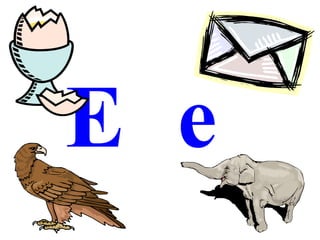
E e
F f
G g
H h
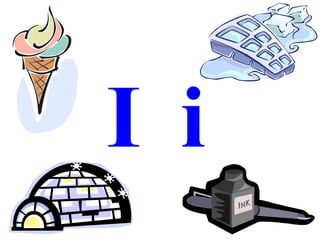
I i
J j
K k
L l
M m
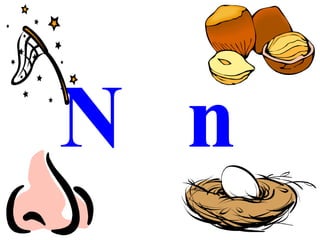
N n
O o
P p
Q q
R r
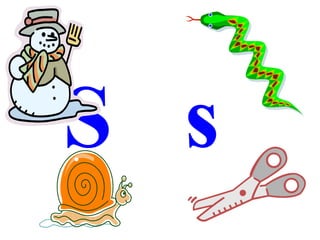
S s
T t
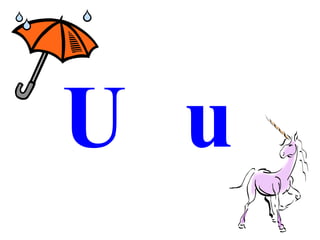
U u
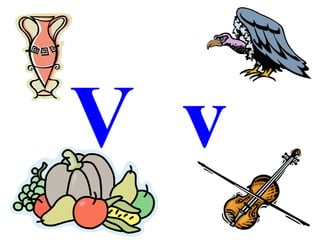
V v
W w
X x
Y y
Z z
UNIT 5 Sports Food Drinks Tennis Football Swimming Skiing Italian food Chinese food Pizza Hamburger Orange Ice cream Tea Coffee Soda Beer Wine
UNIT 5 Present Simple We use the Present Simple to describe habits, routine or everyday actions. It is the most common tense in English. Subject object verb + + Affirmative form She basketball. play s We T.V. watch The boy to the pool. go es
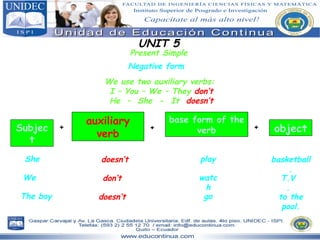
UNIT 5 Present Simple Subject object auxiliary verb + + Negative form She basketball. doesn’t We T.V. don’t The boy to the pool. doesn’t We use two auxiliary verbs:  I – You – We – They  don’t He  –  She  -  It  doesn’t base form of the verb + play watch go
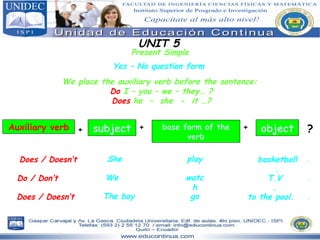
UNIT 5 Present Simple subject object Auxiliary verb + + Yes – No question form She basketball. Does / Doesn’t We T.V. Do / Don’t The boy to the pool. Does / Doesn’t We place the auxiliary verb before the sentence:  Do  I – you – we – they… ? Does  he  –  she  -  it …? base form of the verb + play watch go ? ? ? ?
UNIT 5 Present Simple Short answers She basketball. Does / Doesn’t play ? Yes, she  does No, she  doesn’t Long answers Yes, she play s  basketball No, she  doesn’t  play basketball
UNIT 5 Present Simple Time expressions They can be placed at the beginning or at the end of the sentence every day on Mondays (s) once a…  every week on Christmas twice a… every year on Halloween  three times a… every month on my birthday Every day,  I study my English lesson. or  I study my English lesson  every day .
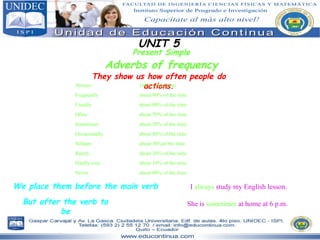
UNIT 5 Present Simple Adverbs of frequency They show us how often people do actions. Always 100% of the time  Frequently about 90% of the time Usually about 80% of the time Often about 70% of the time Sometimes about 50% of the time Occacionally about 40% of the time Seldom about 30%of the time Rarely about 20% of the time Hardly ever  about 10% of the time Never about 00% of the time I  always  study my English lesson. She is  sometimes  at home at 6 p.m. We place them before the main verb  But after the verb to be
UNIT 5 Spelling rules for the third person singular 1. We add  “s”  to most verbs. write  write s read read s sleep  sleep s eat eat s 2. We add  ”es”  to the base form when the verb ends with: z x ch sh s o wash wash es pass pass es watch  watch es go go es fix fix es buzz buzz es
UNIT 5 Spelling rules for the third person singular 2. When the verb ends in  “y”  after a consonant, drop the final  “y”  and add  “ies” fly fl ies study stud ies  copy  cop ies NOTE:  When a verb ends in  “y”  after a vowel, DO NOT drop the final  “y” , simply add  “s” play play s
Countries  & Nationalities
China Hello, my name is Chun Li I come from  China I am  Chinese I speak  Chinese
Japan I am Takuya Kimura I come from  Japan I am  Japanese I speak  Japanese
Korea I am Mr. Kim I come from  Korea I am  Korean I speak  Korean
France My name is  Napoleon I come from  France I am  French I speak  French
Italy I am Del Piero I come from  Italy I am  Italian I speak  Italian
Spain I am Mr. Bull Fighter I come from  Spain I am  Spanish I speak  Spanish
Germany I am Mr. Müller I come from  Germany I am  German I speak  German
The UK I am a guard I come from the  UK   /  Britain  /  England I am  Britain I speak  English
The USA I am George Bush I come from the  USA I am  American  I speak  English The United States of America
I come from China I speak I am I am I speak I come from Japan Chinese Chinese Japanese Japanese I come from the  I am  I speak British English I come from the  I am  I speak American English
UNIT 7 Wh - questions Who What Where Why When How Which Whose Person Things Place Reason Time Manner Choice Possessions Or  information questions  are used to ask for  specific information . Some wh-questions are:
UNIT 7 Wh - questions When you ask about the  subject  use a  wh-word  in place of the subject.  Example: Mike  writes you.     Who  writes you?  Victoria  studies English.     Who  studies English? For questions beginning with  which, whose, how much , and  how many , we often use a  wh-word + noun  in place of the subject. Example: The tall witness  tells you the truth.     Which witness  tells you the truth? Three people  live in that house.     How many people  live in that house?
UNIT 7 When the verb is a form of be ( am, is, are ) use: Wh-word  + be Example :  Harry Adams   is the teacher. Who   is  the teacher? Harry Adams is  the teacher . Who   is  Harry Adams?
UNIT 7 When you ask about the object use:  a wh-word  and this word order: Wh – word +  auxiliary verb  +  subject  +  main verb  +  ? Example: You look at  someone . ( someone = object ) Who(m)  do   you   look at ? He says  something . ( something = object ) What  does  he   say ?
If you have any questions, please let me know. Augusto Sánchez 084133384 [email_address]

English Beginners

  • 1.
  • 2.
    UNIT 1 Verbto be I You He She It We You They am are is is is are are are Feelings, placement, occupations, age Subject pronouns an engineer at home happy 28 years old on the table doctors 18 years old sad Affirmative not not not not not not not not Negative
  • 3.
    UNIT 1 complementVerb to be + Question form Is happy Subject + she ? ? + Are doctors we ? Is in Spain your father ?
  • 4.
    UNIT 1 Spellingrules for plural nouns 1. We add “s” to most nouns. book book s pencil pencil s computer computer s boy boy s 2. We add ”es” when the noun finishes in: x ch sh s o dish dish es sandwich sandwich es class class es hero hero es box box es
  • 5.
    UNIT 1 Spellingrules for plural nouns 3. When the noun ends in “y” after a consonant, drop the final “y” and add “ies” dictionary dictionar ies lady lad ies 4. There are some irregular nouns: child children man men Woman women fish fish
  • 6.
    UNIT 1 Demonstrativeadjectives This is a book Singular Plural Near Far These are books That is a computer Those are computers Those (are) That (is) These (are) This (is)
  • 7.
    UNIT 1 TelevisionCar Picture Computer Camera Bag Hamburger Sandwich Book House
  • 8.
    UNIT 3 JobsTeacher Taxi driver Police officer Businessman Doctor Shop assistant Nurse Student
  • 9.
    UNIT 3 Questionsand answers What’s your name? My name is … I am from… Where are you from? What’s your address? My address is… What’s your telephone number? My telephone number is … How old are you? What’s your job? I am … years old I’m a … Are you married? Yes, … No, …
  • 10.
    UNIT 3 GreetingsInformal Hi! Bye! Hello! See you! / See you later! What’s up? Formal Good morning! Good evening! Good afternoon! Good night! Good bye! How’s it going? Howdy! Take care!
  • 11.
    UNIT 4 Possessiveadjectives I You He She It We You They my your his her its our your their Indicate possession, ownership, or close relationship Subject pronouns It is my birthday. Your friend is beautiful. This is his camera. Her bag is old.
  • 12.
    UNIT 4 Possessivenouns Indicate possession, ownership, or close relationship 1. Singular nouns: Add ’s to most nouns Joe’s car My father’s laptop 2. Plural nouns: Add ’ only to plural nouns that end in s The students’ classroom The companies’ workers 3. Plural nouns: Add ’s to plural nouns that do not end in s The children’s mother The women’s dresses 4. For names ending in s: Add ’s Charles’s cat Louis’s jackets 4.1 For names ending in s: Simply add ’ Charles’ cat Louis’ jackets

  • 13.
    UNIT 4 Membersof the family mother son daughter brother wife husband father sister children parents Male Female Both mother son daughter brother wife husband father sister children parents
  • 14.
    UNIT 4 Membersof the family Sally Tom Kirsty Nick
  • 15.
    UNIT 4 HaveI You He She It We You They have have has has has have have have Subject pronouns three brothers. a car. a book. four jackets.
  • 16.
    The Alphabet AaBb Cc Dd Ee Ff Gg Hh Ii Jj Kk Ll Mm Nn Oo Pp Qq Rr Ss Tt Uu Vv Ww Xx Yy Zz
  • 17.
  • 18.
  • 19.
  • 20.
  • 21.
  • 22.
  • 23.
  • 24.
  • 25.
  • 26.
  • 27.
  • 28.
  • 29.
  • 30.
  • 31.
  • 32.
  • 33.
  • 34.
  • 35.
  • 36.
  • 37.
  • 38.
  • 39.
  • 40.
  • 41.
  • 42.
  • 43.
    UNIT 5 SportsFood Drinks Tennis Football Swimming Skiing Italian food Chinese food Pizza Hamburger Orange Ice cream Tea Coffee Soda Beer Wine
  • 44.
    UNIT 5 PresentSimple We use the Present Simple to describe habits, routine or everyday actions. It is the most common tense in English. Subject object verb + + Affirmative form She basketball. play s We T.V. watch The boy to the pool. go es
  • 45.
    UNIT 5 PresentSimple Subject object auxiliary verb + + Negative form She basketball. doesn’t We T.V. don’t The boy to the pool. doesn’t We use two auxiliary verbs: I – You – We – They don’t He – She - It doesn’t base form of the verb + play watch go
  • 46.
    UNIT 5 PresentSimple subject object Auxiliary verb + + Yes – No question form She basketball. Does / Doesn’t We T.V. Do / Don’t The boy to the pool. Does / Doesn’t We place the auxiliary verb before the sentence: Do I – you – we – they… ? Does he – she - it …? base form of the verb + play watch go ? ? ? ?
  • 47.
    UNIT 5 PresentSimple Short answers She basketball. Does / Doesn’t play ? Yes, she does No, she doesn’t Long answers Yes, she play s basketball No, she doesn’t play basketball
  • 48.
    UNIT 5 PresentSimple Time expressions They can be placed at the beginning or at the end of the sentence every day on Mondays (s) once a… every week on Christmas twice a… every year on Halloween three times a… every month on my birthday Every day, I study my English lesson. or I study my English lesson every day .
  • 49.
    UNIT 5 PresentSimple Adverbs of frequency They show us how often people do actions. Always 100% of the time Frequently about 90% of the time Usually about 80% of the time Often about 70% of the time Sometimes about 50% of the time Occacionally about 40% of the time Seldom about 30%of the time Rarely about 20% of the time Hardly ever about 10% of the time Never about 00% of the time I always study my English lesson. She is sometimes at home at 6 p.m. We place them before the main verb But after the verb to be
  • 50.
    UNIT 5 Spellingrules for the third person singular 1. We add “s” to most verbs. write write s read read s sleep sleep s eat eat s 2. We add ”es” to the base form when the verb ends with: z x ch sh s o wash wash es pass pass es watch watch es go go es fix fix es buzz buzz es
  • 51.
    UNIT 5 Spellingrules for the third person singular 2. When the verb ends in “y” after a consonant, drop the final “y” and add “ies” fly fl ies study stud ies copy cop ies NOTE: When a verb ends in “y” after a vowel, DO NOT drop the final “y” , simply add “s” play play s
  • 52.
    Countries &Nationalities
  • 53.
    China Hello, myname is Chun Li I come from China I am Chinese I speak Chinese
  • 54.
    Japan I amTakuya Kimura I come from Japan I am Japanese I speak Japanese
  • 55.
    Korea I amMr. Kim I come from Korea I am Korean I speak Korean
  • 56.
    France My nameis Napoleon I come from France I am French I speak French
  • 57.
    Italy I amDel Piero I come from Italy I am Italian I speak Italian
  • 58.
    Spain I amMr. Bull Fighter I come from Spain I am Spanish I speak Spanish
  • 59.
    Germany I amMr. Müller I come from Germany I am German I speak German
  • 60.
    The UK Iam a guard I come from the UK / Britain / England I am Britain I speak English
  • 61.
    The USA Iam George Bush I come from the USA I am American I speak English The United States of America
  • 62.
    I come fromChina I speak I am I am I speak I come from Japan Chinese Chinese Japanese Japanese I come from the I am I speak British English I come from the I am I speak American English
  • 63.
    UNIT 7 Wh- questions Who What Where Why When How Which Whose Person Things Place Reason Time Manner Choice Possessions Or information questions are used to ask for specific information . Some wh-questions are:
  • 64.
    UNIT 7 Wh- questions When you ask about the subject use a wh-word in place of the subject. Example: Mike writes you.  Who writes you? Victoria studies English.  Who studies English? For questions beginning with which, whose, how much , and how many , we often use a wh-word + noun in place of the subject. Example: The tall witness tells you the truth.  Which witness tells you the truth? Three people live in that house.  How many people live in that house?
  • 65.
    UNIT 7 Whenthe verb is a form of be ( am, is, are ) use: Wh-word + be Example : Harry Adams is the teacher. Who is the teacher? Harry Adams is the teacher . Who is Harry Adams?
  • 66.
    UNIT 7 Whenyou ask about the object use: a wh-word and this word order: Wh – word + auxiliary verb + subject + main verb + ? Example: You look at someone . ( someone = object ) Who(m) do you look at ? He says something . ( something = object ) What does he say ?
  • 67.
    If you haveany questions, please let me know. Augusto Sánchez 084133384 [email_address]