UNIVERSIDAD VERACRUZANA CENTRO DE IDIOMAS XALAPA CENTRO DE AUTOACCESO IBAS 200 2ª. ASESORIA GRUPAL JUST RIGHT PRE-INTERMEDIATE Martha Edna García Ramírez Unit 2    Unit 3    Unit 4   Unit 5   Unit 6 Unit 7   Unit 8   Unit 11   Unit 12   Unit  13
UNIT 1   The World of English Grammar : Comparative adjectives and  adverbs Vocabulary :  two - word   nouns Function :  Expressing   preferences
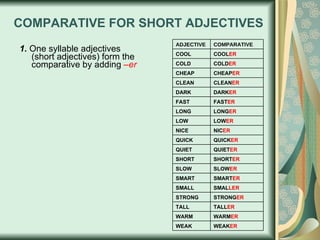
COMPARATIVE FOR SHORT ADJECTIVES 1.  One syllable adjectives (short adjectives) form the comparative by adding  –er COLD ER COLD LOW ER LOW SMART ER SMART CHEAP ER CHEAP COOL ER COOL WEAK ER WEAK WARM ER WARM TALL ER TALL STRONG ER STRONG SMAL LER SMALL SLOW ER SLOW SHORT ER SHORT QUIET ER QUIET QUICK ER QUICK NIC ER NICE LONG ER LONG FAST ER FAST DARK ER DARK CLEAN ER CLEAN COMPARATIVE  ADJECTIVE
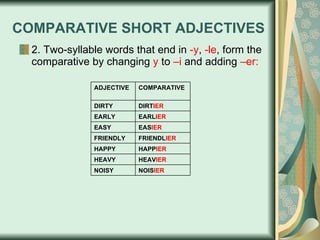
COMPARATIVE SHORT ADJECTIVES 2. Two-syllable words that end in  -y ,  -le , form the comparative by  changing  y  to  –i  and adding  –er: HEAV IER HEAVY NOIS IER NOISY HAPP IER HAPPY FRIENDL IER FRIENDLY EAS IER EASY EARL IER EARLY DIRT IER DIRTY COMPARATIVE ADJECTIVE
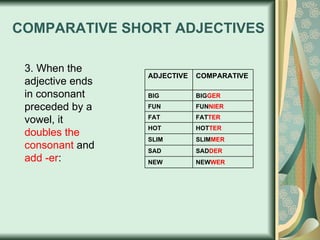
COMPARATIVE SHORT ADJECTIVES 3. When the adjective ends in consonant preceded by a vowel, it  doubles the consonant  and  add -er : FUN NIER FUN NEW WER NEW SAD DER SAD SLIM MER SLIM HOT TER HOT FAT TER FAT BIG GER BIG COMPARATIVE ADJECTIVE
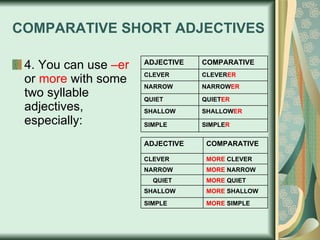
COMPARATIVE SHORT ADJECTIVES 4. You can use  –er  or  more  with some two syllable adjectives, especially: SIMPLE R SIMPLE SHALLOW ER SHALLOW QUIET ER QUIET NARROW ER NARROW CLEVER ER CLEVER COMPARATIVE ADJECTIVE MORE  SIMPLE SIMPLE MORE  SHALLOW SHALLOW MORE  QUIET QUIET MORE  NARROW NARROW MORE  CLEVER CLEVER COMPARATIVE ADJECTIVE
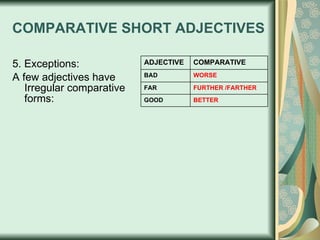
COMPARATIVE SHORT ADJECTIVES 5. Exceptions:  A few adjectives have Irregular comparative forms: FURTHER /FARTHER FAR BETTER GOOD WORSE BAD COMPARATIVE ADJECTIVE
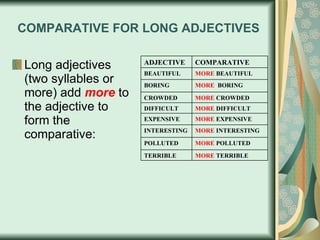
COMPARATIVE FOR LONG ADJECTIVES Long adjectives (two syllables or more) add  more  to the adjective to form the comparative: MORE  TERRIBLE TERRIBLE MORE  POLLUTED POLLUTED MORE  INTERESTING INTERESTING MORE  EXPENSIVE EXPENSIVE MORE  DIFFICULT DIFFICULT MORE  CROWDED CROWDED MORE   BORING BORING MORE  BEAUTIFUL BEAUTIFUL COMPARATIVE ADJECTIVE
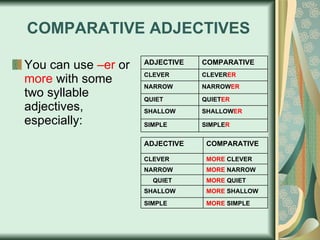
COMPARATIVE ADJECTIVES You can use  –er  or  more  with some two syllable adjectives, especially: SIMPLE R SIMPLE SHALLOW ER SHALLOW QUIET ER QUIET NARROW ER NARROW CLEVER ER CLEVER COMPARATIVE ADJECTIVE MORE  SIMPLE SIMPLE MORE  SHALLOW SHALLOW MORE  QUIET QUIET MORE  NARROW NARROW MORE  CLEVER CLEVER COMPARATIVE ADJECTIVE
REFERENCES: English Grammar in Use, Raymund Murphy, 3rd. Edition CUP, 2007 pp.210 Essential Grammar in Use, Raymund Murphy, 3rd. Ed. CUP 2007 pp 184 Grammar Spectrum 3 English Rules and practice Intermediate, Norman Coe, 2nd. Ed. OUP, p 97 Grammar Spectrum 1 English Rules and practice Elemen tary, Norman Coe, 2nd. Ed. OUP, p 97
ADVERBS An adverb tells you how something happens or how somebody does something: The train stopped  suddenly. He finished his soup  quickly.
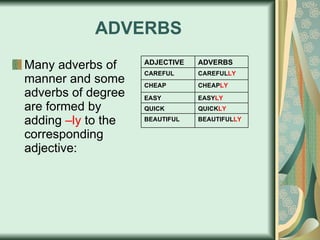
ADVERBS Many adverbs of manner and some adverbs of degree are formed by adding  –ly  to the corresponding adjective: BEAUTIFUL LY BEAUTIFUL QUICK LY QUICK EASY LY EASY CHEAP LY CHEAP CAREFUL LY CAREFUL ADVERBS ADJECTIVE
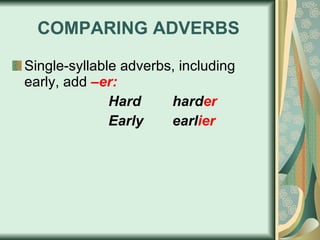
COMPARING ADVERBS Single-syllable adverbs, including early, add  –er: Hard hard er Early earl ier
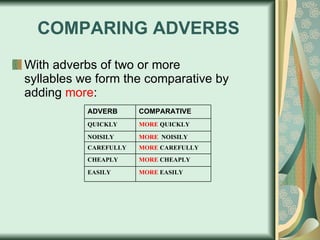
COMPARING ADVERBS With adverbs of two or more syllables we form the comparative by adding  more : MORE  EASILY EASILY MORE  CHEAPLY CHEAPLY MORE  CAREFULLY CAREFULLY MORE   NOISILY NOISILY MORE  QUICKLY QUICKLY COMPARATIVE ADVERB
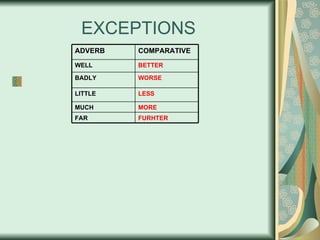
EXCEPTIONS FURHTER FAR MORE MUCH LESS LITTLE WORSE BADLY BETTER WELL COMPARATIVE ADVERB
EXPRESSING PREFERENCES ASKING  FOR PREFERENCES: Which do you prefer? Would you rather  a  to  b …? EXPRESSING PREFERENCES: I’d rather… I prefer…
REFERENCES: A Practical English Grammar, Thompson and Martinet, OUP, 4th ed. pp.47,49 Essential Grammar in Use, Raymund Murphy, 3rd. Ed. CUP 2007 pp 196 P 2000
-ING / ED ADJECTIVES There are adjectives ending in  –ing  an  –ed : Bor ed   bor ing Janes is bored because her job is boring
Adjectives ending in  –ed  are related to people’s attitude or feelings: She ’s  bored  with her job. They  are  interested  in politics. I  get  tired  after work. He  got  satisfied  with the results. I  was  shocked  when I heard the news.
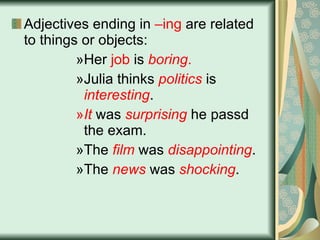
Adjectives ending in  –ing  are related to things or objects: Her  job  is  boring . Julia thinks  politics  is  interesting . It  was  surprising  he passd the exam. The  film  was  disappointing . The  news  was  shocking .
REFERENCES: Essential Grammar in Use, Raymund Murphy, 3rd. Ed. CUP 2007 pp 196
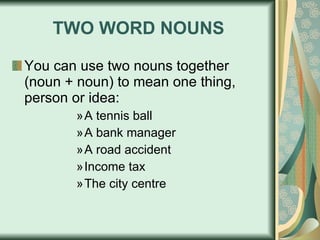
TWO WORD NOUNS You can use two nouns together (noun + noun) to mean one thing, person or idea: A tennis ball A bank manager A road accident Income tax The city centre
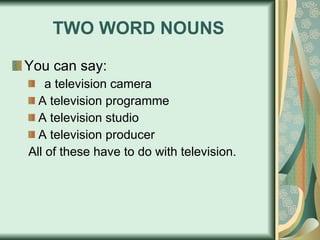
TWO WORD NOUNS You can say: a television camera A television programme A television studio A television producer All of these have to do with television.
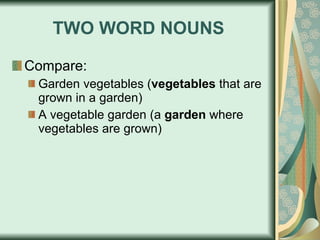
TWO WORD NOUNS Compare: Garden vegetables ( vegetables  that are grown in a garden) A vegetable garden (a  garden  where vegetables are grown)
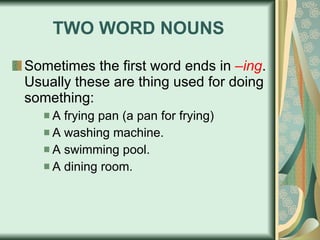
TWO WORD NOUNS Sometimes the first word ends in  –ing . Usually these are thing used for doing something: A frying pan (a pan for frying) A washing machine. A swimming pool. A dining room.
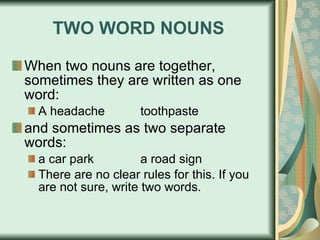
TWO WORD NOUNS When two nouns are together, sometimes they are written as one word:  A headache toothpaste and sometimes as two separate words: a car park a road sign There are no clear rules for this. If you are not sure, write two words.
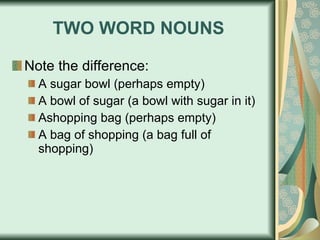
TWO WORD NOUNS Note the difference: A sugar bowl (perhaps empty) A bowl of sugar (a bowl with sugar in it) Ashopping bag (perhaps empty) A bag of shopping (a bag full of shopping)
TWO WORD NOUNS When we use noun + noun, the first noun is like an adjective which is normally singular. However, sometimes it is plural: A bookshop is a shop where you can buy books. An apple tree is a tree with apples.
REFERENCES: Essential Grammar in Use, Raymund Murphy, 3rd. Ed. CUP 2007 pp. 160
UNIT 2  DON’T GET STRESSED OUT Grammar : Countable and  uncountable   nouns . Vocabulary :  Phrases   with   countable   /  uncountable   nouns . Function :  asking   for / giving   advice
COUNTABLE NOUNS A countable noun can be singular or plural: Banana  Bananas  We can use  numbers  with countable nouns: One  banana Two  bananas We can use  a/an  with countable nouns: A  banana  An  apple
COUNTABLE NOUNS We  cannot use singular   countable nouns alone , but using a/the/my, etc: I want  a  banana I want banana We can use plural countable nouns alone: I like  bananas Accidents  can be prevented.
QUANTITY WORDS FOR COUNTABLE NOUNS A LOT OF LOTS OF MANY  A FEW  SOME  NOT MANY  ANY  NO
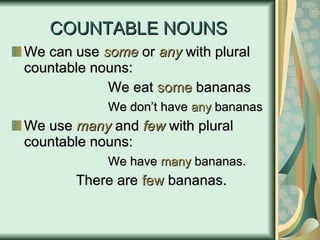
COUNTABLE NOUNS We can use  some  or  any  with plural countable nouns: We eat  some  bananas We don’t have  any  bananas We use  many  and  few  with plural countable nouns: We have  many  bananas. There are  few  bananas.
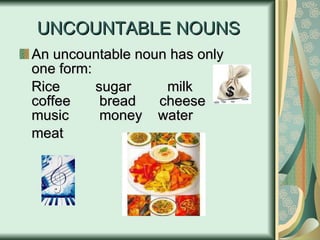
UNCOUNTABLE NOUNS An uncountable noun has only one form: Rice    sugar   milk   coffee   bread   cheese  music   money  water  meat
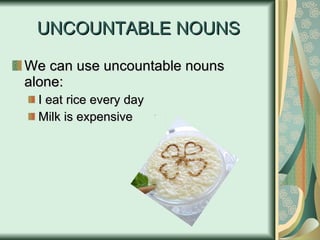
UNCOUNTABLE NOUNS We can use uncountable nouns alone: I eat rice every day Milk is expensive
UNCOUNTABLE NOUNS We  cannot use numbers  with uncountable nouns: Five rices We  cannot  normally  use   a / an   with uncountable nouns: A  sand,  but  sand A  music,  but  music A  rice,  but  rice
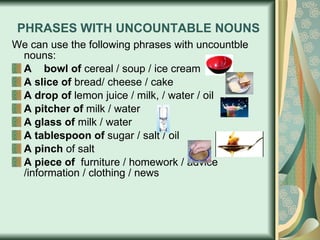
PHRASES WITH UNCOUNTABLE NOUNS We can use the following phrases   with uncountble nouns: A   bowl of  cereal / soup / ice cream A   slice of  bread/ cheese / cake  A drop of  lemon juice / milk, / water / oil A pitcher of  milk / water A glass of  milk / water A tablespoon of  sugar / salt / oil A pinch  of salt A piece of   furniture / homework / advice /information / clothing / news
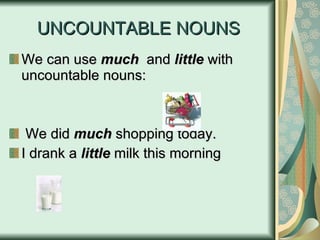
UNCOUNTABLE NOUNS We can use  much   and  little  with uncountable nouns: We did  much  shopping today. I drank a  little  milk this morning
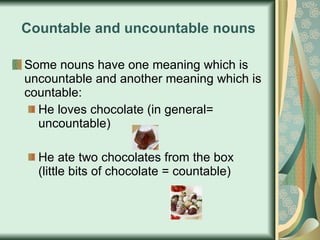
Countable and uncountable nouns Some nouns have one meaning which is uncountable and another meaning which is countable: He loves chocolate (in general= uncountable) He ate two chocolates from the box (little bits of chocolate = countable)
QUANTITY WORDS FOR UNCOUNTABLE NOUNS MUCH A LITTLE SOME NOT MUCH NO ANY
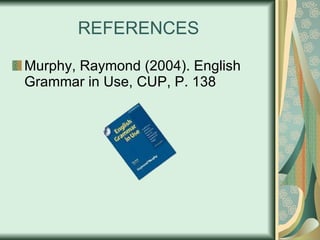
REFERENCES Murphy, Raymond (2004). English Grammar in Use, CUP, P. 138
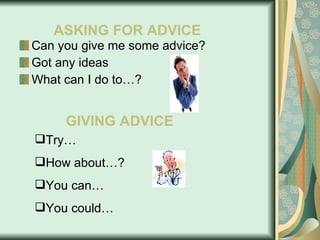
Can you give me some advice? Got any ideas What can I do to…? ASKING FOR ADVICE GIVING ADVICE Try… How about…? You can… You could…
UNIT 3 TV AND THE MEDIA CONTENTS: Present simple Present simple,  subject-object questions   Expressing   opinion
SIMPLE PRESENT TENSE We use the simple present tense to: Talk/ ask about repeated actions and habits: She goes to the movies every weekend. I always get hungry in ther afternoon.
SIMPLE PRESENT TENSE b) Talk/ask about general facts which are true and will be for some time: Water boils at 100º celsius. It doesn`t rain too much in summer. c) Describe what happens in a film, books, tv, or radio program: In the Novel Jane Eyre, jane marries Mr Rochester.
REFERENCES Murphy, Raymond (2004). English Grammar in Use, CUP, P. 6
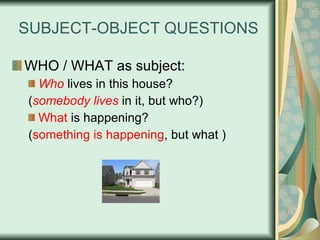
SUBJECT-OBJECT QUESTIONS WHO / WHAT as subject: Who   lives in this house? ( somebody lives  in it, but who?) What  is happening? ( something is happening , but what )
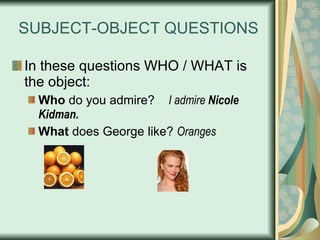
SUBJECT-OBJECT QUESTIONS In these questions WHO / WHAT is the object: Who  do you admire?  I admire  Nicole Kidman. What  does George like?  Oranges
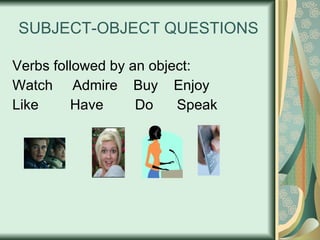
SUBJECT-OBJECT QUESTIONS Verbs followed by an object: Watch  Admire  Buy  Enjoy Like  Have  Do  Speak
REFERENCES Murphy, Raymond (2007). English Grammar in Use, 3dr. Ed. CUP, P. 100
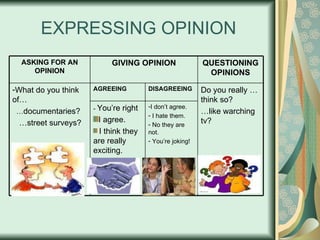
EXPRESSING OPINION Do you really …think so? … like warching tv? I don’t agree. I hate them. No they are not. You’re joking! -  You’re right I agree. I think they are really exciting. What do you think of… … documentaries? … street surveys? DISAGREEING AGREEING QUESTIONING OPINIONS GIVING OPINION ASKING FOR AN OPINION
UNIT 4: MAKING A LIVING Grammar : a)  present  simple  and  present  continuos    b)  present  continuos  with   				 future   meaning Vocabulary :  Jobs  and   work Function :  Likes   and   dislikes
UNIT 4: MAKING A LIVING PRESENT PROGRESSIVE We use  present progressive  or  continuous  to talk about: Things  happening at the time you’re speaking: I’ m  tak ing  a day off from work
UNIT 4: MAKING  LIVING b) Things that are temporary: I’ m  work ing  on Sundays this month . c) Things are going to happen in a near future: I’ m  leav ing  my job next week.
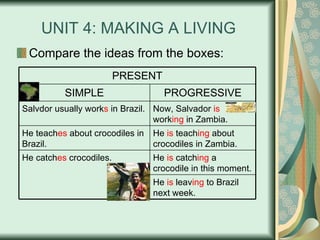
UNIT 4: MAKING A LIVING Compare the ideas from the boxes: PRESENT He  is  leav ing  to Brazil next week. He  is  catch ing  a  crocodile in this moment. He catch es  crocodiles. He  is  teach ing  about crocodiles in Zambia. He teach es  about crocodiles in Brazil. Now, Salvador  is  work ing  in Zambia. Salvdor usually work s  in Brazil. PROGRESSIVE SIMPLE
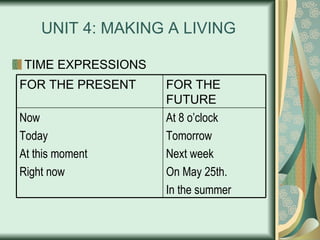
UNIT 4: MAKING A LIVING TIME EXPRESSIONS   At 8 o’clock Tomorrow Next week On May 25th. In the summer Now  Today At this moment Right now FOR THE FUTURE FOR THE PRESENT
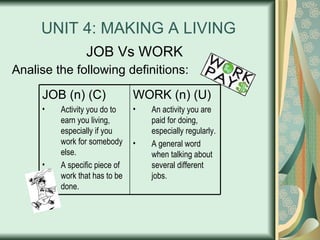
UNIT 4: MAKING A LIVING JOB Vs WORK Analise the following definitions:  WORK (n) (U) An activity you are paid for doing, especially regularly. A general word when talking about several different jobs. JOB (n) (C) Activity you do to earn you living, especially if you work for somebody else. A specific piece of work that has to be done.
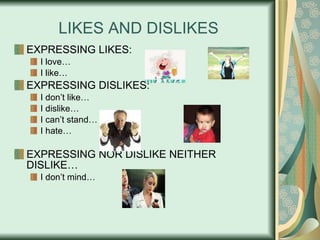
LIKES AND DISLIKES EXPRESSING LIKES: I love… I like… EXPRESSING DISLIKES: I don’t like… I dislike… I can’t stand… I hate… EXPRESSING NOR DISLIKE NEITHER DISLIKE… I don’t mind…
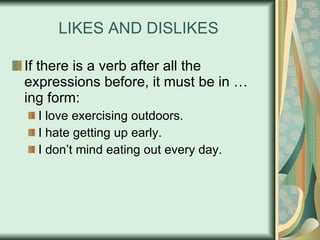
LIKES AND DISLIKES If there is a verb after all the expressions before, it must be in …ing form: I love exercising outdoors. I hate getting up early. I don’t mind eating out every day.
UNIT 5 : ON THE MOVE Grammar:  Prepositions of a) place    b) movement Vocabulary:   Public   Transportation Function:   Arranging   to   meet
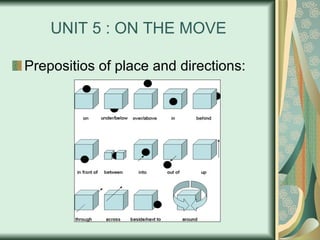
UNIT 5 : ON THE MOVE Prepositios of place and directions:
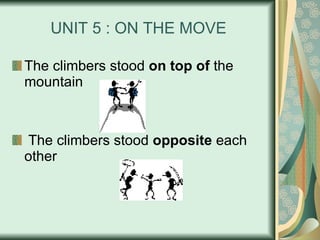
UNIT 5 : ON THE MOVE The climbers stood  on top of  the mountain The climbers stood  opposite  each other
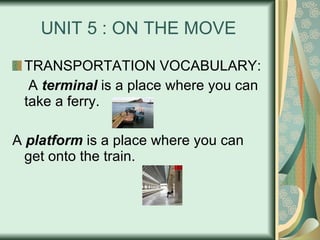
UNIT 5 : ON THE MOVE TRANSPORTATION VOCABULARY:   A  terminal  is a place where you can take a ferry. A  platform  is a place where you can get onto the train.
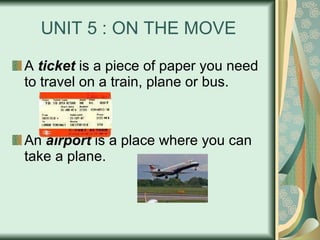
UNIT 5 : ON THE MOVE A  ticket  is a piece of paper you need to travel on a train, plane or bus. An  airport  is a place where you can take a plane.
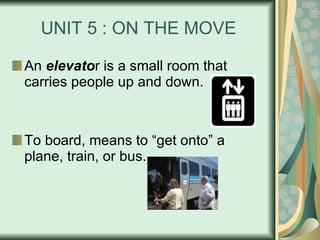
UNIT 5 : ON THE MOVE An  elevato r is a small room that carries people up and down. To board, means to “get onto” a plane, train, or bus.
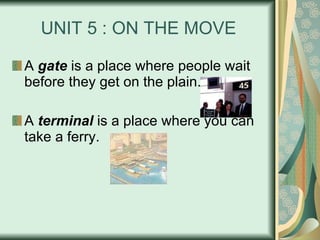
UNIT 5 : ON THE MOVE A  gate  is a place where people wait before they get on the plain. A  terminal  is a place where you can take a ferry.
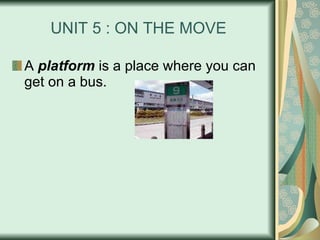
UNIT 5 : ON THE MOVE A  platform  is a place where you can get on a bus.
REFERENCES Harmer Jeremy, et al. (2007) Just Right Pre-Intermediate American edition, Workbook, pp. 26
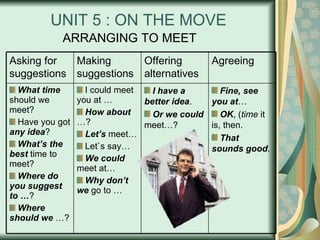
UNIT 5 : ON THE MOVE ARRANGING TO MEET Fine, see you at … OK , ( time  it is, then. That sounds good . I have a better idea . Or we could  meet…? I could meet you at … How about  …? Let’s  meet… Let`s say… We could  meet at… Why don’t we  go to … What time  should we meet? Have you got  any idea ? What’s the best  time to meet? Where do you suggest to … ? Where should we  …? Agreeing Offering alternatives Making suggestions Asking for suggestions
REFERENCES Harmer, Jeremy (2007) Just Right American Edition Student’s book, p 42
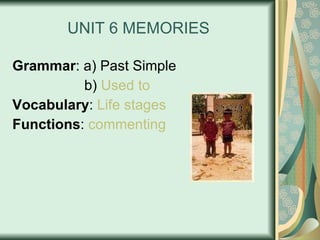
UNIT 6 MEMORIES Grammar : a) Past Simple   b)  Used   to Vocabulary :  Life   stages Functions :  commenting
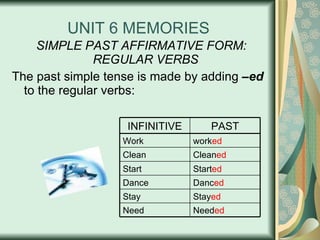
UNIT 6 MEMORIES SIMPLE PAST AFFIRMATIVE FORM: REGULAR VERBS The past simple tense is made by adding  –ed  to the regular verbs: Need ed Need Stay ed Stay Danc ed Dance Start ed Start Clean ed Clean work ed Work PAST INFINITIVE
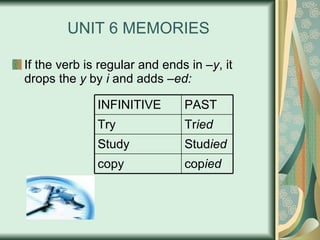
UNIT 6 MEMORIES If the verb is regular and ends in  –y , it drops the  y  by  i  and adds  –ed: cop ied copy Stud ied Study Tr ied Try PAST INFINITIVE
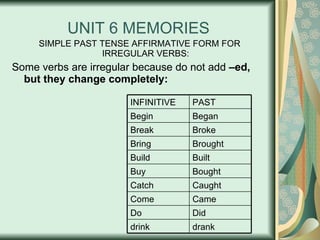
UNIT 6 MEMORIES SIMPLE PAST TENSE AFFIRMATIVE FORM FOR IRREGULAR VERBS: Some verbs are irregular because do not add  –ed,  but they change completely: drank drink Did Do Came Come Caught Catch Bought Buy Built Build Brought Bring Broke Break Began Begin PAST INFINITIVE
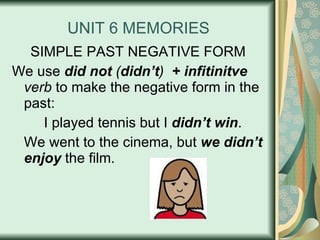
UNIT 6 MEMORIES SIMPLE PAST NEGATIVE FORM We use  did not  ( didn’t )   + infitinitve  verb  to make the negative form in the past: I played tennis but I  didn’t win . We went to the cinema, but  we didn’t enjoy  the film.
UNIT 6 MEMORIES SIMPLE PAST INTERROGATIVE FORM We use auxiliar Did and the infinitive form of the verb to make the interrogative form for simple past tense: Did   you  enjoy  the party? Did  you  see  him yesterday? Did  it  rain  last week? Did  your parents  have  a good holiday?
UNIT 6 MEMORIES TIME ADVERBS FOR SIMPLE PAST : Yesterday Last night / week / weekend / month / summer / year / etc. Ago before a noun: I had dinner an hour  ago Tom went out ten minutes  ago .
REFERENCES Murphy, Raymond (2007) Essential Grammar in Use with answers. 3rd. Ed. CUP, Italy, p 32
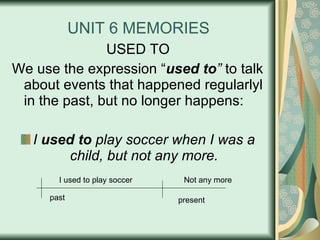
UNIT 6 MEMORIES USED TO We use the expression “ used to ”  to talk about events that happened regularlyl in the past, but no longer happens: I  used to  play soccer when I was a child, but not any more. past I used to play soccer Not any more present
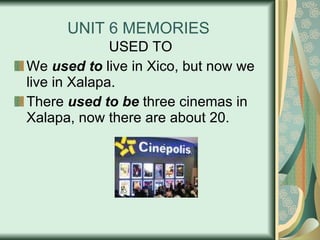
UNIT 6 MEMORIES USED TO We  used to  live in Xico, but now we live in Xalapa. There  used to be  three cinemas in Xalapa, now there are about 20.
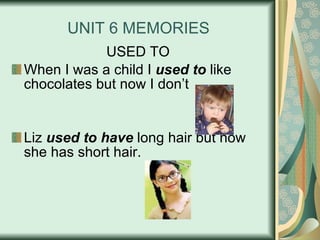
UNIT 6 MEMORIES USED TO When I was a child I  used to  like chocolates but now I don’t Liz  used to have  long hair but now she has short hair.
UNIT 6 MEMORIES USED TO NEGATIVE FORM When I was a child  I did not  (didn’t)  use to  like tomatoes, but now I do. I  didn’t use  to go to work, but now I do. I  didn’t use to  drive a car, now I do.
UNIT 6 MEMORIES USED TO INTERROGTIVE FORM Did you use to watch tv when you were a child? Did your parents use to have a cell phone when they were children? Did you use to travel by car when you were a child?
REFERENCES Murphy, Raymond (2004). English Grammar in Use with answers, CUP, 3rd. ed, p 36 Murphy, Raymond (2007). Essential Grammar in Use with answers, CUP, 3rd. ed, p. 82
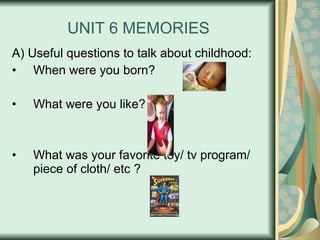
UNIT 6 MEMORIES A) Useful questions to talk about childhood: When were you born? What were you like?  What was your favorite toy/ tv program/ piece of cloth/ etc ?
UNIT 6 MEMORIES 4. Who was your favorite teacher? 5. What was your favorite school subject? 6. What time did you…? 7. Who did you… with? 8. What did you do …? 9. How long did you…? 10. What was ( the weather)  like in the afternoons…?
UNIT 6 MEMORIES B) Useful words to answer about childhood: My favorite teacher/ toy/ tv program/ piece of cloth was… When I was a child… … the weather was… … there were/weren’t… … there was/there wasn’t
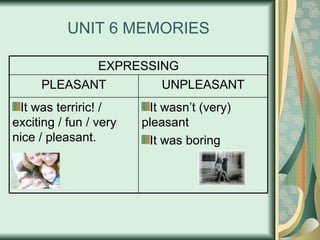
UNIT 6 MEMORIES It wasn’t (very) pleasant It was boring It was terriric! / exciting / fun / very nice / pleasant. UNPLEASANT PLEASANT EXPRESSING
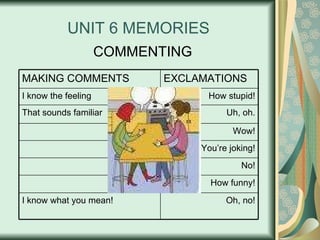
UNIT 6 MEMORIES COMMENTING You’re joking! How funny! No! Wow! Uh, oh. That sounds familiar Oh, no! I know what you mean! How stupid! I know the feeling EXCLAMATIONS MAKING COMMENTS
UNIT 7: TIME OFF Grammar: a)  ing  nouns(gerunds)   b)  verb  +  ing     c)  verb  +  to  +  infinitive Vocabulary:  Activities   Places  to  do  activities . Function:  Inviting
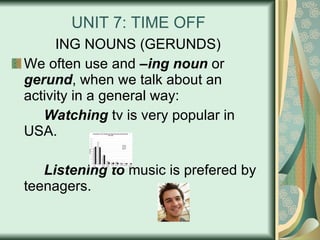
UNIT 7: TIME OFF ING NOUNS (GERUNDS) We often use and  –ing noun  or  gerund , when we talk about an activity in a general way: Watching  tv is very popular in USA. Listening to  music is prefered by teenagers.
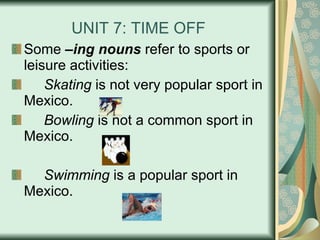
UNIT 7: TIME OFF Some  –ing nouns  refer to sports or leisure activities: Skating  is not very popular sport in Mexico. Bowling  is not a common sport in Mexico. Swimming  is a popular sport in Mexico.
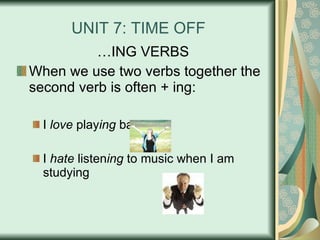
UNIT 7: TIME OFF … ING VERBS When we use two verbs together the second verb is often + ing: I  love  play ing  baseball. I  hate  listen ing  to music when I am studying
UNIT 7: TIME OFF Other verbs which take …ing are: Admit  Avoid   Consider   Deny   Dislike  Enjoy Enjoy  Finish   keep Mind  Suggest  practice  Start  Stop
UNIT 7: TIME OFF Examples: Everybody stopped talk ing . I’ll do the shopping when I’ve finished clean ing  the flat. He tried to avoid answer ing  my questions. I don’t fancy go ing  out this evening. She loves tak ing  exercise.
UNIT 7: TIME OFF VERB + TO + INFINITE After some verbs the second verb is always  to + infinite: I  decided to stay. She  wanted to see  him . Simon was in a difficult situation, so I  agreed to help  him.
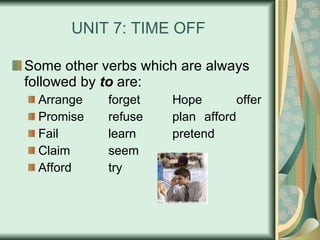
UNIT 7: TIME OFF Some other verbs which are always followed by  to  are: Arrange forget Hope  offer Promise refuse plan afford Fail learn pretend Claim seem Afford  try
REFERENCES Harmer, Jeremy (2007) Just Right Pre-intermediate American Edition mini-grammar Murphy, Raymund (2004) English Grammar in Use with answers, 3rd. Ed. pp106-107
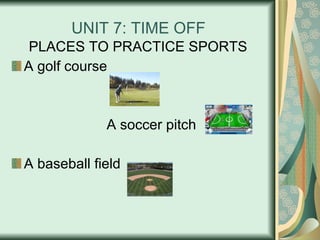
UNIT 7: TIME OFF PLACES TO PRACTICE SPORTS A golf course A soccer pitch A baseball field
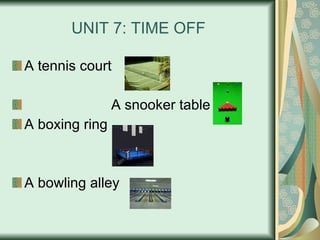
UNIT 7: TIME OFF A tennis court A snooker table A boxing ring A bowling alley
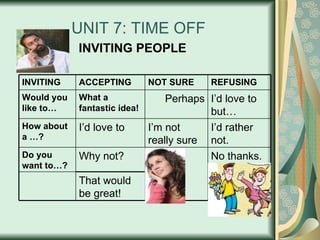
UNIT 7: TIME OFF INVITING PEOPLE No thanks. Why not? Do you want to…? That would be great! I’d rather not. I’m not really sure I’d love to How about a …? I’d love to but… Perhaps What a fantastic idea! Would you like to… REFUSING NOT SURE ACCEPTING INVITING
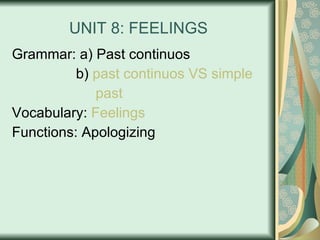
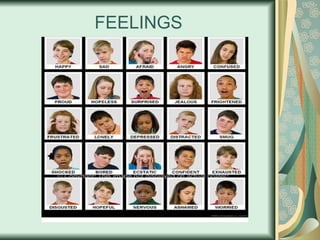
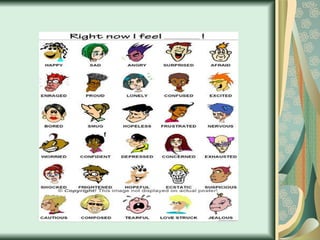
UNIT 8: FEELINGS Grammar: a) Past continuos b)  past  continuos VS simple       past Vocabulary:  Feelings Functions: Apologizing
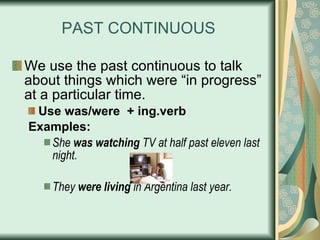
PAST CONTINUOUS We use the past continuous to talk about things which were “in progress” at a particular time.  Use was/were  + ing.verb Examples: She  was watching  TV at half past eleven last night. They  were living  in Argentina last year.
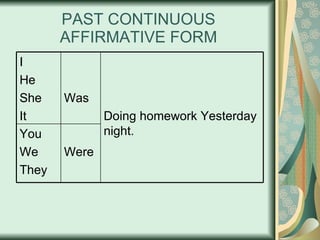
PAST CONTINUOUS AFFIRMATIVE FORM Were You  We They Doing homework Yesterday night. Was I He She It
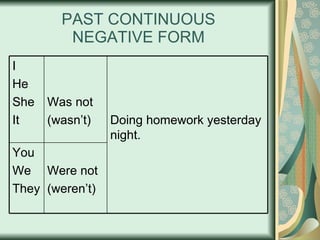
PAST CONTINUOUS NEGATIVE FORM Were not (weren’t) You  We They Doing homework yesterday night. Was not (wasn’t) I He She It
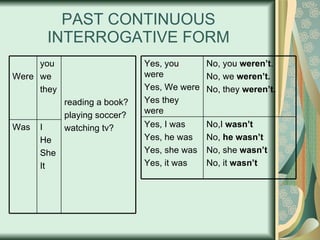
PAST CONTINUOUS INTERROGATIVE FORM I He She It Was reading a book? playing soccer? watching tv? you we they Were  No,I  wasn’t No,  he wasn’t No, she  wasn’t No, it  wasn’t Yes, I was Yes, he was Yes, she was Yes, it was No, you  weren’t . No, we  weren’t. No, they  weren’t. Yes, you were Yes, We were Yes they were
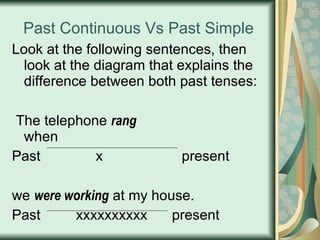
Past Continuous Vs Past Simple Look at the following sentences, then look at the diagram that explains the difference between both past tenses: The telephone  rang  when Past  x  present we  were working  at my house. Past  xxxxxxxxxx present
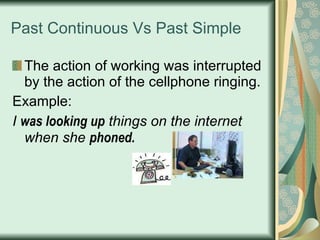
Past Continuous Vs Past Simple The action of working was interrupted by the action of the cellphone ringing. Example: I  was looking up  things on the internet when she  phoned.
FEELINGS
 
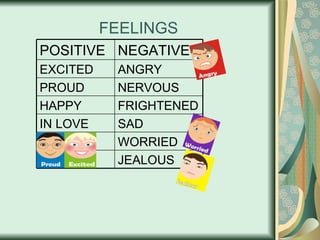
FEELINGS WORRIED SAD IN LOVE JEALOUS FRIGHTENED HAPPY NERVOUS PROUD ANGRY EXCITED NEGATIVE POSITIVE
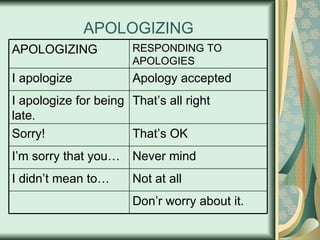
APOLOGIZING Don’r worry about it. Not at all I didn’t mean to… Never mind I’m sorry that you… That’s OK Sorry! That’s all right I apologize for being late. Apology accepted I apologize RESPONDING TO APOLOGIES APOLOGIZING
UNIT 11: BEFORE I’M THIRTY Grammar: a) The presente perfect   b)  for   and   since Vocabulary:  Performance Function:  Reserving  tickets , tables,  rooms.
PRESENT PERFECT We use the  Present Perfect Simple  to talk about things that started in the past and which are still true: I have worked with my father for a long time. They have never lost a competition.
PRESENT PERFECT Present Perfect tense form needs Subjetc (Name or Pronoun) + auxiliar Has /have + past participle of the verb: I  have studied  English for two years. She  has bought  the cake for the party. They  have swumn  in the river before.
PRESENT PERFECT To make the Negative form for Present Perfect use Subject + have + not (haven’t) + past participle verb + complement: I  haven’t  been to India She  hasn’t  called me.
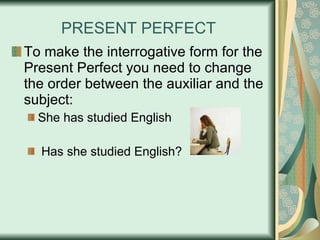
PRESENT PERFECT To make the interrogative form for the Present Perfect you need to change the order between the auxiliar and the subject: She has studied English Has she studied English?
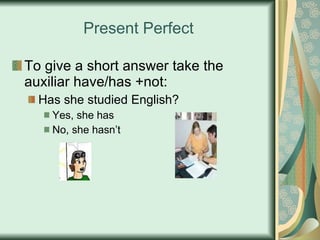
Present Perfect To give a short answer take the auxiliar have/has +not: Has she studied English? Yes, she has No, she hasn’t
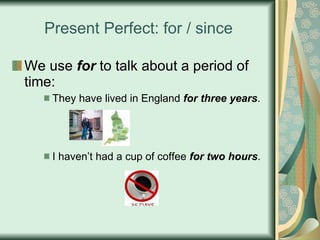
Present Perfect: for / since We use  for  to talk about a period of time: They have lived in England  for three years . I haven’t had a cup of coffee  for two hours .
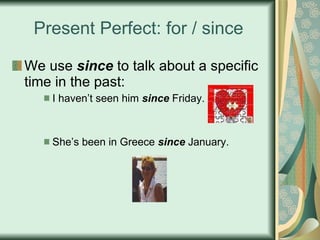
Present Perfect: for / since We use  since  to talk about a specific time in the past: I haven’t seen him  since  Friday. She’s been in Greece  since  January.
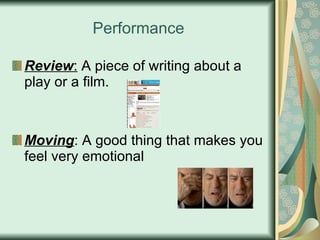
Performance Review :  A piece of writing about a play or a film. Moving : A good thing that makes you feel very emotional
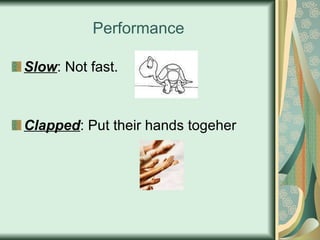
Performance Slow : Not fast. Clapped : Put their hands togeher
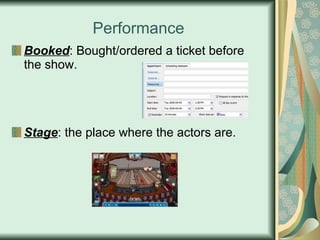
Performance Booked : Bought/ordered a ticket before the show. Stage : the place where the actors are.
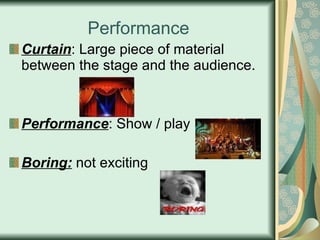
Performance Curtain : Large piece of material between the stage and the audience. Performance : Show / play Boring:  not exciting
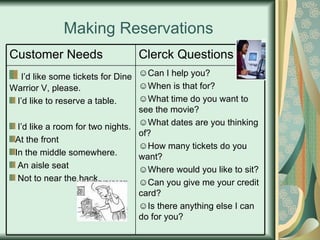
Making Reservations Can I help you? When is that for? What time do you want to see the movie? What dates are you thinking of? How many tickets do you want? Where would you like to sit? Can you give me your credit card? Is there anything else I can do for you? I’d like some tickets for Dine Warrior V, please. I’d like to reserve a table. I’d like a room for two nights. At the front In the middle somewhere. An aisle seat Not to near the back. Clerck Questions Customer Needs
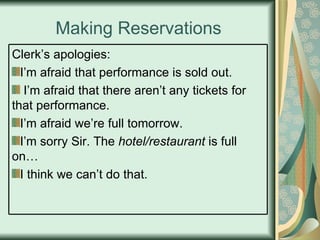
Making Reservations Clerk’s apologies: I’m afraid that performance is sold out. I’m afraid that there aren’t any tickets for that performance. I’m afraid we’re full tomorrow. I’m sorry Sir. The  hotel/restaurant  is full on… I think we can’t do that.
UNIT 12: Making a difference Grammar: 1) Future simple for predictions and  unplanned   decisions .   2)  Probability   modals Vocabulary:  Function Offering to help
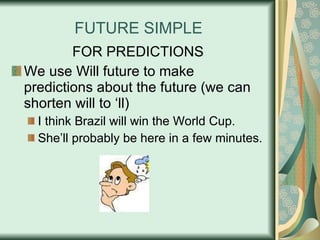
FUTURE SIMPLE FOR PREDICTIONS We use Will future to make predictions about the future (we can shorten will to ‘ll) I think Brazil will win the World Cup. She’ll probably be here in a few minutes.
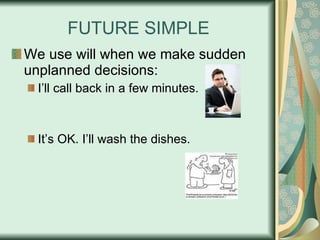
FUTURE SIMPLE We use will when we make sudden unplanned decisions: I’ll call back in a few minutes. It’s OK. I’ll wash the dishes.
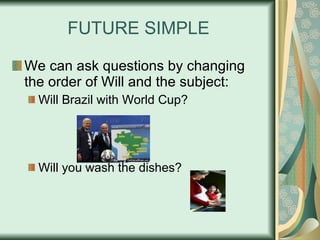
FUTURE SIMPLE We can ask questions by changing the order of Will and the subject: Will Brazil with World Cup? Will you wash the dishes?
Probability Modals Use the modals  will, might, could , may and won’t to talk about how probable the future is: I’ll see you tomorrow  (I am 100% certain) I won’t see you tomorrow (I am 100% certian I won’t see you) I might see you tomorrow I’m 50% certain) I could /may see you tomorrow (I’m 40% certain)
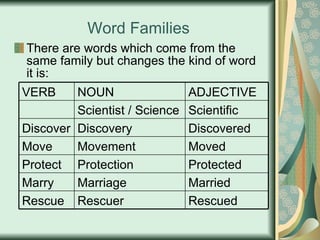
Word Families There are words which come from the same family but changes the kind of word it is: Rescued Rescuer Rescue Married Marriage Marry Protected Protection Protect Moved Movement Move Discovered Discovery Discover Scientific Scientist / Science ADJECTIVE NOUN VERB
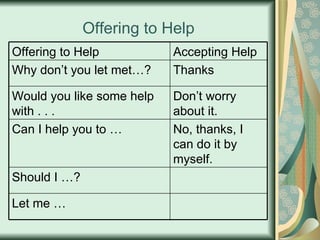
Offering to Help Let me … Should I …? No, thanks, I can do it by myself. Can I help you to … Don’t worry about it. Would you like some help with . . . Thanks Why don’t you let met…? Accepting Help Offering to Help
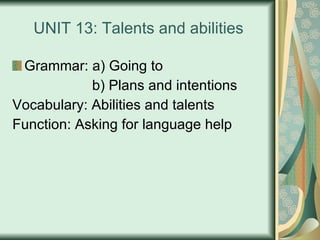
UNIT 13: Talents and abilities Grammar: a) Going to   b) Plans and intentions Vocabulary: Abilities and talents Function: Asking for language help
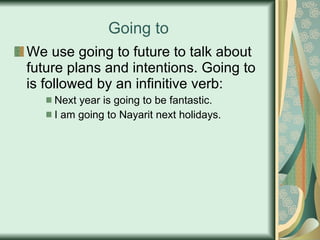
Going to We use going to future to talk about future plans and intentions. Going to is followed by an infinitive verb: Next year is going to be fantastic. I am going to Nayarit next holidays.
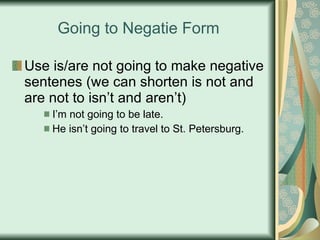
Going to Negatie Form Use is/are not going to make negative sentenes (we can shorten is not and are not to isn’t and aren’t) I’m not going to be late. He isn’t going to travel to St. Petersburg.
Going to Interrogative Form You need to change the verb Be at the beginning to make a question: Are you going to travel to Europe next
This is the end of the Group Couseling We hope you have good results in your next examinatios. GOOD LUCK!!! Self Acces Staff
IBAS 2

  • 1.
    UNIVERSIDAD VERACRUZANA CENTRODE IDIOMAS XALAPA CENTRO DE AUTOACCESO IBAS 200 2ª. ASESORIA GRUPAL JUST RIGHT PRE-INTERMEDIATE Martha Edna García Ramírez Unit 2 Unit 3 Unit 4 Unit 5 Unit 6 Unit 7 Unit 8 Unit 11 Unit 12 Unit 13
  • 2.
    UNIT 1 The World of English Grammar : Comparative adjectives and adverbs Vocabulary : two - word nouns Function : Expressing preferences
  • 3.
    COMPARATIVE FOR SHORTADJECTIVES 1. One syllable adjectives (short adjectives) form the comparative by adding –er COLD ER COLD LOW ER LOW SMART ER SMART CHEAP ER CHEAP COOL ER COOL WEAK ER WEAK WARM ER WARM TALL ER TALL STRONG ER STRONG SMAL LER SMALL SLOW ER SLOW SHORT ER SHORT QUIET ER QUIET QUICK ER QUICK NIC ER NICE LONG ER LONG FAST ER FAST DARK ER DARK CLEAN ER CLEAN COMPARATIVE ADJECTIVE
  • 4.
    COMPARATIVE SHORT ADJECTIVES2. Two-syllable words that end in -y , -le , form the comparative by changing y to –i and adding –er: HEAV IER HEAVY NOIS IER NOISY HAPP IER HAPPY FRIENDL IER FRIENDLY EAS IER EASY EARL IER EARLY DIRT IER DIRTY COMPARATIVE ADJECTIVE
  • 5.
    COMPARATIVE SHORT ADJECTIVES3. When the adjective ends in consonant preceded by a vowel, it doubles the consonant and add -er : FUN NIER FUN NEW WER NEW SAD DER SAD SLIM MER SLIM HOT TER HOT FAT TER FAT BIG GER BIG COMPARATIVE ADJECTIVE
  • 6.
    COMPARATIVE SHORT ADJECTIVES4. You can use –er or more with some two syllable adjectives, especially: SIMPLE R SIMPLE SHALLOW ER SHALLOW QUIET ER QUIET NARROW ER NARROW CLEVER ER CLEVER COMPARATIVE ADJECTIVE MORE SIMPLE SIMPLE MORE SHALLOW SHALLOW MORE QUIET QUIET MORE NARROW NARROW MORE CLEVER CLEVER COMPARATIVE ADJECTIVE
  • 7.
    COMPARATIVE SHORT ADJECTIVES5. Exceptions: A few adjectives have Irregular comparative forms: FURTHER /FARTHER FAR BETTER GOOD WORSE BAD COMPARATIVE ADJECTIVE
  • 8.
    COMPARATIVE FOR LONGADJECTIVES Long adjectives (two syllables or more) add more to the adjective to form the comparative: MORE TERRIBLE TERRIBLE MORE POLLUTED POLLUTED MORE INTERESTING INTERESTING MORE EXPENSIVE EXPENSIVE MORE DIFFICULT DIFFICULT MORE CROWDED CROWDED MORE BORING BORING MORE BEAUTIFUL BEAUTIFUL COMPARATIVE ADJECTIVE
  • 9.
    COMPARATIVE ADJECTIVES Youcan use –er or more with some two syllable adjectives, especially: SIMPLE R SIMPLE SHALLOW ER SHALLOW QUIET ER QUIET NARROW ER NARROW CLEVER ER CLEVER COMPARATIVE ADJECTIVE MORE SIMPLE SIMPLE MORE SHALLOW SHALLOW MORE QUIET QUIET MORE NARROW NARROW MORE CLEVER CLEVER COMPARATIVE ADJECTIVE
  • 10.
    REFERENCES: English Grammarin Use, Raymund Murphy, 3rd. Edition CUP, 2007 pp.210 Essential Grammar in Use, Raymund Murphy, 3rd. Ed. CUP 2007 pp 184 Grammar Spectrum 3 English Rules and practice Intermediate, Norman Coe, 2nd. Ed. OUP, p 97 Grammar Spectrum 1 English Rules and practice Elemen tary, Norman Coe, 2nd. Ed. OUP, p 97
  • 11.
    ADVERBS An adverbtells you how something happens or how somebody does something: The train stopped suddenly. He finished his soup quickly.
  • 12.
    ADVERBS Many adverbsof manner and some adverbs of degree are formed by adding –ly to the corresponding adjective: BEAUTIFUL LY BEAUTIFUL QUICK LY QUICK EASY LY EASY CHEAP LY CHEAP CAREFUL LY CAREFUL ADVERBS ADJECTIVE
  • 13.
    COMPARING ADVERBS Single-syllableadverbs, including early, add –er: Hard hard er Early earl ier
  • 14.
    COMPARING ADVERBS Withadverbs of two or more syllables we form the comparative by adding more : MORE EASILY EASILY MORE CHEAPLY CHEAPLY MORE CAREFULLY CAREFULLY MORE NOISILY NOISILY MORE QUICKLY QUICKLY COMPARATIVE ADVERB
  • 15.
    EXCEPTIONS FURHTER FARMORE MUCH LESS LITTLE WORSE BADLY BETTER WELL COMPARATIVE ADVERB
  • 16.
    EXPRESSING PREFERENCES ASKING FOR PREFERENCES: Which do you prefer? Would you rather a to b …? EXPRESSING PREFERENCES: I’d rather… I prefer…
  • 17.
    REFERENCES: A PracticalEnglish Grammar, Thompson and Martinet, OUP, 4th ed. pp.47,49 Essential Grammar in Use, Raymund Murphy, 3rd. Ed. CUP 2007 pp 196 P 2000
  • 18.
    -ING / EDADJECTIVES There are adjectives ending in –ing an –ed : Bor ed bor ing Janes is bored because her job is boring
  • 19.
    Adjectives ending in –ed are related to people’s attitude or feelings: She ’s bored with her job. They are interested in politics. I get tired after work. He got satisfied with the results. I was shocked when I heard the news.
  • 20.
    Adjectives ending in –ing are related to things or objects: Her job is boring . Julia thinks politics is interesting . It was surprising he passd the exam. The film was disappointing . The news was shocking .
  • 21.
    REFERENCES: Essential Grammarin Use, Raymund Murphy, 3rd. Ed. CUP 2007 pp 196
  • 22.
    TWO WORD NOUNSYou can use two nouns together (noun + noun) to mean one thing, person or idea: A tennis ball A bank manager A road accident Income tax The city centre
  • 23.
    TWO WORD NOUNSYou can say: a television camera A television programme A television studio A television producer All of these have to do with television.
  • 24.
    TWO WORD NOUNSCompare: Garden vegetables ( vegetables that are grown in a garden) A vegetable garden (a garden where vegetables are grown)
  • 25.
    TWO WORD NOUNSSometimes the first word ends in –ing . Usually these are thing used for doing something: A frying pan (a pan for frying) A washing machine. A swimming pool. A dining room.
  • 26.
    TWO WORD NOUNSWhen two nouns are together, sometimes they are written as one word: A headache toothpaste and sometimes as two separate words: a car park a road sign There are no clear rules for this. If you are not sure, write two words.
  • 27.
    TWO WORD NOUNSNote the difference: A sugar bowl (perhaps empty) A bowl of sugar (a bowl with sugar in it) Ashopping bag (perhaps empty) A bag of shopping (a bag full of shopping)
  • 28.
    TWO WORD NOUNSWhen we use noun + noun, the first noun is like an adjective which is normally singular. However, sometimes it is plural: A bookshop is a shop where you can buy books. An apple tree is a tree with apples.
  • 29.
    REFERENCES: Essential Grammarin Use, Raymund Murphy, 3rd. Ed. CUP 2007 pp. 160
  • 30.
    UNIT 2 DON’T GET STRESSED OUT Grammar : Countable and uncountable nouns . Vocabulary : Phrases with countable / uncountable nouns . Function : asking for / giving advice
  • 31.
    COUNTABLE NOUNS Acountable noun can be singular or plural: Banana Bananas We can use numbers with countable nouns: One banana Two bananas We can use a/an with countable nouns: A banana An apple
  • 32.
    COUNTABLE NOUNS We cannot use singular countable nouns alone , but using a/the/my, etc: I want a banana I want banana We can use plural countable nouns alone: I like bananas Accidents can be prevented.
  • 33.
    QUANTITY WORDS FORCOUNTABLE NOUNS A LOT OF LOTS OF MANY A FEW SOME NOT MANY ANY NO
  • 34.
    COUNTABLE NOUNS Wecan use some or any with plural countable nouns: We eat some bananas We don’t have any bananas We use many and few with plural countable nouns: We have many bananas. There are few bananas.
  • 35.
    UNCOUNTABLE NOUNS Anuncountable noun has only one form: Rice sugar milk coffee bread cheese music money water meat
  • 36.
    UNCOUNTABLE NOUNS Wecan use uncountable nouns alone: I eat rice every day Milk is expensive
  • 37.
    UNCOUNTABLE NOUNS We cannot use numbers with uncountable nouns: Five rices We cannot normally use a / an with uncountable nouns: A sand, but sand A music, but music A rice, but rice
  • 38.
    PHRASES WITH UNCOUNTABLENOUNS We can use the following phrases with uncountble nouns: A bowl of cereal / soup / ice cream A slice of bread/ cheese / cake A drop of lemon juice / milk, / water / oil A pitcher of milk / water A glass of milk / water A tablespoon of sugar / salt / oil A pinch of salt A piece of furniture / homework / advice /information / clothing / news
  • 39.
    UNCOUNTABLE NOUNS Wecan use much and little with uncountable nouns: We did much shopping today. I drank a little milk this morning
  • 40.
    Countable and uncountablenouns Some nouns have one meaning which is uncountable and another meaning which is countable: He loves chocolate (in general= uncountable) He ate two chocolates from the box (little bits of chocolate = countable)
  • 41.
    QUANTITY WORDS FORUNCOUNTABLE NOUNS MUCH A LITTLE SOME NOT MUCH NO ANY
  • 42.
    REFERENCES Murphy, Raymond(2004). English Grammar in Use, CUP, P. 138
  • 43.
    Can you giveme some advice? Got any ideas What can I do to…? ASKING FOR ADVICE GIVING ADVICE Try… How about…? You can… You could…
  • 44.
    UNIT 3 TVAND THE MEDIA CONTENTS: Present simple Present simple, subject-object questions Expressing opinion
  • 45.
    SIMPLE PRESENT TENSEWe use the simple present tense to: Talk/ ask about repeated actions and habits: She goes to the movies every weekend. I always get hungry in ther afternoon.
  • 46.
    SIMPLE PRESENT TENSEb) Talk/ask about general facts which are true and will be for some time: Water boils at 100º celsius. It doesn`t rain too much in summer. c) Describe what happens in a film, books, tv, or radio program: In the Novel Jane Eyre, jane marries Mr Rochester.
  • 47.
    REFERENCES Murphy, Raymond(2004). English Grammar in Use, CUP, P. 6
  • 48.
    SUBJECT-OBJECT QUESTIONS WHO/ WHAT as subject: Who lives in this house? ( somebody lives in it, but who?) What is happening? ( something is happening , but what )
  • 49.
    SUBJECT-OBJECT QUESTIONS Inthese questions WHO / WHAT is the object: Who do you admire? I admire Nicole Kidman. What does George like? Oranges
  • 50.
    SUBJECT-OBJECT QUESTIONS Verbsfollowed by an object: Watch Admire Buy Enjoy Like Have Do Speak
  • 51.
    REFERENCES Murphy, Raymond(2007). English Grammar in Use, 3dr. Ed. CUP, P. 100
  • 52.
    EXPRESSING OPINION Doyou really …think so? … like warching tv? I don’t agree. I hate them. No they are not. You’re joking! - You’re right I agree. I think they are really exciting. What do you think of… … documentaries? … street surveys? DISAGREEING AGREEING QUESTIONING OPINIONS GIVING OPINION ASKING FOR AN OPINION
  • 53.
    UNIT 4: MAKINGA LIVING Grammar : a) present simple and present continuos b) present continuos with future meaning Vocabulary : Jobs and work Function : Likes and dislikes
  • 54.
    UNIT 4: MAKINGA LIVING PRESENT PROGRESSIVE We use present progressive or continuous to talk about: Things happening at the time you’re speaking: I’ m tak ing a day off from work
  • 55.
    UNIT 4: MAKING LIVING b) Things that are temporary: I’ m work ing on Sundays this month . c) Things are going to happen in a near future: I’ m leav ing my job next week.
  • 56.
    UNIT 4: MAKINGA LIVING Compare the ideas from the boxes: PRESENT He is leav ing to Brazil next week. He is catch ing a crocodile in this moment. He catch es crocodiles. He is teach ing about crocodiles in Zambia. He teach es about crocodiles in Brazil. Now, Salvador is work ing in Zambia. Salvdor usually work s in Brazil. PROGRESSIVE SIMPLE
  • 57.
    UNIT 4: MAKINGA LIVING TIME EXPRESSIONS At 8 o’clock Tomorrow Next week On May 25th. In the summer Now Today At this moment Right now FOR THE FUTURE FOR THE PRESENT
  • 58.
    UNIT 4: MAKINGA LIVING JOB Vs WORK Analise the following definitions: WORK (n) (U) An activity you are paid for doing, especially regularly. A general word when talking about several different jobs. JOB (n) (C) Activity you do to earn you living, especially if you work for somebody else. A specific piece of work that has to be done.
  • 59.
    LIKES AND DISLIKESEXPRESSING LIKES: I love… I like… EXPRESSING DISLIKES: I don’t like… I dislike… I can’t stand… I hate… EXPRESSING NOR DISLIKE NEITHER DISLIKE… I don’t mind…
  • 60.
    LIKES AND DISLIKESIf there is a verb after all the expressions before, it must be in …ing form: I love exercising outdoors. I hate getting up early. I don’t mind eating out every day.
  • 61.
    UNIT 5 :ON THE MOVE Grammar: Prepositions of a) place b) movement Vocabulary: Public Transportation Function: Arranging to meet
  • 62.
    UNIT 5 :ON THE MOVE Prepositios of place and directions:
  • 63.
    UNIT 5 :ON THE MOVE The climbers stood on top of the mountain The climbers stood opposite each other
  • 64.
    UNIT 5 :ON THE MOVE TRANSPORTATION VOCABULARY: A terminal is a place where you can take a ferry. A platform is a place where you can get onto the train.
  • 65.
    UNIT 5 :ON THE MOVE A ticket is a piece of paper you need to travel on a train, plane or bus. An airport is a place where you can take a plane.
  • 66.
    UNIT 5 :ON THE MOVE An elevato r is a small room that carries people up and down. To board, means to “get onto” a plane, train, or bus.
  • 67.
    UNIT 5 :ON THE MOVE A gate is a place where people wait before they get on the plain. A terminal is a place where you can take a ferry.
  • 68.
    UNIT 5 :ON THE MOVE A platform is a place where you can get on a bus.
  • 69.
    REFERENCES Harmer Jeremy,et al. (2007) Just Right Pre-Intermediate American edition, Workbook, pp. 26
  • 70.
    UNIT 5 :ON THE MOVE ARRANGING TO MEET Fine, see you at … OK , ( time it is, then. That sounds good . I have a better idea . Or we could meet…? I could meet you at … How about …? Let’s meet… Let`s say… We could meet at… Why don’t we go to … What time should we meet? Have you got any idea ? What’s the best time to meet? Where do you suggest to … ? Where should we …? Agreeing Offering alternatives Making suggestions Asking for suggestions
  • 71.
    REFERENCES Harmer, Jeremy(2007) Just Right American Edition Student’s book, p 42
  • 72.
    UNIT 6 MEMORIESGrammar : a) Past Simple b) Used to Vocabulary : Life stages Functions : commenting
  • 73.
    UNIT 6 MEMORIESSIMPLE PAST AFFIRMATIVE FORM: REGULAR VERBS The past simple tense is made by adding –ed to the regular verbs: Need ed Need Stay ed Stay Danc ed Dance Start ed Start Clean ed Clean work ed Work PAST INFINITIVE
  • 74.
    UNIT 6 MEMORIESIf the verb is regular and ends in –y , it drops the y by i and adds –ed: cop ied copy Stud ied Study Tr ied Try PAST INFINITIVE
  • 75.
    UNIT 6 MEMORIESSIMPLE PAST TENSE AFFIRMATIVE FORM FOR IRREGULAR VERBS: Some verbs are irregular because do not add –ed, but they change completely: drank drink Did Do Came Come Caught Catch Bought Buy Built Build Brought Bring Broke Break Began Begin PAST INFINITIVE
  • 76.
    UNIT 6 MEMORIESSIMPLE PAST NEGATIVE FORM We use did not ( didn’t ) + infitinitve verb to make the negative form in the past: I played tennis but I didn’t win . We went to the cinema, but we didn’t enjoy the film.
  • 77.
    UNIT 6 MEMORIESSIMPLE PAST INTERROGATIVE FORM We use auxiliar Did and the infinitive form of the verb to make the interrogative form for simple past tense: Did you enjoy the party? Did you see him yesterday? Did it rain last week? Did your parents have a good holiday?
  • 78.
    UNIT 6 MEMORIESTIME ADVERBS FOR SIMPLE PAST : Yesterday Last night / week / weekend / month / summer / year / etc. Ago before a noun: I had dinner an hour ago Tom went out ten minutes ago .
  • 79.
    REFERENCES Murphy, Raymond(2007) Essential Grammar in Use with answers. 3rd. Ed. CUP, Italy, p 32
  • 80.
    UNIT 6 MEMORIESUSED TO We use the expression “ used to ” to talk about events that happened regularlyl in the past, but no longer happens: I used to play soccer when I was a child, but not any more. past I used to play soccer Not any more present
  • 81.
    UNIT 6 MEMORIESUSED TO We used to live in Xico, but now we live in Xalapa. There used to be three cinemas in Xalapa, now there are about 20.
  • 82.
    UNIT 6 MEMORIESUSED TO When I was a child I used to like chocolates but now I don’t Liz used to have long hair but now she has short hair.
  • 83.
    UNIT 6 MEMORIESUSED TO NEGATIVE FORM When I was a child I did not (didn’t) use to like tomatoes, but now I do. I didn’t use to go to work, but now I do. I didn’t use to drive a car, now I do.
  • 84.
    UNIT 6 MEMORIESUSED TO INTERROGTIVE FORM Did you use to watch tv when you were a child? Did your parents use to have a cell phone when they were children? Did you use to travel by car when you were a child?
  • 85.
    REFERENCES Murphy, Raymond(2004). English Grammar in Use with answers, CUP, 3rd. ed, p 36 Murphy, Raymond (2007). Essential Grammar in Use with answers, CUP, 3rd. ed, p. 82
  • 86.
    UNIT 6 MEMORIESA) Useful questions to talk about childhood: When were you born? What were you like? What was your favorite toy/ tv program/ piece of cloth/ etc ?
  • 87.
    UNIT 6 MEMORIES4. Who was your favorite teacher? 5. What was your favorite school subject? 6. What time did you…? 7. Who did you… with? 8. What did you do …? 9. How long did you…? 10. What was ( the weather) like in the afternoons…?
  • 88.
    UNIT 6 MEMORIESB) Useful words to answer about childhood: My favorite teacher/ toy/ tv program/ piece of cloth was… When I was a child… … the weather was… … there were/weren’t… … there was/there wasn’t
  • 89.
    UNIT 6 MEMORIESIt wasn’t (very) pleasant It was boring It was terriric! / exciting / fun / very nice / pleasant. UNPLEASANT PLEASANT EXPRESSING
  • 90.
    UNIT 6 MEMORIESCOMMENTING You’re joking! How funny! No! Wow! Uh, oh. That sounds familiar Oh, no! I know what you mean! How stupid! I know the feeling EXCLAMATIONS MAKING COMMENTS
  • 91.
    UNIT 7: TIMEOFF Grammar: a) ing nouns(gerunds) b) verb + ing c) verb + to + infinitive Vocabulary: Activities Places to do activities . Function: Inviting
  • 92.
    UNIT 7: TIMEOFF ING NOUNS (GERUNDS) We often use and –ing noun or gerund , when we talk about an activity in a general way: Watching tv is very popular in USA. Listening to music is prefered by teenagers.
  • 93.
    UNIT 7: TIMEOFF Some –ing nouns refer to sports or leisure activities: Skating is not very popular sport in Mexico. Bowling is not a common sport in Mexico. Swimming is a popular sport in Mexico.
  • 94.
    UNIT 7: TIMEOFF … ING VERBS When we use two verbs together the second verb is often + ing: I love play ing baseball. I hate listen ing to music when I am studying
  • 95.
    UNIT 7: TIMEOFF Other verbs which take …ing are: Admit Avoid Consider Deny Dislike Enjoy Enjoy Finish keep Mind Suggest practice Start Stop
  • 96.
    UNIT 7: TIMEOFF Examples: Everybody stopped talk ing . I’ll do the shopping when I’ve finished clean ing the flat. He tried to avoid answer ing my questions. I don’t fancy go ing out this evening. She loves tak ing exercise.
  • 97.
    UNIT 7: TIMEOFF VERB + TO + INFINITE After some verbs the second verb is always to + infinite: I decided to stay. She wanted to see him . Simon was in a difficult situation, so I agreed to help him.
  • 98.
    UNIT 7: TIMEOFF Some other verbs which are always followed by to are: Arrange forget Hope offer Promise refuse plan afford Fail learn pretend Claim seem Afford try
  • 99.
    REFERENCES Harmer, Jeremy(2007) Just Right Pre-intermediate American Edition mini-grammar Murphy, Raymund (2004) English Grammar in Use with answers, 3rd. Ed. pp106-107
  • 100.
    UNIT 7: TIMEOFF PLACES TO PRACTICE SPORTS A golf course A soccer pitch A baseball field
  • 101.
    UNIT 7: TIMEOFF A tennis court A snooker table A boxing ring A bowling alley
  • 102.
    UNIT 7: TIMEOFF INVITING PEOPLE No thanks. Why not? Do you want to…? That would be great! I’d rather not. I’m not really sure I’d love to How about a …? I’d love to but… Perhaps What a fantastic idea! Would you like to… REFUSING NOT SURE ACCEPTING INVITING
  • 103.
    UNIT 8: FEELINGSGrammar: a) Past continuos b) past continuos VS simple past Vocabulary: Feelings Functions: Apologizing
  • 104.
    PAST CONTINUOUS Weuse the past continuous to talk about things which were “in progress” at a particular time. Use was/were + ing.verb Examples: She was watching TV at half past eleven last night. They were living in Argentina last year.
  • 105.
    PAST CONTINUOUS AFFIRMATIVEFORM Were You We They Doing homework Yesterday night. Was I He She It
  • 106.
    PAST CONTINUOUS NEGATIVEFORM Were not (weren’t) You We They Doing homework yesterday night. Was not (wasn’t) I He She It
  • 107.
    PAST CONTINUOUS INTERROGATIVEFORM I He She It Was reading a book? playing soccer? watching tv? you we they Were No,I wasn’t No, he wasn’t No, she wasn’t No, it wasn’t Yes, I was Yes, he was Yes, she was Yes, it was No, you weren’t . No, we weren’t. No, they weren’t. Yes, you were Yes, We were Yes they were
  • 108.
    Past Continuous VsPast Simple Look at the following sentences, then look at the diagram that explains the difference between both past tenses: The telephone rang when Past x present we were working at my house. Past xxxxxxxxxx present
  • 109.
    Past Continuous VsPast Simple The action of working was interrupted by the action of the cellphone ringing. Example: I was looking up things on the internet when she phoned.
  • 110.
  • 111.
  • 112.
    FEELINGS WORRIED SADIN LOVE JEALOUS FRIGHTENED HAPPY NERVOUS PROUD ANGRY EXCITED NEGATIVE POSITIVE
  • 113.
    APOLOGIZING Don’r worryabout it. Not at all I didn’t mean to… Never mind I’m sorry that you… That’s OK Sorry! That’s all right I apologize for being late. Apology accepted I apologize RESPONDING TO APOLOGIES APOLOGIZING
  • 114.
    UNIT 11: BEFOREI’M THIRTY Grammar: a) The presente perfect b) for and since Vocabulary: Performance Function: Reserving tickets , tables, rooms.
  • 115.
    PRESENT PERFECT Weuse the Present Perfect Simple to talk about things that started in the past and which are still true: I have worked with my father for a long time. They have never lost a competition.
  • 116.
    PRESENT PERFECT PresentPerfect tense form needs Subjetc (Name or Pronoun) + auxiliar Has /have + past participle of the verb: I have studied English for two years. She has bought the cake for the party. They have swumn in the river before.
  • 117.
    PRESENT PERFECT Tomake the Negative form for Present Perfect use Subject + have + not (haven’t) + past participle verb + complement: I haven’t been to India She hasn’t called me.
  • 118.
    PRESENT PERFECT Tomake the interrogative form for the Present Perfect you need to change the order between the auxiliar and the subject: She has studied English Has she studied English?
  • 119.
    Present Perfect Togive a short answer take the auxiliar have/has +not: Has she studied English? Yes, she has No, she hasn’t
  • 120.
    Present Perfect: for/ since We use for to talk about a period of time: They have lived in England for three years . I haven’t had a cup of coffee for two hours .
  • 121.
    Present Perfect: for/ since We use since to talk about a specific time in the past: I haven’t seen him since Friday. She’s been in Greece since January.
  • 122.
    Performance Review : A piece of writing about a play or a film. Moving : A good thing that makes you feel very emotional
  • 123.
    Performance Slow :Not fast. Clapped : Put their hands togeher
  • 124.
    Performance Booked :Bought/ordered a ticket before the show. Stage : the place where the actors are.
  • 125.
    Performance Curtain :Large piece of material between the stage and the audience. Performance : Show / play Boring: not exciting
  • 126.
    Making Reservations CanI help you? When is that for? What time do you want to see the movie? What dates are you thinking of? How many tickets do you want? Where would you like to sit? Can you give me your credit card? Is there anything else I can do for you? I’d like some tickets for Dine Warrior V, please. I’d like to reserve a table. I’d like a room for two nights. At the front In the middle somewhere. An aisle seat Not to near the back. Clerck Questions Customer Needs
  • 127.
    Making Reservations Clerk’sapologies: I’m afraid that performance is sold out. I’m afraid that there aren’t any tickets for that performance. I’m afraid we’re full tomorrow. I’m sorry Sir. The hotel/restaurant is full on… I think we can’t do that.
  • 128.
    UNIT 12: Makinga difference Grammar: 1) Future simple for predictions and unplanned decisions . 2) Probability modals Vocabulary: Function Offering to help
  • 129.
    FUTURE SIMPLE FORPREDICTIONS We use Will future to make predictions about the future (we can shorten will to ‘ll) I think Brazil will win the World Cup. She’ll probably be here in a few minutes.
  • 130.
    FUTURE SIMPLE Weuse will when we make sudden unplanned decisions: I’ll call back in a few minutes. It’s OK. I’ll wash the dishes.
  • 131.
    FUTURE SIMPLE Wecan ask questions by changing the order of Will and the subject: Will Brazil with World Cup? Will you wash the dishes?
  • 132.
    Probability Modals Usethe modals will, might, could , may and won’t to talk about how probable the future is: I’ll see you tomorrow (I am 100% certain) I won’t see you tomorrow (I am 100% certian I won’t see you) I might see you tomorrow I’m 50% certain) I could /may see you tomorrow (I’m 40% certain)
  • 133.
    Word Families Thereare words which come from the same family but changes the kind of word it is: Rescued Rescuer Rescue Married Marriage Marry Protected Protection Protect Moved Movement Move Discovered Discovery Discover Scientific Scientist / Science ADJECTIVE NOUN VERB
  • 134.
    Offering to HelpLet me … Should I …? No, thanks, I can do it by myself. Can I help you to … Don’t worry about it. Would you like some help with . . . Thanks Why don’t you let met…? Accepting Help Offering to Help
  • 135.
    UNIT 13: Talentsand abilities Grammar: a) Going to b) Plans and intentions Vocabulary: Abilities and talents Function: Asking for language help
  • 136.
    Going to Weuse going to future to talk about future plans and intentions. Going to is followed by an infinitive verb: Next year is going to be fantastic. I am going to Nayarit next holidays.
  • 137.
    Going to NegatieForm Use is/are not going to make negative sentenes (we can shorten is not and are not to isn’t and aren’t) I’m not going to be late. He isn’t going to travel to St. Petersburg.
  • 138.
    Going to InterrogativeForm You need to change the verb Be at the beginning to make a question: Are you going to travel to Europe next
  • 139.
    This is theend of the Group Couseling We hope you have good results in your next examinatios. GOOD LUCK!!! Self Acces Staff