SUBJECT PRONOUNS
A pronoun is a word that takes the place of a
noun.
WHAT IS A PRONOUN?
 It’s a word used instead of a noun (or a phrase
  containing a noun)
  Example: `He', `it', `who', and `anything' are
  pronouns.
 When the pronoun is the subject (the person
  doing the action) of the sentence, it is called a
  Subject Pronoun.
  Example: Bob is swimming. He is swimming.
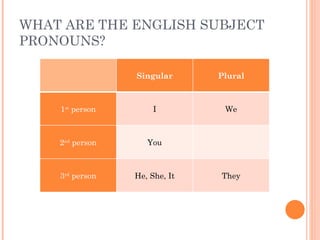
WHAT ARE THE ENGLISH SUBJECT
PRONOUNS?

                 Singular      Plural


    1st person        I         We


    2nd person      You


    3rd person   He, She, It   They
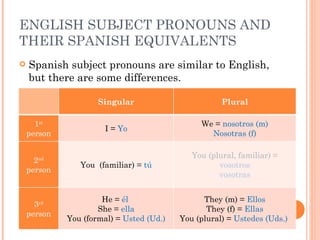
ENGLISH SUBJECT PRONOUNS AND
THEIR SPANISH EQUIVALENTS
   Spanish subject pronouns are similar to English,
    but there are some differences.

                     Singular                        Plural

      1st                                      We = nosotros (m)
                       I = Yo
    person                                       Nosotras (f)

                                             You (plural, familiar) =
      2nd
                You (familiar) = tú                 vosotros
    person
                                                    vosotras


                      He = él                   They (m) = Ellos
      3rd
                     She = ella                  They (f) = Ellas
    person
             You (formal) = Usted (Ud.)   You (plural) = Ustedes (Uds.)
THE FIRST PERSON SINGULAR
               PRONOUN “YO”
   “Yo” means “I” and is used
    in the same way as in
    English.
     Yo soy americano.
     Yo soy estudiante.
   Note that it is not
    capitalized unless it starts
    a sentence:
       Mi amigo y yo…
SECOND PERSON SINGULAR
           PRONOUN
              TÚ

 Tú means you (familiar/
  informal)
 Used when talking to
  someone familiar
 We’ll learn more about
  this in a moment.
3RD PERSON SINGULAR MASCULINE
                               ÉL
 Él = he
 It is used when talking ABOUT a boy/guy/man.

 used in the same way as its English counterpart:
       Jorge es mexicano. Él es de Guadalajara.
   DON’T forget the accent mark. If you do, you are
    actually writing the Spanish word for “the”
                              él = he   el = the
3RD PERSON SINGULAR FEMININE
                 ELLA


 Ella = she
 It is used when talking ABOUT a girl/woman.

 used in the same way as its English counterpart:
       Rosa es mexicana. Ella es de Acapulco.
   Please pronounce it correctly.
     It sounds like (eh-yah) not (el-lah)
     Remember ll= y sound.
FORMAL YOU
               USTED (UD.)
 Usted means you (formal)
 Used when talking to someone you should respect.

 Abbriviated Capital U lower case d period. (Ud.)

 Considered a 3rd person singular pronoun.

 We’ll learn more about this pronoun in a moment.
THE FIRST PERSON PLURAL
    PRONOUN “NOSOTROS / NOSOTRAS”
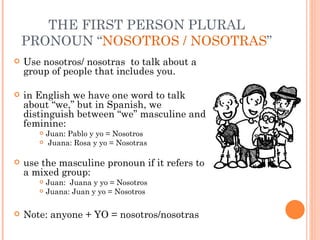
   Use nosotros/ nosotras to talk about a
    group of people that includes you.

   in English we have one word to talk
    about “we,” but in Spanish, we
    distinguish between “we” masculine and
    feminine:
          Juan: Pablo y yo = Nosotros
          Juana: Rosa y yo = Nosotras

   use the masculine pronoun if it refers to
    a mixed group:
          Juan: Juana y yo = Nosotros
          Juana: Juan y yo = Nosotros

   Note: anyone + YO = nosotros/nosotras
3RD PERSON PLURAL MASCULINE
                ELLOS
   Ellos = They (masculine)
   It is used when talking ABOUT a
    group of boys/guys/men or a
    mixed group.
   used in the same way as its
    English counterpart:
           Jorge y Pepe son mexicanos. Ellos
            son de Guadalajara.
           Jorge y Ana son alumnos. Ellos son
            amigos también.
   Please pronounce it correctly.
       It sounds like (eh-yohs) not (el-lohs)
       Remember ll= y sound.
3RD PERSON PLURAL FEMININE
                   ELLAS


 Ellas = They (feminine)
 It is used when talking ABOUT a group of only females.

 used in the same way as its English counterpart:
           Sofía y Ana son alumnas. Ellas son amigas también.
   Please pronounce it correctly.
     It sounds like (eh-yahs) not (el-lahs)
     Remember ll= y sound.
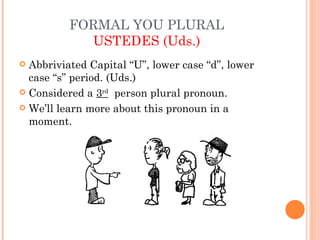
FORMAL YOU PLURAL
            USTEDES (Uds.)
 Abbriviated Capital “U”, lower case “d”, lower
  case “s” period. (Uds.)
 Considered a 3rd person plural pronoun.

 We’ll learn more about this pronoun in a
  moment.
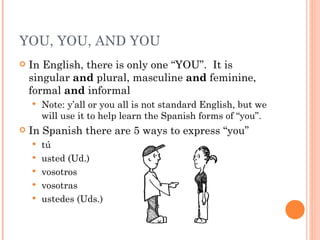
YOU, YOU, AND YOU
   In English, there is only one “YOU”. It is
    singular and plural, masculine and feminine,
    formal and informal
       Note: y’all or you all is not standard English, but we
        will use it to help learn the Spanish forms of “you”.
   In Spanish there are 5 ways to express “you”
       tú
       usted (Ud.)
       vosotros
       vosotras
       ustedes (Uds.)
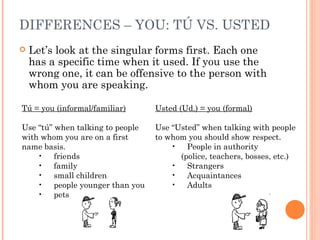
DIFFERENCES – YOU: TÚ VS. USTED
   Let’s look at the singular forms first. Each one
    has a specific time when it used. If you use the
    wrong one, it can be offensive to the person with
    whom you are speaking.

Tú = you (informal/familiar)      Usted (Ud.) = you (formal)

Use “tú” when talking to people   Use “Usted” when talking with people
with whom you are on a first      to whom you should show respect.
name basis.                           • People in authority
    • friends                           (police, teachers, bosses, etc.)
    • family                          • Strangers
    • small children                  • Acquaintances
    • people younger than you         • Adults
    • pets
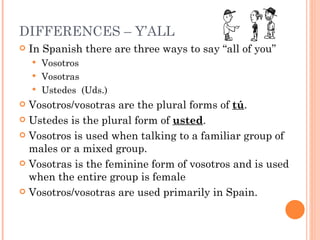
DIFFERENCES – Y’ALL
   In Spanish there are three ways to say “all of you”
     Vosotros
     Vosotras
     Ustedes (Uds.)
 Vosotros/vosotras are the plural forms of tú.
 Ustedes is the plural form of usted.

 Vosotros is used when talking to a familiar group of
  males or a mixed group.
 Vosotras is the feminine form of vosotros and is used
  when the entire group is female
 Vosotros/vosotras are used primarily in Spain.
DIFFERENCES – Y’ALL
 The plural you form “ustedes (Uds.)” Is used
  differently in Spain and Latin America.
 In Spain, vosotros/as is used when talking to an
  informal group. Uds. is used to address a formal
  group.
 In Latin America, Uds. is generally used in both
  formal and informal situations. (They don’t use
  vosotros/as)
 When in doubt, use Ustedes to say “you all”
REVIEW
 Yo = I                                   Nosotros/as = we
 First person singular                    First person plural
 Not capitalized unless the first         distinguish between “we” masculine
 word of the sentence                     and feminine
 Used to talk ABOUT yourself              Used to talk ABOUT yourself and
                                          friends
Tú = You (singular, informal/familiar)   Vosotros/as = You (singular, familiar)
Second person Singular                   Second person Plural
Use it to talk TO a person that is a     Use it to talk TO a group of friends or
friend or family member                  family members.
        Third person singular                        Third person plural
Él = he                                  Ellos = They (masculine)
Don’t forget the accent                  It is used when talking ABOUT a group
Use it to talk ABOUT a guy.              of boys/guys/men or a mixed group.
Ella = she                               Ellas = They (feminine)
Use it to talk ABOUT a girl.             It is used when talking ABOUT a group
Watch the pronunciation.                 of only females.
Ud. = You (singular, formal)             Uds. = You (plural)
Use it to talk TO a person that is due   Use it to talk TO a group of people
respect.

Subjectpronouns

  • 1.
    SUBJECT PRONOUNS A pronounis a word that takes the place of a noun.
  • 2.
    WHAT IS APRONOUN?  It’s a word used instead of a noun (or a phrase containing a noun) Example: `He', `it', `who', and `anything' are pronouns.  When the pronoun is the subject (the person doing the action) of the sentence, it is called a Subject Pronoun. Example: Bob is swimming. He is swimming.
  • 3.
    WHAT ARE THEENGLISH SUBJECT PRONOUNS? Singular Plural 1st person I We 2nd person You 3rd person He, She, It They
  • 4.
    ENGLISH SUBJECT PRONOUNSAND THEIR SPANISH EQUIVALENTS  Spanish subject pronouns are similar to English, but there are some differences. Singular Plural 1st We = nosotros (m) I = Yo person Nosotras (f) You (plural, familiar) = 2nd You (familiar) = tú vosotros person vosotras He = él They (m) = Ellos 3rd She = ella They (f) = Ellas person You (formal) = Usted (Ud.) You (plural) = Ustedes (Uds.)
  • 5.
    THE FIRST PERSONSINGULAR PRONOUN “YO”  “Yo” means “I” and is used in the same way as in English.  Yo soy americano.  Yo soy estudiante.  Note that it is not capitalized unless it starts a sentence:  Mi amigo y yo…
  • 6.
    SECOND PERSON SINGULAR PRONOUN TÚ  Tú means you (familiar/ informal)  Used when talking to someone familiar  We’ll learn more about this in a moment.
  • 7.
    3RD PERSON SINGULARMASCULINE ÉL  Él = he  It is used when talking ABOUT a boy/guy/man.  used in the same way as its English counterpart:  Jorge es mexicano. Él es de Guadalajara.  DON’T forget the accent mark. If you do, you are actually writing the Spanish word for “the”  él = he el = the
  • 8.
    3RD PERSON SINGULARFEMININE ELLA  Ella = she  It is used when talking ABOUT a girl/woman.  used in the same way as its English counterpart:  Rosa es mexicana. Ella es de Acapulco.  Please pronounce it correctly.  It sounds like (eh-yah) not (el-lah)  Remember ll= y sound.
  • 9.
    FORMAL YOU USTED (UD.)  Usted means you (formal)  Used when talking to someone you should respect.  Abbriviated Capital U lower case d period. (Ud.)  Considered a 3rd person singular pronoun.  We’ll learn more about this pronoun in a moment.
  • 10.
    THE FIRST PERSONPLURAL PRONOUN “NOSOTROS / NOSOTRAS”  Use nosotros/ nosotras to talk about a group of people that includes you.  in English we have one word to talk about “we,” but in Spanish, we distinguish between “we” masculine and feminine:  Juan: Pablo y yo = Nosotros  Juana: Rosa y yo = Nosotras  use the masculine pronoun if it refers to a mixed group:  Juan: Juana y yo = Nosotros  Juana: Juan y yo = Nosotros  Note: anyone + YO = nosotros/nosotras
  • 11.
    3RD PERSON PLURALMASCULINE ELLOS  Ellos = They (masculine)  It is used when talking ABOUT a group of boys/guys/men or a mixed group.  used in the same way as its English counterpart:  Jorge y Pepe son mexicanos. Ellos son de Guadalajara.  Jorge y Ana son alumnos. Ellos son amigos también.  Please pronounce it correctly.  It sounds like (eh-yohs) not (el-lohs)  Remember ll= y sound.
  • 12.
    3RD PERSON PLURALFEMININE ELLAS  Ellas = They (feminine)  It is used when talking ABOUT a group of only females.  used in the same way as its English counterpart:  Sofía y Ana son alumnas. Ellas son amigas también.  Please pronounce it correctly.  It sounds like (eh-yahs) not (el-lahs)  Remember ll= y sound.
  • 13.
    FORMAL YOU PLURAL USTEDES (Uds.)  Abbriviated Capital “U”, lower case “d”, lower case “s” period. (Uds.)  Considered a 3rd person plural pronoun.  We’ll learn more about this pronoun in a moment.
  • 14.
    YOU, YOU, ANDYOU  In English, there is only one “YOU”. It is singular and plural, masculine and feminine, formal and informal  Note: y’all or you all is not standard English, but we will use it to help learn the Spanish forms of “you”.  In Spanish there are 5 ways to express “you”  tú  usted (Ud.)  vosotros  vosotras  ustedes (Uds.)
  • 15.
    DIFFERENCES – YOU:TÚ VS. USTED  Let’s look at the singular forms first. Each one has a specific time when it used. If you use the wrong one, it can be offensive to the person with whom you are speaking. Tú = you (informal/familiar) Usted (Ud.) = you (formal) Use “tú” when talking to people Use “Usted” when talking with people with whom you are on a first to whom you should show respect. name basis. • People in authority • friends (police, teachers, bosses, etc.) • family • Strangers • small children • Acquaintances • people younger than you • Adults • pets
  • 16.
    DIFFERENCES – Y’ALL  In Spanish there are three ways to say “all of you”  Vosotros  Vosotras  Ustedes (Uds.)  Vosotros/vosotras are the plural forms of tú.  Ustedes is the plural form of usted.  Vosotros is used when talking to a familiar group of males or a mixed group.  Vosotras is the feminine form of vosotros and is used when the entire group is female  Vosotros/vosotras are used primarily in Spain.
  • 17.
    DIFFERENCES – Y’ALL The plural you form “ustedes (Uds.)” Is used differently in Spain and Latin America.  In Spain, vosotros/as is used when talking to an informal group. Uds. is used to address a formal group.  In Latin America, Uds. is generally used in both formal and informal situations. (They don’t use vosotros/as)  When in doubt, use Ustedes to say “you all”
  • 18.
    REVIEW Yo =I Nosotros/as = we First person singular First person plural Not capitalized unless the first distinguish between “we” masculine word of the sentence and feminine Used to talk ABOUT yourself Used to talk ABOUT yourself and friends Tú = You (singular, informal/familiar) Vosotros/as = You (singular, familiar) Second person Singular Second person Plural Use it to talk TO a person that is a Use it to talk TO a group of friends or friend or family member family members. Third person singular Third person plural Él = he Ellos = They (masculine) Don’t forget the accent It is used when talking ABOUT a group Use it to talk ABOUT a guy. of boys/guys/men or a mixed group. Ella = she Ellas = They (feminine) Use it to talk ABOUT a girl. It is used when talking ABOUT a group Watch the pronunciation. of only females. Ud. = You (singular, formal) Uds. = You (plural) Use it to talk TO a person that is due Use it to talk TO a group of people respect.