Asesoría Grupal INGLÉS INTERMEDIO 100  (IC 400)   Traveller Pre-intermediate Units 4-6 Gabriela Jiménez Aguilar Mayo 2010
Unit 4 Topic The future of communication and technology Functions Making predictions, promises, offers and requests. Talking about the future. Defining people, things and places. Vocabulary Words/phrases related to money Words easyly confused Expressions with “make” Collocations related to technology Adjectives ending in “full” and “less”
Grammar: Future will Will have to /will be able to Time clauses (when, after, before, until, as soon as) Too / enough Relative clauses (who / which / that / where)
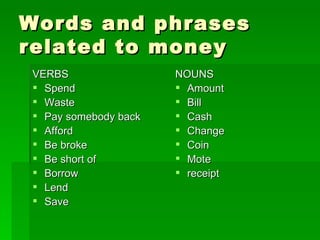
Words and phrases related to money VERBS Spend Waste Pay somebody back Afford Be broke Be short of  Borrow Lend Save  NOUNS Amount Bill Cash Change Coin Mote receipt
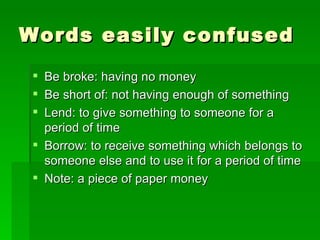
Words easily confused Be broke: having no money Be short of: not having enough of something Lend: to give something to someone for a period of time Borrow: to receive something which belongs to someone else and to use it for a period of time Note: a piece of paper money
Coin: a small round piece of metal used as money Bill: a request for payment of money  Receipt: a request for payment of money paid Afford: to be able to buy something because you have enough money Save (up): to put money aside so that you can buy something with it in the future.
Future “Will” We use will & will not (won’t) when: We make a promise:  I’ll phone you as soon as I arrive. We make on- the-spot decision: I will bring the sodas.
We make a request: Will you lend me your dictionary? We make a prediction usually with the verbs think and believe: I  think you will be a great scientist.
Time clauses Time clauses begin with  when, after, before, as soon as, until,  etc. When the sentence refers to the future, we usually use the present simple in the time clause and the future  will  in the main clause. When the time clause comes before the main clause, the two clauses are separated by a comma.
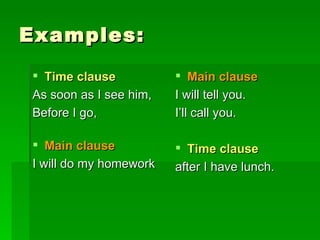
Examples:  Time clause   As soon as I see him, Before I go, Main clause I will do my homework Main clause I will tell you. I’ll call you. Time clause after I have lunch.
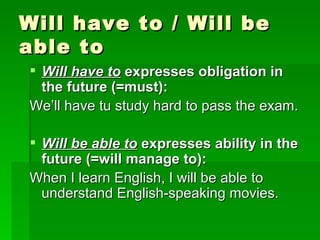
Will have to / Will be able to Will have to  expresses obligation in the future (=must): We’ll have tu study hard to pass the exam. Will be able to  expresses ability in the future (=will manage to): When I learn English, I will be able to understand English-speaking movies.
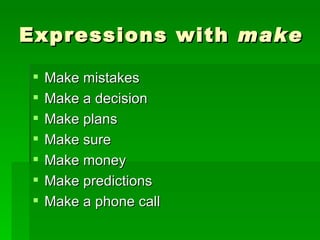
Expressions with  make Make mistakes Make a decision Make plans Make sure Make money Make predictions Make a phone call
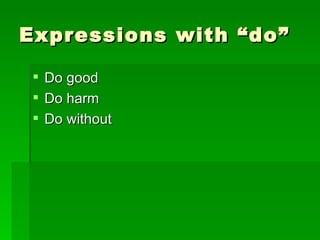
Expressions with “do” Do good Do harm Do without
Too / enough Too: it has a negative meaning and it means “more than necessary”. Too + adjective or adverb E.g.: These shoes are  too big . Could I have a smaller size? Enough: it has a positive meaning. Adjective or adverb + enough Or Enough + noun E.g.: The water isn’t  warm enough . I can´t drink it.   I have been saving for a while, so I have  enough  money  to buy a car.
Relative pronouns Relative pronouns Use:  Who   &   that  for people  Which   &   that  for things, animals and ideas E.g.:  That man who / that is on tv is my uncle. The bag which / that is on the table is yours. Relative adverb Use: Where  for places E.g.: The school where I work is the best.
We can ommit  who, which  and  that  when they refer to the object of the verb: E.g.: The film (which / that) I like most is “Armagedon”. The man (who / that) you saw me with is my fiancé. Where  can never be omitted or replaced with  that.
Suffix “ful” Adjectives: Harmful Successful Helpful Beautiful Peaceful careful
Suffix “less” Adjectives: Careless Harmless Helpless Useless
Linking words When writing a paragraph expressing your opinion use linking words to list points: Firstly, First of all, To begin with, Secondly, Also, in addition,  What is more, Finally, Lastly,
Phrases to express opinion In my opinion… Personally I believe…
Unit 5 Topic Health and emotional problems and phobias Functions Stating a problem. Asking for and giving advice Talking about accidents Narrating experiences Making appointments
Vocabulary Words related to medical and emotional problems Phrasal verbs Prepositional phrases with “in” Words related to accidents Idioms describing feelings Words easily confused
Grammar: Infinitives -ing form Should /had better Passive voice (present simple, past simple)
Words /phrases related to medical problems Allergy Bones Chemist’s Cough Examine Have a cold Hurt Illness pain  Painkiller Patient  Pill Prescribe Prescription Runny nose Sneeze  Sore throat Surgery Treatment
Phrasal verbs A phrasal verb consists fo a verb and an adverb and/or one or more prepositions. The meaning of the phrasal verb is different from the verb it includes. To book up: have no time available To get over: become better To hang on: wait To lie down: rest To run out of: not have any left  To take away: make something disappear
Prepositiona phrases with “in” In the beginning In danger In a hurry In addition In my opinion In fact In common In the end At the beginning (of the century) At the end of (the road)
-ing form We use the –ing form a)  As a subject:  E.g.:  Smoking  is bad  for your health. b)  After certain verbs: (like, love, enjoy, hate, finish, start) and expressions (how about, it’s worth): E.g.: I  hate taking  pills. c)  After prepositions: E.g.: they asked for help  by using  a Morse lamp.
Words / phrases related to emotional problems A fear of Advice Advise Anxiety Control Deal with Deep breath medication Panic Phobia Psychologist Reduce stress Suffer from
Should Should + bare infinitive We use it to: Ask for and give advice: E.g.: should I go to the party? Express an opinion: E.g.: You should study more Make a suggestion: e.g.: Shouldn’t we vote ? Express mild obligations: E.g.: You should do your homework.
Had better Had better + bare infinitive Had better not + bare infinitive We use it to give strong advice. It often expresses threat of warning and it´s stronger than  should . It refers to the present or future, not the past. The short form is ‘d better (I’d better, you’d better, etc.). E.g.: You’d better go to the dentist.
Words related to accidents and emergencies Ambulance Be on fire Burn Crash Die Injure Put out Smoke Survivor tragedy
Passive voice – present simple We use the passive voice to emphasise the action rather than who or what is responsible for it. Affirmative: Subject + verb be + past participle of main verb + (by…) Negative: Subject + verb be + not + past participle of main verb + (by…) Interrogative: Verb be + subject + past participle of main verb (by…)?
Examples: A party is organized by students. A party is not organized by students. Is a party organized by students?
Passive voice – past simple We use the same structure, but the verb “to be” must be in the past. Examples: The lost dog  was  found by a child. The lost dog  was  not found by a child. Was  the lost dog found by a child?
Words & expressions to express feelings Embarrased Surprised Annoyed Want the ground to swallow you Not believe your eyes Go red as a beetroot Get on somebody’s nerves Make a fool of oneself Drive somebody up the wall Jump out of one’s skin Laugh one’s head off
Linking words & phrases As soon as When Before As  Because While But So
Unit 6 Topic Enjoying your free time Functions Describing actions and situations and their consequences Referring to conditions and their results Expressing posibility Agreeing and disagreeing Expressing preference and opinion Vocabulary Words related to sports Collocations Compound nouns
Words related to places or entertainment Phrasal verbs Words related to films Grammar May, might, could Conditional sentences type 1 If vs. when So / neither / too / either Present perfect progressive Present perfect progressive vs present perfect simple
Words related to sports Aerobics Athletics Baseball Bowling Boxing Golf Catch Dribble Drop Hit Kick Move Pass Score Shoot Swing Throw
Word / collocations related to sports Play volleyball Go skiing Do karate Play on / for a team Play a game, Go windsurfing Play in the final Go swimming Do water sports Do athletics Play team sports Do aerobics
May, might, could The verbs may, might and could a) are followed by the base form of the verb. b) are the same in all persons in the singular and plural. c) do not form the questions and negative forms with do. d) express possibility in the present and future.
We use  may not  &  might   not  to express lack of possibility in the present or future. Examples: You may need glue to stick your photos. She might accept to go out with you. They could meet you after the match. He might not come to the party. I may not have a vacation this summer.
Compound nouns They can be formed as two words or as one word. Sometimes they are joined using a hyphen. The first noun defines the second one: Bus stop = a stop for buses Police officer Businessman Check-in
Examples: Fur seals Shark cages Bungee jumping Windsurfing Sightseeing Sea urchins Stingrays Tour guide Rock climbing Speedboat Midday airport
Conditional type 1 The first conditional is used to talk about things which are possible in the present or the future — things which  may happen.
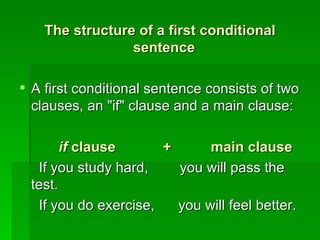
The structure of a first conditional sentence   A first conditional sentence consists of two clauses, an "if" clause and a main clause: if  clause  +  main clause   If you study hard,  you will pass the test.  If you do exercise,  you will feel better.
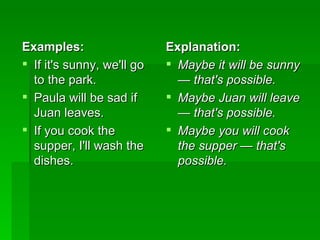
Examples: If it's sunny, we'll go to the park. Paula will be sad if Juan leaves.  If you cook the supper, I'll wash the dishes.  Explanation: Maybe it will be sunny — that's possible. Maybe Juan will leave — that's possible. Maybe you will cook the supper — that's possible.
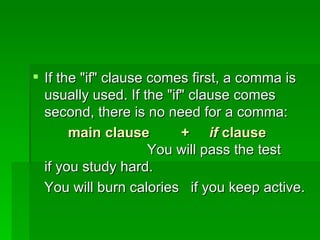
If the "if" clause comes first, a comma is usually used. If the "if" clause comes second, there is no need for a comma: main clause  +  if  clause   You will pass the test  if you study hard. You will burn calories  if you keep active.
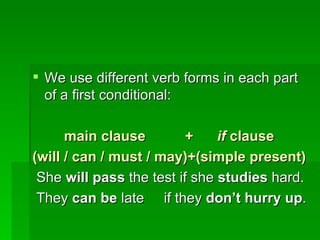
We use different verb forms in each part of a first conditional: main clause  +  if  clause (will / can / must / may)+(simple present) She  will pass  the test if she  studies  hard. They  can be  late  if they  don’t hurry up .
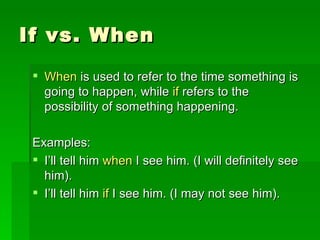
If vs. When When  is used to refer to the time something is going to happen, while  if  refers to the possibility of something happening. Examples: I’ll tell him  when  I see him. (I will definitely see him). I’ll tell him  if  I see him. (I may not see him).
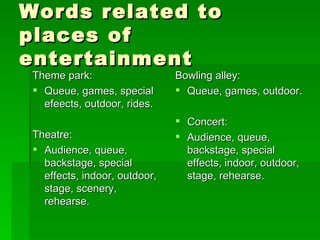
Words related to places of entertainment Theme park: Queue, games, special efeects, outdoor, rides. Theatre: Audience, queue, backstage, special effects, indoor, outdoor, stage, scenery, rehearse. Bowling alley: Queue, games, outdoor. Concert:  Audience, queue, backstage, special effects, indoor, outdoor, stage, rehearse.
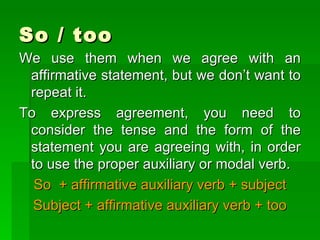
So / too We use them when we agree with an affirmative statement, but we don’t want to repeat it. To express agreement, you need to consider the tense and the form of the statement you are agreeing with, in order to use the proper auxiliary or modal verb. So  + affirmative auxiliary verb + subject Subject + affirmative auxiliary verb + too
For example:  A: I can cook.  B: So can I / I can, too. A: They have seen this fim. B: So we have. / We have, too.
Neither / either We use them when we agree with a negative statement, but we don’t want to repeat it. Neither + affirmative auxiliary verb + subject Subject + negative auxiliary verb + either For example: A: I don’t like broccoli. B: I don’t either / Neither do I. A: Ricki won’t go to the party. B: I won’t either. / Neither will I.
More examples:  I can skate.  -  I can, too. / So can I. Pedro can´t dance. -  Mary can’t either./ Neither can she. I am from Xalapa. -  I am, too. / So am I. My neighbour isn’t very clean. – My neighbour isn’t either./ Neither is my neighbour. I visited my parents yesterday. – I did, too. /So did I.  Mario didn’t come. – I didn’t, either. / Neither did I.
To express disagreement Subject + affirmative auxiliary verb   when we disagree with a negative statement. E.g: I can´t sing. / I can.  Subject + negative auxiliary verb  when we disagree with an affrimative statement. E.g.: I have ridden a camel. / I haven’t.
Present perfect progressive We use the present perfect for: A repeated action or situation which started in the past and continues up to the present. E.g.: They have been swimming for more than two hours now.
b) An action which was happening over a period of time in the past and may have finished, but its results are obviuos in the present. E.g.: She’s very tired. She’s been studying all night.
Time expressions used with the present perfect progressive: For Since How long All day / week, etc.
Present perfect progressive vs. Present perfect simple The present  perfect progressive  emphasizes the  duration   of an action, while the  present perfect simple  emphasizes the  result  of an action. Examples: You have been cooking cookies since 7 a.m. You have cooked a lot of / 3 kilos of cookies since 7 a.m.
Phrasal verbs Bring back: return from somewhere with something. Check somebody / something out: look at something that seems interesting. Cheer on: shout to someone in a reace or competition to encourage him / her. Come across: find by chance. Let down: dissapoint. Log on: connect to a computer system. Sell out: have no tickets left.

Inglés Intermedio 1 (Nivel 4)

  • 1.
    Asesoría Grupal INGLÉSINTERMEDIO 100 (IC 400) Traveller Pre-intermediate Units 4-6 Gabriela Jiménez Aguilar Mayo 2010
  • 2.
    Unit 4 TopicThe future of communication and technology Functions Making predictions, promises, offers and requests. Talking about the future. Defining people, things and places. Vocabulary Words/phrases related to money Words easyly confused Expressions with “make” Collocations related to technology Adjectives ending in “full” and “less”
  • 3.
    Grammar: Future willWill have to /will be able to Time clauses (when, after, before, until, as soon as) Too / enough Relative clauses (who / which / that / where)
  • 4.
    Words and phrasesrelated to money VERBS Spend Waste Pay somebody back Afford Be broke Be short of Borrow Lend Save NOUNS Amount Bill Cash Change Coin Mote receipt
  • 5.
    Words easily confusedBe broke: having no money Be short of: not having enough of something Lend: to give something to someone for a period of time Borrow: to receive something which belongs to someone else and to use it for a period of time Note: a piece of paper money
  • 6.
    Coin: a smallround piece of metal used as money Bill: a request for payment of money Receipt: a request for payment of money paid Afford: to be able to buy something because you have enough money Save (up): to put money aside so that you can buy something with it in the future.
  • 7.
    Future “Will” Weuse will & will not (won’t) when: We make a promise: I’ll phone you as soon as I arrive. We make on- the-spot decision: I will bring the sodas.
  • 8.
    We make arequest: Will you lend me your dictionary? We make a prediction usually with the verbs think and believe: I think you will be a great scientist.
  • 9.
    Time clauses Timeclauses begin with when, after, before, as soon as, until, etc. When the sentence refers to the future, we usually use the present simple in the time clause and the future will in the main clause. When the time clause comes before the main clause, the two clauses are separated by a comma.
  • 10.
    Examples: Timeclause As soon as I see him, Before I go, Main clause I will do my homework Main clause I will tell you. I’ll call you. Time clause after I have lunch.
  • 11.
    Will have to/ Will be able to Will have to expresses obligation in the future (=must): We’ll have tu study hard to pass the exam. Will be able to expresses ability in the future (=will manage to): When I learn English, I will be able to understand English-speaking movies.
  • 12.
    Expressions with make Make mistakes Make a decision Make plans Make sure Make money Make predictions Make a phone call
  • 13.
    Expressions with “do”Do good Do harm Do without
  • 14.
    Too / enoughToo: it has a negative meaning and it means “more than necessary”. Too + adjective or adverb E.g.: These shoes are too big . Could I have a smaller size? Enough: it has a positive meaning. Adjective or adverb + enough Or Enough + noun E.g.: The water isn’t warm enough . I can´t drink it. I have been saving for a while, so I have enough money to buy a car.
  • 15.
    Relative pronouns Relativepronouns Use: Who & that for people Which & that for things, animals and ideas E.g.: That man who / that is on tv is my uncle. The bag which / that is on the table is yours. Relative adverb Use: Where for places E.g.: The school where I work is the best.
  • 16.
    We can ommit who, which and that when they refer to the object of the verb: E.g.: The film (which / that) I like most is “Armagedon”. The man (who / that) you saw me with is my fiancé. Where can never be omitted or replaced with that.
  • 17.
    Suffix “ful” Adjectives:Harmful Successful Helpful Beautiful Peaceful careful
  • 18.
    Suffix “less” Adjectives:Careless Harmless Helpless Useless
  • 19.
    Linking words Whenwriting a paragraph expressing your opinion use linking words to list points: Firstly, First of all, To begin with, Secondly, Also, in addition, What is more, Finally, Lastly,
  • 20.
    Phrases to expressopinion In my opinion… Personally I believe…
  • 21.
    Unit 5 TopicHealth and emotional problems and phobias Functions Stating a problem. Asking for and giving advice Talking about accidents Narrating experiences Making appointments
  • 22.
    Vocabulary Words relatedto medical and emotional problems Phrasal verbs Prepositional phrases with “in” Words related to accidents Idioms describing feelings Words easily confused
  • 23.
    Grammar: Infinitives -ingform Should /had better Passive voice (present simple, past simple)
  • 24.
    Words /phrases relatedto medical problems Allergy Bones Chemist’s Cough Examine Have a cold Hurt Illness pain Painkiller Patient Pill Prescribe Prescription Runny nose Sneeze Sore throat Surgery Treatment
  • 25.
    Phrasal verbs Aphrasal verb consists fo a verb and an adverb and/or one or more prepositions. The meaning of the phrasal verb is different from the verb it includes. To book up: have no time available To get over: become better To hang on: wait To lie down: rest To run out of: not have any left To take away: make something disappear
  • 26.
    Prepositiona phrases with“in” In the beginning In danger In a hurry In addition In my opinion In fact In common In the end At the beginning (of the century) At the end of (the road)
  • 27.
    -ing form Weuse the –ing form a) As a subject: E.g.: Smoking is bad for your health. b) After certain verbs: (like, love, enjoy, hate, finish, start) and expressions (how about, it’s worth): E.g.: I hate taking pills. c) After prepositions: E.g.: they asked for help by using a Morse lamp.
  • 28.
    Words / phrasesrelated to emotional problems A fear of Advice Advise Anxiety Control Deal with Deep breath medication Panic Phobia Psychologist Reduce stress Suffer from
  • 29.
    Should Should +bare infinitive We use it to: Ask for and give advice: E.g.: should I go to the party? Express an opinion: E.g.: You should study more Make a suggestion: e.g.: Shouldn’t we vote ? Express mild obligations: E.g.: You should do your homework.
  • 30.
    Had better Hadbetter + bare infinitive Had better not + bare infinitive We use it to give strong advice. It often expresses threat of warning and it´s stronger than should . It refers to the present or future, not the past. The short form is ‘d better (I’d better, you’d better, etc.). E.g.: You’d better go to the dentist.
  • 31.
    Words related toaccidents and emergencies Ambulance Be on fire Burn Crash Die Injure Put out Smoke Survivor tragedy
  • 32.
    Passive voice –present simple We use the passive voice to emphasise the action rather than who or what is responsible for it. Affirmative: Subject + verb be + past participle of main verb + (by…) Negative: Subject + verb be + not + past participle of main verb + (by…) Interrogative: Verb be + subject + past participle of main verb (by…)?
  • 33.
    Examples: A partyis organized by students. A party is not organized by students. Is a party organized by students?
  • 34.
    Passive voice –past simple We use the same structure, but the verb “to be” must be in the past. Examples: The lost dog was found by a child. The lost dog was not found by a child. Was the lost dog found by a child?
  • 35.
    Words & expressionsto express feelings Embarrased Surprised Annoyed Want the ground to swallow you Not believe your eyes Go red as a beetroot Get on somebody’s nerves Make a fool of oneself Drive somebody up the wall Jump out of one’s skin Laugh one’s head off
  • 36.
    Linking words &phrases As soon as When Before As Because While But So
  • 37.
    Unit 6 TopicEnjoying your free time Functions Describing actions and situations and their consequences Referring to conditions and their results Expressing posibility Agreeing and disagreeing Expressing preference and opinion Vocabulary Words related to sports Collocations Compound nouns
  • 38.
    Words related toplaces or entertainment Phrasal verbs Words related to films Grammar May, might, could Conditional sentences type 1 If vs. when So / neither / too / either Present perfect progressive Present perfect progressive vs present perfect simple
  • 39.
    Words related tosports Aerobics Athletics Baseball Bowling Boxing Golf Catch Dribble Drop Hit Kick Move Pass Score Shoot Swing Throw
  • 40.
    Word / collocationsrelated to sports Play volleyball Go skiing Do karate Play on / for a team Play a game, Go windsurfing Play in the final Go swimming Do water sports Do athletics Play team sports Do aerobics
  • 41.
    May, might, couldThe verbs may, might and could a) are followed by the base form of the verb. b) are the same in all persons in the singular and plural. c) do not form the questions and negative forms with do. d) express possibility in the present and future.
  • 42.
    We use may not & might not to express lack of possibility in the present or future. Examples: You may need glue to stick your photos. She might accept to go out with you. They could meet you after the match. He might not come to the party. I may not have a vacation this summer.
  • 43.
    Compound nouns Theycan be formed as two words or as one word. Sometimes they are joined using a hyphen. The first noun defines the second one: Bus stop = a stop for buses Police officer Businessman Check-in
  • 44.
    Examples: Fur sealsShark cages Bungee jumping Windsurfing Sightseeing Sea urchins Stingrays Tour guide Rock climbing Speedboat Midday airport
  • 45.
    Conditional type 1The first conditional is used to talk about things which are possible in the present or the future — things which may happen.
  • 46.
    The structure ofa first conditional sentence A first conditional sentence consists of two clauses, an "if" clause and a main clause: if clause + main clause If you study hard, you will pass the test. If you do exercise, you will feel better.
  • 47.
    Examples: If it'ssunny, we'll go to the park. Paula will be sad if Juan leaves. If you cook the supper, I'll wash the dishes. Explanation: Maybe it will be sunny — that's possible. Maybe Juan will leave — that's possible. Maybe you will cook the supper — that's possible.
  • 48.
    If the "if"clause comes first, a comma is usually used. If the "if" clause comes second, there is no need for a comma: main clause + if clause You will pass the test if you study hard. You will burn calories if you keep active.
  • 49.
    We use differentverb forms in each part of a first conditional: main clause + if clause (will / can / must / may)+(simple present) She will pass the test if she studies hard. They can be late if they don’t hurry up .
  • 50.
    If vs. WhenWhen is used to refer to the time something is going to happen, while if refers to the possibility of something happening. Examples: I’ll tell him when I see him. (I will definitely see him). I’ll tell him if I see him. (I may not see him).
  • 51.
    Words related toplaces of entertainment Theme park: Queue, games, special efeects, outdoor, rides. Theatre: Audience, queue, backstage, special effects, indoor, outdoor, stage, scenery, rehearse. Bowling alley: Queue, games, outdoor. Concert: Audience, queue, backstage, special effects, indoor, outdoor, stage, rehearse.
  • 52.
    So / tooWe use them when we agree with an affirmative statement, but we don’t want to repeat it. To express agreement, you need to consider the tense and the form of the statement you are agreeing with, in order to use the proper auxiliary or modal verb. So + affirmative auxiliary verb + subject Subject + affirmative auxiliary verb + too
  • 53.
    For example: A: I can cook. B: So can I / I can, too. A: They have seen this fim. B: So we have. / We have, too.
  • 54.
    Neither / eitherWe use them when we agree with a negative statement, but we don’t want to repeat it. Neither + affirmative auxiliary verb + subject Subject + negative auxiliary verb + either For example: A: I don’t like broccoli. B: I don’t either / Neither do I. A: Ricki won’t go to the party. B: I won’t either. / Neither will I.
  • 55.
    More examples: I can skate. - I can, too. / So can I. Pedro can´t dance. - Mary can’t either./ Neither can she. I am from Xalapa. - I am, too. / So am I. My neighbour isn’t very clean. – My neighbour isn’t either./ Neither is my neighbour. I visited my parents yesterday. – I did, too. /So did I. Mario didn’t come. – I didn’t, either. / Neither did I.
  • 56.
    To express disagreementSubject + affirmative auxiliary verb when we disagree with a negative statement. E.g: I can´t sing. / I can. Subject + negative auxiliary verb when we disagree with an affrimative statement. E.g.: I have ridden a camel. / I haven’t.
  • 57.
    Present perfect progressiveWe use the present perfect for: A repeated action or situation which started in the past and continues up to the present. E.g.: They have been swimming for more than two hours now.
  • 58.
    b) An actionwhich was happening over a period of time in the past and may have finished, but its results are obviuos in the present. E.g.: She’s very tired. She’s been studying all night.
  • 59.
    Time expressions usedwith the present perfect progressive: For Since How long All day / week, etc.
  • 60.
    Present perfect progressivevs. Present perfect simple The present perfect progressive emphasizes the duration of an action, while the present perfect simple emphasizes the result of an action. Examples: You have been cooking cookies since 7 a.m. You have cooked a lot of / 3 kilos of cookies since 7 a.m.
  • 61.
    Phrasal verbs Bringback: return from somewhere with something. Check somebody / something out: look at something that seems interesting. Cheer on: shout to someone in a reace or competition to encourage him / her. Come across: find by chance. Let down: dissapoint. Log on: connect to a computer system. Sell out: have no tickets left.