UNIT 01
INTRODUCE YOURSELF
 SPECIFIC OBJECTIVE
 To remember, know and apply the basic
vocabulary through simple oral and written
exercises in order to communicate their ideas and
feelings.
 1.1 Greetings
 1.2 Oral Expressions
 1.3 Introduce Dialogue
 1.4 Vocabulary
 1.5 Self-evaluation
COMMON EXPRESSIONS
 Have a nice day!
 How are you?
 How are you doing?
 I´m fine, thank You.
 I am well (fine), thank you
 Do you speak Spanish?
 Thank you, You are welcome
INTRODUCE
DIALOGUE
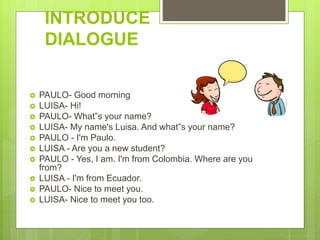
 PAULO- Good morning
 LUISA- Hi!
 PAULO- What‟s your name?
 LUISA- My name's Luisa. And what‟s your name?
 PAULO - I'm Paulo.
 LUISA - Are you a new student?
 PAULO - Yes, I am. I'm from Colombia. Where are you
from?
 LUISA - I'm from Ecuador.
 PAULO- Nice to meet you.
 LUISA- Nice to meet you too.

VOCABULARY
 Introduction
 1. Hello. My name's Pedro. What's your name?
 2. Janet.
 1. Where are you from Janet?
 2. I'm from Guayaquil. Where are you from?
 1. I'm from Madrid.
 My name is... What's (is) your name ... Where are you from? I'm from... Are
you (Spanish, American, German, etc.)
 Hello
 1. Hello, Edwin. How are you?
 2. Fine, thanks. How are you?
 1. I'm fine, thank you.
 Goodbye
 1. Goodbye, Iván. See you tomorrow!
 2. Bye bye, Tony. Have a nice evening.
 1. Thanks, you too!
 2. Thanks.
 Key Vocabulary
 Hello... How are you? I'm fine, - OK, - well, thank you Goodbye, - bye bye See
you tomorrow Have a nice evening, - day
 When you meet a person for the first time , you can ask the following questions.
Prepare your own dialogue
 1. What‟s your first name?
(My first name is Juan).
 2. What‟s your middle name?
(My middle name is Fernando).
 3. What‟s your (last name / family name / surname)?
(My last / family / surname is Gonzalez).
 4. What‟s your second last name?
(My second last name is Escobar).
 5. What‟s your full name?
(My full name is Juan Fernando Gonzalez Escobar).
 6. What‟s your nickname?
(My nickname is Nando).
 7. Where are you from?
(I‟m from Quito).
 8. What´s your marital status?
(I‟m single / married / divorced / a widow / a widower).
 9. What´s your address?
(It‟s 24 – 25 Amazonas Avenue).
 10. What‟s your phone number?
(It‟s 296 – 7463).
 11. How old are you?
(I am 25 years old).
 12. How are you?
(I‟m very well, thanks).
 13. What do you do?
(I‟m a student).
 14. When is your birthday?
(My birthday is on January 2nd)
UNIT 02
TIME AND DATES
 SPECIFIC OBJECTIVE
 To give and ask simple information uses the
time and dates in order to classify the
activities according the importance and their
personal value.
 2.1 Numbers
 2.2 Time
 2.3 Months and Days of the Week
 2.4 Self-evaluation
CARDINALS ORDINALS
 1 one 1st first
 2 two 2nd second
 3 three 3rd third
 4 four 4th fourth
 5 five 5th fifth
 6 six 6th sixth
 7 seven 7th seventh
 8 eight 8th eighth
 9 nine 9th ninth
 10 ten 10th tenth
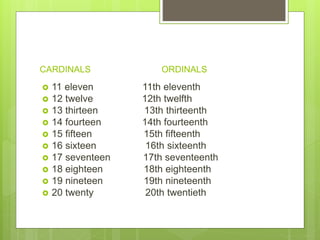
CARDINALS ORDINALS
 11 eleven 11th eleventh
 12 twelve 12th twelfth
 13 thirteen 13th thirteenth
 14 fourteen 14th fourteenth
 15 fifteen 15th fifteenth
 16 sixteen 16th sixteenth
 17 seventeen 17th seventeenth
 18 eighteen 18th eighteenth
 19 nineteen 19th nineteenth
 20 twenty 20th twentieth
 Practice
 Write the following numbers .
 25 ..................... 17....................... 12 ......................
 10 ..................... 18 …................... 9 .......................
 36 ..................... 44........................ 50 …..................

 100 ................... 78 ....................... 60 …..................
 85 ......................39 ....................... 30 ......................

 16 .................. …11.. .................... 14 .......................
 89 ...................... 102 ...................13 ………………..
 Read and complete the phrases
 The first president of Ecuador was
_____________________________
 The second color in the Ecuadorian flag is_______
 The third month of the year is ___________________
 The fourth day of the week is ___________________
 The fifth letter of the alphabet its _______________

 Your first love was _____________________
TIME
In English we use
"past" to say times
after the hour until
half past, or 30
minutes past the
hour.
We use "to" to say
times before the
hour from 31
minutes until the full
hour.
In English we use
o'clock only at the
full hour. Example:
It's eight o'clock
We can also just
say the numbers in
groups of two.
Example: It's seven
twenty-five
DAYS OF THE WEEK and
MONTHS OF THE YEAR
DAYS MONTHS
Monday (Mon.) January (Jan.)
Tuesday (Tues.) February (Feb.)
Wednesday (Wed.) March (Mar.)
Thursday (Thurs.) April (Apr.)
Friday (Fri.) May (May)
Saturday (Sat.) June (June)
Sunday (Sun.) July (July)
August (Aug.)
. September (Sept.)
October (Oct.)
November (Nov.)
. December (Dec.)
Saying dates:
 USUAL WRITTEN FORM USUAL SPOKEN FORM
 January 1 January first / the first of January

 March 2 March second / the second of March

 May 3 May third / the third of May

 June 4 June fourth / the fourth of June

 August 5 August fifth / the fifth of August

 October 10 October tenth / the tenth of October

 November 27 November twenty-seventh / the twenty- .
seventh of November
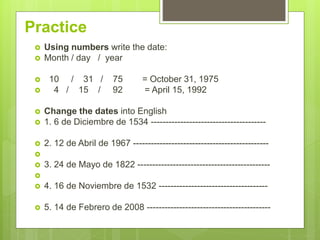
Practice
 Using numbers write the date:
 Month / day / year
 10 / 31 / 75 = October 31, 1975
 4 / 15 / 92 = April 15, 1992
 Change the dates into English
 1. 6 de Diciembre de 1534 ---------------------------------------
 2. 12 de Abril de 1967 ----------------------------------------------

 3. 24 de Mayo de 1822 ---------------------------------------------

 4. 16 de Noviembre de 1532 -------------------------------------
 5. 14 de Febrero de 2008 ------------------------------------------
Write cardinal numbers
 56 ……………………………………………………………………
 28 ……………………………………………………………………
 12 ……………………………………………………………………
 91 ……………………………………………………………………
 1.407 ………………………………………………………….……
 4.598 ………………………………………………………….……
 7.961 …………………………………………………………..……
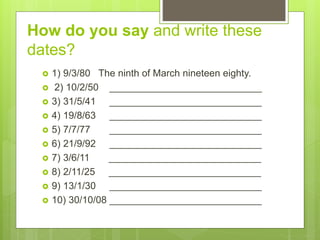
How do you say and write these
dates?
 1) 9/3/80 The ninth of March nineteen eighty.
 2) 10/2/50 ____________________________
 3) 31/5/41 ____________________________
 4) 19/8/63 ____________________________
 5) 7/7/77 ____________________________
 6) 21/9/92 ____________________________
 7) 3/6/11 ____________________________
 8) 2/11/25 ____________________________
 9) 13/1/30 ____________________________
 10) 30/10/08 ____________________________
UNIT 03
 DESCRIBING PEOPLE
 SPECIFIC OBJECTIVE
 To give simple information through people‟s
descriptions using adjectives in order to
communicate ideas in oral and written way.
 3.1 Nouns
 3.2 Articles
 3.3 Adjectives
 3.4 Prepositions
 3.5 Self-evaluation
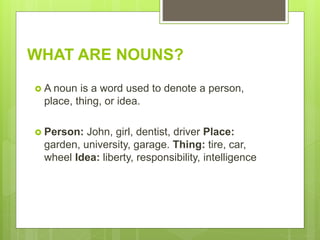
WHAT ARE NOUNS?
 A noun is a word used to denote a person,
place, thing, or idea.
 Person: John, girl, dentist, driver Place:
garden, university, garage. Thing: tire, car,
wheel Idea: liberty, responsibility, intelligence
 Most nouns have distinctive SINGULAR and
PLURAL forms.
 The plural of regular nouns is formed by
adding -s to the singular:
 Singular Plural
 car cars
 pill pills
 tablet tablets
 However, there are many irregular nouns
which do not form the plural in this way:
 Singular Plural
 man men
 child children
 sheep sheep
 Woman women
 Knife knive
 Wolf wolves
 Person people
 If the Word ends in 'sh', 'ch', 's', 'x' o 'z', we
add 'es'.
 Ex.
 one church – two churches
 one bus - two buses

 one box - two boxes
 Some nouns end in 'o' we have to add 'es'.
 Ex.
 one tomato - two tomatoes
 one hero - two heroes
 one potato - two potatoes
 If the noun ends in 'consonant + y', normally we
have to change this 'y' into 'i' then we add “es”.
 Ex.
 one baby - two babies
 one party - two parties
 one lady - two ladies
 If the noun ends in 'vowel + y', normally we
add an extra’s’.
 Ex.
 one day - two days
 one boy - two boys
 THE DEFINITE ARTICLE (THE)
 It´s used before singular and plural nouns when
the noun is specific or particular.
 The signals that the noun is definite, that it
refers to a particular member of a group.
 For example:"The dog that bit me ran away."
Here, we're talking about a specific dog, the
dog that bit me.
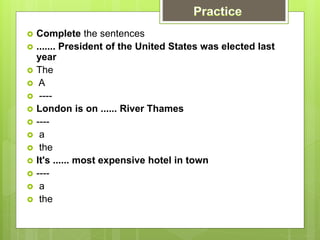
 Complete the sentences
 ....... President of the United States was elected last
year
 The
 A
 ----
 London is on ...... River Thames
 ----
 a
 the
 It's ...... most expensive hotel in town
 ----
 a
 the
 My mother is allergic to ........ cigarette smoke
 The
 ----
 a
 He never listens to ....... classical music
 a
 ---
 the
 My flat is on ..... second floor
 The
 a
 an
An adjective modifies a noun or
a pronoun by describing,
identifying, or quantifying
words.
 An adjective usually precedes
the noun or the pronoun which
it modifies.
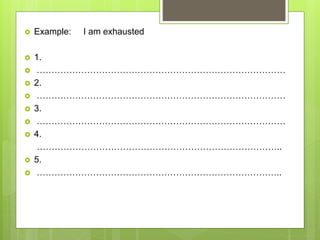
 Example: I am exhausted
 1.
 …………………………………………………………………………
 2.
 …………………………………………………………………………
 3.
 …………………………………………………………………………
 4.
………………………………………………………………………..
 5.
 ………………………………………………………………………..
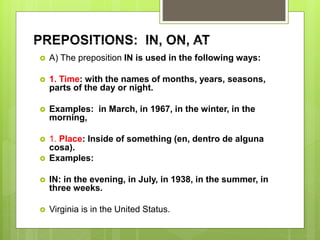
PREPOSITIONS: IN, ON, AT
 A) The preposition IN is used in the following ways:
 1. Time: with the names of months, years, seasons,
parts of the day or night.
 Examples: in March, in 1967, in the winter, in the
morning,
 1. Place: Inside of something (en, dentro de alguna
cosa).
 Examples:
 IN: in the evening, in July, in 1938, in the summer, in
three weeks.
 Virginia is in the United Status.
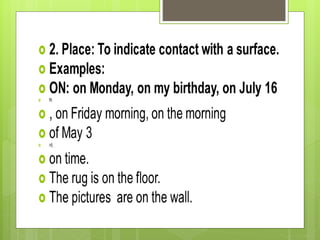
 B) The preposition ON is used:
 1. Time: with the days of the week, and days of the
month.
 Example:
 ON : on Monday, on my birthday, on July 16th
 , on Friday morning, on the morning of May 3rd
 on time.
 On Tuesday, on the tenth of March, on March 10
 C) The preposition AT is used to indicate a
definite time or place.
 Time: for hours and minutes, and with noon,
night, midnight.
 Examples:
 at six o´clock, at ten minutes to two, at half past
five, at noon, at nighmidnight.
 Place: for a definite position.

 Examples:
 AT: at 6.30, at midday, at Christmas, at the
beginning, at the moment.
VERB TO BE
SIMPLE PRESENT TO BE
SPECIFIC OBJECTIVE
 To practice the to be verb in present tense in order to build sentences,
 questions and give affirmative and negative information in oral and
 written way.
 4.1 Personal Pronouns
 4.2 Verb to be
 4.3 Affirmative / Negative Sentences
 4.4 Yes/No Questions and Answers
 4.5 Self-evaluation
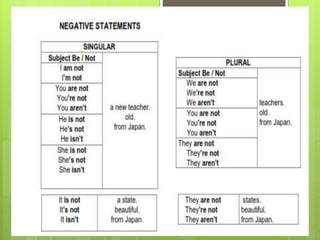
AFFIRMATIVE SENTENCES
 Complete the sentences. Use a VERB: am, is, or are. Use a
NOUN: a student or students.
 1. We are students.
 2. I ________________________.
 3. Rita goes to school . She ____________________________
 4. Rita and Tom go to school . They _____________________
 5. You ( one person ) __________________________________
 6. You ( two people ) __________________________________
 Put in correct order these sentences
 1. I /a/ student/ am. …………………………………………..
 2. They/from/are. …………………………………………..
 3. She/a /is/beautiful girl. …………………………………………..
 4. We/drivers/are. …………………………………………..
 5. teacher/He/a /is. …………………………………………..
 6. You/ a/are/student. ………………………………………….
 Complete the conversation . Use I am, you are, he is, she is, it is, we are, or they are.
 1. A: How are you?
 B: I am wonderful.
 2. A: How are you and your wife?
 B: grate.
 3. A: How is your daughter?
 B: happy.
 4. A: How is your son?
 B: very good.
 5. A: How are your mother and father?
B: very nice.
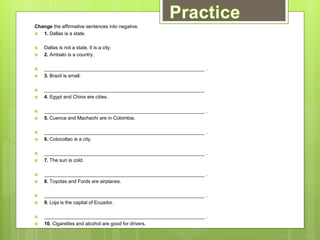
Change the affirmative sentences into negative.
 1. Dallas is a state.
 Dallas is not a state. It is a city.
 2. Ambato is a country.
 ___________________________________________________________ .
 3. Brazil is small.
 ___________________________________________________________
 4. Egypt and China are cities.
 ___________________________________________________________ .
 5. Cuenca and Machachi are in Colombia.
 ___________________________________________________________ .
 6. Cotocollao is a city.
 ___________________________________________________________ .
 7. The sun is cold.
 ___________________________________________________________ .
 8. Toyotas and Fords are airplanes.
 ___________________________________________________________ .
 9. Loja is the capital of Ecuador.
 ___________________________________________________________ .
 10. Cigarettes and alcohol are good for drivers.
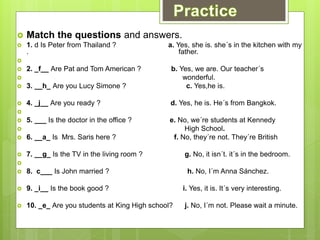
 Match the questions and answers.
 1. d Is Peter from Thailand ? a. Yes, she is. she´s in the kitchen with my
. father.

 2. _f__ Are Pat and Tom American ? b. Yes, we are. Our teacher´s
 wonderful.
 3. __h_ Are you Lucy Simone ? c. Yes,he is.
 4. _j__ Are you ready ? d. Yes, he is. He´s from Bangkok.

 5. ___ Is the doctor in the office ? e. No, we´re students at Kennedy
 High School.
 6. __a_ Is Mrs. Saris here ? f. No, they´re not. They´re British
 7. __g_ Is the TV in the living room ? g. No, it isn´t. it´s in the bedroom.

 8. c___ Is John married ? h. No, I´m Anna Sánchez.
 9. _i__ Is the book good ? i. Yes, it is. It´s very interesting.
 10. _e_ Are you students at King High school? j. No, I´m not. Please wait a minute.
Read the paragraph about Pepita Jimenez then write a
paragraph according to your real life.
 Hi, my name is Pepita Jimenez. I'm from Cuenca.
 I am 37 years old. I am a taxi driver. I am married.
 My husband´s name is Luis. We have two children.
 Their names are Marco and Sofia. I like to drive my car and listen
to music. I love my children my husband and my cab.
 Nice to meet you.
Hello my name is ..………………………….………………………………………
………………………….……………………….………………………………………
…………………….…………………………….………………………………………
……………..…………………………………….………………………………………
………………………………………….…………………………………………………
………………….…………………………………………………………………………
 PRESENT PROGRESSIVE
 SPECIFIC OBJECTIVE
 To use the grammatical structure in correct way in
order to identify the daily activities and the
habitual customs in present tense.
 5.1 The present progressive
 5.2 Grammatical Structure
 5.3 Questions and Answers
 5.4 Self-evaluation
THE PRESENT PROGRESSIVE
 The present progressive, made with a form of
be and the – ING form of the main verb,
indicates an action or event which is actually
in progress at this moment but may terminate
at any time.
 EXAMPLE
 I am studying English this year
 She is opening the door.
 He is using a pencil
 Complete the present progressive sentences.
 Example: I am reading a book.
 a. I am jump………..… rope
 b. You are listen…..…… the radio.
 c. You ……….… watching TV.
 d. He ……….… playing the guitar.
 e. He is go ………… to the bank.
 f. She is drive ……….… a car.
 g. She ………… opening the door.
 h. It is run………….… in the park.
 i. It ……….… eat …..…… soup.
 j. We …………..… walk ………… in the class.
 k. You are doing the exercises.
 l. You …………… dance …….…… now.
 m. They are listen ……….… the teacher.
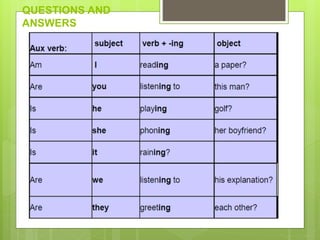
QUESTIONS AND
ANSWERS
Write sentences in present progressive tense. Use
the verbs in the box.
1) ______________________________________________
2) ______________________________________________
3) ______________________________________________
4) ______________________________________________
5) ______________________________________________
6) ______________________________________________
READ WORK PLAY EAT DRIVE
LISTEN
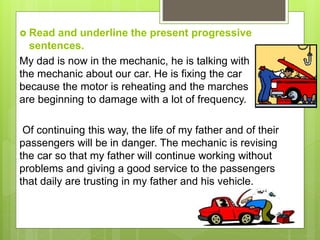
 Read and underline the present progressive
sentences.
My dad is now in the mechanic, he is talking with
the mechanic about our car. He is fixing the car
because the motor is reheating and the marches
are beginning to damage with a lot of frequency.
Of continuing this way, the life of my father and of their
passengers will be in danger. The mechanic is revising
the car so that my father will continue working without
problems and giving a good service to the passengers
that daily are trusting in my father and his vehicle.
SIMPLE PRESENT
 SPECIFIC OBJECTIVE
To express their feelings and activities in real time in order to
apply the grammatical structure in oral and written way.
 6.1 Simple Present
 6.2 Regular Verbs
 6.3 Irregular Verbs
 6.4 Affirmative Sentences
 6.5 Questions and Answers
 6.6.Self-evaluation
 Use the Simple Present to express the idea that an action
is repeated or usual. The action can be a habit, a hobby, a
daily event, a scheduled event or something that often
happens. It can also be something a person often forgets or
usually does not do.
 Examples:
 I play tennis.
 She does not play tennis.
 The train leaves every morning at 8 AM.
 The train does not leave at 9 AM.
 1ª per. singular I work
 2ª per. singular you work
 3ª per. singular he works she works It works
 1ª per. plural we work
 2ª per. plural you work
 3ª per. plural they work
 Notes about formation of the 3rd person singular
(he, she, it): If the verb ends in -ss, -sh, -ch, -x or -o,
add -es to the base form: kiss - kisses, finish - finishes,
watch - watches, mix - mixes, go – goes
 Examples: Susan goes to school.
 She finishes her homework.
 If the verb ends in consonant + y change y to i and
add -es: study - studies, copy - copies, try - tries, carry
– carries
 Examples: He carries his bag.
 He studies the English lesson.
English module
English module

English module

  • 8.
    UNIT 01 INTRODUCE YOURSELF SPECIFIC OBJECTIVE  To remember, know and apply the basic vocabulary through simple oral and written exercises in order to communicate their ideas and feelings.  1.1 Greetings  1.2 Oral Expressions  1.3 Introduce Dialogue  1.4 Vocabulary  1.5 Self-evaluation
  • 10.
    COMMON EXPRESSIONS  Havea nice day!  How are you?  How are you doing?  I´m fine, thank You.  I am well (fine), thank you  Do you speak Spanish?  Thank you, You are welcome
  • 11.
    INTRODUCE DIALOGUE  PAULO- Goodmorning  LUISA- Hi!  PAULO- What‟s your name?  LUISA- My name's Luisa. And what‟s your name?  PAULO - I'm Paulo.  LUISA - Are you a new student?  PAULO - Yes, I am. I'm from Colombia. Where are you from?  LUISA - I'm from Ecuador.  PAULO- Nice to meet you.  LUISA- Nice to meet you too.
  • 12.
  • 13.
    VOCABULARY  Introduction  1.Hello. My name's Pedro. What's your name?  2. Janet.  1. Where are you from Janet?  2. I'm from Guayaquil. Where are you from?  1. I'm from Madrid.  My name is... What's (is) your name ... Where are you from? I'm from... Are you (Spanish, American, German, etc.)  Hello  1. Hello, Edwin. How are you?  2. Fine, thanks. How are you?  1. I'm fine, thank you.  Goodbye  1. Goodbye, Iván. See you tomorrow!  2. Bye bye, Tony. Have a nice evening.  1. Thanks, you too!  2. Thanks.  Key Vocabulary  Hello... How are you? I'm fine, - OK, - well, thank you Goodbye, - bye bye See you tomorrow Have a nice evening, - day
  • 14.
     When youmeet a person for the first time , you can ask the following questions. Prepare your own dialogue  1. What‟s your first name? (My first name is Juan).  2. What‟s your middle name? (My middle name is Fernando).  3. What‟s your (last name / family name / surname)? (My last / family / surname is Gonzalez).  4. What‟s your second last name? (My second last name is Escobar).  5. What‟s your full name? (My full name is Juan Fernando Gonzalez Escobar).  6. What‟s your nickname? (My nickname is Nando).  7. Where are you from? (I‟m from Quito).
  • 15.
     8. What´syour marital status? (I‟m single / married / divorced / a widow / a widower).  9. What´s your address? (It‟s 24 – 25 Amazonas Avenue).  10. What‟s your phone number? (It‟s 296 – 7463).  11. How old are you? (I am 25 years old).  12. How are you? (I‟m very well, thanks).  13. What do you do? (I‟m a student).  14. When is your birthday? (My birthday is on January 2nd)
  • 17.
    UNIT 02 TIME ANDDATES  SPECIFIC OBJECTIVE  To give and ask simple information uses the time and dates in order to classify the activities according the importance and their personal value.  2.1 Numbers  2.2 Time  2.3 Months and Days of the Week  2.4 Self-evaluation
  • 18.
    CARDINALS ORDINALS  1one 1st first  2 two 2nd second  3 three 3rd third  4 four 4th fourth  5 five 5th fifth  6 six 6th sixth  7 seven 7th seventh  8 eight 8th eighth  9 nine 9th ninth  10 ten 10th tenth
  • 19.
    CARDINALS ORDINALS  11eleven 11th eleventh  12 twelve 12th twelfth  13 thirteen 13th thirteenth  14 fourteen 14th fourteenth  15 fifteen 15th fifteenth  16 sixteen 16th sixteenth  17 seventeen 17th seventeenth  18 eighteen 18th eighteenth  19 nineteen 19th nineteenth  20 twenty 20th twentieth
  • 20.
     Practice  Writethe following numbers .  25 ..................... 17....................... 12 ......................  10 ..................... 18 …................... 9 .......................  36 ..................... 44........................ 50 …..................   100 ................... 78 ....................... 60 …..................  85 ......................39 ....................... 30 ......................   16 .................. …11.. .................... 14 .......................  89 ...................... 102 ...................13 ………………..
  • 21.
     Read andcomplete the phrases  The first president of Ecuador was _____________________________  The second color in the Ecuadorian flag is_______  The third month of the year is ___________________  The fourth day of the week is ___________________  The fifth letter of the alphabet its _______________   Your first love was _____________________
  • 22.
    TIME In English weuse "past" to say times after the hour until half past, or 30 minutes past the hour. We use "to" to say times before the hour from 31 minutes until the full hour. In English we use o'clock only at the full hour. Example: It's eight o'clock We can also just say the numbers in groups of two. Example: It's seven twenty-five
  • 24.
    DAYS OF THEWEEK and MONTHS OF THE YEAR DAYS MONTHS Monday (Mon.) January (Jan.) Tuesday (Tues.) February (Feb.) Wednesday (Wed.) March (Mar.) Thursday (Thurs.) April (Apr.) Friday (Fri.) May (May) Saturday (Sat.) June (June) Sunday (Sun.) July (July) August (Aug.) . September (Sept.) October (Oct.) November (Nov.) . December (Dec.)
  • 25.
    Saying dates:  USUALWRITTEN FORM USUAL SPOKEN FORM  January 1 January first / the first of January   March 2 March second / the second of March   May 3 May third / the third of May   June 4 June fourth / the fourth of June   August 5 August fifth / the fifth of August   October 10 October tenth / the tenth of October   November 27 November twenty-seventh / the twenty- . seventh of November
  • 26.
    Practice  Using numberswrite the date:  Month / day / year  10 / 31 / 75 = October 31, 1975  4 / 15 / 92 = April 15, 1992  Change the dates into English  1. 6 de Diciembre de 1534 ---------------------------------------  2. 12 de Abril de 1967 ----------------------------------------------   3. 24 de Mayo de 1822 ---------------------------------------------   4. 16 de Noviembre de 1532 -------------------------------------  5. 14 de Febrero de 2008 ------------------------------------------
  • 27.
    Write cardinal numbers 56 ……………………………………………………………………  28 ……………………………………………………………………  12 ……………………………………………………………………  91 ……………………………………………………………………  1.407 ………………………………………………………….……  4.598 ………………………………………………………….……  7.961 …………………………………………………………..……
  • 28.
    How do yousay and write these dates?  1) 9/3/80 The ninth of March nineteen eighty.  2) 10/2/50 ____________________________  3) 31/5/41 ____________________________  4) 19/8/63 ____________________________  5) 7/7/77 ____________________________  6) 21/9/92 ____________________________  7) 3/6/11 ____________________________  8) 2/11/25 ____________________________  9) 13/1/30 ____________________________  10) 30/10/08 ____________________________
  • 29.
    UNIT 03  DESCRIBINGPEOPLE  SPECIFIC OBJECTIVE  To give simple information through people‟s descriptions using adjectives in order to communicate ideas in oral and written way.  3.1 Nouns  3.2 Articles  3.3 Adjectives  3.4 Prepositions  3.5 Self-evaluation
  • 30.
    WHAT ARE NOUNS? A noun is a word used to denote a person, place, thing, or idea.  Person: John, girl, dentist, driver Place: garden, university, garage. Thing: tire, car, wheel Idea: liberty, responsibility, intelligence
  • 32.
     Most nounshave distinctive SINGULAR and PLURAL forms.  The plural of regular nouns is formed by adding -s to the singular:  Singular Plural  car cars  pill pills  tablet tablets
  • 33.
     However, thereare many irregular nouns which do not form the plural in this way:  Singular Plural  man men  child children  sheep sheep  Woman women  Knife knive  Wolf wolves  Person people
  • 34.
     If theWord ends in 'sh', 'ch', 's', 'x' o 'z', we add 'es'.  Ex.  one church – two churches  one bus - two buses   one box - two boxes
  • 35.
     Some nounsend in 'o' we have to add 'es'.  Ex.  one tomato - two tomatoes  one hero - two heroes  one potato - two potatoes
  • 36.
     If thenoun ends in 'consonant + y', normally we have to change this 'y' into 'i' then we add “es”.  Ex.  one baby - two babies  one party - two parties  one lady - two ladies
  • 37.
     If thenoun ends in 'vowel + y', normally we add an extra’s’.  Ex.  one day - two days  one boy - two boys
  • 40.
     THE DEFINITEARTICLE (THE)  It´s used before singular and plural nouns when the noun is specific or particular.  The signals that the noun is definite, that it refers to a particular member of a group.  For example:"The dog that bit me ran away." Here, we're talking about a specific dog, the dog that bit me.
  • 41.
     Complete thesentences  ....... President of the United States was elected last year  The  A  ----  London is on ...... River Thames  ----  a  the  It's ...... most expensive hotel in town  ----  a  the
  • 42.
     My motheris allergic to ........ cigarette smoke  The  ----  a  He never listens to ....... classical music  a  ---  the  My flat is on ..... second floor  The  a  an
  • 43.
    An adjective modifiesa noun or a pronoun by describing, identifying, or quantifying words.  An adjective usually precedes the noun or the pronoun which it modifies.
  • 46.
     Example: Iam exhausted  1.  …………………………………………………………………………  2.  …………………………………………………………………………  3.  …………………………………………………………………………  4. ………………………………………………………………………..  5.  ………………………………………………………………………..
  • 47.
    PREPOSITIONS: IN, ON,AT  A) The preposition IN is used in the following ways:  1. Time: with the names of months, years, seasons, parts of the day or night.  Examples: in March, in 1967, in the winter, in the morning,  1. Place: Inside of something (en, dentro de alguna cosa).  Examples:  IN: in the evening, in July, in 1938, in the summer, in three weeks.  Virginia is in the United Status.
  • 48.
     B) Thepreposition ON is used:  1. Time: with the days of the week, and days of the month.  Example:  ON : on Monday, on my birthday, on July 16th  , on Friday morning, on the morning of May 3rd  on time.  On Tuesday, on the tenth of March, on March 10
  • 50.
     C) Thepreposition AT is used to indicate a definite time or place.  Time: for hours and minutes, and with noon, night, midnight.  Examples:  at six o´clock, at ten minutes to two, at half past five, at noon, at nighmidnight.  Place: for a definite position.   Examples:  AT: at 6.30, at midday, at Christmas, at the beginning, at the moment.
  • 53.
    VERB TO BE SIMPLEPRESENT TO BE SPECIFIC OBJECTIVE  To practice the to be verb in present tense in order to build sentences,  questions and give affirmative and negative information in oral and  written way.  4.1 Personal Pronouns  4.2 Verb to be  4.3 Affirmative / Negative Sentences  4.4 Yes/No Questions and Answers  4.5 Self-evaluation
  • 57.
  • 59.
     Complete thesentences. Use a VERB: am, is, or are. Use a NOUN: a student or students.  1. We are students.  2. I ________________________.  3. Rita goes to school . She ____________________________  4. Rita and Tom go to school . They _____________________  5. You ( one person ) __________________________________  6. You ( two people ) __________________________________  Put in correct order these sentences  1. I /a/ student/ am. …………………………………………..  2. They/from/are. …………………………………………..  3. She/a /is/beautiful girl. …………………………………………..  4. We/drivers/are. …………………………………………..  5. teacher/He/a /is. …………………………………………..  6. You/ a/are/student. ………………………………………….
  • 60.
     Complete theconversation . Use I am, you are, he is, she is, it is, we are, or they are.  1. A: How are you?  B: I am wonderful.  2. A: How are you and your wife?  B: grate.  3. A: How is your daughter?  B: happy.  4. A: How is your son?  B: very good.  5. A: How are your mother and father? B: very nice.
  • 63.
    Change the affirmativesentences into negative.  1. Dallas is a state.  Dallas is not a state. It is a city.  2. Ambato is a country.  ___________________________________________________________ .  3. Brazil is small.  ___________________________________________________________  4. Egypt and China are cities.  ___________________________________________________________ .  5. Cuenca and Machachi are in Colombia.  ___________________________________________________________ .  6. Cotocollao is a city.  ___________________________________________________________ .  7. The sun is cold.  ___________________________________________________________ .  8. Toyotas and Fords are airplanes.  ___________________________________________________________ .  9. Loja is the capital of Ecuador.  ___________________________________________________________ .  10. Cigarettes and alcohol are good for drivers.
  • 66.
     Match thequestions and answers.  1. d Is Peter from Thailand ? a. Yes, she is. she´s in the kitchen with my . father.   2. _f__ Are Pat and Tom American ? b. Yes, we are. Our teacher´s  wonderful.  3. __h_ Are you Lucy Simone ? c. Yes,he is.  4. _j__ Are you ready ? d. Yes, he is. He´s from Bangkok.   5. ___ Is the doctor in the office ? e. No, we´re students at Kennedy  High School.  6. __a_ Is Mrs. Saris here ? f. No, they´re not. They´re British  7. __g_ Is the TV in the living room ? g. No, it isn´t. it´s in the bedroom.   8. c___ Is John married ? h. No, I´m Anna Sánchez.  9. _i__ Is the book good ? i. Yes, it is. It´s very interesting.  10. _e_ Are you students at King High school? j. No, I´m not. Please wait a minute.
  • 67.
    Read the paragraphabout Pepita Jimenez then write a paragraph according to your real life.  Hi, my name is Pepita Jimenez. I'm from Cuenca.  I am 37 years old. I am a taxi driver. I am married.  My husband´s name is Luis. We have two children.  Their names are Marco and Sofia. I like to drive my car and listen to music. I love my children my husband and my cab.  Nice to meet you. Hello my name is ..………………………….……………………………………… ………………………….……………………….……………………………………… …………………….…………………………….……………………………………… ……………..…………………………………….……………………………………… ………………………………………….………………………………………………… ………………….…………………………………………………………………………
  • 68.
     PRESENT PROGRESSIVE SPECIFIC OBJECTIVE  To use the grammatical structure in correct way in order to identify the daily activities and the habitual customs in present tense.  5.1 The present progressive  5.2 Grammatical Structure  5.3 Questions and Answers  5.4 Self-evaluation
  • 69.
    THE PRESENT PROGRESSIVE The present progressive, made with a form of be and the – ING form of the main verb, indicates an action or event which is actually in progress at this moment but may terminate at any time.
  • 70.
     EXAMPLE  Iam studying English this year  She is opening the door.  He is using a pencil
  • 71.
     Complete thepresent progressive sentences.  Example: I am reading a book.  a. I am jump………..… rope  b. You are listen…..…… the radio.  c. You ……….… watching TV.  d. He ……….… playing the guitar.  e. He is go ………… to the bank.  f. She is drive ……….… a car.  g. She ………… opening the door.  h. It is run………….… in the park.  i. It ……….… eat …..…… soup.  j. We …………..… walk ………… in the class.  k. You are doing the exercises.  l. You …………… dance …….…… now.  m. They are listen ……….… the teacher.
  • 72.
  • 73.
    Write sentences inpresent progressive tense. Use the verbs in the box. 1) ______________________________________________ 2) ______________________________________________ 3) ______________________________________________ 4) ______________________________________________ 5) ______________________________________________ 6) ______________________________________________ READ WORK PLAY EAT DRIVE LISTEN
  • 74.
     Read andunderline the present progressive sentences. My dad is now in the mechanic, he is talking with the mechanic about our car. He is fixing the car because the motor is reheating and the marches are beginning to damage with a lot of frequency. Of continuing this way, the life of my father and of their passengers will be in danger. The mechanic is revising the car so that my father will continue working without problems and giving a good service to the passengers that daily are trusting in my father and his vehicle.
  • 75.
    SIMPLE PRESENT  SPECIFICOBJECTIVE To express their feelings and activities in real time in order to apply the grammatical structure in oral and written way.  6.1 Simple Present  6.2 Regular Verbs  6.3 Irregular Verbs  6.4 Affirmative Sentences  6.5 Questions and Answers  6.6.Self-evaluation
  • 76.
     Use theSimple Present to express the idea that an action is repeated or usual. The action can be a habit, a hobby, a daily event, a scheduled event or something that often happens. It can also be something a person often forgets or usually does not do.  Examples:  I play tennis.  She does not play tennis.  The train leaves every morning at 8 AM.  The train does not leave at 9 AM.  1ª per. singular I work  2ª per. singular you work  3ª per. singular he works she works It works  1ª per. plural we work  2ª per. plural you work  3ª per. plural they work
  • 77.
     Notes aboutformation of the 3rd person singular (he, she, it): If the verb ends in -ss, -sh, -ch, -x or -o, add -es to the base form: kiss - kisses, finish - finishes, watch - watches, mix - mixes, go – goes  Examples: Susan goes to school.  She finishes her homework.  If the verb ends in consonant + y change y to i and add -es: study - studies, copy - copies, try - tries, carry – carries  Examples: He carries his bag.  He studies the English lesson.