1. PREPOSITION.
2. FRAMING QUESTION.
3. CONJUCATION.
4. TENSES.
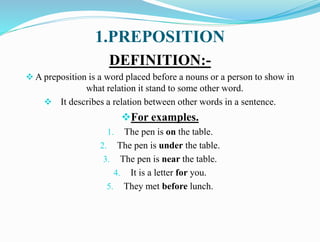
1.PREPOSITION
DEFINITION:-
 A preposition is a word placed before a nouns or a person to show in
what relation it stand to some other word.
 It describes a relation between other words in a sentence.
For examples.
1. The pen is on the table.
2. The pen is under the table.
3. The pen is near the table.
4. It is a letter for you.
5. They met before lunch.
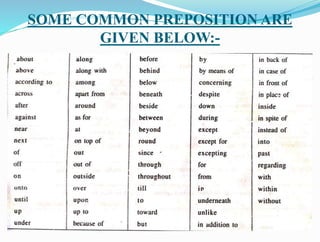
SOME COMMON PREPOSITION ARE
GIVEN BELOW:-
TYPES OF PREPOSITION
1. Simples preposition.
2. Compound preposition.
3. Phrasal preposition.
4. Participation preposition.
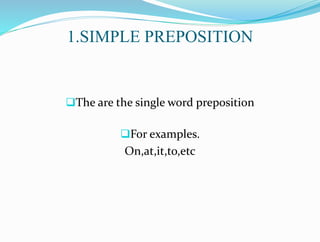
1.SIMPLE PREPOSITION
The are the single word preposition
For examples.
On,at,it,to,etc
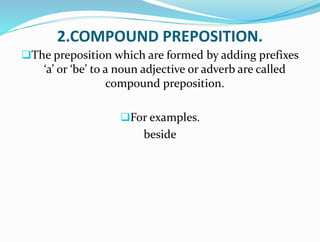
2.COMPOUND PREPOSITION.
The preposition which are formed by adding prefixes
‘a’ or ‘be’ to a noun adjective or adverb are called
compound preposition.
For examples.
beside
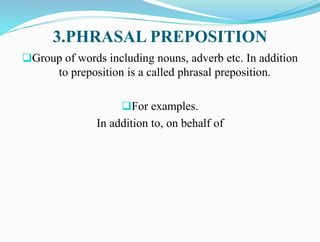
3.PHRASAL PREPOSITION
Group of words including nouns, adverb etc. In addition
to preposition is a called phrasal preposition.
For examples.
In addition to, on behalf of
4.PARTICIPLE PREPOSITION
Present participles of verbs used absolutely without any
noun or pronoun being attached to them.
For examples.
Concerning,Considering,Touching,Respecting,
Regarding,Pending.
USAGE OF DIFFERENT PREPOSITION
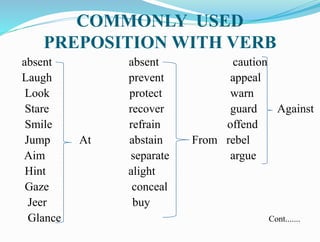
COMMONLY USED
PREPOSITION WITH VERB
absent absent caution
Laugh prevent appeal
Look protect warn
Stare recover guard Against
Smile refrain offend
Jump At abstain From rebel
Aim separate argue
Hint alight
Gaze conceal
Jeer buy
Glance Cont.......
COMMONLY USED PREPOSITION WITH
VERB
Fill Beg Alight
Succeed Care Benefit
Involve Change Borrow
Indulge Wait Derive From
Fail Hope Differ
Excel In Wish From Exclude
Believe Forgive Abstain
Abound Excuse
Delight Exchange
Arbitrate Escape Cont........
COMMONLY USED PREPOSITION WITH
VERB
Rely Pray Consist
Spend Yield Tire
Operate Surrender Think
Insist Submit Smell
Persist Object Suspect
Impose Listen Dream
Flown On Liken To Dispose Of
Depend Introduce Die
Congratulate Drink Graduate
Comment Contribution Boast
Bestow Consign Complain
Base Consent Accuse
Confine Acquit
COMMONLY USED PREPOSITION WITH VERB
Comply Admit
Agree Accede
Disagree Adapt
Compromise Add
Coincide Attach To
Cope Attend
Dispense With Belong
Interfere Regard
Meddle Listen
Part
Quarrel
Sympathise
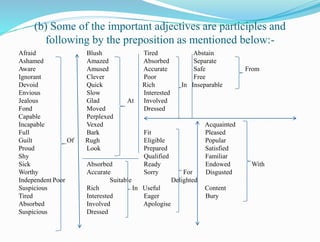
(b) Some of the important adjectives are participles and
following by the preposition as mentioned below:-
Afraid Blush Tired Abstain
Ashamed Amazed Absorbed Separate
Aware Amused Accurate Safe From
Ignorant Clever Poor Free
Devoid Quick Rich In Inseparable
Envious Slow Interested
Jealous Glad At Involved
Fond Moved Dressed
Capable Perplexed
Incapable Vexed Acquainted
Full Bark Fit Pleased
Guilt Of Rugh Eligible Popular
Proud Look Prepared Satisfied
Shy Qualified Familiar
Sick Absorbed Ready Endowed With
Worthy Accurate Sorry For Disgusted
Independent Poor Suitable Delighted
Suspicious Rich In Useful Content
Tired Interested Eager Bury
Absorbed Involved Apologise
Suspicious Dressed
USAGE OF DIFFERENT
PREPOSITION
1.Some preposition which follow certain verbs(ex.)
A. At.
 What are we aiming at?
 The train has arrived at the station ?
 We should not laugh at others
B. In
 I believe in your honesty.
 He will never fail in his duty.
C. From
 He differ from his father in his nature.
 The thief escaped from the police custody
 These chapters have been excluded from our course.
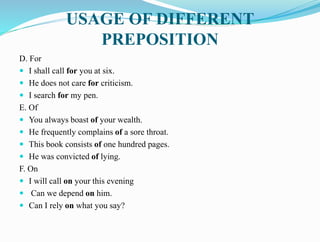
USAGE OF DIFFERENT
PREPOSITION
D. For
 I shall call for you at six.
 He does not care for criticism.
 I search for my pen.
E. Of
 You always boast of your wealth.
 He frequently complains of a sore throat.
 This book consists of one hundred pages.
 He was convicted of lying.
F. On
 I will call on your this evening
 Can we depend on him.
 Can I rely on what you say?
USAGE OF DIFFERENT
PREPOSITION
G. To
 Animals adapt themselves to their surrounding.
 We agree to your proposal.
 Rakesh appealed to the principal to excuse him.
 Please attend to your own works.
 This house belongs to my father.
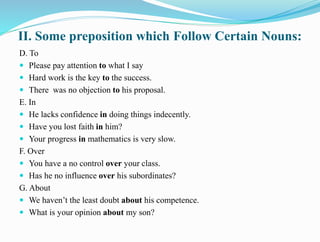
II. Some preposition which Follow Certain
Nouns:
A. For
 A mother has great affection for her children.
 He had no ambition for fame of fortune.
 I see you anxiety for getting a good job.
 My son has no aptitude for science.
 Are you a candidate for the post of lecture?
B. Of
 Mr. Jayant has no experience of teaching.
 Have you no fear of the law?
 He is in the habit of telling lies.
 Are you in need of money?
 What is the use of going there?
C. On
 What is your opinion on this issue?
 The lion felt pity on the rat and set it free.
II. Some preposition which Follow Certain Nouns:
D. To
 Please pay attention to what I say
 Hard work is the key to the success.
 There was no objection to his proposal.
E. In
 He lacks confidence in doing things indecently.
 Have you lost faith in him?
 Your progress in mathematics is very slow.
F. Over
 You have a no control over your class.
 Has he no influence over his subordinates?
G. About
 We haven’t the least doubt about his competence.
 What is your opinion about my son?
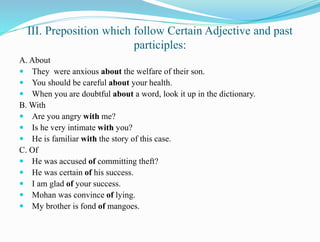
III. Preposition which follow Certain Adjective and past
participles:
A. About
 They were anxious about the welfare of their son.
 You should be careful about your health.
 When you are doubtful about a word, look it up in the dictionary.
B. With
 Are you angry with me?
 Is he very intimate with you?
 He is familiar with the story of this case.
C. Of
 He was accused of committing theft?
 He was certain of his success.
 I am glad of your success.
 Mohan was convince of lying.
 My brother is fond of mangoes.
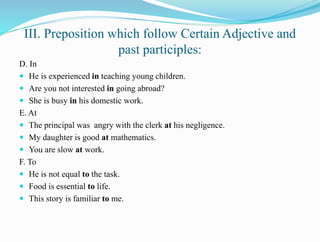
III. Preposition which follow Certain Adjective and
past participles:
D. In
 He is experienced in teaching young children.
 Are you not interested in going abroad?
 She is busy in his domestic work.
E. At
 The principal was angry with the clerk at his negligence.
 My daughter is good at mathematics.
 You are slow at work.
F. To
 He is not equal to the task.
 Food is essential to life.
 This story is familiar to me.
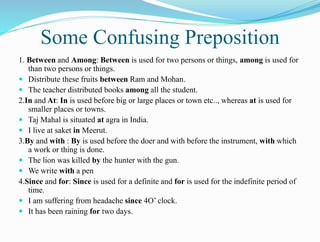
Some Confusing Preposition
1. Between and Among: Between is used for two persons or things, among is used for
than two persons or things.
 Distribute these fruits between Ram and Mohan.
 The teacher distributed books among all the student.
2.In and At: In is used before big or large places or town etc.., whereas at is used for
smaller places or towns.
 Taj Mahal is situated at agra in India.
 I live at saket in Meerut.
3.By and with : By is used before the doer and with before the instrument, with which
a work or thing is done.
 The lion was killed by the hunter with the gun.
 We write with a pen
4.Since and for: Since is used for a definite and for is used for the indefinite period of
time.
 I am suffering from headache since 4O’ clock.
 It has been raining for two days.
Some Confusing Preposition
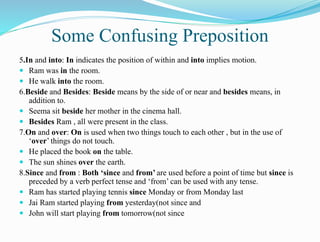
5.In and into: In indicates the position of within and into implies motion.
 Ram was in the room.
 He walk into the room.
6.Beside and Besides: Beside means by the side of or near and besides means, in
addition to.
 Seema sit beside her mother in the cinema hall.
 Besides Ram , all were present in the class.
7.On and over: On is used when two things touch to each other , but in the use of
‘over’ things do not touch.
 He placed the book on the table.
 The sun shines over the earth.
8.Since and from : Both ‘since and from’ are used before a point of time but since is
preceded by a verb perfect tense and ‘from’ can be used with any tense.
 Ram has started playing tennis since Monday or from Monday last
 Jai Ram started playing from yesterday(not since and
 John will start playing from tomorrow(not since
Some Confusing Preposition
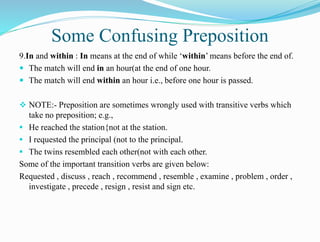
9.In and within : In means at the end of while ‘within’ means before the end of.
 The match will end in an hour(at the end of one hour.
 The match will end within an hour i.e., before one hour is passed.
 NOTE:- Preposition are sometimes wrongly used with transitive verbs which
take no preposition; e.g.,
 He reached the station{not at the station.
 I requested the principal (not to the principal.
 The twins resembled each other(not with each other.
Some of the important transition verbs are given below:
Requested , discuss , reach , recommend , resemble , examine , problem , order ,
investigate , precede , resign , resist and sign etc.
COMMON EXAMPLES
1. The cat is under the table (under)
2. His work was below average (below)
3. Student are walking along the path(along)
4. Frog jumped into the wall(into)
5. Teacher told about his student(about)
6. Child ran across the crowded road(across)
7. Distribute sweets between two boys(between)
8. Divide these pages among all student(among)
9. Sanjana was standing before me(before)
10. He jumped off the moving bus.(off)
11. He has been working her since 2002(since)
12. He must finish the work within a weak(within)
13. The boys should write the essay without any delay(without)
14. He lives beyond the hills(beyond)
15. I shall send this message through my brother(through)
16. My mother sat besides me and told a story(beside)
COMMON EXAMPLES
17. A white cat jumped upon the chair(upon)
18. He is afraid of the dog(of)
19. Listen to the teacher(to)
20. He died for his country(for)
21. The teacher is in the class(in)
22. The teacher came into the class(into)
23. He aimed at the bird(at)
24. I shall call on you (on)
25. The village was destroyed with fire(with)
26. He spoke to me in Urdu(to,in)
27. He has recovered from the illness(from)
28. The earth revolves around the sun (around)
29. I would rather die then beg
30. Walk fast lest you should miss the train
31. He is taller than the brother
32. We eat so that we may live
33. He walk as if he were a king
COMMON EXAMPLES
34. Make hay while the sun shine(while)
35. You may do as you please(as)
36. He was mad with anger (with)
37. I congratulation him on/at his success.(on/at)
38. Do not fall out over trifles(over)
39. He bears a grudge against me(against)
40. He felt in the battlefield(in)
41. Can you came by to night (by)
42. He came round my views(round)
43. It is very kind of you to help me(of,to)
44. He stood by me through thick and thin(by,throgh)
45. The sun is behind the clouds(behind)
46. The pond is full of fishes.
TOPIC -1 PREPOSITION

TOPIC -1 PREPOSITION

  • 1.
    1. PREPOSITION. 2. FRAMINGQUESTION. 3. CONJUCATION. 4. TENSES.
  • 2.
    1.PREPOSITION DEFINITION:-  A prepositionis a word placed before a nouns or a person to show in what relation it stand to some other word.  It describes a relation between other words in a sentence. For examples. 1. The pen is on the table. 2. The pen is under the table. 3. The pen is near the table. 4. It is a letter for you. 5. They met before lunch.
  • 3.
    SOME COMMON PREPOSITIONARE GIVEN BELOW:-
  • 4.
    TYPES OF PREPOSITION 1.Simples preposition. 2. Compound preposition. 3. Phrasal preposition. 4. Participation preposition.
  • 5.
    1.SIMPLE PREPOSITION The arethe single word preposition For examples. On,at,it,to,etc
  • 6.
    2.COMPOUND PREPOSITION. The prepositionwhich are formed by adding prefixes ‘a’ or ‘be’ to a noun adjective or adverb are called compound preposition. For examples. beside
  • 7.
    3.PHRASAL PREPOSITION Group ofwords including nouns, adverb etc. In addition to preposition is a called phrasal preposition. For examples. In addition to, on behalf of
  • 8.
    4.PARTICIPLE PREPOSITION Present participlesof verbs used absolutely without any noun or pronoun being attached to them. For examples. Concerning,Considering,Touching,Respecting, Regarding,Pending.
  • 9.
    USAGE OF DIFFERENTPREPOSITION
  • 12.
    COMMONLY USED PREPOSITION WITHVERB absent absent caution Laugh prevent appeal Look protect warn Stare recover guard Against Smile refrain offend Jump At abstain From rebel Aim separate argue Hint alight Gaze conceal Jeer buy Glance Cont.......
  • 13.
    COMMONLY USED PREPOSITIONWITH VERB Fill Beg Alight Succeed Care Benefit Involve Change Borrow Indulge Wait Derive From Fail Hope Differ Excel In Wish From Exclude Believe Forgive Abstain Abound Excuse Delight Exchange Arbitrate Escape Cont........
  • 14.
    COMMONLY USED PREPOSITIONWITH VERB Rely Pray Consist Spend Yield Tire Operate Surrender Think Insist Submit Smell Persist Object Suspect Impose Listen Dream Flown On Liken To Dispose Of Depend Introduce Die Congratulate Drink Graduate Comment Contribution Boast Bestow Consign Complain Base Consent Accuse Confine Acquit
  • 15.
    COMMONLY USED PREPOSITIONWITH VERB Comply Admit Agree Accede Disagree Adapt Compromise Add Coincide Attach To Cope Attend Dispense With Belong Interfere Regard Meddle Listen Part Quarrel Sympathise
  • 16.
    (b) Some ofthe important adjectives are participles and following by the preposition as mentioned below:- Afraid Blush Tired Abstain Ashamed Amazed Absorbed Separate Aware Amused Accurate Safe From Ignorant Clever Poor Free Devoid Quick Rich In Inseparable Envious Slow Interested Jealous Glad At Involved Fond Moved Dressed Capable Perplexed Incapable Vexed Acquainted Full Bark Fit Pleased Guilt Of Rugh Eligible Popular Proud Look Prepared Satisfied Shy Qualified Familiar Sick Absorbed Ready Endowed With Worthy Accurate Sorry For Disgusted Independent Poor Suitable Delighted Suspicious Rich In Useful Content Tired Interested Eager Bury Absorbed Involved Apologise Suspicious Dressed
  • 17.
    USAGE OF DIFFERENT PREPOSITION 1.Somepreposition which follow certain verbs(ex.) A. At.  What are we aiming at?  The train has arrived at the station ?  We should not laugh at others B. In  I believe in your honesty.  He will never fail in his duty. C. From  He differ from his father in his nature.  The thief escaped from the police custody  These chapters have been excluded from our course.
  • 18.
    USAGE OF DIFFERENT PREPOSITION D.For  I shall call for you at six.  He does not care for criticism.  I search for my pen. E. Of  You always boast of your wealth.  He frequently complains of a sore throat.  This book consists of one hundred pages.  He was convicted of lying. F. On  I will call on your this evening  Can we depend on him.  Can I rely on what you say?
  • 19.
    USAGE OF DIFFERENT PREPOSITION G.To  Animals adapt themselves to their surrounding.  We agree to your proposal.  Rakesh appealed to the principal to excuse him.  Please attend to your own works.  This house belongs to my father.
  • 20.
    II. Some prepositionwhich Follow Certain Nouns: A. For  A mother has great affection for her children.  He had no ambition for fame of fortune.  I see you anxiety for getting a good job.  My son has no aptitude for science.  Are you a candidate for the post of lecture? B. Of  Mr. Jayant has no experience of teaching.  Have you no fear of the law?  He is in the habit of telling lies.  Are you in need of money?  What is the use of going there? C. On  What is your opinion on this issue?  The lion felt pity on the rat and set it free.
  • 21.
    II. Some prepositionwhich Follow Certain Nouns: D. To  Please pay attention to what I say  Hard work is the key to the success.  There was no objection to his proposal. E. In  He lacks confidence in doing things indecently.  Have you lost faith in him?  Your progress in mathematics is very slow. F. Over  You have a no control over your class.  Has he no influence over his subordinates? G. About  We haven’t the least doubt about his competence.  What is your opinion about my son?
  • 22.
    III. Preposition whichfollow Certain Adjective and past participles: A. About  They were anxious about the welfare of their son.  You should be careful about your health.  When you are doubtful about a word, look it up in the dictionary. B. With  Are you angry with me?  Is he very intimate with you?  He is familiar with the story of this case. C. Of  He was accused of committing theft?  He was certain of his success.  I am glad of your success.  Mohan was convince of lying.  My brother is fond of mangoes.
  • 23.
    III. Preposition whichfollow Certain Adjective and past participles: D. In  He is experienced in teaching young children.  Are you not interested in going abroad?  She is busy in his domestic work. E. At  The principal was angry with the clerk at his negligence.  My daughter is good at mathematics.  You are slow at work. F. To  He is not equal to the task.  Food is essential to life.  This story is familiar to me.
  • 24.
    Some Confusing Preposition 1.Between and Among: Between is used for two persons or things, among is used for than two persons or things.  Distribute these fruits between Ram and Mohan.  The teacher distributed books among all the student. 2.In and At: In is used before big or large places or town etc.., whereas at is used for smaller places or towns.  Taj Mahal is situated at agra in India.  I live at saket in Meerut. 3.By and with : By is used before the doer and with before the instrument, with which a work or thing is done.  The lion was killed by the hunter with the gun.  We write with a pen 4.Since and for: Since is used for a definite and for is used for the indefinite period of time.  I am suffering from headache since 4O’ clock.  It has been raining for two days.
  • 25.
    Some Confusing Preposition 5.Inand into: In indicates the position of within and into implies motion.  Ram was in the room.  He walk into the room. 6.Beside and Besides: Beside means by the side of or near and besides means, in addition to.  Seema sit beside her mother in the cinema hall.  Besides Ram , all were present in the class. 7.On and over: On is used when two things touch to each other , but in the use of ‘over’ things do not touch.  He placed the book on the table.  The sun shines over the earth. 8.Since and from : Both ‘since and from’ are used before a point of time but since is preceded by a verb perfect tense and ‘from’ can be used with any tense.  Ram has started playing tennis since Monday or from Monday last  Jai Ram started playing from yesterday(not since and  John will start playing from tomorrow(not since
  • 26.
    Some Confusing Preposition 9.Inand within : In means at the end of while ‘within’ means before the end of.  The match will end in an hour(at the end of one hour.  The match will end within an hour i.e., before one hour is passed.  NOTE:- Preposition are sometimes wrongly used with transitive verbs which take no preposition; e.g.,  He reached the station{not at the station.  I requested the principal (not to the principal.  The twins resembled each other(not with each other. Some of the important transition verbs are given below: Requested , discuss , reach , recommend , resemble , examine , problem , order , investigate , precede , resign , resist and sign etc.
  • 27.
    COMMON EXAMPLES 1. Thecat is under the table (under) 2. His work was below average (below) 3. Student are walking along the path(along) 4. Frog jumped into the wall(into) 5. Teacher told about his student(about) 6. Child ran across the crowded road(across) 7. Distribute sweets between two boys(between) 8. Divide these pages among all student(among) 9. Sanjana was standing before me(before) 10. He jumped off the moving bus.(off) 11. He has been working her since 2002(since) 12. He must finish the work within a weak(within) 13. The boys should write the essay without any delay(without) 14. He lives beyond the hills(beyond) 15. I shall send this message through my brother(through) 16. My mother sat besides me and told a story(beside)
  • 28.
    COMMON EXAMPLES 17. Awhite cat jumped upon the chair(upon) 18. He is afraid of the dog(of) 19. Listen to the teacher(to) 20. He died for his country(for) 21. The teacher is in the class(in) 22. The teacher came into the class(into) 23. He aimed at the bird(at) 24. I shall call on you (on) 25. The village was destroyed with fire(with) 26. He spoke to me in Urdu(to,in) 27. He has recovered from the illness(from) 28. The earth revolves around the sun (around) 29. I would rather die then beg 30. Walk fast lest you should miss the train 31. He is taller than the brother 32. We eat so that we may live 33. He walk as if he were a king
  • 29.
    COMMON EXAMPLES 34. Makehay while the sun shine(while) 35. You may do as you please(as) 36. He was mad with anger (with) 37. I congratulation him on/at his success.(on/at) 38. Do not fall out over trifles(over) 39. He bears a grudge against me(against) 40. He felt in the battlefield(in) 41. Can you came by to night (by) 42. He came round my views(round) 43. It is very kind of you to help me(of,to) 44. He stood by me through thick and thin(by,throgh) 45. The sun is behind the clouds(behind) 46. The pond is full of fishes.