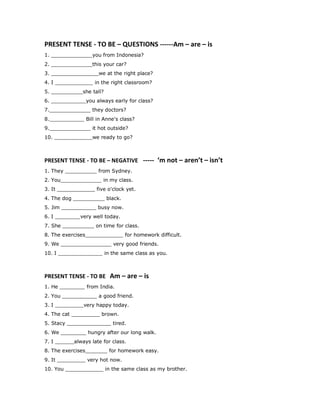
PRESENT TENSE - TO BE – QUESTIONS ------Am – are – is
1. _____________you from Indonesia?
2. _____________this your car?
3. _______________we at the right place?
4. I ____________ in the right classroom?
5. __________she tall?
6. ___________you always early for class?
7._____________ they doctors?
8.___________ Bill in Anne's class?
9._____________ it hot outside?
10. ____________we ready to go?
PRESENT TENSE - TO BE – NEGATIVE ----- ‘m not – aren’t – isn’t
1. They __________ from Sydney.
2. You_____________ in my class.
3. It ____________ five o'clock yet.
4. The dog __________ black.
5. Jim ___________ busy now.
6. I ________very well today.
7. She __________ on time for class.
8. The exercises____________ for homework difficult.
9. We ________________ very good friends.
10. I ______________ in the same class as you.
PRESENT TENSE - TO BE Am – are – is
1. He ________ from India.
2. You ___________ a good friend.
3. I _________very happy today.
4. The cat _________ brown.
5. Stacy ______________ tired.
6. We ________ hungry after our long walk.
7. I ______always late for class.
8. The exercises_______ for homework easy.
9. It _________ very hot now.
10. You ____________ in the same class as my brother.
Introducing Yourself
Hello! My name is Ana. I am twenty-five years old. I live in Miami, Florida with my
husband and two children. I have one son in kindergarten and one daughter in first
grade. They both attend public school. My husband is a mechanic. On weekends,
he works at a restaurant as a dishwasher. The restaurant usually gets more
customers on weekends, so they need extra people to wash dishes.
Q1: Who is introducing herself? Ans:
_________________________________________________
Q2: How old is she? Ans:
___________________________________________________________
Q3: Where does Ana live? Ans
______________________________________________________
Q4: What is her husband’s profession? Ans:
____________________________________________
Q5: Where does he work on weekends? Ans:
___________________________________________
Q6: How many children does Ana have? Ans:
___________________________________________
Excepciones:
1. Palabras que terminan en consonante + "y": la "y" cambia a "i" y añadimos "es".
party / parties (fiesta/s)
city / cities (ciudad/es)
2. Palabras que terminan en vocal + "y": añadimos una "s".
boy / boys (chico/s)
toy / toys (juguete/s)
3. Palabras que terminan en "s", "ss", "sh", "ch", "x", "o": añadimos "es".
watch / watches (reloj/es)
box / boxes (caja/s)
tomato / tomatoes (tomate/s)
4. Palabras que terminan en "f" o "fe": cambiamos la "f" o "fe" por "ves".
leaf / leaves (hoja/s)
wife / wives (esposa/s)
Regular plurals:
Form: Add "s" to the noun:
Noun + S
Spelling of plurals:
The plural form of most nouns is created simply by adding the letter "s".
 more than one snake = snakes
 more than one girl = girls
Nouns that end in -ch, x, s, z or s-Sh, like sounds, however, will require an es for the
plural:
 more than one bus = buses
 more than one kiss = kisses
Nouns that end in a vowel + y take the letter s:
 more than one boy = boys
 more than one way = ways
Nouns that end in a consonant + y drop the y and take ies:
 more than one baby = babies
 more than one lorry = lorries
A lot of nouns that end in o take es in the plural:
 more than one potato = potatoes
 more than one hero = heroes
Plurals of nouns that end in f or fe usually change the f sound to a v sound and add s or -
es.
 more than one knife = knives
 more than one leaf = leaves
Irregular plurals:
There are several nouns that have irregular plural forms.
Singular Plural
foot feet
tooth teeth
tooth teeth
Singular Plural
child children
man men
woman women
Singular Plural
person people
mouse mice
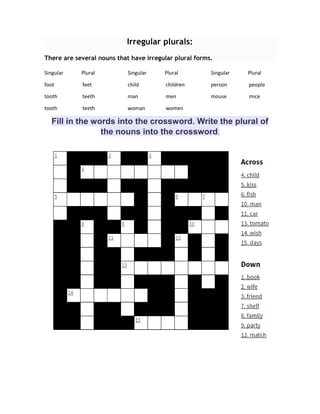
Fill in the words into the crossword. Write the plural of
the nouns into the crossword.
Family
My name is Sangeeta. I am 11. I live in New Delhi, India with my father, mother, two
brothers and three sisters. My grandparents also live with us. In India, family is very
important. It is common to have grandparents, aunts, uncles and/or cousins living in
the same house. My aunts, uncles and cousins also live nearby. We see each other
often. My older brother is a computer programmer. Right now, he is in Australia. His
company sent him there for one year. We all miss him a lot. We write him letters
every week. I want him to come home soon.
Q1: How old is Sangeeta? Asn:
_______________________________________________________
Q2: Which country does she live in?
___________________________________________________
Q3: Does she live with her parents? Ans:
_______________________________________________
Q4: Who else lives with her? Ans:
_____________________________________________________
Q4: What does her older brother do? Ans:
_____________________________________________
Q5: Where is he right now? Ans:
_____________________________________________________
Q6: Does the family miss him? How do you
know?_________________________________________________________
A New Home
Francisco stands outside his new house. He reaches into his pocket and pulls out
the key. He turns the key in the lock and opens the door. He steps into the living
room and looks around. The paint is peeling off the walls. There is no furniture. The
house is dirty and smells bad. He tries to open a window but it is broken. The house
does not have a kitchen or a bedroom but there is a microwave on the floor on one
side of the room. He wonders if it works. The place looks terrible but it is all he can
afford. He covers his nose and mouth with his hand and opens the bathroom door.
It is in bad condition.
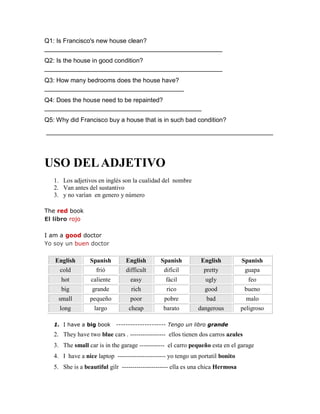
Q1: Is Francisco's new house clean?
___________________________________________________
Q2: Is the house in good condition?
___________________________________________________
Q3: How many bedrooms does the house have?
________________________________________
Q4: Does the house need to be repainted?
_____________________________________________
Q5: Why did Francisco buy a house that is in such bad condition?
_________________________________________________________________
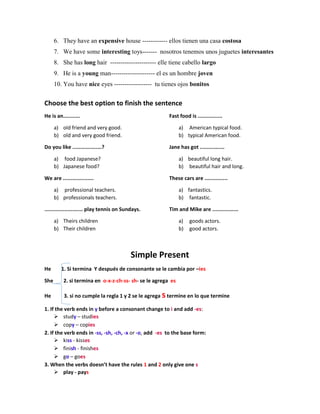
USO DELADJETIVO
1. Los adjetivos en inglés son la cualidad del nombre
2. Van antes del sustantivo
3. y no varían en genero y número
The red book
El libro rojo
I am a good doctor
Yo soy un buen doctor
English Spanish English Spanish English Spanish
cold frió difficult difícil pretty guapa
hot caliente easy fácil ugly feo
big grande rich rico good bueno
small pequeño poor pobre bad malo
long largo cheap barato dangerous peligroso
1. I have a big book --------------------- Tengo un libro grande
2. They have two blue cars . ----------------- ellos tienen dos carros azules
3. The small car is in the garage ------------ el carro pequeño esta en el garage
4. I have a nice laptop ----------------------- yo tengo un portatil bonito
5. She is a beautiful gilr ---------------------- ella es una chica Hermosa
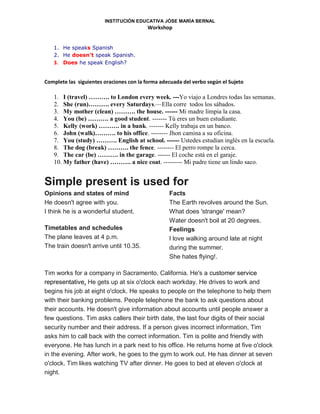
6. They have an expensive house ------------ ellos tienen una casa costosa
7. We have some interesting toys------- nosotros tenemos unos juguetes interesantes
8. She has long hair ---------------------- elle tiene cabello largo
9. He is a young man--------------------- el es un hombre joven
10. You have nice eyes ------------------ tu tienes ojos bonitos
Choose the best option to finish the sentence
He is an...........
a) old friend and very good.
b) old and very good friend.
Do you like ...................?
a) food Japanese?
b) Japanese food?
We are ....................
a) professional teachers.
b) professionals teachers.
......................... play tennis on Sundays.
a) Theirs children
b) Their children
Fast food is ................
a) American typical food.
b) typical American food.
Jane has got ................
a) beautiful long hair.
b) beautiful hair and long.
These cars are ...............
a) fantastics.
b) fantastic.
Tim and Mike are .................
a) goods actors.
b) good actors.
Simple Present
He 1. Si termina Y después de consonante se le cambia por –ies
She 2. si termina en o-x-z-ch-ss- sh- se le agrega es
He 3. si no cumple la regla 1 y 2 se le agrega stermine en lo que termine
1. If the verb ends in y before a consonant change to i and add -es:
 study – studies
 copy – copies
2. If the verb ends in -ss, -sh, -ch, -x or -o, add -es to the base form:
 kiss - kisses
 finish - finishes
 go – goes
3. When the verbs doesn’t have the rules 1 and 2 only give one s
 play - pays
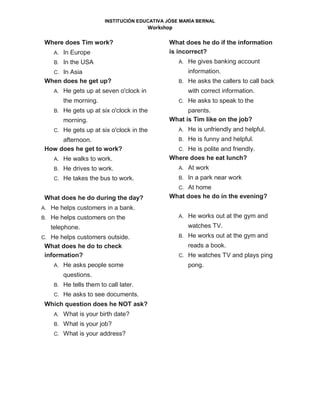
INSTITUCIÓN EDUCATIVA JÓSE MARÍA BERNAL
Workshop
1. He speaks Spanish
2. He doesn't speak Spanish.
3. Does he speak English?
Complete las siguientes oraciones con la forma adecuada del verbo según el Sujeto
1. I (travel) ………. to London every week. ---Yo viajo a Londres todas las semanas.
2. She (run)………. every Saturdays.—Ella corre todos los sábados.
3. My mother (clean) ………. the house. ------ Mi madre limpia la casa.
4. You (be) ………. a good student. ------- Tú eres un buen estudiante.
5. Kelly (work) ………. in a bank. ------- Kelly trabaja en un banco.
6. John (walk)………. to his office. -------- Jhon camina a su oficina.
7. You (study) ………. English at school. ------ Ustedes estudian inglés en la escuela.
8. The dog (break) ………. the fence. -------- El perro rompe la cerca.
9. The car (be) ………. in the garage. ------ El coche está en el garaje.
10. My father (have) ………. a nice coat. --------- Mi padre tiene un lindo saco.
Simple present is used for
Opinions and states of mind
He doesn't agree with you.
I think he is a wonderful student.
Timetables and schedules
The plane leaves at 4 p.m.
The train doesn't arrive until 10.35.
Facts
The Earth revolves around the Sun.
What does 'strange' mean?
Water doesn't boil at 20 degrees.
Feelings
I love walking around late at night
during the summer.
She hates flying!.
Tim works for a company in Sacramento, California. He's a customer service
representative. He gets up at six o'clock each workday. He drives to work and
begins his job at eight o'clock. He speaks to people on the telephone to help them
with their banking problems. People telephone the bank to ask questions about
their accounts. He doesn't give information about accounts until people answer a
few questions. Tim asks callers their birth date, the last four digits of their social
security number and their address. If a person gives incorrect information, Tim
asks him to call back with the correct information. Tim is polite and friendly with
everyone. He has lunch in a park next to his office. He returns home at five o'clock
in the evening. After work, he goes to the gym to work out. He has dinner at seven
o'clock. Tim likes watching TV after dinner. He goes to bed at eleven o'clock at
night.
INSTITUCIÓN EDUCATIVA JÓSE MARÍA BERNAL
Workshop
Where does Tim work?
A. In Europe
B. In the USA
C. In Asia
When does he get up?
A. He gets up at seven o'clock in
the morning.
B. He gets up at six o'clock in the
morning.
C. He gets up at six o'clock in the
afternoon.
How does he get to work?
A. He walks to work.
B. He drives to work.
C. He takes the bus to work.
What does he do during the day?
A. He helps customers in a bank.
B. He helps customers on the
telephone.
C. He helps customers outside.
What does he do to check
information?
A. He asks people some
questions.
B. He tells them to call later.
C. He asks to see documents.
Which question does he NOT ask?
A. What is your birth date?
B. What is your job?
C. What is your address?
What does he do if the information
is incorrect?
A. He gives banking account
information.
B. He asks the callers to call back
with correct information.
C. He asks to speak to the
parents.
What is Tim like on the job?
A. He is unfriendly and helpful.
B. He is funny and helpful.
C. He is polite and friendly.
Where does he eat lunch?
A. At work
B. In a park near work
C. At home
What does he do in the evening?
A. He works out at the gym and
watches TV.
B. He works out at the gym and
reads a book.
C. He watches TV and plays ping
pong.

Workshop recuperación 7mos

  • 1.
    PRESENT TENSE -TO BE – QUESTIONS ------Am – are – is 1. _____________you from Indonesia? 2. _____________this your car? 3. _______________we at the right place? 4. I ____________ in the right classroom? 5. __________she tall? 6. ___________you always early for class? 7._____________ they doctors? 8.___________ Bill in Anne's class? 9._____________ it hot outside? 10. ____________we ready to go? PRESENT TENSE - TO BE – NEGATIVE ----- ‘m not – aren’t – isn’t 1. They __________ from Sydney. 2. You_____________ in my class. 3. It ____________ five o'clock yet. 4. The dog __________ black. 5. Jim ___________ busy now. 6. I ________very well today. 7. She __________ on time for class. 8. The exercises____________ for homework difficult. 9. We ________________ very good friends. 10. I ______________ in the same class as you. PRESENT TENSE - TO BE Am – are – is 1. He ________ from India. 2. You ___________ a good friend. 3. I _________very happy today. 4. The cat _________ brown. 5. Stacy ______________ tired. 6. We ________ hungry after our long walk. 7. I ______always late for class. 8. The exercises_______ for homework easy. 9. It _________ very hot now. 10. You ____________ in the same class as my brother.
  • 2.
    Introducing Yourself Hello! Myname is Ana. I am twenty-five years old. I live in Miami, Florida with my husband and two children. I have one son in kindergarten and one daughter in first grade. They both attend public school. My husband is a mechanic. On weekends, he works at a restaurant as a dishwasher. The restaurant usually gets more customers on weekends, so they need extra people to wash dishes. Q1: Who is introducing herself? Ans: _________________________________________________ Q2: How old is she? Ans: ___________________________________________________________ Q3: Where does Ana live? Ans ______________________________________________________ Q4: What is her husband’s profession? Ans: ____________________________________________ Q5: Where does he work on weekends? Ans: ___________________________________________ Q6: How many children does Ana have? Ans: ___________________________________________ Excepciones: 1. Palabras que terminan en consonante + "y": la "y" cambia a "i" y añadimos "es". party / parties (fiesta/s) city / cities (ciudad/es) 2. Palabras que terminan en vocal + "y": añadimos una "s". boy / boys (chico/s) toy / toys (juguete/s) 3. Palabras que terminan en "s", "ss", "sh", "ch", "x", "o": añadimos "es". watch / watches (reloj/es) box / boxes (caja/s) tomato / tomatoes (tomate/s) 4. Palabras que terminan en "f" o "fe": cambiamos la "f" o "fe" por "ves". leaf / leaves (hoja/s) wife / wives (esposa/s) Regular plurals: Form: Add "s" to the noun:
  • 3.
    Noun + S Spellingof plurals: The plural form of most nouns is created simply by adding the letter "s".  more than one snake = snakes  more than one girl = girls Nouns that end in -ch, x, s, z or s-Sh, like sounds, however, will require an es for the plural:  more than one bus = buses  more than one kiss = kisses Nouns that end in a vowel + y take the letter s:  more than one boy = boys  more than one way = ways Nouns that end in a consonant + y drop the y and take ies:  more than one baby = babies  more than one lorry = lorries A lot of nouns that end in o take es in the plural:  more than one potato = potatoes  more than one hero = heroes Plurals of nouns that end in f or fe usually change the f sound to a v sound and add s or - es.  more than one knife = knives  more than one leaf = leaves
  • 4.
    Irregular plurals: There areseveral nouns that have irregular plural forms. Singular Plural foot feet tooth teeth tooth teeth Singular Plural child children man men woman women Singular Plural person people mouse mice Fill in the words into the crossword. Write the plural of the nouns into the crossword.
  • 5.
    Family My name isSangeeta. I am 11. I live in New Delhi, India with my father, mother, two brothers and three sisters. My grandparents also live with us. In India, family is very important. It is common to have grandparents, aunts, uncles and/or cousins living in the same house. My aunts, uncles and cousins also live nearby. We see each other often. My older brother is a computer programmer. Right now, he is in Australia. His company sent him there for one year. We all miss him a lot. We write him letters every week. I want him to come home soon. Q1: How old is Sangeeta? Asn: _______________________________________________________ Q2: Which country does she live in? ___________________________________________________ Q3: Does she live with her parents? Ans: _______________________________________________ Q4: Who else lives with her? Ans: _____________________________________________________ Q4: What does her older brother do? Ans: _____________________________________________ Q5: Where is he right now? Ans: _____________________________________________________ Q6: Does the family miss him? How do you know?_________________________________________________________ A New Home Francisco stands outside his new house. He reaches into his pocket and pulls out the key. He turns the key in the lock and opens the door. He steps into the living room and looks around. The paint is peeling off the walls. There is no furniture. The house is dirty and smells bad. He tries to open a window but it is broken. The house does not have a kitchen or a bedroom but there is a microwave on the floor on one side of the room. He wonders if it works. The place looks terrible but it is all he can afford. He covers his nose and mouth with his hand and opens the bathroom door. It is in bad condition.
  • 6.
    Q1: Is Francisco'snew house clean? ___________________________________________________ Q2: Is the house in good condition? ___________________________________________________ Q3: How many bedrooms does the house have? ________________________________________ Q4: Does the house need to be repainted? _____________________________________________ Q5: Why did Francisco buy a house that is in such bad condition? _________________________________________________________________ USO DELADJETIVO 1. Los adjetivos en inglés son la cualidad del nombre 2. Van antes del sustantivo 3. y no varían en genero y número The red book El libro rojo I am a good doctor Yo soy un buen doctor English Spanish English Spanish English Spanish cold frió difficult difícil pretty guapa hot caliente easy fácil ugly feo big grande rich rico good bueno small pequeño poor pobre bad malo long largo cheap barato dangerous peligroso 1. I have a big book --------------------- Tengo un libro grande 2. They have two blue cars . ----------------- ellos tienen dos carros azules 3. The small car is in the garage ------------ el carro pequeño esta en el garage 4. I have a nice laptop ----------------------- yo tengo un portatil bonito 5. She is a beautiful gilr ---------------------- ella es una chica Hermosa
  • 7.
    6. They havean expensive house ------------ ellos tienen una casa costosa 7. We have some interesting toys------- nosotros tenemos unos juguetes interesantes 8. She has long hair ---------------------- elle tiene cabello largo 9. He is a young man--------------------- el es un hombre joven 10. You have nice eyes ------------------ tu tienes ojos bonitos Choose the best option to finish the sentence He is an........... a) old friend and very good. b) old and very good friend. Do you like ...................? a) food Japanese? b) Japanese food? We are .................... a) professional teachers. b) professionals teachers. ......................... play tennis on Sundays. a) Theirs children b) Their children Fast food is ................ a) American typical food. b) typical American food. Jane has got ................ a) beautiful long hair. b) beautiful hair and long. These cars are ............... a) fantastics. b) fantastic. Tim and Mike are ................. a) goods actors. b) good actors. Simple Present He 1. Si termina Y después de consonante se le cambia por –ies She 2. si termina en o-x-z-ch-ss- sh- se le agrega es He 3. si no cumple la regla 1 y 2 se le agrega stermine en lo que termine 1. If the verb ends in y before a consonant change to i and add -es:  study – studies  copy – copies 2. If the verb ends in -ss, -sh, -ch, -x or -o, add -es to the base form:  kiss - kisses  finish - finishes  go – goes 3. When the verbs doesn’t have the rules 1 and 2 only give one s  play - pays
  • 8.
    INSTITUCIÓN EDUCATIVA JÓSEMARÍA BERNAL Workshop 1. He speaks Spanish 2. He doesn't speak Spanish. 3. Does he speak English? Complete las siguientes oraciones con la forma adecuada del verbo según el Sujeto 1. I (travel) ………. to London every week. ---Yo viajo a Londres todas las semanas. 2. She (run)………. every Saturdays.—Ella corre todos los sábados. 3. My mother (clean) ………. the house. ------ Mi madre limpia la casa. 4. You (be) ………. a good student. ------- Tú eres un buen estudiante. 5. Kelly (work) ………. in a bank. ------- Kelly trabaja en un banco. 6. John (walk)………. to his office. -------- Jhon camina a su oficina. 7. You (study) ………. English at school. ------ Ustedes estudian inglés en la escuela. 8. The dog (break) ………. the fence. -------- El perro rompe la cerca. 9. The car (be) ………. in the garage. ------ El coche está en el garaje. 10. My father (have) ………. a nice coat. --------- Mi padre tiene un lindo saco. Simple present is used for Opinions and states of mind He doesn't agree with you. I think he is a wonderful student. Timetables and schedules The plane leaves at 4 p.m. The train doesn't arrive until 10.35. Facts The Earth revolves around the Sun. What does 'strange' mean? Water doesn't boil at 20 degrees. Feelings I love walking around late at night during the summer. She hates flying!. Tim works for a company in Sacramento, California. He's a customer service representative. He gets up at six o'clock each workday. He drives to work and begins his job at eight o'clock. He speaks to people on the telephone to help them with their banking problems. People telephone the bank to ask questions about their accounts. He doesn't give information about accounts until people answer a few questions. Tim asks callers their birth date, the last four digits of their social security number and their address. If a person gives incorrect information, Tim asks him to call back with the correct information. Tim is polite and friendly with everyone. He has lunch in a park next to his office. He returns home at five o'clock in the evening. After work, he goes to the gym to work out. He has dinner at seven o'clock. Tim likes watching TV after dinner. He goes to bed at eleven o'clock at night.
  • 9.
    INSTITUCIÓN EDUCATIVA JÓSEMARÍA BERNAL Workshop Where does Tim work? A. In Europe B. In the USA C. In Asia When does he get up? A. He gets up at seven o'clock in the morning. B. He gets up at six o'clock in the morning. C. He gets up at six o'clock in the afternoon. How does he get to work? A. He walks to work. B. He drives to work. C. He takes the bus to work. What does he do during the day? A. He helps customers in a bank. B. He helps customers on the telephone. C. He helps customers outside. What does he do to check information? A. He asks people some questions. B. He tells them to call later. C. He asks to see documents. Which question does he NOT ask? A. What is your birth date? B. What is your job? C. What is your address? What does he do if the information is incorrect? A. He gives banking account information. B. He asks the callers to call back with correct information. C. He asks to speak to the parents. What is Tim like on the job? A. He is unfriendly and helpful. B. He is funny and helpful. C. He is polite and friendly. Where does he eat lunch? A. At work B. In a park near work C. At home What does he do in the evening? A. He works out at the gym and watches TV. B. He works out at the gym and reads a book. C. He watches TV and plays ping pong.