presents
a               production


Sight and Wave
  Phenomena
        1
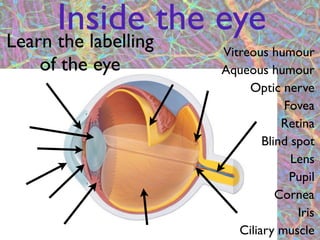
Inside the eye
Learn the labellingVitreous humour
  of the eye       Aqueous humour
                        Optic nerve
                               Fovea
                               Retina
                           Blind spot
                                 Lens
                                Pupil
                              Cornea
                                  Iris
               2      Ciliary muscle
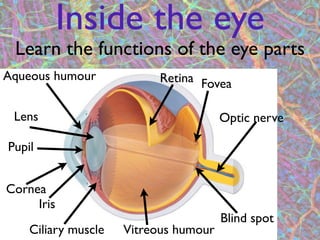
Inside the eye
 Learn the functions of the eye parts
Aqueous humour             Retina Fovea

 Lens                                  Optic nerve

Pupil


Cornea
     Iris
                                       Blind spot
    Ciliary muscle   Vitreous humour
                        3
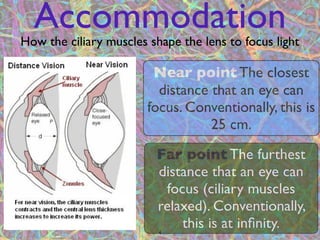
Accommodation
How the ciliary muscles shape the lens to focus light

                         Near point The closest
                          distance that an eye can
                        focus. Conventionally, this is
                                   25 cm.

                         Far point The furthest
                         distance that an eye can
                          focus (ciliary muscles
                         relaxed). Conventionally,
                          4
                             this is at infinity.
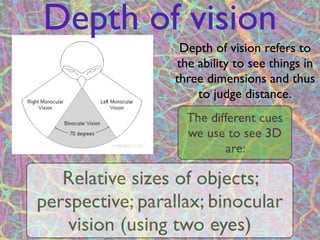
Depth of vision
                    Depth of vision refers to
                   the ability to see things in
                   three dimensions and thus
                       to judge distance.
                     The different cues
                     we use to see 3D
                             are:

   Relative sizes of objects;
perspective; parallax; binocular
    vision (using two eyes)
               5
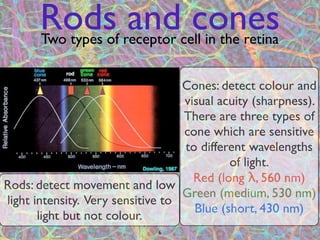
Rods and cones
       Two types of receptor cell in the retina


                                   Cones: detect colour and
                                   visual acuity (sharpness).
                                   There are three types of
                                   cone which are sensitive
                                   to different wavelengths
                                            of light.
                                     Red (long λ, 560 nm)
Rods: detect movement and low
                                   Green (medium, 530 nm)
light intensity. Very sensitive to
                                     Blue (short, 430 nm)
       light but not colour.
                              6
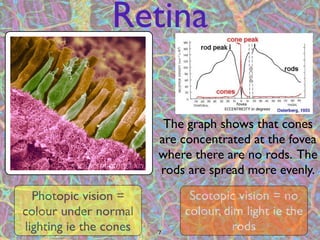
Retina

                         The graph shows that cones
                        are concentrated at the fovea
                        where there are no rods. The
                        rods are spread more evenly.
  Photopic vision =          Scotopic vision = no
colour under normal         colour, dim light ie the
lighting ie the cones   7
                                      rods
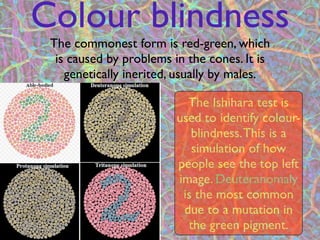
Colour blindness
 The commonest form is red-green, which
  is caused by problems in the cones. It is
    genetically inerited, usually by males.

                           The Ishihara test is
                         used to identify colour-
                            blindness. This is a
                            simulation of how
                         people see the top left
                         image. Deuteranomaly
                          is the most common
                          due to a mutation in
                     8
                           the green pigment.
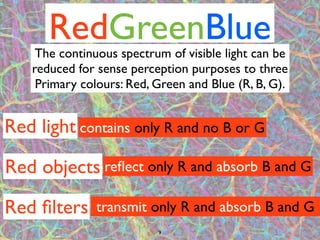
RedGreenBlue
     The continuous spectrum of visible light can be
    reduced for sense perception purposes to three
     Primary colours: Red, Green and Blue (R, B, G).


Red light contains only R and no B or G

Red objects reflect only R and absorb B and G

Red filters      transmit only R and absorb B and G
                           9
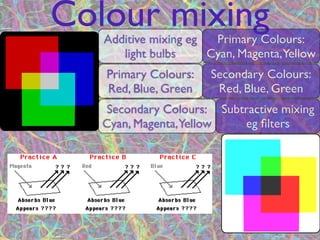
Colour mixing
   Additive mixing eg  Primary Colours:
      light bulbs     Cyan, Magenta,Yellow
   Primary Colours:   Secondary Colours:
   Red, Blue, Green    Red, Blue, Green
   Secondary Colours: Subtractive mixing
   Cyan, Magenta,Yellow   eg filters
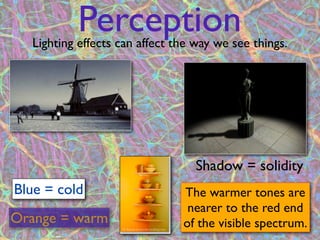
Perception
  Lighting effects can affect the way we see things.


                                  Shadow = solidity
Blue = cold                    The warmer tones are
                                nearer to the red end
Orange = warm                  of the visible spectrum.
                          11
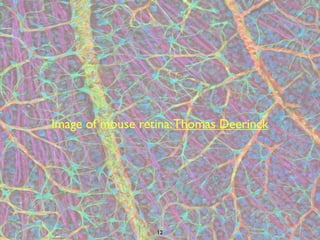
Image of mouse retina: Thomas Deerinck


                  12
a                                       production


          MUCH MORE AT
http://nothingnerdy.wikispaces.com
http://nothingnerdy.wikispaces.com/IGCSE+RADIOACTIVITY
                          13

IB Sl Physics Sight and Waves Flippingphysics by Nothingnerdy

  • 1.
    presents a production Sight and Wave Phenomena 1
  • 2.
    Inside the eye Learnthe labellingVitreous humour of the eye Aqueous humour Optic nerve Fovea Retina Blind spot Lens Pupil Cornea Iris 2 Ciliary muscle
  • 3.
    Inside the eye Learn the functions of the eye parts Aqueous humour Retina Fovea Lens Optic nerve Pupil Cornea Iris Blind spot Ciliary muscle Vitreous humour 3
  • 4.
    Accommodation How the ciliarymuscles shape the lens to focus light Near point The closest distance that an eye can focus. Conventionally, this is 25 cm. Far point The furthest distance that an eye can focus (ciliary muscles relaxed). Conventionally, 4 this is at infinity.
  • 5.
    Depth of vision Depth of vision refers to the ability to see things in three dimensions and thus to judge distance. The different cues we use to see 3D are: Relative sizes of objects; perspective; parallax; binocular vision (using two eyes) 5
  • 6.
    Rods and cones Two types of receptor cell in the retina Cones: detect colour and visual acuity (sharpness). There are three types of cone which are sensitive to different wavelengths of light. Red (long λ, 560 nm) Rods: detect movement and low Green (medium, 530 nm) light intensity. Very sensitive to Blue (short, 430 nm) light but not colour. 6
  • 7.
    Retina The graph shows that cones are concentrated at the fovea where there are no rods. The rods are spread more evenly. Photopic vision = Scotopic vision = no colour under normal colour, dim light ie the lighting ie the cones 7 rods
  • 8.
    Colour blindness Thecommonest form is red-green, which is caused by problems in the cones. It is genetically inerited, usually by males. The Ishihara test is used to identify colour- blindness. This is a simulation of how people see the top left image. Deuteranomaly is the most common due to a mutation in 8 the green pigment.
  • 9.
    RedGreenBlue The continuous spectrum of visible light can be reduced for sense perception purposes to three Primary colours: Red, Green and Blue (R, B, G). Red light contains only R and no B or G Red objects reflect only R and absorb B and G Red filters transmit only R and absorb B and G 9
  • 10.
    Colour mixing Additive mixing eg Primary Colours: light bulbs Cyan, Magenta,Yellow Primary Colours: Secondary Colours: Red, Blue, Green Red, Blue, Green Secondary Colours: Subtractive mixing Cyan, Magenta,Yellow eg filters
  • 11.
    Perception Lightingeffects can affect the way we see things. Shadow = solidity Blue = cold The warmer tones are nearer to the red end Orange = warm of the visible spectrum. 11
  • 12.
    Image of mouseretina: Thomas Deerinck 12
  • 13.
    a production MUCH MORE AT http://nothingnerdy.wikispaces.com http://nothingnerdy.wikispaces.com/IGCSE+RADIOACTIVITY 13

Editor's Notes