Human
Sciences


     … or why Economics
     is hard and Physics
     is easy
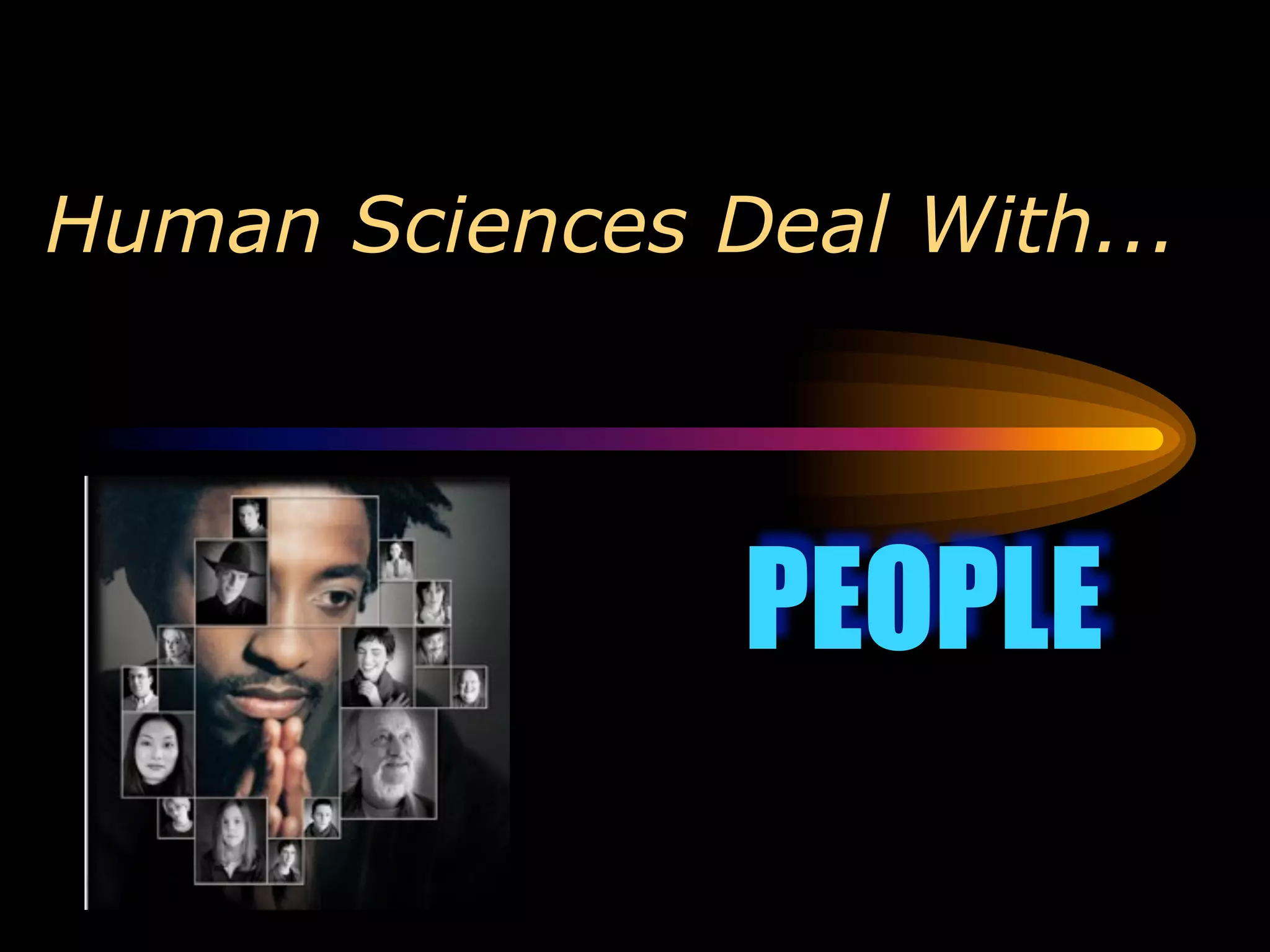
Human Sciences Deal With...


                PEOPLE
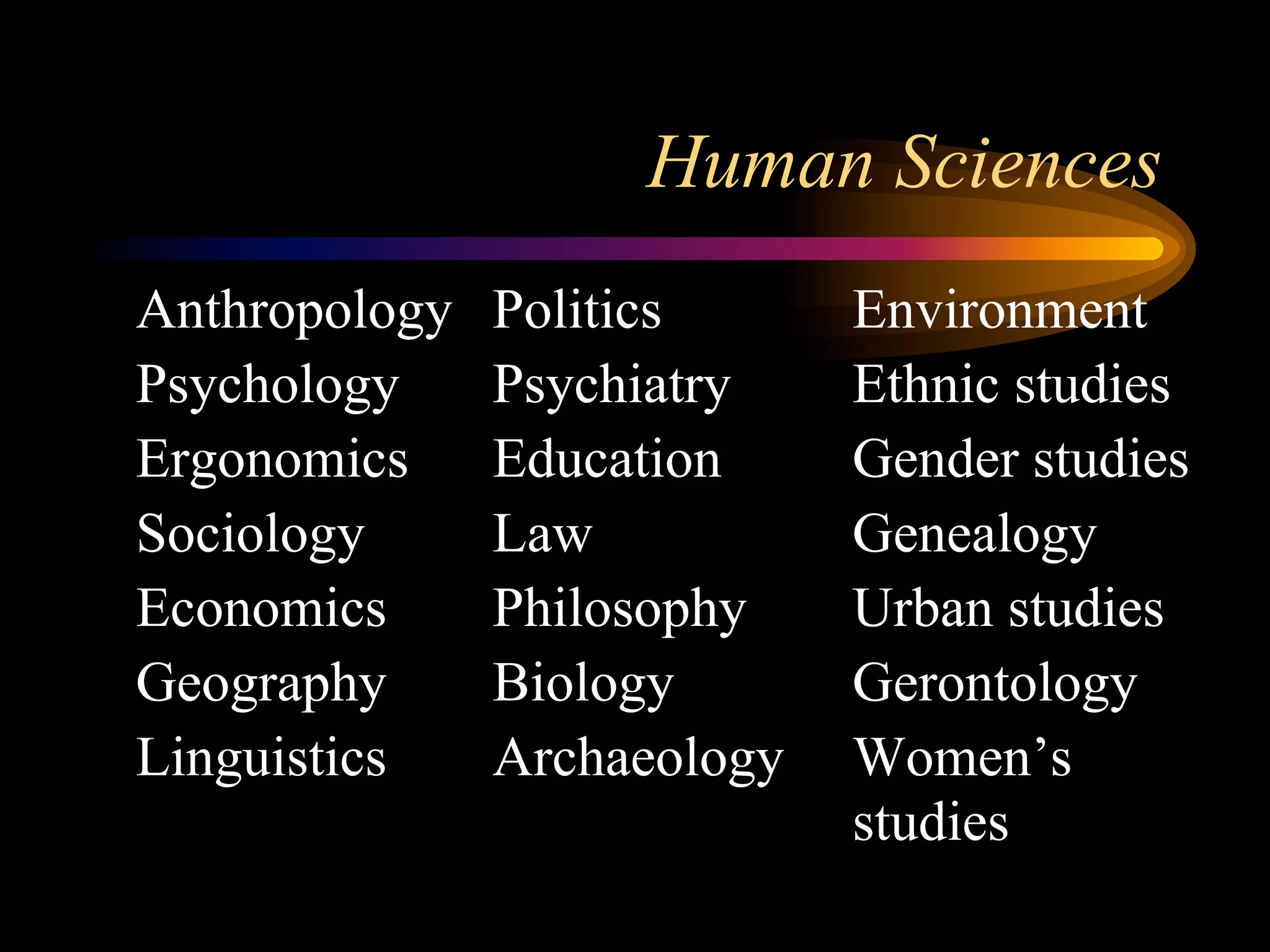
Human Sciences
Write down 10 ways in which people
differ from a gram of tungsten
HUMAN SCIENCES
            Methods of gaining knowledge

• How can we gather
  data on human
  behaviour?
Human Science
                         So how do we study it?


• Scientific method?

• Asking questions?
Problems with experiments

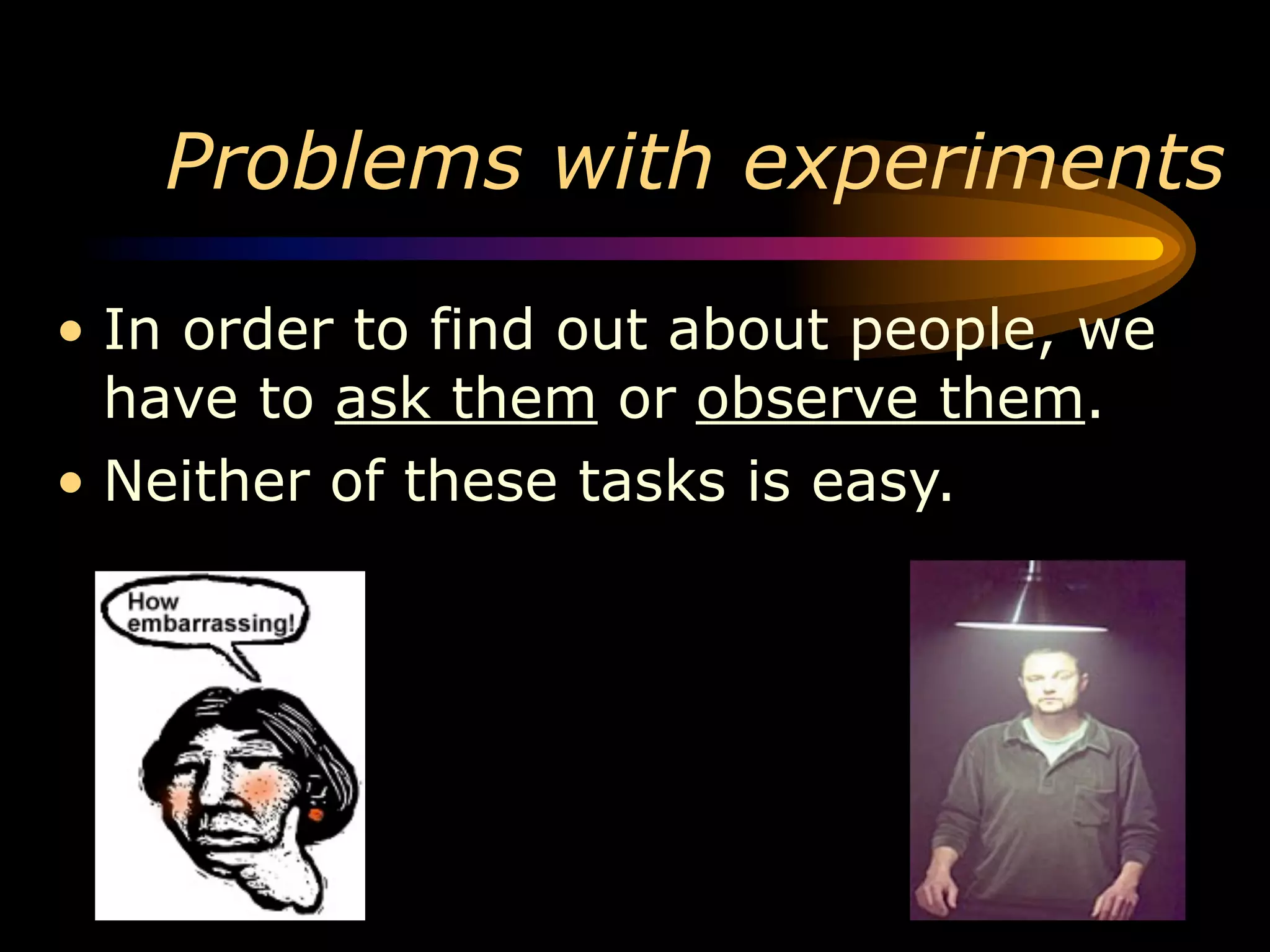
• In order to find out about people, we
  have to ask them or observe them.
• Neither of these tasks is easy.
Scientific method
         Asking the right questions!

• In devising experiments we are
  interrogating nature, and we should expect
  the view we form also depends on the
  questions we ask!
Scientific method

• Assumptions - in order to make
  generalizations we must assume that all
  humans act the same. Is it fair to assume
  that humans are rational?
The rational human?
•   An elderly woman spent a leisurely shopping at the mall. Upon return
    to her vehicle, she found four strange males sitting in her car.
    Frightened, the woman dropped her shopping bags and drew her
    handgun. She told the men that if they did not get out of the car, she
    would shoot. The four men ran off quickly, whereupon the lady got
    into the car.


• What do you think happened?
The rational human?
•   Her key, however, would not fit. The woman realized that her car was
    the identical one parked a few spaces down. She drove to the police
    department and reported the story. The officer on duty laughed
    hysterically and pointed to the other end of the counter where four pale
    men had reported a hijacking by a mean old lady; no charges were
    filed.


• Is this what you imagined?
Or can this be considered
                            rational?
• Two young larcenists in Florida--14 and 15 to be
  exact--appeared before Judge Larry Seidlin after
  stealing their twenty-fifth car in just two short
  years. After the boys were released, they walked
  out of the courthouse and realized they did not
  have bus fare for a ride home. Promptly, the duo
  stole number twenty-six; they crashed the vehicle
  into a fence less than an hour later.
Hey Man, Stop Asking Me
         Questions

• Try to think of 5    • Try to think of 5
  questions which        questions to which
  most people            your answer to your
  would refuse to        friends would differ
  answer.                from your answer to
• Try to think of 5      your parents.
  questions which
  people might
  answer with a lie.
I never wanted you to see me like this!

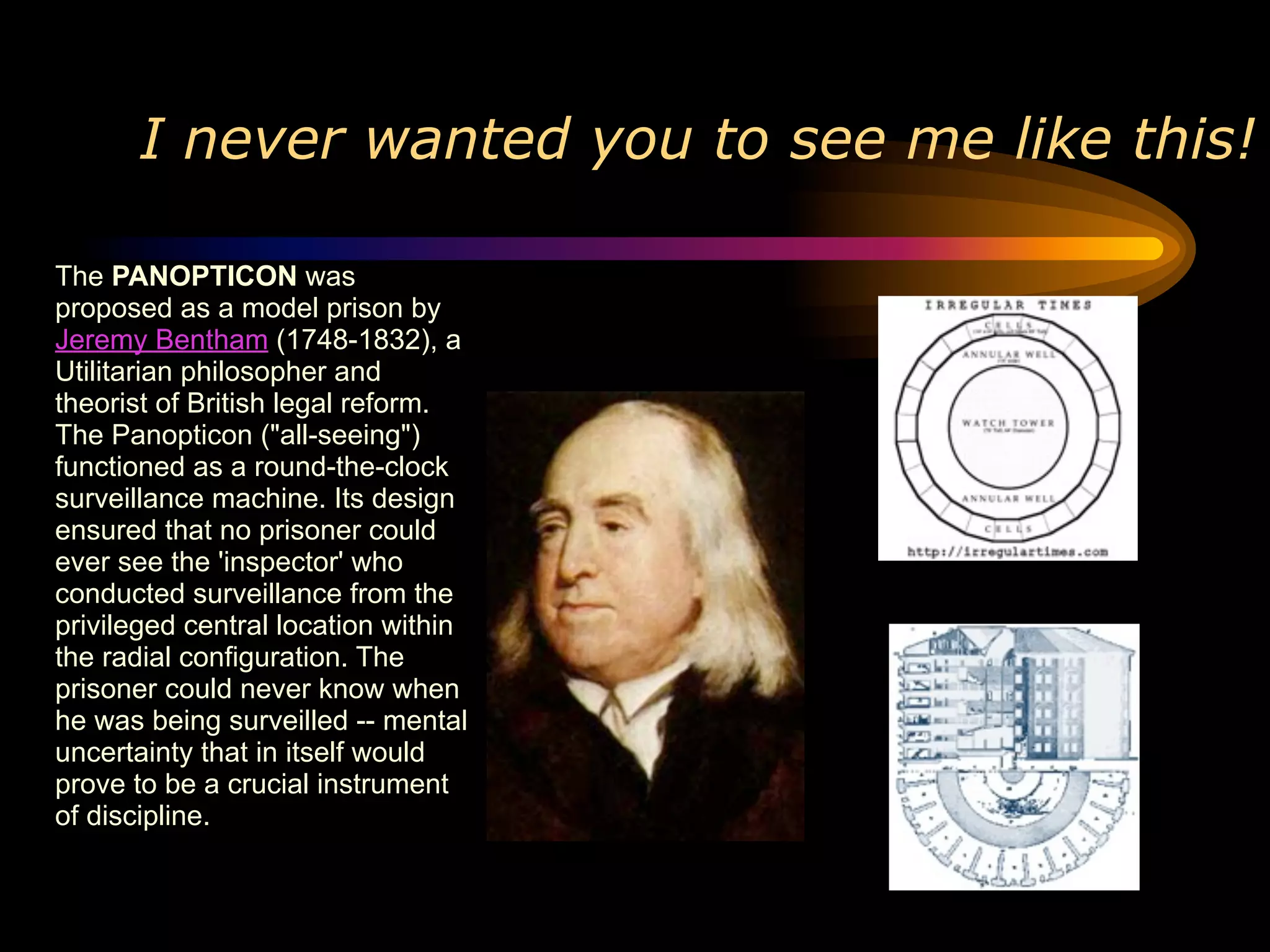
The PANOPTICON was
proposed as a model prison by
Jeremy Bentham (1748-1832), a
Utilitarian philosopher and
theorist of British legal reform.
The Panopticon ("all-seeing")
functioned as a round-the-clock
surveillance machine. Its design
ensured that no prisoner could
ever see the 'inspector' who
conducted surveillance from the
privileged central location within
the radial configuration. The
prisoner could never know when
he was being surveilled -- mental
uncertainty that in itself would
prove to be a crucial instrument
of discipline.
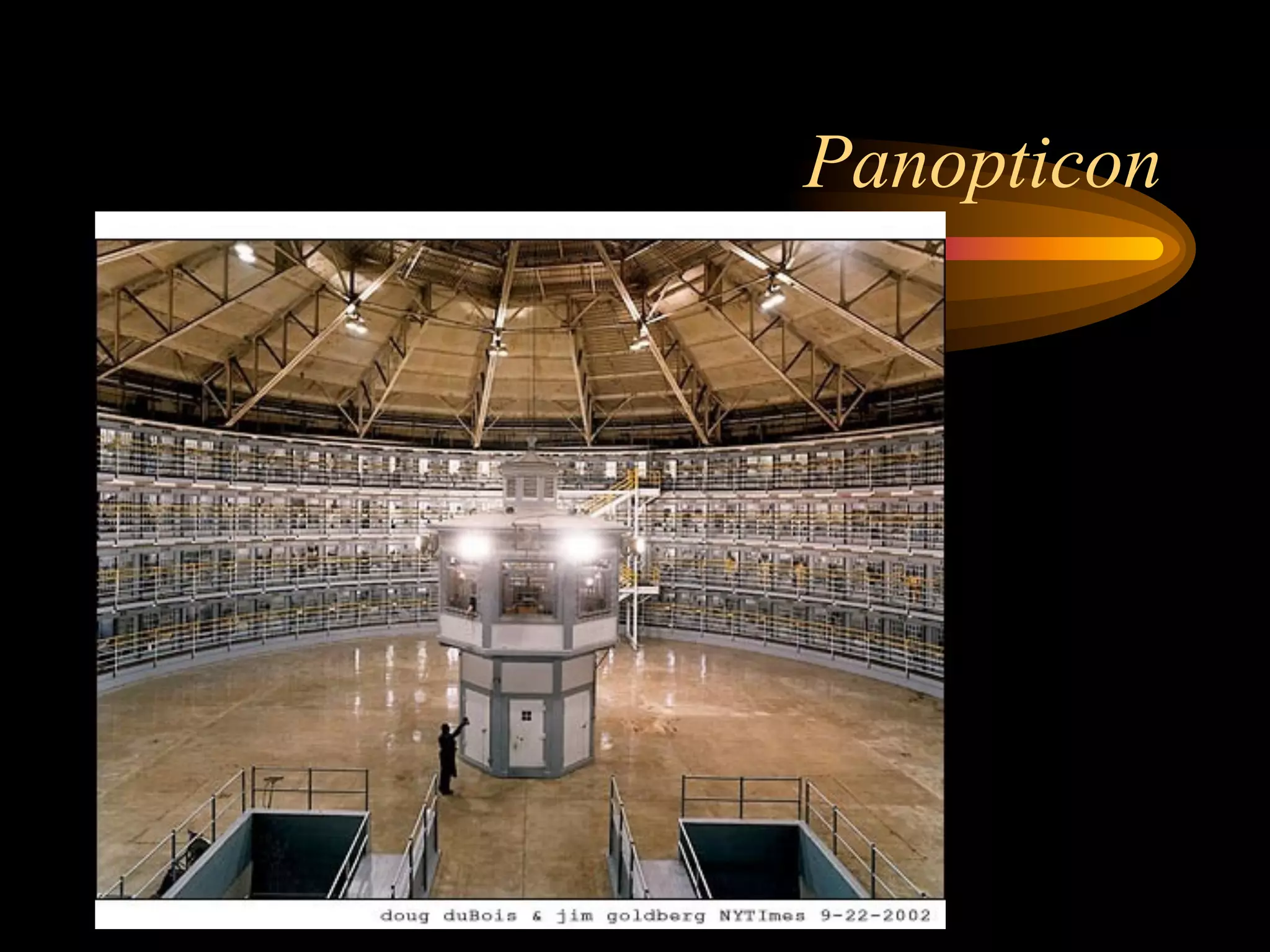
Panopticon
Experimentation
In groups of around 4, try to put an experiment together
for one of the following. List all the problems and possible
errors that may arise:
1) Compare how kind you are vs a rival school.
2) Compare how intelligent you are vs the rival school
3) Find out how people think local derelict land should be
used
4) Find out if people would pay extra tax to increase
spending on health and education
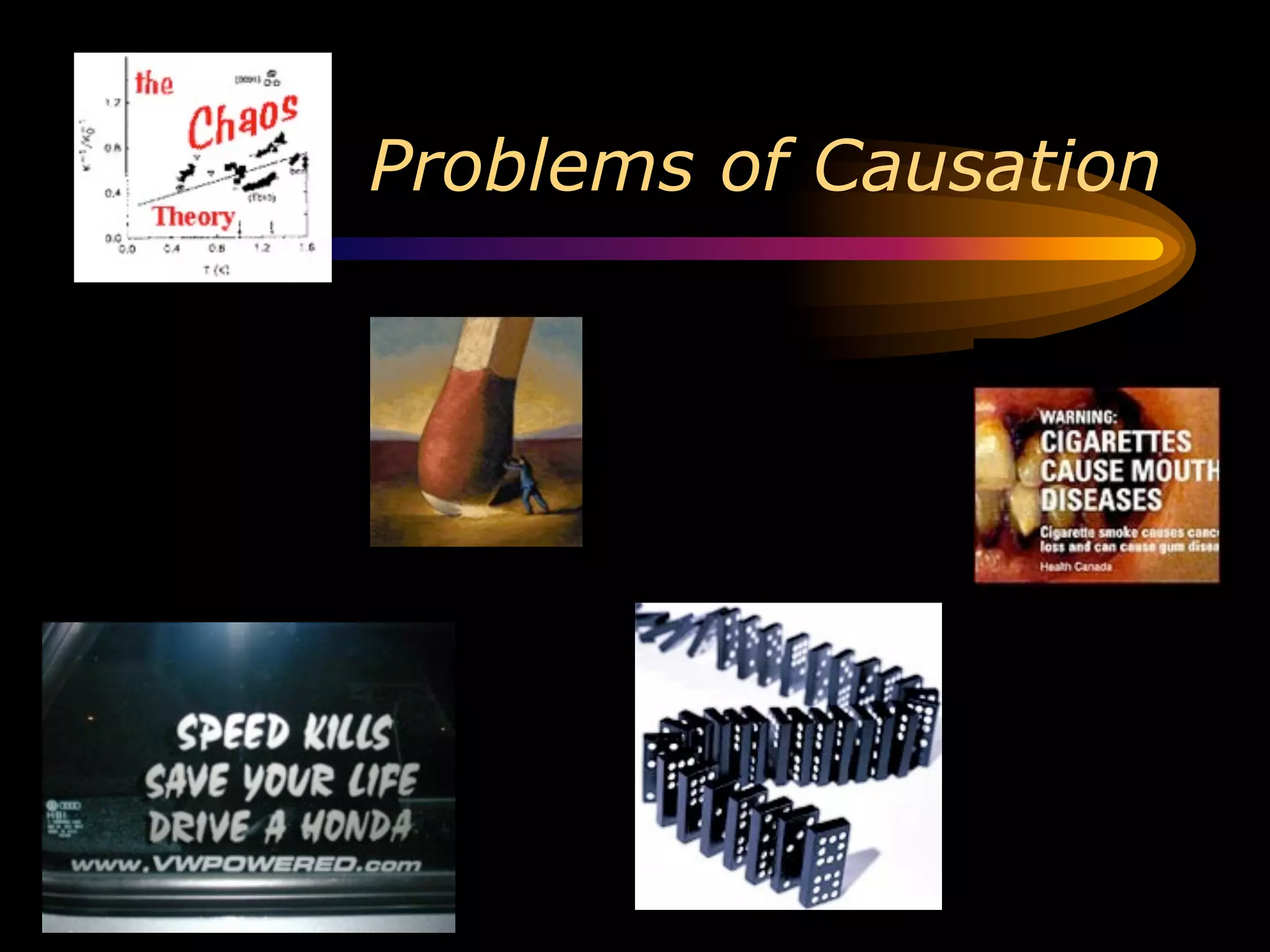
Problems of Causation
Hume and Causation
• On page 156 of Hume's "Treatise of Human Nature", we find
  the paragraph that shook up causation so thoroughly that it
  has not recovered to this day.
  "Thus we remember to have seen that species of object we
  call *FLAME*, and to have felt that species of sensation we
  call *HEAT*. We likewise call to mind their constant
  conjunction in all past instances. Without any farther
  ceremony, we call the one *CAUSE* and the other *EFFECT*,
  and infer the existence of the one from that of the other."
• Thus, causal connections according to Hume are product of
  observations. Causation is a learnable habit of the mind,
  almost as fictional as optical illusions
Long-lived
                    living alone
    Single
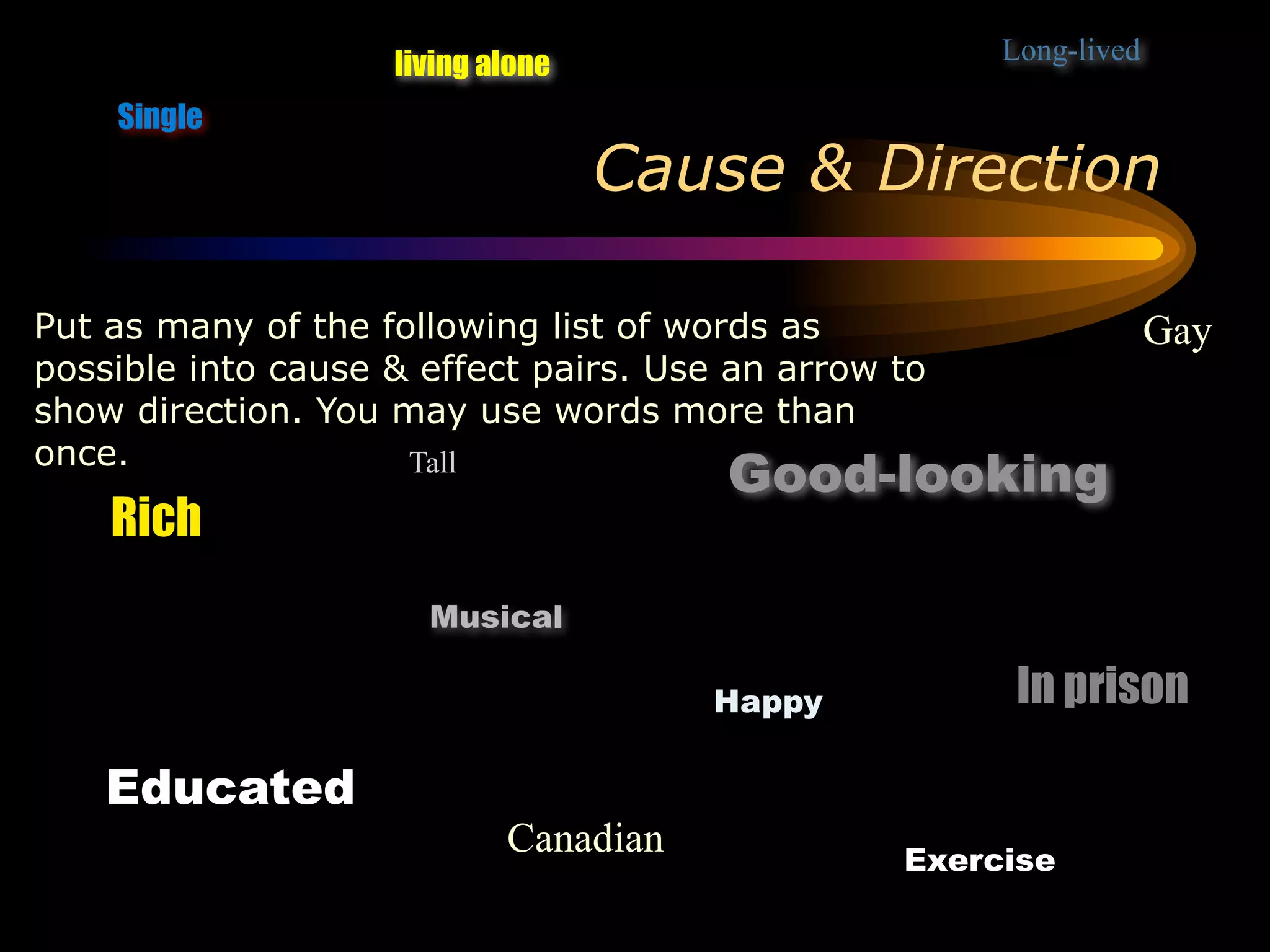
                                   Cause & Direction

Put as many of the following list of words as                      Gay
possible into cause & effect pairs. Use an arrow to
show direction. You may use words more than
once.                Tall
                                       Good-looking
    Rich
                      Musical

                                       Happy           In prison

    Educated
                            Canadian             Exercise
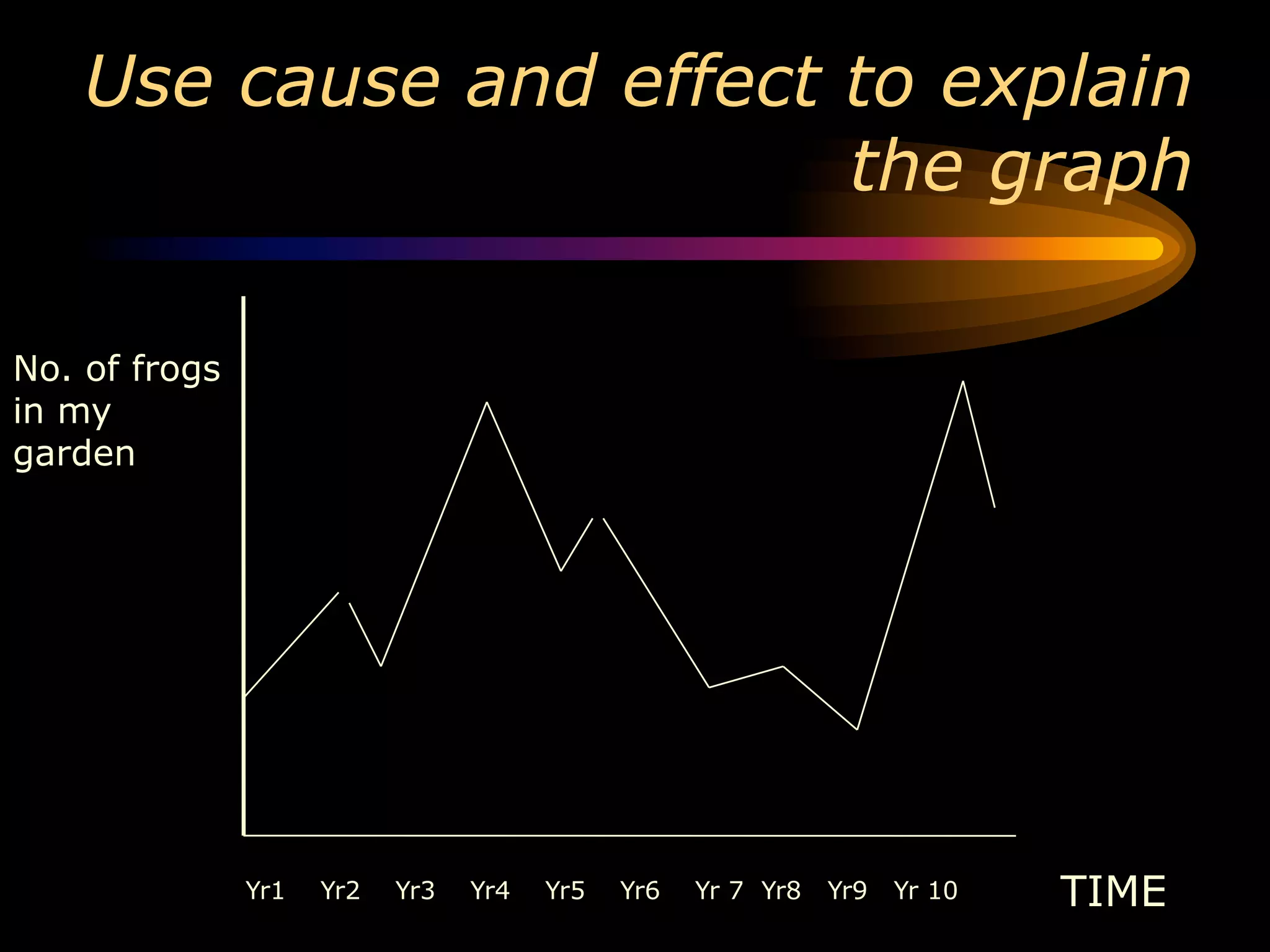
Use cause and effect to explain
                         the graph

No. of frogs
in my
garden


               Yr1   Yr2   Yr3   Yr4   Yr5   Yr6   Yr 7 Yr8   Yr9   Yr 10   TIME
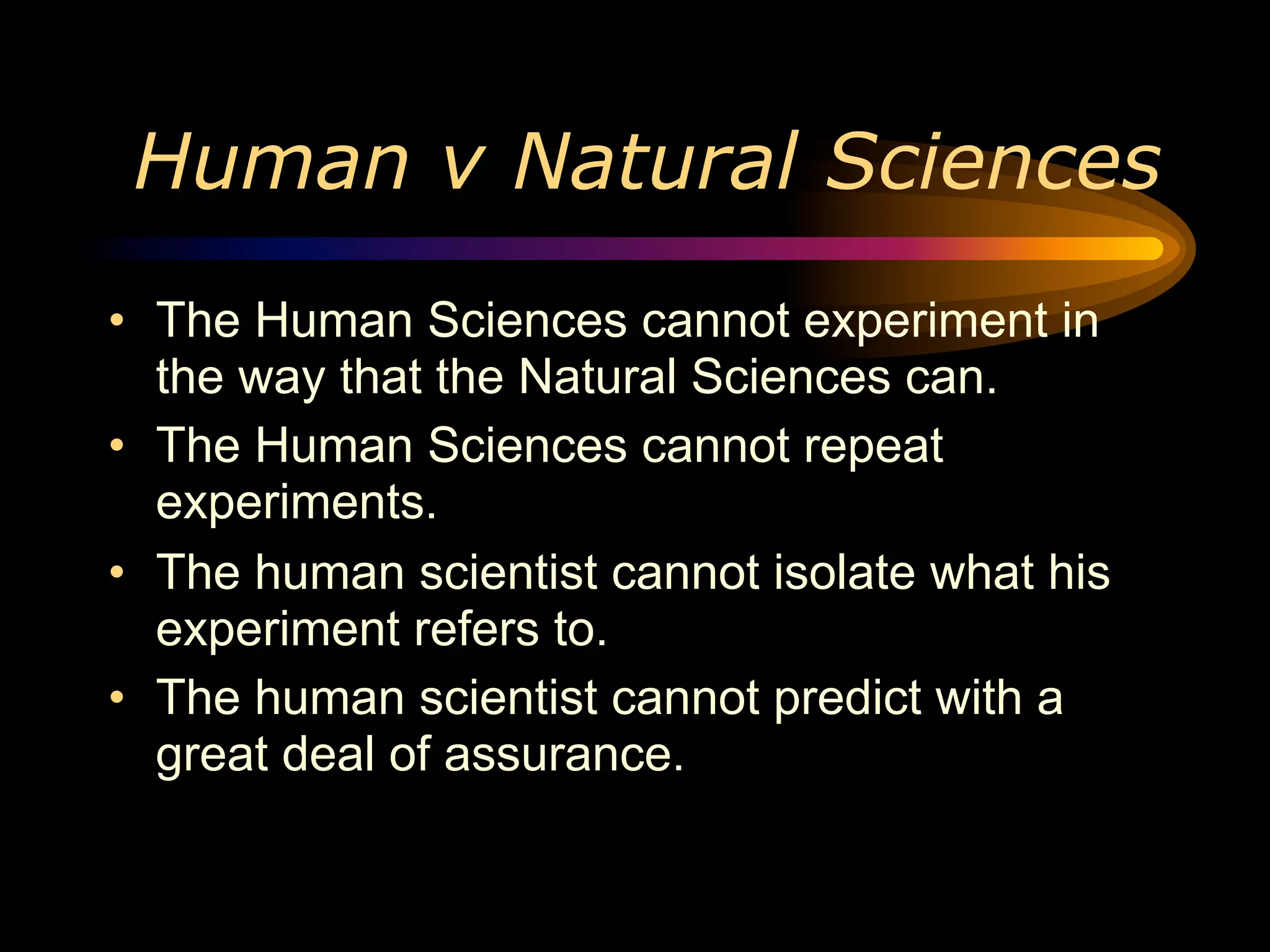
Human v Natural Sciences
• The Human Sciences cannot experiment in
  the way that the Natural Sciences can.
• The Human Sciences cannot repeat
  experiments.
• The human scientist cannot isolate what his
  experiment refers to.
• The human scientist cannot predict with a
  great deal of assurance.
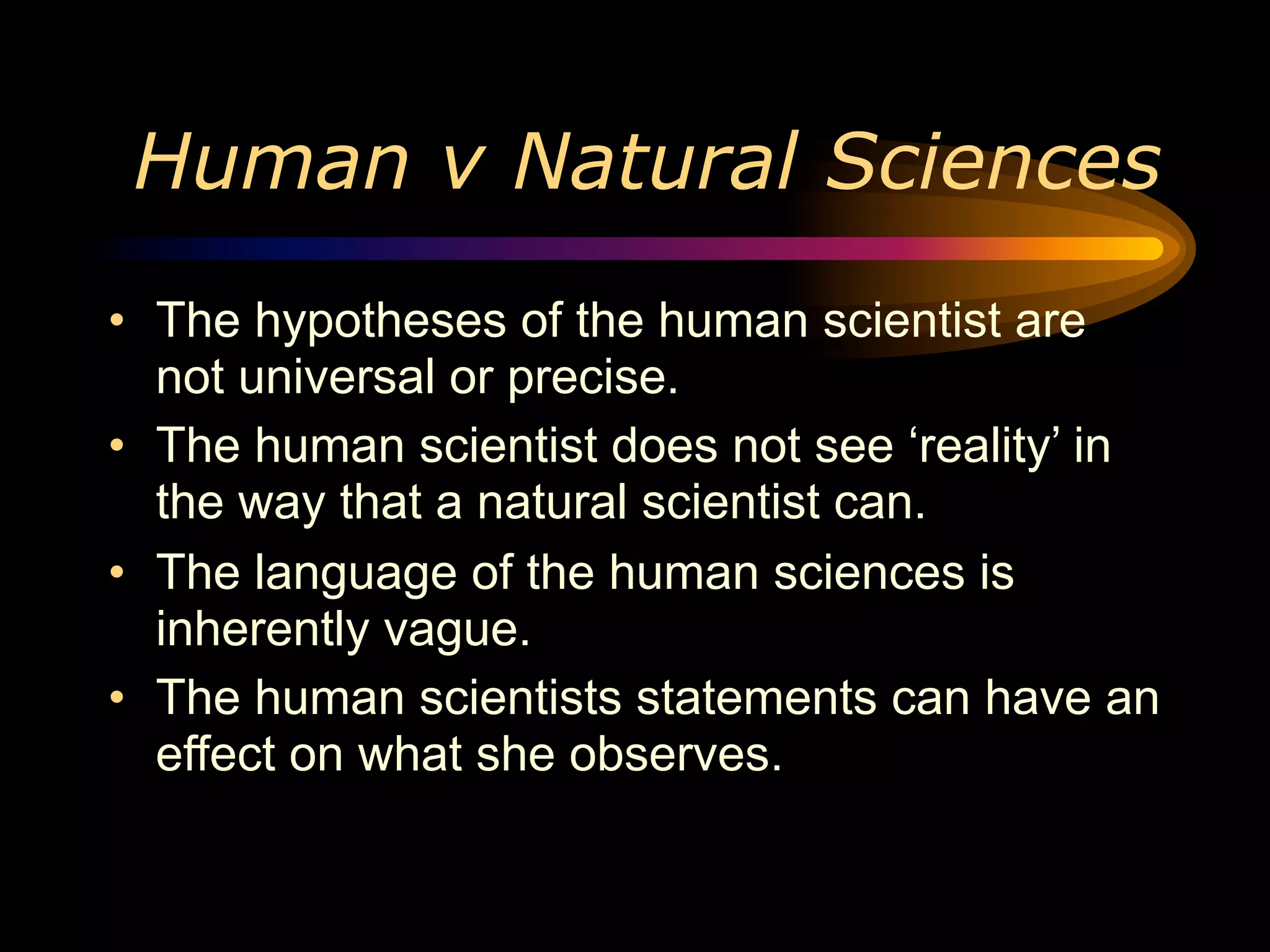
Human v Natural Sciences
• The hypotheses of the human scientist are
  not universal or precise.
• The human scientist does not see ‘reality’ in
  the way that a natural scientist can.
• The language of the human sciences is
  inherently vague.
• The human scientists statements can have an
  effect on what she observes.
Human v Natural Sciences

• “The human scientist cannot be
  indifferent to his subject matter.”


                 Steven Pinker

Human sciences introduction no build

  • 1.
    Human Sciences … or why Economics is hard and Physics is easy
  • 2.
    Human Sciences DealWith... PEOPLE
  • 3.
  • 4.
    Write down 10ways in which people differ from a gram of tungsten
  • 5.
    HUMAN SCIENCES Methods of gaining knowledge • How can we gather data on human behaviour?
  • 6.
    Human Science So how do we study it? • Scientific method? • Asking questions?
  • 7.
    Problems with experiments •In order to find out about people, we have to ask them or observe them. • Neither of these tasks is easy.
  • 8.
    Scientific method Asking the right questions! • In devising experiments we are interrogating nature, and we should expect the view we form also depends on the questions we ask!
  • 9.
    Scientific method • Assumptions- in order to make generalizations we must assume that all humans act the same. Is it fair to assume that humans are rational?
  • 10.
    The rational human? • An elderly woman spent a leisurely shopping at the mall. Upon return to her vehicle, she found four strange males sitting in her car. Frightened, the woman dropped her shopping bags and drew her handgun. She told the men that if they did not get out of the car, she would shoot. The four men ran off quickly, whereupon the lady got into the car. • What do you think happened?
  • 11.
    The rational human? • Her key, however, would not fit. The woman realized that her car was the identical one parked a few spaces down. She drove to the police department and reported the story. The officer on duty laughed hysterically and pointed to the other end of the counter where four pale men had reported a hijacking by a mean old lady; no charges were filed. • Is this what you imagined?
  • 12.
    Or can thisbe considered rational? • Two young larcenists in Florida--14 and 15 to be exact--appeared before Judge Larry Seidlin after stealing their twenty-fifth car in just two short years. After the boys were released, they walked out of the courthouse and realized they did not have bus fare for a ride home. Promptly, the duo stole number twenty-six; they crashed the vehicle into a fence less than an hour later.
  • 13.
    Hey Man, StopAsking Me Questions • Try to think of 5 • Try to think of 5 questions which questions to which most people your answer to your would refuse to friends would differ answer. from your answer to • Try to think of 5 your parents. questions which people might answer with a lie.
  • 14.
    I never wantedyou to see me like this! The PANOPTICON was proposed as a model prison by Jeremy Bentham (1748-1832), a Utilitarian philosopher and theorist of British legal reform. The Panopticon ("all-seeing") functioned as a round-the-clock surveillance machine. Its design ensured that no prisoner could ever see the 'inspector' who conducted surveillance from the privileged central location within the radial configuration. The prisoner could never know when he was being surveilled -- mental uncertainty that in itself would prove to be a crucial instrument of discipline.
  • 15.
  • 16.
    Experimentation In groups ofaround 4, try to put an experiment together for one of the following. List all the problems and possible errors that may arise: 1) Compare how kind you are vs a rival school. 2) Compare how intelligent you are vs the rival school 3) Find out how people think local derelict land should be used 4) Find out if people would pay extra tax to increase spending on health and education
  • 17.
  • 18.
    Hume and Causation •On page 156 of Hume's "Treatise of Human Nature", we find the paragraph that shook up causation so thoroughly that it has not recovered to this day. "Thus we remember to have seen that species of object we call *FLAME*, and to have felt that species of sensation we call *HEAT*. We likewise call to mind their constant conjunction in all past instances. Without any farther ceremony, we call the one *CAUSE* and the other *EFFECT*, and infer the existence of the one from that of the other." • Thus, causal connections according to Hume are product of observations. Causation is a learnable habit of the mind, almost as fictional as optical illusions
  • 19.
    Long-lived living alone Single Cause & Direction Put as many of the following list of words as Gay possible into cause & effect pairs. Use an arrow to show direction. You may use words more than once. Tall Good-looking Rich Musical Happy In prison Educated Canadian Exercise
  • 20.
    Use cause andeffect to explain the graph No. of frogs in my garden Yr1 Yr2 Yr3 Yr4 Yr5 Yr6 Yr 7 Yr8 Yr9 Yr 10 TIME
  • 21.
    Human v NaturalSciences • The Human Sciences cannot experiment in the way that the Natural Sciences can. • The Human Sciences cannot repeat experiments. • The human scientist cannot isolate what his experiment refers to. • The human scientist cannot predict with a great deal of assurance.
  • 22.
    Human v NaturalSciences • The hypotheses of the human scientist are not universal or precise. • The human scientist does not see ‘reality’ in the way that a natural scientist can. • The language of the human sciences is inherently vague. • The human scientists statements can have an effect on what she observes.
  • 23.
    Human v NaturalSciences • “The human scientist cannot be indifferent to his subject matter.” Steven Pinker