Making the transition to university a success

              Niall Bradley
    Student Recruitment & Admissions
       The University of Edinburgh
Transition – from a recruitment & admissions perspective


    What do I mean by transition?


    Why does it matter?


    What are we doing?


    How can you help?
Transition


  Increasing academic focus on the first year experience and how
  Universities can improve the transition of school/college students

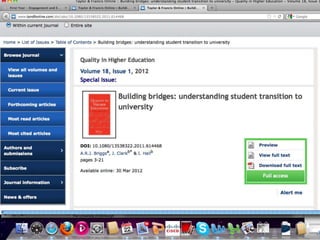
  Considerable research on going into how to improve the first year
  experience
Transition – means many things


 Used to just mean
 • Freshers’ week or perhaps the first few weeks

 Get in, have a drink, get on with it – everyone enjoys Freshers’ Week

 Now means
 • First term/semester or year and increasingly pre-entry support and guidance
 • Much more focus on support


 In effect often now as seen as having three distinct phases
 • pre-arrival
 • induction – Freshers’ week
       • with a very different focus now in many universities
 • semester one and ongoing
Transition – the social side


  Two key strands to transition for students
  • Adapting to changes in academic teaching and expectations
  • Adapting to changes in social lives, living more independently, a new circle of
  peers

  Much can to be done in terms of academic preparation but successful transition
  will depend on more than just academic transition

  Social transition is also key as it is not possible to completely separate the
  intellectual and social

  Increasing focus in recruitment &
  admissions on how we can help with this
                                                      I                      S
Transition – why does it matter?


  For a multitude of reasons in different reasons…….

  …..but with positive outcomes whatever the reasons

  Different universities will have slightly different motivations but the following will
  apply to some/all/most

  Increasing focus on student experience overall – if we get the transition right
  then we hope the rest will follow

  If students enter with realistic understanding of what life will be like then it
  should be easier to meet their expectations

  They need to know what we will expect of them academically and what life will
  be like socially
Transition – retention


As institutions have grown and, in many instances, attempted to broaden their
intake many have found it necessary to consider how ready entrants are for the
environment they are admitted to

Retention is vital for both the student and the institution and a student that has
undergone a successful transition to higher education will be more successful

Students from all backgrounds are at risk of failing to complete and successful
transition strategies help to reduce this risk

Failure to complete costs a student – loss of opportunity, impact on
confidence, financial cost

Failure to retain a student – lost revenue, space denied to another student, impact
on continuation figures, impact on rankings and reputation
Transition – satisfaction


It is reasonable to anticipate that levels of expectation will increase as costs rise
placing even greater importance on realistic arrival guidance and successful initial
transition to the University

Better informed students with realistic expectations are more likely to be satisfied
upon arrival - we want round pegs in round holes

Students sold something which proves to be illusory are likely to be disappointed

Happy students and graduates are our best ambassadors who promote our
institutions to future students – unhappy students can tell the world via Facebook
Twitter etc.

While you will never achieve 100% satisfaction better support in the transition
phase can help and may ultimately improve your performance in the National
Student Survey NSS - which impacts on league tables and rankings
Transition – outcomes


Students who are happy with their social environment and confident in their
academic skills - and what is expected of them academically – are likely to:

• be easier to teach
• achieve at a higher level
• develop transferable skills
• take opportunities for year abroad or extra-curricular activity
• contribute to the university and wider community
• make the most of the social networking opportunities afforded by the student
body

• benefit from the value added the institution has to offer

Successful students will go on to be successful graduates and then successful
graduates and alumni and possibly, in time, donors
Transition – outcomes


Many students will have problems during their studies but if they know where to
seek support and are confident in doing so their problems should be quicker, easier
and cheaper to support for the student and the institution

Giving early attention to social, personal, academic, financial, problems is more
likely to deliver an early and satisfactory resolution


Problems that are not addressed at an early stage can gain momentum and prove
much harder to revolve over time
Transition – so what are universities actually doing?


Much focus on adapting the first year at university across the sector and trying to
establish what skills and attributes entrants bring with them and whether they
match what we expect of them

Amendments to existing programmes and learning outcomes

Changes to entry requirements
• additional tests? – pre-entry or on arrival

Changes to procedures for development of new degree programmes and courses

Considerable resources expended in academic support across the sector in terms of
study skills development
Transition – so what are Edinburgh actually doing?


Institute for Academic Development

Maths Base, peer support and mentoring projects

Coming to the University of Edinburgh – CUE

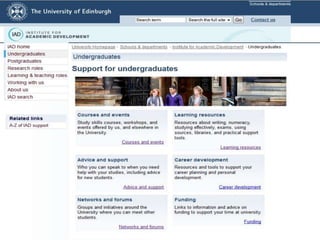
New Students web pages

PESE - Project to enhance the student experience

Personal Tutors and Student Support Officers replacing
Directors of Study

Residence Life scheme

Different focus on Freshers’ Weeks
Transition – Residence Life


Always had wardens and residents assistants

Now expanded full time professional staff recruited from the US to help us become
more fully focused on welfare and support

Focus on whole student
• to ensure that students are engaged and happy in their home away from home
• Emphasis on community building
• Academic Colleges focus on “school learning” Res Life focuses on “life lessons”
Offer students events throughout the year in the following areas:
• Getting to Know Edinburgh
• Wellness/Athletic
• Cultural/Diversity
• Holiday
• Site Tradition
• Bus Trips
• Sustainability
• Charity
Transition – Residence Life


Activities not focussed on alcohol


Benefits?

•More community feel, fewer discipline problems & less damage
•Awareness of welfare situations
      • Students not afraid to talk to staff so we can help find solutions in more
         timely manner
•Positive advertising for future customers

•Helps identify and address the wobbles that many many student have at the very
start of the academic year
Transition – but…..


However all of this is irrelevant if the student is in the wrong place doing the wrong
subject

Irrespective of the support mechanisms in place upon arrival the transition will be
unsuccessful if the student makes the wrong choice for them

Focus therefore has to be on IAG to help students make informed decisions about
their future – prior to arrival

It is not in our or their interests to admit students to the wrong degree programme
at the wrong institution

From an institutional perspective it is a very short sighted approach to admit
students on the basis of a false prospectus
Transition – pre-entry information


Universities offer their services free and should offer fair, balanced and accurate
information about their programmes and facilities

The HELOA Code of Practice - Wales

It is in our interest to provide realistic advice

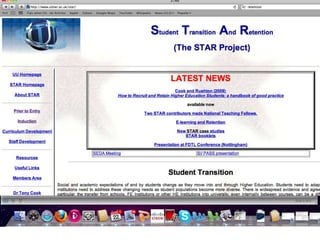
(The STAR Project)

Information is offered by Universities
•via schools and colleges, via UCAS (EPs), direct to applicants and their parents
•on paper, online and face to face

Information is also available from an ever growing number of third parties
Transition – pre-entry information


Universities are increasingly engaging with students after they have applied
• We often see this as the start of the induction process
• This is increasingly carried out via email and the web


Students will be invited to visit – if not called for interview
• An essential part of successful transition – is it really as nice as the prospectus or
the website?
• How easy is it to get back and forth?
• Opportunity to see what the facilities are really like
• To view accommodation?
• To speak to staff abut programme content and options
• To speak to current students
Transition – pre-entry information


Key elements of information needed if students are to make the right choice

• Entry requirements and competition for places

• Programme contents, options, flexibility

• Careers destinations of previous graduates

• Environment and facilities and extra curricular opportunities

• Cost – overall - including likely benefits
    • Fees may help focus the mind – but may encourage the wrong decision

• An understanding of the implications of their chosen career
    • Especially when Mum and Dad are the driving force behind that choice
Transition – too much information?


League tables – how many? which ones?

Independent guides

Online student for a – expert advice or something else?

Key Information Sets – as from September 2012

Media coverage
Transition – advice and guidance remains key


Helping students sift through the growing volumes of information will become more
important. Implications of the wrong choice is becoming more significant

What is relevant information and what is significant?
• Does it matter how much was spent on accommodation if they are staying at
home?
• Does it matter how much was spent on sports facilities recently if they wont be
using them?
• What should really matter to them?

Does reputation matter? Do league tables matter?

Why does the student want to study X? If they cannot explain to you then how will
they manage to write a good personal statement?

Why does the student want to go to X?
Transition – advice and guidance remains key


Ultimately students have to take responsibility

It is their decision. You can guide them BUT you cannot make them take your advice
Transition


Niall Bradley
Head of Recruitment
Student Recruitment & Admissions
The University of Edinburgh

0131 650 4314

niall.bradley@ed.ac.uk
Transition – key elements


  • coordinated institutional strategic approach
  • pre-entry support - informed choice, preparation, expectations␣
  • longitudinal approach to induction, including timely provision of
  information to avoid information overload, and orientation that focuses
  on social integration
  • focus on social integration - peer support networks
  • progressive skills development and personal development planning
  (PDP) through programme modules and support services
  • embedding transition support in learning, teaching and assessment
  strategies
  • proactive student support - developing a sense of belonging
  • student control and choice.

Niall Bradley

  • 1.
    Making the transitionto university a success Niall Bradley Student Recruitment & Admissions The University of Edinburgh
  • 2.
    Transition – froma recruitment & admissions perspective What do I mean by transition? Why does it matter? What are we doing? How can you help?
  • 3.
    Transition Increasingacademic focus on the first year experience and how Universities can improve the transition of school/college students Considerable research on going into how to improve the first year experience
  • 8.
    Transition – meansmany things Used to just mean • Freshers’ week or perhaps the first few weeks Get in, have a drink, get on with it – everyone enjoys Freshers’ Week Now means • First term/semester or year and increasingly pre-entry support and guidance • Much more focus on support In effect often now as seen as having three distinct phases • pre-arrival • induction – Freshers’ week • with a very different focus now in many universities • semester one and ongoing
  • 9.
    Transition – thesocial side Two key strands to transition for students • Adapting to changes in academic teaching and expectations • Adapting to changes in social lives, living more independently, a new circle of peers Much can to be done in terms of academic preparation but successful transition will depend on more than just academic transition Social transition is also key as it is not possible to completely separate the intellectual and social Increasing focus in recruitment & admissions on how we can help with this I S
  • 10.
    Transition – whydoes it matter? For a multitude of reasons in different reasons……. …..but with positive outcomes whatever the reasons Different universities will have slightly different motivations but the following will apply to some/all/most Increasing focus on student experience overall – if we get the transition right then we hope the rest will follow If students enter with realistic understanding of what life will be like then it should be easier to meet their expectations They need to know what we will expect of them academically and what life will be like socially
  • 11.
    Transition – retention Asinstitutions have grown and, in many instances, attempted to broaden their intake many have found it necessary to consider how ready entrants are for the environment they are admitted to Retention is vital for both the student and the institution and a student that has undergone a successful transition to higher education will be more successful Students from all backgrounds are at risk of failing to complete and successful transition strategies help to reduce this risk Failure to complete costs a student – loss of opportunity, impact on confidence, financial cost Failure to retain a student – lost revenue, space denied to another student, impact on continuation figures, impact on rankings and reputation
  • 12.
    Transition – satisfaction Itis reasonable to anticipate that levels of expectation will increase as costs rise placing even greater importance on realistic arrival guidance and successful initial transition to the University Better informed students with realistic expectations are more likely to be satisfied upon arrival - we want round pegs in round holes Students sold something which proves to be illusory are likely to be disappointed Happy students and graduates are our best ambassadors who promote our institutions to future students – unhappy students can tell the world via Facebook Twitter etc. While you will never achieve 100% satisfaction better support in the transition phase can help and may ultimately improve your performance in the National Student Survey NSS - which impacts on league tables and rankings
  • 13.
    Transition – outcomes Studentswho are happy with their social environment and confident in their academic skills - and what is expected of them academically – are likely to: • be easier to teach • achieve at a higher level • develop transferable skills • take opportunities for year abroad or extra-curricular activity • contribute to the university and wider community • make the most of the social networking opportunities afforded by the student body • benefit from the value added the institution has to offer Successful students will go on to be successful graduates and then successful graduates and alumni and possibly, in time, donors
  • 14.
    Transition – outcomes Manystudents will have problems during their studies but if they know where to seek support and are confident in doing so their problems should be quicker, easier and cheaper to support for the student and the institution Giving early attention to social, personal, academic, financial, problems is more likely to deliver an early and satisfactory resolution Problems that are not addressed at an early stage can gain momentum and prove much harder to revolve over time
  • 15.
    Transition – sowhat are universities actually doing? Much focus on adapting the first year at university across the sector and trying to establish what skills and attributes entrants bring with them and whether they match what we expect of them Amendments to existing programmes and learning outcomes Changes to entry requirements • additional tests? – pre-entry or on arrival Changes to procedures for development of new degree programmes and courses Considerable resources expended in academic support across the sector in terms of study skills development
  • 17.
    Transition – sowhat are Edinburgh actually doing? Institute for Academic Development Maths Base, peer support and mentoring projects Coming to the University of Edinburgh – CUE New Students web pages PESE - Project to enhance the student experience Personal Tutors and Student Support Officers replacing Directors of Study Residence Life scheme Different focus on Freshers’ Weeks
  • 18.
    Transition – ResidenceLife Always had wardens and residents assistants Now expanded full time professional staff recruited from the US to help us become more fully focused on welfare and support Focus on whole student • to ensure that students are engaged and happy in their home away from home • Emphasis on community building • Academic Colleges focus on “school learning” Res Life focuses on “life lessons” Offer students events throughout the year in the following areas: • Getting to Know Edinburgh • Wellness/Athletic • Cultural/Diversity • Holiday • Site Tradition • Bus Trips • Sustainability • Charity
  • 19.
    Transition – ResidenceLife Activities not focussed on alcohol Benefits? •More community feel, fewer discipline problems & less damage •Awareness of welfare situations • Students not afraid to talk to staff so we can help find solutions in more timely manner •Positive advertising for future customers •Helps identify and address the wobbles that many many student have at the very start of the academic year
  • 20.
    Transition – but….. Howeverall of this is irrelevant if the student is in the wrong place doing the wrong subject Irrespective of the support mechanisms in place upon arrival the transition will be unsuccessful if the student makes the wrong choice for them Focus therefore has to be on IAG to help students make informed decisions about their future – prior to arrival It is not in our or their interests to admit students to the wrong degree programme at the wrong institution From an institutional perspective it is a very short sighted approach to admit students on the basis of a false prospectus
  • 21.
    Transition – pre-entryinformation Universities offer their services free and should offer fair, balanced and accurate information about their programmes and facilities The HELOA Code of Practice - Wales It is in our interest to provide realistic advice (The STAR Project) Information is offered by Universities •via schools and colleges, via UCAS (EPs), direct to applicants and their parents •on paper, online and face to face Information is also available from an ever growing number of third parties
  • 22.
    Transition – pre-entryinformation Universities are increasingly engaging with students after they have applied • We often see this as the start of the induction process • This is increasingly carried out via email and the web Students will be invited to visit – if not called for interview • An essential part of successful transition – is it really as nice as the prospectus or the website? • How easy is it to get back and forth? • Opportunity to see what the facilities are really like • To view accommodation? • To speak to staff abut programme content and options • To speak to current students
  • 23.
    Transition – pre-entryinformation Key elements of information needed if students are to make the right choice • Entry requirements and competition for places • Programme contents, options, flexibility • Careers destinations of previous graduates • Environment and facilities and extra curricular opportunities • Cost – overall - including likely benefits • Fees may help focus the mind – but may encourage the wrong decision • An understanding of the implications of their chosen career • Especially when Mum and Dad are the driving force behind that choice
  • 24.
    Transition – toomuch information? League tables – how many? which ones? Independent guides Online student for a – expert advice or something else? Key Information Sets – as from September 2012 Media coverage
  • 25.
    Transition – adviceand guidance remains key Helping students sift through the growing volumes of information will become more important. Implications of the wrong choice is becoming more significant What is relevant information and what is significant? • Does it matter how much was spent on accommodation if they are staying at home? • Does it matter how much was spent on sports facilities recently if they wont be using them? • What should really matter to them? Does reputation matter? Do league tables matter? Why does the student want to study X? If they cannot explain to you then how will they manage to write a good personal statement? Why does the student want to go to X?
  • 26.
    Transition – adviceand guidance remains key Ultimately students have to take responsibility It is their decision. You can guide them BUT you cannot make them take your advice
  • 27.
    Transition Niall Bradley Head ofRecruitment Student Recruitment & Admissions The University of Edinburgh 0131 650 4314 niall.bradley@ed.ac.uk
  • 29.
    Transition – keyelements • coordinated institutional strategic approach • pre-entry support - informed choice, preparation, expectations␣ • longitudinal approach to induction, including timely provision of information to avoid information overload, and orientation that focuses on social integration • focus on social integration - peer support networks • progressive skills development and personal development planning (PDP) through programme modules and support services • embedding transition support in learning, teaching and assessment strategies • proactive student support - developing a sense of belonging • student control and choice.