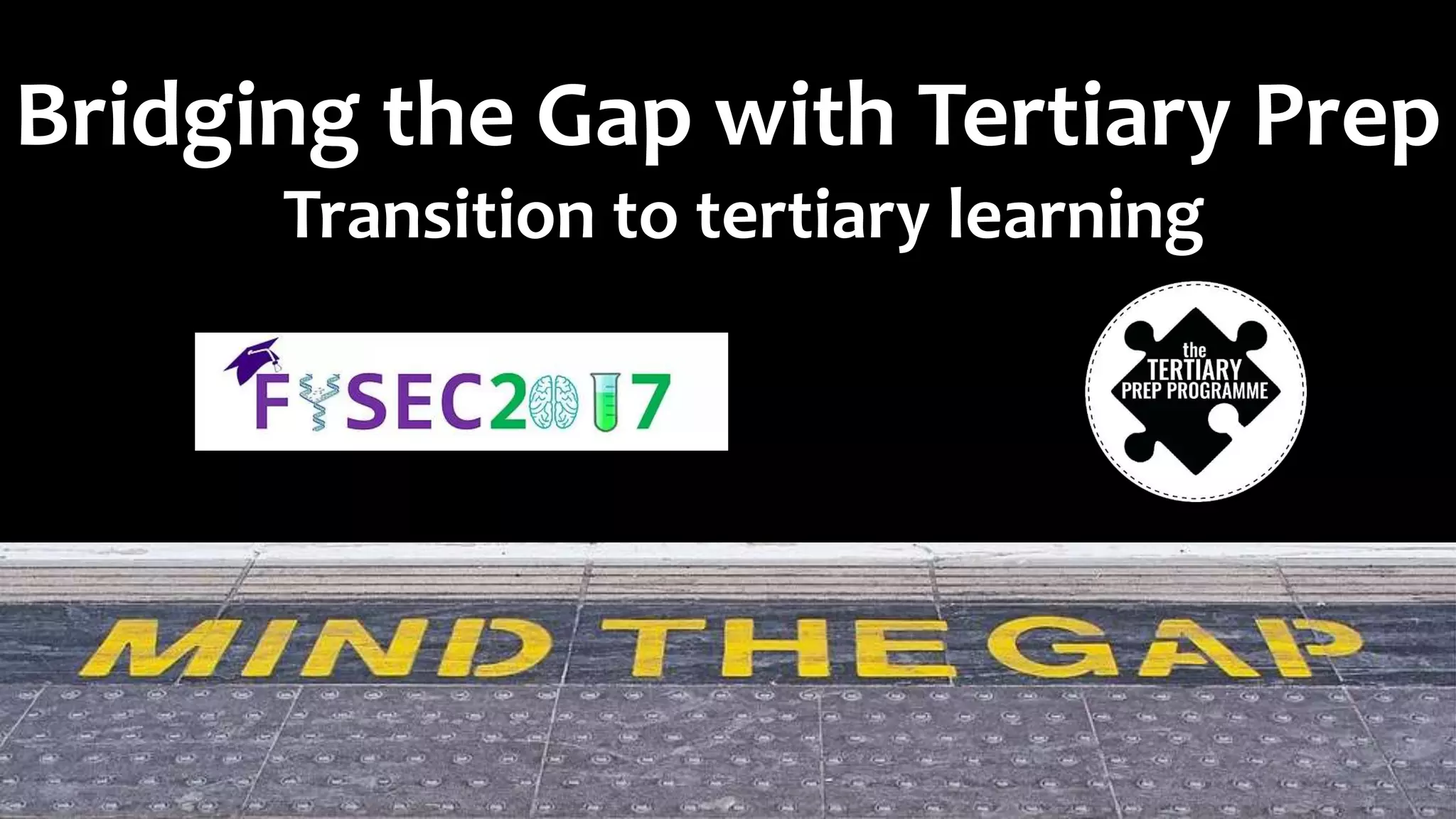
Bridging the Gap with Tertiary Prep
Transition to tertiary learning
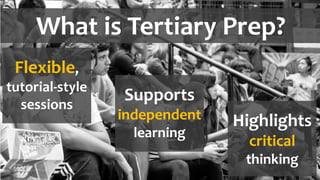
What is Tertiary Prep?
Flexible,
tutorial-style
sessions
What is Tertiary Prep?
Flexible,
tutorial-style
sessions
Supports
independent
learning
What is Tertiary Prep?
Flexible,
tutorial-style
sessions
Supports
independent
learning
Highlights
critical
thinking
Origins of Tertiary Prep
Part of a wider information literacy approach
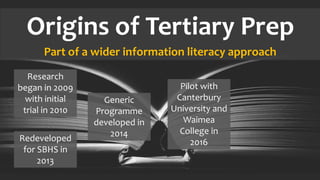
Research
began in 2009
with initial
trial in 2010
Origins of Tertiary Prep
Part of a wider information literacy approach
Research
began in 2009
with initial
trial in 2010
Redeveloped
for SBHS in
2013
Origins of Tertiary Prep
Part of a wider information literacy approach
Research
began in 2009
with initial
trial in 2010
Redeveloped
for SBHS in
2013
Generic
Programme
developed in
2014
Origins of Tertiary Prep
Part of a wider information literacy approach
Research
began in 2009
with initial
trial in 2010
Redeveloped
for SBHS in
2013
Generic
Programme
developed in
2014
Pilot with
Canterbury
University and
Waimea
College in
2016
Origins of Tertiary Prep
Part of a wider information literacy approach
Research
began in 2009
with initial
trial in 2010
Redeveloped
for SBHS in
2013
Generic
Programme
developed in
2014
Pilot with
Canterbury
University and
Waimea
College in
2016
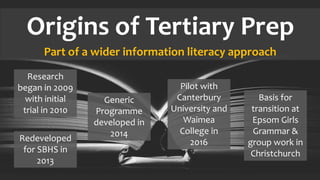
Basis for
transition at
Epsom Girls
Grammar &
group work in
Christchurch
Why Tertiary Prep?
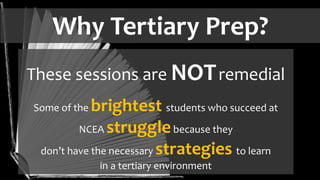
These sessions are NOTremedial
Some of the brightest students who succeed at
NCEA strugglebecause they
don’t have the necessary strategies to learn
in a tertiary environment
Why Tertiary Prep?
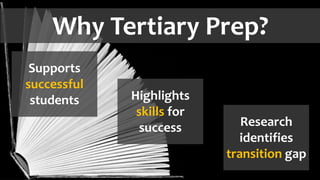
Supports
successful
students Highlights
skills for
success Research
identifies
transition gap
Why Tertiary Prep?
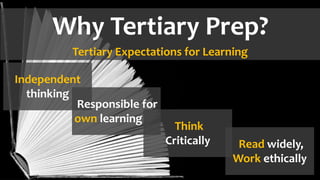
Tertiary Expectations for Learning
Independent
thinking
Responsible for
own learning
Think
Critically Read widely,
Work ethically
Keys to Success
Plan for it
Be organised
Be positive
Stay curious
Starts with Why
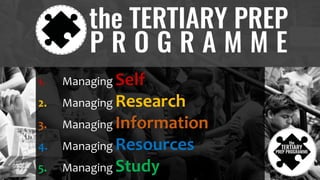
1. Managing Self
1. Managing Self
2. Managing Research
1. Managing Self
2. Managing Research
3. Managing Information
1. Managing Self
2. Managing Research
3. Managing Information
4. Managing Resources
1. Managing Self
2. Managing Research
3. Managing Information
4. Managing Resources
5. Managing Study
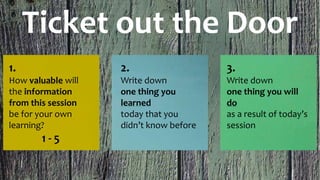
Ticket out the Door
1.
How valuable will
the information
from this session
be for your own
learning?
1 - 5
2.
Write down
one thing you
learned
today that you
didn’t know before
3.
Write down
one thing you will
do
as a result of today’s
session
What Students Say
“The programme has given significant
insight into the differences between
university & secondary school as well as
techniques to further my academic career.”
What Students Say
“The programme has given significant
insight into the differences between
university & secondary school as well as
techniques to further my academic career.”
“Tertiary prep helped me understand what
is expected in further study and how to
manage myself.”
Year 13 students - 2017
What Students Say
“It has helped me with my internal grades
and I have found out new ways of
researching information.
Year 13 students - 2017
What Students Say
“It has helped me with my internal grades
and I have found out new ways of
researching information.
I am now managing my time better,
not procrastinating, so I can be prepared
for exams.”
Year 13 students - 2017
University Students
“There is a large gap between NCEA and
University, I don't think this can be stressed
enough.”
University Students
“There is a large gap between NCEA and
University, I don't think this can be stressed
enough.”
“Being able to Google effectively and study
alone is huge.”
University Students
“There is a large gap between NCEA and
University, I don't think this can be stressed
enough.”
“Being able to Google effectively and study
alone is huge.”
“How to plan for study because sometimes
without planning the studying doesn't
even happen.”
University Students
“The skills and abilities in searching for
information I was introduced to in this
program helped me to more quickly reduce
this gap in knowledge.”
University Students
“The skills and abilities in searching for
information I was introduced to in this
program helped me to more quickly reduce
this gap in knowledge.”
“Makes for a smoother process moving
into a University setting.”
University Students
“The skills and abilities in searching for
information I was introduced to in this
program helped me to more quickly reduce
this gap in knowledge.”
“Makes for a smoother process moving
into a University setting.”
“Being prepared for the different approach
to learning University offers and making
sure you get a head start regarding its
tools and techniques.”
“University can be really stressful in your first
year and not being adequately prepared only
adds to this stress.
Whilst you do pick up some of these skills as
you go along, you never really get a chance to
truly explore what works for you.
The courses at University are good at
delivering content, but a number of my
classmates really struggled to learn this
material in a meaningful way and often failed
courses or picked up bad habits like
cramming material, as a result.”
Third Year Student, 2017
http://tertiaryprep.nz
“The gapbetween secondary
and tertiary education in terms of
literacy and the learning
environment is bigger
than anyone is acknowledging.”
Emerson, Kilpin & Feekery, 2014
The Research
Issues
Independent
learning skills
Disconnect
between sectors
Level of IL not robust
Factors
Pressures around NCEA
Communication
between sectors
Understanding about
the nature of literacy
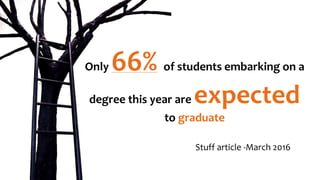
Only 66% of students embarking on a
degree this year are expected
to graduate
Stuff article -March 2016
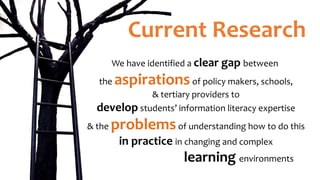
Current Research
We have identified a clear gap between
the aspirationsof policy makers, schools,
& tertiary providers to
develop students’ information literacy expertise
& the problemsof understanding how to do this
in practice in changing and complex
learning environments
We plan to
Year 1 - 2017
Collaboratively develop a baseline IL study
Year 2 - 2018
Develop collaborative teacher/librarian
partnerships
Year 3 - 2019
Develop IL progressions and resources to
ultimately embed IL skills throughout
secondary and tertiary programmes
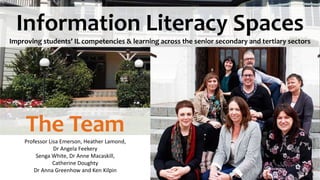
Information Literacy Spaces
Improving students’ IL competencies & learning across the senior secondary and tertiary sectors
The TeamProfessor Lisa Emerson, Heather Lamond,
Dr Angela Feekery
Senga White, Dr Anne Macaskill,
Catherine Doughty
Dr Anna Greenhow and Ken Kilpin
Follow our progress!
Information Literacy Spaces
Improving students’ IL competencies & learning across the senior secondary and tertiary sectors
Website Informationliteracyspaces@wordpress.com
Twitter @il_spaces
Facebook Information Literacy Spaces
Ultimately,
information literate
people
are those who have
learnedhow to
learnAmerican Library Association
Tertiary Prep
from
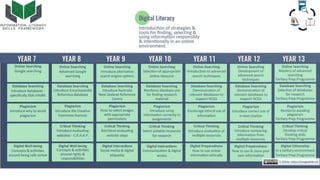
Year 11?
Information Literacy involves the processes,
strategies, skills, competencies,
expertise and ways of thinking which enable
individuals to engage with information to learn
across a range of platforms, transform the known,
and discover the unknown.
Definition
Next Steps
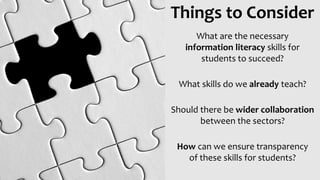
Things to Consider
What are the necessary
information literacy skills for
students to succeed?
What skills do we already teach?
Should there be wider collaboration
between the sectors?
How can we ensure transparency
of these skills for students?
“You can never
be
over-dressed
or
over-educated.”
Oscar Wilde
Tertiary Transition - Bridging the Information Literacy Gap

Tertiary Transition - Bridging the Information Literacy Gap

  • 1.
    Bridging the Gapwith Tertiary Prep Transition to tertiary learning
  • 2.
  • 3.
    What is TertiaryPrep? Flexible, tutorial-style sessions
  • 4.
    What is TertiaryPrep? Flexible, tutorial-style sessions Supports independent learning
  • 5.
    What is TertiaryPrep? Flexible, tutorial-style sessions Supports independent learning Highlights critical thinking
  • 6.
    Origins of TertiaryPrep Part of a wider information literacy approach Research began in 2009 with initial trial in 2010
  • 7.
    Origins of TertiaryPrep Part of a wider information literacy approach Research began in 2009 with initial trial in 2010 Redeveloped for SBHS in 2013
  • 8.
    Origins of TertiaryPrep Part of a wider information literacy approach Research began in 2009 with initial trial in 2010 Redeveloped for SBHS in 2013 Generic Programme developed in 2014
  • 9.
    Origins of TertiaryPrep Part of a wider information literacy approach Research began in 2009 with initial trial in 2010 Redeveloped for SBHS in 2013 Generic Programme developed in 2014 Pilot with Canterbury University and Waimea College in 2016
  • 10.
    Origins of TertiaryPrep Part of a wider information literacy approach Research began in 2009 with initial trial in 2010 Redeveloped for SBHS in 2013 Generic Programme developed in 2014 Pilot with Canterbury University and Waimea College in 2016 Basis for transition at Epsom Girls Grammar & group work in Christchurch
  • 11.
    Why Tertiary Prep? Thesesessions are NOTremedial Some of the brightest students who succeed at NCEA strugglebecause they don’t have the necessary strategies to learn in a tertiary environment
  • 12.
    Why Tertiary Prep? Supports successful studentsHighlights skills for success Research identifies transition gap
  • 13.
    Why Tertiary Prep? TertiaryExpectations for Learning Independent thinking Responsible for own learning Think Critically Read widely, Work ethically
  • 14.
    Keys to Success Planfor it Be organised Be positive Stay curious
  • 16.
  • 17.
  • 18.
    1. Managing Self 2.Managing Research
  • 19.
    1. Managing Self 2.Managing Research 3. Managing Information
  • 20.
    1. Managing Self 2.Managing Research 3. Managing Information 4. Managing Resources
  • 21.
    1. Managing Self 2.Managing Research 3. Managing Information 4. Managing Resources 5. Managing Study
  • 22.
    Ticket out theDoor 1. How valuable will the information from this session be for your own learning? 1 - 5 2. Write down one thing you learned today that you didn’t know before 3. Write down one thing you will do as a result of today’s session
  • 24.
    What Students Say “Theprogramme has given significant insight into the differences between university & secondary school as well as techniques to further my academic career.”
  • 25.
    What Students Say “Theprogramme has given significant insight into the differences between university & secondary school as well as techniques to further my academic career.” “Tertiary prep helped me understand what is expected in further study and how to manage myself.” Year 13 students - 2017
  • 26.
    What Students Say “Ithas helped me with my internal grades and I have found out new ways of researching information. Year 13 students - 2017
  • 27.
    What Students Say “Ithas helped me with my internal grades and I have found out new ways of researching information. I am now managing my time better, not procrastinating, so I can be prepared for exams.” Year 13 students - 2017
  • 28.
    University Students “There isa large gap between NCEA and University, I don't think this can be stressed enough.”
  • 29.
    University Students “There isa large gap between NCEA and University, I don't think this can be stressed enough.” “Being able to Google effectively and study alone is huge.”
  • 30.
    University Students “There isa large gap between NCEA and University, I don't think this can be stressed enough.” “Being able to Google effectively and study alone is huge.” “How to plan for study because sometimes without planning the studying doesn't even happen.”
  • 31.
    University Students “The skillsand abilities in searching for information I was introduced to in this program helped me to more quickly reduce this gap in knowledge.”
  • 32.
    University Students “The skillsand abilities in searching for information I was introduced to in this program helped me to more quickly reduce this gap in knowledge.” “Makes for a smoother process moving into a University setting.”
  • 33.
    University Students “The skillsand abilities in searching for information I was introduced to in this program helped me to more quickly reduce this gap in knowledge.” “Makes for a smoother process moving into a University setting.” “Being prepared for the different approach to learning University offers and making sure you get a head start regarding its tools and techniques.”
  • 34.
    “University can bereally stressful in your first year and not being adequately prepared only adds to this stress. Whilst you do pick up some of these skills as you go along, you never really get a chance to truly explore what works for you. The courses at University are good at delivering content, but a number of my classmates really struggled to learn this material in a meaningful way and often failed courses or picked up bad habits like cramming material, as a result.” Third Year Student, 2017
  • 35.
  • 36.
    “The gapbetween secondary andtertiary education in terms of literacy and the learning environment is bigger than anyone is acknowledging.” Emerson, Kilpin & Feekery, 2014 The Research
  • 37.
  • 38.
    Factors Pressures around NCEA Communication betweensectors Understanding about the nature of literacy
  • 39.
    Only 66% ofstudents embarking on a degree this year are expected to graduate Stuff article -March 2016
  • 40.
    Current Research We haveidentified a clear gap between the aspirationsof policy makers, schools, & tertiary providers to develop students’ information literacy expertise & the problemsof understanding how to do this in practice in changing and complex learning environments
  • 41.
    We plan to Year1 - 2017 Collaboratively develop a baseline IL study Year 2 - 2018 Develop collaborative teacher/librarian partnerships Year 3 - 2019 Develop IL progressions and resources to ultimately embed IL skills throughout secondary and tertiary programmes
  • 42.
    Information Literacy Spaces Improvingstudents’ IL competencies & learning across the senior secondary and tertiary sectors The TeamProfessor Lisa Emerson, Heather Lamond, Dr Angela Feekery Senga White, Dr Anne Macaskill, Catherine Doughty Dr Anna Greenhow and Ken Kilpin
  • 43.
    Follow our progress! InformationLiteracy Spaces Improving students’ IL competencies & learning across the senior secondary and tertiary sectors Website Informationliteracyspaces@wordpress.com Twitter @il_spaces Facebook Information Literacy Spaces
  • 44.
    Ultimately, information literate people are thosewho have learnedhow to learnAmerican Library Association
  • 45.
  • 47.
    Information Literacy involvesthe processes, strategies, skills, competencies, expertise and ways of thinking which enable individuals to engage with information to learn across a range of platforms, transform the known, and discover the unknown. Definition
  • 50.
  • 51.
    Things to Consider Whatare the necessary information literacy skills for students to succeed? What skills do we already teach? Should there be wider collaboration between the sectors? How can we ensure transparency of these skills for students?
  • 52.

Editor's Notes

  • #2 Don’t forget Mihi!
  • #3 Preparation for the transition from learning in a secondary school environment to tertiary study and research Skills learned through Tertiary Prep will also support achievement at level 3 NCEA
  • #12 More discussion is happening from different sectors of education around transition to university, but this one is focussed on preparation the literacy gap
  • #13 Even greater transition for students relocating for tertiary study They don’t know what they don’t know – NCEA can often make them over-confident – same strategies work time and again so not enough ‘tools in the toolbox’
  • #17 Why they need it Differences between secondary and tertiary How to use academic libraries
  • #18 Time management Personal organisation Learning styles and memory techniques
  • #19 Research Process Effective use of Google (Google Scholar & Google Books Searching databases
  • #20 Notetaking and note-making (Cornell method) Revision using notes Basic essay structure
  • #21 Evaluating information Referencing, bibliographies, citations Storage and retrieval of information
  • #22 Planning and preparation for exams Study techniques Group study
  • #23 Collecting feedback and evidence. I also put out an end of programme survey for more overall feedback
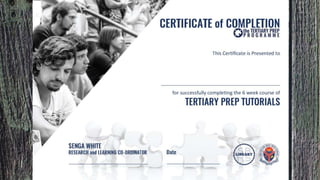
  • #24 Acknowledgement of their participation to incorporate into their CVs
  • #26 “If you want help reaching your full potential academically, attend the programme”
  • #31 Skills & abilities to research effectively Standards vary wildly between schools
  • #36 Website has information and resources. Examples of how other schools have used it and information about universities
  • #37 Research to back up need for Tertiary Prep from 2013-14
  • #40 “tertiary providers need to form partnerships with high schools to make sure students are prepared for a range of options.” Rick Ede, Unitech Chief Executive “the university environment was incredibly challenging and there were many things that caused social, financial and mental distress.” Will Matthews, AUSA President
  • #41 Taken from the TLRI project description August 2016
  • #46 What Skills?? Goal Setting, Time Management, Independent learning skills
  • #51 Next phase is creating opportunities for online programme and lessons to practise some of the skills introduced through the tutorials Also needed by adult students who maybe haven’t studied for a while, have never studied or are distance learners
  • #52 So far it seems to be more of the domain of librarians. How do we collaborate?