The National Forum for the Enhancement of Teaching and Learning 
in Higher Education. Seminar Series: IT Tallaght, 11th June, 2014 
Telling it straight: 
incorporating the student 
voice into your learning 
support strategy 
Siobhán Dunne 
@dunnesiobhan 
Dublin City University 
Source: https://flic.kr/p/6D8gTg
Overview 
1 CONTEXT FOR THIS MODULE 
2 THE VALUE OF REFLECTIVE JOURNALS 
3 BUILDING RELATIONSHIPS
Source: http://www.theguardian.com/ Everett Kennedy Brown/EPA 
“The type and process of teaching 
and learning in second level was 
seen as a barrier to being ready to 
successfully access third level 
learning. The strong emphasis on 
note learning, the absence of 
training in higher order thinking 
skills, the focus on the leaving cert as 
a memory test, which had students 
see the leaving cert from a short 
term perspective, did not furnish 
students with the skills to progress 
to college” 
Student submission (2009) to National 
Strategy for Higher Eduction to 2030 (2011)
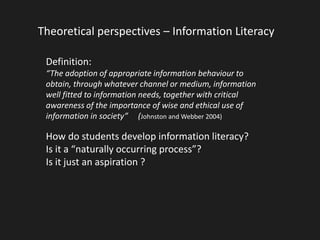
Theoretical perspectives – Information Literacy 
Definition: 
“The adoption of appropriate information behaviour to 
obtain, through whatever channel or medium, information 
well fitted to information needs, together with critical 
awareness of the importance of wise and ethical use of 
information in society” (Johnston and Webber 2004) 
How do students develop information literacy? 
Is it a “naturally occurring process”? 
Is it just an aspiration ?
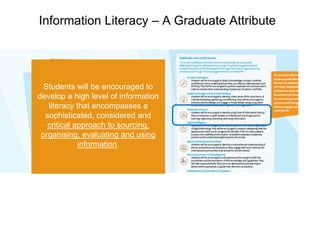
Information Literacy – A Graduate Attribute 
Students will be encouraged to 
develop a high level of information 
literacy that encompasses a 
sophisticated, considered and 
critical approach to sourcing, 
organising, evaluating and using 
information.
The Module 
Information and Study Skills - core module 
on BA in Contemporary Culture and 
Society 
Interdisciplinary degree programme 
delivered by DCU’s Faculty of Humanities 
and Social Sciences 
Source: http://www.lostintechnology.com/apple/top-five-iphone-4-apps-for-college-students/
Module Aims - Students will know: 
How their experiences of learning (past and present) are 
different 
How to use information with confidence 
The value of transferable skills and their importance in the 
world of work 
How to reflect on their learning experience and draw 
conclusions from such reflection
Guidelines for Journal entries 
1 Goals: what you intend to cover/do in the week 
2 Activities: what you actually accomplish, that is, manage to do. 
3 Readings: any information sources referred to during the week 
4 Problems: outline honestly any difficulties encountered with 
research, that is finding and accessing information, your learning 
with regard to a particular incident, overall feelings or impressions 
about your learning and differences with previous learning
Guidelines for Journal entries (continued) 
5. Reflection: reflect on the experience, such as a particular incident. 
How did you cope? What did you learn/realise? 
6. Reflection on reflection: how is this journal helping you to discover 
new things about yourself? How is it developing your learning? 
You may not always use this but it should be there sometimes.
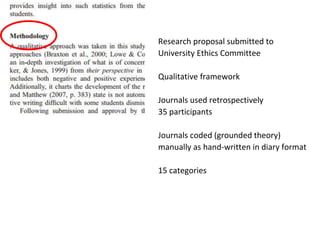
Research proposal submitted to 
University Ethics Committee 
Qualitative framework 
Journals used retrospectively 
35 participants 
Journals coded (grounded theory) 
manually as hand-written in diary format 
15 categories
Journal Finding: 
Coping with a new environment 
The university because it is different from school: 
“I’m also adjusting to the new style of teaching that university life brings. 
It’s very different from the teaching style of secondary school”.
Journal Finding: 
A different type of working week 
“Monday never really happens study wise as I have lecture 9-6 with only a 
break 3-4 and I’m always knackered by the end of the day…on Tuesdays 
and Wednesdays I go to the library from lunch time until around 8 or 9 so 
I usually get a lot done then. However I now have work on a Tuesday 
evening so have to stop studying around half 4 or 5 so to compensate I’m 
going to come in at 11 for 2 hours before my lecture”
Journal Finding: 
Researching for an assignment 
“I find it hard to just sit down and write because I’m afraid I don’t have 
enough information on the topic, so I have to read books, and look it up 
on the internet. However, I then worry that the information I have is 
irrelevant to the essay”.
Journal Finding: being proactive 
“I have registered for a workshop of academic writing which I hope will 
help me. Learning how to write academically is very important. Writing a 
college essay is so different to school essays I had to write”.
The Value of the Journal 
“This journal is making me realize that I must organize myself and get my 
priorities in place”. 
Realised at different stages of the reflective process
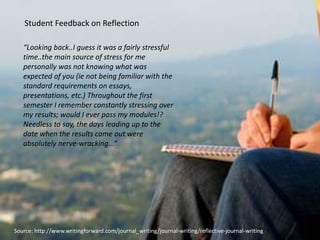
Student Feedback on Reflection 
“Looking back..I guess it was a fairly stressful 
time..the main source of stress for me 
personally was not knowing what was 
expected of you (ie not being familiar with the 
standard requirements on essays, 
presentations, etc.) Throughout the first 
semester I remember constantly stressing over 
my results; would I ever pass my modules!? 
Needless to say, the days leading up to the 
date when the results came out were 
absolutely nerve-wracking...” 
Source: http://www.writingforward.com/journal_writing/journal-writing/reflective-journal-writing
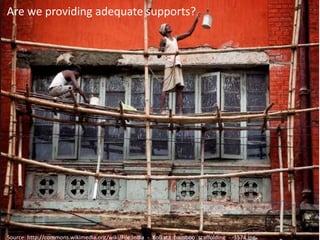
Are we providing adequate supports? 
Source: http://commons.wikimedia.org/wiki/File:India_-_Kolkata_bamboo_scaffolding_-_3574.jpg
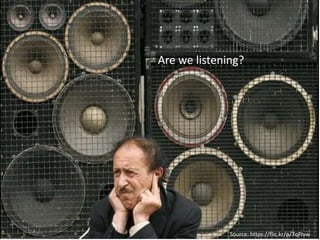
Are we listening? 
Source: https://flic.kr/p/7qPJvw
” 
The journals have provided a unique 
insight and understanding into what 
students think about their learning 
experiences. They have provided the 
rationale for implementing changes into 
what is perceived as a traditional 
standalone study skills module. The 
journals indicate that designing curricula 
for the future comes firstly, from being 
open to new forms of collaboration across 
a university, and secondly, providing 
routes for incorporating student feedback 
meaningfully into this process.
Source: https://flic.kr/p/6rDroh 
Traditionally third level curricula have been designed 
solely by academics. However, designing a curriculum for 
the future requires a more diverse educational input from 
a number of stakeholders. These include academics, 
librarians and students themselves.
References 
Dunne, S. and Sheridan, V., 2012. ‘The Bigger Picture: Undergraduate Voices 
Reflecting on Academic Transition in an Irish University’ Innovations in Education & 
Teaching International, 49 (2), pp. 237-247. 
Dunne, S. and Sheridan, V., 2013. ‘How Staff Collaboration Can Improve the Student 
Learning Experience: the Development of a Module to Support Student Transition 
into Higher Education’ In Morgan, Michelle (ed.) ‘Recruiting and Supporting 
Diversity – a Practical Guide for Universities and Colleges’. New York: Routledge, pp. 
201-203. 
Kift, S., 2009. Articulating a transition pedagogy to scaffold and to enhance the first 
year student learning experience in Australian higher education: Final Report for 
ALTC Senior Fellowship Program 
McGuinness, C. 2007. 'The Use of Reflective Research Journals in a 1st Year 
Information Literacy Module' In: Case Studies of Good Practices in Assessment of 
Student Learning in Higher Education. Dublin: AISHE.

Telling it straight: incorporating the student voice into your learning support strategy

  • 1.
    The National Forumfor the Enhancement of Teaching and Learning in Higher Education. Seminar Series: IT Tallaght, 11th June, 2014 Telling it straight: incorporating the student voice into your learning support strategy Siobhán Dunne @dunnesiobhan Dublin City University Source: https://flic.kr/p/6D8gTg
  • 2.
    Overview 1 CONTEXTFOR THIS MODULE 2 THE VALUE OF REFLECTIVE JOURNALS 3 BUILDING RELATIONSHIPS
  • 3.
    Source: http://www.theguardian.com/ EverettKennedy Brown/EPA “The type and process of teaching and learning in second level was seen as a barrier to being ready to successfully access third level learning. The strong emphasis on note learning, the absence of training in higher order thinking skills, the focus on the leaving cert as a memory test, which had students see the leaving cert from a short term perspective, did not furnish students with the skills to progress to college” Student submission (2009) to National Strategy for Higher Eduction to 2030 (2011)
  • 4.
    Theoretical perspectives –Information Literacy Definition: “The adoption of appropriate information behaviour to obtain, through whatever channel or medium, information well fitted to information needs, together with critical awareness of the importance of wise and ethical use of information in society” (Johnston and Webber 2004) How do students develop information literacy? Is it a “naturally occurring process”? Is it just an aspiration ?
  • 5.
    Information Literacy –A Graduate Attribute Students will be encouraged to develop a high level of information literacy that encompasses a sophisticated, considered and critical approach to sourcing, organising, evaluating and using information.
  • 6.
    The Module Informationand Study Skills - core module on BA in Contemporary Culture and Society Interdisciplinary degree programme delivered by DCU’s Faculty of Humanities and Social Sciences Source: http://www.lostintechnology.com/apple/top-five-iphone-4-apps-for-college-students/
  • 7.
    Module Aims -Students will know: How their experiences of learning (past and present) are different How to use information with confidence The value of transferable skills and their importance in the world of work How to reflect on their learning experience and draw conclusions from such reflection
  • 8.
    Guidelines for Journalentries 1 Goals: what you intend to cover/do in the week 2 Activities: what you actually accomplish, that is, manage to do. 3 Readings: any information sources referred to during the week 4 Problems: outline honestly any difficulties encountered with research, that is finding and accessing information, your learning with regard to a particular incident, overall feelings or impressions about your learning and differences with previous learning
  • 9.
    Guidelines for Journalentries (continued) 5. Reflection: reflect on the experience, such as a particular incident. How did you cope? What did you learn/realise? 6. Reflection on reflection: how is this journal helping you to discover new things about yourself? How is it developing your learning? You may not always use this but it should be there sometimes.
  • 10.
    Research proposal submittedto University Ethics Committee Qualitative framework Journals used retrospectively 35 participants Journals coded (grounded theory) manually as hand-written in diary format 15 categories
  • 11.
    Journal Finding: Copingwith a new environment The university because it is different from school: “I’m also adjusting to the new style of teaching that university life brings. It’s very different from the teaching style of secondary school”.
  • 12.
    Journal Finding: Adifferent type of working week “Monday never really happens study wise as I have lecture 9-6 with only a break 3-4 and I’m always knackered by the end of the day…on Tuesdays and Wednesdays I go to the library from lunch time until around 8 or 9 so I usually get a lot done then. However I now have work on a Tuesday evening so have to stop studying around half 4 or 5 so to compensate I’m going to come in at 11 for 2 hours before my lecture”
  • 13.
    Journal Finding: Researchingfor an assignment “I find it hard to just sit down and write because I’m afraid I don’t have enough information on the topic, so I have to read books, and look it up on the internet. However, I then worry that the information I have is irrelevant to the essay”.
  • 14.
    Journal Finding: beingproactive “I have registered for a workshop of academic writing which I hope will help me. Learning how to write academically is very important. Writing a college essay is so different to school essays I had to write”.
  • 15.
    The Value ofthe Journal “This journal is making me realize that I must organize myself and get my priorities in place”. Realised at different stages of the reflective process
  • 16.
    Student Feedback onReflection “Looking back..I guess it was a fairly stressful time..the main source of stress for me personally was not knowing what was expected of you (ie not being familiar with the standard requirements on essays, presentations, etc.) Throughout the first semester I remember constantly stressing over my results; would I ever pass my modules!? Needless to say, the days leading up to the date when the results came out were absolutely nerve-wracking...” Source: http://www.writingforward.com/journal_writing/journal-writing/reflective-journal-writing
  • 17.
    Are we providingadequate supports? Source: http://commons.wikimedia.org/wiki/File:India_-_Kolkata_bamboo_scaffolding_-_3574.jpg
  • 18.
    Are we listening? Source: https://flic.kr/p/7qPJvw
  • 19.
    ” The journalshave provided a unique insight and understanding into what students think about their learning experiences. They have provided the rationale for implementing changes into what is perceived as a traditional standalone study skills module. The journals indicate that designing curricula for the future comes firstly, from being open to new forms of collaboration across a university, and secondly, providing routes for incorporating student feedback meaningfully into this process.
  • 20.
    Source: https://flic.kr/p/6rDroh Traditionallythird level curricula have been designed solely by academics. However, designing a curriculum for the future requires a more diverse educational input from a number of stakeholders. These include academics, librarians and students themselves.
  • 21.
    References Dunne, S.and Sheridan, V., 2012. ‘The Bigger Picture: Undergraduate Voices Reflecting on Academic Transition in an Irish University’ Innovations in Education & Teaching International, 49 (2), pp. 237-247. Dunne, S. and Sheridan, V., 2013. ‘How Staff Collaboration Can Improve the Student Learning Experience: the Development of a Module to Support Student Transition into Higher Education’ In Morgan, Michelle (ed.) ‘Recruiting and Supporting Diversity – a Practical Guide for Universities and Colleges’. New York: Routledge, pp. 201-203. Kift, S., 2009. Articulating a transition pedagogy to scaffold and to enhance the first year student learning experience in Australian higher education: Final Report for ALTC Senior Fellowship Program McGuinness, C. 2007. 'The Use of Reflective Research Journals in a 1st Year Information Literacy Module' In: Case Studies of Good Practices in Assessment of Student Learning in Higher Education. Dublin: AISHE.