


















































































































































“Own It, Activate It, EngageWith It”
Innovation in Public Education
May 3, 2013
CHRIS KENNEDY
Superintendent of
Schools,West
Vancouver School
District
BCCPAC 2013 Spring
Conference and AGM
Richmond, BC
With thanks to Bill Selak: http://www.billselak.com/2012/thingsthatsuck
AWESOME OR NOT!?
Your High School Experience?
Your Perception of SchoolsToday?
The Relevance ofWhat Kids Learn?
Why?
SELF-RELIANCE
CRITICALTHINKING
INQUIRY
CREATIVITY
PROBLEM-SOLVING
INNOVATION
TEAMWORK
COLLABORATION
CROSS-CULTURAL
TECHNOLOGICAL
LITERACY
CONNECT
ACROSS
TOPIC AREAS
Credit: Scott McLeod – danngerouslyirrelevent.org
Our kids have tasted the honey
What
could be
DO OLDTHINGS
BETTER
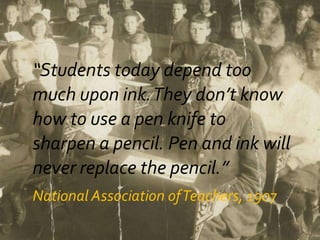
“Students today depend too
much upon ink.They don’t know
how to use a pen knife to
sharpen a pencil. Pen and ink will
never replace the pencil.”
National Association ofTeachers, 1907
DO NEWTHINGS
YOU COULDN’T
DO AT ALL
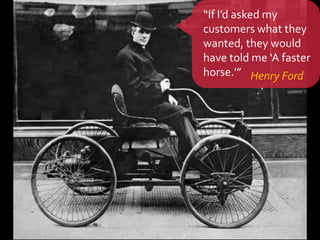
“If I’d asked my
customers what they
wanted, they would
have told me ‘A faster
horse.’” Henry Ford
5 obstacles
No need
No money
No hurry
No desire
No trust
People prefer things that are easy to think about
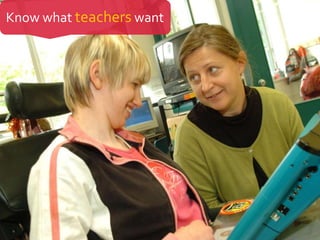
Know what teachers want
Can I change?
Everyone benefits
The
goal
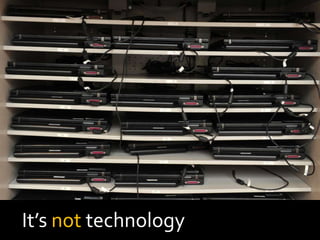
It’s not technology
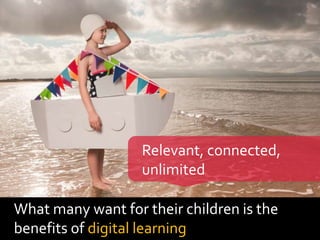
What many want for their children is the
benefits of digital learning
Relevant, connected,
unlimited
Create a new
norm for how
teachers and
students learn
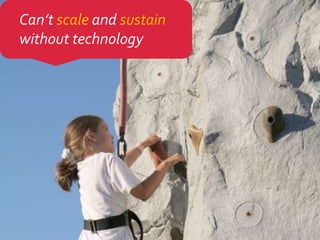
Can’t scale and sustain
without technology
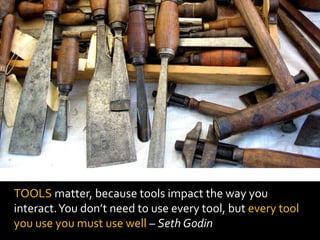
TOOLS matter, because tools impact the way you
interact.You don’t need to use every tool, but every tool
you use you must use well – Seth Godin
Access
Direction
Moving to one-to-one opportunities
What does
this mean?
What about
equity?
Technology can help overcome
barriers of access and
geography
Learning
powered by
technology
GOAL:
Personalized
learning for
every student
What does innovation look like in your
school / school district??
Assumptions for
the next 5 years
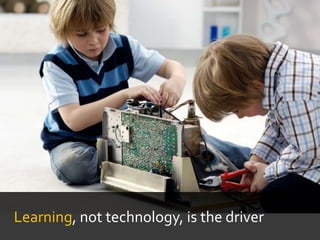
Learning, not technology, is the driver
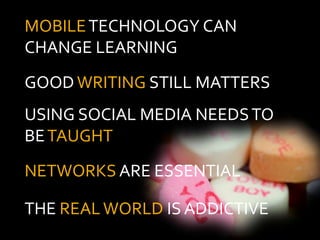
MOBILETECHNOLOGY CAN
CHANGE LEARNING
GOOD WRITING STILL MATTERS
USING SOCIAL MEDIA NEEDSTO
BETAUGHT
NETWORKS ARE ESSENTIAL
THE REALWORLD IS ADDICTIVE
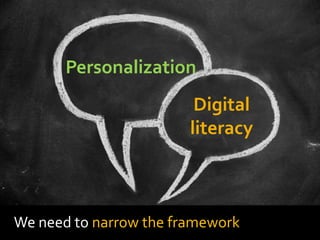
Personalization
We need to narrow the framework
Digital
literacy
What should change in schools over the next
five years??
What we
would do
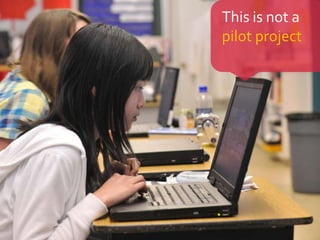
This is not a
pilot project
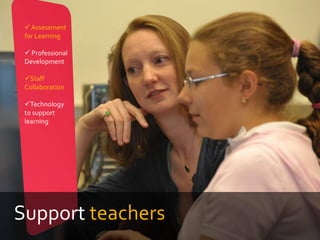
 Assessment
for Learning
 Professional
Development
Staff
Collaboration
Technology
to support
learning
Support teachers
Teachers will always push the boundaries
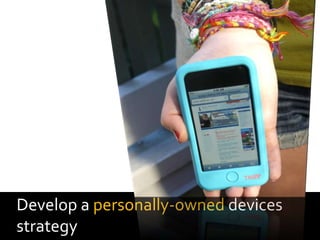
Develop a personally-owned devices
strategy
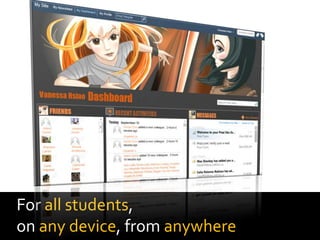
For all students,
on any device, from anywhere
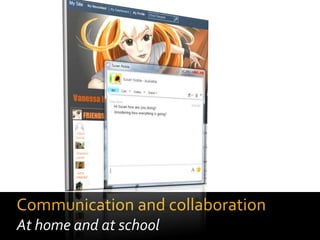
Communication and collaboration
At home and at school
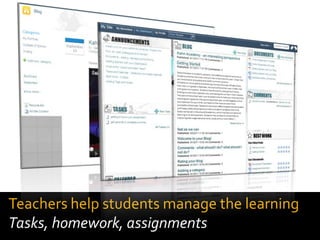
Teachers help students manage the learning
Tasks, homework, assignments
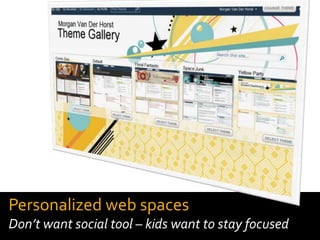
Personalized web spaces
Don’t want social tool – kids want to stay focused
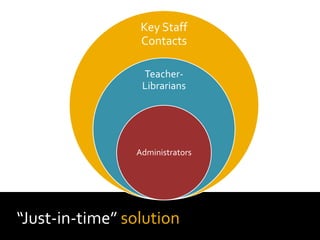
Key Staff
Contacts
Teacher-
Librarians
Administrators
“Just-in-time” solution
What we
WOULDN’T do
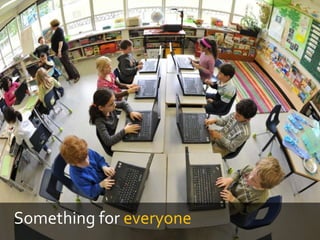
Something for everyone
TRENDS
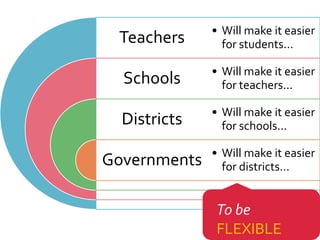
Teachers
Schools
Districts
Governments
• Will make it easier
for students...
• Will make it easier
for teachers...
• Will make it easier
for schools...
• Will make it easier
for districts...
To be
FLEXIBLE
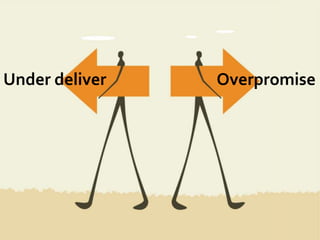
OverpromiseUnder deliver
NEXT
CHALLENGE
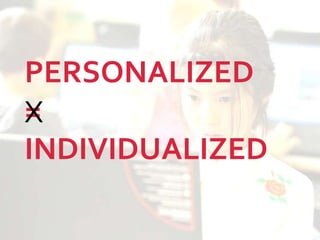
PERSONALIZED
=
INDIVIDUALIZED
X
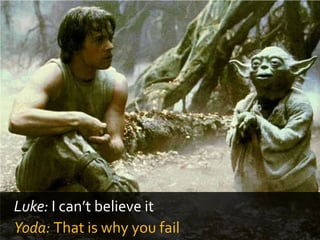
Luke: I can’t believe it
Yoda: That is why you fail
He says the problem with teachers is
What’s a kid going to learn
from someone who decided his best option in life
was to become a teacher?
He reminds the other dinner guests that it’s true
what they say about teachers:
Those who can, do; those who can’t, teach.
. . .
I mean, you’re a teacher, Taylor.
Be honest. What do you make?
This is . . .
OUR WORLD
OUR LIVES
OUR CHILDREN
OUR CURRICULUM
OUR CHALLENGE
OUR WORK
OUR ART
OUR JOY
You want to know what I make? I make kids
wonder,
I make them question.
I make them criticize.
I make them apologize and mean it.
I make them write.
I make them read, read, read.
I make them spell definitely beautiful,
definitely beautiful, definitely beautiful
over and over and over again until they will
never misspell
either one of those words again.
. . .
and if someone ever tries to judge you
by what you by what you make, you give them this.
. . .
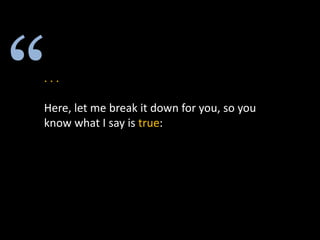
Here, let me break it down for you, so you
know what I say is true:
Teachers make a goddamn difference! Now
what about you?
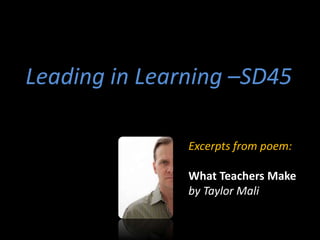
Excerpts from poem:
What Teachers Make
by Taylor Mali
Leading in Learning –SD45
Where you can find me:
ckennedy@sd45.bc.ca
604-202-4379
@chrkennedy
Chris Kennedy
cultureofyes.ca
www.sd45.bc.ca

BCCPAC Presentation

Editor's Notes

  • #9 To better prepare students for the future there will be more emphasis on key competencies like:
  • #20  . . . With the world outside of school
  • #23 We can’t wait for the decisions of others – it is go time . . . now
  • #24 Your budget is one-third of what you would require to do all that you feel would be effective
  • #25 All the necessary infrastructure is in place
  • #29 Do old things better
  • #32 If I'd have asked my customers what they wanted, they would have told me "A faster horse.” – Henry Ford
  • #36 Expense, effort, risk
  • #37 Result:Everyone benefitsThe “state-of-the-art” progresses and changesIncrease in [number] and diversity of learners (also financial goal of SD . . .)
  • #44 It is access to the benefits of a digitized world that is the greater goal. For our students to thrive in this world, they need to have ACCESS and DIRECTION.
  • #45 To be clear, one-to-one computing is not the solution to any challenge – it may, though, be part of the answer to going forward.
  • #46 If we think by placing an Internet appliance in a student’s hands alone will create a more creative, innovative, or more intelligent student, we are missing the point. Like the paper and pen of the last generation, it is the “oxygen” to breathe in a digital world.
  • #47 Won’t this further divide our students (and teachers) into haves and have-nots?Given that it is unlikely any grand plan will come together to support all students and staff with technology, implementation will be incremental.
  • #48 If we believe technology is crucial for students moving forward, we need to find a way for all students to have a base level of access.
  • #52 Teachers and schools are not going anywhere (sense of community/social-emotional learning)
  • #53 All efforts need to be learning efforts. The goal is to increase personalized learning that improves engagement, relevancy and achievement. The technology is there to SUPPORT this goal.
  • #55 Complex problems often have a simple solution
  • #56 External inventions will continue to dramatically impact what we do, and we have no control over it!
  • #60 Start at Grades 4–7 (maybe 6-8 if a middle model) – spill both ways over time – the “sweet spot” extends from 4 – 10 depending on your school organization
  • #61 Teachers need to have the technology in their hands early on to become comfortable with it BEFORE students are using it on a regular basis. There is also a lot of work to be done to support teachers in adopting pedagogy in this “new” classroom environment.
  • #62 There will be teachers who continue to push the boundaries, who will do amazing and edgy stuff – teachers always have and always will. This should be encouraged, but it is not the base expectation.
  • #63 Develop a personally owned devices strategy that addresses equity. Simply encouraging students to bring their own devices is not enough, or an effective strategy. The strategy must be purposeful, supported and unified for both TEACHERS and STUDENTS.
  • #64 Focus on a web environment / space for learning / personalization that allows a common structure that changes the norm of how we do business
  • #68 Have high expectations for leadership with your administrators and librarians
  • #69 Make our learning leaders our digital learning leaders
  • #73 Find your “simple thing” that changes the norm – it could be:1.    Digital writing2.    Digital content3.    PortfolioNote all 3 fit into the content, learning, assessment triangle. Need to find the one sticky piece to expand learning.
  • #74 Link technology to physical activity and the arts – it is not just about language arts – integrate, integrate, integrate!  (High Tech High examples)
  • #76 Distributive learning – we want all classes to be blended classes / others are experts – get out of competing – let a few do it well for the students who need it  - focus on what we will do for all students
  • #77 Not allow technology to solely report to the business side of the organization
  • #78 Slate crazy (iPads) – doesn’t lend itself to creation and participation – more (at least so far) about consuming information – we want to create creators
  • #79 Something for everyone – focus on some students, in some schools – nice to say you have an IWB in every class – but to what end?
  • #80 More staff (and not just students) will be bringing their own devices to workDistricts will own and store lessTension between formal and informal learning will increase; what matters most is what happens in informal settings – the true learning!Digital content will increase / devices will get cheaper
  • #81 Tension between formal and informal learning will increase; what matters most is what happens in informal settings – the true learning!
  • #83 Digital content will increase / devices will get cheaper
  • #86 More staff (and not just students) will be bringing their own devices to workDistricts will own and store lessTension between formal and informal learning will increase; what matters most is what happens in informal settings – the true learning!Digital content will increase / devices will get cheaper
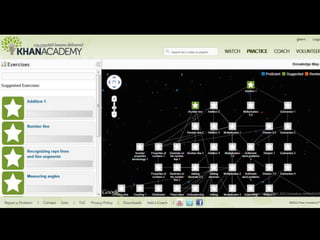
  • #87 Moving from a space to a plan – how will we manage personalized learning in the digital space?Use the Khan Academy map of an individual plan – layered into assessment and demonstrations
  • #215 Link technology to physical activity and the arts – it is not just about language arts – integrate, integrate, integrate!  (High Tech High examples)
  • #216 Start at Grades 4–7 (maybe 6-8 if a middle model) – spill both ways over time – the “sweet spot” extends from 4 – 10 depending on your school organization
  • #253 Tension between formal and informal learning will increase; what matters most is what happens in informal settings – the true learning!