Presentation by –
Ar Avitesh
Research Scholar, SAA,
Sushant University, Gurugram
2
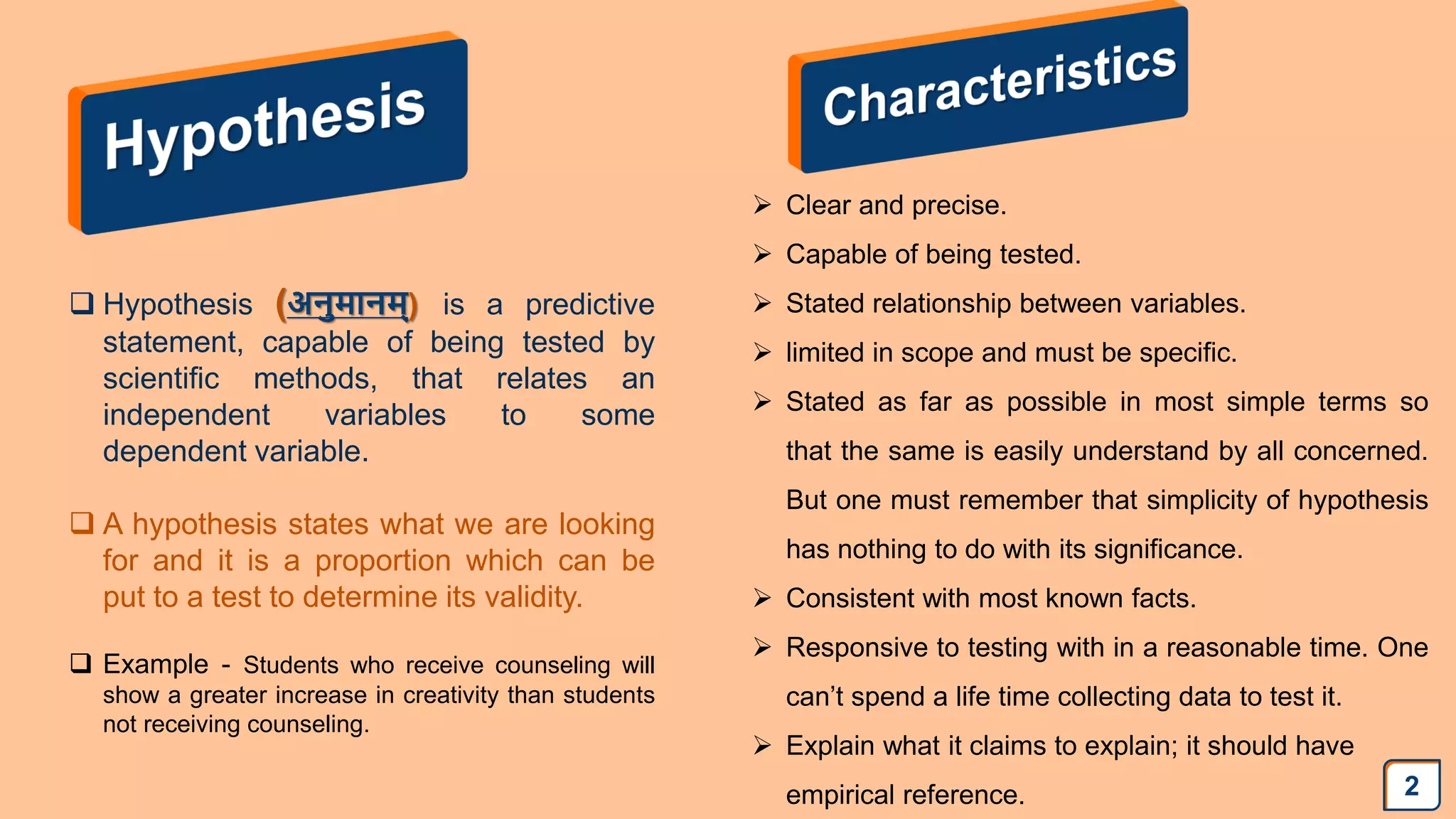
 Hypothesis (अनुमानम्) is a predictive
statement, capable of being tested by
scientific methods, that relates an
independent variables to some
dependent variable.
 A hypothesis states what we are looking
for and it is a proportion which can be
put to a test to determine its validity.
 Example - Students who receive counseling will
show a greater increase in creativity than students
not receiving counseling.
 Clear and precise.
 Capable of being tested.
 Stated relationship between variables.
 limited in scope and must be specific.
 Stated as far as possible in most simple terms so
that the same is easily understand by all concerned.
But one must remember that simplicity of hypothesis
has nothing to do with its significance.
 Consistent with most known facts.
 Responsive to testing with in a reasonable time. One
can’t spend a life time collecting data to test it.
 Explain what it claims to explain; it should have
empirical reference.
3
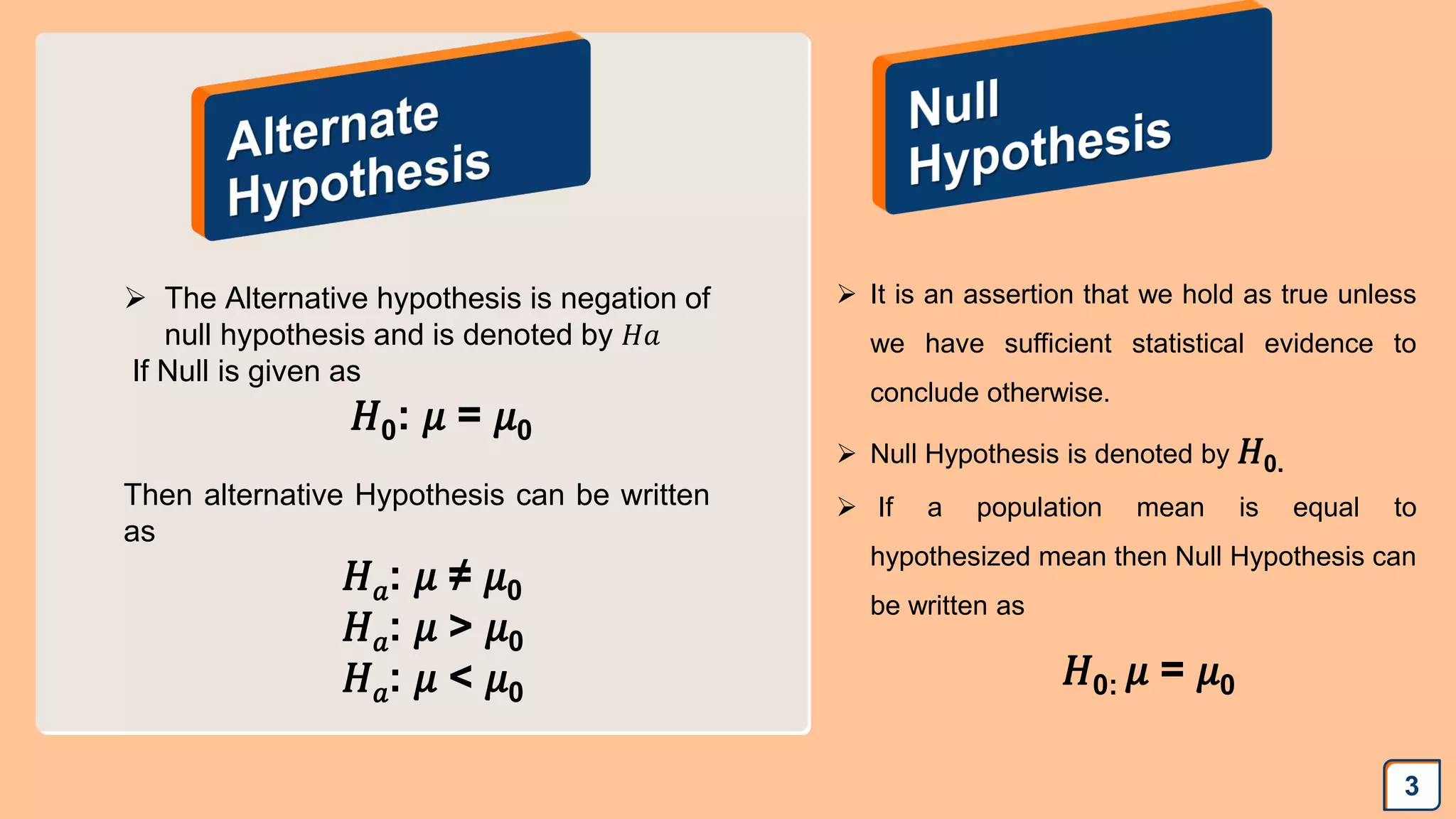
 The Alternative hypothesis is negation of
null hypothesis and is denoted by 𝐻𝑎
If Null is given as
𝐻0: 𝜇 = 𝜇0
Then alternative Hypothesis can be written
as
𝐻𝑎: 𝜇 ≠ 𝜇0
𝐻𝑎: 𝜇 > 𝜇0
𝐻𝑎: 𝜇 < 𝜇0
 It is an assertion that we hold as true unless
we have sufficient statistical evidence to
conclude otherwise.
 Null Hypothesis is denoted by 𝐻0.
 If a population mean is equal to
hypothesized mean then Null Hypothesis can
be written as
𝐻0: 𝜇 = 𝜇0
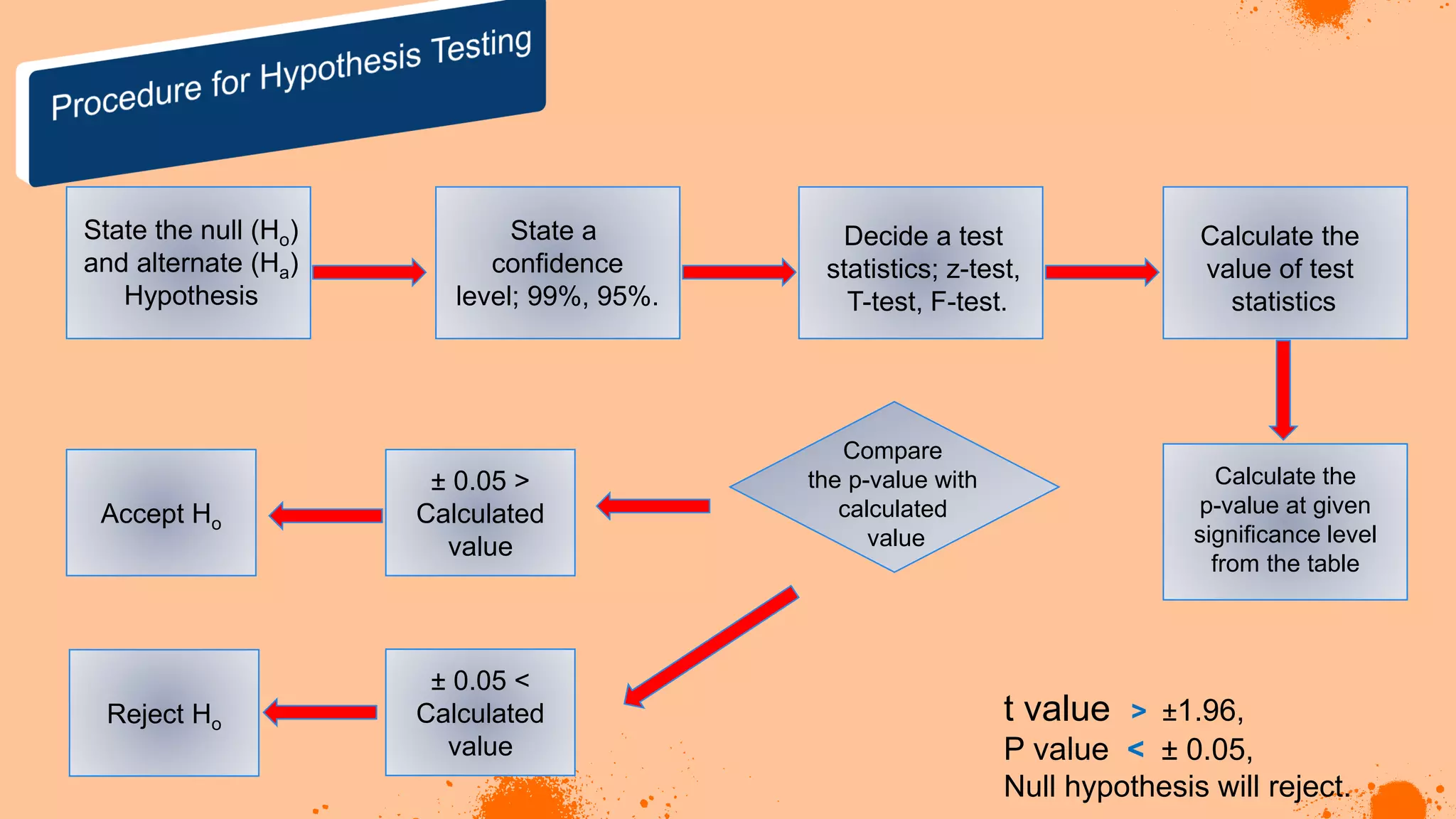
State the null (Ho)
and alternate (Ha)
Hypothesis
State a
confidence
level; 99%, 95%.
Decide a test
statistics; z-test,
T-test, F-test.
Calculate the
value of test
statistics
Calculate the
p-value at given
significance level
from the table
Compare
the p-value with
calculated
value
Accept Ho
± 0.05 >
Calculated
value
Reject Ho
± 0.05 <
Calculated
value
t value > ±1.96,
P value < ± 0.05,
Null hypothesis will reject.
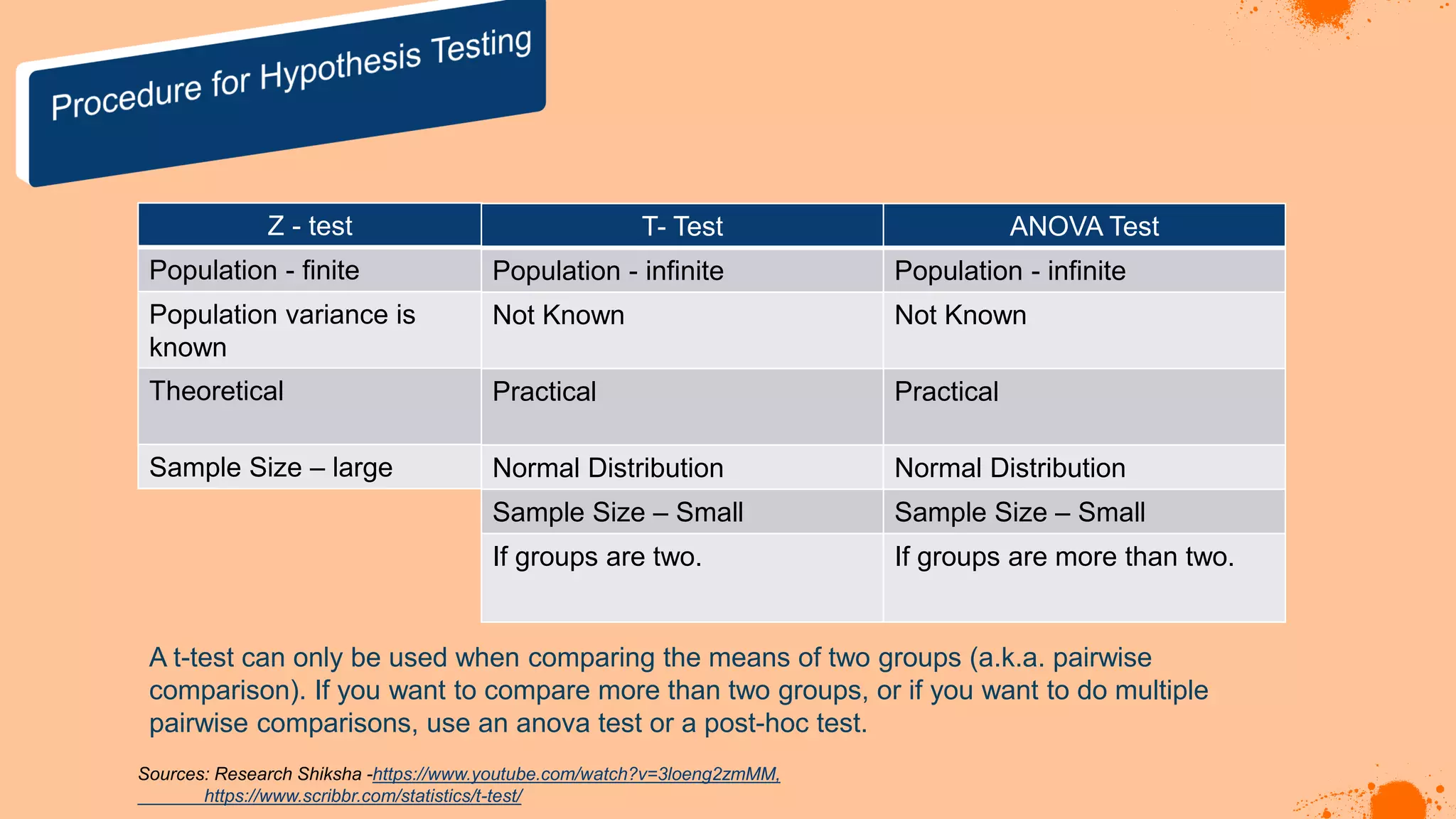
Z - test
Population - finite
Population variance is
known
Theoretical
Sample Size – large
T- Test ANOVA Test
Population - infinite Population - infinite
Not Known Not Known
Practical Practical
Normal Distribution Normal Distribution
Sample Size – Small Sample Size – Small
If groups are two. If groups are more than two.
A t-test can only be used when comparing the means of two groups (a.k.a. pairwise
comparison). If you want to compare more than two groups, or if you want to do multiple
pairwise comparisons, use an anova test or a post-hoc test.
Sources: Research Shiksha -https://www.youtube.com/watch?v=3loeng2zmMM,
https://www.scribbr.com/statistics/t-test/
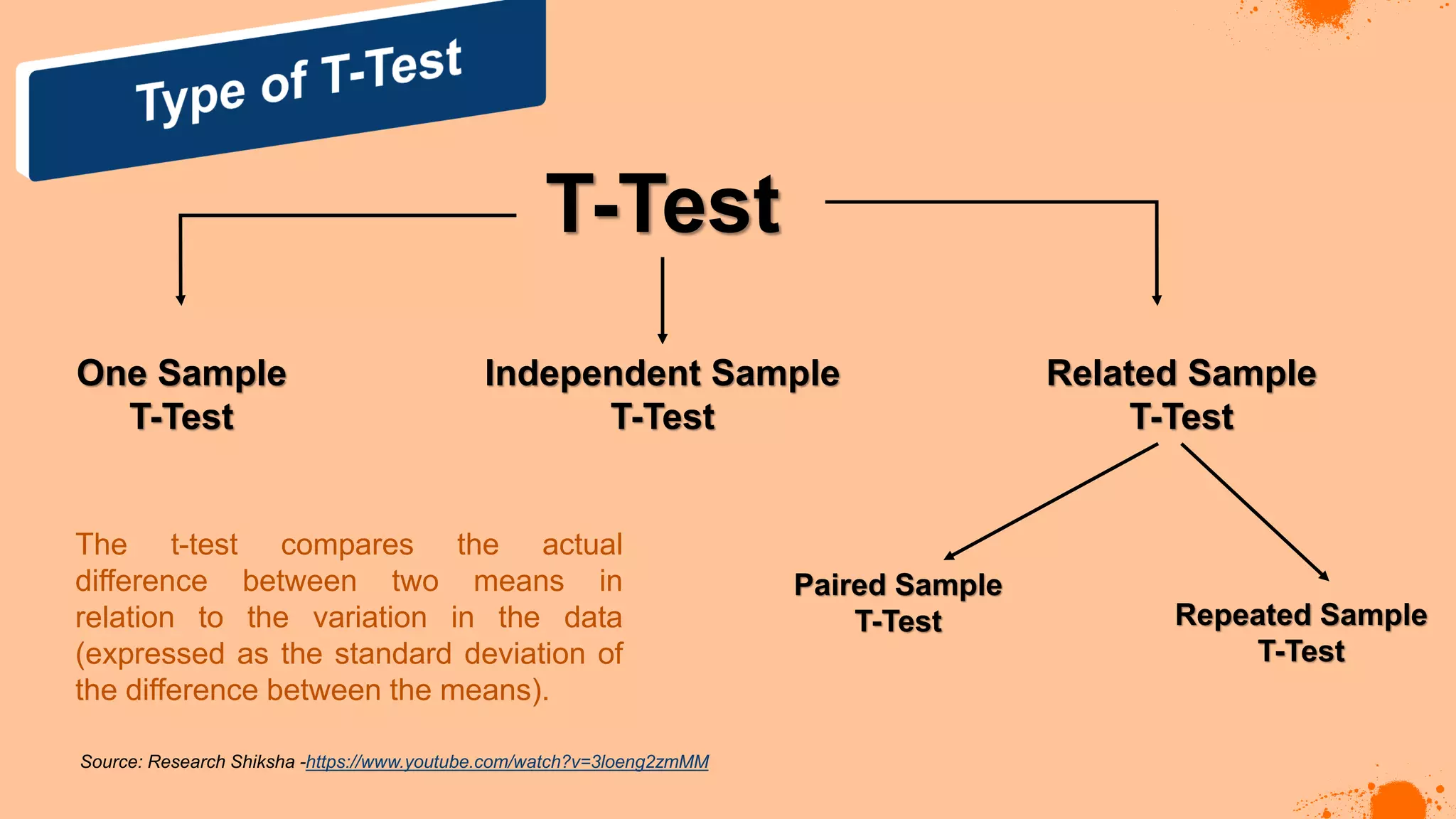
T-Test
One Sample
T-Test
Independent Sample
T-Test
Related Sample
T-Test
Paired Sample
T-Test Repeated Sample
T-Test
Source: Research Shiksha -https://www.youtube.com/watch?v=3loeng2zmMM
The t-test compares the actual
difference between two means in
relation to the variation in the data
(expressed as the standard deviation of
the difference between the means).
Source: Research Shiksha -https://www.youtube.com/watch?v=3loeng2zmMM
Mostly we have heard these types of claims around us -
1. You are conducting an experiment to see if a given therapy works to reduce test anxiety in a sample
of college students.
2. Any green tea company claims that if you will take their products regularly for detoxing, you can
loose 5 Kg weight in a month.
3. One physics coaching center claims that all students will get marks above 80 in one month
coaching.
4. Any height booster powder company claims that child’s height will increase 2 inches in just 6
months.
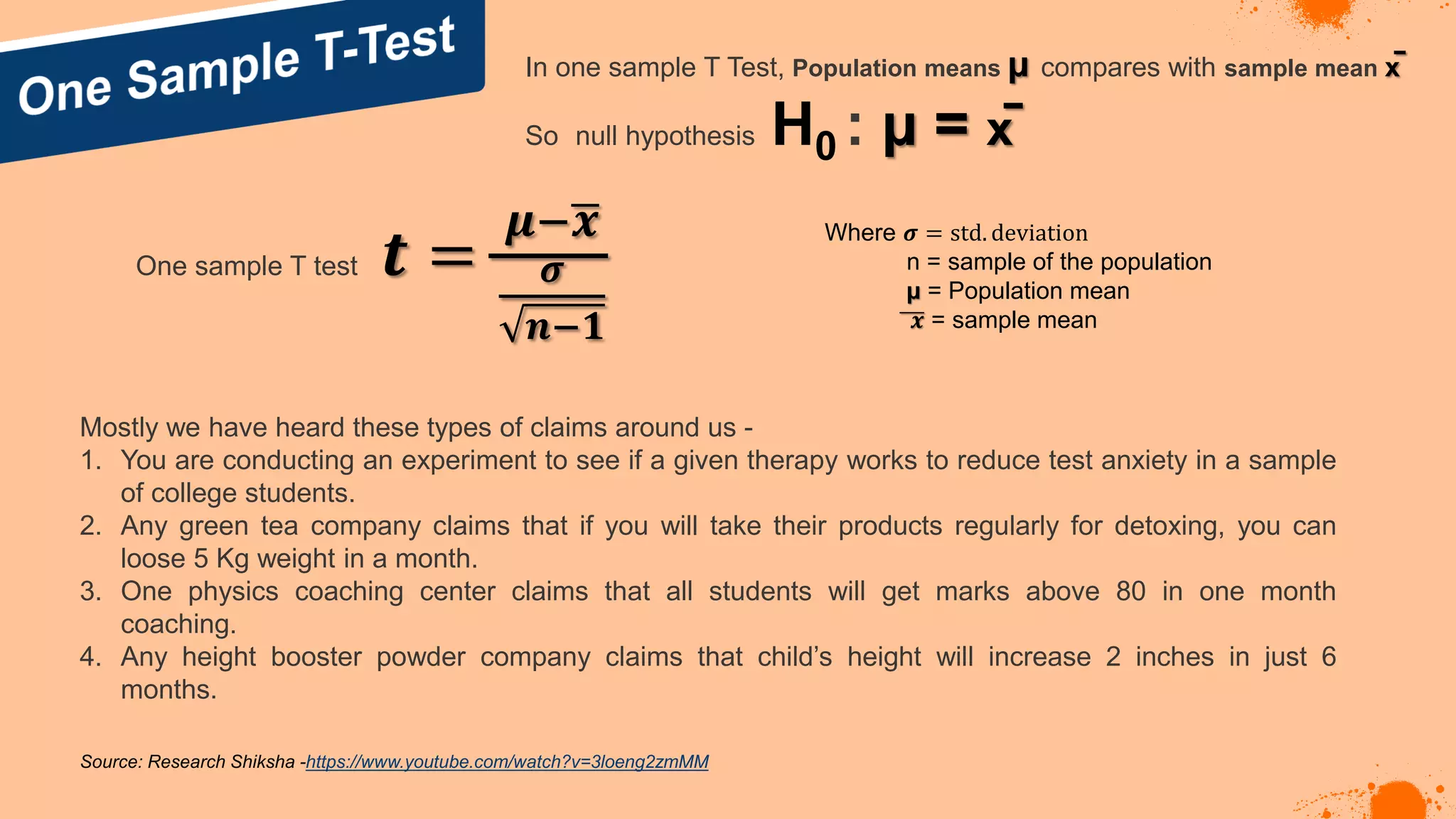
In one sample T Test, Population means µ compares with sample mean x̄
So null hypothesis H0 : µ = x̄
One sample T test 𝒕 =
𝝁−ഥ
𝒙
𝝈
𝒏−𝟏
Where 𝝈 = std. deviation
n = sample of the population
µ = Population mean
𝒙 = sample mean
Source: Research Shiksha -https://www.youtube.com/watch?v=3loeng2zmMM
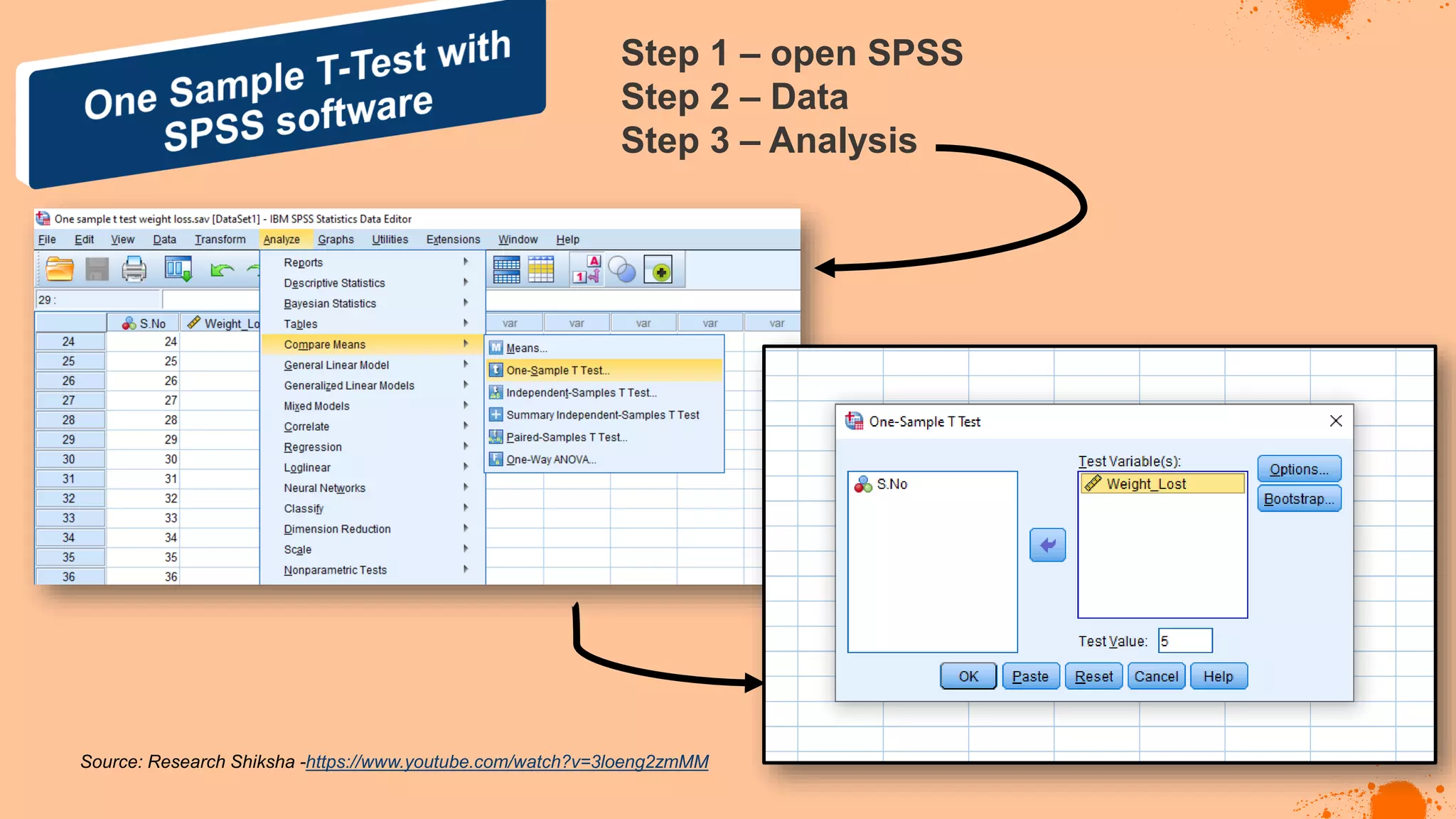
Step 1 – open SPSS
Step 2 – Data
Step 3 – Analysis
Sourse: Research Shiksha -https://www.youtube.com/watch?v=3loeng2zmMM
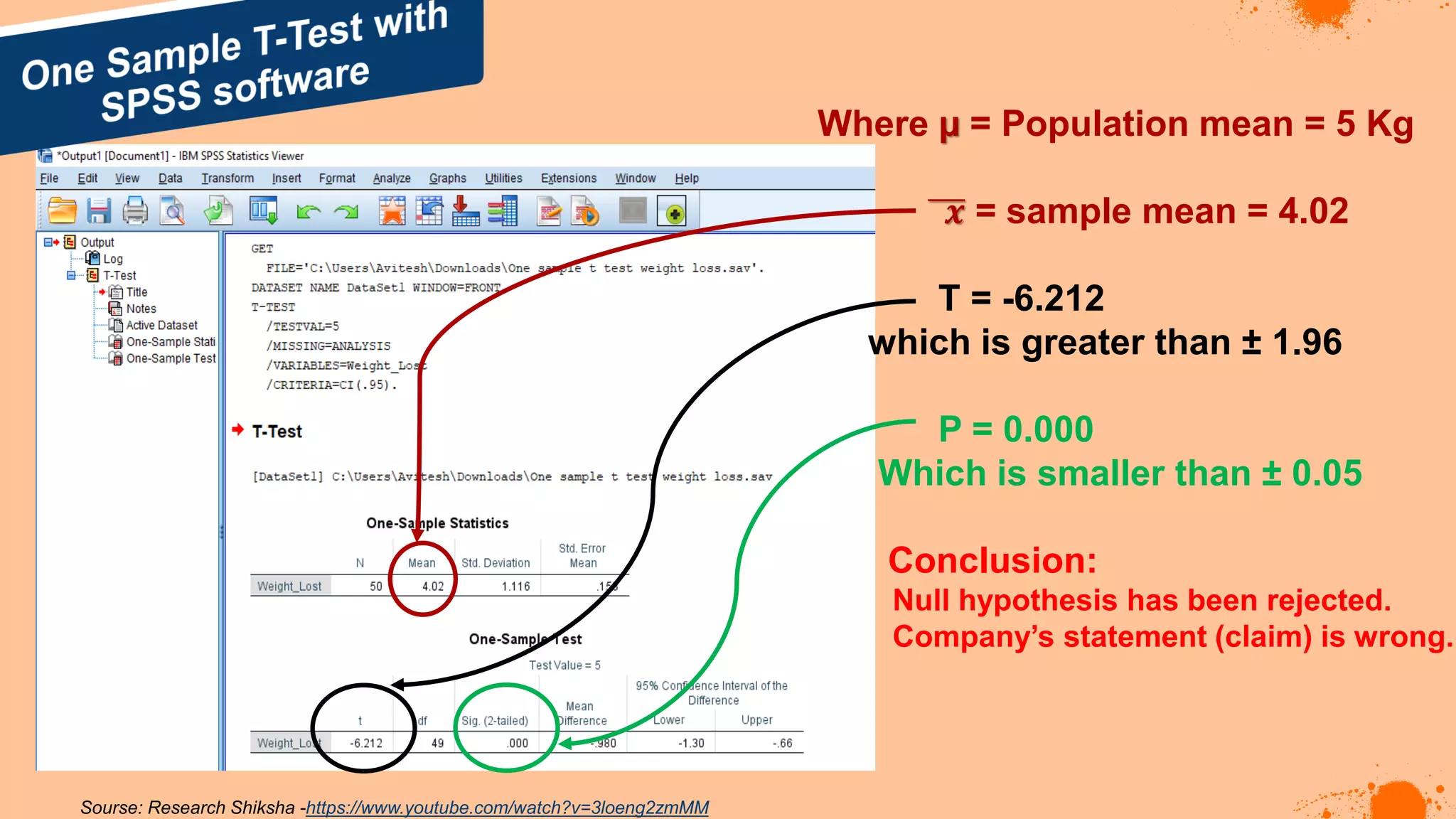
Where µ = Population mean = 5 Kg
𝒙 = sample mean = 4.02
T = -6.212
which is greater than ± 1.96
P = 0.000
Which is smaller than ± 0.05
Conclusion:
Null hypothesis has been rejected.
Company’s statement (claim) is wrong.
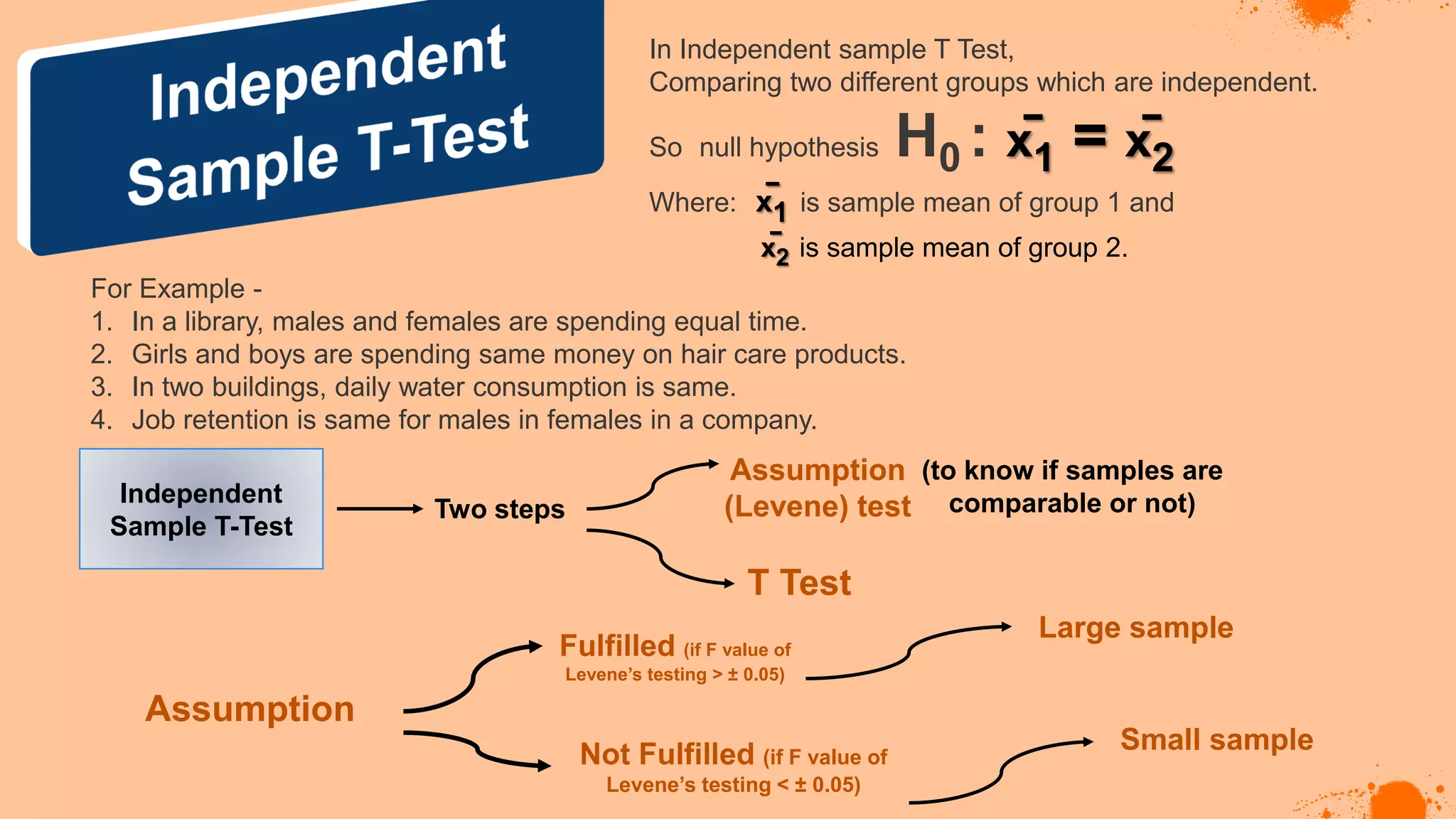
In Independent sample T Test,
Comparing two different groups which are independent.
So null hypothesis H0 : x̄1 = x̄2
Where: x̄1 is sample mean of group 1 and
x̄2 is sample mean of group 2.
For Example -
1. In a library, males and females are spending equal time.
2. Girls and boys are spending same money on hair care products.
3. In two buildings, daily water consumption is same.
4. Job retention is same for males in females in a company.
Two steps
Assumption
(Levene) test
T Test
(to know if samples are
comparable or not)
Independent
Sample T-Test
Assumption
Fulfilled (if F value of
Levene’s testing > ± 0.05)
Not Fulfilled (if F value of
Levene’s testing < ± 0.05)
Large sample
Small sample
Source: Research Shiksha -https://www.youtube.com/watch?v=3loeng2zmMM
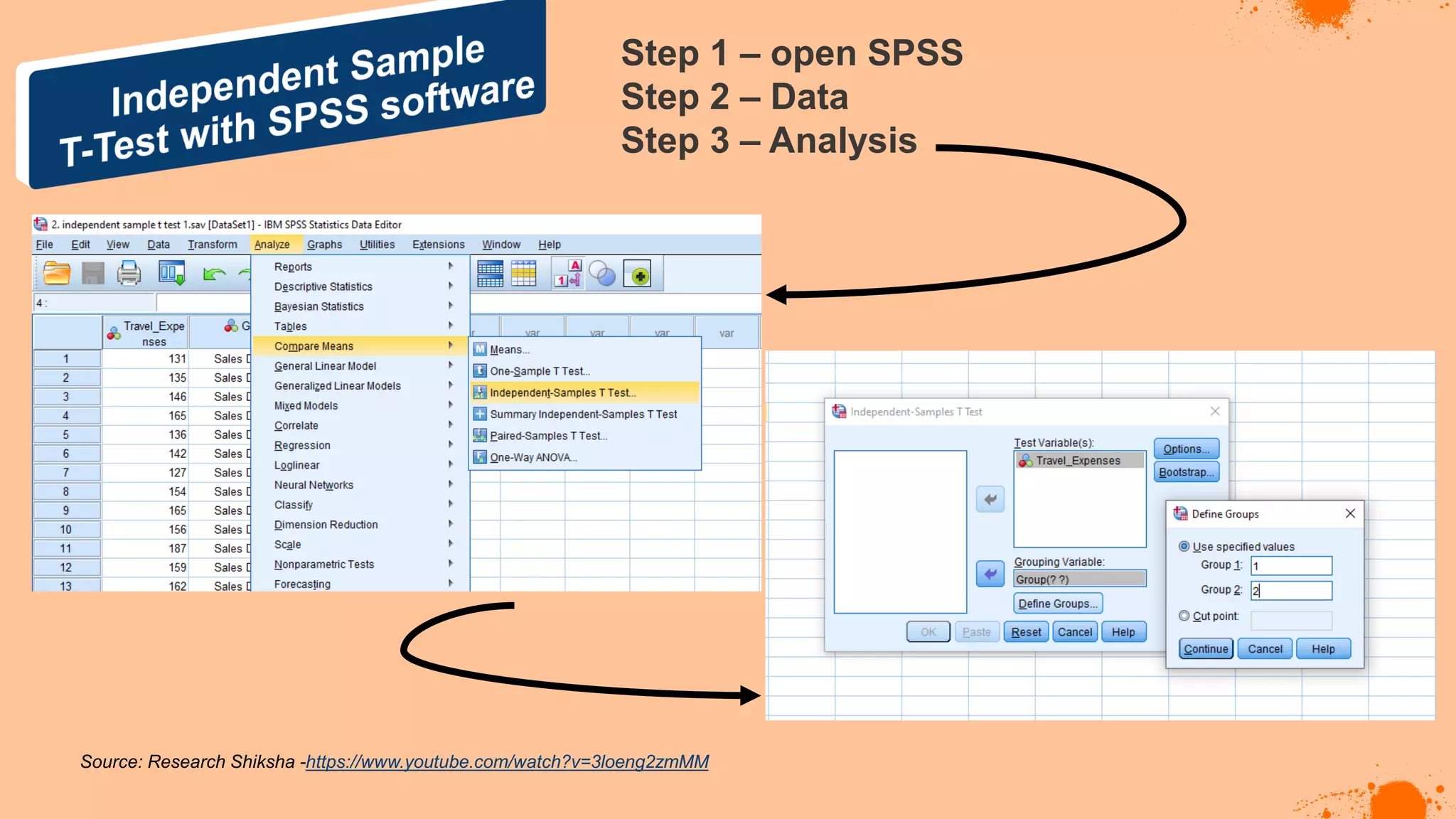
Step 1 – open SPSS
Step 2 – Data
Step 3 – Analysis
Sourse: Research Shiksha -https://www.youtube.com/watch?v=3loeng2zmMM
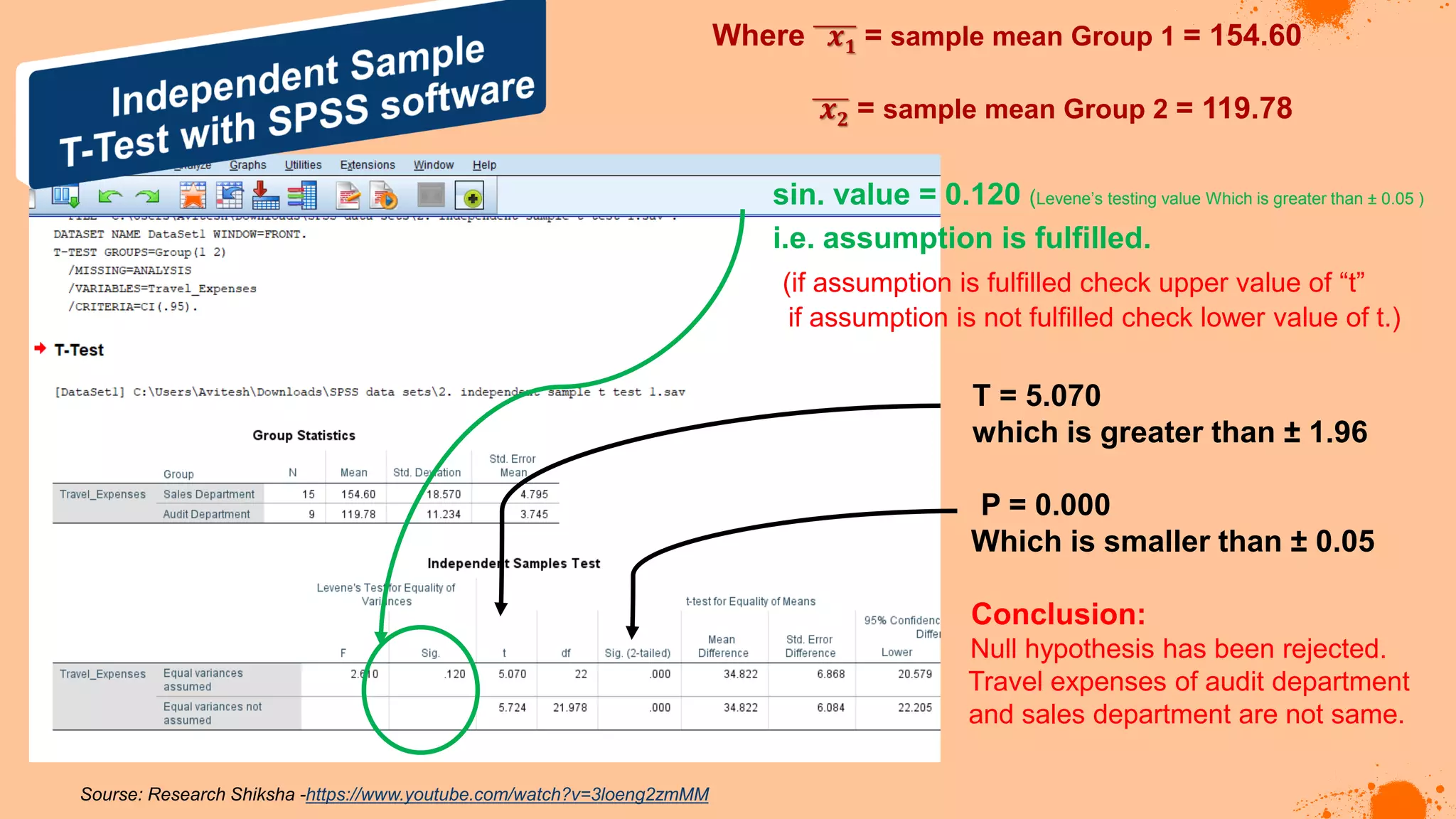
Where 𝒙𝟏 = sample mean Group 1 = 154.60
𝒙𝟐 = sample mean Group 2 = 119.78
sin. value = 0.120 (Levene’s testing value Which is greater than ± 0.05 )
i.e. assumption is fulfilled.
(if assumption is fulfilled check upper value of “t”
if assumption is not fulfilled check lower value of t.)
T = 5.070
which is greater than ± 1.96
P = 0.000
Which is smaller than ± 0.05
Conclusion:
Null hypothesis has been rejected.
Travel expenses of audit department
and sales department are not same.
Sourse: Research Shiksha -https://www.youtube.com/watch?v=3loeng2zmMM
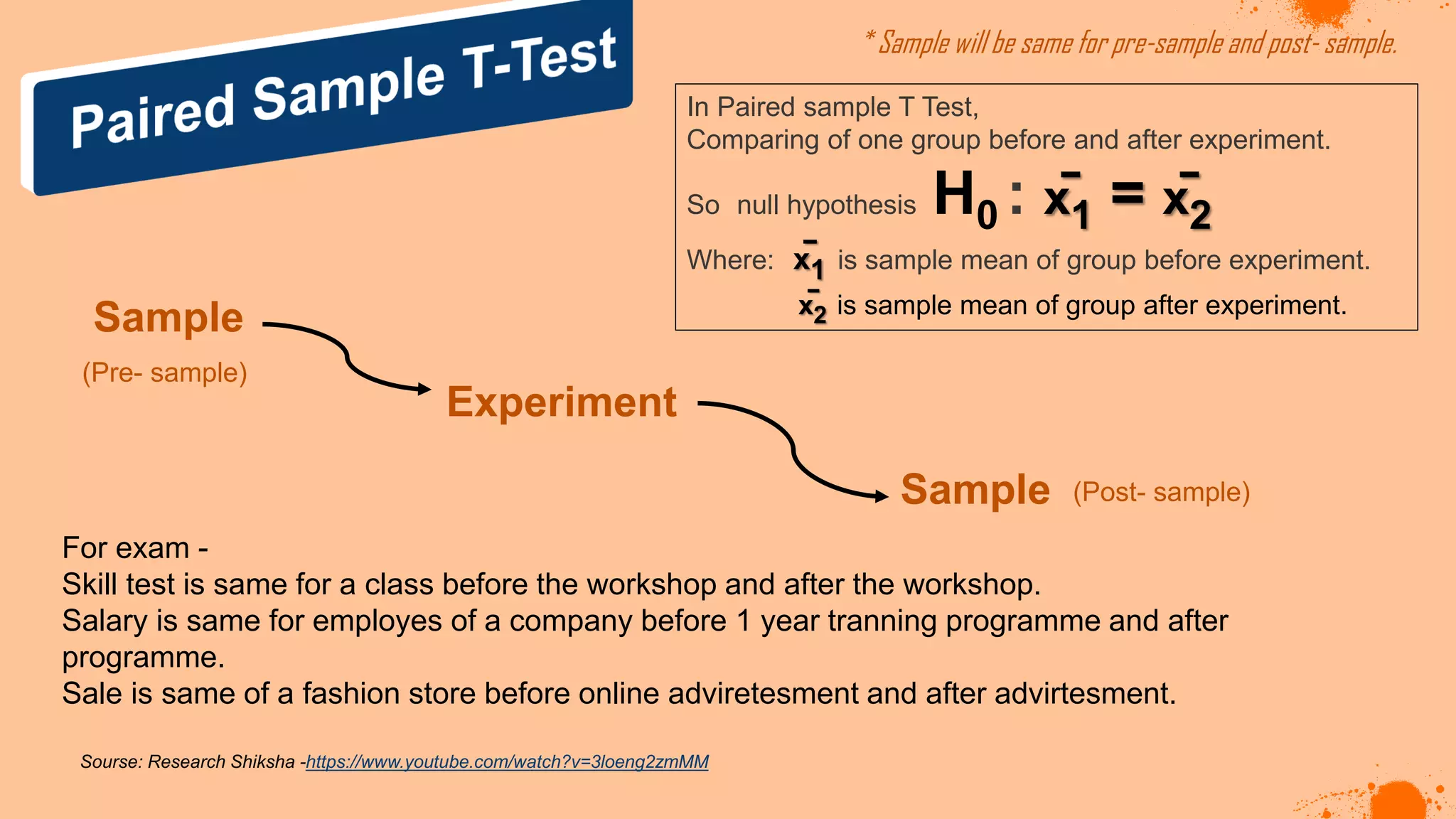
(Post- sample)
* Sample will be same for pre-sample and post- sample.
For exam -
Skill test is same for a class before the workshop and after the workshop.
Salary is same for employes of a company before 1 year tranning programme and after
programme.
Sale is same of a fashion store before online adviretesment and after advirtesment.
In Paired sample T Test,
Comparing of one group before and after experiment.
So null hypothesis H0 : x̄1 = x̄2
Where: x̄1 is sample mean of group before experiment.
x̄2 is sample mean of group after experiment.
Sample
Experiment
Sample
(Pre- sample)
Sourse: Research Shiksha -https://www.youtube.com/watch?v=3loeng2zmMM
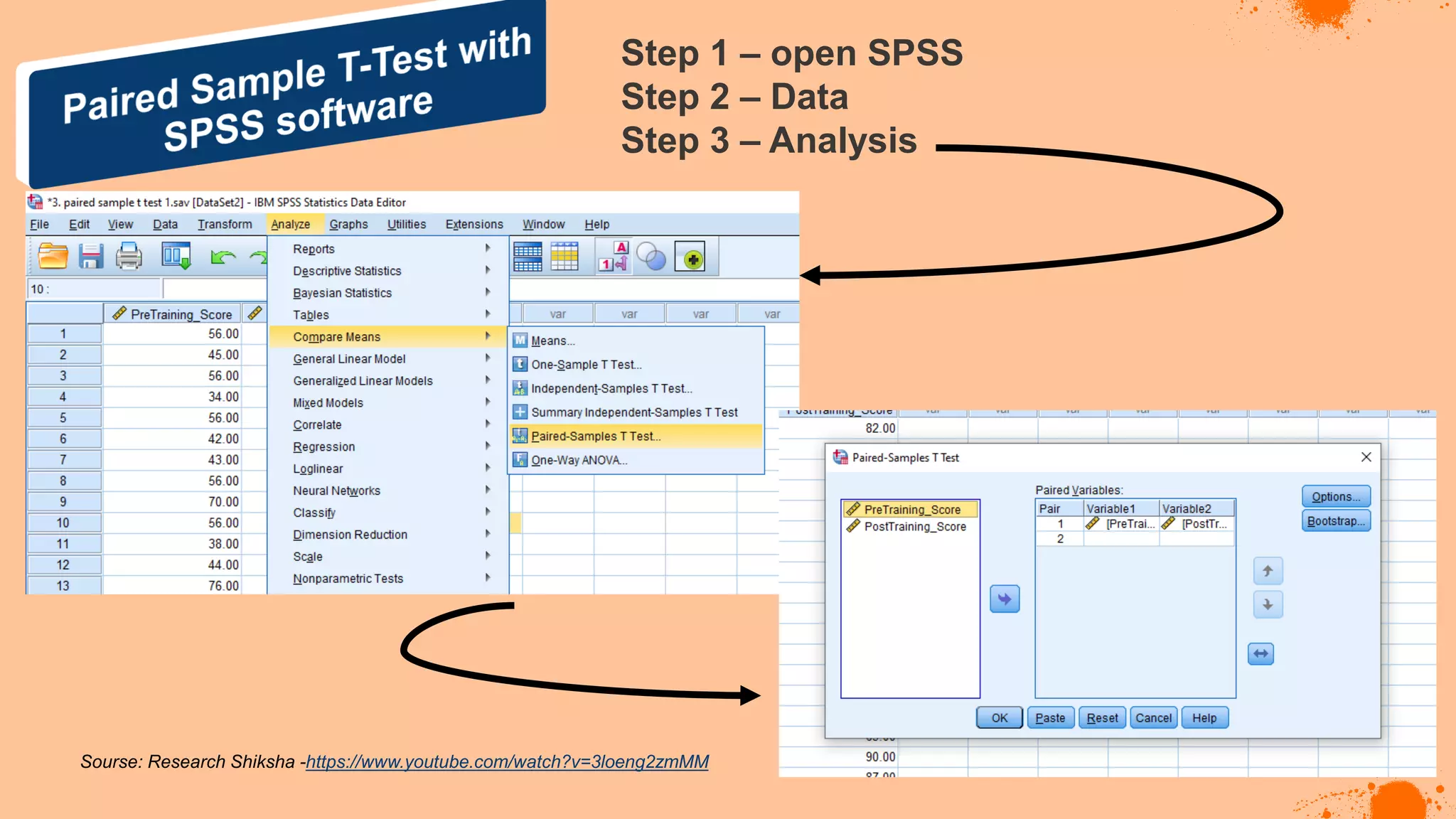
Step 1 – open SPSS
Step 2 – Data
Step 3 – Analysis
Sourse: Research Shiksha -https://www.youtube.com/watch?v=3loeng2zmMM
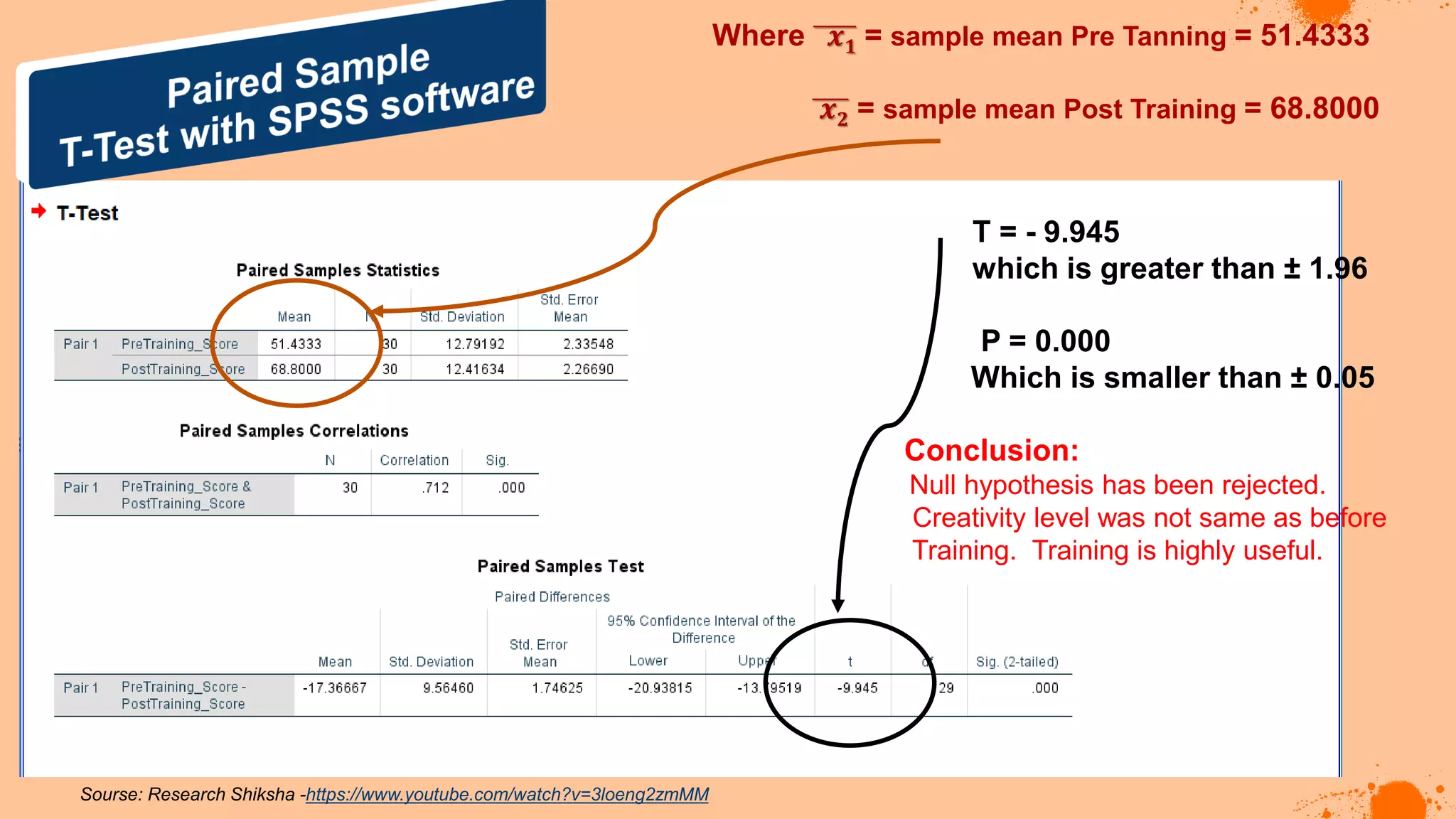
Where 𝒙𝟏 = sample mean Pre Tanning = 51.4333
𝒙𝟐 = sample mean Post Training = 68.8000
T = - 9.945
which is greater than ± 1.96
P = 0.000
Which is smaller than ± 0.05
Conclusion:
Null hypothesis has been rejected.
Creativity level was not same as before
Training. Training is highly useful.
Sourse: Research Shiksha -https://www.youtube.com/watch?v=3loeng2zmMM
* Sample will be same for both analysis.
For exam -
Time of using computer and mobile is same for a month of a student .
Feedback is same for design & construction of one faculty.
Spending hours for Yoga and gym are equal in three months of a model.
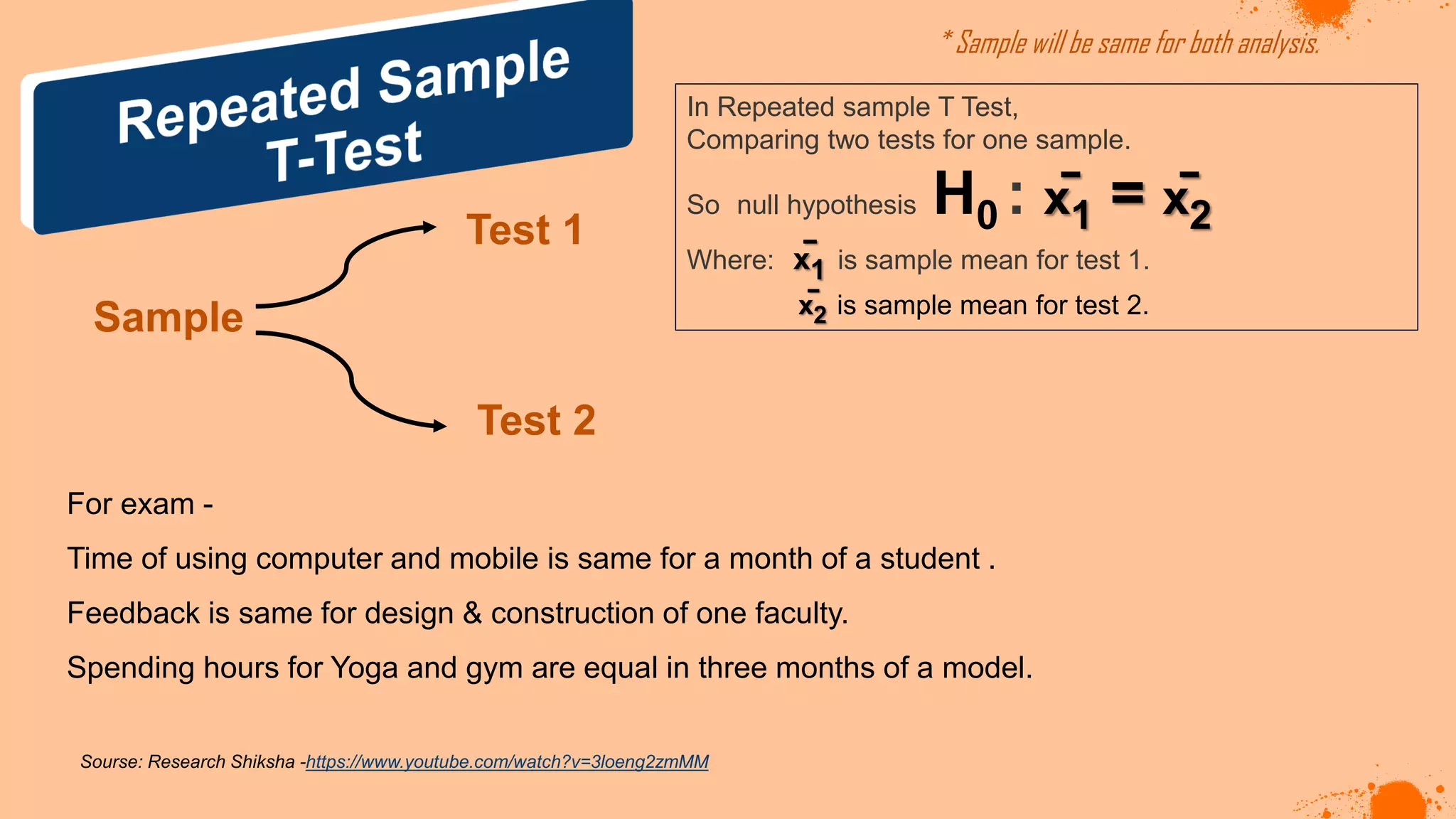
In Repeated sample T Test,
Comparing two tests for one sample.
So null hypothesis H0 : x̄1 = x̄2
Where: x̄1 is sample mean for test 1.
x̄2 is sample mean for test 2.
Sample
Test 1
Test 2
Sourse: Research Shiksha -https://www.youtube.com/watch?v=3loeng2zmMM
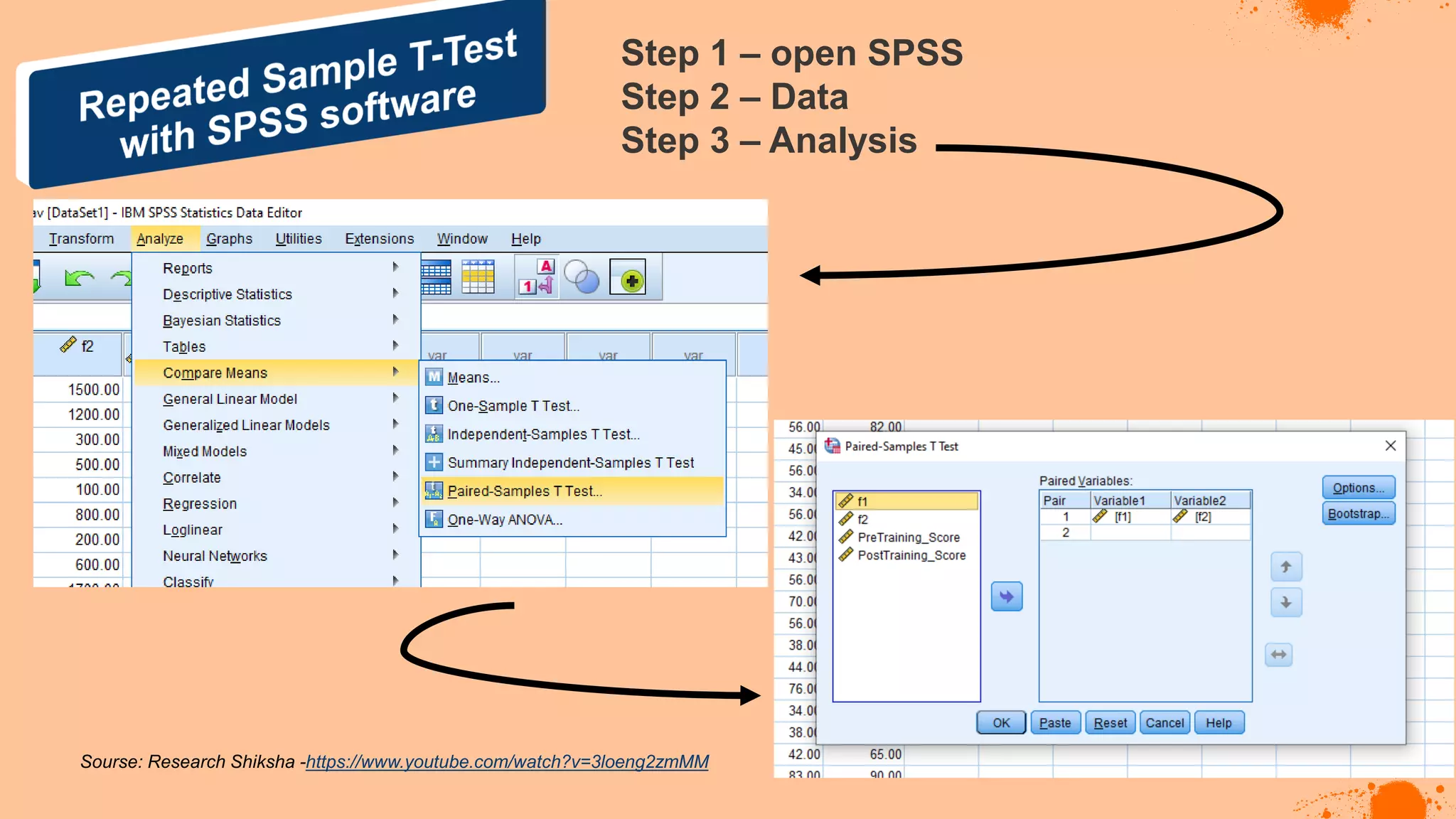
Step 1 – open SPSS
Step 2 – Data
Step 3 – Analysis
Sourse: Research Shiksha -https://www.youtube.com/watch?v=3loeng2zmMM
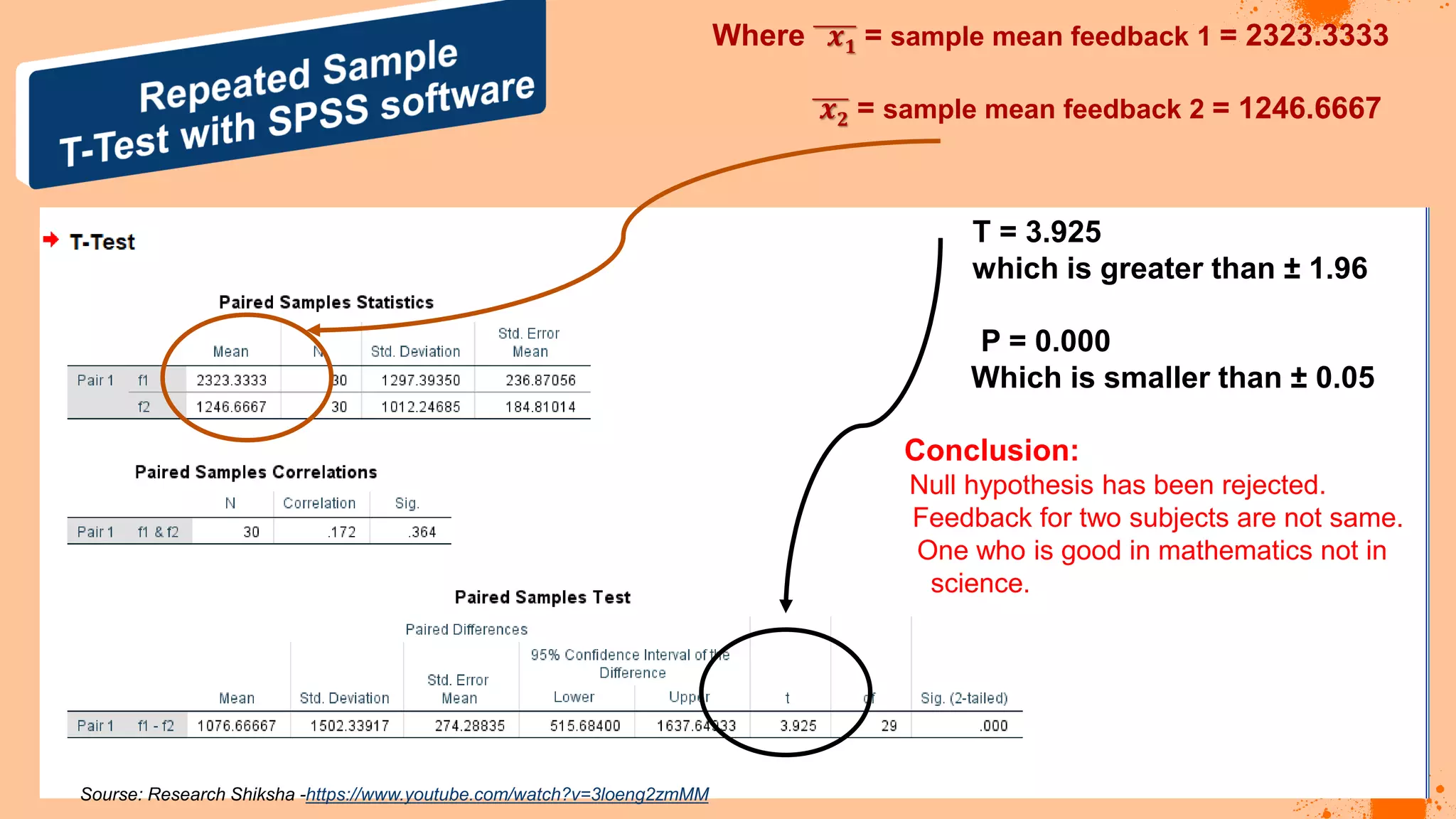
Where 𝒙𝟏 = sample mean feedback 1 = 2323.3333
𝒙𝟐 = sample mean feedback 2 = 1246.6667
T = 3.925
which is greater than ± 1.96
P = 0.000
Which is smaller than ± 0.05
Conclusion:
Null hypothesis has been rejected.
Feedback for two subjects are not same.
One who is good in mathematics not in
science.
References
1. https://www.scribbr.com/
2. Research Shiksha - https://www.youtube.com/watch?v=pDmxhreZZcc&t=626s
3. https://www.youtube.com/watch?v=qyCUl8rsl-A&t=463s
4. https://www.youtube.com/watch?v=3loeng2zmMM&t=553s
5. Hypothesis testing; z test, t-test. f-test - BY NARENDER SHARMA
(https://www.slideshare.net/shakehandwithlife/hypothesis-testing-z-test-ttest-ftest?qid=6f69d0df-08b3-42a7-afff-
08534e2bc866&v=&b=&from_search=11)
6. https://www.investopedia.com/terms/t/t-test.asp
19
Hypothesis testing - T Test

Hypothesis testing - T Test

  • 1.
    Presentation by – ArAvitesh Research Scholar, SAA, Sushant University, Gurugram
  • 2.
    2  Hypothesis (अनुमानम्)is a predictive statement, capable of being tested by scientific methods, that relates an independent variables to some dependent variable.  A hypothesis states what we are looking for and it is a proportion which can be put to a test to determine its validity.  Example - Students who receive counseling will show a greater increase in creativity than students not receiving counseling.  Clear and precise.  Capable of being tested.  Stated relationship between variables.  limited in scope and must be specific.  Stated as far as possible in most simple terms so that the same is easily understand by all concerned. But one must remember that simplicity of hypothesis has nothing to do with its significance.  Consistent with most known facts.  Responsive to testing with in a reasonable time. One can’t spend a life time collecting data to test it.  Explain what it claims to explain; it should have empirical reference.
  • 3.
    3  The Alternativehypothesis is negation of null hypothesis and is denoted by 𝐻𝑎 If Null is given as 𝐻0: 𝜇 = 𝜇0 Then alternative Hypothesis can be written as 𝐻𝑎: 𝜇 ≠ 𝜇0 𝐻𝑎: 𝜇 > 𝜇0 𝐻𝑎: 𝜇 < 𝜇0  It is an assertion that we hold as true unless we have sufficient statistical evidence to conclude otherwise.  Null Hypothesis is denoted by 𝐻0.  If a population mean is equal to hypothesized mean then Null Hypothesis can be written as 𝐻0: 𝜇 = 𝜇0
  • 4.
    State the null(Ho) and alternate (Ha) Hypothesis State a confidence level; 99%, 95%. Decide a test statistics; z-test, T-test, F-test. Calculate the value of test statistics Calculate the p-value at given significance level from the table Compare the p-value with calculated value Accept Ho ± 0.05 > Calculated value Reject Ho ± 0.05 < Calculated value t value > ±1.96, P value < ± 0.05, Null hypothesis will reject.
  • 5.
    Z - test Population- finite Population variance is known Theoretical Sample Size – large T- Test ANOVA Test Population - infinite Population - infinite Not Known Not Known Practical Practical Normal Distribution Normal Distribution Sample Size – Small Sample Size – Small If groups are two. If groups are more than two. A t-test can only be used when comparing the means of two groups (a.k.a. pairwise comparison). If you want to compare more than two groups, or if you want to do multiple pairwise comparisons, use an anova test or a post-hoc test. Sources: Research Shiksha -https://www.youtube.com/watch?v=3loeng2zmMM, https://www.scribbr.com/statistics/t-test/
  • 6.
    T-Test One Sample T-Test Independent Sample T-Test RelatedSample T-Test Paired Sample T-Test Repeated Sample T-Test Source: Research Shiksha -https://www.youtube.com/watch?v=3loeng2zmMM The t-test compares the actual difference between two means in relation to the variation in the data (expressed as the standard deviation of the difference between the means).
  • 7.
    Source: Research Shiksha-https://www.youtube.com/watch?v=3loeng2zmMM Mostly we have heard these types of claims around us - 1. You are conducting an experiment to see if a given therapy works to reduce test anxiety in a sample of college students. 2. Any green tea company claims that if you will take their products regularly for detoxing, you can loose 5 Kg weight in a month. 3. One physics coaching center claims that all students will get marks above 80 in one month coaching. 4. Any height booster powder company claims that child’s height will increase 2 inches in just 6 months. In one sample T Test, Population means µ compares with sample mean x̄ So null hypothesis H0 : µ = x̄ One sample T test 𝒕 = 𝝁−ഥ 𝒙 𝝈 𝒏−𝟏 Where 𝝈 = std. deviation n = sample of the population µ = Population mean 𝒙 = sample mean
  • 8.
    Source: Research Shiksha-https://www.youtube.com/watch?v=3loeng2zmMM Step 1 – open SPSS Step 2 – Data Step 3 – Analysis
  • 9.
    Sourse: Research Shiksha-https://www.youtube.com/watch?v=3loeng2zmMM Where µ = Population mean = 5 Kg 𝒙 = sample mean = 4.02 T = -6.212 which is greater than ± 1.96 P = 0.000 Which is smaller than ± 0.05 Conclusion: Null hypothesis has been rejected. Company’s statement (claim) is wrong.
  • 10.
    In Independent sampleT Test, Comparing two different groups which are independent. So null hypothesis H0 : x̄1 = x̄2 Where: x̄1 is sample mean of group 1 and x̄2 is sample mean of group 2. For Example - 1. In a library, males and females are spending equal time. 2. Girls and boys are spending same money on hair care products. 3. In two buildings, daily water consumption is same. 4. Job retention is same for males in females in a company. Two steps Assumption (Levene) test T Test (to know if samples are comparable or not) Independent Sample T-Test Assumption Fulfilled (if F value of Levene’s testing > ± 0.05) Not Fulfilled (if F value of Levene’s testing < ± 0.05) Large sample Small sample
  • 11.
    Source: Research Shiksha-https://www.youtube.com/watch?v=3loeng2zmMM Step 1 – open SPSS Step 2 – Data Step 3 – Analysis
  • 12.
    Sourse: Research Shiksha-https://www.youtube.com/watch?v=3loeng2zmMM Where 𝒙𝟏 = sample mean Group 1 = 154.60 𝒙𝟐 = sample mean Group 2 = 119.78 sin. value = 0.120 (Levene’s testing value Which is greater than ± 0.05 ) i.e. assumption is fulfilled. (if assumption is fulfilled check upper value of “t” if assumption is not fulfilled check lower value of t.) T = 5.070 which is greater than ± 1.96 P = 0.000 Which is smaller than ± 0.05 Conclusion: Null hypothesis has been rejected. Travel expenses of audit department and sales department are not same.
  • 13.
    Sourse: Research Shiksha-https://www.youtube.com/watch?v=3loeng2zmMM (Post- sample) * Sample will be same for pre-sample and post- sample. For exam - Skill test is same for a class before the workshop and after the workshop. Salary is same for employes of a company before 1 year tranning programme and after programme. Sale is same of a fashion store before online adviretesment and after advirtesment. In Paired sample T Test, Comparing of one group before and after experiment. So null hypothesis H0 : x̄1 = x̄2 Where: x̄1 is sample mean of group before experiment. x̄2 is sample mean of group after experiment. Sample Experiment Sample (Pre- sample)
  • 14.
    Sourse: Research Shiksha-https://www.youtube.com/watch?v=3loeng2zmMM Step 1 – open SPSS Step 2 – Data Step 3 – Analysis
  • 15.
    Sourse: Research Shiksha-https://www.youtube.com/watch?v=3loeng2zmMM Where 𝒙𝟏 = sample mean Pre Tanning = 51.4333 𝒙𝟐 = sample mean Post Training = 68.8000 T = - 9.945 which is greater than ± 1.96 P = 0.000 Which is smaller than ± 0.05 Conclusion: Null hypothesis has been rejected. Creativity level was not same as before Training. Training is highly useful.
  • 16.
    Sourse: Research Shiksha-https://www.youtube.com/watch?v=3loeng2zmMM * Sample will be same for both analysis. For exam - Time of using computer and mobile is same for a month of a student . Feedback is same for design & construction of one faculty. Spending hours for Yoga and gym are equal in three months of a model. In Repeated sample T Test, Comparing two tests for one sample. So null hypothesis H0 : x̄1 = x̄2 Where: x̄1 is sample mean for test 1. x̄2 is sample mean for test 2. Sample Test 1 Test 2
  • 17.
    Sourse: Research Shiksha-https://www.youtube.com/watch?v=3loeng2zmMM Step 1 – open SPSS Step 2 – Data Step 3 – Analysis
  • 18.
    Sourse: Research Shiksha-https://www.youtube.com/watch?v=3loeng2zmMM Where 𝒙𝟏 = sample mean feedback 1 = 2323.3333 𝒙𝟐 = sample mean feedback 2 = 1246.6667 T = 3.925 which is greater than ± 1.96 P = 0.000 Which is smaller than ± 0.05 Conclusion: Null hypothesis has been rejected. Feedback for two subjects are not same. One who is good in mathematics not in science.
  • 19.
    References 1. https://www.scribbr.com/ 2. ResearchShiksha - https://www.youtube.com/watch?v=pDmxhreZZcc&t=626s 3. https://www.youtube.com/watch?v=qyCUl8rsl-A&t=463s 4. https://www.youtube.com/watch?v=3loeng2zmMM&t=553s 5. Hypothesis testing; z test, t-test. f-test - BY NARENDER SHARMA (https://www.slideshare.net/shakehandwithlife/hypothesis-testing-z-test-ttest-ftest?qid=6f69d0df-08b3-42a7-afff- 08534e2bc866&v=&b=&from_search=11) 6. https://www.investopedia.com/terms/t/t-test.asp 19