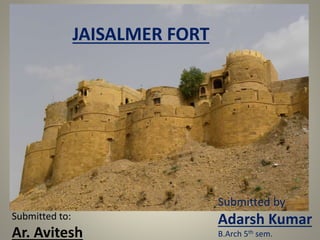
JAISALMER FORT
Submitted by
Adarsh Kumar
B.Arch 5th sem.
Submitted to:
Ar. Avitesh
LOCATION : The city is situated in the midst
of the Great Indian Desert on the western
frontier of India.
Jaisalmer is almost entirely a sandy waste,
forming a part of the Thar desert (great Indian
desert). Those in the west are covered with log
bushes, those in the east with tufts of long
grass. The climate is dry and health
CLIMATE : The region experiences an arid
climate through the year.
The temperature remains low during the
winter season while summers are
characterized by cold and dry Jaisalmer
weather.
Hot winds blow during summer and sand
storms are also seen.
The absorbed radiation are dissipated to
atmosphere at night. Mud hut of Rajasthan.
Its massive yellow sandstone walls are a
tawny lion colour during the day, fading to
honey-gold as the sun sets, thereby
camouflaging the fort in the yellow desert.
For this reason, it is also known as the Sonar
Quila or Golden Fort.
Jaisalmer Fort situated in the city of Jaisalmer,
in the Indian state ofRajasthan. It is a World
Heritage Site. It was built in 1156 AD by
the Rajput ruler Rawal Jaisal, from whom it
derives its name. The fort stands amidst the
sandy expanse of the great Thar Desert,
on Trikuta Hill, and has been the scene of
many battles.
The fort is located in the very heart of the city, and is one of
the most notable monuments in the locality.
The fort is 1,500 ft (460 m) long
750 ft (230 m) wide
.
It is built on a hill that raises
above a height of 250 ft (76 m) above the surrounding
country side
•Raj Mahal (Royal palace)
•Laxminath temple 4 massive gateways Merchant Havelis
The fort has an ingenious drainage system called the ghut nali which allows for the easy
drainage of rainwater away from the fort in all four directions of the fort. Over the years,
haphazard construction activities and building of new roads has greatly reduced its
effectiveness
The basement of the fort has
a 15 ft (4.6 m) tall wall
forming a double line of
defence. Used for exibitions
Desert Festival of Jaisalmer is the
most awaited and famous cultural
and colorful events that dominates
the sand of Rajasthan and Camel
races, turban tying competitions are
organized. It is held in the month of
February every year in Rajasthan.
The desert festival in Jaisalmer is
showcase Rajasthani folk songs and
dance so it is very attracted festival
for foreign tourists. The rich culture
of the region is on display during
this three day long festival. This is
the best time to visit Jaisalmer to
witness performing arts like Kalbelia
dances and folk songs and music.
The natural cooling systems used
at Jaisalmer include:
1. Dense clustering of buildings.
2. Sun control through orientation and
structural projections.
3. Cooling of sunlit surfaces by use of fins.
4. Massive construction for roofs and walls.
5. Courtyards and other air ducts for
ventilation.
This cluster is yet to be
developed to utilise its full
potential.
In general the sandstones of
Rajasthan are fine grained,
compact and can be easily
dressed, chiselled and take good
polish
Jaisalmer Fort showing the
three different sand stone
walls and the bastion houses
along the periphery
The Gadisar Lake in the city of Jaisalmer is one
of the primary tourist attractions of the region,
originally conceived as a water conservation
tank to fulfil the water requirements of this
acrid city,
The advantage of a jali is that it
blocks the direct rays of the sun and
yet permits air to enter the room and
is designed to grant privacy. The
advantage of a jali is that it blocks
the direct rays of the sun and yet
permits air to enter the room and is
designed to grant privacy.

Jaisalmer fort - Rajasthan

  • 1.
    JAISALMER FORT Submitted by AdarshKumar B.Arch 5th sem. Submitted to: Ar. Avitesh
  • 2.
    LOCATION : Thecity is situated in the midst of the Great Indian Desert on the western frontier of India. Jaisalmer is almost entirely a sandy waste, forming a part of the Thar desert (great Indian desert). Those in the west are covered with log bushes, those in the east with tufts of long grass. The climate is dry and health CLIMATE : The region experiences an arid climate through the year. The temperature remains low during the winter season while summers are characterized by cold and dry Jaisalmer weather. Hot winds blow during summer and sand storms are also seen. The absorbed radiation are dissipated to atmosphere at night. Mud hut of Rajasthan.
  • 3.
    Its massive yellowsandstone walls are a tawny lion colour during the day, fading to honey-gold as the sun sets, thereby camouflaging the fort in the yellow desert. For this reason, it is also known as the Sonar Quila or Golden Fort. Jaisalmer Fort situated in the city of Jaisalmer, in the Indian state ofRajasthan. It is a World Heritage Site. It was built in 1156 AD by the Rajput ruler Rawal Jaisal, from whom it derives its name. The fort stands amidst the sandy expanse of the great Thar Desert, on Trikuta Hill, and has been the scene of many battles.
  • 4.
    The fort islocated in the very heart of the city, and is one of the most notable monuments in the locality.
  • 5.
    The fort is1,500 ft (460 m) long 750 ft (230 m) wide . It is built on a hill that raises above a height of 250 ft (76 m) above the surrounding country side
  • 8.
    •Raj Mahal (Royalpalace) •Laxminath temple 4 massive gateways Merchant Havelis
  • 9.
    The fort hasan ingenious drainage system called the ghut nali which allows for the easy drainage of rainwater away from the fort in all four directions of the fort. Over the years, haphazard construction activities and building of new roads has greatly reduced its effectiveness
  • 10.
    The basement ofthe fort has a 15 ft (4.6 m) tall wall forming a double line of defence. Used for exibitions
  • 11.
    Desert Festival ofJaisalmer is the most awaited and famous cultural and colorful events that dominates the sand of Rajasthan and Camel races, turban tying competitions are organized. It is held in the month of February every year in Rajasthan. The desert festival in Jaisalmer is showcase Rajasthani folk songs and dance so it is very attracted festival for foreign tourists. The rich culture of the region is on display during this three day long festival. This is the best time to visit Jaisalmer to witness performing arts like Kalbelia dances and folk songs and music.
  • 12.
    The natural coolingsystems used at Jaisalmer include: 1. Dense clustering of buildings. 2. Sun control through orientation and structural projections. 3. Cooling of sunlit surfaces by use of fins. 4. Massive construction for roofs and walls. 5. Courtyards and other air ducts for ventilation.
  • 13.
    This cluster isyet to be developed to utilise its full potential. In general the sandstones of Rajasthan are fine grained, compact and can be easily dressed, chiselled and take good polish Jaisalmer Fort showing the three different sand stone walls and the bastion houses along the periphery
  • 14.
    The Gadisar Lakein the city of Jaisalmer is one of the primary tourist attractions of the region, originally conceived as a water conservation tank to fulfil the water requirements of this acrid city,
  • 15.
    The advantage ofa jali is that it blocks the direct rays of the sun and yet permits air to enter the room and is designed to grant privacy. The advantage of a jali is that it blocks the direct rays of the sun and yet permits air to enter the room and is designed to grant privacy.