COUNTOURINGin
Survey & Levelling
PRESENTATION BY: -ANANYA SADHU -
-PRAKHAR RASTOGI
-SANJANA SINGH
-ADIT GUPTA
(B.Arch 1st year)
Submitted to:
Ar. Avitesh
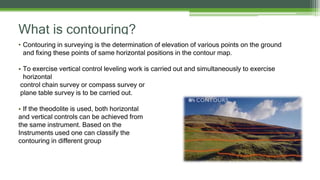
What is contouring?
• Contouring in surveying is the determination of elevation of various points on the ground
and fixing these points of same horizontal positions in the contour map.
• To exercise vertical control leveling work is carried out and simultaneously to exercise
horizontal
control chain survey or compass survey or
plane table survey is to be carried out.
• If the theodolite is used, both horizontal
and vertical controls can be achieved from
the same instrument. Based on the
Instruments used one can classify the
contouring in different group
CONTOUR LINE
• An imaginary line passing through
points of equal reduced level.
• The elevation difference between
the adjacent contours is called
the contour interval.
CONTOUR INTERVAL
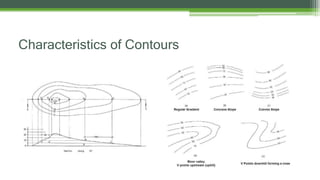
Characteristics of Contours
Contours are Continuous
• Some contour lines may close within the map,
but others will not. In this case, they will
start at a boundary line and end at a boundary line.
• Contours must either close or extend
from boundary to boundary.
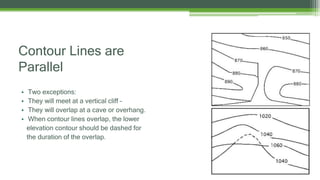
Contour Lines are
Parallel
• Two exceptions:
• They will meet at a vertical cliff –
• They will overlap at a cave or overhang.
• When contour lines overlap, the lower
elevation contour should be dashed for
the duration of the overlap.
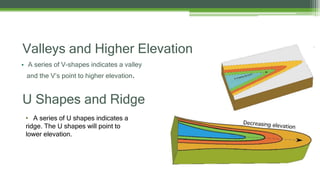
U Shapes and Ridge
• A series of V-shapes indicates a valley
and the V’s point to higher elevation.
Valleys and Higher Elevation
• A series of U shapes indicates a
ridge. The U shapes will point to
lower elevation.
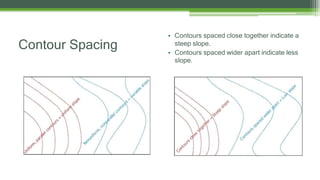
Contour Spacing
• Contours spaced close together indicate a
steep slope.
• Contours spaced wider apart indicate less
slope.
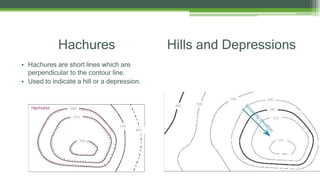
Hachures Hills and Depressions
• Hachures are short lines which are
perpendicular to the contour line.
• Used to indicate a hill or a depression.
Data Acquisition
• When collecting topo data there are two important issues:
 Ensuring sufficient data is collected to define the object.
 Ensuring two types of information is gathered for each station:
 Location
 Elevation
METHODS OF CONTOURING
DIRECT METHOD
• Most accurate but slow and tedious.
• Expensive
• Not suitable for hilly area
• During the work calculation can be done
• Calculation cannot be checked after
contouring
INDIRECT METHOD
• Not so accurate but rapid and less tedious
• Cheaper
• Suitable for hilly areas
• Calculations are not required in field
• Calculations can be checked as and when
required
Contouring in "Survey & Levelling".

Contouring in "Survey & Levelling".

  • 1.
    COUNTOURINGin Survey & Levelling PRESENTATIONBY: -ANANYA SADHU - -PRAKHAR RASTOGI -SANJANA SINGH -ADIT GUPTA (B.Arch 1st year) Submitted to: Ar. Avitesh
  • 2.
    What is contouring? •Contouring in surveying is the determination of elevation of various points on the ground and fixing these points of same horizontal positions in the contour map. • To exercise vertical control leveling work is carried out and simultaneously to exercise horizontal control chain survey or compass survey or plane table survey is to be carried out. • If the theodolite is used, both horizontal and vertical controls can be achieved from the same instrument. Based on the Instruments used one can classify the contouring in different group
  • 3.
    CONTOUR LINE • Animaginary line passing through points of equal reduced level. • The elevation difference between the adjacent contours is called the contour interval. CONTOUR INTERVAL
  • 4.
  • 5.
    Contours are Continuous •Some contour lines may close within the map, but others will not. In this case, they will start at a boundary line and end at a boundary line. • Contours must either close or extend from boundary to boundary.
  • 6.
    Contour Lines are Parallel •Two exceptions: • They will meet at a vertical cliff – • They will overlap at a cave or overhang. • When contour lines overlap, the lower elevation contour should be dashed for the duration of the overlap.
  • 7.
    U Shapes andRidge • A series of V-shapes indicates a valley and the V’s point to higher elevation. Valleys and Higher Elevation • A series of U shapes indicates a ridge. The U shapes will point to lower elevation.
  • 8.
    Contour Spacing • Contoursspaced close together indicate a steep slope. • Contours spaced wider apart indicate less slope.
  • 9.
    Hachures Hills andDepressions • Hachures are short lines which are perpendicular to the contour line. • Used to indicate a hill or a depression.
  • 10.
    Data Acquisition • Whencollecting topo data there are two important issues:  Ensuring sufficient data is collected to define the object.  Ensuring two types of information is gathered for each station:  Location  Elevation
  • 11.
    METHODS OF CONTOURING DIRECTMETHOD • Most accurate but slow and tedious. • Expensive • Not suitable for hilly area • During the work calculation can be done • Calculation cannot be checked after contouring INDIRECT METHOD • Not so accurate but rapid and less tedious • Cheaper • Suitable for hilly areas • Calculations are not required in field • Calculations can be checked as and when required

Editor's Notes

  • #3 How presentation will benefit audience: Adult learners are more interested in a subject if they know how or why it is important to them. Presenter’s level of expertise in the subject: Briefly state your credentials in this area, or explain why participants should listen to you.
  • #4 Lesson descriptions should be brief.