Hypothesis
Dr.Viral Bharat Bhai Jadav
Associate Professor
IITE,Gandhinagar
Hypothesis is a suggested
answer to the problem under
investigation
JOHN T. TOWNSEND
A hypothesis is a tentative
generalization, the validity of
which remains to be tested
JOHN W. BEST
A hypothesis is a proposition which can
be put to test to determine its validity. It
may be proved correct or incorrect
GOOD AND HATT
A hypothesis is a conjectural
statement of the relation
between two or more variables
F. N. KERLINGER
A
B
C
D
DEFINITIONS OF HYPOTHESIS
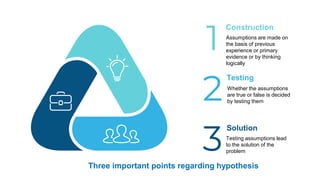
Assumptions are made on
the basis of previous
experience or primary
evidence or by thinking
logically
Construction
Testing
Solution
Whether the assumptions
are true or false is decided
by testing them
Testing assumptions lead
to the solution of the
problem
Three important points regarding hypothesis
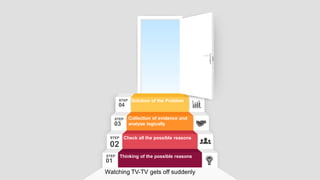
01
STEP
02
STEP
03
STEP
04
STEP Solution of the Problem
Collection of evidence and
analyse logically
Check all the possible reasons
Thinking of the possible reasons
Watching TV-TV gets off suddenly
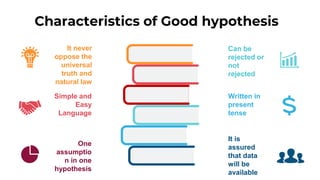
It is
assured
that data
will be
available
Written in
present
tense
Can be
rejected or
not
rejected
One
assumptio
n in one
hypothesis
Simple and
Easy
Language
It never
oppose the
universal
truth and
natural law
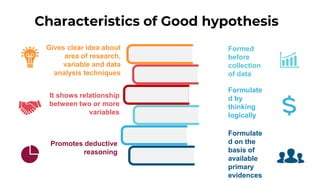
Formulate
d on the
basis of
available
primary
evidences
Formulate
d by
thinking
logically
Formed
before
collection
of data
Promotes deductive
reasoning
It shows relationship
between two or more
variables
Gives clear idea about
area of research,
variable and data
analysis techniques
CULTURE
BELIEFS
PREVALING IN
THE FIELD
PRE-
EXPERIENCE
RELATED
LITERATURE
RESERCH
REVIEW
INTELLECTUAL
DISCUSSION
CREATIVE
THINKING
INSIGHT OF THE
RESEARCHER
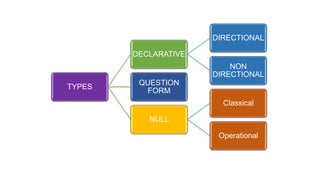
TYPES
DECLARATIVE
DIRECTIONAL
NON
DIRECTIONAL
QUESTION
FORM
NULL
Classical
Operational
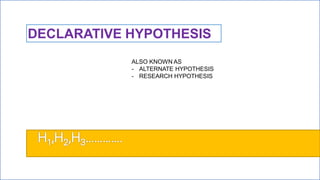
DECLARATIVE HYPOTHESIS
ALSO KNOWN AS
- ALTERNATE HYPOTHESIS
- RESEARCH HYPOTHESIS
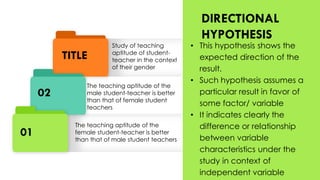
01
02
TITLE
Study of teaching
aptitude of student-
teacher in the context
of their gender
The teaching aptitude of the
male student-teacher is better
than that of female student
teachers
The teaching aptitude of the
female student-teacher is better
than that of male student teachers
DIRECTIONAL
HYPOTHESIS
• This hypothesis shows the
expected direction of the
result.
• Such hypothesis assumes a
particular result in favor of
some factor/ variable
• It indicates clearly the
difference or relationship
between variable
characteristics under the
study in context of
independent variable
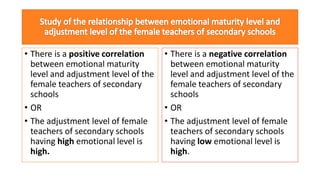
• There is a positive correlation
between emotional maturity
level and adjustment level of the
female teachers of secondary
schools
• OR
• The adjustment level of female
teachers of secondary schools
having high emotional level is
high.
• There is a negative correlation
between emotional maturity
level and adjustment level of the
female teachers of secondary
schools
• OR
• The adjustment level of female
teachers of secondary schools
having low emotional level is
high.
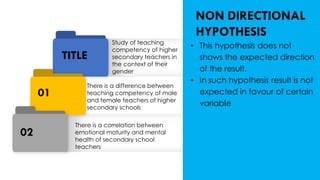
02
01
TITLE
Study of teaching
competency of higher
secondary teachers in
the context of their
gender
There is a difference between
teaching competency of male
and female teachers of higher
secondary schools
There is a correlation between
emotional maturity and mental
health of secondary school
teachers
NON DIRECTIONAL
HYPOTHESIS
• This hypothesis does not
shows the expected direction
of the result.
• In such hypothesis result is not
expected in favour of certain
variable
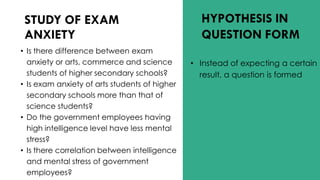
HYPOTHESIS IN
QUESTION FORM
• Instead of expecting a certain
result, a question is formed
STUDY OF EXAM
ANXIETY
• Is there difference between exam
anxiety or arts, commerce and science
students of higher secondary schools?
• Is exam anxiety of arts students of higher
secondary schools more than that of
science students?
• Do the government employees having
high intelligence level have less mental
stress?
• Is there correlation between intelligence
and mental stress of government
employees?
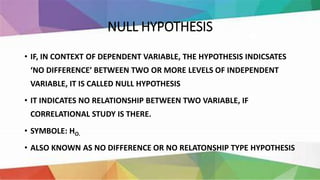
NULL HYPOTHESIS
• IF, IN CONTEXT OF DEPENDENT VARIABLE, THE HYPOTHESIS INDICSATES
‘NO DIFFERENCE’ BETWEEN TWO OR MORE LEVELS OF INDEPENDENT
VARIABLE, IT IS CALLED NULL HYPOTHESIS
• IT INDICATES NO RELATIONSHIP BETWEEN TWO VARIABLE, IF
CORRELATIONAL STUDY IS THERE.
• SYMBOLE: HO.
• ALSO KNOWN AS NO DIFFERENCE OR NO RELATONSHIP TYPE HYPOTHESIS
STUDY OF THE IMPACT OF THE INSTRUCTIONAL METHOD
ON ACHIEVEMENT OF THE STUDENTS OF GRADE 9 IN
ENGLISH
• There is no significant effect of instructional method o the
achievement of the students of grade 9 in English
• There is no significant difference between achievement of the
students in English, who have learned through CAI and PLM
• There is no significant effect of the instructional method on the mean
achievement score of the students of grade 9 in English
• There is no significant relationship between the mental health and
reasoning ability of the students of secondary schools
• There is no significant correlation between the scores of the students
of secondary schools in mental health scale and reasoning ability test
• If measurement is not mentioned in the null hypothesis, it is called
classical hypothesis
• Eg.
• There is no significant difference between the achievement of the
students of grade 9 in English, who have learnt through PIM and CAI
• There is no significant relationship between mental health and
reasoning ability of the students of primary schools.
Operational hypothesis
• When measurement of the variable characteristics is indicated in null
hypothesis, it is called operational hypothesis
• Eg.
• There is no significant difference between the mean scores of the
students of grade nine in achievement test in English who have learnt
through PIM and CAI
• There is no significant correlation between the scores of the students
of secondary schools in reasoning ability test and mental health scale.
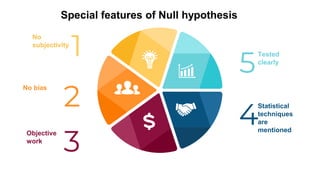
Tested
clearly
Statistical
techniques
are
mentioned
Objective
work
No bias
No
subjectivity
Special features of Null hypothesis
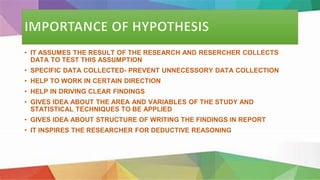
• IT ASSUMES THE RESULT OF THE RESEARCH AND RESERCHER COLLECTS
DATA TO TEST THIS ASSUMPTION
• SPECIFIC DATA COLLECTED- PREVENT UNNECESSORY DATA COLLECTION
• HELP TO WORK IN CERTAIN DIRECTION
• HELP IN DRIVING CLEAR FINDINGS
• GIVES IDEA ABOUT THE AREA AND VARIABLES OF THE STUDY AND
STATISTICAL TECHNIQUES TO BE APPLIED
• GIVES IDEA ABOUT STRUCTURE OF WRITING THE FINDINGS IN REPORT
• IT INSPIRES THE RESEARCHER FOR DEDUCTIVE REASONING
Hypothesis
Hypothesis

Hypothesis

  • 1.
    Hypothesis Dr.Viral Bharat BhaiJadav Associate Professor IITE,Gandhinagar
  • 2.
    Hypothesis is asuggested answer to the problem under investigation JOHN T. TOWNSEND A hypothesis is a tentative generalization, the validity of which remains to be tested JOHN W. BEST A hypothesis is a proposition which can be put to test to determine its validity. It may be proved correct or incorrect GOOD AND HATT A hypothesis is a conjectural statement of the relation between two or more variables F. N. KERLINGER A B C D DEFINITIONS OF HYPOTHESIS
  • 3.
    Assumptions are madeon the basis of previous experience or primary evidence or by thinking logically Construction Testing Solution Whether the assumptions are true or false is decided by testing them Testing assumptions lead to the solution of the problem Three important points regarding hypothesis
  • 4.
    01 STEP 02 STEP 03 STEP 04 STEP Solution ofthe Problem Collection of evidence and analyse logically Check all the possible reasons Thinking of the possible reasons Watching TV-TV gets off suddenly
  • 5.
    It is assured that data willbe available Written in present tense Can be rejected or not rejected One assumptio n in one hypothesis Simple and Easy Language It never oppose the universal truth and natural law
  • 6.
    Formulate d on the basisof available primary evidences Formulate d by thinking logically Formed before collection of data Promotes deductive reasoning It shows relationship between two or more variables Gives clear idea about area of research, variable and data analysis techniques
  • 7.
  • 8.
  • 9.
    DECLARATIVE HYPOTHESIS ALSO KNOWNAS - ALTERNATE HYPOTHESIS - RESEARCH HYPOTHESIS
  • 10.
    01 02 TITLE Study of teaching aptitudeof student- teacher in the context of their gender The teaching aptitude of the male student-teacher is better than that of female student teachers The teaching aptitude of the female student-teacher is better than that of male student teachers DIRECTIONAL HYPOTHESIS • This hypothesis shows the expected direction of the result. • Such hypothesis assumes a particular result in favor of some factor/ variable • It indicates clearly the difference or relationship between variable characteristics under the study in context of independent variable
  • 11.
    • There isa positive correlation between emotional maturity level and adjustment level of the female teachers of secondary schools • OR • The adjustment level of female teachers of secondary schools having high emotional level is high. • There is a negative correlation between emotional maturity level and adjustment level of the female teachers of secondary schools • OR • The adjustment level of female teachers of secondary schools having low emotional level is high.
  • 12.
    02 01 TITLE Study of teaching competencyof higher secondary teachers in the context of their gender There is a difference between teaching competency of male and female teachers of higher secondary schools There is a correlation between emotional maturity and mental health of secondary school teachers NON DIRECTIONAL HYPOTHESIS • This hypothesis does not shows the expected direction of the result. • In such hypothesis result is not expected in favour of certain variable
  • 13.
    HYPOTHESIS IN QUESTION FORM •Instead of expecting a certain result, a question is formed STUDY OF EXAM ANXIETY • Is there difference between exam anxiety or arts, commerce and science students of higher secondary schools? • Is exam anxiety of arts students of higher secondary schools more than that of science students? • Do the government employees having high intelligence level have less mental stress? • Is there correlation between intelligence and mental stress of government employees?
  • 14.
    NULL HYPOTHESIS • IF,IN CONTEXT OF DEPENDENT VARIABLE, THE HYPOTHESIS INDICSATES ‘NO DIFFERENCE’ BETWEEN TWO OR MORE LEVELS OF INDEPENDENT VARIABLE, IT IS CALLED NULL HYPOTHESIS • IT INDICATES NO RELATIONSHIP BETWEEN TWO VARIABLE, IF CORRELATIONAL STUDY IS THERE. • SYMBOLE: HO. • ALSO KNOWN AS NO DIFFERENCE OR NO RELATONSHIP TYPE HYPOTHESIS
  • 15.
    STUDY OF THEIMPACT OF THE INSTRUCTIONAL METHOD ON ACHIEVEMENT OF THE STUDENTS OF GRADE 9 IN ENGLISH • There is no significant effect of instructional method o the achievement of the students of grade 9 in English • There is no significant difference between achievement of the students in English, who have learned through CAI and PLM • There is no significant effect of the instructional method on the mean achievement score of the students of grade 9 in English
  • 16.
    • There isno significant relationship between the mental health and reasoning ability of the students of secondary schools • There is no significant correlation between the scores of the students of secondary schools in mental health scale and reasoning ability test
  • 17.
    • If measurementis not mentioned in the null hypothesis, it is called classical hypothesis • Eg. • There is no significant difference between the achievement of the students of grade 9 in English, who have learnt through PIM and CAI • There is no significant relationship between mental health and reasoning ability of the students of primary schools.
  • 18.
    Operational hypothesis • Whenmeasurement of the variable characteristics is indicated in null hypothesis, it is called operational hypothesis • Eg. • There is no significant difference between the mean scores of the students of grade nine in achievement test in English who have learnt through PIM and CAI • There is no significant correlation between the scores of the students of secondary schools in reasoning ability test and mental health scale.
  • 19.
  • 20.
    • IT ASSUMESTHE RESULT OF THE RESEARCH AND RESERCHER COLLECTS DATA TO TEST THIS ASSUMPTION • SPECIFIC DATA COLLECTED- PREVENT UNNECESSORY DATA COLLECTION • HELP TO WORK IN CERTAIN DIRECTION • HELP IN DRIVING CLEAR FINDINGS • GIVES IDEA ABOUT THE AREA AND VARIABLES OF THE STUDY AND STATISTICAL TECHNIQUES TO BE APPLIED • GIVES IDEA ABOUT STRUCTURE OF WRITING THE FINDINGS IN REPORT • IT INSPIRES THE RESEARCHER FOR DEDUCTIVE REASONING