INTEGRATIVE CENTRES OF THE
NERVOUS SYSTEM
Neurophysiology
Lecture Notes for Undergraduate Students
Prof. Isyaku Umar Yarube
Neuroscience and Pathophysiology Unit,
Department of Human Physiology,
Bayero University, Kano
1
INTRODUCTION
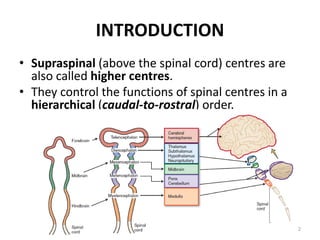
• Supraspinal (above the spinal cord) centres are
also called higher centres.
• They control the functions of spinal centres in a
hierarchical (caudal-to-rostral) order.
2
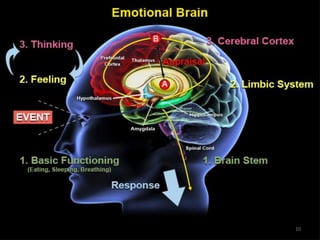
• Integrative brain centres receive internal and
external stimuli and integrate same in their
extensive neural networks, and subsequently
coordinate appropriate responses such as energy
balance, sleep and arousal, emotion, learning,
memory and speech.
• They are mainly in the diencephalon and
telencephalon - Hypothalamus, thalamus, limbic
system, reticular formation and cerebral cortex
are considered here.
3
• There are also other important supraspinal
(higher) centres such as the medullary
centres, which are mainly for autonomic
functions and are considered under ANS and
elsewhere.
• These centres, though supraspinal, are
influenced by centres that are hierachically
higher.
4
HYPOTHALAMUS
5
Learning Objectives
Upon mastering the material covered in this
lecture, you should be able to:
1. Define the major nuclear groups and neural
connections of the hypothalamus.
2. Enumerate and explain at least 10 functions
of the hypothalamus.
3. Identify at least 5 manifestations of lesions of
the hypothalamus.
6
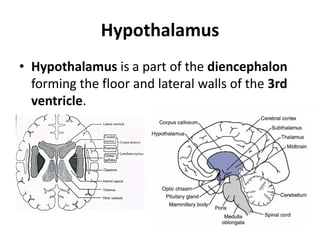
Hypothalamus
• Hypothalamus is a part of the diencephalon
forming the floor and lateral walls of the 3rd
ventricle.
7
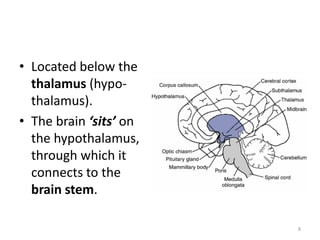
• Located below the
thalamus (hypo-
thalamus).
• The brain ‘sits’ on
the hypothalamus,
through which it
connects to the
brain stem.
8
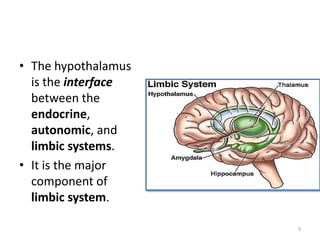
• The hypothalamus
is the interface
between the
endocrine,
autonomic, and
limbic systems.
• It is the major
component of
limbic system.
9
10
11
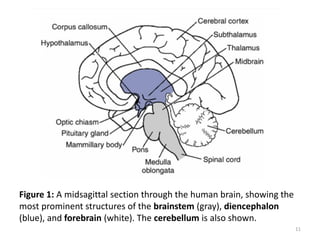
Figure 1: A midsagittal section through the human brain, showing the
most prominent structures of the brainstem (gray), diencephalon
(blue), and forebrain (white). The cerebellum is also shown.
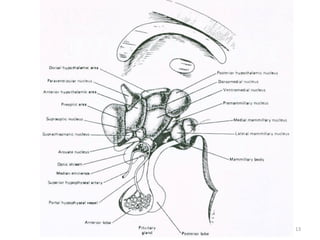
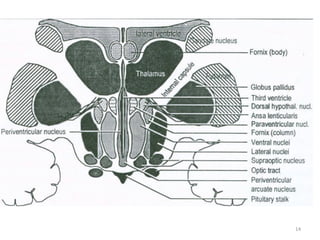
Hypothalamic Nuclei
1. Anterior Group: Supraoptic, paraventricular,
suprachiasmatic & preoptic nuclei.
2. Medial Group: Ventromedial, arcuate &
dorsomedial nuclei.
3. Lateral Nucleus: Large nuclear mass.
4. Posterior Group: Posterior nucleus, medial &
lateral mamillary bodies.
5. Periventricular Nucleus: Thin sheet of gray
matter adjacent to the 3rd ventricle.
12
13
14
Neural Connections of the
Hypothalamus
A. Afferent Connections
1. Limbic system via medial forebrain bundle,
amygdala & hippocampus
2. Thalamus
3. Reticular formation (RF) of the brainstem
4. Retina: optic nerve terminates in SCN
5. Globus pallidus via pallido-thalamic tract.
15
B. Efferent Connections
1. Thalamus and limbic lobe
2. RF of the brainstem and spinal cord (control
the autonomic functions)
3. Posterior pituitary gland via hypothalamo-
hypophysial tract
16
Functions of the Hypothalamus
1) Autonomic functions
a) Posterior, dorsomedial & lateral nuclei are
considered a sympathetic center responding
to emotions by generalized sympathetic
stimulation.
b) Anterior nuclei produce parasympathetic
effects as bradycardia and pupillo-constriction.
17
2) Endocrine functions
• Control the endocrine functions by controlling
hormonal secretion of pituitary glands.
a) Control of anterior pituitary:
• Secretes releasing hormones to the anterior
pituitary and stimulates the secretion of tropic
hormones as ACTH, TSH.
• Secretes inhibitory factors as prolactin and GH
inhibiting hormones.
18
b) Control of posterior pituitary:
• Supraoptic and paraventricular nuclei are
connected to the posterior pituitary gland via
hypothalamo-hypophyseal tract.
• They secrete ADH and oxytocin hormones
which flow down to the posterior pituitary to
be stored & released by its specific stimulus.
19
3) Control of water balance
• Lateral hypothalamus regulates body water
via stimulation of thirst center (thirst
sensation) leading to drinking of water.
• Afferents to the thirst center:
a. Osmoreceptors: liver & ant. hypothalamus.
b. Volume receptors: right atrium & big veins.
20
c. Limbic system and cerebral cortex: psychic
and emotional stimuli.
d. Mouth and pharyngeal receptors: plasma
hypertonicity or hypovolaemia.
• The hypothalamus controls ADH secretion
which increase the permeability of the DCTs
and CDs leading to increased water
reabsorption.
21
4) Thermoregulation
• Hypothal contains heat regulating centers;
– Heat gain center in the posterior nuclei.
– Heat loss center in the anterior nuclei.
• Stimulation of heat gain center (by cold):
Leads to vasoconstriction and shivering.
• Stimulation of heat loss center (by heat):
Leads to vasodilatation and sweating.
22
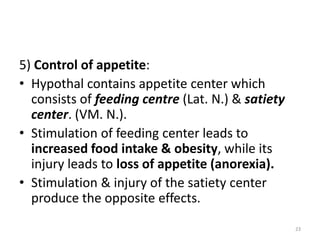
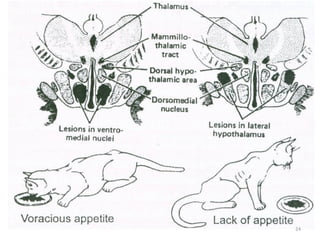
5) Control of appetite:
• Hypothal contains appetite center which
consists of feeding centre (Lat. N.) & satiety
center. (VM. N.).
• Stimulation of feeding center leads to
increased food intake & obesity, while its
injury leads to loss of appetite (anorexia).
• Stimulation & injury of the satiety center
produce the opposite effects.
23
24
6) Control of salt appetite
• Salt appetite center lies in the anterior
hypothalamus close to the osmoreceptors.
• It is sensitive to changes in the plasma
osmolality as well as plasma sodium level.
• Stimulated by: a- Hypotonicity.
b- Hypovolaemia. c- Hyponatraemia.
• All these factors lead to increase salt intake.
25
7) Control of circadian rhythm
• Suprachiasmatic nucleus (SCN) is connected
to the retina via retino-hypothalamic tract
which synchronize the SCN to the circadian
light/dark cycle and responsible for regulation
of wake/sleep rhythm.
• The VMN is connected to the SCN and
responsible for temperature, endocrine and
feeding rhythms.
26
8) Role in learning and memory
• The hypothalamus contains a reward center in
the lateral & VM nuclei.
• When stimulated, it gives a sense of reward.
• Also, it contains a punishment center in the
periventricular nuclei.
• When stimulated, gives a sense of
punishment.
27
9) Control of motor responses to emotion
• Stimulation or injury of certain areas in the
hypothalamus produce certain emotions with
specific motor response.
a) Fear:
• Produced by stimulation of fear center in the
periventricular nuclei of the hypothalamus.
• Fear reaction include sweating, pupillary
dilatation, turning the head from side to side
seeking escape.
28
b) Rage:
• Is a violent anger reaction occurs by
stimulation of rage area in the hypothalamus.
• Rage area is tonically inhibited by the VMN
(placidity area) & the limbic association area
of the cerebral cortex.
• Rage reaction include generalized sympathetic
stimulation & fighting.
29
10) Control of sexual behavior
• Sexual behavior is mainly under control of
cerebral cortex & limbic system.
• With involvement of hypothalamus;
a) Control of pituitary gonadotropins.
b) Stimulates sexual desire in females (contain
estrogen sensitive neurons).
c) Lat. hypothal. produces sexual excitement.
30
11. Relation to sleep
• The hypothalamus contains ascending fibers
of the RAS which desynchronize the cerebral
cortex and cause wakefulness.
• Lesion in the posterior hypothalamus leads to
prolonged sleep.
31
Manifestations of hypothalamic
lesions
1. Endocrine disturbance:
• Diabetes insipidus or precocious puberty.
2. Hyper- or hypothermia.
3. Hyperphagia or anorexia.
4 Sleep disturbance: Insomnia or hypersomnia.
5. Emotional disturbances: Fear & rage.
6. Autonomic disturbances:
• Decreased response to urgent situations
32
LIMBIC SYSTEM
33
Learning Objectives
Upon mastering the material covered in this
lecture, you should be able to:
1. Identify the structural components and
neural connections of the limbic system.
2. Enumerate and explain at least 10 functions
of the limbic system.
34
35
Limbic System
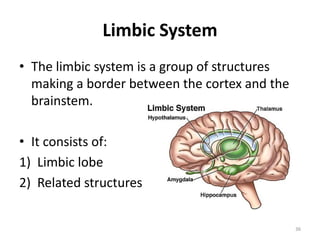
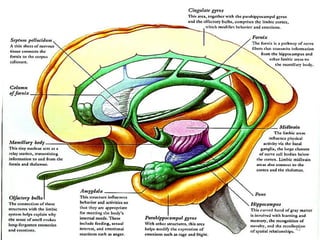
• The limbic system is a group of structures
making a border between the cortex and the
brainstem.
• It consists of:
1) Limbic lobe
2) Related structures
36
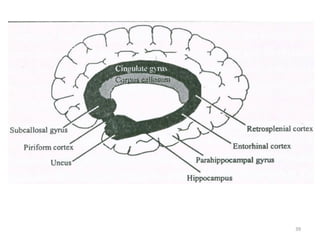
1.Limbic Lobe
• The oldest cortical part.
Structures of the limbic lobe:
• Subcallosal gyrus, cingulated gyrus,
retrosplenial cortex, entorhinal cortex,
hippocampus, parahippocampal gyrus, uncus
and piriform cortex, which are connected to
the olfactory bulb and tubercle.
37
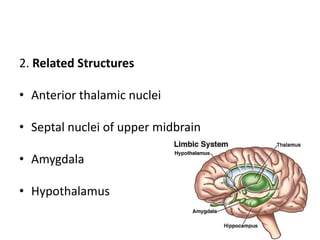
2. Related Structures
• Anterior thalamic nuclei
• Septal nuclei of upper midbrain
• Amygdala
• Hypothalamus
38
39
41
42
Neural Connections of Limbic System
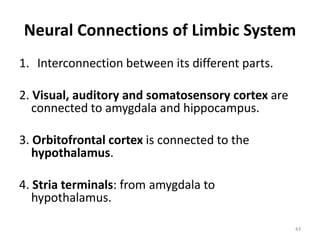
1. Interconnection between its different parts.
2. Visual, auditory and somatosensory cortex are
connected to amygdala and hippocampus.
3. Orbitofrontal cortex is connected to the
hypothalamus.
4. Stria terminals: from amygdala to
hypothalamus.
43
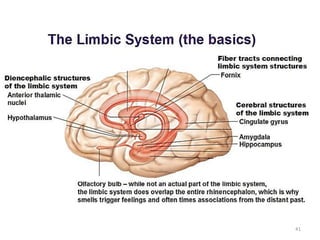
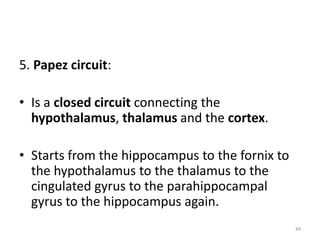
5. Papez circuit:
• Is a closed circuit connecting the
hypothalamus, thalamus and the cortex.
• Starts from the hippocampus to the fornix to
the hypothalamus to the thalamus to the
cingulated gyrus to the parahippocampal
gyrus to the hippocampus again.
44
Functions of the Limbic System
• They are closely related to the hypothalamic
functions.
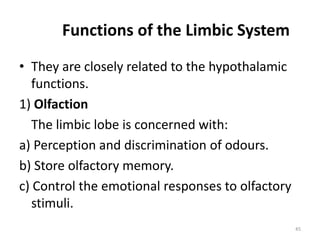
1) Olfaction
The limbic lobe is concerned with:
a) Perception and discrimination of odours.
b) Store olfactory memory.
c) Control the emotional responses to olfactory
stimuli.
45
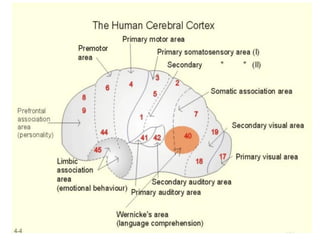
2) Motivation
• Is the feeling which activates a certain behaviour
to achieve a certain goal.
• Controlled by limbic association area
(orbitofrontal cortex, cingulated gyrus).
• Sensations may be in the form of reward or
punishment.
46
47
Reward and punishment centers
A) Reward Center:
Consists of:
i) Major components:
Lateral and VM hypothalamic nuclei.
ii) Minor components (less potent centers):
Amygdala, thalamus and tegmentum of the
limbic midbrain area.
48
B) Punishment center:
Consists of:
i) Major components:
Periventricular nucleus of the hypothalamus,
thalamus and periaquiductal gray matter of
the limbic midbrain area.
ii) Minor components (less potent centers):
Amygdala and hippocampus
49
• Stimulation of reward center gives a sensation
of pleasure, relaxation and satisfaction.
• So,
• the subject is motivated to approach or repeat
the rewarding experience.
• This is termed as approach reaction.
50
• Dopamine is the main chemical transmitter in
reward center.
• Cocaine produces sense of well-being and
pleasure; through
• Increasing the release of dopamine from
dopaminergic nerve endings of reward
system.
51
• Stimulation of the punishment center gives a
sensation of displeasure, fear and terror.
• So,
• The subject is motivated to avoid the
punishment.
• This is called aversion reaction.
52
3) Feeding behaviour
• Is the function of the amygdaloid nucleus.
• It enables the subject to discriminate different
kinds of foods.
• So, its lesion leads to hyperphagia and
ominophagia (indiscrimination of food types).
53
4) Autonomic Functions
Stimulation of the limbic system produces
autonomic effects as changes in BP, RR & HR
as a part of emotional response.
5) Control of release of some hormones
ACTH and catecholamines are released in
response to stimulation of limbic lobe as a
part of emotional response.
54
6) Control of sexual behavior
• Sexual behaviour in man is controlled by
orbitofrontal cortex.
• The desire and innate reactions that lead to
matting and pregnancy are the function of the
limbic system and hypothalamus.
55
• Bilateral lesion in the peri-amygdaloid nuclei
leads to hypersexuality in male animals.
• The diseased animal copulate with adult and
non-adult female of same and other species.
• In addition, the diseased animal may mount male
animals and even inanimate objects.
• Same lesion in female animals does not affect
their sexual behavior.
56
• Human sexual behaviors are modified by
learning, psychic and social factors by the
effect of limbic lobe and the neocortex.
57
7) Role in memory
Has a major role in memory via:
a) Discriminating significant and insignificant
sensory signals.
• Significant signals are stored in memory while,
insignificant ones are ignored.
b) Encoding and consolidation of memory.
58
8) Role in learning
• Hippocampus and amygdala play an important
role in operant conditioning and intelligence.
9) Control of maternal behavior in females (nursing
and care of babies):
• Facilitated by the prolactin hormone.
• Inhibited by lesion in the cingulated &
retrosplenial gyri.
59
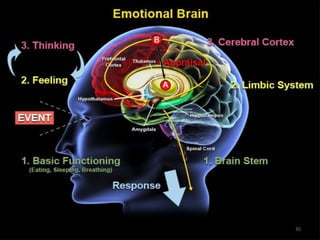
10) Control of emotions
• Emotions are a state of strong feelings associated
with autonomic, endocrine changes and strong
affect.
• Emotional state starts by stimulation of reward
and punishment centers.
• This activates reverberating circuits of the limbic
system to set other structures into action.
60
a) Thalamus:
• Activates the cortex to increase the alertness
level.
b) Hypothalamus:
• Starts autonomic and endocrine reactions as
tachycardia, increased BP and adrenaline
secretion.
61
c) Amygdaloid nucleus:
• Adjust the hypothalamic activity.
d) Hippocampus:
• Decide which signals are stored and which are
ignored and discarded.
62
Note that:
• Emotional states last for a long time because it is
based on the activity of reverberating circuits of
the limbic system (which has long after-
discharge).
• Emotional response can not be turned on or off
voluntarily because the motor cortex can not
interfere with these circuits (has no efferent
connections with these circuits).
63

10. _Hypothalamus _& _Limbic _System.pdf

  • 1.
    INTEGRATIVE CENTRES OFTHE NERVOUS SYSTEM Neurophysiology Lecture Notes for Undergraduate Students Prof. Isyaku Umar Yarube Neuroscience and Pathophysiology Unit, Department of Human Physiology, Bayero University, Kano 1
  • 2.
    INTRODUCTION • Supraspinal (abovethe spinal cord) centres are also called higher centres. • They control the functions of spinal centres in a hierarchical (caudal-to-rostral) order. 2
  • 3.
    • Integrative braincentres receive internal and external stimuli and integrate same in their extensive neural networks, and subsequently coordinate appropriate responses such as energy balance, sleep and arousal, emotion, learning, memory and speech. • They are mainly in the diencephalon and telencephalon - Hypothalamus, thalamus, limbic system, reticular formation and cerebral cortex are considered here. 3
  • 4.
    • There arealso other important supraspinal (higher) centres such as the medullary centres, which are mainly for autonomic functions and are considered under ANS and elsewhere. • These centres, though supraspinal, are influenced by centres that are hierachically higher. 4
  • 5.
  • 6.
    Learning Objectives Upon masteringthe material covered in this lecture, you should be able to: 1. Define the major nuclear groups and neural connections of the hypothalamus. 2. Enumerate and explain at least 10 functions of the hypothalamus. 3. Identify at least 5 manifestations of lesions of the hypothalamus. 6
  • 7.
    Hypothalamus • Hypothalamus isa part of the diencephalon forming the floor and lateral walls of the 3rd ventricle. 7
  • 8.
    • Located belowthe thalamus (hypo- thalamus). • The brain ‘sits’ on the hypothalamus, through which it connects to the brain stem. 8
  • 9.
    • The hypothalamus isthe interface between the endocrine, autonomic, and limbic systems. • It is the major component of limbic system. 9
  • 10.
  • 11.
    11 Figure 1: Amidsagittal section through the human brain, showing the most prominent structures of the brainstem (gray), diencephalon (blue), and forebrain (white). The cerebellum is also shown.
  • 12.
    Hypothalamic Nuclei 1. AnteriorGroup: Supraoptic, paraventricular, suprachiasmatic & preoptic nuclei. 2. Medial Group: Ventromedial, arcuate & dorsomedial nuclei. 3. Lateral Nucleus: Large nuclear mass. 4. Posterior Group: Posterior nucleus, medial & lateral mamillary bodies. 5. Periventricular Nucleus: Thin sheet of gray matter adjacent to the 3rd ventricle. 12
  • 13.
  • 14.
  • 15.
    Neural Connections ofthe Hypothalamus A. Afferent Connections 1. Limbic system via medial forebrain bundle, amygdala & hippocampus 2. Thalamus 3. Reticular formation (RF) of the brainstem 4. Retina: optic nerve terminates in SCN 5. Globus pallidus via pallido-thalamic tract. 15
  • 16.
    B. Efferent Connections 1.Thalamus and limbic lobe 2. RF of the brainstem and spinal cord (control the autonomic functions) 3. Posterior pituitary gland via hypothalamo- hypophysial tract 16
  • 17.
    Functions of theHypothalamus 1) Autonomic functions a) Posterior, dorsomedial & lateral nuclei are considered a sympathetic center responding to emotions by generalized sympathetic stimulation. b) Anterior nuclei produce parasympathetic effects as bradycardia and pupillo-constriction. 17
  • 18.
    2) Endocrine functions •Control the endocrine functions by controlling hormonal secretion of pituitary glands. a) Control of anterior pituitary: • Secretes releasing hormones to the anterior pituitary and stimulates the secretion of tropic hormones as ACTH, TSH. • Secretes inhibitory factors as prolactin and GH inhibiting hormones. 18
  • 19.
    b) Control ofposterior pituitary: • Supraoptic and paraventricular nuclei are connected to the posterior pituitary gland via hypothalamo-hypophyseal tract. • They secrete ADH and oxytocin hormones which flow down to the posterior pituitary to be stored & released by its specific stimulus. 19
  • 20.
    3) Control ofwater balance • Lateral hypothalamus regulates body water via stimulation of thirst center (thirst sensation) leading to drinking of water. • Afferents to the thirst center: a. Osmoreceptors: liver & ant. hypothalamus. b. Volume receptors: right atrium & big veins. 20
  • 21.
    c. Limbic systemand cerebral cortex: psychic and emotional stimuli. d. Mouth and pharyngeal receptors: plasma hypertonicity or hypovolaemia. • The hypothalamus controls ADH secretion which increase the permeability of the DCTs and CDs leading to increased water reabsorption. 21
  • 22.
    4) Thermoregulation • Hypothalcontains heat regulating centers; – Heat gain center in the posterior nuclei. – Heat loss center in the anterior nuclei. • Stimulation of heat gain center (by cold): Leads to vasoconstriction and shivering. • Stimulation of heat loss center (by heat): Leads to vasodilatation and sweating. 22
  • 23.
    5) Control ofappetite: • Hypothal contains appetite center which consists of feeding centre (Lat. N.) & satiety center. (VM. N.). • Stimulation of feeding center leads to increased food intake & obesity, while its injury leads to loss of appetite (anorexia). • Stimulation & injury of the satiety center produce the opposite effects. 23
  • 24.
  • 25.
    6) Control ofsalt appetite • Salt appetite center lies in the anterior hypothalamus close to the osmoreceptors. • It is sensitive to changes in the plasma osmolality as well as plasma sodium level. • Stimulated by: a- Hypotonicity. b- Hypovolaemia. c- Hyponatraemia. • All these factors lead to increase salt intake. 25
  • 26.
    7) Control ofcircadian rhythm • Suprachiasmatic nucleus (SCN) is connected to the retina via retino-hypothalamic tract which synchronize the SCN to the circadian light/dark cycle and responsible for regulation of wake/sleep rhythm. • The VMN is connected to the SCN and responsible for temperature, endocrine and feeding rhythms. 26
  • 27.
    8) Role inlearning and memory • The hypothalamus contains a reward center in the lateral & VM nuclei. • When stimulated, it gives a sense of reward. • Also, it contains a punishment center in the periventricular nuclei. • When stimulated, gives a sense of punishment. 27
  • 28.
    9) Control ofmotor responses to emotion • Stimulation or injury of certain areas in the hypothalamus produce certain emotions with specific motor response. a) Fear: • Produced by stimulation of fear center in the periventricular nuclei of the hypothalamus. • Fear reaction include sweating, pupillary dilatation, turning the head from side to side seeking escape. 28
  • 29.
    b) Rage: • Isa violent anger reaction occurs by stimulation of rage area in the hypothalamus. • Rage area is tonically inhibited by the VMN (placidity area) & the limbic association area of the cerebral cortex. • Rage reaction include generalized sympathetic stimulation & fighting. 29
  • 30.
    10) Control ofsexual behavior • Sexual behavior is mainly under control of cerebral cortex & limbic system. • With involvement of hypothalamus; a) Control of pituitary gonadotropins. b) Stimulates sexual desire in females (contain estrogen sensitive neurons). c) Lat. hypothal. produces sexual excitement. 30
  • 31.
    11. Relation tosleep • The hypothalamus contains ascending fibers of the RAS which desynchronize the cerebral cortex and cause wakefulness. • Lesion in the posterior hypothalamus leads to prolonged sleep. 31
  • 32.
    Manifestations of hypothalamic lesions 1.Endocrine disturbance: • Diabetes insipidus or precocious puberty. 2. Hyper- or hypothermia. 3. Hyperphagia or anorexia. 4 Sleep disturbance: Insomnia or hypersomnia. 5. Emotional disturbances: Fear & rage. 6. Autonomic disturbances: • Decreased response to urgent situations 32
  • 33.
  • 34.
    Learning Objectives Upon masteringthe material covered in this lecture, you should be able to: 1. Identify the structural components and neural connections of the limbic system. 2. Enumerate and explain at least 10 functions of the limbic system. 34
  • 35.
  • 36.
    Limbic System • Thelimbic system is a group of structures making a border between the cortex and the brainstem. • It consists of: 1) Limbic lobe 2) Related structures 36
  • 37.
    1.Limbic Lobe • Theoldest cortical part. Structures of the limbic lobe: • Subcallosal gyrus, cingulated gyrus, retrosplenial cortex, entorhinal cortex, hippocampus, parahippocampal gyrus, uncus and piriform cortex, which are connected to the olfactory bulb and tubercle. 37
  • 38.
    2. Related Structures •Anterior thalamic nuclei • Septal nuclei of upper midbrain • Amygdala • Hypothalamus 38
  • 39.
  • 40.
  • 41.
  • 42.
    Neural Connections ofLimbic System 1. Interconnection between its different parts. 2. Visual, auditory and somatosensory cortex are connected to amygdala and hippocampus. 3. Orbitofrontal cortex is connected to the hypothalamus. 4. Stria terminals: from amygdala to hypothalamus. 43
  • 43.
    5. Papez circuit: •Is a closed circuit connecting the hypothalamus, thalamus and the cortex. • Starts from the hippocampus to the fornix to the hypothalamus to the thalamus to the cingulated gyrus to the parahippocampal gyrus to the hippocampus again. 44
  • 44.
    Functions of theLimbic System • They are closely related to the hypothalamic functions. 1) Olfaction The limbic lobe is concerned with: a) Perception and discrimination of odours. b) Store olfactory memory. c) Control the emotional responses to olfactory stimuli. 45
  • 45.
    2) Motivation • Isthe feeling which activates a certain behaviour to achieve a certain goal. • Controlled by limbic association area (orbitofrontal cortex, cingulated gyrus). • Sensations may be in the form of reward or punishment. 46
  • 46.
  • 47.
    Reward and punishmentcenters A) Reward Center: Consists of: i) Major components: Lateral and VM hypothalamic nuclei. ii) Minor components (less potent centers): Amygdala, thalamus and tegmentum of the limbic midbrain area. 48
  • 48.
    B) Punishment center: Consistsof: i) Major components: Periventricular nucleus of the hypothalamus, thalamus and periaquiductal gray matter of the limbic midbrain area. ii) Minor components (less potent centers): Amygdala and hippocampus 49
  • 49.
    • Stimulation ofreward center gives a sensation of pleasure, relaxation and satisfaction. • So, • the subject is motivated to approach or repeat the rewarding experience. • This is termed as approach reaction. 50
  • 50.
    • Dopamine isthe main chemical transmitter in reward center. • Cocaine produces sense of well-being and pleasure; through • Increasing the release of dopamine from dopaminergic nerve endings of reward system. 51
  • 51.
    • Stimulation ofthe punishment center gives a sensation of displeasure, fear and terror. • So, • The subject is motivated to avoid the punishment. • This is called aversion reaction. 52
  • 52.
    3) Feeding behaviour •Is the function of the amygdaloid nucleus. • It enables the subject to discriminate different kinds of foods. • So, its lesion leads to hyperphagia and ominophagia (indiscrimination of food types). 53
  • 53.
    4) Autonomic Functions Stimulationof the limbic system produces autonomic effects as changes in BP, RR & HR as a part of emotional response. 5) Control of release of some hormones ACTH and catecholamines are released in response to stimulation of limbic lobe as a part of emotional response. 54
  • 54.
    6) Control ofsexual behavior • Sexual behaviour in man is controlled by orbitofrontal cortex. • The desire and innate reactions that lead to matting and pregnancy are the function of the limbic system and hypothalamus. 55
  • 55.
    • Bilateral lesionin the peri-amygdaloid nuclei leads to hypersexuality in male animals. • The diseased animal copulate with adult and non-adult female of same and other species. • In addition, the diseased animal may mount male animals and even inanimate objects. • Same lesion in female animals does not affect their sexual behavior. 56
  • 56.
    • Human sexualbehaviors are modified by learning, psychic and social factors by the effect of limbic lobe and the neocortex. 57
  • 57.
    7) Role inmemory Has a major role in memory via: a) Discriminating significant and insignificant sensory signals. • Significant signals are stored in memory while, insignificant ones are ignored. b) Encoding and consolidation of memory. 58
  • 58.
    8) Role inlearning • Hippocampus and amygdala play an important role in operant conditioning and intelligence. 9) Control of maternal behavior in females (nursing and care of babies): • Facilitated by the prolactin hormone. • Inhibited by lesion in the cingulated & retrosplenial gyri. 59
  • 59.
    10) Control ofemotions • Emotions are a state of strong feelings associated with autonomic, endocrine changes and strong affect. • Emotional state starts by stimulation of reward and punishment centers. • This activates reverberating circuits of the limbic system to set other structures into action. 60
  • 60.
    a) Thalamus: • Activatesthe cortex to increase the alertness level. b) Hypothalamus: • Starts autonomic and endocrine reactions as tachycardia, increased BP and adrenaline secretion. 61
  • 61.
    c) Amygdaloid nucleus: •Adjust the hypothalamic activity. d) Hippocampus: • Decide which signals are stored and which are ignored and discarded. 62
  • 62.
    Note that: • Emotionalstates last for a long time because it is based on the activity of reverberating circuits of the limbic system (which has long after- discharge). • Emotional response can not be turned on or off voluntarily because the motor cortex can not interfere with these circuits (has no efferent connections with these circuits). 63