Hypothalamus
E!en Robben and Sophia Freckmann
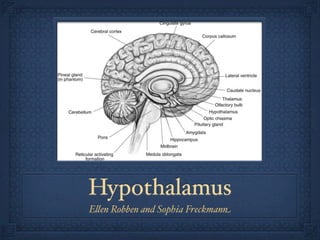
Location
Located under the
Thalamus
Originates $om the
Greek ύπό (below,
under) and θάλαμος
(room, chamber)
Roughly the size of an
Almond
Functions
Homeostasis
Hunger & Thirst
Food & Water intake regulation
Fatigue
Sleep Patterns
Blood Pressure
Fluid Balance
Body weight

Sleep/Wake Cycle regulation
                                              It’s your Hypothalamus
Produces & discharges certain neurohormones
                                                   talking to YOU!
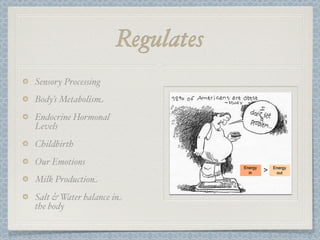
Regulates
Sensory Processing
Body’s Metabolism
Endocrine Hormonal
Levels
Childbirth
Our Emotions
Milk Production
Salt & Water balance in
the body
Parts of the Body it Controls


Thyroid glands
Adrenal glands
Ovaries
Testes
a quick Did You Know?
Hypothalamus is the regulatory
center of the menstrual cycle

Hypothalamus produces hormone
gonadotrophin (GnRH)

Pituitary gland targeted by
gonadotrophin

Pituitary gland releases two
hormones; fo!icle stimulating
hormone (FSH) & luteinizing      Interesting Fact
hormone (LH)
                                 Men produce the same Luteinizing Hormone (LH),
                                 also known as the Interstitial Cell-Stimulating
Hormones target ovaries          Hormone (ICSH). The hormone stimulates the
                                 production of Testosterone in men.
Hypothalamus and Huntington’s
                                             2011
Study $om Lund, Sweden carried out at Lund University
Huntington’s Disease: causes certain nerve ce!s in the brain to be less responsive
Mice were injected with Huntington’s proteins into the Hypothalamus area
Mice displayed reduced ability to control their metabolism (and appetite)
Immediate changes were seen, the rats started to eat more and gained a lot of weight
Huntington’s proteins altered the normal amount of blood sugar levels in the body, and a resistance to
insulin is developed , making some nerve ce!s unresponsive to important messages. This stops the
metabolic system

Changes seen in the mice brains similar to those seen in Huntington’s patients brains
SO WHAT? Now that we know that the Hypothalamus shows pathological changes appear 10
years before movement problems are seen, new treatments can target this part of the brain and could
help Huntington’s patients $om an earlier stage

One treatment su+ests switching off the mutated Huntington’s disease, resulting in termination of
irregularities in metabolism
Hypothalamus and Obesity
                                           2010
Study $om the University of Cambridge

Creation of new anti-obesity drug, works as a reduction to response of Hypothalamus and Amygdala
( both important for appetite control and eating behaviors )

Obese volunteers were viewed under an fMRI and shown pictures of high calorie foods (eg. chocolate
muffin) and low calorie foods (eg. a carrot)

Procedure carried out both a/er two weeks treatment with anti-obesity drug (sibutramine), and two
weeks a/er placebo treatment

Placebo treatment showed that when viewing appetizing foods, more parts of the brain for reward
processing were tri+ered; on drug, reduction of response in Hypothalamus & Amygdala

People with more reduction in response were more likely to eat less and lose more weight
Hypothalamus and Fear
                                       2009
Larry Swanson University of Southern California

Studied rats and mice exposed to cats and rival rodents protecting their territory; both
encounters activated part of the Hypothalamus

Next, minor lesions were made to that part of the brain, resulting in the rodents losing
fear in cats as oppose to previous encounters

Also a study on social interaction, the rodents wandered on to rival rodent’s territory
stood upright, and not taking the passive pose that was norma!y taken

Even when losing, they came back for more

Previously thought that fear was responsive in the amygdala; different kind of fear (risk
aversion or caution)

Shows that there isn’t just ONE system that controls a! fear
Hypothalamic Dysfunction

Anorexia
Bleeding
Bulimia
Genetic disorders
Growths (tumors)
Head trauma
Infection and swe!ing
Malnutrition
Too Much Iron

The Brain: Hypothalamus

  • 1.
  • 2.
    Location Located under the Thalamus Originates$om the Greek ύπό (below, under) and θάλαμος (room, chamber) Roughly the size of an Almond
  • 3.
    Functions Homeostasis Hunger & Thirst Food& Water intake regulation Fatigue Sleep Patterns Blood Pressure Fluid Balance Body weight Sleep/Wake Cycle regulation It’s your Hypothalamus Produces & discharges certain neurohormones talking to YOU!
  • 4.
    Regulates Sensory Processing Body’s Metabolism EndocrineHormonal Levels Childbirth Our Emotions Milk Production Salt & Water balance in the body
  • 5.
    Parts of theBody it Controls Thyroid glands Adrenal glands Ovaries Testes
  • 6.
    a quick DidYou Know? Hypothalamus is the regulatory center of the menstrual cycle Hypothalamus produces hormone gonadotrophin (GnRH) Pituitary gland targeted by gonadotrophin Pituitary gland releases two hormones; fo!icle stimulating hormone (FSH) & luteinizing Interesting Fact hormone (LH) Men produce the same Luteinizing Hormone (LH), also known as the Interstitial Cell-Stimulating Hormones target ovaries Hormone (ICSH). The hormone stimulates the production of Testosterone in men.
  • 7.
    Hypothalamus and Huntington’s 2011 Study $om Lund, Sweden carried out at Lund University Huntington’s Disease: causes certain nerve ce!s in the brain to be less responsive Mice were injected with Huntington’s proteins into the Hypothalamus area Mice displayed reduced ability to control their metabolism (and appetite) Immediate changes were seen, the rats started to eat more and gained a lot of weight Huntington’s proteins altered the normal amount of blood sugar levels in the body, and a resistance to insulin is developed , making some nerve ce!s unresponsive to important messages. This stops the metabolic system Changes seen in the mice brains similar to those seen in Huntington’s patients brains SO WHAT? Now that we know that the Hypothalamus shows pathological changes appear 10 years before movement problems are seen, new treatments can target this part of the brain and could help Huntington’s patients $om an earlier stage One treatment su+ests switching off the mutated Huntington’s disease, resulting in termination of irregularities in metabolism
  • 8.
    Hypothalamus and Obesity 2010 Study $om the University of Cambridge Creation of new anti-obesity drug, works as a reduction to response of Hypothalamus and Amygdala ( both important for appetite control and eating behaviors ) Obese volunteers were viewed under an fMRI and shown pictures of high calorie foods (eg. chocolate muffin) and low calorie foods (eg. a carrot) Procedure carried out both a/er two weeks treatment with anti-obesity drug (sibutramine), and two weeks a/er placebo treatment Placebo treatment showed that when viewing appetizing foods, more parts of the brain for reward processing were tri+ered; on drug, reduction of response in Hypothalamus & Amygdala People with more reduction in response were more likely to eat less and lose more weight
  • 9.
    Hypothalamus and Fear 2009 Larry Swanson University of Southern California Studied rats and mice exposed to cats and rival rodents protecting their territory; both encounters activated part of the Hypothalamus Next, minor lesions were made to that part of the brain, resulting in the rodents losing fear in cats as oppose to previous encounters Also a study on social interaction, the rodents wandered on to rival rodent’s territory stood upright, and not taking the passive pose that was norma!y taken Even when losing, they came back for more Previously thought that fear was responsive in the amygdala; different kind of fear (risk aversion or caution) Shows that there isn’t just ONE system that controls a! fear
  • 10.
    Hypothalamic Dysfunction Anorexia Bleeding Bulimia Genetic disorders Growths(tumors) Head trauma Infection and swe!ing Malnutrition Too Much Iron

Editor's Notes