HYPOTHALAMUS
NAME : ZOHA KHAN
BATCH : DPT BATCH II
SUBMITTED TO : DR SUMEET KUMAR.
CONTENT:
• Hypothalamus
• Physiological anatomy
• Functions of hypothalamus.
HYPOTHALAMUS:
• Latin word- hypo- below ; Thalamus- chamber.
• The hypothalamus is a part of diencephalon.
• Very small part of brain weighting about 4gms.
• As it implies it below the thalamus and is separated from it by hypothalamic
sulcus.
• Most part of hypothalamus is hidden.
• Regulate all vegetative and endocrine process.
• The most part of the diencephalon which lies below the thalamus.
PHYSIOLOGICAL ANATOMY:
• External features.
• Subdivision and nuclei of hypothalamus.
• Connections of hypothalamus.
EXTERNAL FEATURES:
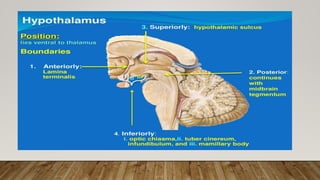
• BOUNDRIES:
• Superior. the hypothalamic sulcus separating it from the thalamus.
• Inferior. the optic chiasm , tuber cinereum , and mammillary bodies
• Medial. the lamina terminalis.
• Lateral. the tegmentum of the midbrain.
• Anterior. the third ventricle.
• Posterior. the internal capsule.
SUBDIVISION OF HYPOTHALAMUS:
From medial to lateral into three zones:
Periventricular.
Intermediate.
Lateral.
The periventricular and intermediate zones are often described together as
medial zone.
ZONES;
SUBDIVISION OF HYPOTHALAMUS:
• The hypothalamus also subdivided anterioposteriorly into four regions:
• The preoptic region.
• The supraoptic region.
• The tuberal. ( infundibulotuberal) includes infundibulum tubercinereum.
• The mammillary posterior. ( consist of mammillary body and area above it ).
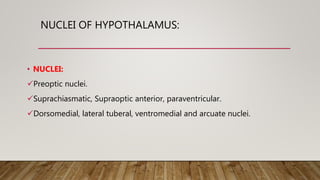
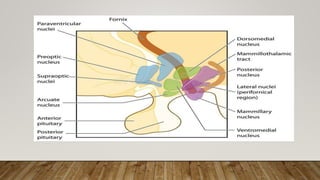
NUCLEI OF HYPOTHALAMUS:
• NUCLEI:
Preoptic nuclei.
Suprachiasmatic, Supraoptic anterior, paraventricular.
Dorsomedial, lateral tuberal, ventromedial and arcuate nuclei.
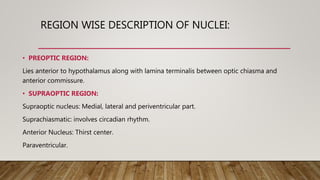
REGION WISE DESCRIPTION OF NUCLEI:
• PREOPTIC REGION:
Lies anterior to hypothalamus along with lamina terminalis between optic chiasma and
anterior commissure.
• SUPRAOPTIC REGION:
Supraoptic nucleus: Medial, lateral and periventricular part.
Suprachiasmatic: involves circadian rhythm.
Anterior Nucleus: Thirst center.
Paraventricular.
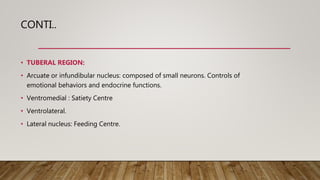
CONTI..
• TUBERAL REGION:
• Arcuate or infundibular nucleus: composed of small neurons. Controls of
emotional behaviors and endocrine functions.
• Ventromedial : Satiety Centre
• Ventrolateral.
• Lateral nucleus: Feeding Centre.
CONTI..
• MAMILARY REGION:
• Mamillary Bodies:
• Medial intercalated nucleus: small neurons forms the bulk of mammillary body.
• Lateral intercalated nucleus: Receive termination of fornix and provide origin to
mammillothalamic tract and mammilotegmental tract.
• Posterior Hypothalamic nucleus.
CONNECTIONS OF HYPOTHALAMUS:
• Hypothalamus is concerned with the visceral function.
• Connected to various parts of limbic system, reticular formation
, autonomic centers in brainstem and spinal cord.
• It also releases secretions into the blood stream and into CSF.
FUNCTIONS OF HYPOTHALAMUS:
• Autonomic system
• Food Intake.
• Temperature.
• Thirst- Fluid regulation.
• Endocrine functions.
• Regulation of sexual activity and reproduction.
• Sleep and wakefulness.
• Emotion and stress.
• Reward and punishment.
https://www.slideshare.net/ananthatiger/anatomy-of-hypothalamus-
REFRENCE:
Hypothalamus

Hypothalamus

  • 1.
    HYPOTHALAMUS NAME : ZOHAKHAN BATCH : DPT BATCH II SUBMITTED TO : DR SUMEET KUMAR.
  • 2.
    CONTENT: • Hypothalamus • Physiologicalanatomy • Functions of hypothalamus.
  • 3.
    HYPOTHALAMUS: • Latin word-hypo- below ; Thalamus- chamber. • The hypothalamus is a part of diencephalon. • Very small part of brain weighting about 4gms. • As it implies it below the thalamus and is separated from it by hypothalamic sulcus. • Most part of hypothalamus is hidden. • Regulate all vegetative and endocrine process. • The most part of the diencephalon which lies below the thalamus.
  • 4.
    PHYSIOLOGICAL ANATOMY: • Externalfeatures. • Subdivision and nuclei of hypothalamus. • Connections of hypothalamus.
  • 5.
    EXTERNAL FEATURES: • BOUNDRIES: •Superior. the hypothalamic sulcus separating it from the thalamus. • Inferior. the optic chiasm , tuber cinereum , and mammillary bodies • Medial. the lamina terminalis. • Lateral. the tegmentum of the midbrain. • Anterior. the third ventricle. • Posterior. the internal capsule.
  • 7.
    SUBDIVISION OF HYPOTHALAMUS: Frommedial to lateral into three zones: Periventricular. Intermediate. Lateral. The periventricular and intermediate zones are often described together as medial zone. ZONES;
  • 8.
    SUBDIVISION OF HYPOTHALAMUS: •The hypothalamus also subdivided anterioposteriorly into four regions: • The preoptic region. • The supraoptic region. • The tuberal. ( infundibulotuberal) includes infundibulum tubercinereum. • The mammillary posterior. ( consist of mammillary body and area above it ).
  • 9.
    NUCLEI OF HYPOTHALAMUS: •NUCLEI: Preoptic nuclei. Suprachiasmatic, Supraoptic anterior, paraventricular. Dorsomedial, lateral tuberal, ventromedial and arcuate nuclei.
  • 11.
    REGION WISE DESCRIPTIONOF NUCLEI: • PREOPTIC REGION: Lies anterior to hypothalamus along with lamina terminalis between optic chiasma and anterior commissure. • SUPRAOPTIC REGION: Supraoptic nucleus: Medial, lateral and periventricular part. Suprachiasmatic: involves circadian rhythm. Anterior Nucleus: Thirst center. Paraventricular.
  • 12.
    CONTI.. • TUBERAL REGION: •Arcuate or infundibular nucleus: composed of small neurons. Controls of emotional behaviors and endocrine functions. • Ventromedial : Satiety Centre • Ventrolateral. • Lateral nucleus: Feeding Centre.
  • 13.
    CONTI.. • MAMILARY REGION: •Mamillary Bodies: • Medial intercalated nucleus: small neurons forms the bulk of mammillary body. • Lateral intercalated nucleus: Receive termination of fornix and provide origin to mammillothalamic tract and mammilotegmental tract. • Posterior Hypothalamic nucleus.
  • 14.
    CONNECTIONS OF HYPOTHALAMUS: •Hypothalamus is concerned with the visceral function. • Connected to various parts of limbic system, reticular formation , autonomic centers in brainstem and spinal cord. • It also releases secretions into the blood stream and into CSF.
  • 15.
    FUNCTIONS OF HYPOTHALAMUS: •Autonomic system • Food Intake. • Temperature. • Thirst- Fluid regulation. • Endocrine functions. • Regulation of sexual activity and reproduction. • Sleep and wakefulness. • Emotion and stress. • Reward and punishment.
  • 16.