HYPERTHYROIDISM
Soumya Ranjan Parida
Basic B.Sc. Nursing 4th
year
Sum Nursing College
Hyperthyroidism
Etiology :-
• Diffuse toxic goiter (Graves disease )
• Mc Cune Albright syndrome
• Toxic uninodular goiter (Plummer disease )
• Hyper functioning thyroid Ca
• Thyrotoxicosis factitia
• Subacute thyroiditis
• Acute suppurative thyroiditis
Graves disease
• Incidence :-
It occurs in 1: 5000 children.
Peak at 11 – 15 years.
F :M 5 :1
• Etiology :-
Infiltration of thyroid gland with
lymphocytes & plasma cells.
CD4/Th- predominate in dense lymphoid
aggrgate.
CD8/Ts - predominate in low dense area.
Etiology
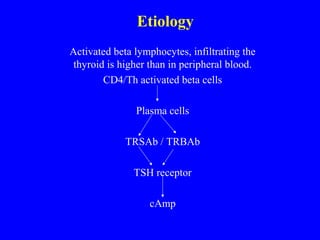
Activated beta lymphocytes, infiltrating the
thyroid is higher than in peripheral blood.
CD4/Th activated beta cells
Plasma cells
TRSAb / TRBAb
TSH receptor
cAmp
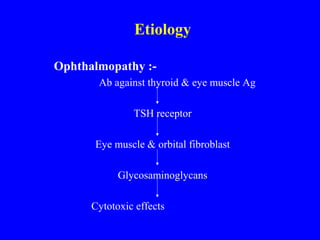
Etiology
Ophthalmopathy :-
Ab against thyroid & eye muscle Ag
TSH receptor
Eye muscle & orbital fibroblast
Glycosaminoglycans
Cytotoxic effects
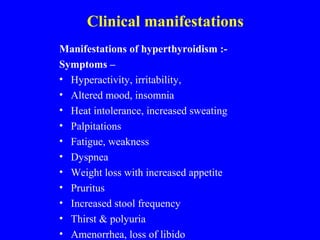
Clinical manifestations
Manifestations of hyperthyroidism :-
Symptoms –
• Hyperactivity, irritability,
• Altered mood, insomnia
• Heat intolerance, increased sweating
• Palpitations
• Fatigue, weakness
• Dyspnea
• Weight loss with increased appetite
• Pruritus
• Increased stool frequency
• Thirst & polyuria
• Amenorrhea, loss of libido
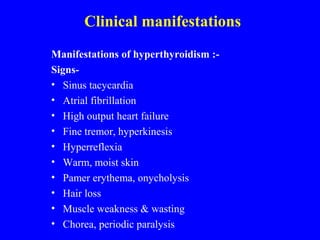
Clinical manifestations
Manifestations of hyperthyroidism :-
Signs-
• Sinus tacycardia
• Atrial fibrillation
• High output heart failure
• Fine tremor, hyperkinesis
• Hyperreflexia
• Warm, moist skin
• Pamer erythema, onycholysis
• Hair loss
• Muscle weakness & wasting
• Chorea, periodic paralysis
Clinical manifestations
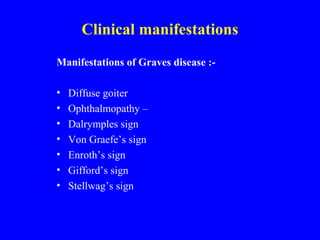
Manifestations of Graves disease :-
• Diffuse goiter
• Ophthalmopathy –
• Dalrymples sign
• Von Graefe’s sign
• Enroth’s sign
• Gifford’s sign
• Stellwag’s sign
Clinical manifestations
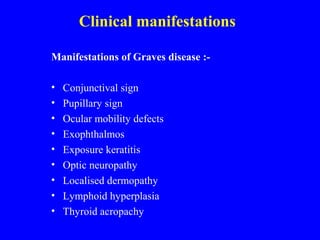
Manifestations of Graves disease :-
• Conjunctival sign
• Pupillary sign
• Ocular mobility defects
• Exophthalmos
• Exposure keratitis
• Optic neuropathy
• Localised dermopathy
• Lymphoid hyperplasia
• Thyroid acropachy
Diagnosis
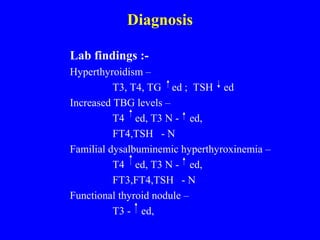
Lab findings :-
Hyperthyroidism –
T3, T4, TG ed ; TSH ed
Increased TBG levels –
T4 ed, T3 N - ed,
FT4,TSH - N
Familial dysalbuminemic hyperthyroxinemia –
T4 ed, T3 N - ed,
FT3,FT4,TSH - N
Functional thyroid nodule –
T3 - ed,
Diagnosis
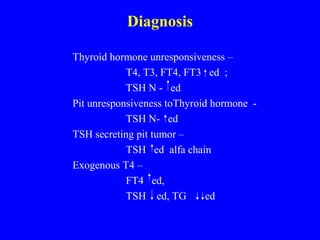
Thyroid hormone unresponsiveness –
T4, T3, FT4, FT3 ed ;
TSH N - ed
Pit unresponsiveness toThyroid hormone -
TSH N- ed
TSH secreting pit tumor –
TSH ed alfa chain
Exogenous T4 –
FT4 ed,
TSH ed, TG ed
Treatment
Drugs :-
1. Propylthiouracil - ( PTU )
• Dose to dose less potent.
• Highly plasma protein bound.
• Less transferred across placenta, milk
• Plasma T ½ is 1- 2 hour
• Single dose acts for 4-8 hour
• No active metabolite
• Multiple doses
• Inhibit peripheral T4 T3
Treatment
2. Carbimazole –
• 3 times more potent
• Less bound to plasms proteins
• Large amount transferred across placenta
• Plasma T ½ is 6 – 8 hour
• Acts for 12 - 24 hour
• Methimazole is active metabolite
• Single dose
• Does not inhibit peripheral T4 T3
Treatment
Dose :-
• Propylthiouracil - ( PTU )
5 - 10 mg/kg/day TDS orally
• Methimazole –
0.25 – 1.0 mg/kg/day OD orally
• Propranolol –
0.5 – 2 mg/kg/day TDS orally
Clinical response in 2–3 weeks
Adequate control in 1–3 months
Duration – 5 years
Treatment
• Subtotal thyroidectomy –
ATD is given for 2-3 mo to obtain euthyroid
state. 5 drops of saturated solution of KI
dailyfor 2 wk
• Radioiodine –
Safe in more than 10 years age
Pretreatment with ATD not necessary
ATD should be stopped a week before
starting RI
Propranolol & low dose ATD for 2-3 mo
Side effects
ATD –
Transient leukopenia
Transient urticarial rash
Hypersensitivity
Agranulocytosis
Hepatitis
Lupus like syndrome
Glomerulonephritis
vasculitis
Side effects
• Subtotal thyroidectomy –
Paralysis of vocal cord
Hypoparathyroidism
• Radioiodine –
Benign adenoma ( 0.6-1.9 % )
Hypothyroidism ( 10-20 % )
Congenital hyperthyroidism
Etiology : –
• Transplacental passage of TRSAb
• 2 % of infants are born to mothers with
graves disease
• M : F - 1 : 1
Clinical features : -
• PT /IUGR with goiter
• Restless, irritable,
• Hyperactive,anxious
• Microcephaly with ventricular enlargement
• Eyes widely open, exophthalmos
Congenital hyperthyroidism
• Tachycardia,
• Tachypnea,
• Hyperthermia
• Weight loss despite revenous appetite
• Jaundice,
• HSM
• Cardiac decompensation,
• HT
• Advanced bone age,
• Frontal bossing with triangular facies,
• Craniosynostosis
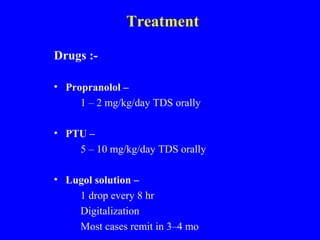
Treatment
Drugs :-
• Propranolol –
1 – 2 mg/kg/day TDS orally
• PTU –
5 – 10 mg/kg/day TDS orally
• Lugol solution –
1 drop every 8 hr
Digitalization
Most cases remit in 3–4 mo
THANKS

Hyperthyroidism

  • 1.
    HYPERTHYROIDISM Soumya Ranjan Parida BasicB.Sc. Nursing 4th year Sum Nursing College
  • 2.
    Hyperthyroidism Etiology :- • Diffusetoxic goiter (Graves disease ) • Mc Cune Albright syndrome • Toxic uninodular goiter (Plummer disease ) • Hyper functioning thyroid Ca • Thyrotoxicosis factitia • Subacute thyroiditis • Acute suppurative thyroiditis
  • 3.
    Graves disease • Incidence:- It occurs in 1: 5000 children. Peak at 11 – 15 years. F :M 5 :1 • Etiology :- Infiltration of thyroid gland with lymphocytes & plasma cells. CD4/Th- predominate in dense lymphoid aggrgate. CD8/Ts - predominate in low dense area.
  • 4.
    Etiology Activated beta lymphocytes,infiltrating the thyroid is higher than in peripheral blood. CD4/Th activated beta cells Plasma cells TRSAb / TRBAb TSH receptor cAmp
  • 5.
    Etiology Ophthalmopathy :- Ab againstthyroid & eye muscle Ag TSH receptor Eye muscle & orbital fibroblast Glycosaminoglycans Cytotoxic effects
  • 6.
    Clinical manifestations Manifestations ofhyperthyroidism :- Symptoms – • Hyperactivity, irritability, • Altered mood, insomnia • Heat intolerance, increased sweating • Palpitations • Fatigue, weakness • Dyspnea • Weight loss with increased appetite • Pruritus • Increased stool frequency • Thirst & polyuria • Amenorrhea, loss of libido
  • 7.
    Clinical manifestations Manifestations ofhyperthyroidism :- Signs- • Sinus tacycardia • Atrial fibrillation • High output heart failure • Fine tremor, hyperkinesis • Hyperreflexia • Warm, moist skin • Pamer erythema, onycholysis • Hair loss • Muscle weakness & wasting • Chorea, periodic paralysis
  • 8.
    Clinical manifestations Manifestations ofGraves disease :- • Diffuse goiter • Ophthalmopathy – • Dalrymples sign • Von Graefe’s sign • Enroth’s sign • Gifford’s sign • Stellwag’s sign
  • 9.
    Clinical manifestations Manifestations ofGraves disease :- • Conjunctival sign • Pupillary sign • Ocular mobility defects • Exophthalmos • Exposure keratitis • Optic neuropathy • Localised dermopathy • Lymphoid hyperplasia • Thyroid acropachy
  • 10.
    Diagnosis Lab findings :- Hyperthyroidism– T3, T4, TG ed ; TSH ed Increased TBG levels – T4 ed, T3 N - ed, FT4,TSH - N Familial dysalbuminemic hyperthyroxinemia – T4 ed, T3 N - ed, FT3,FT4,TSH - N Functional thyroid nodule – T3 - ed,
  • 11.
    Diagnosis Thyroid hormone unresponsiveness– T4, T3, FT4, FT3 ed ; TSH N - ed Pit unresponsiveness toThyroid hormone - TSH N- ed TSH secreting pit tumor – TSH ed alfa chain Exogenous T4 – FT4 ed, TSH ed, TG ed
  • 12.
    Treatment Drugs :- 1. Propylthiouracil- ( PTU ) • Dose to dose less potent. • Highly plasma protein bound. • Less transferred across placenta, milk • Plasma T ½ is 1- 2 hour • Single dose acts for 4-8 hour • No active metabolite • Multiple doses • Inhibit peripheral T4 T3
  • 13.
    Treatment 2. Carbimazole – •3 times more potent • Less bound to plasms proteins • Large amount transferred across placenta • Plasma T ½ is 6 – 8 hour • Acts for 12 - 24 hour • Methimazole is active metabolite • Single dose • Does not inhibit peripheral T4 T3
  • 14.
    Treatment Dose :- • Propylthiouracil- ( PTU ) 5 - 10 mg/kg/day TDS orally • Methimazole – 0.25 – 1.0 mg/kg/day OD orally • Propranolol – 0.5 – 2 mg/kg/day TDS orally Clinical response in 2–3 weeks Adequate control in 1–3 months Duration – 5 years
  • 15.
    Treatment • Subtotal thyroidectomy– ATD is given for 2-3 mo to obtain euthyroid state. 5 drops of saturated solution of KI dailyfor 2 wk • Radioiodine – Safe in more than 10 years age Pretreatment with ATD not necessary ATD should be stopped a week before starting RI Propranolol & low dose ATD for 2-3 mo
  • 16.
    Side effects ATD – Transientleukopenia Transient urticarial rash Hypersensitivity Agranulocytosis Hepatitis Lupus like syndrome Glomerulonephritis vasculitis
  • 17.
    Side effects • Subtotalthyroidectomy – Paralysis of vocal cord Hypoparathyroidism • Radioiodine – Benign adenoma ( 0.6-1.9 % ) Hypothyroidism ( 10-20 % )
  • 18.
    Congenital hyperthyroidism Etiology :– • Transplacental passage of TRSAb • 2 % of infants are born to mothers with graves disease • M : F - 1 : 1 Clinical features : - • PT /IUGR with goiter • Restless, irritable, • Hyperactive,anxious • Microcephaly with ventricular enlargement • Eyes widely open, exophthalmos
  • 19.
    Congenital hyperthyroidism • Tachycardia, •Tachypnea, • Hyperthermia • Weight loss despite revenous appetite • Jaundice, • HSM • Cardiac decompensation, • HT • Advanced bone age, • Frontal bossing with triangular facies, • Craniosynostosis
  • 20.
    Treatment Drugs :- • Propranolol– 1 – 2 mg/kg/day TDS orally • PTU – 5 – 10 mg/kg/day TDS orally • Lugol solution – 1 drop every 8 hr Digitalization Most cases remit in 3–4 mo
  • 21.