Thyroid disorders
Prof. Assim A Alfadda
MD,FACP,FRCPC,MSc
Objectives
* How to evaluate a patient with thyroid
disease?
* Hypothyroidism and Hyperthyroidism: causes,
pathogenesis, diagnosis and treatment.
* Other thyroid disorders.
Patients with thyroid disease
๏ฌ Thyroid enlargement (goiter): diffuse or nodular
๏ฌ Symptoms of hypothyroidism
๏ฌ Symptoms of hyperthyroidism
๏ฌ Complications of a specific form of hyperthyroidism-
Gravesโ€™ disease-which may present with:
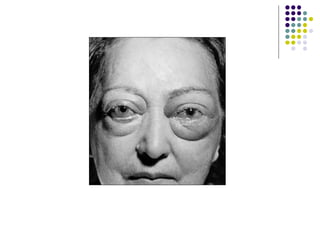
- Striking prominence of the eyes (exophthalmos)
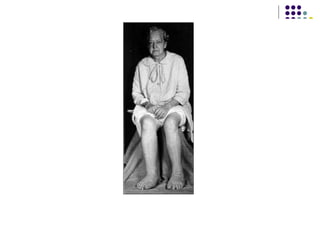
- Thickening of the skin over the lower leg (thyroid
dermopathy)
History
๏ฌ Exposure to ionizing radiation
๏ฌ Iodide ingestion:
- Kelp
- Iodide-containing cough preparation
- IV Iodide-containing contrast media
๏ฌ Lithium carbonate
๏ฌ Residence in an area of low dietary iodide
History
๏ฌ Family history
- Thyroid disease
- Immunologic disorders:
* Diabetes
* Rheumatoid disease
* Pernicious anemia
* Alopecia
* Vitiligo
* Myasthenia gravis
* MEN 2A
Physical examination
๏ฌ Observe the neck, especially as the patient
swallows
๏ฌ Examine from the front, rotating the gland
slightly with one thumb while palpating the
other lobe with the other thumb
๏ฌ Examine from behind, using three fingers and
the same technique
๏ฌ Determine the size of the thyroid lobes,
consistency, presence of nodules
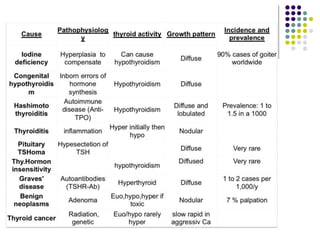
HYPOTHYROIDISM
Causes
๏ฌ Primary:
1. Hashimotoโ€™s thyroiditis:
- With goiter
- โ€œIdiopathicโ€ thyroid atrophy, presumably end-stage autoimmune thyroid
disease, following either Hashimotoโ€™s thyroiditis or Gravesโ€™ disease
- Neonatal hypothyroidism due to placental transmission of TSH-R blocking
antibodies
2. Radioactive iodine therapy for Gravesโ€™ disease
3. Subtotal thyroidectomy for Gravesโ€™ disease or nodular goiter
4. Excessive iodine intake (kelp, radiocontrast dyes)
5. Subacute thyroiditis
6. Iodide deficiency
7. Other goitrogens such as lithium, amiodarone, antithyroid drug therapy
8. Inborn errors of thyroid hormone synthesis
Causes
๏ฌ Secondary
- Hypopituitarism due to:
a- Pituitary adenoma
b- pituitary ablative therapy
c- pituitary destruction
๏ฌ Tertiary
- Hypothalamic dysfunction (rare)
๏ฌ Peripheral resistance of the action of thyroid
hormone
Pathogenesis
๏ฌ Thyroid hormone deficiency affects every
tissue in the body, so that the symptoms are
multiple
๏ฌ Accumulation of glycosaminoglycans-mostly
hyaluronic acid- in interstitial tissues
๏ฌ Increase capillary permeability to albumin
๏ฌ Interstitial edema (skin, heart muscle, striated
muscle)
Clinical presentations and
findings
๏ฌ Adults
- Common feature: easy fatigability, coldness, weight gain, constipation,
menstrual irregularities, and muscle cramps.
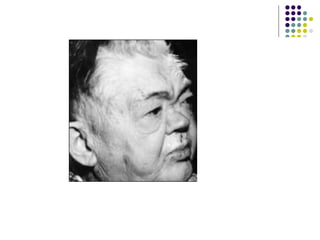
- Physical findings: cool rough dry skin, puffy face and hands, hoarse
husky voice, and slow reflexes, yellowish skin discoloration.
- Cardiovascular:
๏ฌ Bradycardia
๏ฌ Decreased cardiac output
๏ฌ Low voltage ECG
๏ฌ Cardiomegaly
๏ฌ Pericardial effusion
- Pulmonary function
๏ฌ Shallow and slow respiration
๏ฌ Respiratory failure
Clinical presentations and
findings
๏ฌ Adults (contโ€™)
- GI:
๏ฌ Chronic constipation
๏ฌ Ileus
- Renal function:
๏ฌ Impaired GFR
๏ฌ Water intoxication
- Anemia:
๏ฌ Impaired hemoglobin synthesis
๏ฌ Iron deficiency
๏ฌ Folate deficiency
๏ฌ Pernicious anemia, with B12 deficient megaloblastic anemia
Clinical presentations and
findings
๏ฌ Adults (contโ€™)
- Neuromuscular system:
๏ฌ Severe muscle cramps
๏ฌ Paresthesias
๏ฌ Muscle weakness
๏ฌ Carpal tunnel syndrome
- CNS:
๏ฌ Chronic fatigue
๏ฌ Lethargy
๏ฌ Decreased concentration
๏ฌ Anovulatory cycles and infertility
๏ฌ Menorrhagia
๏ฌ Depression
๏ฌ Agitation
Diagnosis
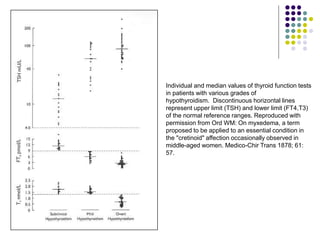
๏ฌ Low serum FT4
๏ฌ Elevated serum TSH
๏ฌ Thyroid antibodies
๏ฌ TRH stimulation test
Individual and median values of thyroid function tests
in patients with various grades of
hypothyroidism. Discontinuous horizontal lines
represent upper limit (TSH) and lower limit (FT4,T3)
of the normal reference ranges. Reproduced with
permission from Ord WM: On myxedema, a term
proposed to be applied to an essential condition in
the "cretinoid" affection occasionally observed in
middle-aged women. Medico-Chir Trans 1878; 61:
57.
Complications
๏ฌ 1- Myxedema coma
- The end stage of untreated hypothyroidism
- Progressive weakness, stupor, hypothermia, hypoventilation,
hypoglycemia, hyponatremia, water intoxication, shock, and death.
- Associate illnesses and precipitating factors: pneumonia, MI, cerebral
thrombosis, GI bleeding, ileus, excessive fluid administration, and
administration of sedatives and narcotics.
- Three main issues: CO2 retention and hypoxia, fluid and electrolyte
imbalance, and hypothermia.
๏ฌ 2- Myxedema and heart disease
๏ฌ 3- Hypothyroidism and neuropsychiatric
disease
Treatment
๏ฌ A- Hypothyroidism
- Levothyroxine (T4).
- Follow serum Free T4 and TSH
- Take dose in AM
- Do blood test fasting before taking the daily dose
- Adults: 1.7 ug/kg/d, but lower in elderly (1.6 ug/kg/d)
- For TSH suppression (nodular goiters or cancer): 2.2 ug/kg/d
- Increase dose of T4 in malabsorptive states or concurrent
administration of aluminum preparations, cholestyramine,
calcium, or iron compounds
- Increase dose of T4 in pregnancy and lactation
- The t1/2 of levothyroxine is 7 days
Treatment
๏ฌ B- Myxedema coma
- Acute medical emergency
- Monitor blood gases
- Patient may need intubation and mechanical ventilation
- Treat associated medical problems
- Avoid excessive hydration
- Asses adrenal function and treat if needed
- In pituitary myxedema, glucocorticoid replacement is essential
- IV levothyroxine: loading 300-400 ug, daily maintenance 50 ug
- Be cautious in patients with coronary artery disease
- Active rewarming of the body in contraindicated
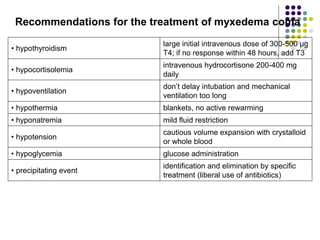
Recommendations for the treatment of myxedema coma
โ€ข hypothyroidism
large initial intravenous dose of 300-500 ยตg
T4; if no response within 48 hours, add T3
โ€ข hypocortisolemia
intravenous hydrocortisone 200-400 mg
daily
โ€ข hypoventilation
donโ€™t delay intubation and mechanical
ventilation too long
โ€ข hypothermia blankets, no active rewarming
โ€ข hyponatremia mild fluid restriction
โ€ข hypotension
cautious volume expansion with crystalloid
or whole blood
โ€ข hypoglycemia glucose administration
โ€ข precipitating event
identification and elimination by specific
treatment (liberal use of antibiotics)
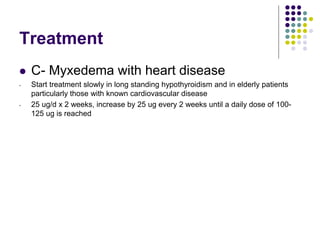
Treatment
๏ฌ C- Myxedema with heart disease
- Start treatment slowly in long standing hypothyroidism and in elderly patients
particularly those with known cardiovascular disease
- 25 ug/d x 2 weeks, increase by 25 ug every 2 weeks until a daily dose of 100-
125 ug is reached
Treatment
๏ฌ Toxic effects of levothyroxine therapy
- No allergy has been reported to pure levothyroxine
- If FT4 and TSH are followed and T4 dose is adjusted, no side effects are
reported
- If FT4 is higher than normal: hyperthyroidism symptoms may occur:
๏ฌ Cardiac symptoms
๏ฌ Osteopenia and osteoporosis
HYPERTHYROIDISM &
THYROTOXICOSIS
Definitions
๏ฌ Thyrotoxicosis: is the clinical syndrome that
results when tissues are exposed to high
levels of circulating thyroid hormone
๏ฌ Hyperthyroidism: is the hyperactivity of the
thyroid gland
Conditions associated with
thyrotoxicosis
๏ฌ Diffuse toxic goiter (Gravesโ€™ disease)
๏ฌ Toxic adenoma (Plummerโ€™s disease)
๏ฌ Toxic multinodular goiter
๏ฌ Subacute thyroiditis
๏ฌ Hyperthyroid phase of Hashimotoโ€™s thyroiditis
๏ฌ Thyrotoxicosis factitia
๏ฌ Rare: ovarian struma, metastatic thyroid carcinoma
(follicular), hydatiform mole, TSH secreting pituitary
tumor, pituitary resistance to T3 and T4
Diffuse Toxic Goiter
(Gravesโ€™ disease)
๏ฌ Most common form of thyrotoxicosis
๏ฌ Females > Males
๏ฌ Features:
- Thyrotoxicosis
- Goiter
- Orbitopathy (exophthalmos)
- Dermopathy (pretibial myxedema)
Etiology
๏ฌ Autoimmune disease of unknown cause
๏ฌ There is a strong familial predisposition
๏ฌ Peak incidence in the 20- to 40- year age
group
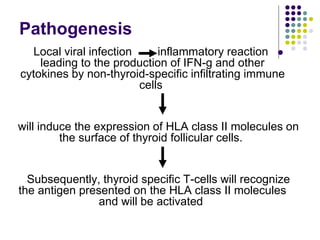
Pathogenesis
๏ฌ
Local viral infection inflammatory reaction
leading to the production of IFN-g and other
cytokines by non-thyroid-specific infiltrating immune
cells
will induce the expression of HLA class II molecules on
the surface of thyroid follicular cells.
Subsequently, thyroid specific T-cells will recognize
the antigen presented on the HLA class II molecules
and will be activated
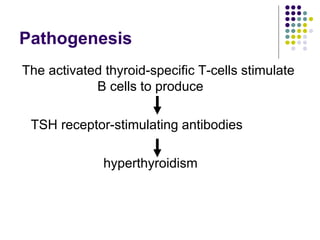
Pathogenesis
The activated thyroid-specific T-cells stimulate
B cells to produce
TSH receptor-stimulating antibodies
hyperthyroidism
WWW.thyroidmanager.org
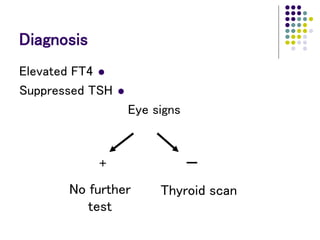
Diagnosis
๏ฌ
Elevated FT4
๏ฌ
Suppressed TSH
Eye signs
+
No further
test
-
Thyroid scan
Radioiodine uptake scan
๏ฌ Elevated uptake:
- Gravesโ€™ disease
- TMN
๏ฌ Low uptake:
- Spontaneous resolving hyperthyroidism
- Subacute thyroiditis
- Thyrotoxic phase of Hashimotoโ€™s thyroiditis
- Iodine loaded patients
- Patients on LT4 therapy
- Struma ovarii
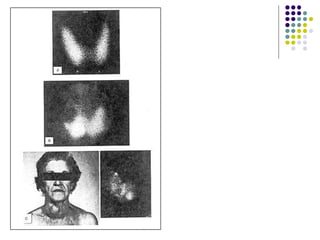
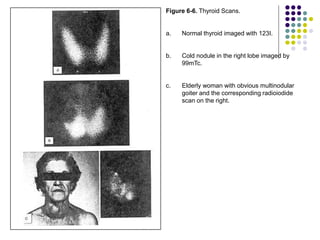
Figure 6-6. Thyroid Scans.
a. Normal thyroid imaged with 123I.
b. Cold nodule in the right lobe imaged by
99mTc.
c. Elderly woman with obvious multinodular
goiter and the corresponding radioiodide
scan on the right.
Diagnosis
๏ฌ TSH-R Ab [stim]
๏ฌ Free T3
๏ฌ Atypical presentations:
- Thyrotoxic periodic paralysis
- Thyrocardiac disease
- Apathetic hyperthyroidism
- Familial dysalbuminemic hyperthyroxinemia
Complications
๏ฌ Thyrotoxic crisis (thyroid storm)
- Predisposing conditions
- Clinical features:
* Fever / Agitation
* Altered mental status
* Atrial fibrillation / Heart failure
Treatment of Gravesโ€™ disease
๏ฌ Antithyroid drug therapy
- Propylthiouracil or methimazole
- Spontaneous remission 20-40%
- Relapse 50-60%
- Duration of treatment 6 months โ€“ years
- Reactions to antithyroid drugs
Treatment of Gravesโ€™ disease
๏ฌ Surgical treatment
- Subtotal thyroidectomy
- Preparation for surgery
- Complications:
* hypothyroidism/ hypoparathyroidism
* Recurrent laryngeal nerve injury
Treatment of Gravesโ€™ disease
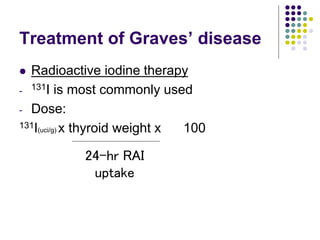
๏ฌ Radioactive iodine therapy
- 131I is most commonly used
- Dose:
131I(uci/g) x thyroid weight x 100
24-hr RAI
uptake
Treatment of Gravesโ€™ disease
๏ฌ b-blockers
๏ฌ SSKI
Treatment of Gravesโ€™ disease
complications
๏ฌ Thyrotoxic crisis
๏ฌ Orbitopathy
๏ฌ Thyrotoxicosis and pregnancy
Treatment of other forms of
thyrotoxicosis
๏ฌ Toxic adenoma
๏ฌ TMN
๏ฌ Amiodarone
๏ฌ Subacute thyroiditis
๏ฌ Thyrotoxicosis factitia
๏ฌ Struma ovarii
Other thyroid disorders
๏ฌ Nontoxic goiter
๏ฌ Subacute thyroiditis (De Quervainโ€™s)
๏ฌ Chronic thyroiditis
๏ฌ Acute thyroiditis
๏ฌ Thyroid nodules
๏ฌ Thyroid cancer
๏‚งThank you
Goiter and thyroid
nodules
Anwar Ali Jammah,
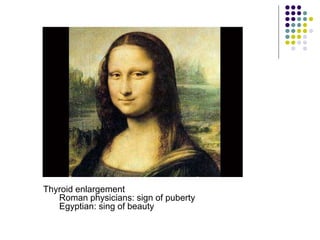
Thyroid enlargement
Roman physicians: sign of puberty
Egyptian: sing of beauty
History
๏ฌ Goiter
๏ฌ Fist described in China in 2700 BC
๏ฌ Thyroid Function
๏ฌ Da Vinci โ€“ thyroid is designed to fill empty spaces in the neck
๏ฌ Parry โ€“ thyroid works as a buffer to protect the brain from
surges in blood flow
Surgical advances
๏ฌ 500 AD
๏ฌ First goiter excision in Baghdad.
๏ฌ Procedure: unknown
๏ฌ 1200โ€™s AD
๏ฌ Advancements in goiter procedures included applying hot irons through
the skin and slowly withdrawing them at right angles.
๏ฌ Most died from hemorrhage or sepsis.
๏ฌ 1646 AD
๏ฌ Wilhelm Fabricus performed a thyroidectomy with standard surgical
scalpels.
๏ฌ The 10 y/o girl died, and he was imprisoned
๏ฌ 1808 AD
๏ฌ Guillaume Dupuytren performed a total thyroidectomy.
๏ฌ The patient died postoperatively of โ€œshockโ€
Surgical advances
๏ฌ 1866
๏ฌ โ€œIf a surgeon should be so foolhardy as to undertake it
[thyroidectomy] โ€ฆ every step of the way will be
environed with difficulty, every stroke of his knife will
be followed by a torrent of blood, and lucky will it be
for him if his victim lives long enough to enable him to
finish his horrid butchery.โ€
โ€“ Samuel David Gross
Surgical advances
๏ฌ 1883
Kocherโ€™s performs a retrospective review
๏ฌ 5000 career thyroidectomies
๏ฌ Mortality rates decreased
๏‚ง 40% in 1850 (pre-Kocher & Bilroth)
๏‚ง 12.6% in 1870โ€™s (Kocher begins practice)
๏‚ง 0.2% in 1898 (end of Kocherโ€™s career)
๏ฌ Many patients developed cretinism or myxedema
His conclusions โ€ฆ.
Surgical advances
In presentation to the German Surgical
Congress โ€ฆ
โ€œ โ€ฆthe thyroid gland in fact had a functionโ€ฆ.โ€
- Theodor Kocher, 1883
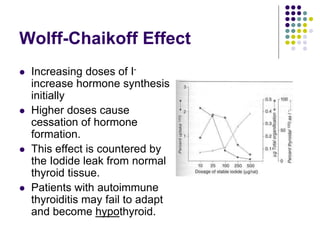
Wolff-Chaikoff Effect
๏ฌ Increasing doses of I-
increase hormone synthesis
initially
๏ฌ Higher doses cause
cessation of hormone
formation.
๏ฌ This effect is countered by
the Iodide leak from normal
thyroid tissue.
๏ฌ Patients with autoimmune
thyroiditis may fail to adapt
and become hypothyroid.
Jod-Basedow Effect
๏ฌ Opposite of the Wolff-Chaikoff effect
๏ฌ Excessive iodine loads induce hyperthyroidism
๏ฌ Observed in hyperthyroid disease processes
๏ฌ Gravesโ€™ disease
๏ฌ Toxic multinodular goiter
๏ฌ Toxic adenoma
๏ฌ This effect may lead to symptomatic thyrotoxicosis in
patients who receive large iodine doses from
๏ฌ Dietary changes
๏ฌ Contrast administration
๏ฌ Iodine containing medication (Amiodarone)
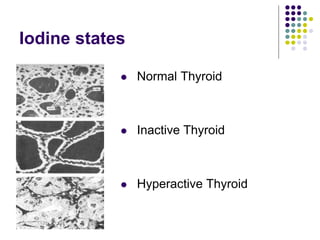
Iodine states
๏ฌ Normal Thyroid
๏ฌ Inactive Thyroid
๏ฌ Hyperactive Thyroid
Hypo and Hyperthyroidism.ppt

Hypo and Hyperthyroidism.ppt

  • 1.
    Thyroid disorders Prof. AssimA Alfadda MD,FACP,FRCPC,MSc
  • 2.
    Objectives * How toevaluate a patient with thyroid disease? * Hypothyroidism and Hyperthyroidism: causes, pathogenesis, diagnosis and treatment. * Other thyroid disorders.
  • 3.
    Patients with thyroiddisease ๏ฌ Thyroid enlargement (goiter): diffuse or nodular ๏ฌ Symptoms of hypothyroidism ๏ฌ Symptoms of hyperthyroidism ๏ฌ Complications of a specific form of hyperthyroidism- Gravesโ€™ disease-which may present with: - Striking prominence of the eyes (exophthalmos) - Thickening of the skin over the lower leg (thyroid dermopathy)
  • 4.
    History ๏ฌ Exposure toionizing radiation ๏ฌ Iodide ingestion: - Kelp - Iodide-containing cough preparation - IV Iodide-containing contrast media ๏ฌ Lithium carbonate ๏ฌ Residence in an area of low dietary iodide
  • 5.
    History ๏ฌ Family history -Thyroid disease - Immunologic disorders: * Diabetes * Rheumatoid disease * Pernicious anemia * Alopecia * Vitiligo * Myasthenia gravis * MEN 2A
  • 6.
    Physical examination ๏ฌ Observethe neck, especially as the patient swallows ๏ฌ Examine from the front, rotating the gland slightly with one thumb while palpating the other lobe with the other thumb ๏ฌ Examine from behind, using three fingers and the same technique ๏ฌ Determine the size of the thyroid lobes, consistency, presence of nodules
  • 7.
  • 8.
    Causes ๏ฌ Primary: 1. Hashimotoโ€™sthyroiditis: - With goiter - โ€œIdiopathicโ€ thyroid atrophy, presumably end-stage autoimmune thyroid disease, following either Hashimotoโ€™s thyroiditis or Gravesโ€™ disease - Neonatal hypothyroidism due to placental transmission of TSH-R blocking antibodies 2. Radioactive iodine therapy for Gravesโ€™ disease 3. Subtotal thyroidectomy for Gravesโ€™ disease or nodular goiter 4. Excessive iodine intake (kelp, radiocontrast dyes) 5. Subacute thyroiditis 6. Iodide deficiency 7. Other goitrogens such as lithium, amiodarone, antithyroid drug therapy 8. Inborn errors of thyroid hormone synthesis
  • 9.
    Causes ๏ฌ Secondary - Hypopituitarismdue to: a- Pituitary adenoma b- pituitary ablative therapy c- pituitary destruction ๏ฌ Tertiary - Hypothalamic dysfunction (rare) ๏ฌ Peripheral resistance of the action of thyroid hormone
  • 10.
    Pathogenesis ๏ฌ Thyroid hormonedeficiency affects every tissue in the body, so that the symptoms are multiple ๏ฌ Accumulation of glycosaminoglycans-mostly hyaluronic acid- in interstitial tissues ๏ฌ Increase capillary permeability to albumin ๏ฌ Interstitial edema (skin, heart muscle, striated muscle)
  • 12.
    Clinical presentations and findings ๏ฌAdults - Common feature: easy fatigability, coldness, weight gain, constipation, menstrual irregularities, and muscle cramps. - Physical findings: cool rough dry skin, puffy face and hands, hoarse husky voice, and slow reflexes, yellowish skin discoloration. - Cardiovascular: ๏ฌ Bradycardia ๏ฌ Decreased cardiac output ๏ฌ Low voltage ECG ๏ฌ Cardiomegaly ๏ฌ Pericardial effusion - Pulmonary function ๏ฌ Shallow and slow respiration ๏ฌ Respiratory failure
  • 13.
    Clinical presentations and findings ๏ฌAdults (contโ€™) - GI: ๏ฌ Chronic constipation ๏ฌ Ileus - Renal function: ๏ฌ Impaired GFR ๏ฌ Water intoxication - Anemia: ๏ฌ Impaired hemoglobin synthesis ๏ฌ Iron deficiency ๏ฌ Folate deficiency ๏ฌ Pernicious anemia, with B12 deficient megaloblastic anemia
  • 14.
    Clinical presentations and findings ๏ฌAdults (contโ€™) - Neuromuscular system: ๏ฌ Severe muscle cramps ๏ฌ Paresthesias ๏ฌ Muscle weakness ๏ฌ Carpal tunnel syndrome - CNS: ๏ฌ Chronic fatigue ๏ฌ Lethargy ๏ฌ Decreased concentration ๏ฌ Anovulatory cycles and infertility ๏ฌ Menorrhagia ๏ฌ Depression ๏ฌ Agitation
  • 15.
    Diagnosis ๏ฌ Low serumFT4 ๏ฌ Elevated serum TSH ๏ฌ Thyroid antibodies ๏ฌ TRH stimulation test
  • 16.
    Individual and medianvalues of thyroid function tests in patients with various grades of hypothyroidism. Discontinuous horizontal lines represent upper limit (TSH) and lower limit (FT4,T3) of the normal reference ranges. Reproduced with permission from Ord WM: On myxedema, a term proposed to be applied to an essential condition in the "cretinoid" affection occasionally observed in middle-aged women. Medico-Chir Trans 1878; 61: 57.
  • 17.
    Complications ๏ฌ 1- Myxedemacoma - The end stage of untreated hypothyroidism - Progressive weakness, stupor, hypothermia, hypoventilation, hypoglycemia, hyponatremia, water intoxication, shock, and death. - Associate illnesses and precipitating factors: pneumonia, MI, cerebral thrombosis, GI bleeding, ileus, excessive fluid administration, and administration of sedatives and narcotics. - Three main issues: CO2 retention and hypoxia, fluid and electrolyte imbalance, and hypothermia. ๏ฌ 2- Myxedema and heart disease ๏ฌ 3- Hypothyroidism and neuropsychiatric disease
  • 18.
    Treatment ๏ฌ A- Hypothyroidism -Levothyroxine (T4). - Follow serum Free T4 and TSH - Take dose in AM - Do blood test fasting before taking the daily dose - Adults: 1.7 ug/kg/d, but lower in elderly (1.6 ug/kg/d) - For TSH suppression (nodular goiters or cancer): 2.2 ug/kg/d - Increase dose of T4 in malabsorptive states or concurrent administration of aluminum preparations, cholestyramine, calcium, or iron compounds - Increase dose of T4 in pregnancy and lactation - The t1/2 of levothyroxine is 7 days
  • 19.
    Treatment ๏ฌ B- Myxedemacoma - Acute medical emergency - Monitor blood gases - Patient may need intubation and mechanical ventilation - Treat associated medical problems - Avoid excessive hydration - Asses adrenal function and treat if needed - In pituitary myxedema, glucocorticoid replacement is essential - IV levothyroxine: loading 300-400 ug, daily maintenance 50 ug - Be cautious in patients with coronary artery disease - Active rewarming of the body in contraindicated
  • 20.
    Recommendations for thetreatment of myxedema coma โ€ข hypothyroidism large initial intravenous dose of 300-500 ยตg T4; if no response within 48 hours, add T3 โ€ข hypocortisolemia intravenous hydrocortisone 200-400 mg daily โ€ข hypoventilation donโ€™t delay intubation and mechanical ventilation too long โ€ข hypothermia blankets, no active rewarming โ€ข hyponatremia mild fluid restriction โ€ข hypotension cautious volume expansion with crystalloid or whole blood โ€ข hypoglycemia glucose administration โ€ข precipitating event identification and elimination by specific treatment (liberal use of antibiotics)
  • 21.
    Treatment ๏ฌ C- Myxedemawith heart disease - Start treatment slowly in long standing hypothyroidism and in elderly patients particularly those with known cardiovascular disease - 25 ug/d x 2 weeks, increase by 25 ug every 2 weeks until a daily dose of 100- 125 ug is reached
  • 22.
    Treatment ๏ฌ Toxic effectsof levothyroxine therapy - No allergy has been reported to pure levothyroxine - If FT4 and TSH are followed and T4 dose is adjusted, no side effects are reported - If FT4 is higher than normal: hyperthyroidism symptoms may occur: ๏ฌ Cardiac symptoms ๏ฌ Osteopenia and osteoporosis
  • 23.
  • 24.
    Definitions ๏ฌ Thyrotoxicosis: isthe clinical syndrome that results when tissues are exposed to high levels of circulating thyroid hormone ๏ฌ Hyperthyroidism: is the hyperactivity of the thyroid gland
  • 25.
    Conditions associated with thyrotoxicosis ๏ฌDiffuse toxic goiter (Gravesโ€™ disease) ๏ฌ Toxic adenoma (Plummerโ€™s disease) ๏ฌ Toxic multinodular goiter ๏ฌ Subacute thyroiditis ๏ฌ Hyperthyroid phase of Hashimotoโ€™s thyroiditis ๏ฌ Thyrotoxicosis factitia ๏ฌ Rare: ovarian struma, metastatic thyroid carcinoma (follicular), hydatiform mole, TSH secreting pituitary tumor, pituitary resistance to T3 and T4
  • 26.
    Diffuse Toxic Goiter (Gravesโ€™disease) ๏ฌ Most common form of thyrotoxicosis ๏ฌ Females > Males ๏ฌ Features: - Thyrotoxicosis - Goiter - Orbitopathy (exophthalmos) - Dermopathy (pretibial myxedema)
  • 27.
    Etiology ๏ฌ Autoimmune diseaseof unknown cause ๏ฌ There is a strong familial predisposition ๏ฌ Peak incidence in the 20- to 40- year age group
  • 28.
    Pathogenesis ๏ฌ Local viral infectioninflammatory reaction leading to the production of IFN-g and other cytokines by non-thyroid-specific infiltrating immune cells will induce the expression of HLA class II molecules on the surface of thyroid follicular cells. Subsequently, thyroid specific T-cells will recognize the antigen presented on the HLA class II molecules and will be activated
  • 29.
    Pathogenesis The activated thyroid-specificT-cells stimulate B cells to produce TSH receptor-stimulating antibodies hyperthyroidism
  • 30.
  • 32.
  • 33.
    Radioiodine uptake scan ๏ฌElevated uptake: - Gravesโ€™ disease - TMN ๏ฌ Low uptake: - Spontaneous resolving hyperthyroidism - Subacute thyroiditis - Thyrotoxic phase of Hashimotoโ€™s thyroiditis - Iodine loaded patients - Patients on LT4 therapy - Struma ovarii
  • 37.
    Figure 6-6. ThyroidScans. a. Normal thyroid imaged with 123I. b. Cold nodule in the right lobe imaged by 99mTc. c. Elderly woman with obvious multinodular goiter and the corresponding radioiodide scan on the right.
  • 38.
    Diagnosis ๏ฌ TSH-R Ab[stim] ๏ฌ Free T3 ๏ฌ Atypical presentations: - Thyrotoxic periodic paralysis - Thyrocardiac disease - Apathetic hyperthyroidism - Familial dysalbuminemic hyperthyroxinemia
  • 39.
    Complications ๏ฌ Thyrotoxic crisis(thyroid storm) - Predisposing conditions - Clinical features: * Fever / Agitation * Altered mental status * Atrial fibrillation / Heart failure
  • 40.
    Treatment of Gravesโ€™disease ๏ฌ Antithyroid drug therapy - Propylthiouracil or methimazole - Spontaneous remission 20-40% - Relapse 50-60% - Duration of treatment 6 months โ€“ years - Reactions to antithyroid drugs
  • 41.
    Treatment of Gravesโ€™disease ๏ฌ Surgical treatment - Subtotal thyroidectomy - Preparation for surgery - Complications: * hypothyroidism/ hypoparathyroidism * Recurrent laryngeal nerve injury
  • 42.
    Treatment of Gravesโ€™disease ๏ฌ Radioactive iodine therapy - 131I is most commonly used - Dose: 131I(uci/g) x thyroid weight x 100 24-hr RAI uptake
  • 43.
    Treatment of Gravesโ€™disease ๏ฌ b-blockers ๏ฌ SSKI
  • 44.
    Treatment of Gravesโ€™disease complications ๏ฌ Thyrotoxic crisis ๏ฌ Orbitopathy ๏ฌ Thyrotoxicosis and pregnancy
  • 45.
    Treatment of otherforms of thyrotoxicosis ๏ฌ Toxic adenoma ๏ฌ TMN ๏ฌ Amiodarone ๏ฌ Subacute thyroiditis ๏ฌ Thyrotoxicosis factitia ๏ฌ Struma ovarii
  • 46.
    Other thyroid disorders ๏ฌNontoxic goiter ๏ฌ Subacute thyroiditis (De Quervainโ€™s) ๏ฌ Chronic thyroiditis ๏ฌ Acute thyroiditis ๏ฌ Thyroid nodules ๏ฌ Thyroid cancer
  • 47.
  • 48.
  • 49.
    Thyroid enlargement Roman physicians:sign of puberty Egyptian: sing of beauty
  • 50.
    History ๏ฌ Goiter ๏ฌ Fistdescribed in China in 2700 BC ๏ฌ Thyroid Function ๏ฌ Da Vinci โ€“ thyroid is designed to fill empty spaces in the neck ๏ฌ Parry โ€“ thyroid works as a buffer to protect the brain from surges in blood flow
  • 51.
    Surgical advances ๏ฌ 500AD ๏ฌ First goiter excision in Baghdad. ๏ฌ Procedure: unknown ๏ฌ 1200โ€™s AD ๏ฌ Advancements in goiter procedures included applying hot irons through the skin and slowly withdrawing them at right angles. ๏ฌ Most died from hemorrhage or sepsis. ๏ฌ 1646 AD ๏ฌ Wilhelm Fabricus performed a thyroidectomy with standard surgical scalpels. ๏ฌ The 10 y/o girl died, and he was imprisoned ๏ฌ 1808 AD ๏ฌ Guillaume Dupuytren performed a total thyroidectomy. ๏ฌ The patient died postoperatively of โ€œshockโ€
  • 52.
    Surgical advances ๏ฌ 1866 ๏ฌโ€œIf a surgeon should be so foolhardy as to undertake it [thyroidectomy] โ€ฆ every step of the way will be environed with difficulty, every stroke of his knife will be followed by a torrent of blood, and lucky will it be for him if his victim lives long enough to enable him to finish his horrid butchery.โ€ โ€“ Samuel David Gross
  • 53.
    Surgical advances ๏ฌ 1883 Kocherโ€™sperforms a retrospective review ๏ฌ 5000 career thyroidectomies ๏ฌ Mortality rates decreased ๏‚ง 40% in 1850 (pre-Kocher & Bilroth) ๏‚ง 12.6% in 1870โ€™s (Kocher begins practice) ๏‚ง 0.2% in 1898 (end of Kocherโ€™s career) ๏ฌ Many patients developed cretinism or myxedema His conclusions โ€ฆ.
  • 54.
    Surgical advances In presentationto the German Surgical Congress โ€ฆ โ€œ โ€ฆthe thyroid gland in fact had a functionโ€ฆ.โ€ - Theodor Kocher, 1883
  • 55.
    Wolff-Chaikoff Effect ๏ฌ Increasingdoses of I- increase hormone synthesis initially ๏ฌ Higher doses cause cessation of hormone formation. ๏ฌ This effect is countered by the Iodide leak from normal thyroid tissue. ๏ฌ Patients with autoimmune thyroiditis may fail to adapt and become hypothyroid.
  • 56.
    Jod-Basedow Effect ๏ฌ Oppositeof the Wolff-Chaikoff effect ๏ฌ Excessive iodine loads induce hyperthyroidism ๏ฌ Observed in hyperthyroid disease processes ๏ฌ Gravesโ€™ disease ๏ฌ Toxic multinodular goiter ๏ฌ Toxic adenoma ๏ฌ This effect may lead to symptomatic thyrotoxicosis in patients who receive large iodine doses from ๏ฌ Dietary changes ๏ฌ Contrast administration ๏ฌ Iodine containing medication (Amiodarone)
  • 57.
    Iodine states ๏ฌ NormalThyroid ๏ฌ Inactive Thyroid ๏ฌ Hyperactive Thyroid