HYPERTHYROIDISM
PRESENTED BY: MUHAMMAD WASIL KHAN
CASE 1
 A 35-year-old female presents with complaints of a rapid heartbeat, excessive
sweating, difficulty sleeping, irritability, and weight loss of 25 lb in the last 4
months despite having an increased appetite. Upon further questioning, she
reports frequently feeling hot, having increased loose stools or diarrhea, and
thinning of her hair. She has no other past medical history. Family history
reveals a history of maternal “thyroid issues” and paternal hypertension.
 Past routine physical examinations document heart rates in the 70s and blood
pressures around 110/70, but today her blood pressure is 135/90 and heart
rate is 110 beats per minute. On examination, you note a fine tremor in her
hands, bulging eyes, pretibial myxedema (PTM), and a diffusely enlarged
thyroid.
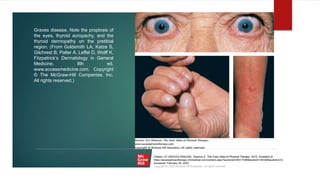
Graves disease. Note the proptosis of
the eyes, thyroid acropachy, and the
thyroid dermopathy on the pretibial
region. (From Goldsmith LA, Katze S,
Gilchrest B, Paller A, Leffel D, Wolff K.
Fitzpatrick’s Dermatology in General
Medicine, 8th ed.
www.accessmedicine.com. Copyright
© The McGraw-Hill Companies, Inc.
All rights reserved.)
Citation: 47 GRAVES DISEASE, Shamus E. The Color Atlas of Physical Therapy; 2015. Available at:
https://accessphysiotherapy.mhmedical.com/content.aspx?sectionid=90317395&bookid=1491&Resultclick=2
Accessed: February 26, 2023
Copyright © 2023 McGraw-Hill Education. All rights reserved
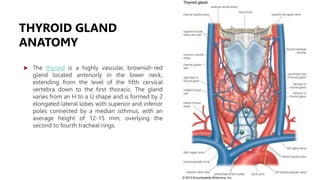
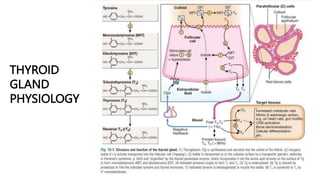
 The thyroid is a highly vascular, brownish-red
gland located anteriorly in the lower neck,
extending from the level of the fifth cervical
vertebra down to the first thoracic. The gland
varies from an H to a U shape and is formed by 2
elongated lateral lobes with superior and inferior
poles connected by a median isthmus, with an
average height of 12-15 mm, overlying the
second to fourth tracheal rings.
THYROID GLAND
ANATOMY
THYROID
GLAND
PHYSIOLOGY
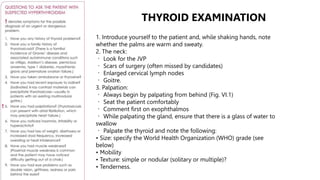
1. Introduce yourself to the patient and, while shaking hands, note
whether the palms are warm and sweaty.
2. The neck:
Look for the JVP
Scars of surgery (often missed by candidates)
Enlarged cervical lymph nodes
Goitre.
3. Palpation:
Always begin by palpating from behind (Fig. VI.1)
Seat the patient comfortably
Comment first on exophthalmos
While palpating the gland, ensure that there is a glass of water to
swallow
Palpate the thyroid and note the following:
• Size: specify the World Health Organization (WHO) grade (see
below)
• Mobility
• Texture: simple or nodular (solitary or multiple)?
• Tenderness.
THYROID EXAMINATION
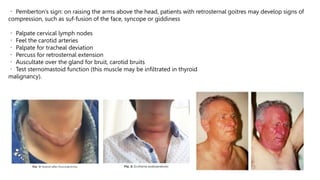
Pemberton’s sign: on raising the arms above the head, patients with retrosternal goitres may develop signs of
compression, such as suf-fusion of the face, syncope or giddiness
Palpate cervical lymph nodes
Feel the carotid arteries
Palpate for tracheal deviation
Percuss for retrosternal extension
Auscultate over the gland for bruit, carotid bruits
Test sternomastoid function (this muscle may be infiltrated in thyroid
malignancy).
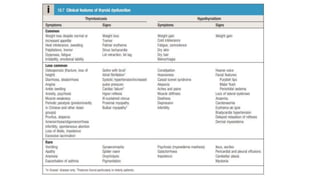
4. Thyroid function:
Eye signs:
• Lid lag
• Exophthalmos
• Lid retraction (sclera visible above the cornea)
• Extraocular movements.
Hands:
• Pulse for tachycardia or atrial fibrillation
• Tremor
• Acropachy or clubbing
Palmar erythema (thyrotoxicosis)
• Supinator jerks (inverted in hypothyroidism)
• Proximal weakness in the upper arm.
Skin
• Look for pretibial myxoedema.
Elicit the ankle jerks.
5. If you are permitted to ask questions, enquire about
shortness of breath,
dysphagia, about iodine-containing medications and possible
exposure
to radiation.
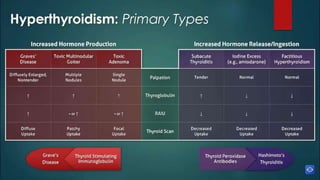
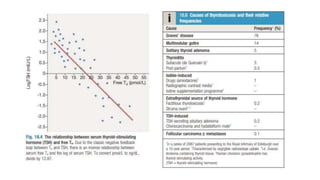
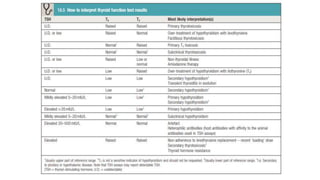
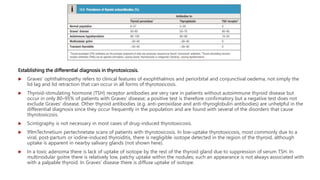
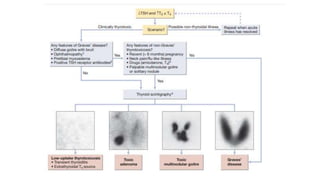
Establishing the differential diagnosis in thyrotoxicosis.
 Graves’ ophthalmopathy refers to clinical features of exophthalmos and periorbital and conjunctival oedema, not simply the
lid lag and lid retraction that can occur in all forms of thyrotoxicosis.
 Thyroid-stimulating hormone (TSH) receptor antibodies are very rare in patients without autoimmune thyroid disease but
occur in only 80–95% of patients with Graves’ disease; a positive test is therefore confirmatory but a negative test does not
exclude Graves’ disease. Other thyroid antibodies (e.g. anti-peroxidase and anti-thyroglobulin antibodies) are unhelpful in the
differential diagnosis since they occur frequently in the population and are found with several of the disorders that cause
thyrotoxicosis.
 Scintigraphy is not necessary in most cases of drug-induced thyrotoxicosis.
 99mTechnetium pertechnetate scans of patients with thyrotoxicosis. In low-uptake thyrotoxicosis, most commonly due to a
viral, post-partum or iodine-induced thyroiditis, there is negligible isotope detected in the region of the thyroid, although
uptake is apparent in nearby salivary glands (not shown here).
 In a toxic adenoma there is lack of uptake of isotope by the rest of the thyroid gland due to suppression of serum TSH. In
multinodular goitre there is relatively low, patchy uptake within the nodules; such an appearance is not always associated with
with a palpable thyroid. In Graves’ disease there is diffuse uptake of isotope.
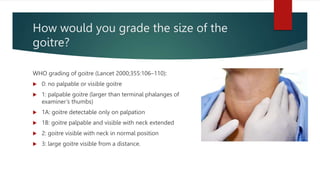
How would you grade the size of the
goitre?
WHO grading of goitre (Lancet 2000;355:106–110):
 0: no palpable or visible goitre
 1: palpable goitre (larger than terminal phalanges of
examiner’s thumbs)
 1A: goitre detectable only on palpation
 1B: goitre palpable and visible with neck extended
 2: goitre visible with neck in normal position
 3: large goitre visible from a distance.
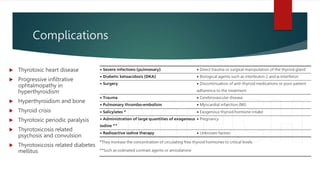
Complications
 Thyrotoxic heart disease
 Progressive infiltrative
ophtalmopathy in
hyperthyroidism
 Hyperthyroidism and bone
 Thyroid crisis
 Thyrotoxic periodic paralysis
 Thyrotoxicosis related
psychosis and convulsion
 Thyrotoxicosis related diabetes
mellitus
Case 2
A 26-year-old woman presented to the acute medical unit with palpitations, tremor, and
anxiety. She gave a six-month history of weight loss and oligomenorrhoea. She
complained of dry, gritty eyes, which were more prominent than usual, and she’d
developed a non-tender swelling in her neck. She was usually fit and well, took no over-
the-counter supplements, and was on no regular medication. She had not been able to
exercise at the gym due to fatigue and was finding the stairs difficult. Her mother had
hypothyroidism following radioactive iodine treatment, her twin sister had type 1
diabetes, and a cousin had coeliac disease. She was not using any contraception and
wanted to get pregnant.
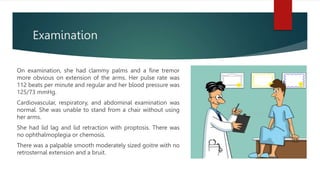
Examination
On examination, she had clammy palms and a fine tremor
more obvious on extension of the arms. Her pulse rate was
112 beats per minute and regular and her blood pressure was
125/73 mmHg.
Cardiovascular, respiratory, and abdominal examination was
normal. She was unable to stand from a chair without using
her arms.
She had lid lag and lid retraction with proptosis. There was
no ophthalmoplegia or chemosis.
There was a palpable smooth moderately sized goitre with no
retrosternal extension and a bruit.
Investigations
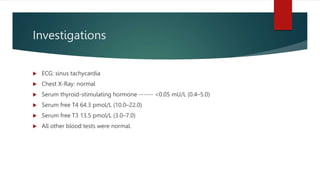
 ECG: sinus tachycardia
 Chest X-Ray: normal
 Serum thyroid-stimulating hormone ------ <0.05 mU/L (0.4–5.0)
 Serum free T4 64.3 pmol/L (10.0–22.0)
 Serum free T3 13.5 pmol/L (3.0–7.0)
 All other blood tests were normal.
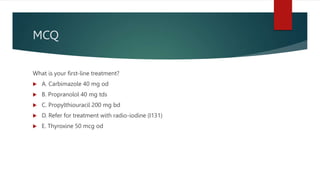
MCQ
What is your first-line treatment?
 A. Carbimazole 40 mg od
 B. Propranolol 40 mg tds
 C. Propylthiouracil 200 mg bd
 D. Refer for treatment with radio-iodine (I131)
 E. Thyroxine 50 mcg od
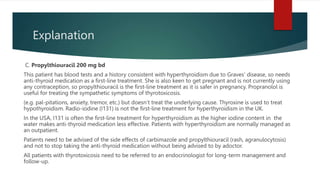
Explanation
C. Propylthiouracil 200 mg bd
This patient has blood tests and a history consistent with hyperthyroidism due to Graves’ disease, so needs
anti-thyroid medication as a first-line treatment. She is also keen to get pregnant and is not currently using
any contraception, so propylthiouracil is the first-line treatment as it is safer in pregnancy. Propranolol is
useful for treating the sympathetic symptoms of thyrotoxicosis.
(e.g. pal-pitations, anxiety, tremor, etc.) but doesn’t treat the underlying cause. Thyroxine is used to treat
hypothyroidism. Radio-iodine (I131) is not the first-line treatment for hyperthyroidism in the UK.
In the USA, I131 is often the first-line treatment for hyperthyroidism as the higher iodine content in the
water makes anti-thyroid medication less effective. Patients with hyperthyroidism are normally managed as
an outpatient.
Patients need to be advised of the side effects of carbimazole and propylthiouracil (rash, agranulocytosis)
and not to stop taking the anti-thyroid medication without being advised to by adoctor.
All patients with thyrotoxicosis need to be referred to an endocrinologist for long-term management and
follow-up.
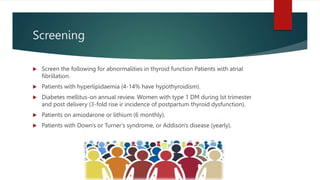
Screening
 Screen the following for abnormalities in thyroid function Patients with atrial
fibrillation.
 Patients with hyperlipidaemia (4-14% have hypothyroidism).
 Diabetes mellitus-on annual review. Women with type 1 DM during lst trimester
and post delivery (3-fold rise ir incidence of postpartum thyroid dysfunction).
 Patients on amiodarone or lithium (6 monthly).
 Patients with Down's or Turner's syndrome, or Addison's disease (yearly).
https://pubmed.ncbi.nlm.nih.gov/36831150/
Biomedicines. 2023 Feb 18;11(2):614.
doi: 10.3390/biomedicines11020614.
PMID: 36831150.
References
 250 Cases in Clinical Medicine International Edition, 6th Edition
 Davidson's Principles and Practice of Medicine - 24th Edition
 https://www.semanticscholar.org/paper/Complications-of-Hyperthyroidism-
Say%C4%B1n-Ertek/e0aab81f7a855598dd4cdc11d0ece908f771d4a5/figure/4
 https://accessmedicine.mhmedical.com/Content.aspx?bookId=685&sectionId=453613
04
 Best of Five MCQs for the Acute Medicine SCE
 De Groot L. http://endotext.org, thyroid disease manager. Accessed January 2013.
 Wass J, Owen K. Oxford handbook of endocrinology and diabetes. Oxford University
Press, 2014.
 Wass J, Stewart P et al. Oxford textbook of endocrinology and diabetes. Oxford
University Press, 2011.
HYPERTHYROIDISM

HYPERTHYROIDISM

  • 1.
  • 2.
    CASE 1  A35-year-old female presents with complaints of a rapid heartbeat, excessive sweating, difficulty sleeping, irritability, and weight loss of 25 lb in the last 4 months despite having an increased appetite. Upon further questioning, she reports frequently feeling hot, having increased loose stools or diarrhea, and thinning of her hair. She has no other past medical history. Family history reveals a history of maternal “thyroid issues” and paternal hypertension.  Past routine physical examinations document heart rates in the 70s and blood pressures around 110/70, but today her blood pressure is 135/90 and heart rate is 110 beats per minute. On examination, you note a fine tremor in her hands, bulging eyes, pretibial myxedema (PTM), and a diffusely enlarged thyroid.
  • 3.
    Graves disease. Notethe proptosis of the eyes, thyroid acropachy, and the thyroid dermopathy on the pretibial region. (From Goldsmith LA, Katze S, Gilchrest B, Paller A, Leffel D, Wolff K. Fitzpatrick’s Dermatology in General Medicine, 8th ed. www.accessmedicine.com. Copyright © The McGraw-Hill Companies, Inc. All rights reserved.) Citation: 47 GRAVES DISEASE, Shamus E. The Color Atlas of Physical Therapy; 2015. Available at: https://accessphysiotherapy.mhmedical.com/content.aspx?sectionid=90317395&bookid=1491&Resultclick=2 Accessed: February 26, 2023 Copyright © 2023 McGraw-Hill Education. All rights reserved
  • 4.
     The thyroidis a highly vascular, brownish-red gland located anteriorly in the lower neck, extending from the level of the fifth cervical vertebra down to the first thoracic. The gland varies from an H to a U shape and is formed by 2 elongated lateral lobes with superior and inferior poles connected by a median isthmus, with an average height of 12-15 mm, overlying the second to fourth tracheal rings. THYROID GLAND ANATOMY
  • 5.
  • 9.
    1. Introduce yourselfto the patient and, while shaking hands, note whether the palms are warm and sweaty. 2. The neck: Look for the JVP Scars of surgery (often missed by candidates) Enlarged cervical lymph nodes Goitre. 3. Palpation: Always begin by palpating from behind (Fig. VI.1) Seat the patient comfortably Comment first on exophthalmos While palpating the gland, ensure that there is a glass of water to swallow Palpate the thyroid and note the following: • Size: specify the World Health Organization (WHO) grade (see below) • Mobility • Texture: simple or nodular (solitary or multiple)? • Tenderness. THYROID EXAMINATION
  • 10.
    Pemberton’s sign: onraising the arms above the head, patients with retrosternal goitres may develop signs of compression, such as suf-fusion of the face, syncope or giddiness Palpate cervical lymph nodes Feel the carotid arteries Palpate for tracheal deviation Percuss for retrosternal extension Auscultate over the gland for bruit, carotid bruits Test sternomastoid function (this muscle may be infiltrated in thyroid malignancy).
  • 11.
    4. Thyroid function: Eyesigns: • Lid lag • Exophthalmos • Lid retraction (sclera visible above the cornea) • Extraocular movements. Hands: • Pulse for tachycardia or atrial fibrillation • Tremor • Acropachy or clubbing Palmar erythema (thyrotoxicosis) • Supinator jerks (inverted in hypothyroidism) • Proximal weakness in the upper arm. Skin • Look for pretibial myxoedema. Elicit the ankle jerks. 5. If you are permitted to ask questions, enquire about shortness of breath, dysphagia, about iodine-containing medications and possible exposure to radiation.
  • 13.
    Establishing the differentialdiagnosis in thyrotoxicosis.  Graves’ ophthalmopathy refers to clinical features of exophthalmos and periorbital and conjunctival oedema, not simply the lid lag and lid retraction that can occur in all forms of thyrotoxicosis.  Thyroid-stimulating hormone (TSH) receptor antibodies are very rare in patients without autoimmune thyroid disease but occur in only 80–95% of patients with Graves’ disease; a positive test is therefore confirmatory but a negative test does not exclude Graves’ disease. Other thyroid antibodies (e.g. anti-peroxidase and anti-thyroglobulin antibodies) are unhelpful in the differential diagnosis since they occur frequently in the population and are found with several of the disorders that cause thyrotoxicosis.  Scintigraphy is not necessary in most cases of drug-induced thyrotoxicosis.  99mTechnetium pertechnetate scans of patients with thyrotoxicosis. In low-uptake thyrotoxicosis, most commonly due to a viral, post-partum or iodine-induced thyroiditis, there is negligible isotope detected in the region of the thyroid, although uptake is apparent in nearby salivary glands (not shown here).  In a toxic adenoma there is lack of uptake of isotope by the rest of the thyroid gland due to suppression of serum TSH. In multinodular goitre there is relatively low, patchy uptake within the nodules; such an appearance is not always associated with with a palpable thyroid. In Graves’ disease there is diffuse uptake of isotope.
  • 15.
    How would yougrade the size of the goitre? WHO grading of goitre (Lancet 2000;355:106–110):  0: no palpable or visible goitre  1: palpable goitre (larger than terminal phalanges of examiner’s thumbs)  1A: goitre detectable only on palpation  1B: goitre palpable and visible with neck extended  2: goitre visible with neck in normal position  3: large goitre visible from a distance.
  • 18.
    Complications  Thyrotoxic heartdisease  Progressive infiltrative ophtalmopathy in hyperthyroidism  Hyperthyroidism and bone  Thyroid crisis  Thyrotoxic periodic paralysis  Thyrotoxicosis related psychosis and convulsion  Thyrotoxicosis related diabetes mellitus
  • 20.
    Case 2 A 26-year-oldwoman presented to the acute medical unit with palpitations, tremor, and anxiety. She gave a six-month history of weight loss and oligomenorrhoea. She complained of dry, gritty eyes, which were more prominent than usual, and she’d developed a non-tender swelling in her neck. She was usually fit and well, took no over- the-counter supplements, and was on no regular medication. She had not been able to exercise at the gym due to fatigue and was finding the stairs difficult. Her mother had hypothyroidism following radioactive iodine treatment, her twin sister had type 1 diabetes, and a cousin had coeliac disease. She was not using any contraception and wanted to get pregnant.
  • 21.
    Examination On examination, shehad clammy palms and a fine tremor more obvious on extension of the arms. Her pulse rate was 112 beats per minute and regular and her blood pressure was 125/73 mmHg. Cardiovascular, respiratory, and abdominal examination was normal. She was unable to stand from a chair without using her arms. She had lid lag and lid retraction with proptosis. There was no ophthalmoplegia or chemosis. There was a palpable smooth moderately sized goitre with no retrosternal extension and a bruit.
  • 22.
    Investigations  ECG: sinustachycardia  Chest X-Ray: normal  Serum thyroid-stimulating hormone ------ <0.05 mU/L (0.4–5.0)  Serum free T4 64.3 pmol/L (10.0–22.0)  Serum free T3 13.5 pmol/L (3.0–7.0)  All other blood tests were normal.
  • 23.
    MCQ What is yourfirst-line treatment?  A. Carbimazole 40 mg od  B. Propranolol 40 mg tds  C. Propylthiouracil 200 mg bd  D. Refer for treatment with radio-iodine (I131)  E. Thyroxine 50 mcg od
  • 24.
    Explanation C. Propylthiouracil 200mg bd This patient has blood tests and a history consistent with hyperthyroidism due to Graves’ disease, so needs anti-thyroid medication as a first-line treatment. She is also keen to get pregnant and is not currently using any contraception, so propylthiouracil is the first-line treatment as it is safer in pregnancy. Propranolol is useful for treating the sympathetic symptoms of thyrotoxicosis. (e.g. pal-pitations, anxiety, tremor, etc.) but doesn’t treat the underlying cause. Thyroxine is used to treat hypothyroidism. Radio-iodine (I131) is not the first-line treatment for hyperthyroidism in the UK. In the USA, I131 is often the first-line treatment for hyperthyroidism as the higher iodine content in the water makes anti-thyroid medication less effective. Patients with hyperthyroidism are normally managed as an outpatient. Patients need to be advised of the side effects of carbimazole and propylthiouracil (rash, agranulocytosis) and not to stop taking the anti-thyroid medication without being advised to by adoctor. All patients with thyrotoxicosis need to be referred to an endocrinologist for long-term management and follow-up.
  • 25.
    Screening  Screen thefollowing for abnormalities in thyroid function Patients with atrial fibrillation.  Patients with hyperlipidaemia (4-14% have hypothyroidism).  Diabetes mellitus-on annual review. Women with type 1 DM during lst trimester and post delivery (3-fold rise ir incidence of postpartum thyroid dysfunction).  Patients on amiodarone or lithium (6 monthly).  Patients with Down's or Turner's syndrome, or Addison's disease (yearly).
  • 26.
    https://pubmed.ncbi.nlm.nih.gov/36831150/ Biomedicines. 2023 Feb18;11(2):614. doi: 10.3390/biomedicines11020614. PMID: 36831150.
  • 27.
    References  250 Casesin Clinical Medicine International Edition, 6th Edition  Davidson's Principles and Practice of Medicine - 24th Edition  https://www.semanticscholar.org/paper/Complications-of-Hyperthyroidism- Say%C4%B1n-Ertek/e0aab81f7a855598dd4cdc11d0ece908f771d4a5/figure/4  https://accessmedicine.mhmedical.com/Content.aspx?bookId=685&sectionId=453613 04  Best of Five MCQs for the Acute Medicine SCE  De Groot L. http://endotext.org, thyroid disease manager. Accessed January 2013.  Wass J, Owen K. Oxford handbook of endocrinology and diabetes. Oxford University Press, 2014.  Wass J, Stewart P et al. Oxford textbook of endocrinology and diabetes. Oxford University Press, 2011.