CASE PRESENTATION
Samina Hussain - 2018/158
Soeba Nadeem - 2018/177
Muhammad Wasil Khan - 2018/066
Biodata
Name: XYZ
Age: 33 Years
Gender: Male
Marital status: Married
Address: North nazimabad , Karachi
Occupation: Employee at Private company
Date of Admission: 11th March 2023
Time of Admission: 10:41 am
Mode of Admission: ER
Presenting complaint
33 year old Male with no known comorbids, R/O North nazimabad
presented to the ER on Thursday 11th March 2023 with complaints of
→ Testicular swelling ( since 3 days)
→ Fever (since 3 days)
HOPC
According to the patient he was in his usual state of health 7 days ago when he
developed swelling on left mandibular area/jaw. Swelling increased gradually and
was unilateral initially however after 2 days was present on Right side also.
Patient complained of mild pain which increased on chewing. On 4th day swelling
started to decrease. No history of earache. He started taking Augmentin 625mg
and Panadol.
Patient complaint of testicular swelling and Fever since 3 days. Testicular swelling
is localized on Left side. It is associated with mild pain which increase while
walking and during urination. Slight pain relief while lying down. Pain radiates
towards the umbilical region. On pain scale it is 3/10
Patient developed fever 3 days ago. Fever was intermittent, recorded at 101-102
F. It was associated with shivering, nausea and vomiting. 2-3 episodes of vomiting
which was non-projectile and watery in nature. Fever was temporarily relieved
with Panadol. Patients daughter was treated for mumps 2 months ago.
Past Medical History: admitted for 4 days for treatment of dengue in Sept ‘22
Past Surgical History: no past surgical history
Drug History:
→ Augmentin (Amoxicillin/clavulanic acid) 625 mg
→ Caflam 50 mg (NSAID)
→ Panadol
Allergy: dust allergy. No food or drug allergy.
Blood transfusion: No history of Blood transfusion
Family History: No history of DM, HTN, Asthma or TB exposure.
Daughter had Mumps 2 months ago
Personal history:
1. Appetite: Normal
2. Sleep: disturbed due to pain
3. Urine: dysuria. No complaint of frequency, hesitancy or urgency.
4. Stool: normal
Socio-economic History: Patient lives in a 2 bedroom apartment. Total 4
family members. One breadwinner. Drink filter water. No pets at home.
Systemic review
Constitutional symptoms:
CVS: No shortness of breath, orthopnoea, paroxysmal nocturnal dyspnea, palpitations
Respiratory system: No cough, hemoptysis and hoarseness or wheeze.
GIT: Nausea and vomiting present. No Indigestion and heartburn/reflux , epigastric
pain, or haematemesis. No complaint of Constipation, fecal incontinence, diarrhea or
melena.
Genitourinary: Complaint of Dysuria. No urinary incontinence, frequency,
urgency,hesitancy, nocturia or haematuria. No impotence.
Haematological: no bruises, epistaxis,lumps or gum bleeding.
Musculoskeletal: no joint pain, swelling or tenderness
Endocrine system: no neck swelling, tremors, excessive heat or cold sensation,
excessive thirst, and appetite normal. No changes in appearance of skin/hair/voice.
Neurological: No weakness and numbness in arms and legs, no dizziness present, no
headache, deafness, visual disturbances ,fits, fainting episodes or blackout recorded.
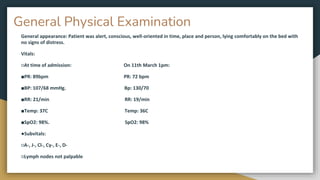
General Physical Examination
General appearance: Patient was alert, conscious, well-oriented in time, place and person, lying comfortably on the bed with
no signs of distress.
Vitals:
○At time of admission: On 11th March 1pm:
■PR: 89bpm PR: 72 bpm
■BP: 107/68 mmHg. Bp: 130/70
■RR: 21/min RR: 19/min
■Temp: 37C Temp: 36C
■SpO2: 98%. SpO2: 98%
●Subvitals:
○A-, J-, Cl-, Cy-, E-, D-
○Lymph nodes not palpable
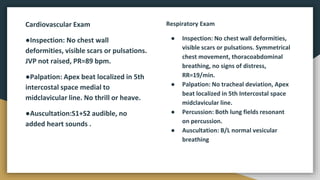
Cardiovascular Exam
●Inspection: No chest wall
deformities, visible scars or pulsations.
JVP not raised, PR=89 bpm.
●Palpation: Apex beat localized in 5th
intercostal space medial to
midclavicular line. No thrill or heave.
●Auscultation:S1+S2 audible, no
added heart sounds .
Respiratory Exam
● Inspection: No chest wall deformities,
visible scars or pulsations. Symmetrical
chest movement, thoracoabdominal
breathing, no signs of distress,
RR=19/min.
● Palpation: No tracheal deviation, Apex
beat localized in 5th Intercostal space
midclavicular line.
● Percussion: Both lung fields resonant
on percussion.
● Auscultation: B/L normal vesicular
breathing
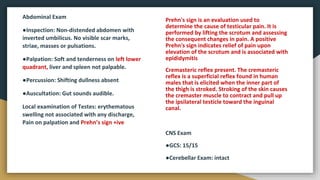
Abdominal Exam
●Inspection: Non-distended abdomen with
inverted umbilicus. No visible scar marks,
striae, masses or pulsations.
●Palpation: Soft and tenderness on left lower
quadrant, liver and spleen not palpable.
●Percussion: Shifting dullness absent
●Auscultation: Gut sounds audible.
Local examination of Testes: erythematous
swelling not associated with any discharge,
Pain on palpation and Prehn’s sign +ive
Prehn's sign is an evaluation used to
determine the cause of testicular pain. It is
performed by lifting the scrotum and assessing
the consequent changes in pain. A positive
Prehn's sign indicates relief of pain upon
elevation of the scrotum and is associated with
epididymitis
Cremasteric reflex present. The cremasteric
reflex is a superficial reflex found in human
males that is elicited when the inner part of
the thigh is stroked. Stroking of the skin causes
the cremaster muscle to contract and pull up
the ipsilateral testicle toward the inguinal
canal.
CNS Exam
●GCS: 15/15
●Cerebellar Exam: intact
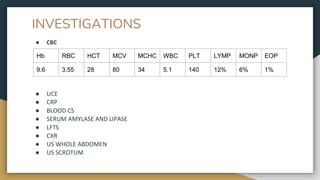
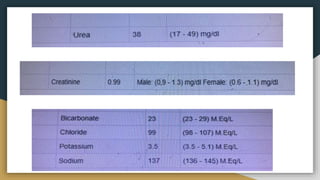
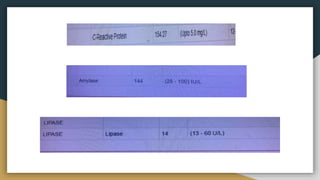
INVESTIGATIONS
● CBC
● UCE
● CRP
● BLOOD CS
● SERUM AMYLASE AND LIPASE
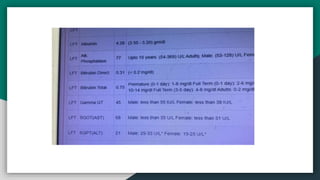
● LFTS
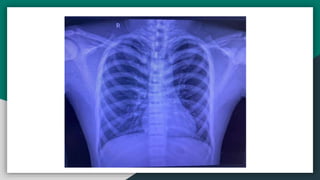
● CXR
● US WHOLE ABDOMEN
● US SCROTUM
Hb RBC HCT MCV MCHC WBC PLT LYMP MONP EOP
9.6 3.55 28 80 34 5.1 140 12% 6% 1%
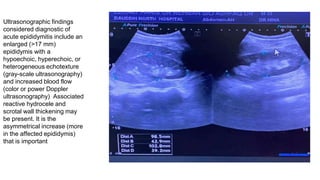
Ultrasonographic findings
considered diagnostic of
acute epididymitis include an
enlarged (>17 mm)
epididymis with a
hypoechoic, hyperechoic, or
heterogeneous echotexture
(gray-scale ultrasonography)
and increased blood flow
(color or power Doppler
ultrasonography) Associated
reactive hydrocele and
scrotal wall thickening may
be present. It is the
asymmetrical increase (more
in the affected epididymis)
that is important
DIFFERENTIAL DIAGNOSIS
● Epididymo-orchitis; Scrotal edema, Positive Prehn's sign, Epididymal
tenderness, dysuria, bacterial or viral cause, spermatic cord is not thickened
● Testicular torsion; Sudden asymmetrical scrotal pain, Scrotal edema,Fever,
nausea, vomiting,Negative Prehn's sign,Absence of cremasteric reflex,Acute
onset of symptoms, clapper bell sign
● Inguinal hernia; Idiopathic scrotal edema
● Hydrocele
● Trauma (testicular rupture)
MANAGEMENT
● IV hydration
● Injection toradol
● Inj rocephin
● INJ ONSET
● Tab Delta (corticoseroid) 5mg x BDS for 5 days
● Scrotal support
MUMPS & ORCHITIS
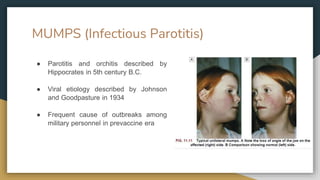
MUMPS (Infectious Parotitis)
● Parotitis and orchitis described by
Hippocrates in 5th century B.C.
● Viral etiology described by Johnson
and Goodpasture in 1934
● Frequent cause of outbreaks among
military personnel in prevaccine era
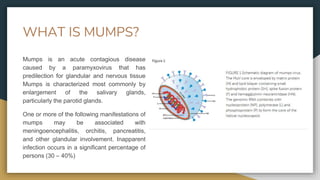
WHAT IS MUMPS?
Mumps is an acute contagious disease
caused by a paramyxovirus that has
predilection for glandular and nervous tissue
Mumps is characterized most commonly by
enlargement of the salivary glands,
particularly the parotid glands.
One or more of the following manifestations of
mumps may be associated with
meningoencephalitis, orchitis, pancreatitis,
and other glandular involvement. Inapparent
infection occurs in a significant percentage of
persons (30 – 40%)
MUMPS EPIDEMIOLOGY
● Reservoir Human
● Transmission Respiratory Drop Nuclei
Subclinical Infections may transmit
● Temporal Pattern Peak in late winter and spring
● Communicability Three days before to five days after the onset of active
disease
China is the top country by mumps cases in the world. As of 2021, mumps cases in
China was 119,955 that accounts for 53.36% of the world's mumps cases. The top 5
countries (others are Kenya, Madagascar, Ghana, and Ethiopia) account for 84.07% of it.
The world's total mumps cases was estimated at 224,805 in 2021.
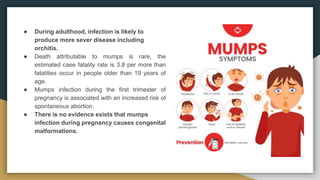
● During adulthood, infection is likely to
produce more sever disease including
orchitis.
● Death attributable to mumps is rare, the
estimated case fatality rate is 3.8 per more than
fatalities occur in people older than 19 years of
age.
● Mumps infection during the first trimester of
pregnancy is associated with an increased risk of
spontaneous abortion.
● There is no evidence exists that mumps
infection during pregnancy causes congenital
malformations.
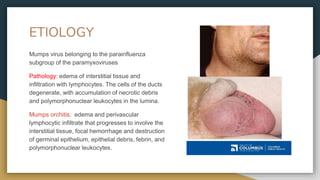
ETIOLOGY
Mumps virus belonging to the parainfluenza
subgroup of the paramyxoviruses
Pathology: edema of interstitial tissue and
infiltration with lymphocytes. The cells of the ducts
degenerate, with accumulation of necrotic debris
and polymorphonuclear leukocytes in the lumina.
Mumps orchitis: edema and perivascular
lymphocytic infiltrate that progresses to involve the
interstitial tissue, focal hemorrhage and destruction
of germinal epithelium, epithelial debris, febrin, and
polymorphonuclear leukocytes.
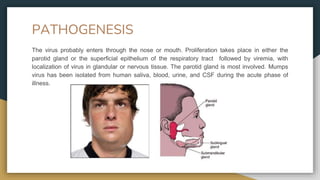
PATHOGENESIS
The virus probably enters through the nose or mouth. Proliferation takes place in either the
parotid gland or the superficial epithelium of the respiratory tract followed by viremia, with
localization of virus in glandular or nervous tissue. The parotid gland is most involved. Mumps
virus has been isolated from human saliva, blood, urine, and CSF during the acute phase of
illness.
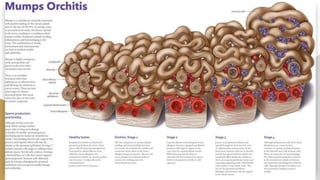
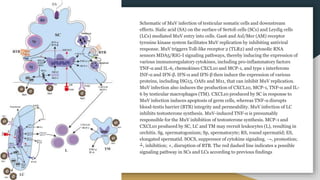
Schematic of MuV infection of testicular somatic cells and downstream
effects. Sialic acid (SA) on the surface of Sertoli cells (SCs) and Leydig cells
(LCs) mediated MuV entry into cells. Gas6 and Axl/Mer (AM) receptor
tyrosine kinase system facilitates MuV replication by inhibiting antiviral
response. MuV triggers Toll-like receptor 2 (TLR2) and cytosolic RNA
sensors MDA5/RIG-I signaling pathways, thereby inducing the expression of
various immunoregulatory cytokines, including pro-inflammatory factors
TNF-α and IL-6, chemokines CXCL10 and MCP-1, and type 1 interferons
INF-α and IFN-β. IFN-α and IFN-β then induce the expression of various
proteins, including ISG15, OAS1 and Mx1, that can inhibit MuV replication.
MuV infection also induces the production of CXCL10, MCP-1, TNF-α and IL-
6 by testicular macrophages (TM). CXCL10 produced by SC in response to
MuV infection induces apoptosis of germ cells, whereas TNF-α disrupts
blood-testis barrier (BTB) integrity and permeability. MuV infection of LC
inhibits testosterone synthesis. MuV-induced TNF-α is presumably
responsible for the MuV inhibition of testosterone synthesis. MCP-1 and
CXCL10 produced by SC, LC and TM may recruit leukocytes (L), resulting in
orchitis. Sg, spermatogonium; Sp, spermatocyte; RS, round spermatid; ES,
elongated spermatid. SOCS, suppressor of cytokine signaling. →, promotion;
┴, inhibition; ×, disruption of BTB. The red dashed line indicates a possible
signaling pathway in SCs and LCs according to previous findings
CLINICAL MANIFESTATIONS
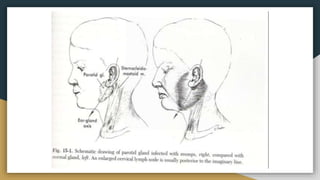
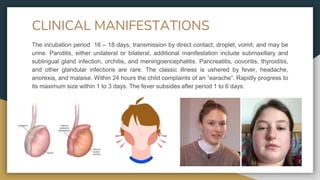
The incubation period 16 – 18 days, transmission by direct contact, droplet, vomit, and may be
urine. Parotitis, either unilateral or bilateral, additional manifestation include submaxillary and
sublingual gland infection, orchitis, and meningoencephalitis. Pancreatitis, oovoritis, thyroiditis,
and other glandular infections are rare. The classic illness is ushered by fever, headache,
anorexia, and malaise. Within 24 hours the child complaints of an “earache”. Rapidly progress to
its maximum size within 1 to 3 days. The fever subsides after period 1 to 6 days.
DIAGNOSIS
1. Confirmatory clinical factors a history of exposure to mumps 2 to 3 weeks before onset of
illness; a compatible clinical picture of parotitis or other glandular involvement; and signs of
aseptic meningitis.
2. Isolation of causative agent from the saliva, mouth washing, urine during the acute phase.
3. Serological test CF(Complement Fixation), HI(Hemagglutination Inhibition), ELISA(enzyme
linked immunosorbent assay), Virus neutralization.
4. Ancillary laboratory findings serum amylase level is elevated. WBC normal or slightly
elevated with slightly predominant of lymphocytes.
DIFFERENTIAL DIAGNOSIS
1. Anterior cervical or pre auricular adenitis
2. Suppurative parotitis
3. Recurrent parotitis
4. Calculus, that obstructs Stensen’s duct
5. Coxsackie virus infection
6. Mixed tumors, hemangiomas, lymphangiomas of the parotid
7. Mikulicz’s syndrome, chronic bilateral parotid and lacrimal gland enlargement,
associated with dryness of the mouth and absence of tears.
COMPLICATIONS
1. Deafness
2. Meningoencephalitis
3. Facial neuritis, myelitis
4. Myocarditis
5. Arthritis
6. Diabetes mellitus
7. Hepatitis
8. Hematological complications thrombocytopenia, hemolytic anemia.
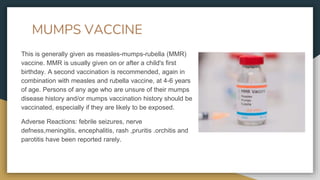
MUMPS VACCINE
This is generally given as measles-mumps-rubella (MMR)
vaccine. MMR is usually given on or after a child's first
birthday. A second vaccination is recommended, again in
combination with measles and rubella vaccine, at 4-6 years
of age. Persons of any age who are unsure of their mumps
disease history and/or mumps vaccination history should be
vaccinated, especially if they are likely to be exposed.
Adverse Reactions: febrile seizures, nerve
defness,meningitis, encephalitis, rash ,pruritis .orchitis and
parotitis have been reported rarely.
MUMPS VACCINE
● Composition Live Virus
● Efficacy 95% (Range- 90% - 97%)
● Duration of Immunity Lifelong
● Schedule 2 doses
● Should be administered with Measles and Rubella (MMR)
PRECAUTIONS & CONTRAINDICATION
1. Febrile illness: fever is not contraindication to immunization . However if other manifestations
suggest a more serious illness , the child should not be immunized until recovered .
2. Allergies
3. Recent administration of immune globulin: because high dose of Ig can inhibit the response to
measles vaccine for longer intervals , MMR immunization should be deferred for a longer period
after administration of IG.
4. Altered immunity: patients with immunodeficiency diseases or people receiving
immunosuppressive therapy except patients with HIV infection.
5. Corticosteroids: the recommended interval is at least one month after steroids is discontinued.
6. Pregnancy: live – virus mumps vaccine can infect the placenta but the virus has not been
isolated from fetal tissue
However conception should be avoided for 28 days after mumps immunization.
SPREAD PREVENTION
● The single most effective control measure is maintaining the highest possible level of
immunization in the community.
● Children with mumps should not attend school, and adults should not work, until five days
after swelling began or until they are well, whichever is longer.
● Measures such as covering coughs and sneezes, washing hands frequently, and not sharing
food or eating utensils can also help.
● A person who may have had contact with a mumps case should be evaluated by their
physician.
● High MMR vaccine coverage levels and vaccine effectiveness likely prevented thousands of
additional mumps cases (9 out of 10 exposures that may have resulted in infection in 2 dose
vaccinees prevented)
● Incidence relatively low
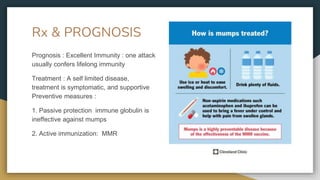
Rx & PROGNOSIS
Prognosis : Excellent Immunity : one attack
usually confers lifelong immunity
Treatment : A self limited disease,
treatment is symptomatic, and supportive
Preventive measures :
1. Passive protection immune globulin is
ineffective against mumps
2. Active immunization: MMR
References
Davidson's Principles and Practice of Medicine - 24th Edition
https://www.frontiersin.org/articles/10.3389/fimmu.2021.582946/full
https://www.sandiegocounty.gov/content/sdc/hhsa/programs/phs/community
_epidemiology/dc/Mumpsdraft.html
https://www.karynho.com/gallery/MumpsOrchitis.html
https://www.ncbi.nlm.nih.gov/pmc/articles/PMC1633545/
https://www.ncbi.nlm.nih.gov/pmc/articles/PMC8013702/
Mumps & Orchitis

Mumps & Orchitis

  • 1.
    CASE PRESENTATION Samina Hussain- 2018/158 Soeba Nadeem - 2018/177 Muhammad Wasil Khan - 2018/066
  • 2.
    Biodata Name: XYZ Age: 33Years Gender: Male Marital status: Married Address: North nazimabad , Karachi Occupation: Employee at Private company Date of Admission: 11th March 2023 Time of Admission: 10:41 am Mode of Admission: ER
  • 3.
    Presenting complaint 33 yearold Male with no known comorbids, R/O North nazimabad presented to the ER on Thursday 11th March 2023 with complaints of → Testicular swelling ( since 3 days) → Fever (since 3 days)
  • 4.
    HOPC According to thepatient he was in his usual state of health 7 days ago when he developed swelling on left mandibular area/jaw. Swelling increased gradually and was unilateral initially however after 2 days was present on Right side also. Patient complained of mild pain which increased on chewing. On 4th day swelling started to decrease. No history of earache. He started taking Augmentin 625mg and Panadol. Patient complaint of testicular swelling and Fever since 3 days. Testicular swelling is localized on Left side. It is associated with mild pain which increase while walking and during urination. Slight pain relief while lying down. Pain radiates towards the umbilical region. On pain scale it is 3/10 Patient developed fever 3 days ago. Fever was intermittent, recorded at 101-102 F. It was associated with shivering, nausea and vomiting. 2-3 episodes of vomiting which was non-projectile and watery in nature. Fever was temporarily relieved with Panadol. Patients daughter was treated for mumps 2 months ago.
  • 5.
    Past Medical History:admitted for 4 days for treatment of dengue in Sept ‘22 Past Surgical History: no past surgical history Drug History: → Augmentin (Amoxicillin/clavulanic acid) 625 mg → Caflam 50 mg (NSAID) → Panadol Allergy: dust allergy. No food or drug allergy. Blood transfusion: No history of Blood transfusion
  • 6.
    Family History: Nohistory of DM, HTN, Asthma or TB exposure. Daughter had Mumps 2 months ago Personal history: 1. Appetite: Normal 2. Sleep: disturbed due to pain 3. Urine: dysuria. No complaint of frequency, hesitancy or urgency. 4. Stool: normal Socio-economic History: Patient lives in a 2 bedroom apartment. Total 4 family members. One breadwinner. Drink filter water. No pets at home.
  • 7.
    Systemic review Constitutional symptoms: CVS:No shortness of breath, orthopnoea, paroxysmal nocturnal dyspnea, palpitations Respiratory system: No cough, hemoptysis and hoarseness or wheeze. GIT: Nausea and vomiting present. No Indigestion and heartburn/reflux , epigastric pain, or haematemesis. No complaint of Constipation, fecal incontinence, diarrhea or melena. Genitourinary: Complaint of Dysuria. No urinary incontinence, frequency, urgency,hesitancy, nocturia or haematuria. No impotence.
  • 8.
    Haematological: no bruises,epistaxis,lumps or gum bleeding. Musculoskeletal: no joint pain, swelling or tenderness Endocrine system: no neck swelling, tremors, excessive heat or cold sensation, excessive thirst, and appetite normal. No changes in appearance of skin/hair/voice. Neurological: No weakness and numbness in arms and legs, no dizziness present, no headache, deafness, visual disturbances ,fits, fainting episodes or blackout recorded.
  • 9.
    General Physical Examination Generalappearance: Patient was alert, conscious, well-oriented in time, place and person, lying comfortably on the bed with no signs of distress. Vitals: ○At time of admission: On 11th March 1pm: ■PR: 89bpm PR: 72 bpm ■BP: 107/68 mmHg. Bp: 130/70 ■RR: 21/min RR: 19/min ■Temp: 37C Temp: 36C ■SpO2: 98%. SpO2: 98% ●Subvitals: ○A-, J-, Cl-, Cy-, E-, D- ○Lymph nodes not palpable
  • 10.
    Cardiovascular Exam ●Inspection: Nochest wall deformities, visible scars or pulsations. JVP not raised, PR=89 bpm. ●Palpation: Apex beat localized in 5th intercostal space medial to midclavicular line. No thrill or heave. ●Auscultation:S1+S2 audible, no added heart sounds . Respiratory Exam ● Inspection: No chest wall deformities, visible scars or pulsations. Symmetrical chest movement, thoracoabdominal breathing, no signs of distress, RR=19/min. ● Palpation: No tracheal deviation, Apex beat localized in 5th Intercostal space midclavicular line. ● Percussion: Both lung fields resonant on percussion. ● Auscultation: B/L normal vesicular breathing
  • 11.
    Abdominal Exam ●Inspection: Non-distendedabdomen with inverted umbilicus. No visible scar marks, striae, masses or pulsations. ●Palpation: Soft and tenderness on left lower quadrant, liver and spleen not palpable. ●Percussion: Shifting dullness absent ●Auscultation: Gut sounds audible. Local examination of Testes: erythematous swelling not associated with any discharge, Pain on palpation and Prehn’s sign +ive Prehn's sign is an evaluation used to determine the cause of testicular pain. It is performed by lifting the scrotum and assessing the consequent changes in pain. A positive Prehn's sign indicates relief of pain upon elevation of the scrotum and is associated with epididymitis Cremasteric reflex present. The cremasteric reflex is a superficial reflex found in human males that is elicited when the inner part of the thigh is stroked. Stroking of the skin causes the cremaster muscle to contract and pull up the ipsilateral testicle toward the inguinal canal. CNS Exam ●GCS: 15/15 ●Cerebellar Exam: intact
  • 12.
    INVESTIGATIONS ● CBC ● UCE ●CRP ● BLOOD CS ● SERUM AMYLASE AND LIPASE ● LFTS ● CXR ● US WHOLE ABDOMEN ● US SCROTUM Hb RBC HCT MCV MCHC WBC PLT LYMP MONP EOP 9.6 3.55 28 80 34 5.1 140 12% 6% 1%
  • 17.
    Ultrasonographic findings considered diagnosticof acute epididymitis include an enlarged (>17 mm) epididymis with a hypoechoic, hyperechoic, or heterogeneous echotexture (gray-scale ultrasonography) and increased blood flow (color or power Doppler ultrasonography) Associated reactive hydrocele and scrotal wall thickening may be present. It is the asymmetrical increase (more in the affected epididymis) that is important
  • 18.
    DIFFERENTIAL DIAGNOSIS ● Epididymo-orchitis;Scrotal edema, Positive Prehn's sign, Epididymal tenderness, dysuria, bacterial or viral cause, spermatic cord is not thickened ● Testicular torsion; Sudden asymmetrical scrotal pain, Scrotal edema,Fever, nausea, vomiting,Negative Prehn's sign,Absence of cremasteric reflex,Acute onset of symptoms, clapper bell sign ● Inguinal hernia; Idiopathic scrotal edema ● Hydrocele ● Trauma (testicular rupture)
  • 19.
    MANAGEMENT ● IV hydration ●Injection toradol ● Inj rocephin ● INJ ONSET ● Tab Delta (corticoseroid) 5mg x BDS for 5 days ● Scrotal support
  • 20.
  • 21.
    MUMPS (Infectious Parotitis) ●Parotitis and orchitis described by Hippocrates in 5th century B.C. ● Viral etiology described by Johnson and Goodpasture in 1934 ● Frequent cause of outbreaks among military personnel in prevaccine era
  • 22.
    WHAT IS MUMPS? Mumpsis an acute contagious disease caused by a paramyxovirus that has predilection for glandular and nervous tissue Mumps is characterized most commonly by enlargement of the salivary glands, particularly the parotid glands. One or more of the following manifestations of mumps may be associated with meningoencephalitis, orchitis, pancreatitis, and other glandular involvement. Inapparent infection occurs in a significant percentage of persons (30 – 40%)
  • 23.
    MUMPS EPIDEMIOLOGY ● ReservoirHuman ● Transmission Respiratory Drop Nuclei Subclinical Infections may transmit ● Temporal Pattern Peak in late winter and spring ● Communicability Three days before to five days after the onset of active disease China is the top country by mumps cases in the world. As of 2021, mumps cases in China was 119,955 that accounts for 53.36% of the world's mumps cases. The top 5 countries (others are Kenya, Madagascar, Ghana, and Ethiopia) account for 84.07% of it. The world's total mumps cases was estimated at 224,805 in 2021.
  • 24.
    ● During adulthood,infection is likely to produce more sever disease including orchitis. ● Death attributable to mumps is rare, the estimated case fatality rate is 3.8 per more than fatalities occur in people older than 19 years of age. ● Mumps infection during the first trimester of pregnancy is associated with an increased risk of spontaneous abortion. ● There is no evidence exists that mumps infection during pregnancy causes congenital malformations.
  • 25.
    ETIOLOGY Mumps virus belongingto the parainfluenza subgroup of the paramyxoviruses Pathology: edema of interstitial tissue and infiltration with lymphocytes. The cells of the ducts degenerate, with accumulation of necrotic debris and polymorphonuclear leukocytes in the lumina. Mumps orchitis: edema and perivascular lymphocytic infiltrate that progresses to involve the interstitial tissue, focal hemorrhage and destruction of germinal epithelium, epithelial debris, febrin, and polymorphonuclear leukocytes.
  • 26.
    PATHOGENESIS The virus probablyenters through the nose or mouth. Proliferation takes place in either the parotid gland or the superficial epithelium of the respiratory tract followed by viremia, with localization of virus in glandular or nervous tissue. The parotid gland is most involved. Mumps virus has been isolated from human saliva, blood, urine, and CSF during the acute phase of illness.
  • 28.
    Schematic of MuVinfection of testicular somatic cells and downstream effects. Sialic acid (SA) on the surface of Sertoli cells (SCs) and Leydig cells (LCs) mediated MuV entry into cells. Gas6 and Axl/Mer (AM) receptor tyrosine kinase system facilitates MuV replication by inhibiting antiviral response. MuV triggers Toll-like receptor 2 (TLR2) and cytosolic RNA sensors MDA5/RIG-I signaling pathways, thereby inducing the expression of various immunoregulatory cytokines, including pro-inflammatory factors TNF-α and IL-6, chemokines CXCL10 and MCP-1, and type 1 interferons INF-α and IFN-β. IFN-α and IFN-β then induce the expression of various proteins, including ISG15, OAS1 and Mx1, that can inhibit MuV replication. MuV infection also induces the production of CXCL10, MCP-1, TNF-α and IL- 6 by testicular macrophages (TM). CXCL10 produced by SC in response to MuV infection induces apoptosis of germ cells, whereas TNF-α disrupts blood-testis barrier (BTB) integrity and permeability. MuV infection of LC inhibits testosterone synthesis. MuV-induced TNF-α is presumably responsible for the MuV inhibition of testosterone synthesis. MCP-1 and CXCL10 produced by SC, LC and TM may recruit leukocytes (L), resulting in orchitis. Sg, spermatogonium; Sp, spermatocyte; RS, round spermatid; ES, elongated spermatid. SOCS, suppressor of cytokine signaling. →, promotion; ┴, inhibition; ×, disruption of BTB. The red dashed line indicates a possible signaling pathway in SCs and LCs according to previous findings
  • 30.
    CLINICAL MANIFESTATIONS The incubationperiod 16 – 18 days, transmission by direct contact, droplet, vomit, and may be urine. Parotitis, either unilateral or bilateral, additional manifestation include submaxillary and sublingual gland infection, orchitis, and meningoencephalitis. Pancreatitis, oovoritis, thyroiditis, and other glandular infections are rare. The classic illness is ushered by fever, headache, anorexia, and malaise. Within 24 hours the child complaints of an “earache”. Rapidly progress to its maximum size within 1 to 3 days. The fever subsides after period 1 to 6 days.
  • 31.
    DIAGNOSIS 1. Confirmatory clinicalfactors a history of exposure to mumps 2 to 3 weeks before onset of illness; a compatible clinical picture of parotitis or other glandular involvement; and signs of aseptic meningitis. 2. Isolation of causative agent from the saliva, mouth washing, urine during the acute phase. 3. Serological test CF(Complement Fixation), HI(Hemagglutination Inhibition), ELISA(enzyme linked immunosorbent assay), Virus neutralization. 4. Ancillary laboratory findings serum amylase level is elevated. WBC normal or slightly elevated with slightly predominant of lymphocytes.
  • 32.
    DIFFERENTIAL DIAGNOSIS 1. Anteriorcervical or pre auricular adenitis 2. Suppurative parotitis 3. Recurrent parotitis 4. Calculus, that obstructs Stensen’s duct 5. Coxsackie virus infection 6. Mixed tumors, hemangiomas, lymphangiomas of the parotid 7. Mikulicz’s syndrome, chronic bilateral parotid and lacrimal gland enlargement, associated with dryness of the mouth and absence of tears.
  • 33.
    COMPLICATIONS 1. Deafness 2. Meningoencephalitis 3.Facial neuritis, myelitis 4. Myocarditis 5. Arthritis 6. Diabetes mellitus 7. Hepatitis 8. Hematological complications thrombocytopenia, hemolytic anemia.
  • 34.
    MUMPS VACCINE This isgenerally given as measles-mumps-rubella (MMR) vaccine. MMR is usually given on or after a child's first birthday. A second vaccination is recommended, again in combination with measles and rubella vaccine, at 4-6 years of age. Persons of any age who are unsure of their mumps disease history and/or mumps vaccination history should be vaccinated, especially if they are likely to be exposed. Adverse Reactions: febrile seizures, nerve defness,meningitis, encephalitis, rash ,pruritis .orchitis and parotitis have been reported rarely.
  • 35.
    MUMPS VACCINE ● CompositionLive Virus ● Efficacy 95% (Range- 90% - 97%) ● Duration of Immunity Lifelong ● Schedule 2 doses ● Should be administered with Measles and Rubella (MMR)
  • 36.
    PRECAUTIONS & CONTRAINDICATION 1.Febrile illness: fever is not contraindication to immunization . However if other manifestations suggest a more serious illness , the child should not be immunized until recovered . 2. Allergies 3. Recent administration of immune globulin: because high dose of Ig can inhibit the response to measles vaccine for longer intervals , MMR immunization should be deferred for a longer period after administration of IG. 4. Altered immunity: patients with immunodeficiency diseases or people receiving immunosuppressive therapy except patients with HIV infection. 5. Corticosteroids: the recommended interval is at least one month after steroids is discontinued. 6. Pregnancy: live – virus mumps vaccine can infect the placenta but the virus has not been isolated from fetal tissue However conception should be avoided for 28 days after mumps immunization.
  • 37.
    SPREAD PREVENTION ● Thesingle most effective control measure is maintaining the highest possible level of immunization in the community. ● Children with mumps should not attend school, and adults should not work, until five days after swelling began or until they are well, whichever is longer. ● Measures such as covering coughs and sneezes, washing hands frequently, and not sharing food or eating utensils can also help. ● A person who may have had contact with a mumps case should be evaluated by their physician. ● High MMR vaccine coverage levels and vaccine effectiveness likely prevented thousands of additional mumps cases (9 out of 10 exposures that may have resulted in infection in 2 dose vaccinees prevented) ● Incidence relatively low
  • 38.
    Rx & PROGNOSIS Prognosis: Excellent Immunity : one attack usually confers lifelong immunity Treatment : A self limited disease, treatment is symptomatic, and supportive Preventive measures : 1. Passive protection immune globulin is ineffective against mumps 2. Active immunization: MMR
  • 39.
    References Davidson's Principles andPractice of Medicine - 24th Edition https://www.frontiersin.org/articles/10.3389/fimmu.2021.582946/full https://www.sandiegocounty.gov/content/sdc/hhsa/programs/phs/community _epidemiology/dc/Mumpsdraft.html https://www.karynho.com/gallery/MumpsOrchitis.html https://www.ncbi.nlm.nih.gov/pmc/articles/PMC1633545/ https://www.ncbi.nlm.nih.gov/pmc/articles/PMC8013702/

Editor's Notes

  • #22 Like measles, mumps is an acute viral illness. Hippocrates was the first to describe the clinical picture of mumps in the 5th century BC. In 1934, Johnson and Goodpasture identified the etiologic agent of mumps as a virus. Although mumps was generally thought of as a disease of childhood, it was also a frequent cause of outbreaks among military personnel in the pre-vaccine era. During WWI, only influenza and gonorrhea were more common causes of hospitalization. Outbreaks are still occurring among military personnel. The last one I’m aware of was on board a ship in the western Pacific in 1992.
  • #24 Humans are the only natural host for the mumps virus. The virus is transmitted via direct contact (such as saliva or infected droplets on surfaces) or by respiratory droplets and enters through the nose and mouth. Asymptomatic or nonclassical infections can also transmit the virus. Mumps peaks in late winter and spring but can occur year round. Patients are communicable 3 days before to 4 days after the onset of active disease.
  • #34 Symptomatic meningitis occurs in up to 15% of patients, usually resolving without sequelae in 3-10 days. Adults are at higher risk for this than children, and males at higher risk than females. Testicular inflammation occurs in up to 50% of postpubertal males. About half of these patients are left with some degree of testicular atrophy but sterility is rare. Pancreatitis only occurs in about 2-5% of patients. No causal relationship between mumps and diabetes has been conclusively demonstrated. Deafness caused by mumps is rare and is usually unilateral. Death is also rare with an average of 1 death from mumps per year from
  • #36 As with measles, the mumps vaccine produces an inapparent or mild noncommunicable infection. A single dose has a clinical efficacy of about 95%. The duration of immunity is thought to be more than 25 years, and is probably life-long in most people. The schedule calls for a single dose of mumps vaccine. However, since measles is recommended as a 2-dose series and we now use the combined MMR, children will be getting 2 doses of mumps vaccine as well. There is not much data on the immune response to the mumps and rubella components from a second dose of MMR. However, most persons who do not respond to the first dose of the mumps or rubella components would be expected to respond to the second dose.